Connection Protection

The college my wife attended many years ago was a small Midwestern campus, maybe twenty buildings in all. Because of the extreme winter temps, the college had the foresight to install tunnels between the primary buildings, allowing for warm, comfortable walks from say, the dorms to the central dining hall. It’s the same concept my wife and I discovered in Nuremberg, Germany last month, only this tunnel complex was on a much larger scale.  And getting from Point A to Point B wasn’t its only intent.

Nuremberg, Germany

You’ll find Nuremberg in the center of Bavaria, the forested southwest region of Germany.  The city served as the final destination on our recent Viking River Cruise on the Danube.  Like Salzburg, Austria a few days before, Nuremberg is known for its “Old City” area (now surrounded by modern-day sprawl).  Once inside those towering protective walls, it’s like you’ve stepped back into the Middle Ages.  If there’s a more preserved city of the period, with its moats, castles, towers, and bridges, I’m not aware of it.

A walking tour of Nuremberg is impressive enough with the history, architecture, and stories, but what trumps everything about it is what lies beneath the city.  My wife and I signed up for an excursion called “Flavors of Nuremberg”, expecting to enjoy a culinary sampling of regional delights.  Indeed we did.  Our first stop was for a plate of Nuremberg’s famous white sausages (with a tall beer to wash them down). This could have been lunch alone, but we pressed on for more.

Our next stop was for Lebkuchen, or gingerbread.  It’s even more famous than the white sausages.  Here are two things to know about Nuremberg gingerbread.  One, it contains no ginger.  Two, it’s not nearly as sweet as its American counterpart (typical).  Okay, let’s add a Three: Lebkuchen is absolutely delicious.  We packed a pile of gingerbread cookies into our suitcases to give to family members (but most of them ended up in our own pantry).

Our final stop – of course -was at a Nuremberg brewery for several glasses of local beer.  But what I wasn’t prepared for was how we would get to our beer  Instead of just walking through the front door of Hausbrauerei Altstadthof, our guide took us to the top of a stone staircase, set right into the middle of a nondescript Nuremberg street.  The stair was surrounded by modest iron rails but otherwise would’ve been something you’d walk by without pause.  Our guide explained how the original brewery was located on this spot centuries ago, marked by a plaque in the street.

What followed might have been my favorite moment of the tour.  Our guide excused himself to “go get the key”, so he could unlock the imposing door at the bottom of the stairs.  The key was held by some nearby merchant and our guide had the credentials to borrow it.  I find that charming, versus typing on a computer keypad or gaining the approval of a German guard.  You just open the door with an old brass key.

Our guide returned, beckoned us down the stairs, opened the door, and away we went.  Or should I say, down we went.  Even after passing through the door fifteen feet below street level, we continued down what must’ve been the equivalent of three more floors of stairs.  Our guide stayed behind to lock the door behind us, so we kind of descended on our own.  The walls closed in and it got darker as we went.  Suddenly beer was the last thing on my mind.

Which way do we go, Mr. Guide sir?

What followed was the equivalent of rats in a maze.  Seriously, if I planned to gulp fresh air or glimpse daylight ever again, I was entirely dependent on the movements of our tour guide over the next forty-five minutes.  He’d turn here or turn there, beckon us down one tunnel or push us through another, and he stopped several times to click on or click off the bare bulbs weakly lighting our way.  We passed through several intersections where we could’ve spun off in half a dozen directions, to be hopelessly lost under the city forever.  We saw what looked like dungeons and prison cells.  Suddenly I really wanted a beer.  Above ground.

Dungeon, or just storage?

Our guide stopped us would-be-spelunkers at several junctures to explain the fascinating history of Nuremberg’s miles-long network of hand-dug tunnels, originally used in the making of beer, then used as the city’s prison, and finally, remarkably, used to hide the thousands of residents the Nazis sought during WWII.  It’s an amazing history I can’t begin to do justice in this post, but you can read more about it here.  Suffice it to say, us tourists had a taste of what it’d be like to live in suddenly protective, seemingly endless tunnels for months on end.  Not for the faint of heart.

Watch your step!

At long last, we carefully ascended another long, irregular staircase, and our guide unlocked the final door at the top, where we burst into the sunshine and fresh air of Hausbrauerei Altstadthof‘s colorful outdoor biergarten.  It was a surreal moment, being thrust back into modern-day civilization from the medieval tunnels below.  The several beers that followed not only quenched my thirst but also calmed my nerves.  This “flavors” city tour was unquestionably the most adventurous excursion of the entire river cruise.

Relief in a glass

There was a time, when we lived in Colorado, where my wife and I considered connecting our house to our nearby barn.  We thought, why not string together a series of shipping containers below ground, to act as a tunnel to keep us warm during the frigid winter months?  After our subterranean tour of Nuremberg, I wondered what we were thinking.  Better to just hoof it through the snow than to get lost in the grounds of Colorado forever.

Middling Name

Sixteen years after her debut album Some Hearts, Carrie Underwood released a collection of Christian songs called My Savior, a genre for which her signature was long overdue. My Savior was the perfect companion for the drive to and from Easter church last Sunday. On the other hand, Carrie dabbles in hard-driving, anger-cleansing rants like “Last Name”, which is a convenient segue to today’s topic. What (and why) is your middle name?

Hard to believe, but only 75% of Americans had a middle name in 1970.

Think about it for a sec… when was the last time you used your middle name?  When you pulled out your driver’s license?  Your Social Security card?  When you signed an important document?  Most likely it was for your last airplane ticket.  After all, the name you enter into the reservation has to match the name on the form of identification you provide.

Middle names originated in the Middle Ages (and boy do I love that coincidence). European countries – and much later America – picked up on Italy’s tradition of “double” first names.  Since Italian descendants were often named after parents and grandparents, you had a whole lot of Leonardos and Marcos wandering around.  “Secondary first” names helped distinguish Leo III from Leo IV.  Kind of like George H. W. Bush and George W. Bush.

I don’t know anyone – and I mean anyone – who uses their middle name by way of introduction, let alone conversation.  Outside of family members you might know the middle name of a friend or two but that’s about it.  Whatever practical purpose middle names served seems to have come and gone.

Unless you’re me, of course.  “David Wilson” is about as common as “John Smith” (and the reason you readers will never be able to hunt me down… bah-ha-ha!)  Just how common is my name?  Years ago I joined Hertz’s #1 Club and proudly stated my name at the counter for my first rental.  The agent tapped away and then said, “Sorry, but we have over 400 David Wilson’s in our database.  Could you be more specific?”  Then I gave her my middle name (Scott), to which she said, “Okay, so now I still have five of you”.  Sigh…

Girls = “Marie”, Boys = “James”

Scott was a common middle name back when I was born.  In fact, Scott ranked in the top ten boys’ middle names of the 1960s. (See if your middle name is/was a top tenner here.)  Maybe that’s why my parents chose Scott, because I’m not aware of any ancestors with the name.  Then again, Ancestry.com tells me I’m 12% Scottish.  Hey, my parents could’ve gone with “Scot” instead!

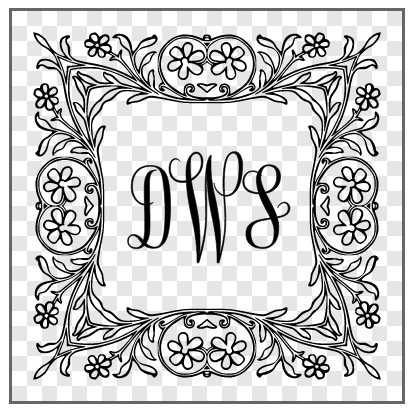
Early in my career, my colleagues and I decided to use our middle names in a desperate attempt to sound cooler.  We started referring to each other by first initial and middle name.  Hence I was “D. Scott” around the office (which sounds oh-so pompous in hindsight).  Didn’t last very long and my signature never changed.  I’ve always been a first-name, middle initial, last-name kind of guy with the pen.

Wouldn’t be as elegant without the “S”, don’t you agree?

Chances are your middle name was given to you because it sounded good alongside your first name.  Such was the case with our oldest son Mark.  We came up blank with middle names when he was born, so my wife got in touch with a college friend, whose husband was also Mark.  Mark Christopher.  The middle name sounded great to us so we promptly “adopted” it.  Not that our Mark will ever meet his namesake.

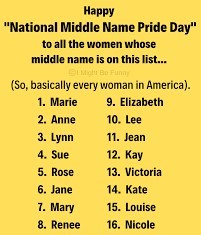
Speaking of my wife, her middle name is Marie; the same middle name given to both of her sisters (and later on to our daughter).  Marie and Ann are the most popular American female middle names of all time (for the males: Lee, Edward, and Michael).  Check those decade lists again – Marie and Ann were tops in 1950 and again for the next forty years.  Ann dropped off a little after that but Marie continues to be the most popular to this day.

Here in the South, a lot of people combine first and middle names.  Hence, Sarah is better known as Sarah Beth and Billy is better known as Billy Bob.  At least they’re using their middle names.  Some of today’s parents are choosing names like “Symphony” and “Rembrandt” to go in the middle.  As if their kids will actually use those names someday, right?  With that in mind, I’d like to thank my parents for (middle) naming me “Scott”.  Sounds just fine to me.

Some content sourced from The Atlantic article, “Middle Names Reveal More Than You Think”, and the Fox8.com article, “The most common middle names from the last 12 decades”.

The Original “Black Friday”

The first two weeks of November were jammed with “un-often” events this year.  For starters the bright light of Halloween’s blue moon spilled into the wee hours of November 1st.  During those same wee hours most of us lost Daylight Savings Time.  The very next day (Monday) marked the official arrival of Hurricane Eta to our shores. The day after that we voted in a presidential election. A week later we staged the Masters golf tournament (it’s supposed to be in April, people).  Then we had another hurricane (Iota), the first time we’ve had two in November.  Finally, we spiked positive COVID-19 tests in record numbers after months of declines.

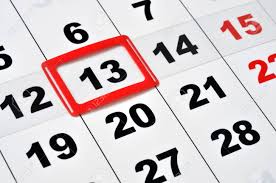
That’s a pile of rarities in a short amount of time.  So why not add one more to the heap?  Friday the 13th.  I missed it completely.  Maybe you missed it too (and you’d be forgiven with all those other distractions).  Last Friday – the 13th – came and went without an ounce of bad luck to blog about.  Ironically, the only story I can share brought good luck.  I placed a carry-out dinner order last Thursday night and the restaurant gave me someone else’s food.  When I went back for the right order they told me to keep both.  As a result my Friday the 13th dinner was unexpectedly “on the house”.

Are you superstitious?  I’m not – not in the least.  I have no problems with sidewalk cracks, leaning ladders, or black cats. I don’t lose sleep anticipating the third occurrence of a bad thing.  I gladly pick up a penny (it’s free money after all) but with no expectations of luck.  I’ve broken mirrors (deliberately, in remodel projects) and wishbones (on a whim, in turkeys).  I’ve even knocked on lots of wood (mostly doors) but hey, my life goes on as usual.

Leonardo da Vinci’s masterpiece

As for Friday the 13th’s “un-luck”, its long-ago origins are suspiciously weak.  The most common comes from the story of Jesus in the Bible: thirteen individuals at the Last Supper (Thursday) followed by Jesus’ foretold crucifixion the following day.  Other theories point to fighting gods in mythology and fighting knights in the Middle Ages.  None of these carry water in my book.  Seriously, how did misfortune come to be associated with the collision of a particular day and date?

I read up on calendar averages, thinking the 13th falling on a Friday was as uncommon as a blue moon.  Maybe the 13th favors the other days of the week instead?  Nope, try the reverse.  Over a significant number of years the 13th falls on Friday more than Saturday, Sunday, or any other day of the week.

To add a helping of confusion, look no further than Spain or Greece.  These countries have an irrational fear of Tuesday the 13th.  Italy?  Friday the 17th.  Imagine watching America’s famous horror movie franchise in any of these places and wondering, “so… why do they call it ‘Friday the 13th'”?

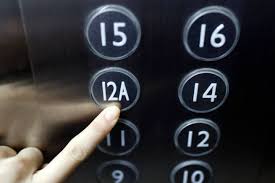
No matter my efforts to undermine this superstition, the effects are real.  Over 17 million Americans admit to a dread of Friday the 13th.  Some avoid airplane travel and others won’t even get out of bed.  Buildings remove the thirteenth floor from the stack (which is a lot of demolition for a superstition, isn’t it?)  Elevators conspicuously delete the “13” button.  Numbered seats in stadiums go 10, 11, 12… 14, 15, 16.

For some of you, Black Friday means bargains.  For others, Black Friday means “13”. If nothing else, I’ll give you a couple of words to describe the circumstance of the latter’s irrational fear.  If you’re afraid of the number 13 you have triskaidekaphobia.  If you’re afraid of just Friday the 13th you have paraskevidekatriaphobia.  (Me, I only have acrophobia.  At least your phobias sound more sophisticated.)

Fact check.  This post was published close to the midpoint between Black Friday (the 13th) and Black Friday (the retail binge).  Okay-y-y-y.  This post also contains exactly 666 words.  WHOO boy.

Let me repeat… I am NOT superstitious.

Some content sourced from Wikipedia, “the free encyclopedia”.