Concourses or Golf Courses?

Whenever flying is a part of my travel plans, I wear my most comfortable pair of walking shoes. Long gone are the days of the coat-and-tie-to-fly dress code, in favor of sneakers (and jeans). My reason for rubber-soled kicks used to be, “What if we’re in some kind of accident and I need to get off in a hurry?” Today I go with a wholly different reason. The long, long walk I can expect from curb to concourse to airplane cabin simply demands something easy on the feet.
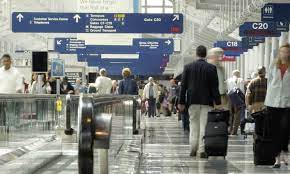
Here’s a startling comparison.  If you play golf and skip the cart, you’re going to walk over four miles to finish your round.  By almost the same token, if you’re connecting through Dallas-Ft. Worth or Atlanta and choose to walk from Terminal B to Terminal E, you’re going to walk over two miles.  Add in the inevitable search for food, a stop or two at retail, and a visit to the restroom and you’re closer to three miles.  And none of that includes the distance from the curb to the ticket counter, from the counter through security, and from your gate down the jetway to your seat on the plane.

How do they do it in heels?

Now for the bad news.  Airports are only getting bigger, and not for the reasons you might think.  Sure, more people fly than ever before, which adds more planes, more gates, and even more airports.  But behind the scenes a couple of stronger forces are at work.  One, airlines are shifting to larger aircraft, which translates to more space between parked planes.  Two, airport parking revenue is down (thanks to Uber, Lyft, and more mass transit), which translates to the airport’s need to find revenue elsewhere.  Where?  Retail, bars, and restaurants.

Don’t get used to these…

From recent trips through airports, I’ve noticed the following.  In Denver International, remodeled Concourse B is already labeled “Gates 1-100”, even though there aren’t a hundred gates.  It’s a straight-line concourse and it’s only going to get longer.  In Atlanta’s Hartsfield-Jackson, the concourses are so long and narrow (and so crowded), that last gate is farther than you can see without binoculars.  And in San Diego’s Lindbergh Field, when you’re processed into Terminal 2 from security, you can’t see a single gate, because you have to pass through a veritable shopping mall first.

In the ultimate insult to long walks to planes, some airports have left the moving walkways out of their concourse remodels.  Those walkways discourage you from passing directly in front of the food and retail the airport so desperately needs you to patronize.  And intentional or not, the airlines encourage these purchases by offering less food onboard.  You, weary traveler, are a captive audience to more than one performer.

I prefer this kind of walk

Let’s not forget the rental cars.  Avis’s slogan is “We try harder”.  Maybe it should be, “We try harder… to take more of your money“.  I just reviewed my receipt from a recent San Diego rental for a full-size standard Kia sedan.  Right there below the actual daily rate: “11.11% Concession Recovery Fee”; essentially the cost of doing business at the airport.  Add in Vehicle License Recoup fee, Customer Facility Charge (another airport fee), California Tourism Fee, and a final flourish of “tax”, and the rate increased by 32%.  All so I can walk further to get to my rental car?

An early chapter of my career was in airport planning.  We’re the people who figure out how to get the planes from the runways to the taxiways to the gates without hitting each other.  We also design the terminal buildings to include enough gates, concessions and restrooms (yeah, yeah, bring on the heat with that last item).  Concourse design used to be “spoke and hub”, meaning you walked down the spoke to a circular boarding hub of several gates.  It made the airplane taxiing a little trickier outside, but it significantly reduced a passenger’s walk to the gate.  Today, airports no longer favor the design (er, traveler) because it reduces the square footage for concessions.
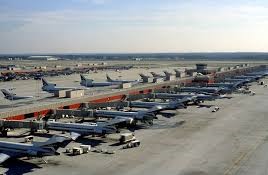
For those of you who live and die by your 10,000 steps, take heart; airports are helping you accomplish your daily goal.  Phoenix Sky Harbor even disguised the long walk through the concourses by calling it a “Fitness Trail”.  Be sure to allow enough time to get in a (seriously overpriced) shopping trip at all those concessions.  But don’t forget, the airlines only allow one reasonably sized carry-on these days.  Any others will cost you a checked bag fee… because the airport isn’t making enough money already.

Some content sourced from the CNN Business article, “Why you have to walk so far to your gate at the airport”, and Wikipedia, “the free encyclopedia”.

Boundaries

My wife and I took a “triangle trip” last week to see her family and then our son, flying from Augusta (GA) to Denver to Dallas, before returning to Augusta again. There’s nothing round-trip about an itinerary like that; just three one-way flights in a row. Like any other frolic in the friendly skies however, the journey served up easy fodder for a blog post. Hectic airports? Uncomfortable turbulence? Delayed flights? Yes, yes, and yes.  But for today’s post, step up to the podium my fellow passengers, for it is you who have earned my writing wrath.

We’re in familiar territory here.  I’ve written about my flying annoyances in Sitting in the Catbird Seat and First Class is now un-American (among others). But those musings focused on airplane seats and airplane sections.  Today is about airplane occupants.  Some of them are making the national headlines for their ridiculous antics.  The others all seem to have ended up on my flights.  Allow me to introduce my new “friends”.

Which one is the child?

On the flight from Augusta to Denver, a family of three filed into the row directly in front of us; wife on the aisle, young child in the middle, husband on the window.  As they settled into their seats, the kiddo started rapid-firing questions:  Dad, when are we going to take off?  Mom, where do I put my jacket?  Dad, I can’t get my seat belt on!  Do we get snacks? Dad? Hey, DAD!!!

Kids are loud.  I remember my first flight too, and the drive-you-crazy curiosity of a six year old.  But I certainly didn’t expect the parents to answer in baby talk.  Oh Stevie, the biggy wiggy pilot way up in the fwont of the plane decides when we get to fly up, up, up in the sky!  Maybe if you’re a weely weely good boy he’ll give you a wittle pair of wings to put on your backpack!

Or how about… Now Stevie, yelling at Mr. Seat Belt isn’t very nice. Look, there’s a wittle buckle and a wittle other end!  Let’s make it a game!  See if you can snap those bad boys together!

This is why I never leave home without noise-cancelling headphones.

“Hola!”

On the flight from Denver to Dallas, we had our choice of “uncomfortable”.  First, we trudged to the back of the plane, in front of and back of a large group of men who a) chose to be loud and laughy, and b) chose to speak across the aisle/rows in Spanish (even though the smattering of English made it clear they were fluent in both).  At first I thought my nearby amigos were just being a little obnoxious.  But the longer they kept it up, the more I thought I probably ought to know what they’re saying just in case…

This is why I never leave home without Google Translate.

Also on Denver to Dallas, a small child several rows forward spent the whole flight wailing I want Mommy!  I want Mommy!  I want Mommy!  We were too far behind to see or hear what her traveling companion was doing (if anything) to make her feel better, but eventually some kind of alarm went off in my head.  What if this child was being abducted?  After all we were heading to Dallas, which could be considered a gateway to the world for that sort of thing.  I alerted the flight attendant, who assured me everything was okay.  And it was.  Turns out the child belonged to one very overwhelmed father, solo-parenting (or not) a total of three kids.

This is why I never leave home without my wife.

I haven’t even mentioned the usual annoyance.  Since my wife prefers the window seat I graciously accept the middle.  So why is it my neighbor in the aisle seat always takes the armrest?  Doesn’t he or she realize I’m squeezed between two bodies?  Over the last two decades the average airline seat width has shrunk from 18.5″ to 17″.  If the passenger on either side of the middle takes the armrests that means I’m reduced to 15″, while each of them gets 18″.

This is why I never leave home without my elbows.

If you ever fly with me, I’m the guy with his head down reading his Kindle.  I’ll be polite and, for the most part, leave you alone.  But don’t be fooled.  I’ll only have one eye on my e-reader.  The other – and both ears – will be tuned into whatever you’re up to in your seat.  Please respect your boundaries.

Arid (and) Extra Dry

Most of us reacted to eighteen months in the unwelcome company of COVID-19 the same. We reflected on our time with Mr. Virus and wondered, “What would we have done more of?” More get-togethers? More travel? More dinners out?  Yes, yes, and yes.  But instead, we hunkered down and waited for things to get better. Our routines became more… routine.  Everything faded to black and white.  Clocks came to a standstill. It’s the same feeling I had, coincidentally, enduring a drive from Colorado to California earlier this month.

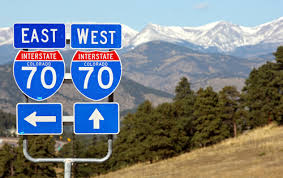
My advice: choose “East” while you still can

Maybe you’ve made the trek: Denver to San Diego via Interstate 70 and then Interstate 15.  Sounds so clean and easy, doesn’t it?  Two highways.  Plenty of lanes.  Rocky Mountains on one end and Pacific Ocean on the other.  Yeah, well, it’s all the mind-numbing in-between stuff that makes you want to burst through your sunroof and flag down a helicopter heading west.  There’s a whole lot of nothing in the desert.

The problem with this drive (which was not a flight because my wife & I wanted to bring our bikes) is the beautiful part comes first.  From Denver, it’s four hours of majestic snow-capped mountains, rushing rivers, red rock canyons, and breathless (literally) summits as you cruise on over to Grand Junction.  There’s good reason America the Beautiful was penned in the Rockies.

Cruise control suggested here

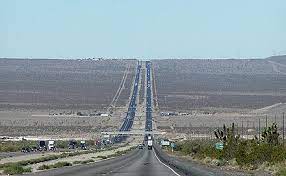
But don’t get comfortable.  Once you reach Grand Junction (which isn’t so grand), beauty takes a big break.  Pretend you’re a marble inside a rolled-up blanket.  Then someone flips that blanket out and off you go, rolling across the flattest, most desolate desert floor you’ve ever seen.  The mountains reduce to buttes reduce to sand dunes reduce to nothing.  The highway morphs from all sorts of curvy to ruler-straight. Your cell phone signal goes MIA.  You suddenly feel parched.  And you wonder, why-oh-why does the dusty sign say “Welcome to Utah” when there’s nothing welcoming about it at all?

So it goes in middle-eastern Utah.  Every exit is anonymously labeled “Ranch Road” (and why would you want to exit anyway?)  The highway signs counting down the mileage to Interstate 15 march endlessly.  When you finally do arrive at I-15 (your single steering wheel turn the entire journey), you bring out the balloons and the confetti and do a happy dance.  YOU MADE IT ACROSS THE MOON!  Well, sort of.  Now you’re just in central Utah.

I-15 wanders south a couple hours to St. George.  It’s probably a perfectly nice place to live, but St. George reminds me of the Middle East.  Squarish stucco/stone buildings, mostly white.  Not many people on the streets.  The temperatures quietly ascended to triple digits when you weren’t looking.  You realize you’re starting to sunburn through the car windows.

Proceed with caution (and water)

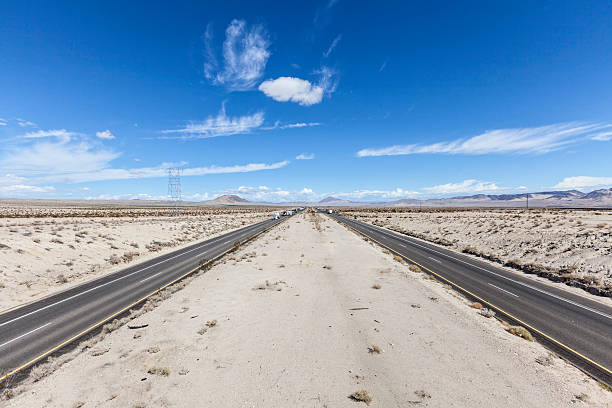
But then you make it to Arizona (briefly).  The landscape changes, suddenly and dramatically, as if Arizona declares, “Take that, Utah!  We’re a much prettier state!”  You descend through curve after highway curve of a twisting, narrow canyon, rich with layers of red rock. It’s the entrance to the promised land!  Alas, Arizona then gives way to Nevada, and here my friends, are the proverbial gates of Hell.  Welcome to the arid, endless, scrub-oak-laden vastness of the Mojave Desert, where everything is decidedly dead except for a brief glittery oasis known as Las Vegas.  The Mojave looks like it wants to swallow you whole and spit you out (except spit requires water so you’d probably just be gone forever).

Hang on to those dashboard gauges for dear life, friends, because it’s a full four hours in the Mojave broiler before your car gasps past the “Welcome to California” sign.  In those hours you’ll call your kids (one last time?), declare your final wishes, and wonder why you didn’t visit your parents more often.  Anything you see in motion off the highway is probably a mirage.  If you do make it to California, you’ll pull over and kiss the ground sand before wondering, “Hey, how come California looks exactly like Nevada?  Then Google Maps smirks the bad news.  You’re nowhere near the end of the Mojave Desert.

Baker. Barstow. Victorville. Hesperia.  You’ll pass through each of these towns and wonder, a) Why does anybody live here? and b) Is this the land that time forgot?  But finally, mercifully, you’ll descend the mighty Cajon Pass (the outside temperature descending alongside you), burst forth onto the freeway spaghetti of the LA Basin, and declare, “Los Angeles.  Thank the Good Lord.  I must be close now”.

You’re never alone on the Cajon

Except you’re not.  The Basin is dozens of cities, hundreds of miles, and millions of cars collectively called “Los Angeles”.  Hunker down, good buddy.  The Pacific is still hours away.

Here’s the short of it.  My wife & I made it to San Diego.  The car didn’t die in the middle of the Mojave.  Neither did we (though I left a piece of my soul behind).  We even rode the bikes a few times.  But I can’t account for those nineteen hours behind the wheel.  It’s like Monday morning became Tuesday night in a single blink.  Just like 2019 became 2021 without much in between.

What goes down must come back up.  The time has come to do the death drive in reverse.  Ugh.  Maybe we’ll leave the bikes in San Diego and catch a flight instead.

Maker’s Marks

In the 1993 thriller Cliffhanger, the opening scene is truly disturbing. Having summited a mountaintop for a little adventure, young climbers suspend a cable across a deep chasm to a nearby peak, then cross the open space one by one in zip-line fashion. One climber, terrified to cross the void, gets caught in the middle of the fraying cable, holding on by her fingers for dear life. Despite Sylvester Stallone’s valiant efforts, she shockingly loses her grip, plunging untold feet into the abyss. I remember envisioning myself as her and thinking, “I’m going to die”.

Almost sixty years into life as I know it, I have three unforgettable, take-it-to-the-grave moments where I thought, “I’m going to die”.  One of them happened two nights ago.

Returning from a Rockies baseball game in downtown Denver, I drove myself and a friend through a long stretch of interstate road construction.  We chatted about nothing and everything as we eyed the late-night traffic around us.  I’ve driven this stretch countless times, so much so my brain moves to a certain degree of autopilot.  However, I was not prepared for one unexpected moment.  As we ascended a rise in the divided two-lane highway, the lane to our right began to disappear without warning.  Orange cones cut across its width too quickly, with no signage or blinking lights to grab our attention.

All would’ve been fine were it not for the well-lit semi-trailer truck already occupying the disappearing lane.  He was just enough ahead of me he wasn’t going to back off.  I don’t think he could even see my car was occupying the lane into which he was about to merge.  Instinctively, I pressed the brake pedal, but not before realizing how much of his trailer was still trailing my car.  How the back of his trailer didn’t merge directly with the hood of my car is beyond me.  As he swung over into my lane there couldn’t have been two inches between his bumper and mine.

This miracle of a no-accident is an example of a “shoulda died” moment.  The semi was at least four times the length of my car (and three times as high).  It’s safe to say he and his truck would’ve survived the collision (me, not so much).  It’s also safe to say providence of a higher being was present at that very moment.

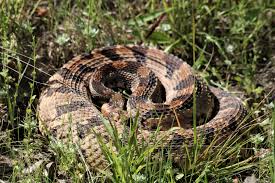
The two other “shoulda” moments in my life are etched into my brain as clear as crystal.  When I was a kid, I once hit a tennis ball over my neighbor’s fence and into their backyard.  It was easy enough to sneak through their side gate and down the side of their house.  Then I ran into their tall grass to the approximate location of the ball.  Just short of it, I leaped instinctively over a fully coiled rattlesnake, ready to strike.  No question, the most terrifying moment of my young life.  I remember yelling and screaming until our neighbor came out and killed the snake.  “Shoulda died?”  Maybe not, but tell that to a ten-year-old who was sure he’d be bitten by a poisonous snake.  To this day I’m convinced there was an angel nearby telling me to “JUMP!” at just the right moment.

My one other “shoulda” happened in my twenties.  Driving back to my college after a road trip, I fell asleep at the wheel in the early-morning hours of an almost deserted divided highway.  My car drove itself into the road’s grass median at 60 mph, where I awoke to the horrifying realization I was completely out of control.  Struggling to get the car in hand, I swerved this way and that until finally crossing three lanes of oncoming traffic, plunging into a ditch, completely rolling the car, and finally skidding to a stop, adding the flourish of a 180° spin.  How was the hospital?  Never saw it.  I walked away from my totaled car with just cuts and bruises, in an understandable state of shock.  Why wasn’t I hit by oncoming traffic?  Why didn’t I perish in the remains of my car?  Another dose of providence, I think.

We all have one or two of these “shoulda” moments in our lives.  They leave an indelible stamp on our memory as if to say, “Nope, not done with this life just yet.”  Now let’s add “coulda” and “woulda” moments.

“Coulda died” moments are all over the map:

I coulda died if I didn’t catch my balance on the edge of that cliff.

I coulda died if I hadn’t been strong enough to swim out of that riptide.

I coulda died if I rode my bicycle on that busy highway.

And so on.

Woulda died” moments are even worse because you know the life-or-death consequences beforehand.  “Woulda’s” are typically fraught with ignorance.  Choosing to drag race down a busy city street.  Choosing to scale the steep roof of your house in shorts and sandals.  Choosing to act on your road rage.  Have I done any of these “woulda’s” myself?  No. I choose to live instead.

Maker’s Mark is a small-batch bourbon whiskey produced in Loretto, Kentucky by the company Beam Suntory. Maker’s marks, by my definition, are those “shoulda” moments where we emerge on the other side, a sweating bundle of nerves, thankful to be alive.

That semi and I had a “shoulda” moment the other night, but divine providence chose to play a part.

Thanks be to God.

Tryst With a Twist

I’m leaving my wife for another woman. There, I said it.

I never thought it would come to this; I really didn’t. My wife and I have been together for thirty-one bliss-filled years – as smooth and as satisfying a marriage as one could hope for. And yet, tomorrow afternoon, I’ll catch a ride to the airport, kiss my beloved goodbye, and board a one-way flight to Las Vegas. All my worldly possessions stay behind, save for the overnight bag in my hand and the wad of cash in my pocket. When I get there, I’ll dress up, head over to one of the finer restaurants on the Strip and reunite with a woman over thirty years my junior. We’ll smile at each other and raise our glasses in anticipation. A new adventure will commence.

Now then, let’s shed a little more light on my tryst, shall we? Yes, I’m leaving my wife (but only for a day and half). Yes, I’m going to Sin City on a one-way ticket (but then I’ll turn around and drive back home the next day). And yes, I’m meeting up with a woman thirty years my junior. She also just happens to be my daughter.

Here’s the detail. After a year of living and working in Los Angeles, our youngest has decided to return to Colorado to give Denver a try (the “new adventure” I refer to above). The drive between those cities – if you’ve ever done it – is Las Vegas and a whole lot of nothing else. Imagine a twenty-hour jaunt in a lunar rover on the moon, only somewhere along the way you get thirty minutes in Disneyland. That’s LA to Denver: no people (at least, no sane ones) and a whole lot of cactus, dotted with a single oasis of slot machines and casino-hotels. Come to think of it, I’d wager big money the moon is more interesting than LA-Denver, especially the never-ending portion of the drive known as southern Utah.

Anyhoo, (to use a word from my daughter’s unique vocabulary), I’m sharing the Vegas-to-Denver drive with her – responsible father that I am – fully fourteen of the twenty hours it takes from Los Angeles. Somehow the idea of my daughter and her cat all alone in the desert doesn’t sit well with me.

The more I ponder this little adventure, the more I wonder if I shouldn’t be worried more about my time in Vegas. Think about it. I’ll show up at the hotel, and the front desk will undoubtedly eye my much-younger companion from head-to-toe. “Oh!”, I’ll say with a sheepish grin, “she’s my daughter.” Yeah, right pal, your ‘daughter’. When I arrive at the restaurant for dinner, the maitre d’ will say, “Sir, if you and your – uh – ‘niece’ will follow me, I’ll show you to your table.” Or let’s say I get my daughter to blow on the crap table dice for luck. Stink eyes all the way around. Hey big spender; who’s your prom date?

This is a no-win situation. Short of a blood test and a doctor’s proclamation, “Holy cow, they’re actually related!”, I’m destined to a jackpot’s worth of dirty-old-man looks in the next few days. At least I won’t be mistaken for a gigolo.

What happens in Vegas, stays in Vegas. Sorry, I beg to differ. I’ll be pleased as punch to share the intimate details of my time with my “other woman” in Sin City. Heck, maybe I’ll even make it my next blog post. We checked into the hotel. We went to dinner. Dropped a few quarters into the slots. Went to bed early so we’d be rested up for the long drive head. Riveting reading, huh?

Winning the Big One

U.S. News & World Report just ranked Denver and Colorado Springs high on its list of “best places to live” in America.  Apparently the job market, cost of living, and quality of life in the Rocky Mountains leaves little to be desired.  To add to the accolades, the Broncos just won the Super Bowl.

sequestered

Before you say “Honey – pack up the kids!  We’re moving to Colorado!”, you must pause if you’re a sports fan.  Sure, that Lombardi Trophy is shiny and new and will feed Denver’s ego for the rest of the year.  But it sure is lacking for company.  If the State of Colorado had a trophy case for professional sports, the Lombardi would almost find itself in solitary confinement.  Sequestered.  You might even feel bad for it.

Denver wasn’t even supposed to win this Super Bowl.  Fans from North Carolina (and frankly, anywhere outside of Colorado) never gave us a chance.  But we’re used to it out here.  Denver and Colorado are perpetual underdogs when it comes to sports championships.

The Super Bowl win got me curious, so I spent a few hours researching Colorado’s professional sports franchises (Wikipedia is my new best friend).  I desperately wanted to use the phrase “a list of championships a mile high“.  Far from it.  To be honest I had to dig deep to find any noteworthy performances.

To spin it positive, Colorado might earn your envy for being one of only thirteen states where the four major professional sports are represented.  whoop-dee-doo.  The last time the Broncos won the Super Bowl was last century.  The one and only time the Avalanche (hockey) won the Stanley Cup was 2001.  The last time the Rockies (baseball) won the World Series was never.  But at least the Rockies made it to the World Series .  The Nuggets (basketball) started play in 1967 and fifty years later we’re still waiting for a spot in the Finals, let alone an NBA Championship.

To add a miserable exclamation point to Colorado’s track record, the Nuggets will once again miss the playoffs this year (it’s a tradition), the Avalanche are battling a half-dozen teams for the very last playoff slot in the Western Conference, and the Rockies… well, the Rockies haven’t even begun the new season yet they’re projected to finish in last place in the National League.  Go COLORADO!

My Wikipedia search – ever more desperate – moved on to college championships.  Colorado’s six D1 schools have accounted for a grand total of one football championship in their entire un-storied histories (Univ. of Colorado, 1990).  None of these schools have come anywhere close to tasting college basketball or baseball glory.  But then, mercifully, we have hockey.  On the college ice the Centennial State shines.  Denver University and Colorado College have combined for nine hockey championships; the most recent in 2005.  I need to become a better fan of the puck.

If you’re reading from California, Massachusetts, Texas, or Florida, you feel none of my pain.  Each of you can account for five, ten, even twenty professional or college sports championships in the last fifteen years alone.  But if you’re reading from Georgia or Washington D.C., you’re pitching the proverbial championship shutout.  You have my sympathies.

On the heels (hooves?) of the Broncos’ Super Bowl victory, Peyton Manning hung up his cleats for good – a justified decision.  But Peyton’s backup just signed with the Houston Texans.  In fact, several marquee Broncos have already left the state for other (better?) teams and higher salaries.  Sigh.  Back up the truck boys; the Lombardi Trophy is heading to another state soon.  Let Colorado’s next sports championship drought commence.

So go ahead sports fans – move to Colorado.  But I suggest you follow soccer.  The Colorado Rapids have only been kicking for twenty years and they’ve already made the finals twice and won the whole thing once.  Go RAPIDS!