Where The Buffalo Roam

In southwestern Alberta, Canada, there’s a historical landmark curiously named “Head-Smashed-In Buffalo Jump”. It’s the former location of a vast communal bison trap. Thousands of years ago native hunters would drive herds of the roaming animals over the plains and then right over the adjacent cliffs, in what is described as “the single greatest food-gathering method ever developed in human history.” The buffalo aren’t running in this part of Canada anymore. They’re no longer running in Boulder, Colorado either.

In case you missed it, the American college football season kicked off last Saturday… in Dublin, Ireland.  Kansas State played Iowa State in a converted rugby stadium in front of a sell-out Guinness-filled crowd.  A roving reporter took to the streets to ask locals what they knew about the American game and the answers were wonderfully ignorant.  How many points is a touchdown? (“4?”)  Name any American college football team (“Yankees?” “Dodgers?”)  And then my favorite: What is Kansas State’s mascot? (“A tractor?”)  Not a bad answer if you ask me.  I’d guess there are more tractors than wildcats in Kansas.

Ralphie’s run

Speaking of wild things, let’s get back to Boulder.  The University of Colorado (CU) boasts one of the few live animal mascots in college football: a full-grown snortin’ stompin’ buffalo named Ralphie.  Before each half of the home games Ralphie is released from her trailer on the sidelines (yes, Ralphie is a “her”) to run a horseshoe lap around the field at full speed, before her five handlers corral her back into the trailer.  It’s the stuff of rodeos, and more than a few handlers have eaten dirt in the process (but at least they earn a varsity letter for their efforts).

Ralphie is actually the sixth live buffalo to represent CU since the mascot was selected in 1934.  But Ralphie VI – aka “Ember” – has a singular distinction.  She’s just not into the run.  Whereas her five predecessors ran for at least ten seasons each, Ember decided to call it quits after just three.  The University officially called it “indifference to running” and cut Ember from the team so she could spend the rest of her days roaming in pastures.  Maybe Ember’s thinking she’s going to go over a cliff every time she runs.  Can you blame her for hanging it up?  No word on whether Ralphie VII is up for the task.

At least CU has a ferocious mascot, one a fan would associate with the Colorado surrounds.  Like Texas’s Longhorn or Florida’s ‘Gator, you want a mascot that speaks to your particular locale and does so with a confident puff of the chest.  But instead, a lot of America’s college football mascots have you thinking either lightweight or what the heck is THAT?

Don’t mess with Texas!

Cases in point.  If I pull up this year’s top college football teams, I guarantee I’ll find several to underscore my point.  And I am right.  Ohio State’s mascot is a buckeye (which is a tree, and not a very ferocious one at that).  Georgia’s is a bulldog, described as “loyal, gentle, and affectionate”.  Oregon’s is a duck (A duck!)  Alabama is known as “the Crimson Tide”, which was a reporter’s colorful spin on a long-ago game played in the mud (and not a mascot at all).  Finally, Arizona State’s is a Sun Devil, which better belongs on Saturday morning cartoons than Saturday afternoon football fields.

On the other hand, you have the Penn State Nittany (Mountain) Lions, the Michigan Wolverines (don’t mess with wolverines), the South Carolina Gamecocks (don’t mess with those either), and the Miami Hurricanes (not an animal, but points for ferociousness and local flavor). Any one of those deserves to stand side-by-side with a live buffalo.

Notre Dame’s leprechaun

As much as I’d like leave this topic with Ember the Buffalo and her chest-thumping buddies, I sheepishly include one more: my beloved alma mater Notre Dame.  We at Notre Dame are the Fightin’ Irish, because our football teams (at least those from the early 1900s) showed “the grit, determination, and tenacity characteristic of Irish immigrants”)  That all sounds great until you see our mascot: a leprechaun who looks like he’s taking a break from the Lucky Charms cereal box.  Is there anything less ferocious and less “state of Indiana” than that?

NOW we’re talking!

If it were up to me, Notre Dame’s mascot would be an open-wheeled, open-cockpit IndyCar (VROOM! VROOM!), the kind they race every year at the Indianapolis 500 just four hours south of campus.  An IndyCar toughs out a jigging leprechaun by a mile, not to mention an indifferent buffalo who’d rather roam than run.  I still say, good on you for choosing to head out to pasture, Ember.  I wish the Notre Dame leprechaun would tag along.

Some content sourced from the Athabasca University Press article, “Imagining Head-Smashed-In”, the CUBuffs.com article, “Ralphie VI retires”, and Wikipedia, “the free encyclopedia”.

Here’s What’s Bugging Me

In the years we raised our family in Colorado we made a lot of friends and acquaintances… but none of them were bugs. Actually that’s not true; every now and then a spider would introduce itself; somehow enduring the region’s high altitude and low oxygen. But the other 99.9% of the world’s insect population flew south for the winter… and stayed there. Or rather, here. Right here on the property where we now live.  On that not-so-exaggerated claim let’s you and I make a deal.  I’ll happily take all of your cicadas, wasps, and fire ants in exchange for my countless gnats.

You-see-um?

A gnat may be the most annoying living thing you’ll ever encounter, (including every last one of your family members).  Anyone who’s experienced an out-of-nowhere cloud of these little dive-bombers knows what I’m talking about.  Gnats are so tiny instead of “now you see ’em, now you don’t” you just say no-see-um.  Gnats are so whiny you’ll swear your ears are being perforated by dozens of microscopic dentist drills.  Finally, gnats have such a sense of smell that once you give off your particular scent (i.e. sweat) they’ll happily follow you to the ends of the earth.

Here’s what a gnat looks like (blown up a million, billion times).  I’m not surprised to see they’re a relatively simple-looking creature.  After all, there can’t be much to something beyond microscopic.  In all fairness, a gnat’s virtual invisibility has to do with a preference for shade, nighttime hours and things that grow.  At least that’s my experience.  I’m out there walking the dog on a humid summer evening and it’s as quiet as the “g” in gnat.  Suddenly the little air force shows up out of nowhere and for the rest of the walk you’re swatting your head every time you hear a dentist drill.  And it’s not like you kill gnats with your swats (or maybe you do but they’re so small you have no idea if you did, so why bother?)

Entering this third summer of my newfound cloud of Southern friends, I decided it was time to go on the offensive.  My wife bought a stack of human-head sized mosquito nets.  These nets work great in that you’ll no longer feel that slightest of sensations when a gnat lands on your ear.  But the little sand grains still knock-knock-knock on the net with their dentist-drill buzzes.  You still swat and you still no-see-um.  Not to mention, a sweaty mosquito net is really uncomfortable.

A month or so ago we were at our local farm supply and came across this product at check-out.  The cashier was all about it, so I figured I’d give it a try.  Gnats don’t like particular botanicals: citronella, lemongrass, rosemary, and geranium, and No Natz has them all in a nice little spray cocktail.  Darned if the stuff doesn’t work!  You put it on like sunscreen, you smell like an entire can of Lemon Pledge, but the gnats keep their distance.  For a little while anyway.  Eventually you sweat off the No Natz and then it’s “mo natz” all over again.

Flower power

I might have to try a batch of pyrethrins instead (my new favorite word). Pyrethrins are compounds found in chrysanthemums which, conveniently, target the nervous system of a gnat.  Gets at ’em from the inside out.  The idea of a gnat spiraling out of control like a wounded helicopter is entirely appealing in my present state of mind.

Per Wikipedia, there is “no scientific consensus on what constitutes a gnat”.  Whichever ones are my new best friends here are harmless because they just buzz around your eyes and ears making their dentist-drill noises.  Other varieties prefer biting and blood so I guess I should be grateful.  Doesn’t make “Gnatus South Carolinus” any less annoying.

Maybe subscribing to the alleged origin of “no-see-um” will put me out of my misery.  The word is rooted in skeptical theism.  That is, if a human (me) thinks hard enough about a given thing (gnat) and can’t come up with a single God-justifying reason for permitting such an organism (nope, not one), AND considering said organism can’t be seen (they’re invisible!) then perhaps I should entertain the notion that a gnat doesn’t really exist.

Figment of my imagination?

Yes, let’s go with skeptical theism.  There aren’t any gnats in South Carolina after all (hooray!)  Ignore the previous 500+ words of this post.  My countless friends were all in my head.  Or uh, around my head?  Whatever.. guess I’m just hearing things.

Some content sourced from Wikipedia, “the free encyclopedia”.

Licking My Lips

I wouldn’t normally be drawn to a company whose products target women. I’m pretty well stocked when it comes to lip balms, lotions, and shaving cream. But here comes EOS (“Evolution of Smooth”), a newish company using organic ingredients and bright, colorful packaging to entice its buyers. Now I’m enticed too because EOS just came out with an orange product. Or should I say, a product in an orange. You could say it’s something that only comes ’round once in a blue moon.

Evolution of Smooth may be trying to target men as well.  Why else would they concoct a lip balm that tastes like Blue Moon?  If you haven’t had so much as a sniff of beer, Blue Moon is an everyday man’s brew produced by the Canadian-American conglomerate Molson Coors.  It’s a Belgian-style wheat beer: high on the wheat but not so much on the malted barley.  And now it’s a flavor of EOS lip balm inside of a plastic orange.

If you order a Blue Moon off the menu, the bottle or glass should arrive garnished with an orange slice.  It’s a nod to the orange peel component of the beer; an ingredient giving the witbier its subtle citrus flavor.  I should know because I’ve had more Blue Moons than any other beer out there.  When you live in Colorado as long as I did (almost 30 years) sooner or later you’ll tour the Molson Coors facility in Golden, just west of Denver.  They bus you around town first (a quaint holdover from the era of the Pikes Peak Gold Rush) before depositing you at the doors of the rather industrial-looking facility. 

Golden, Colorado

When you get down to touring – walking through the massive brewery, seeing the step-by-step production process, and sort-of-but-not-really believing the beer’s water content flows straight from the nearby Colorado Rockies – you’ll get a better appreciation of just how much effort goes into a single bottle.  But like most breweries a beer fan anticipates the final stop – the tasting room – where you’re offered brands and flavors not yet released to the public.  It was here I discovered Blue Moon, back in 1995 when it was just a concept beer.

Fancy homes boast of well-stocked, temp-regulated walk-in wine cellars with dozens of the finest bottles on display.  I boast of a 24″x 24″x 36″ below-counter drink cooler, purchased on sale at The Home Depot for $225.  I may not have dozens of the finest bottles on display, but in my house you’ll always find a half-dozen bottles of Blue Moon at the ready.

My “wine cellar”

To be clear, I’m any occasional beer drinker at best.  I can make a six-pack last a month.  The only time a beer really appeals to me is after an afternoon of hard, sweaty, gnat-filled yard work.  I’ll come back into the house after hours of that kind of fun and Blue Moon beckons. And even if I consumed more than a half-dozen bottles a month I certainly wouldn’t be put off by the price.  A six runs you $11.99 at Target.

I do know how good a beer can really taste.  Make your way to Dublin, Ireland sometime, tour the downtown Guinness Storehouse brewery (which trumps the Molson Coors experience in every way imaginable), and have a fresh pint in the top floor tasting room as you gaze out the floor-to-ceiling windows at the fairy-tale surroundings below.  You’ll never want to leave.  You’ll also realize that Guinness you’ve been having in America doesn’t measure up to the one you can have on Irish soil.

Dublin, Ireland

Any beer connoisseur reading this post is laughing at my reverence to Blue Moon.  It’s a product whose color, strength, and lack of history bears little resemblance to the storied lagers of the world.  It’s like the cosmopolitan offerings among the “real” alcoholic drinks on the bar menu.  Light on ingredients and better meant for women.

No, Blue Moon isn’t necessarily meant for women (I hope), but maybe EOS’ latest lip balm is a clever way to get them interested.  It certainly got my attention, and the thought of the taste of Blue Moon on my lips the entire time I’m working outside sounds amazing.  No bottle or glass to juggle while I run the lawn mower.  No garnish of an orange slice necessary.  $4.99 instead of $11.99.  Good call, EOS.  I’m in.

Some content sourced from the CNN Business article, “Blue Moon… is being turned into a lip balm”, and Wikipedia, “the free encyclopedia”.
Overblown Air

When you travel to Colorado, you should pack a few things you might not think to bring. A reusable water bottle will be your constant companion since it’s high and dry in the Centennial State. Lip balm will be your pocket pal. Your wardrobe should be designed in layers since Colorado’s weather is so unpredictable. And finally, for the lack of air in the Rockies, don’t forget to bring a can or two of oxygen.

Canned oxygen?  For the longest time I thought this was the biggest scam on earth.  There was a time you could find “oxygen bars” at Colorado ski resorts – high altitude establishments where you’d pull up a stool and choose from a menu of “airs” to augment your oxygen intake.  Watching those suckers – heh – with their mouths attached to transparent hoses had me picturing a guy on the other side of the wall furiously working the plungers of bicycle pumps.  But forget oxygen bars.  Now you can take a hit from your very own can instead.

Boost , a popular brand of canned oxygen, has been around for a while since its humble beginnings through Shark Tank.  In Colorado you’ll find Boost products in every market, drug store, gas station, and airport concession.  Boost is  advertised as “95% Pure Supplemental Oxygen in lightweight, portable, and affordable canisters for health, recovery, natural energy, and athletic performance”.  That’s an impressive string of words to describe nothing but canned air.

First-timers will react to Boost with a well-defined smirk.  Gag gift for the relatives back home?  Stocking-stuffer?  After all, you’re paying $10 for a can of… well, nothing.  Yes, Boost comes in flavored varieties like lavender or eucalyptus menthol but in the end, it’s just air.  And watching someone take a hit of Boost is just like the goofball in your kitchen who tips the can of whipped cream directly into his mouth.  Even the sound of escaping compressed air is the same.  Just no whipped cream.

Naturally this is the point where I admit I’m a canned-air convert.  Never thought I’d see the day I’d actually need a “boost”.  But last January as I was moving belongings out of our Colorado house, I came to a breathtaking realization: I was no longer acclimated to the thin air of the Rocky Mountains.  Climbing a set of stairs had me huffing and puffing.  Lifting a box made my heart go pitter-patter.  For some reason I’d thought to add a can of Boost into my suitcase, so what do you know?  Compressed air to the rescue.  Every now and then I’d blast the can into my mouth and darned if it didn’t clear my head and help me breathe.  I was no whipped-cream junkie but rather a bold astronaut, seeking the occasional hiss of his supplemental oxygen.

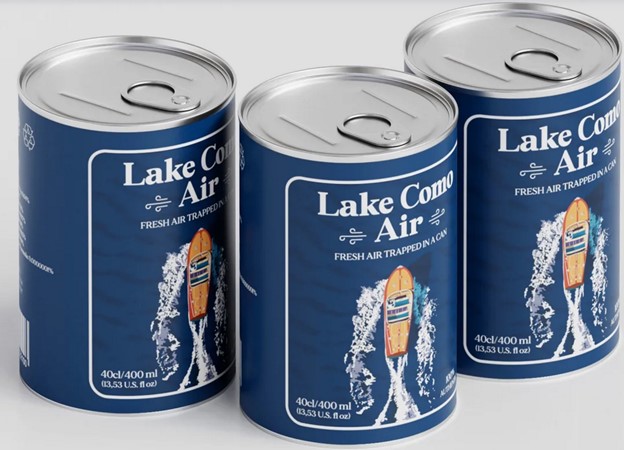
For all its success, the legitimacy of a product like Boost is sullied by similar products having no health benefits whatsoever.  On your next trip to Italy, head up to Lake Como in the far north for a look at the pristine waters and nearby snow-covered Alps.  While you’re there you can purchase a can of “Lake Como Air” for $11.  Lake Como Air claims no value other than “something original, provocative, and fun”, or “… a tangible memory you carry in your heart”.  Really?  I have lots of tangible memories from Italy and they didn’t cost me a dime.

On your next trip to Israel (which best not be anytime soon), head over to the Dead Sea for a look at the biggest, saltiest resource of natural minerals in the world.  You can float in the Dead Sea without even treading water.  And no surprise, you can “purchase” the Dead Sea in small containers.  The so-called manufacturer claims its consumption “contributes measurably to feeling better and to looking wonderful and healthy”.  Huh.  Not sure about you but I like to think I feel better and look healthy just by drinking from the tap at my kitchen sink.

The list goes on and on.  Holy dirt from New Mexico.  Healing waters from right here in western South Carolina.  Rocks from outer space.  I mean, seriously, when are we going to stop paying for natural elements we can help ourselves to just by stepping outside our front doors?  Yeah, probably never.  That train left the station for good the day someone decided to bottle water.  Now we have canned air as well… and it’s a good thing.  Turns out, I’ll never take another trip to Colorado without a little Boost in my suitcase.

Some content sourced from the CNN Travel article, “Cans of ‘fresh air’ from Lake Como on sale to tourists in Italy”.

“Thoughtless Driving”

One of the inconveniences of living in a small town is the proximity to airports. In western South Carolina we actually have a choice of six, including tiny Augusta Regional just beyond the nearby Savannah River. But whether Augusta or one of the larger airports hours away on the East Coast, the drive to get there is mostly two-lane blacktop, speeding along and then slowing down through the small towns along the way. Correction. You’re supposed to slow down through the small towns.

Blame it on puzzle apps. My wife and I were just thirty miles into our eastward trek to Charleston International when we hit the pretty-much-forgotten small town of Springfield, SC. The speed limit sign suggested 25 through its residential streets. I chose 38 instead. Okay, I didn’t intentionally choose 38. I simply elected to ignore the laws of little Springfield, in favor of focusing on the puzzles my wife was trying to solve on her iPad. Maybe I missed the speed limit sign, but I did see the spinning blue/red lights on the police car sitting quietly in a church parking lot.

Here’s something all four of my life’s speeding violations have in common. As soon as each of them happened, I pulled over pretty much the moment the cop reached for his lights. My thought process went, “Hey, I’m breaking the law”, followed by “Hey, that cop noticed me breaking the law” and finally, “I think I’ll just pull over immediately and save him or her any further trouble”.

38 mph in a 25; yeah, that’s pretty bad. Totally deserved the ticket. At least it wasn’t another school zone this time. My last two speeding tickets, one in the middle of 1992 and the other around 2013, were earned as I passed by primary schools with loads of children on their playgrounds. Even worse, the 1992 ticket was collected from the driver’s seat of a midlife crisis two-door convertible Alfa Romeo Spider. Bet the cop loved ordering youngish me to traffic school in lieu of the ticket.

Speaking of “in lieu”, my Springfield, SC cop (who had nothing better to do because there’s nothing at all to do in Springfield) gave me a no-brainer choice in settling my flagrant speeding violation. Option 1: Pay the fine as advertised and earn four points against my driver’s license (“Ouch!”) Option 2: Pay an additional 30% on the fine and avoid the points entirely (not-so-“Ouch!”) Maybe Springfield’s not a bad little town after all… even if the ticket mocked my violation with a description of “thoughtless driving”.

Here’s the nice thing about making peace with a speeding violation before the cop even reaches the driver’s side window: you have a pleasant conversation. Officer: Do you know why I pulled you over?  Me: Why yes sir, I do, and here’s my driver’s license and registration. Officer: Okay Mr. David, let me spell out your options here (spells out options).  Me: Why thank you sir, I’ll take Option 2, if you please. Officer: Okay then Mr. David, pay the fine online and enjoy the rest of your day.  Me: And you too, officer!  It was almost as if a friendship was born over a speeding ticket.

I can’t talk about three of my speeding tickets without a mention of the fourth.  I made it through my high school driving years before ever getting pulled over – but just barely. It was on a graduation trip, where my parents loaned me their car and paid for enough gas to get me and a buddy a driving tour of the Western U.S. And right there in the middle of Colorado, streaking up the interstate towards the Rockies, I earned the blue/red lights for the very first time.

I will always remember two things about that first ticket. First, the officer gave me a personal escort to a nearby mailbox so he could watch me mail the check for the violation (no online or credit card option in 1980). Second, I turned to my buddy afterwards and said, “My parents are gonna kill me!”… which wasn’t true at all, but it’s how most teenagers feel after they get a speeding ticket in their parents’ car.

I doff my hat to those who make the effort to plead down a speeding ticket. I also admire those who continue driving after a violation, as if they don’t think the police car in the rear-view mirror intends to pull them over. Me, I embrace the fines for my brushes with the law.  It’s easy to claim accountability when you’ve only had four instances. And for the foreseeable future, I’ll be the most well-behaved driver behind the wheel.  You just won’t find me anywhere near Springfield, SC.

Ear Plugs Recommended

I try to avoid topics causing thoughts of negativity or fear. After all, who wants to read about invasions when they can find plenty about them in their daily news feed? But one particular assault has been relentless, both in the media’s coverage and the anticipation of its arrival. They’re coming… I know they’re coming. One day very soon I’m going to be surrounded by buzzing, mating, disgusting cicadas.

“I’m coming for you!”

Until we moved to the South, I admit to knowing virtually nothing about cicadas.  Sure, I could pronounce the word and probably had a vague idea of what they looked like, but I’d never heard, let alone seen the insect in locales further to the West.  Well, Mother Nature has decided to address that deficit of knowledge this year, in spades.  The forecast infiltration of B-flick bugs is projected to run into the billions (as if anyone could possibly count how many).  And they’ll be here in the next week or two.

To prepare for this overwhelming assault, I decided to learn a little more about the humble cicada.  It is one of God’s more bizarre creatures, both the look and the lifecycle.  Cicadas live underground almost their entire lives.  They feed on the sap of plant roots.  The only time they surface is to mate, about fifteen years after birth.  The females lay their eggs in slits they make in the branches of trees.  After birth their little “nymphs” plunge to the ground, where they burrow down deep to begin their subterranean lives, and the cycle starts over again while Mom and Dad promptly enter the pearly gates of cicada heaven.

“Bug eyes”

It’s the stuff of horror movies, this bonanza of bugs.  The problem is, a realistic depiction on the big screen has to include a soundtrack loud enough to make the viewing unbearable.  THIS is what your local reporter is so jazzed about.  The male cicada makes a shrill sound to attract the female, which can only be described as an incessant scritch-scritch, scritch-scritch.  Now multiply the sound by billions, and the better descriptor is “lawnmower” or “jet engine”.  Best get a set of earplugs while the stores still have them.

The “buzz” (ugh) about this year’s offensive is the overlapping emergence of two broods where there would normally only be one.  It’s a doubling-up that hasn’t happened since the days of Thomas Jefferson.  There’s enough membership in both clubs to adjust the forecast from “billions” to “trillions”.  Brings a new meaning to “take shelter”.

Let’s build the horror film script, shall we?  Cicadas make their skritch-skritch sound with vibrating membranes on their abdomens [pausing here to allow stomachs to settle].  Cicadas shed their exoskeleton as they transition from juvenile to adult (time to grow up, little ones), and leave those shells all over tree trunks for us humans to find afterwards.  Finally, cicadas are chock full of tree sap.  For a wish-I’d-never-read-it analogy, just think of cicadas as nature’s Gushers… the bright green variety of the candy.

Nope, absolutely not

Birds will be thrilled with the arrival of trillions of Gushers.  They’ll feed on them to their heart’s content.  Okay, so now we’re talking about two cicada invasions followed by one bird invasion.  Oh, and throw in several poisonous copperhead snakes while you’re at it.  The copperheads like to hang out at the base of the trees, to feed on any falling cicadas.  I told you this would be a horror movie.

The rumors are flying on the when and where of this year’s cicada onslaught.  America’s Midwest and Southeast regions seem to be sure things.  More specifically, Illinois and Georgia, although one report includes several counties here in South Carolina.  Seriously, the thought of untold numbers of these winged nightmares living below the very ground I walk my dog on puts some serious shakes into my legs.

Despite the headlines and anticipation (and the inevitable movie due out next Halloween) there’s very little “horror” to expect from the cicada raid.  They don’t bite, they don’t move around much, and they die pretty darned quick after they mate.  I’m guessing they don’t care much about the humans walking underneath them either, because they’re too busy making trillions of nymphs.

Mr. and Mrs. Miller

Normally this time of year I’m complaining about a wholly different invasion of insects. Out in Colorado – where we still have a “For Sale” sign on the property of our former ranch – we’re about to get a visit from the wretched miller moth (which I blogged about in Late Night Racquet Sports).  Like the cicada, miller moths don’t bite and don’t care much about humans, but man do they migrate.  Like, from the Midwest to the Rocky Mountain states and on into Utah.  They’re so messy I’d almost prefer a double dose of trillions of cicadas instead.  Like I have a choice.

Some content sourced from the Mercer University article, “What’s up with all the cicadas?…”, and Wikipedia, “the free encyclopedia”.

State Flyovers

The heavy-duty bracket I purchased to display our American flag sits patiently on the garage shelf. The flagpole and flag stay wrapped in the plastic they came in. I hesitate with this little DIY project because I’m mounting the bracket onto a rounded wood column on the front porch. If the column isn’t solid throughout, it may not support the Stars and Stripes. Or the Palmetto State flag, for that matter.

South Carolina

If you’re not familiar with the South Carolina state flag, you are now.  Not very exciting, eh?  A white palmetto tree in the middle and a white crescent to the upper left, on a rectangle of deep blue.  Okay, but what about why the flag has this look?  That’s a little more interesting.  All of it is a nod to the Revolutionary War.  The crescent could be found on an American soldier’s cap, palmetto logs were used to build the forts they fought from, and the deep blue was the color of their uniforms.  My assumption was simply, “Oh, our state has a lot of palm trees and a lot of clear moonlit nights.”

Colorado

The same could be said for the state of our former residence.  Colorado’s flag is likewise simple, with a big red “C” for Colorado surrounding what I assumed was a yellow nod to the state’s bountiful days of sunshine (300+/year).  Nope, I only got the sunshine part right.  The “C” represents “columbine” (state flower) and “centennial” (Colorado became a state in the hundredth year of America’s independence).  The red represents the state’s distinctive sandstone soil, the white its ever-present snow, and the blue its endless skies (which really are an amazing blue).  More than meets the eye with this “state flyover”, am I right?

Maine

Not content with just SC and CO, I decided to give a few other state flags a whirl… literally.  I flicked my mouse wheel the way someone might spin the bottle, for an unsuspecting kiss choice from the list.  Up came ME.  There’s a lot going on with Maine’s state flag, including a couple of proud characters and a moose that looks rather cartoonish.  “Dirigo”, from a long-ago-but-now-defunct language of the region, means simply, “I lead”.

Here’s a further sampling of U.S. state flag trivia:

  • Arkansas was the first of the fifty states to produce diamonds.
  • Hawaii was once under British control, so their flag includes a small version of the “Union Jack”.
  • Montana’s motto is “gold and silver”.
  • Ohio’s flag is not rectangular and includes a “swallowtail” notch (which can’t be said for any of the others).
  • Oregon’s flag has a different design on each side.
  • Utah’s flag changes in 2024, to better represent the makeup of the state’s residents.
Ohio

If you live in an American state, you should play this game yourself.  Scroll to the image of your flag in the article: The state flag for all 50 states… but before you read the written description, make your best guess on the colors and symbols.  It’s fair to say most Americans don’t really know our state flags.

Go Dawgs!

South Carolinians love to fly flags.  You’ll see the colors of colleges and universities from all over down here (including the red/black of those nearby football champion Georgia Bulldogs).  You’ll see a lot of those “garden flags” designed to represent the year’s seasons and holidays.  But mostly you see the Stars and Stripes, and the Palmetto and Crescent.  South Carolina’s forever nod to the Revolutionary War means I’ll never look at our flag the same way again.  Now I just have to get the bracket where it belongs so I can hoist the banner same as every other resident.

Some content sourced from the USA Today article, “The state flag for all 50 states…”, and Wikipedia, “the free encyclopedia”.

Conifer Confetti

When you move to a new city and state, you deal with the expected and the unexpected. The expected includes boxes that don’t unpack themselves (but what a great invention, right?), over-the-fence greetings with neighbors (categorized as “nice”, “cranky”, and “utterly weird”), and enough wrong turns on roads where you finally pull over and mutter, “Where the heck am I?” Unexpected includes the drip of a leaky pipe ($$$, sigh), chew-crazy squirrels in the backyard (anything plastic is fair game), and, oh yes… pine cones. Lots and lots of pine cones.

Five acres may seem like a lot to some of you readers but to us it’s downsizing from our ranch in Colorado.  You’d think a property a sixth the size of the former would suggest lower maintenance.  After last Sunday I’m not so sure.  My wife came in from the barn the day before and said, rather gently, “We should probably pick up the pine cones in the back pasture before they get out of control.”  Simple enough.  After we fed and watered the horses, we went out to the field with the muck rakes and began picking.  A muck rake can hold ten pine cones.  Around the first tree I figured I picked up fifteen rakes’ worth.  Again, simple enough… except we have at least twenty pine trees.  Do the math.  Our pickup amounted to a motherlode of pine cones, somewhere between two and three thousand.

Back in Colorado we had, like, one pine tree on our property (a magical one actually, which I wrote about in My Dandy-Lion Pine Tree).  After last weekend I’m thinking I should’ve amended our purchase agreement on the new place to say, “Remove nineteen of twenty pine trees”.

I need the “giant” version of this

What does Dave do with all of his pine cones?  Nothing, for now.  The most efficient system of gathering is to throw them against the base of the trees and then haul them away to the “yard waste” dump.  But in the three hours we collected cones, I had plenty of time to think about better ways to do it.  The neighbors suggested a “pasture vacuum”, which is like one of those big spinning brushes you see in the car wash, dragged behind the tractor.  Others suggested a big bonfire, pretty much the last thing a person from Colorado wants to see in their backyard.

My new pet

Here’s thinking outside of the box: I could get a pet Parasaurolophus, the dinosaur with a distinctive crested head.  The Para has thousands of teeth perfectly suited for their favorite meal: pine cones.  But I’d need a time machine so I can bring one back from sixty million years ago.  Looks like it’s still me and the muck rake for now.

Conifer cones”, which include pine cones, play a vital role in the evolution of the trees.  Between all those little wooden scales are the seeds, first pollinated and later released.  It’s a sophisticated process which you can read a lot more about here.  In its simplest terms you have the smaller, meeker “males”, who release pollen for the “females” to catch.  Then the females release the seeds, even after they lay in my pastures by the thousands, seemingly dead.

“He” (lower) doesn’t even look like a pine cone

There was a moment in all that raking where I followed a squirrel as he bounded across the grass and onto the trunk of one of the trees.  Up, up, up he went until he disappeared into the umbrella of the branches above.  And that’s where, to my horror, I noticed how many thousands of pine cones sat poised above me. Maybe millions… almost all of them female.  It’s like having the world’s biggest sorority row above my backyard, and every house is about to disgorge its girls for a giant party on the ground.  Maybe I should hire Sticky Vikki & The Pine Cones for the music.

“Widowmaker” cone

I know, I know, it could be worse.  I could live in Maine, where there are so many pine trees the state flower is the pine cone (and a pine cone is not even a flower).  Or I could have Coulter pine trees, with cones so big they’re nicknamed “widowmakers”.  Seriously, these ladies are massive – you don’t want one falling on your head. Speaking of falling, the mere sound of a plummeting cone is unnerving enough.  It’s like a warplane flying overhead and releasing a bomb, only the bomb whistles straight to the ground without detonating. “THUNK”.

I’d have a massive herd of these Scandinavian toys

We shared the story of our pine cone bounty with my brother-in-law, who promptly encouraged us to do something creative with them.  Make wreaths for the holidays.  Turn them into coffee and jam like they do in Eastern Europe.  Sell them as the fertility charm they’re supposed to be.  Nah, I don’t have time for all that.  We’re expecting extra wind in the next few days courtesy of Hurricane Ian.  I have another three thousand pine cones to pick up.

Some content sourced from the HuffPost blog, “Thirteen Things You Never Knew About Pine Cones…”, and Wikipedia, “the free encyclopedia”.

(No) Separation of Church and State

This weekend my wife & I packed up the last of our things and moved from Colorado to South Carolina. We’ve decided the lower elevation and milder temps of the “Palmetto State” make better sense for our retirement. But instead of a moving truck, we trailered the horse (and the dog and the barn cat) along with our suitcases. A half-ton of horse means driving in the slow lane, our top speed 65 mph without blowing a gasket. And driving through Kansas in the slow lane – or any lane for that matter – feels like forever.

The western edge of Kansas, at Interstate 70, is an encouraging starting point as you leave Colorado.  You pass an attractive “Welcome Center”, a convenient place to take a break and learn a little about the “Sunflower State” before you venture further.  More importantly, you notice an immediate improvement in the road conditions.  Kansas, unlike Colorado, not only earmarks tax dollars to keep its highways pristine, the state actually spends those dollars accordingly (instead of dipping into them for other purposes).  Our horse – standing on four legs the entire journey – appreciated the smoother ride, if not the triple-digit temps.

Twenty or thirty miles into Kansas, the sobering reality of America’s Heartland sets in.  For one, you could lay a ruler on the hundreds of miles of Interstate 70 and hardly need a turn of the steering wheel.  For two, you realize every town along the way – save Kansas City to the far east – looks exactly the same.  Water tower. Cell phone tower. Church. Gas station. Fast food. A surround of corn fields. Lather, rinse, repeat.  It’s like someone drew up a generic template of a town and laid it down a couple dozen times along the interstate.  Doesn’t help to keep a slow driver alert, especially when you’re on cruise control.

But suddenly, mercifully, and completely out of nowhere, you see little Victoria, Kansas on the horizon.  Not Victoria, British Columbia (though it might feel like you’re driving all the way to Canada).  Victoria, Kansas, with its mere 1,200 residents and one square mile of town.  And right in the middle of Victoria, rising out of the earth as abruptly as the Rocky Mountains, sits the Basilica of St. Fidelis, better known as the Cathedral of the Plains.

You can probably spy St. Fidelis from fifty miles away as you approach, but you certainly don’t believe what you’re seeing.  Kansas is as flat as a pancake yet Victoria boasts a cathedral worthy of a spot in Rome.  The first time I saw St. Fidelis several years ago (driving a whole lot fast than 65 mph), I thought it was the Kansas heat bringing me a heavenly mirage.  I half expected the clouds to part (even though there weren’t any) and a host of angels to surround those tall twin spires.

But St. Fidelis is a lot more real than a mirage.  It was built in the early 1900s by German and Russian immigrants, each of whom pledged to haul six wagonloads of limestone and another four of sand from nearby quarries.  St. Fidelis predates any kind of construction equipment so the entire structure was raised by hand.  These industrious Kansans knew the meaning of hard work.

St. Fidelis boasts forty-eight handcrafted stained-glass windows, valued at more than $1M.  Its beautiful procession of Romanesque-style arches hovers above marble floors.  The cathedral was “elevated” to the status of Minor Basilica by decree of the Pope in 2014, and earned a place on America’s National Register of Historic Places.  In other words, there’s no separating this church from this state.  Not bad for an old building in a tiny metropolis in the middle of cornfields.  I only wish I’d had the time to exit the interstate and head down to Victoria for a closer look.

The Sunflower State has adopted the Latin phrase ad astra per aspera as its motto.  It means “to the stars through difficulties”, representing the aspirations and hard-working spirit of the state.  I’d say the Cathedral of the Plains is Kansas’ perfect example, wouldn’t you?

Some content sourced from Wikipedia, “the free encyclopedia”.

Too Much on My Plate

In the latest spin on subscription services, BMW will – for a small fee – heat the seats in your car. Maybe you saw this headline already and thought, “Fake News”.  Afraid not. Rather than simply pushing the heat-the-seat button on your 3 Series sedan you must contact BMW first, who will remotely unlock the feature and charge you by the month. A separate soon-to-be-offered subscription gets you a heated steering wheel. I shouldn’t be surprised by this latest cash grab at the expense of driving comfort. After all, we’re also about to enter the era of electronic license plates.

I find U.S. license plates to be mini-artworks, don’t you?  They’re colorful, often including an image or slogan to proudly advertise the state itself.  The letters and numbers raise from the rest of the aluminum rectangle, giving the fingers a pleasing sensation when you brush over them.  Drivers who choose “vanity plates” offer the rest of us on the road a puzzle, to figure out what phrase the chosen letters/numbers represent (and never getting the chance to ask).  The U.S. Mint should take a cue from colorful license plates and print American dollars with the same pizzazz.  After all, “greenbacks” are anything but mini-artworks.

But I digress. Today we’re talking about license plates, displaying numbers and letters in pixels instead of raised metal.  My first thought when I read about electronic license plates?  Fraud.  I mean, seriously, how easy will it be to hack into the software and alter the numbers and letters, effectively rendering the vehicle impossible to track?  Or worse, what if the software hiccups and the plate displays nothing at all?  It’s kind of like when Colorado legalized recreational marijuana several years ago.  Our state didn’t think that one through either and now we’re dealing with all sorts of hitches in the giddyup.  Electronic license plates are bound to be an imperfect technology.

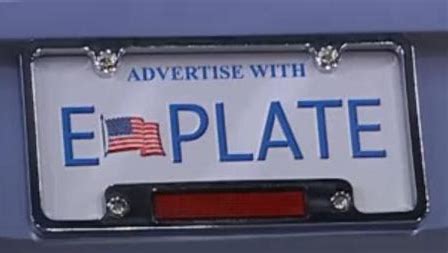
And yet, just like heated seat subscriptions “digital display plates” have their advantages.  They’ll emit a signal for tracking and monitoring (which some will surely drive to the Supreme Court as an invasion of privacy).  They can flash an easy-to-see message if the vehicle is not properly registered or insured.  They can interface with parking meters and toll systems for automated payments.  Finally, inevitably, they’ll offer advertisements to the captive audience in the car directly behind them, switching from letters/numbers to digital commercials when the car is stopped.

Colorado has joined four other U.S. states who already offer electronic license plates.  Like BMW’s services, the plates will be offered on a monthly subscription.  At $20-$25/mo. they’re a whole lot pricier than standard or even vanity plates.  But you just know there are plenty of drivers who want the latest/greatest technology, even with the inevitable drawbacks of a first-generation product.

[Trivia Break!  Recent demand in several U.S. states moved the license plate character count from six to seven.  Guess how many unique plates you can make from a combination of three numbers and four letters alone?  Sixteen million. It’s fair to say we won’t be needing an eighth license plate character anytime soon.]

I admit I’m slow to adopt new inventions, even though I spent the last twenty years of my career in tech.  The laptop I’m typing on is five years old and doing just fine.  The SUV I drive will last fifteen years since the one I had before it did as well.  And the fitness band I wear gives me a dozen angles on my health yet I’m more interested in the time of day.

Electronic license plates may be overcomplicating the issue.  The metal variety sits there quietly, displaying letters and numbers like it’s supposed to.  The electronic variety aims to be anything but a license plate.  Amber Alerts.  Insurance/registration violations.  Product advertisements.  Or – God forbid – electronic bumper stickers, where the owner can publicly express the kinds of opinions to drive the rest of us to road rage.

Say what you will about BMW, but the automaker is simply climbing onboard the subscription bandwagon.  Who can blame them for finding new ways to make (our) money?  On the other hand, drivers may wake up one day and wonder why we ever caved to electronic license plates.  We just have to glance at our roadside billboards to know we had it coming.

Some content sourced from Wikipedia, “the free encyclopedia”.