I’ve often thought the airport is the best place to people-watch. With downtime while you wait for your flight and the close proximity to others, it’s inevitable you’re going to look around. Every kind of person can be found at the airport (sporting every size, shape, fashion statement, stress level, and age). Travelers are unknowingly entertaining to those who watch them. But today let’s explore perhaps an even better venue where people do their thing: the beach.
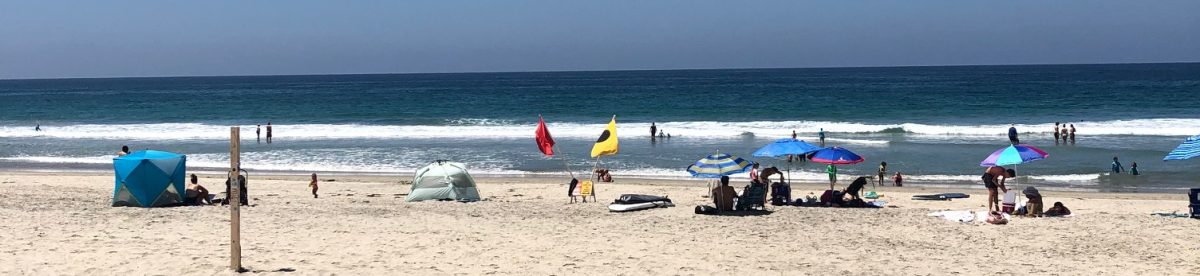
 As I type today, a sweeping look at the sandy shore beyond my patio shows me (in no particular order): A mother and daughter in animated conversation with a lifeguard; a group of teenagers (male) playing an aggressive form of beach four-square called Spikeball; another group of teenagers (female) sprawled on beach towels in giggly conversation; a father dragging his young son through the shallow waves on a boogie-board; a surfer wiping out in the not-so-shallow waves further out; and an ambitious child shoveling dirt out of a divot of sand as if digging to China.
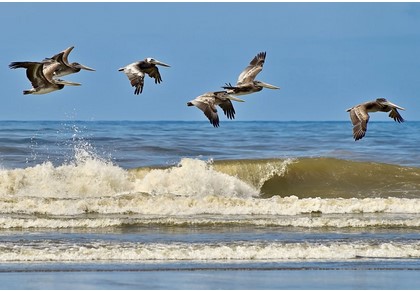 I look away for a second and then look again: A pack of aggressive seagulls pecking away at someone’s leftovers aside their abandoned beach chair; that same lifeguard sprinting into the water to rescue a struggling swimmer; an older couple having a (clearly) not-so-happy conversation at the water’s edge; a jogger attempting to put in the miles while dodging the less active in his way; and a paused beach volleyball game where the players can’t determine if the ball hit the (sand) line or not.
 It’s a rare treat when I can create a blog post from the goings-on on right in front of me, but the beach allows me to do just that. More to today’s point, an active beach like this one changes character throughout the day. In other words, there are the sands of time and then there are the times of sand:
- Dawn: Seagulls, sand, and surf. The beach at its most peaceful and pristine.
- Early morning: Serious runners at the shore (unlike the casual joggers later in the day); an Asian elder performing a standing form of meditative yoga; a surf camp for pre-teens to the north; a lifeguard training camp for teens to the south; a pickup truck clearing the trash from the evenly-spaced cans.
- Mid-morning: The gradual arrival of the masses (and all they bring with them). Also the arrival of the lifeguards, with bright cones marking the “no-man’s land” for emergency vehicles, flags indicating the adjacent street number so people know where to find you, and more flags to mark the beach’s “surf zone” versus “swim zone”.
- Midday: Everything I observed at the start of this post (and so much more).
- Mid-afternoon: The gradual departure of the masses, and (hopefully) all they brought with them. Also the departure of the lifeguards, signing off with a megaphone farewell to those who remain behind.
- Early evening: The ritual of the sun-worshippers, who simply must remain behind to witness the (West Coast) sunset. There’s nothing like a setting sun to bring a person to a focused standstill.
- Dark: An umbrella of stars, a rhythmic ribbon of white foam as the waves crash to shore, and an occasional party of two out for a romantic stroll at the water’s edge.
 Trust me, it’s easy to be mesmerized by the times of sand if you watch them long enough. They’re the reason I never make progress with my latest “summer read”, and the reason I can abandon my electronic devices for hours at a time. Frankly, it’s a wonder I was able to turn away from the sands long enough to bring you this blog post today.

 Life In A Word