Finial Touch

In early January you walked into my blog, took a seat in a pew up front, and witnessed the longest church service in the history of France. From the first LEGO piece I laid as the cornerstone – a now-hidden flat black rectangle – to this week’s placement of the oversized finial on top of the roof, you watched – for almost two hundred years – the slow, somewhat steady rise of Notre-Dame de Paris. Time sure flies, doesn’t it?  But at last we’ve made it to the end (or at least, the year 1345), where the pastor dismisses the congregation with a “Go in peace!”(which sounds much better than “Go in pieces!”)
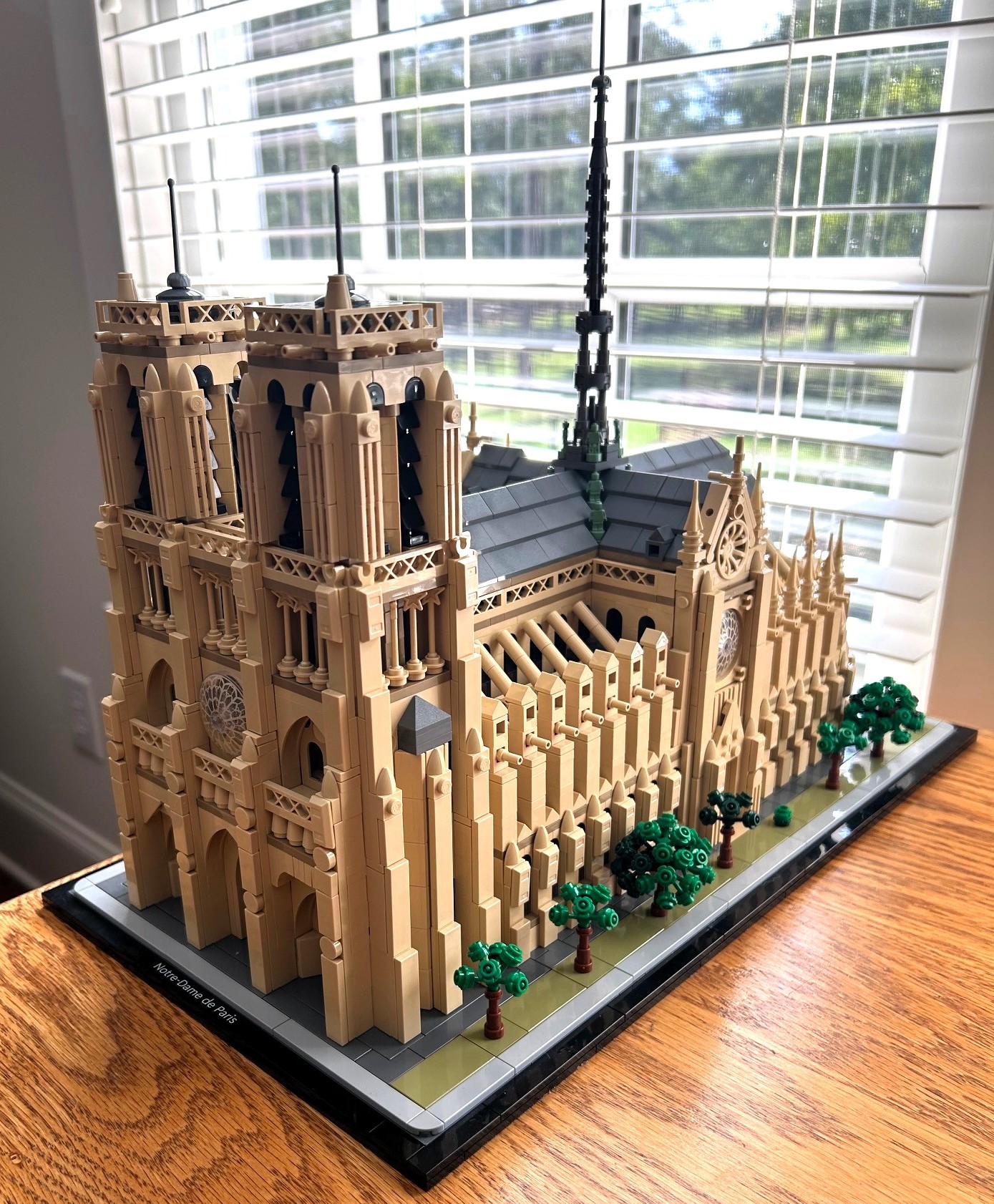
Notre-Dame de Paris

Some reflection is in order today, especially since we’re talking about a building of faith. Our cathedral adventure over the last 19 weeks took us through 4,383 LEGO pieces and 393 steps of the instruction manual, snapped together in fifteen hours, resulting in a five-pound plastic model that – “thank heavens” – really does look like the famous French cathedral on the Seine River in Paris.

[Builder/blogger note:  I chose my Spotify classical music playlist while I finished up the cathedral.  The first selection was entirely fitting: Edward Elgar’s “Pomp and Circumstance”, because this really did feel like a graduation of sorts.  But the second selection was eerily more fitting: the final chorus of Handel’s “Messiah”.  Ha-a-a-a-a-llelujah indeed!]

Some of the photos here aren’t much different than last week’s, but only because bags 31-34… of 34 bags of pieces, were all about embellishment: capstones, pinnacles, tabernacles, finials, statuary, and all the other little architectural flourishes unique to a cathedral (plus a little landscape on the sidewalk).  You know those cake decorator videos where a white cake sits on a spinner and you get to witness the slow, mesmerizing development of frosting, flowers, and such?  That was me this week; spinning, applying, and fully decorating my cake… er, cathedral.

Here’s a good photo of some of this decor (and click on any of the photos to see everything better).  To the far left you can see several of the pinnacles; the little spires all in a row high up.  There are 30 pinnacles on the entire cathedral.  To the right you can see a couple of the tabernacles (14 of those); the open box-like structures above the tiny drainpipes.  And running along the first floor you can see capstones; the helmet-like headers on either side of the open bays.  There are more capstones on Notre-Dame de Paris than any other decorative element (68!)

Here’s a look at the cathedral’s famous flying buttresses, the exterior structural elements keeping the building from falling in on itself.  There are 28 buttresses, including 14 running around the chancel and apse on the east end.  Just below the tabernacle boxes you see the drainpipes.  There are 46 of those.  During a good rainstorm this view would include an elegant line of waterfalls.

Remember those curious “stars on flagpoles” (or “magic wands”)?  Here they are again, all grouped together just below the part of the towers housing the bells.  There are 24 of them.  You can also see one of the cathedral’s three majestic rose windows front and center.  Finally, note the round “medallions” just under the curved arches on either side of the rose window.  You’ll find 24 of those on Notre-Dame de Paris as well; several stamped proudly with a “LEGO” logo.

Okay, one more example of embellishment.  Here you can see the 12 disciples in green, symmetrically positioned around the base of the finial (all facing inward).  When I pulled these little guys out of the plastic bag I thought they were scale figures for down on the sidewalk, but instead they are the statuary I referred to when I first talked about the cathedral back in January.
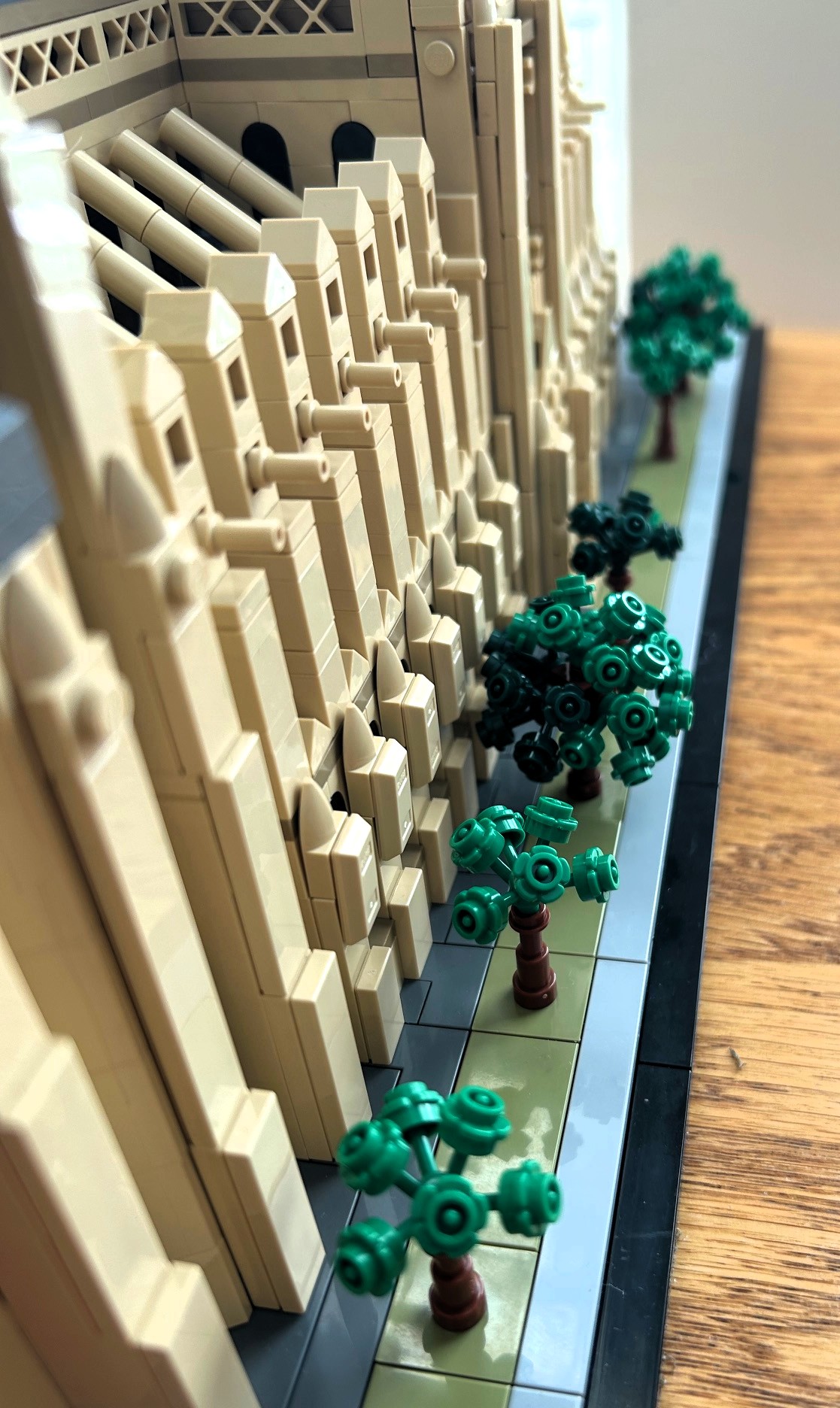
I’d be remiss if I didn’t say something about the model’s landscape elements.  LEGO has come a long way since the boxy trees surrounding LEGO Fallingwater.  These little “growees” are pretty sophisticated.  Consider the tree in the middle. (Click on the photo for more detail).  It’s made up of 37 LEGO pieces, including the trunk, branches, and leaves.  Furthermore, the branches up against the cathedral are a darker green because, of course, that part of the tree is typically shaded.

Now then, before you “go in peace” I must mention one more thing; the so-called surprise I teased in last week’s post.  Notre-Dame de Paris is such an elegant structure it deserves to be seen by day… and by night.  Thanks to the good people at Briksmax, I am able to do just that: light up the cathedral from one end to the other.  That’s the good news.  The bad?  I’m looking at another 2 instruction manuals and another 230 steps to get it done.  Are you kidding me?
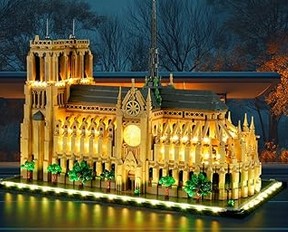
Briksmax lighting

When I purchased the lights I figured they would be simply and cleverly inserted in and around the completed structure, but NO-O-O-O-O-O!!! (cue horror-movie music).  In order to light up Notre Dame de Paris I must deconstruct the model.  Again I say, are you kidding me?  Here I finally complete my cathedral and now you want me to take it apart again?  Sorry good readers; it’s just not something I can stomach right now.  I’m going to sit and admire my completed cathedral while you settle for admiring the Briksmax photo above.  You don’t place the finial on the roof of the catheral with a flourish, only to then remove the entire roof.  Another church service for another time.
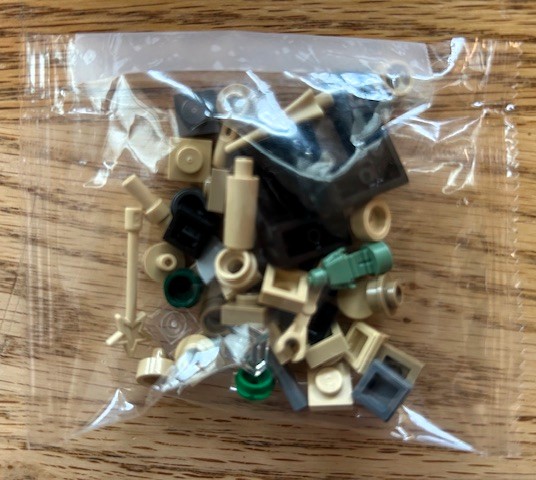
I leave you with one last look at our poor, unused, leftover pieces, all 48 of them in plastic-bagged captivity (but still trying to escape).  I think they all ganged up and cried, “RUN FOR IT!”, because the 49th leftover – a tiny cluster of leaves from one of the trees – went skittering off the desk and onto the carpet below, where it immediately hushed and hid. I still haven’t found it, but no worries.  The next time I walk into my office I’ll probably step on it with a satisfying crunch.

Running build time: 15 hrs. 6 min.

Total leftover pieces: 49

Highest Chair

When we babysit our granddaughters here at the house, we tap into several items to make the job easier. A big basket of toys and stuffed animals sits in the corner of our living room. A dozen children’s books line the lowest shelf just waiting to tell their stories. Sesame Street is easily streamed on the nearby television. And at dinner time we roll out the high chair so everyone’s on the same level. So who would’ve thought a high chair would be my blog topic for today? Maybe you, if you know anything about cathedrals.

Notre-Dame de Paris

We’re almost there, loyal readers.  I will lay the corner-block of my LEGO model of Notre-Dame de Paris next week.  Why not this week, you ask?  Because before we crack the seal on the giant box of pieces, we need to pay a little respect to the real Cathedral.  I want you to know a few things about the stone and glass Notre-Dame before you witness the rising of the plastic one.

West facade

It’s a cathedral in the middle of Paris, Dave… what more do I need to know?  Uh, a LOT more.  To begin with, do you even know what a cathedral is?  I didn’t (and I have a background in architecture, for gosh sake).  It’s a big, giant church with stained glass and chapels and a raised altar, you say.  Well yes, you’re right, but what makes a church a cathedral?  Interestingly, it has nothing to do with the building itself.  Instead, a cathedral is the seat of a bishop (the ordained clergy-person who presides over the surrounding parishes). For lack of a church this person could just as easily be in a small house and it would still be considered a cathedral.

Cathedrals really do have “high chairs” on their altars for the bishops (cathedra in Latin means “seat”) but Notre-Dame de Paris is much more than a place for furniture.  First and foremost, it took a hundred years to construct (1163-1260).  In that era the building evolved from the common Romanesque style of the period to the more elegant French Gothic.  Notre-Dame feels unusually vertical and airy for a structure of its time and there’s a novel reason for this: flying buttresses.

Flying buttresses

Imagine Notre-Dame’s architect – Eugène Viollet-le-Duc – talking to the Paris city council in the twelfth century and saying, “Look guys, let’s think outside the box here… literally.  The structural support for this church ought to be outside of the building instead of inside”.  Why would the architect want this?  Because the flying buttresses assume the structural load that was previously handled by short, thick interior walls.  The result is taller, more dramatic spaces, filled with the light of high-up stained glass windows.  In other words, flying buttresses allow Notre-Dame to “reach for the heavens” much better than its Romanesque predecessors.

North rose window

There’s also more to this French “grande dame” than structure, of course.  Notre-Dame has twenty-nine chapels surrounding the main sanctuary (that’s gonna take a lot of LEGO).  It features three spectacular stained glass “rose” windows that would not be as large or as high were it not for those flying buttresses.  Notre-Dame’s twin towers host ten massive bronze bells and they each have first names.  “Emmanuel” (listen to his sound bite below) and “Marie” are so big they take up the entire south tower, while their eight ringing siblings all fit into the north tower.

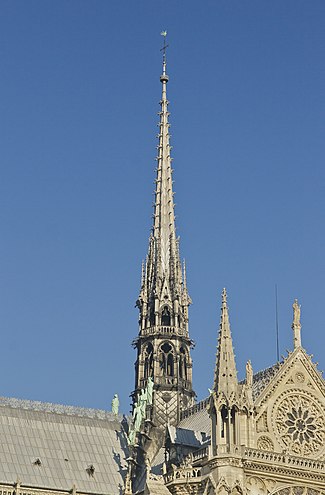
Notre-Dame also has a central flèche, a spire not unlike the ones you see on more modest churches.  This spire, however, is topped by a bronze rooster, which is not only the symbol of the French state but also a container for (supposedly) a small piece of the Crown of Thorns, worn by Jesus leading up to his crucifixion.

Rooster-topped “flèche”

As you would expect, Notre-Dame de Paris hosts countless works of art, whether paintings or sculptures.  Many of the sculptures are biblical scenes intended to educate the illiterate parishioners of the twelfth century.  But my favorite sculptures may be those of the twelve apostles, way up high surrounding the base of the flèche and looking outwards towards Paris… all except one.  St. Thomas – patron saint of architects – faces Notre-Dame itself, and was given the facial features of Viollet-le-Duc.

Okay, so now you know more about Notre-Dame de Paris than just the LEGO model.  Considering there are over 500 Gothic cathedrals in Europe, it’s impressive to see Notre-Dame at the very top of at least one “Top Ten Cathedrals” list.  We’ll visit some of those other “high chairs” in future posts, to add even more life to my pile of plastic pieces. In the meantime, my LEGO “church service” begins promptly at 10am next Thursday.

Some content sourced from Wikipedia, “the free encyclopedia”.

It’s (Not) Just a House

Let’s agree to disagree today (one of my favorite catchphrases). You see things one way while I see them another. Perspective, angle, viewpoint – choose your word – we all come to our conclusions on different roads. Which is ironic, because four of us came to Frank Lloyd Wright’s Fallingwater on the same road three weeks ago.

I blogged about Fallingwater in Perfect Harmony a couple of years ago.  The post was meant to be a primer on what makes the house an iconic work of American architecture.  At the time I was also building LEGO’s version, which is as close as I thought I’d ever get to the real thing.  Today I can say I’ve checked an up close and personal visit off my bucket list.

Fair warning: there’s no convenient route to travel to Fallingwater, which shouldn’t surprise you about a house hidden in the forest.  You’ll drive ninety minutes southeast of Pittsburgh on two-lane roads, some in desperate need of repair. And watch carefully for the driveway entry; it kind of pops up out of nowhere.

You won’t get to see Fallingwater without booking a reservation beforehand.  Despite my dismay in last week’s post about required reservations in Rome they make a ton of sense with Fallingwater.  It’s a small house after all, so it’d be overwhelming if visitors just showed up and walked in.  We took the final tour on a Saturday and our guide said 600 others had already been through the house earlier in the day.

Fallingwater’s Visitors Center

Thanks to the resources of the Frank Lloyd Wright Conservancy (which is still buying up property around Fallingwater), the experience begins before you ever see the house itself.  The driveway wanders past a guard house to a modest parking lot.  From there you walk to a beautiful Visitors Center nestled in the trees.  A central outdoor seating area is surrounded by a small museum of Wright’s work, a cafe, and a gift shop that offers much more than shirts and postcards.  Frankly, the Visitors Center is a nice little work of architecture all by itself.

The walk to the house begins down a kind of woodsy nature trail, so you can see the rocks, trees, and other materials used to construct Fallingwater in their native forms.  What impressed me most about the tour is how you never see the house until you’re practically at its front door, making for a dramatic reveal.  Your walk descends through the canyon of Bear Run (the river over which Fallingwater is perched) until the house’s signature cantilevered forms emerge from the dense forest.

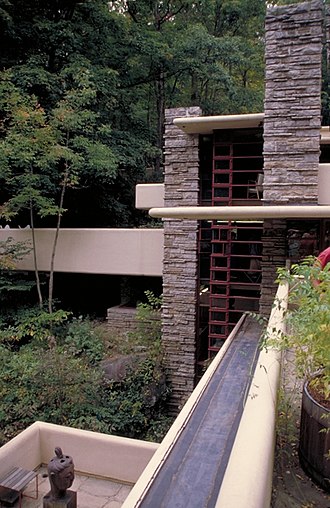
As I described it in Perfect Harmony, Fallingwater looks like it was “constructed entirely offsite and dropped gently within the forest by pushing aside a few tree branches”.  After seeing the house in person, I wouldn’t change a word of that statement.  The design is a marvel, not only in how the indoor/outdoor spaces integrate with their natural surroundings, but also in how it was built as if floating over the waterfall below.

Enough with the fawning over Fallingwater, am I right?  After the four of us took the tour we had a chance to process what we’d seen, and my wife’s and brother’s reactions were clear: it’s just a house.  It’s not even a nice house, with its low ceilings, dark spaces, and anything-but-cozy use of rock, concrete, and glass.  Fallingwater is hard to get to, and it’s in the middle of nowhere.  And with its hundredth birthday not far off, everything about the house has a decidedly dated feel.

I did my best to explain why I love Fallingwater.  My sister-in-law, who appreciates everything about the arts, understood the significance of the house.  She “got” what Frank Lloyd Wright was conveying in the design, and allowed the sacrifice of comfortable living for the sake of the indoor-outdoor interplay.  She probably took in the house the way she would a painting at the Louvre.  My wife and my brother, not so much.  For them the ninety minute tour was probably sixty minutes too long.
Fallingwater promotes the thought: “one person’s junk is another’s treasure”.  My treasure is architecture (so much so I studied it in college).  Yours is probably something entirely different.  It fascinates me how my brother spent years and years of research, consulting, and money to restore a 1960s vintage Ferrari in his back garage.  To me, cars get you from Point A to Point B; a mere convenience.  My brother could spend hours explaining why his Ferrari goes worlds beyond that statement.

Still lingering on my bucket list is a visit to Paris, where among the city’s many wonders stands the Eiffel Tower.  I want to see this engineering/architectural masterpiece from far and near, and of course, ascend it’s many levels to fully experience the structure itself.  For now however, I’ll have to settle for building LEGO’s version.  As with Fallingwater, we can all agree to disagree. The Eiffel is (not) just a tower.

Some content sourced from Wikipedia, “the free encyclopedia”.

Game, Set, Matches

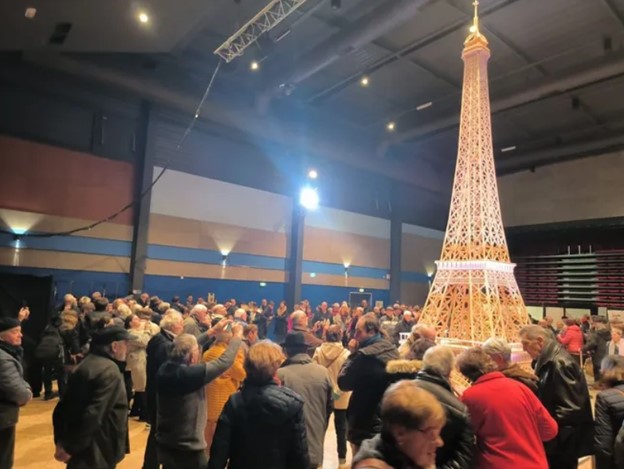
The LEGO Eiffel Tower is the tallest of its model kits and undoubtedly the largest of its Architecture Series. At a deliberate count of 10,001 pieces, this behemoth is a whole lot more detailed than LEGO’s 2014 original, which clocked in at a mere 321 pieces. So imagine my awe (okay, and shock) when I learned about another Eiffel Tower model; one with a staggering 700,000 pieces. Suddenly 10,000 seems like a nice, reasonable number.

Matchstick model

It’s true, of course.  A Frenchman recently converted 700,000 matches into a model of the Eiffel Tower, in an attempt to break the world record for, naturally, “tallest matchstick Eiffel Tower”. (Is there a world record for everything these days?)  I suppose I can get past the 700,000 matches – even if I can’t picture that many in one model – but what I can’t fathom is the eight years Richard Plaud sacrificed to build his creation. I’m picturing Monsieur Plaud waking up each morning, bidding adieu to his wife after a croissant and some French press coffee, and heading off to his studio to play with matches, a giant bottle of glue in hand.  Day after day after day.

Our Frenchman’s accomplishment wouldn’t be so interesting if there weren’t a little drama thrown in for spice.  Turns out his 23.6-foot model may not earn the world record after all.  Why?  Because Plaud cut the heads off the matchsticks as he built.  When he got tired of cutting, he contacted a French “matchmaker” (ha) and asked if he could place a massive order of headless matches.  And there’s the rub, fellow model builders.  Guinness is disputing Plaud’s claim of the world record because the materials used can’t be purchased by you or me, should we try to build our own matchstick Eiffel Tower (but would we?)

Meanwhile, a 21.6-foot Eiffel Tower model built by Toufic Daher (coolest name ever) retains the world record.  Daher’s model was completed in 2009 using six million (headed) matches.  I have no idea how long it took him to build, but seriously, how long does it take to simply pick up six million little sticks, let alone shape and glue them into a replica of the Eiffel Tower?

“La Dame de fer”

Gustave Eiffel (another cool name) surely had no idea people like Plaud and Daher would be obsessed with his tower 135 years after the fact, in pursuit of world records.  Frankly (“France-ly?”) Eiffel’s “Iron Lady” is impressive enough to stand on her own wrought-iron feet.  After all, she’s among the most recognizable structures in the world.  She surpassed the Washington Monument when she opened to the public in 1889, as “tallest human-made structure” (sadly, seventy years before Guinness started tallying world records). Today she still merits an entry in the world record book, albeit for a different reason:”Most Visited Monument with an Entrance Fee”.

There’s a touch of iron-y to this post.  As much as I’m making blog fodder of these Eiffel Tower model builders, I’m tempted to become one myself.  Not with headless matchsticks; the LEGO version.  Several years ago I completed the LEGO U.S. Capitol Building (1,032 pieces), followed by the LEGO Grand Piano (3,662 pieces), and more recently, LEGO Fallingwater (811 pieces).  I keep an eye on the LEGO catalog for other models of interest but not one calls to me… except La Dam de fer.  But then I pause to ask myself, am I really willing to dive into a project that’s effectively one hundred bags of one hundred pieces each, where ever single piece dark grey?  Stay tuned.

LEGO’s version

As for our French ami Richard Plaud, his eight years of pick-up sticks may not have been in vain after all.  Guinness admits they might’ve been a little quick to dismiss his claim.  In their words, they wanted to make sure “the playing field is level for everyone”.  Playing field?  Ah, so this Eiffel Tower model-building is a game, is it?  For Plaud at least, I’d call it game, set, matches.

Some content sourced from the USA Today article, “8 years down the drain?…”, and Wikipedia, “the free encyclopedia”.

Renaissance Man

In the second movement of Antonin Dvořák’s New World Symphony, the orchestra settles down as the English horn begins its soft, wailing solo. You’ve heard this famous lullaby in one version or another, but never more powerfully than in the “Largo” movement of Dvořák’s symphony, with the strings and woodwinds providing the sweeping background (~45 seconds into the following video). It’s one of my favorite classical pieces, and my performance is flawless every time I play it.  Play it in my head, that is.

I’ve developed a satisfying habit over the years which you might share (or at least, be willing to try).  Think about something that interests you, or an activity in which you like to participate.  Over time you’ve developed a fair understanding of your subject, though your level of knowledge and skill would never qualify you as a professional.  But what if it did?  What if you suddenly had the smarts or the talent to find yourself among the world’s best?  Wouldn’t your life be wildly different?

My years of piano lessons never propelled me anywhere close to the ranks of “professional” or “best”.  I never even advanced beyond the piano’s foundation to pursue an instrument like the English horn.  To do so would’ve meant a wholly different direction in life.  More practice and lessons instead of time spent with friends or years in the Boy Scouts.  A different college or at least a different degree.  Competitions.  Travel.

Music eventually gave way to an interest in sports and soon I found myself on the basketball court more than in front of the piano keyboard.  I’d practice endlessly at our backyard hoop, imagining myself making game-winning shot after shot.  I did play a couple of years of JV ball in high school and went to college games at nearby UCLA.  But my skills never developed to the varsity-, let alone college-level.  Was I infatuated with basketball at the time?  Yes, but I also knew early on I’d never be one of the greats.

You’re starting to see a pattern here and it continued in college.  I studied architecture (“I’ll be the next Frank Lloyd Wright!”) but only spent the first few years of my career in the field.  I had a good run with info technology companies (“Bill Gates!”) but never developed the level of expertise to be labeled a “techy”.  I write these weekly blog posts (“John Grisham!”) but have no plans for the next Great American Novel.

Here’s my point, and maybe you never saw it coming.  I find all of this dabbling and dreaming incredibly satisfying.  My interest in a subject or activity wanes well before it becomes an obsession, and then I simply move on to the next thing vying for my attention.  Why do I behave this way?  Two reasons.  First, I prefer to be a jack of all trades (or a master of none, if you will), not a virtuoso.  Second, more importantly, I am far too content with my life as it is to ever be tempted by the sacrifices necessary for the pursuit of singular success.
Michelangelo’s “David” 🙂

There’s a complimentary phrase for people like me: Renaissance Men.  We hearken back to the great thinkers and artists who came along just after the Middle Ages; Leonardo da Vinci and Michelangelo, for example, with “unquenchable curiosity” and “feverishly inventive imaginations”.  Mind you, I can’t paint like da Vinci or sculpt like Michelangelo, but my curiosity and imagination may run just as rampant.  The modern Renaissance Man, in a nutshell, has “broad interests” and “superficial talents”.  Me to a tee.

Playing in my head

The next time I hear Dvořák’s “New World Symphony”, I’ll think about playing the English horn.  Maybe I’ll sign up for lessons and eventually get good enough to play the “Largo” movement.  Maybe then I’ll join the local orchestra so I get the chance to perform in front of a live audience!  Yeah… probably not. Long before my much-anticipated stage debut, some other activity will vie for my attention and off I’ll go.

Some content sourced from Wikipedia, “the free encyclopedia”.

Wings and Prayers

One of the must-sees on a visit to Colorado Springs is the campus of the United States Air Force Academy (USAFA). Besides a training ground for our future servicemen and women, the Academy hosts a high school, an airfield, two golf courses, and a cohesive campus of modernist buildings spread across 18,500 acres of the Rocky Mountain Front Range. But one structure stands prouder and taller than anything else on the property. Welcome to the USAFA Cadet Chapel.

USAFA Cadet Chapel

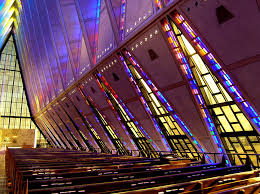
If you’re following my blog posts on architecture (as I complete my LEGO Fallingwater model), you’ll recall Thorncrown Chapel from a few weeks back.  The USAFA Cadet Chapel is a much bolder animal, dominating the academy campus skyline and easy to see from miles around.  Instead of Thorncrown’s wood and glass, the Cadet Chapel boasts an impressive open structural steel frame, married with tall triangular stained glass windows.  The main sanctuary is big enough to seat 1,200 (or about 25% of the USAFA student body); more like a church than a chapel.  Frankly, the only thing the Cadet Chapel has in common with Thorncrown is its design inspiration: France’s Sainte-Chapelle.

Fighter jets all in a row?

The distinctive feature of the USAFA Cadet Chapel is its seventeen spires, marching from one end of the building to the other.  The bold design, by architect Walter Netsche, took a little getting used to when the doors opened in 1962.  Visitors described the structure as a giant accordion made of triangles.  I describe it, more fittingly, as a series of fighter jets standing on their tails.

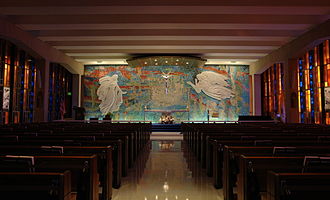
If you haven’t visited the Cadet Chapel you probably don’t know its biggest secret.  It’s a chapel for all faiths.  The main sanctuary is just the top floor of a multi-level structure.  Hidden below, you’ll find individual chapels for Catholics (500 seats), Jews (100 seats), Muslims, and Buddhists.  You’ll even find two “all-faiths rooms” and an outdoor area for “Earth-Centered Spirituality” (reserved for you Pagans and Druids).  It’s safe to say your acceptance into the Academy has nothing to do with who or how you choose to worship.

USAFA Catholic chapel (lower level)

The Cadet Chapel is a structural marvel, assembled from precisely one hundred prefabricated tetrahedral panels.  Over the years its popularity has grown to where it was designated a National Historic Landmark in 2004.  That’s the good news.  Now for the bad.  The original design called for a series of gutters to transfer water away from the building, instead of streaming directly down its panels.  But the gutters were scrapped due to budget constraints…

Mistake.

Sixty years of caulking and recaulking leaks finally forced the Academy to close the chapel for remodeling in 2019.  Now for the really bad news… they’re still not finished with the repairs.  In fact, you won’t be able to walk through the doors for another four years.  What’s taking so long?  Adding all those gutters, the ones that were supposed to be there in the first place.

The Cadet Chapel is “boxed” until 2027

One more bit of bad news (the fighter jets are really nosediving).  Getting construction workers to the tops of the chapel spires meant building an entire hangar-like structure around the chapel.  No joke – they put the whole building in a box.  In other words, not only can you not walk through the doors, you can’t even see the Cadet Chapel today.  Trust me, absence makes the heart grow fonder.  Mark your calendar for 2027, because you really need to see the USAFA Cadet Chapel.  It’s the only place I know where a (jet) wing and a prayer can be found in the same place.

Now for the latest on LEGO Fallingwater…

____________________

LEGO Fallingwater – Update #4  (Read how this project got started in Perfect Harmony)

I’m starting to wish I’d built Fallingwater before the LEGO Grand Piano, so you’d see me taking on a greater challenge versus the other way around.  30 pages (or 33%, or 118 minutes) into the build, this is what we have:

Pretty much the same as last week.  We added some landscape to the left side (the green/brown pieces), more landscape along the back, and we raised the foundation a little higher up off the water.  We have yet to see any of the distinctive house itself.  Not so adventurous.

What IS adventurous is sifting through 800 tiny pieces.  There’s no logic in how they were bagged (thanks, LEGO!) so I end up just spilling everything out onto the desk, searching for a lot of minutes followed by building for a few minutes.  Tedious?  Heck no, this is a blast.  If “tedious” entered my brain I’d have no business building LEGO models.

LEGO Gamble House by Grant W. Scholbrock

Props to my college buddy Bruce for sharing this photo, an example of a custom LEGO build… and one you can’t buy.  It belongs in a museum if you ask me.  There are pedestrian model builders (yours truly) and then there are professionals.  Way to go, Grant!

Tune in next Thursday as construction continues!  Now for another nod to Frank Lloyd Wright…

Solomon R. Guggenheim Museum

Guggenheim Museum

I’m not a big fan of museums.  Maybe that’s because, as Frank Lloyd Wright said, a lot of them look like “Protestant barns”.  No wonder New York City’s Guggenheim Museum is radically different.  When Wright set out to design it in 1943 he vowed to “make the building and the paintings a symphony such as never existed before in the World of Art”.

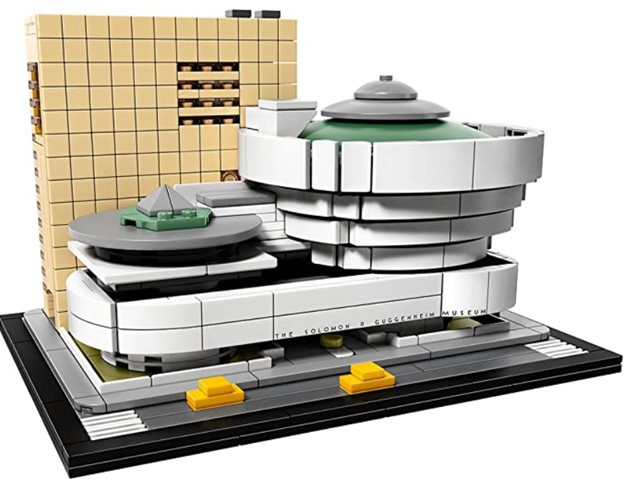
I can’t describe “The Goog” any better than the website of the Frank Lloyd Wright Foundation.  Their words: “… a white ribbon curled into a cylindrical stack that grows continuously wider as it spirals upwards towards a glass ceiling.” In other words, you the visitor climb in circles ever-ascending, enjoying the art as you go.  The Guggenheim was the first museum design where the “physical home” played an important role in the experience of the art itself.  If you’ve ever been to a museum that deserves a similar description, you have the Guggenheim to thank.

LEGO Guggenheim

In closing I ask, is the Goog significant enough to earn a spot in the LEGO Architecture series of models?  Why yes, it is!

Some content sourced from the Frank Lloyd Wright Foundation website, and  Wikipedia, “the free encyclopedia”.

This Gamble Pays Off

In the movie Back to the Future, there’s a memorable scene shortly after Marty McFly time-travels back to 1950s California. Marty looks up Doc Brown in the phone book and heads over to his house. Doc doesn’t recognize Marty when he opens the door but he drags him inside anyway.  The scene is memorable because Doc’s house (the exterior, at least) is recognizable to any student of American architecture. Welcome to Pasadena’s Gamble House.

Greene and Greene’s Gamble House

Maybe you guessed this Gamble wasn’t won in a wager (although it would’ve been a handsome payoff!)  Rather, it was built for a member of the (Proctor &) Gamble family who liked the look of his next-door neighbor’s place.  That house, and many others on the same street, was designed by sibling architects (Charles) Greene and (Henry) Greene.  The Gamble House is perhaps their most famous design.

Front doors and foyer

The Greene brothers, who studied architecture at MIT, made a significant stop on their journey to the West Coast.  They spent time at the 1893 Columbian Exposition in Chicago.  While there, they picked up design influences from the temple look of the Japanese pavilion (wood construction, tiled roofs, open verandas).

Dining area

The Greene and Greene “ultimate bungalow” look, with its liberal use of dark wood slats and panels, became known as the Craftsman style of architecture.  This label was all the more fitting because the Greene brothers also studied furniture design, and incorporated many custom pieces into their houses.  Even more impressive, the finished look relies on elegant leather straps and wooden pegs as fasteners; not a nail or screw in sight.

Main staircase

The Gamble House is 6,000 square feet of indoor/outdoor living, in concert with California’s mild temperatures.  You can tour the house courtesy of the USC School of Architecture students who get to live there every school year (luckies!)  A separate tour walks you through the neighborhood to see other Greene and Greene designs.  But the Gamble remains their masterpiece.  And if you ever see this inviting residence, you may wish you owned a time-traveling DeLorean to take you back to its heyday in the early 1900s.

Courtesy of Universal Pictures

Now for the latest on LEGO Fallingwater…

____________________

LEGO Fallingwater – Update #3  (Read how this project got started in Perfect Harmony)

I find it funny how this Fallingwater model is “rising” off of its foundation at the same time the water below is “falling”.  It’s like I’m going in opposite directions at the same time.  20 pages (or 22%, or 83 minutes) into the build, this is what we have.

As you can see, the stream is now “built” from the front of the house all the way to the back, with the modest waterfall front and center.  We also have our first piece of “landscape”, that dark green strip you see on the left.  Otherwise, we’re still at the foundation level.  I expect the house to rise dramatically in the next few chapters of the build.

LEGO “wrench”

Here’s something unnerving about this model.  You don’t really understand what you’re building as you go.  You’re putting together very small pieces which look like, well, LEGO blocks, until you stand back and take the whole model in.  For this reason, you have to build very, very carefully.  I still got the location of a few pieces wrong and had to utilize my handy-dandy wrench to yank them out.  It’s like pulling teeth.

Tune in next Thursday as construction continues!  Now for another nod to Frank Lloyd Wright…

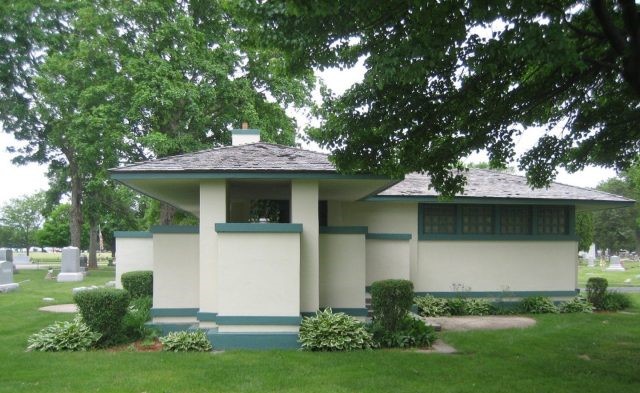
Pettit Memorial Chapel

Over five hundred structures were built from the designs of Frank Lloyd Wright, but only one of those five hundred is in a cemetery.  That would be the Pettit Chapel in Belvidere, Illinois.  Dr. Pettit was a beloved physician of his time, and his sudden passing prompted his wife to hire Wright to design a graveside chapel as a memorial to the man.

Pettit Chapel

The design of the “petite” Pettit is very much in line with Wright’s signature Prairie Style.  The low roof lines, broad eaves, and high horizontal bands of glass are typical.  Wright used the shape of a cruciform – common in medieval cathedrals – to house the smallest of sanctuaries, as well as two open-air porches and a central fireplace.  He then added storage, restrooms, and a furnace so the chapel could be used for public functions.

The Pettit Chapel has survived since its construction in 1906, thanks to restorations in 1977 and 2003.  The chapel is open to the public, and, like many structures designed by Wright, included on America’s National Register of Historic Places.

Some content sourced from The Museum of Lost Things website article, “The Real ‘Back to the Future’ House”, and Wikipedia, “the free encyclopedia”.

Crowned Jewel

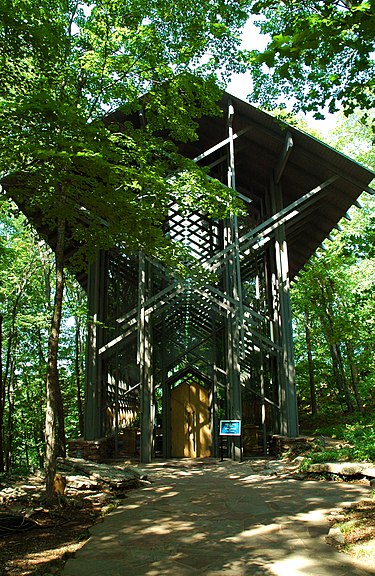
A little south and a little west of our downtown proper, you’ll find a wide street with stately old homes. The homes sit to the back of their properties, playing second fiddle to lines of majestic oak trees closer to the street. Overhead, the tree branches are densely intertwined, barely allowing the sun to peek through, creating a cozy, comforting canopy as you drive through. It’s a look that could’ve inspired the design of Thorncrown Chapel in Eureka Springs, Arkansas.

Thorncrown Chapel

When I gushed about Fallingwater in last week’s Perfect Harmony, I thought it would be appropriate to revisit some of my favorite American architecture as I share the adventure of my LEGO model build.  Were it not for my architecture degree in college I probably wouldn’t be aware of these beautiful structures.  Instead, all these years later I can recall my favorites from memory.  They’re a diverse bunch but I think they exemplify almost-perfect spaces, thanks to the work of the architect behind the scenes.

Thorncrown Chapel is an appropriate choice to lead off my list.  Just like Fallingwater, the chapel’s intent is to bring the outside in so that worship (or weddings, or any other celebration) feels as if you’re one with nature, yet with the conveniences and comfort of an enclosed space.  Thorncrown was built in 1980 (by coincidence, my freshman year of college).  Its architect, E. Fay Jones, turned a childhood interest in treehouses into a decorated career, including an apprenticeship under Frank Lloyd Wright.  Fay Jones’ designs “focused primarily on the intimate rather than the grandiose“.  Hence, chapels.

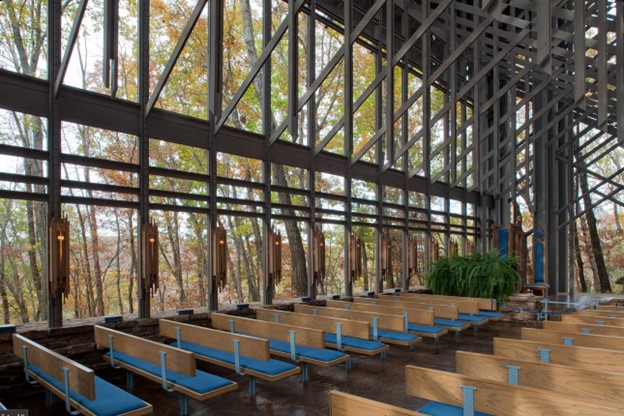
As a disciple of Wright (and the only one to win the American Institute of Architect’s [AIA] prestigious Gold Medal), it’s no surprise Fay Jones’ Thorncrown Chapel design is reminiscent of Wright’s Prairie School houses, with its broad overhanging eaves, horizontal lines,  and deliberate integration with the landscape.  Thorncrown contains 425 individual windows.  Those with stained glass bring in so much colored light the chapel’s interior is often described as “jewel-like”.

As with Fallingwater, Thorncrown is constructed of organic materials, including Southern pine and flagstone from the surrounding area.  The chapel seats 100 and is non-denominational, intended more for meditation for those who make the pilgrimage to Eureka Springs (in other words, go see it!)  For all of the beautiful structures you’ll find in America over the last forty years, the AIA has given Thorncrown the distinction of “best American building constructed since 1980”. 

Sainte-Chapelle

Despite my longtime familiarity with Thorncrown, I never thought to wonder how it got its name.  Turns out, Thorncrown’s design was not only inspired by Frank Lloyd Wright but also by Sainte-Chapelle, the Gothic church in Paris, France.  And at some point in its history, Sainte-Chapelle supposedly housed the crown of thorns worn by Jesus Christ.

If your wanderings ever bring you to the northwest corner of Arkansas, take time to visit this crowned jewel of a chapel.  Whether it strikes you as a treehouse or a miniature cathedral, being in church will never feel so comforting and cozy.

Now then, let’s turn our attention to (LEGO) Fallingwater, shall we?

____________________

Fallingwater – Update #1

As with the LEGO Grand Piano, the first step in the build is to simply open the box and assess the contents.  Here’s what is immediately apparent about the LEGO Fallingwater model:

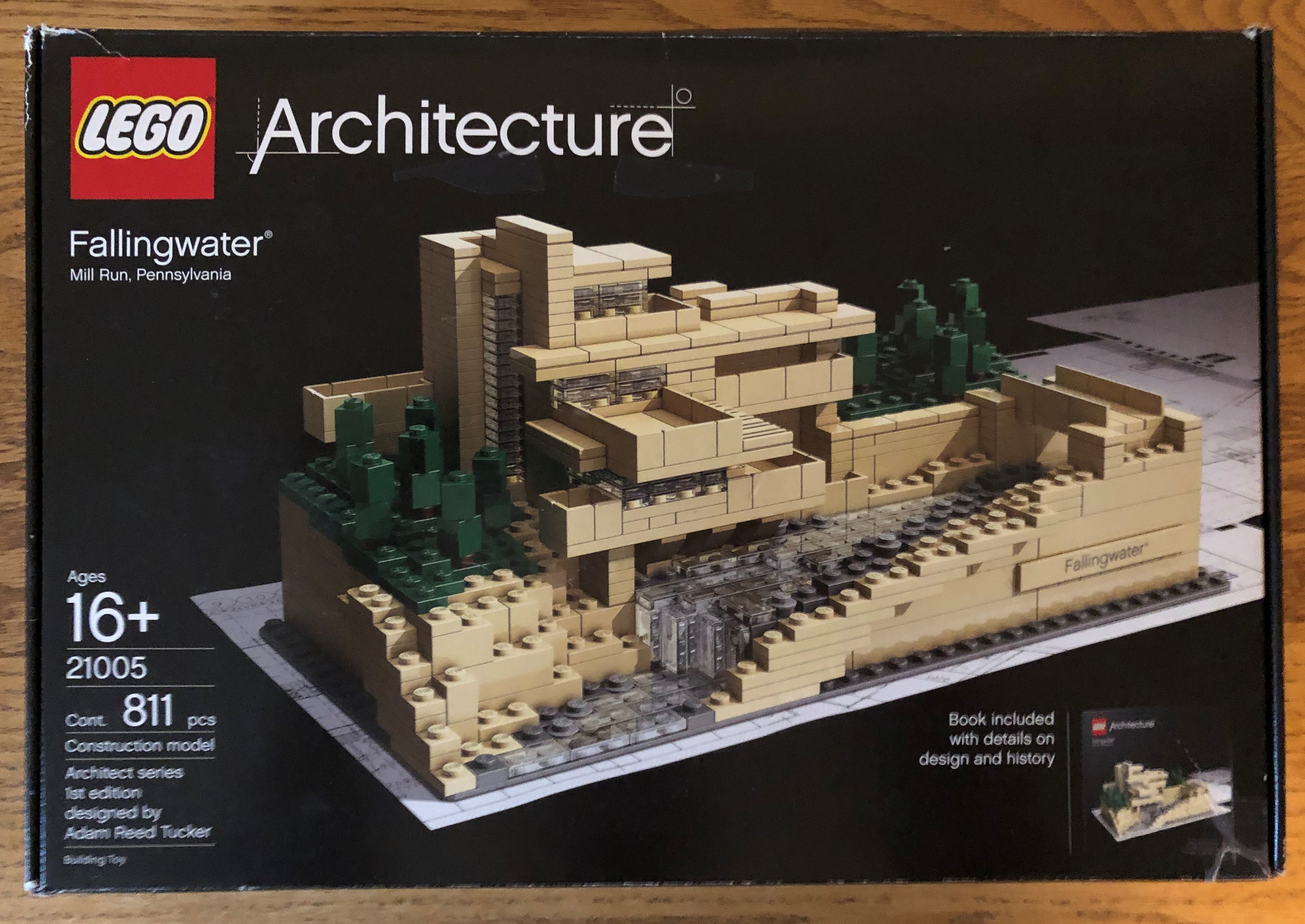
  1. The finished product will look much more like LEGO than the Grand Piano looks like a miniature piano.  I can’t pinpoint the date LEGO first produced its Fallingwater model but it must’ve been years before the Grand Piano, with pieces more in line with basic LEGO blocks.  I mean, check out the photo below.  Would you believe this inventory of boring little pieces comes together as a house over a waterfall?
  2. The Fallingwater model will be completed much faster than the Grand Piano.  The design is intricate, yes, and we’re still talking about thousands of pieces, but the instruction manual hints at a much easier assembly.  I won’t have those heartstopping moments like I did with the Piano, where I realized I’d built a section backwards.  (Then again, my LEGO-building confidence may be getting the best of me.)
  3. The Piano was interesting to look at even as it was coming together.  Fallingwater… not so much.  Under construction it’ll look like haphazard piles of LEGO bricks.  Not exactly riveting to you the reader.  Instead, as I did with the Piano and classical music, I’ll cover a few of Frank Lloyd Wright’s other designs, so you gain a better appreciation for the diversity of his life’s work.

Next week, “groundbreaking”!

Some content sourced from the official Thorncrown website, and Wikipedia, “the free encyclopedia”.

Perfect Harmony

In the toe of my wife’s Christmas stocking this year, I nestled a small gift to help her sleep. It’s a travel version of one of those sound machines, where you can dial up anything from rain to ocean waves to lull you off to Never Never Land. You can even mimic a waterfall, which would be my personal choice. After all, it’s the same sound the Kaufmann family enjoyed for years at their stunning retreat in the Pennsylvania forest, southeast of Pittsburgh. Seeing this famous house is an entry on my bucket list. Yes, one of these days I will make the trek to Fallingwater.

If you’re old enough to remember, “I’d Like to Teach the World to Sing”, you know the song’s about more than just apple trees and honey bees.  It’s about “perfect harmony”, which is how anyone would describe Fallingwater.  This beautiful structure is exactly as named: a house on top of a waterfall.  It is considered one of architect Frank Lloyd Wright’s greatest achievements.  The design is a melding of interior and exterior spaces, a principle borrowed from the Japanese.  Fallingwater is a building, yes, but it’s more often described as “… harmony between man and nature”.

If you know anything about Wright, you know he was an eccentric architect.  When the Kaufmann’s called to stop by his studio for a progress report, Wright hadn’t even begun the drawings.  Yet by the time they arrived two hours later, Wright had completed the entire design.  This production under pressure reminds me of author Ray Bradbury’s Fahrenheit 451, a novel written in just nine days and considered one of Bradbury’s greatest works.

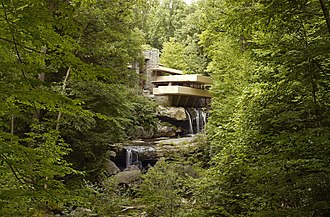
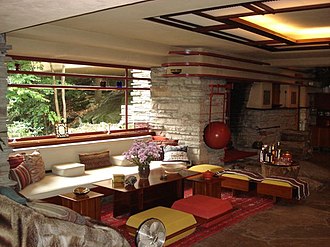
The genius of Fallingwater’s design is in the details, or perhaps the lack of them.  The house is constructed of reinforced concrete, stone, and glass.  Its interior spaces are small and dark, encouraging more time spent outdoors.  The sound of water can be heard everywhere, whether from the stream and waterfall below or from the natural spring allowed to drip along one of the hallways.  Fallingwater’s distinctive cantilevered terraces are meant to resemble nearby rock formations, extending in every direction to the forested surroundings.  Its dramatic perch on top of the waterfall is hidden from the approach to the house, lending to a sense of modesty.

Fallingwater brings the outdoors in wherever possible, and its best example may be a ledge-shaped rock in the living room, left undisturbed in its original location.  The surrounding stone floor is waxed while the ledge is left plain and dull, creating the look of a rock protruding from a stream.  A stair descends from the same room, several steps down to a platform whose function is to simply admire the stream.  From photos, you’d believe Fallingwater was constructed entirely offsite and dropped gently within the forest by pushing aside a few tree branches.

Today, Fallingwater is a National Historic Landmark.  You can tour the house and grounds with the purchase of a ticket at the visitor’s information website.  If I were to visit, it’d be a ten-hour drive from where I live.  That’s not going to happen anytime soon.  Instead, I will build Fallingwater; literally.  It is a model in the LEGO Architecture series and I am lucky to own a copy.  As I tell my family, there are only two LEGO models I’ve ever wanted to build: the Grand Piano (completed last year and blogged about here), and Fallingwater.  It’s a new year and it’s time to get started.

I’ll bring you along for the ride as my miniature Fallingwater takes shape in my home office.  You can look for updates at the end of the next several posts.  Eight hundred pieces from now, when all is said and done, I may borrow that little sleep aid I gave my wife for Christmas.  After all, no house built on top of a waterfall would be complete without the sounds to go with it.  Remember, we’re talking (er, singing) about perfect harmony here.

Some content sourced from Wikipedia, “the free encyclopedia”.

Let’s Do the Twist!

My Amazon order history says a lot about my purchasing habits. I am a buyer of needs vs. wants. Pet food. Printer ink. Humidifier filters. But every now and then, a little something nostalgic sneaks into My Shopping Cart. Favorite childhood books for my one-year-old granddaughter.  A balloon-launching catapult to make a Thanksgiving turkey fly (it didn’t).  Italian chocolates from Perugia, also discovered during a year abroad in college.  And just today – on total impulse – a Rubik’s Cube.

Rubik’s Cube – adding a few wrinkles to us baby boomers – celebrates its forty-fifth birthday this year.  Back in 1974 when it was invented (and originally dubbed “Magic Cube”), the 3x3x3 trinket earned our attention for its mechanical magic as well as its almost-impossible-to-memorize solution.

To be precise, there are 43,252,003,274,489,856,000 (that’s “quintillion”) possible positions of Rubik’s colorful squares.  The Cube comes with neither instructions nor answers.  Already solved in its packaging, you can’t help twisting it up into a mess of color.  In our pre-Internet world, Rubik’s Cube required endless gyrations in search of the answer (instead of just, “Hey Alexa”).  But there was something immensely satisfying about the resulting nine squares of single color on each of its six sides.  There was also something tempting about peeling off the colored stickers and rearranging them instead.

Erno Rubik (courtesy of Wikipedia)

Erno Rubik, a Hungarian inventor, was an architect and architecture professor “searching to find a good task for his students” when he completed the Cube’s first working prototype – a mess of wood blocks and rubber bands.  A small plastics company took a chance on its manufacture and the rest is history.  In the first four years alone, two hundred million Cubes were produced and sold.

I was in college (and also an architecture student) when Rubik’s Cube first hit the shelves.  Its perfect symmetry and twisting ability to reinvent its colorful look went hand-in-hand with my interest in building design.  I remember keeping a Cube on my dorm room desk – at first for mindless manipulation; later for successful solving.  Not that I could solve it quickly, mind you.  The world record – an average of five solves – is six seconds.  The world record with one hand (???) is nine seconds.  The world record using only your feet (again, ???) is twenty-two seconds.  My solve is expressed in minutes, if not hours.


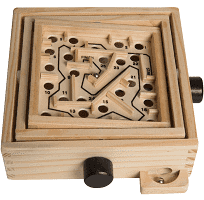
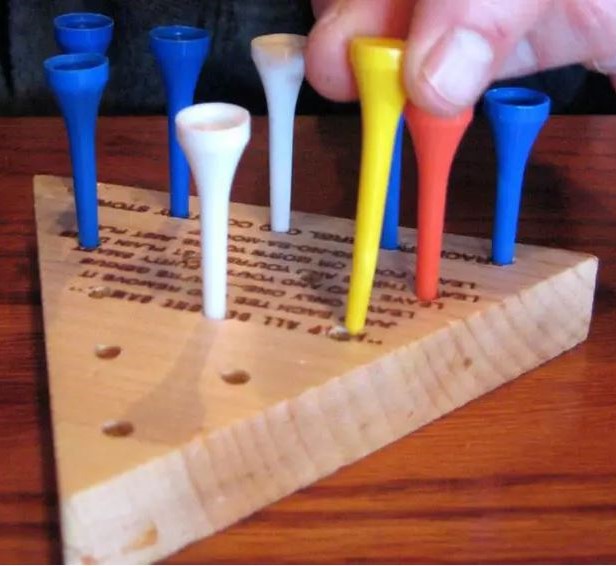
Few puzzles compete with Rubik’s Cube for sheer “can’t put it down”.  But there are a few.  One of my favorites was the wooden double maze, the box-like puzzle with the Etch-A-Sketch dials on the side, maneuvering the steel ball through the walled maze without dropping it through one of several holes.  I devoted hours and hours to that puzzle, always sweating those final tricky turns to the finish.  Another favorite: Marble Solitaire, where you hop-eliminated marbles in search of the perfect solution: a single marble standing proudly in the board’s center divot.  Finally (courtesy of Cracker Barrel restaurants), how about “Triangle Peg Solitaire”, the hop-elimination puzzle with the colored golf tees?  Thanks to that little game, my kids were supremely patient after the dinner order was placed.

With somewhere near four hundred million sold, Rubik’s Cube is considered the best-selling toy of all time.  Its inventive design landed the Cube in the permanent collection of the Museum of Modern Art (MoMA) in 1982.  The Cube also garnered “Toy of the Year” in eight countries, including Germany, France, and the U.S.

GoCube

Inevitably, there were attempts to advance Rubik’s design, such as a 4x4x4 version (“Rubik’s Revenge”), or pyramid, dodecahedron, and hexahedron shapes.  But going completely off the rails, look no further than GoCube – a thoroughly high-tech update to Rubik’s.  GoCube is also 3x3x3, but rimmed with LED lights, and contains wireless smart sensors, an embedded gyro, and an accelerometer.  Download the GoCube app to your phone (of course there’s an app), and watch your twists on-screen instead of on the cube itself.  The app guides you to the solution (if you so choose), creates alternative mosaic-looking puzzles, and run reports on solving speed and efficiency.  You can even wage virtual head-to-head competitions.  All for “only” $119.

“The Pursuit of Happyness” (courtesy of Warner Brothers)

I’m sure Erno Rubik (and Will Smith) would pooh-pooh GoCube as too much of a good thing.  I would agree.  The app-driven, light-up, hundred-dollar GoCube is over the top, with zero nostalgia to boot.  On the other hand, Rubik’s Cube cost me $4.59 on Amazon.  That’s a sweet deal, and a cheap way to learn how to do the twist all over again.

Some content sourced from Wikipedia, “the free encyclopedia”, and the Wall Street Journal article, “Never Solved the Rubik’s Cube?…”