
Last Saturday our little town hosted a festive 10k run. High school cheerleaders pom-pommed us away from the starting line while hundreds of residents waved flags and tossed water bottles along the way. The finish in the town square was packed with people, and included the music, food, and fun you’d find at a carnival. As I struggled to complete the last couple of “k’s” I struck up a conversation with a nearby runner to distract myself from the effort. She was pleasant enough, with just the right pace, and she was even a human being. At least, I think she was.
 Suddenly, shockingly, we’ve come to this. The entry form for your next running race may ask you to identify as 1) human being, or 2) human-oid . If you choose the latter, you’re saying you still have the physical form and characteristics of a human being. You just happen to be a robot.
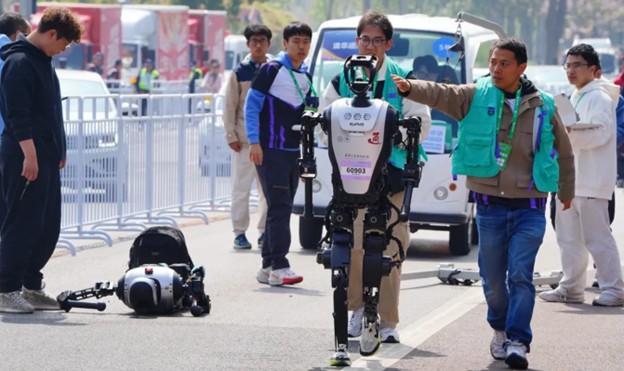
Ten days ago this eerie scenario really played out in Beijing. A half-marathon took place with thousands of human participants, but the spotlight was clearly on the twenty-one humanoids who also showed up at the starting line. These robots were accompanied by operators running close behind them, but make no mistake; absent of the wires or other attachments you might expect with a remote-controlled device. They were running free, with the look and gait of any other runner in the race.
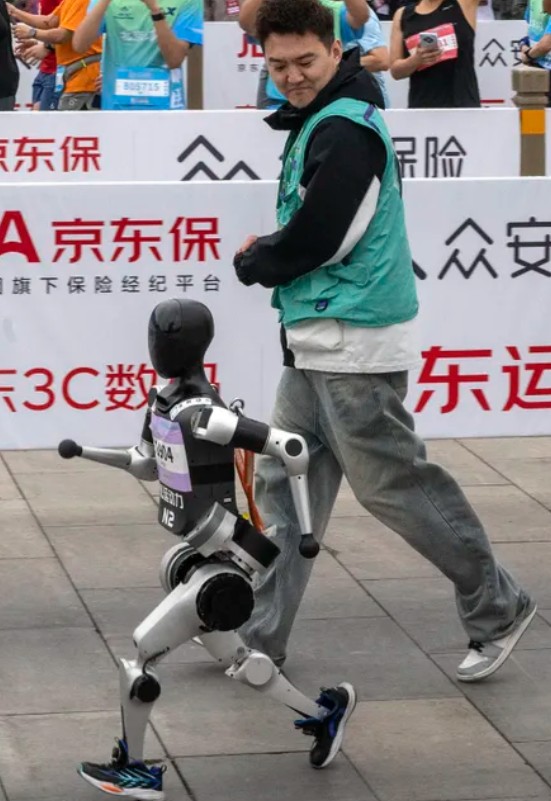 I’m wondering how any of the human runners kept their focus as they ran this race. I’d want to pace myself against one or two of these machines and just admire their every step. The humanoid winner, Tiangong Ultra, finished the half-marathon in 2 hours and 40 minutes, or about five miles an hour. Trust me: five miles an hour is not a walk; it’s a run.
I’ll have to search for the video online, because a still of a running humanoid doesn’t do the accomplishment justice. I just can’t get over the fact we now have robots who run. Granted, the Beijing half-marathon wasn’t what you’d call a “run in the park” for these technological marvels. Only six of the twenty-one finished the race. Others fell down or exhausted their battery packs. Still others lost their heads or spun out of control. If there had been a humanoid hospital nearby, its ER would’ve been a machine-shop hotbed of activity.
 My perception of all things “robot” is clearly outdated. I’m more inclined to picture self-guided vacuum cleaners and assembly-line automatons than race-running humanoids. Case in point: I’ll never forget the grade-school novel, Andy Buckram’s Tin Men. It was a wonderfully imaginative tale about a boy who created a family of robots from a pile of cans, and his unexpected adventures when those robots came to life courtesy of a lightning strike. The book was written in the 1960s and was a work of fiction. Of course it was.
 I’ll also never forget the movie Silent Running (1972), a future shock story of a destroyed Earth, with spaceships housing giant terrariums cared for by lovable lifelike service robots. Or Westworld – the 1973 original, not the HBO series – an adult amusement park of sorts where robots catered to the guilty pleasures of their human customers (until collectively the robots decided to run amuck).

C-3PO from the original Star Wars trilogy (1977) might’ve been the first humanoid to get me wondering if such technology was possible. Blade Runner (1982) took the concept an interesting step further, with humanoids desperate to demonstrate their emotional capacity. Less than fifty years later we’re still working on that emotions bit, but I certainly wouldn’t have bet we’d have humanoids who could run.
Let’s be clear – we’re at least another fifty years removed from any technology that remotely suggests “human”. Even if Siri and Alexa appear to read your mind and hold meaningful conversations with you, they’re not going to jump out of your smartphone tomorrow and land on two legs. Even if your little robot dog wags its tail, lies down, and rolls over, it’s not going to take a bite out of your leg when it doesn’t get enough attention. Your Roomba might suck up the lion’s share of dust and dirt in your house but it’s not coming for your valuables.
 I sleep peacefully at night knowing the nightmares of Westworld and Blade Runner continue to be the stuff of (evil) Hollywood imaginations. Virtual reality will remain virtual, and robots will continue to be nothing more than subservient devices for years to come. But admittedly, you can’t help but question “years to come” when you see a humanoid run a half-marathon.
LEGO Notre-Dame de Paris – Update #13
(Read about the start of this “church service” in Highest Chair)
I’m not sure I’ve ever stopped the construction of a LEGO model smack-dab in the middle of a bag of pieces. Imagine our priest at Notre-Dame de Paris, pausing midway/mid-sentence into his homily only to say to his congregation, “I’m tired. Let’s pick this up next week, shall we?”
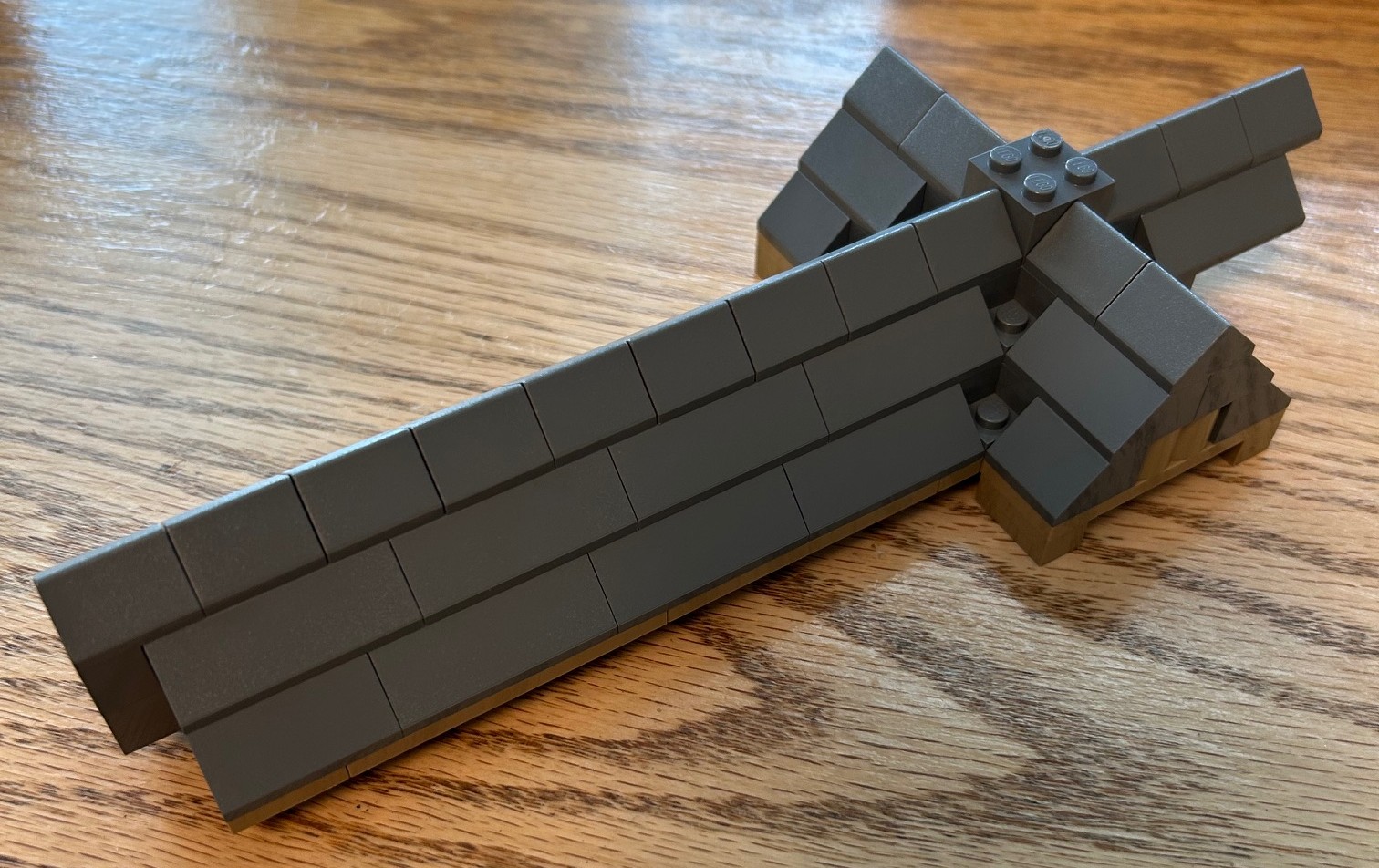
Bags 25-28 – of 34 bags of pieces, were a study in opposites. In a crisp fifteen minutes, Bag 25 assembled to the roof structure you see here, covering the remainder of the nave (the sanctuary) and transept (the cross section). Even Bag 26 wasn’t a stretch as we built the “cores” of the uppermost cubes of the cathedral towers.
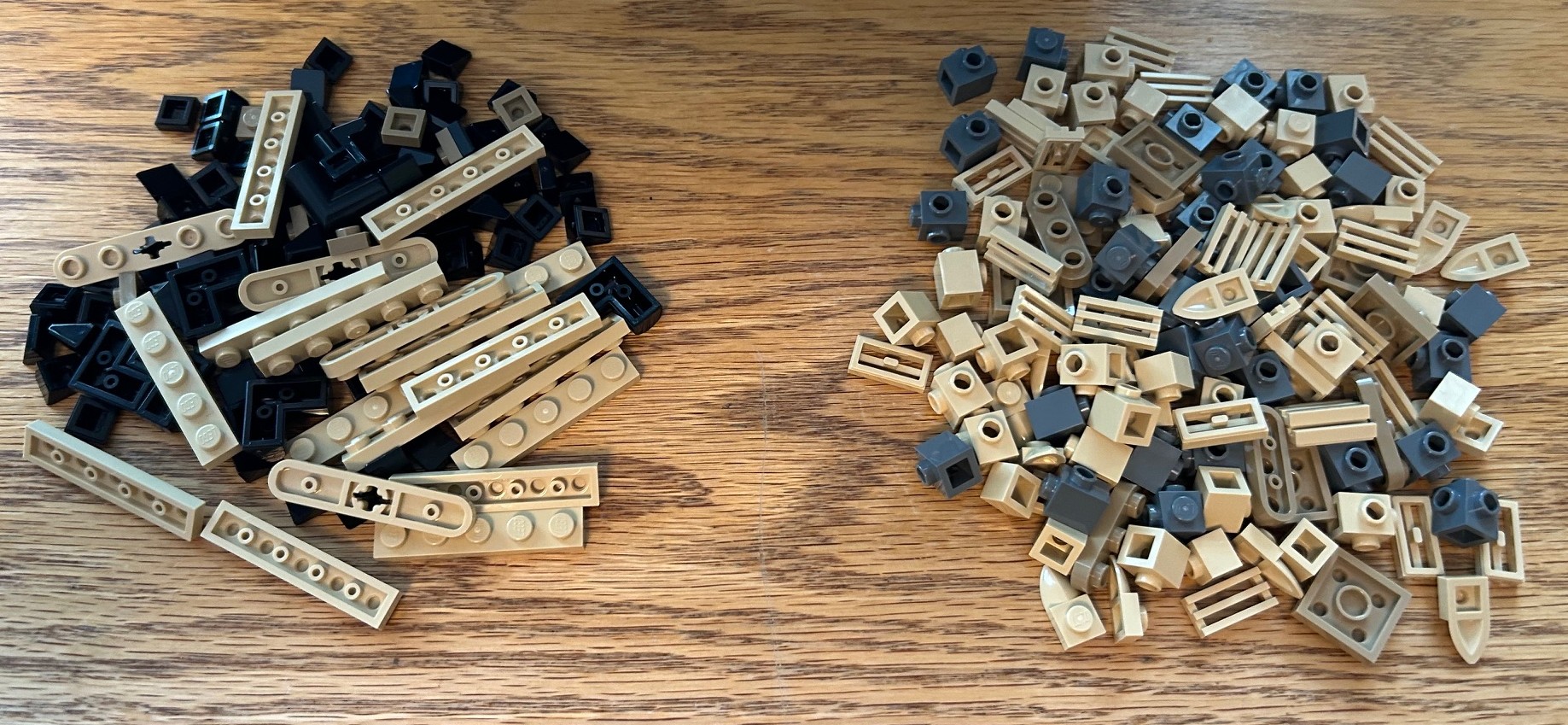
But that’s when I should’ve stepped on the brakes. The instruction manual told me to break open Bags 27 and 28 together and this is what stared up at me. If you think the pile on the right adds up to a lot of pieces, you are correct about both piles and you’re probably underestimating the number. These tiny, tiny pieces come together slowly to complete the uppermost cubes of the cathedral towers. One cube took 75 minutes. Why so long? 186 pieces each. No kidding – zoom in on the top of the completed tower below and you’ll get some sense of how intricate it is. Now you understand why we paused in the middle of the homily. I just didn’t have the energy to build up the other tower. Next week!

Since we’re close to the end of the build, let me admit to looking ahead in the process. The remaining six bags are small, and the pieces inside of them are minuscule. If I had visions of finishing off the cathedral in a flurry of construction, they’ve been dashed by the thought that I’m still a good five hundred pieces from the finish line. Sigh… this church service is getting a little long.
Running build time: 13 hrs. 0 min.
Total leftover pieces: 32
Some content sourced from the Smithsonian Magazine article, “Humanoid Robots Just Raced Alongside Human Runners…”, and Wikipedia, “the free encyclopedia”.




 Life In A Word