Hello, I’m Veronica
The sky is not completely dark at night. Were the sky absolutely dark, one would not be able to see the silhouette of an object against the sky.


-
Practice-Makes-Perfect Memories
Classical music has been one of my constant companions since childhood. Piano lessons initially mandated by my parents (but ultimately demanded by me) cemented a love for the timeless sonatas and symphonies of the master composers. I built up a stock of memorized pieces – my very own repertoire. I was “hooked on classics” at an early age.

In 1947, a children’s audio story was created for Capitol Records called “Sparky’s Magic Piano”. Sparky was a little boy who hated to practice the piano but benefited from an active imagination. One day Sparky’s piano starts talking to him, and declares if he simply runs his hands across the keyboard he will make beautiful music. Instantly Sparky is playing with the accomplished skills of a concert pianist, effortlessly churning out Rimsky-Korsakov’s “The Flight of the Bumblebee”, Beethoven’s “Moonlight Sonata”, and Mendelssohn’s “The Spinning Song”. Sparky’s piano teacher and parents want to show the world this wonder, so they book a series of concerts across the country. But in one of those performances, Sparky suddenly loses his abilities and can’t play a single note. He demands the music from his magic piano but nothing comes. He looks out to his waiting audience in horror… and wakes up from a dream.
Virtually the entire story of “Sparky’s Magic Piano” is in his imagination, but the moral-of-the-story ending has Sparky practicing with renewed focus and hopes of some day becoming a great pianist. Also, the story aged well, as I first heard it twenty-five years after it was created and still loved it.
“Sparky’s Magic Piano” resonates for several reasons. It inspired me with wonderful piano compositions at an age when I wanted to play outside instead of practice. My piano teacher helped me learn “The Spinning Song” and the first movement of the “Moonlight Sonata” (alas, the “Bumblebee” is reserved for only the most accomplished of pianists. Watch this performance as proof: http://www.wimp.com/fastgirl/ )
Also, whenever I hear the classical music from Sparky’s story I’m instantly transported back in time to my grandparents’ house. Besides the children’s stories and toys (enjoyed decades earlier by my own father), my grandparents owned a few audio stories. Their copy of “Sparky’s Magic Piano” was on “45’s”: those 7-inch records that contained a single song on each side. Sparky’s story required six or seven 45’s (both sides), which meant you had to flip or change the discs every 3-4 minutes to hear the entire story.
Thanks to Sparky I will always remember childhood time with my grandparents. I can picture myself sitting cross-legged on their floor in front of the living-room “hi-fi” (the size of a small refrigerator back then), listening to Sparky’s story with a focus broken only by the need to flip the discs. Fittingly, that living room also contained an old, out-of-tune, upright piano, which I was allowed to play every now and then.
Remarkably, “Sparky’s Magic Piano” is still available today. You can buy a copy for a couple dollars on Amazon Music or iTunes. Have a listen to a story that was created almost seventy years ago. Thanks to your iPod you won’t even have to get up to change the discs. And if you can endure the corny dialogue, you may find yourself captivated by the repertoire of wonderful piano music – truly “classical”.
-
gratuity
Last week as I was buying lottery tickets, it occurred to me that very few transactions require payment by cash these days. Perhaps you still buy your newspaper at the street corner box. Or you feed the parking meter with coins, even though most meters now take credit. Maybe you still throw coins into the bridge toll basket just because it’s fun.
My family and I were in New York City this past weekend and I was quickly reminded that cash is a necessity in the big city. Specifically, I’m talking about tips. “Tip” is a word that supposedly originated in the 17th century, and somewhere along the way it was more elegantly referred to as a gratuity. But sometimes I question how elegant the practice of tipping really is.

When my family and I arrived at our mid-town Manhattan hotel last Friday, I found myself tipping three people inside of fifteen minutes. The cabbie, the curbside bellman, and the valet (who helped us with our bags and refused to step aside until I “greased his palm”). In my book, a gratuity is a gesture of recognition for a job well done; a service that went above and beyond what you had in mind. Nowadays however, tipping has reduced itself to more of an expectation.
Case in point. That New York City cab ride was nothing more than a lift from Point A (airport) to Point B (hotel). The cabbie did not say a word the entire time, when in fact he could’ve joined in the family conversation or at least pointed out the city sights as we passed them. When we arrived at the hotel, the cab’s credit card machine allowed me the gratuity options of 20%, 25%, and 30% (nothing lower), and the cabbie actually complained about my choice of 20% for a large party. I suppose you could decline all of those options and hand over less cash instead (which is what the cabbie’s sour attitude deserved). Regardless I felt manipulated, as if the tip was mandatory instead of voluntary.
Americans would be surprised to learn that tipping is not a common practice outside of this country. Canada and a few locales in Europe promote the practice, but otherwise the world’s countries don’t expect tipping and in some cases discourage it. I find it interesting that tipping in the U.S. supposedly started in the Prohibition Era, when business owners reluctantly promoted tipping as a means of supplementing their employees’ wages at a time of lost revenue. But again, the spirit of tipping in those days was for recognition; not as an expectation.
When I was in sixth grade, gratuity showed up on the weekly list of spelling words. A few days after, a friend and I found ourselves at a local snack bar; the kind where you order at the counter and take your tray to a dining area. After finishing our food we realized we could be “cool” and use one of our spelling words. We left a $10 gratuity (virtually the same amount we spent on our snacks), then went to the corner of the dining area where we could watch the person who clears the trays. I remember that person looking around as if someone had forgotten their cash. I also remember the lecture from my friend’s mother a few hours later. That verbal smack-down – fully deserved – included something along the lines of not understanding the meaning of our spelling words, and clearly not understanding how long it took our fathers to earn $10. Whoops.
Here’s a little tip for you – ha. The next time you dine at a restaurant or have your hair done, or receive some other service that asks for a little recognition, ask yourself the following: Was the experience beyond expectation? Did the person go out of their way to make the meal or the service a little more meaningful? If yes, then the inevitable gratuity will be given in the spirit it was intended for all those years ago.
-
abeyance
Imagine what it’s like to get knocked out cold. You’re in the boxing ring, or you slip on the ice, or you faint, and WHAM! – you’re out for the count. You never see it coming. Your very next memory is waking up as if it never happened at all. To be fair, you can’t imagine what it’s like to get knocked out cold. Your brain doesn’t register the experience; or if it does, it stores the memory in a place you’ll never be able to access. It’s as if you’ve took a break from your conscious world. This temporary inactivity of the mind – a kind of suspended animation – is known as abeyance.

Recently I had a tooth extracted. Since I have a strong jaw my dentist suggested I should be fully knocked out instead of hitting the laughing gas. So there I went, from “counting backwards from ten” to waking up post-op, as if the hour the procedure required was a split second.
After a tooth extraction, the dentist talks to you to make sure you feel okay, and more importantly to give you instructions for self-care for the next several hours. And here’s where it gets interesting. In the time frame of those several hours your brain is awake but not fully awake. My wife was in the room when I received my self-care instructions, and she said I was coherent and having a perfectly normal conversation with the doctor. But one day later I had no knowledge of that conversation – and I never have since.
That little amnesia experience got me to thinking: what if I could capture the “half-awake” brain in writing? Wouldn’t it be interesting to see what I write about in my semi-comatose stage, knowing that after the fact I’ll have no recollection of writing a single word?
I completed this experiment last month, when I went back to the dentist to have a post inserted (for a future crown). It was the same drill as before (ha). I was knocked out and woke up an hour later with no memory of the surgery. But when I was at home later in the day to recover, I wrote a quick story before my brain fully restored itself. The following day, and now a month later, I have no memory of writing that story.
To conclude, I am sharing that story with you below. I’ve read it several times and have zero recollection of ever writing it. Isn’t that amazing? Don’t ask me for the hidden meaning because I don’t think there is any, and needless to say, the story is unfinished. But I do think it’s remarkable this story was created – and stored – in a part of my brain I’ll never have access to. Here then – my moment of abeyance.
Todd was a gentle man, who worked an apple farm near the west coast of Central Washington. Each morning he’d get up with the dawn, climb on his John Deere tractor, and plow the rows between the trees, keeping the orchard nice and neat. The trees produced a variety of apples: Macintosh, Gala, Red Delicious, Granny Smith, and so on. It was not the sort of orchard that required a lot of labor or equipment. A typical harvest yielded 100 bushels or so, which were largely sold to the small organic markets in the region. Todd’s apples boasted a quality product year-in and year-out over several years.
One harvest season, Todd discovered that many of his apples were bigger and heavier than in previous years. They even shone brighter with their reds, yellows, and greens. Thinking nothing of it, Todd continued the harvest as usual, bringing home the first day’s bushels to prepare for market. As was always his custom, Todd brought several samples of each variety into the house, to give them a closer inspection and taste. Again, as he looked at an especially ripe Macintosh, he noticed the brightness: an almost glittery look to the skin. The fruit was probably an inch or so larger in diameter than any he had seen from his trees in previous years. The bite was crisp and delicious, the flesh firm and consistent.
After a couple of bites, Todd took a sharp knife and cut the fruit to the core. Imagine his surprise when his knife hit a solid core; the consistency of a peach pit instead of small seeds. Carefully, Todd cut the apple into vertical slices, revealing a one-inch solid core in the middle of the fruit. This was most unusual, as an apple typically has a hardened fruit core with seeds distributed throughout.
Todd took the pit to the sink and washed it carefully under mildly hot water. The surface was the woody gnarled look you would expect from most fruits, but it was as if a peach pit had found its way into an apple. Looking closer, Todd saw small bits of light emanating from between the gnarls. Taking up the knife once again, Todd began to scrape the outer surface of the core. Suddenly the core divided neatly into four sections, and fell away easily, to reveal… the most beautiful diamond Todd had ever seen. It was egg-shaped, with countless pentagonal facets, and it shone so brightly it was almost a brilliant blue.
Holding it up to the light, Todd thought he could see yet another core within the diamond, but it was difficult to make out with the layers of faceted diamond on top of it. The diamond felt solid and heavy; almost 10 ounces by his amateur guess.
With no small amount of anticipation, Todd returned to the fruit basket, picked a Granny Smith, and carefully cut the fruit into several slices.. While he discovered the same “peach pit” core, this time the core revealed a spectacular center cut emerald. Again, the core of the emerald was darker than the surface, suggesting something different inside of it. Otherwise, Todd was looking at two large gems, apparently the product of two fruits from his orchard.
Just what had happened here? How does a fruit generate a gemstone at its core?
-
abstruse
You’re probably typing on your keyboard as you read this. But imagine you have a handwritten document sitting upright in front of you and you’re simply copying the words one keystroke at a time. Now imagine you have several keyboards at your disposal, each on top of the next like stair steps. Your hands move up and down the stairs, finding just the right key for each letter. Finally, imagine one more keyboard beneath your feet, which you occasionally depress like the gas pedal of a car. This my friends, is but a hint of what it takes to play a church organ. It’s a complex, hard-to-grasp skill requiring an absurd amount of focus. It’s abstruse.
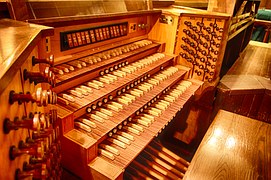
The Basilica of the Sacred Heart at the University of Notre Dame is scheduled to receive a brand new organ; the first note to be played during the Christmas holidays in December 2016. This is the fifth organ in the 165-year history of the Basilica and as you would expect, the most impressive. The instrument will boast four keyboards (five if you count the one beneath the feet) and almost 5,200 pipes. The pipe diameters are as small as a pencil and as large as a ship’s smokestack. Listen for the shrill tone of a tin whistle or the booming alert of a departing cruise liner – this organ can duplicate both. It can even duplicate the soprano, alto, tenor, baritone and bass sounds of the singing human voice.
An organ of this complexity and size – it will soar to almost four stories in height – is taking several years to construct. But most remarkably, it is being assembled in the modest workshop of Paul Fritts & Company, in the outskirts of Seattle, by a grand total of six craftsmen. The University chose this group because its founders were trained back through several generations, dating to those who built the most prominent cathedral organs in Western Europe.
Next spring Fritts & Company will host an open house in their workshop, to show off the nearly completed Notre Dame organ. Then next summer when the University’s campus is relatively quiet, the organ will be shipped from the West Coast to Northern Indiana to be assembled in time for that first performance a few months later. Can you imagine the responsibility of the drivers of those several flat-beds, trucking so many handmade components over the mountains and across the plains to their final destination? They should have a police escort to clear the highways.
When I was in middle school I took organ lessons for a brief time, learning on a modest instrument in the loft of the small chapel of our Methodist church. There were only two keyboards for the hands and a small keyboard for the feet. I found it overwhelming to play with hands and feet at the same time. To further complicate the skill – and this is true of most organs – there are a few milliseconds of delay between the time a key is pressed and the sound is issued (thanks to the mechanics of opening and closing the organ pipes). So you’re playing the music a moment before you actually hear it.
I did perform in public once. Every year our Methodist leaders would allow the church youth group to conduct the Sunday services – from the sermon to the bible readings to the music. Our organist “rigged” the sanctuary organ for me so it felt more like playing that small chapel organ. A little less abstruse, if you will. Regardless, that was the end of my career as an organist. Two hands on the single keyboard of a piano (with little else for the feet and brain to worry about) is more than enough for me.
-
copious
Ricky Gervais, the English comedian, once said, “the only reason I work out is to live longer so I can eat more cheese and drink more wine.” Maybe he was thinking about me when he came up with that one. I like a glass of wine, but my love of cheese borders on the unhealthy. Every time I pose for the camera and “say cheese!”, I’m salivating instead of smiling. I must be part mouse.

Cheese came into my life at an early age; probably true for most of us. A kid’s meal was a single slice of Kraft cheese sandwiched between two pieces of Wonder bread, mayonnaise or Miracle Whip for the glue. The cheese was technically “pasteurized processed cheese product” – infused with enough preservatives to sit in the frig for a decade and still taste the same. Like margarine. Or Twinkies.
By middle school I was making my own cheese sandwiches, with real cheddar cut straight from the brick. You could make the slices as thick as you wanted, and it was a great excuse to wield one of Mom’s biggest kitchen knives. One time though, the knife slipped from the cheese to the knuckle of my ring finger and the result was a small scar I still carry to this day. It’s like my little badge of courage, only for cheese.
When I discovered the wonders of grilled cheese, there was no turning back. We had this little cast-iron sandwich maker (the precursor to the panini press, I suppose) that would imprint a clam shell on the bread as it grilled the sandwich. Like I cared about an imprint, but it was a convenient excuse to crank out dozens of grilled cheese sandwiches.
Eventually I was adding Monterey Jack to my omelets, a spicy Mexican blend to my quesadillas, and handfuls of Mozzarella to my homemade pizzas. I was consuming copious amounts of queso. Cheese became its own level on my personal food pyramid.
Several years ago, in a particularly cruel twist of fate, I developed what I think was an allergy to cheese. Every time I ate a little Swiss or Ricotta my lips would puff up to the point where they didn’t look like lips anymore. Picture a blowfish minus the gills. No amount of antihistamines would bring me back to normal. It was like God waving a big white flag and saying “Dave, the (cheese) party is OVER!” Mercifully, the allergy went away and my cheese consumption returned to its previously unhealthy levels.
Trivia time-out: If you sample every variety of cheese ever made – one a day – it would take you more than five years to get through them all. Dang. My lips would explode.
My taste for cheese has become more refined in recent years. I actually sort through and sample all those little blocks you find at your supermarket deli. I’ll pair my cheeses with a nice wine for an overly elegant appetizer.
On a recent trip to Estonia, my wife and I visited a small dairy farm that specializes in cheese and yogurt production (our tour guide was appropriately nicknamed “cheese angel”). We bought an entire wheel of Gouda, just because I thought it was cool to have a “wheel” of anything. Shreds and slices, blocks and bricks; now entire wheels of cheese.
The U.S. is the world’s leader in cheese production, at more than 5,700,000 tons per year. You could pave a very long, very wide, yellow-bricked road to Oz with all that Provolone. I’d call us the “big cheese” of the world’s producers, wouldn’t you? Speaking of the U.S., Vermont has what may be the country’s only “cheese trail”. 40 dairy farms and cheese factories are networked on a back-country circuit of highways that covers most of the state. Many farms operate on an honor system, with free samples and help-yourself purchases. I need to go to Vermont. Tomorrow.
If I’m looking for an excuse to continue my copious consumption, they say cheddar, Mozzarella, and some varieties of Swiss and American help prevent tooth decay. But they also say without your gall bladder you’ll have a hard time digesting fats (like cheese). So I need to take care of that little guy. And there’s my reason to work out.


About Me
The sky is not completely dark at night. Were the sky absolutely dark, one would not be able to see the silhouette of an object against the sky.
Follow Me On
Subscribe To My Newsletter
Subscribe for new travel stories and exclusive content.

