It’s (Not) Just a House

Let’s agree to disagree today (one of my favorite catchphrases). You see things one way while I see them another. Perspective, angle, viewpoint – choose your word – we all come to our conclusions on different roads. Which is ironic, because four of us came to Frank Lloyd Wright’s Fallingwater on the same road three weeks ago.

I blogged about Fallingwater in Perfect Harmony a couple of years ago.  The post was meant to be a primer on what makes the house an iconic work of American architecture.  At the time I was also building LEGO’s version, which is as close as I thought I’d ever get to the real thing.  Today I can say I’ve checked an up close and personal visit off my bucket list.

Fair warning: there’s no convenient route to travel to Fallingwater, which shouldn’t surprise you about a house hidden in the forest.  You’ll drive ninety minutes southeast of Pittsburgh on two-lane roads, some in desperate need of repair. And watch carefully for the driveway entry; it kind of pops up out of nowhere.

You won’t get to see Fallingwater without booking a reservation beforehand.  Despite my dismay in last week’s post about required reservations in Rome they make a ton of sense with Fallingwater.  It’s a small house after all, so it’d be overwhelming if visitors just showed up and walked in.  We took the final tour on a Saturday and our guide said 600 others had already been through the house earlier in the day.

Fallingwater’s Visitors Center

Thanks to the resources of the Frank Lloyd Wright Conservancy (which is still buying up property around Fallingwater), the experience begins before you ever see the house itself.  The driveway wanders past a guard house to a modest parking lot.  From there you walk to a beautiful Visitors Center nestled in the trees.  A central outdoor seating area is surrounded by a small museum of Wright’s work, a cafe, and a gift shop that offers much more than shirts and postcards.  Frankly, the Visitors Center is a nice little work of architecture all by itself.

The walk to the house begins down a kind of woodsy nature trail, so you can see the rocks, trees, and other materials used to construct Fallingwater in their native forms.  What impressed me most about the tour is how you never see the house until you’re practically at its front door, making for a dramatic reveal.  Your walk descends through the canyon of Bear Run (the river over which Fallingwater is perched) until the house’s signature cantilevered forms emerge from the dense forest.

As I described it in Perfect Harmony, Fallingwater looks like it was “constructed entirely offsite and dropped gently within the forest by pushing aside a few tree branches”.  After seeing the house in person, I wouldn’t change a word of that statement.  The design is a marvel, not only in how the indoor/outdoor spaces integrate with their natural surroundings, but also in how it was built as if floating over the waterfall below.

Enough with the fawning over Fallingwater, am I right?  After the four of us took the tour we had a chance to process what we’d seen, and my wife’s and brother’s reactions were clear: it’s just a house.  It’s not even a nice house, with its low ceilings, dark spaces, and anything-but-cozy use of rock, concrete, and glass.  Fallingwater is hard to get to, and it’s in the middle of nowhere.  And with its hundredth birthday not far off, everything about the house has a decidedly dated feel.

I did my best to explain why I love Fallingwater.  My sister-in-law, who appreciates everything about the arts, understood the significance of the house.  She “got” what Frank Lloyd Wright was conveying in the design, and allowed the sacrifice of comfortable living for the sake of the indoor-outdoor interplay.  She probably took in the house the way she would a painting at the Louvre.  My wife and my brother, not so much.  For them the ninety minute tour was probably sixty minutes too long.

Fallingwater promotes the thought: “one person’s junk is another’s treasure”.  My treasure is architecture (so much so I studied it in college).  Yours is probably something entirely different.  It fascinates me how my brother spent years and years of research, consulting, and money to restore a 1960s vintage Ferrari in his back garage.  To me, cars get you from Point A to Point B; a mere convenience.  My brother could spend hours explaining why his Ferrari goes worlds beyond that statement.

Still lingering on my bucket list is a visit to Paris, where among the city’s many wonders stands the Eiffel Tower.  I want to see this engineering/architectural masterpiece from far and near, and of course, ascend it’s many levels to fully experience the structure itself.  For now however, I’ll have to settle for building LEGO’s version.  As with Fallingwater, we can all agree to disagree. The Eiffel is (not) just a tower.

Some content sourced from Wikipedia, “the free encyclopedia”.

For Whom the Road Tolls

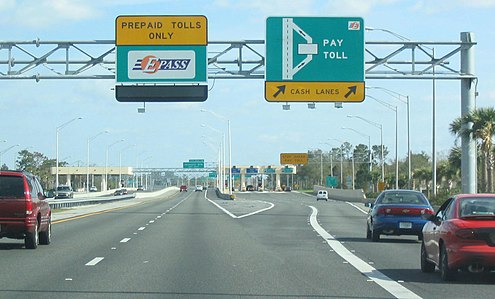
Because we raised our kids in Colorado, vacations to visit our extended families were often by airplane, since my relatives were in California and my wife’s were in Florida. It was the rare trip where we could see any of them by taking the car. So when my wife and I drove from South Carolina to Pennsylvania recently to visit my brother and his wife, we were reminded of what makes travel by car different than by plane. Toll roads, for instance.

Take your pick of payment

I have memories of toll roads my kids will never have. They’re old enough to remember passing through the booths and handing coins or bills to the collector. But they won’t remember the unmanned alternative, which was to toss exact change into a big plastic basket, listen to the coins process through the mechanics below, and hope/pray the gate to the toll road would raise. That automated approach seems almost quaint compared to today’s electronic alternatives.

I say alternatives (plural) because yes, that’s what we have with today’s toll roads. It confounds me. Why in heaven’s name haven’t we developed a painless, seamless, and most importantly, nationally coordinated approach to toll road payments? To some extent (nineteen states) we have a solution – E-ZPass, which by subscription and sticker allows convenient passage.  But even E-ZPass is not a perfect system.

Not so E-Z

For the rest of the country’s tolls – and for most of our round-trip drive between South Carolina and Pennsylvania – we have the clunky alternative. You pass through a now-unmanned (“un-personned?”) toll booth, where a camera grabs your license plate with a noticeable flash. Then, somewhere down the road (ha) a paper bill arrives in your mailbox. By my count I have four or five of these bills coming my way. It’s been ten days since we’ve returned home and I have yet to receive even one.

The cookie recipe is still on the back of the package

[Trivia detour:  Nestlé’s famous Toll House chocolate chip cookies aren’t named after toll booths but rather for an inn in Massachusetts where baker Ruth Wakefield came up with the recipe.  Wakefield and Nestlé struck a deal in the 1940s: her recipe printed on their bags in exchange for a lifetime supply of chocolate.  How very “Willy Wonka”, eh?]

Here is my unequivocally efficient approach to paying tolls across our many-highway’d nation. When you first get a driver’s license, you also sign up for a bank account-linked program which allows seamless paying of ALL tolls across the land – roads, bridges, tunnels, whatever – through a single readable sticker on your windshield. If you somehow don’t pay the tolls because of say, “insufficient funds”? Well sorry, your driver’s license doesn’t get renewed until you settle up at the DMV.

A $3 toll gets you through Baltimore’s Harbor Tunnel

My system is so logical it’s probably the reason I’ve never been pegged for a government job. In Colorado and elsewhere they almost have it right with the E-ZPass system – a sticker linked to a bank account. The problem is, they hold a minimum balance in a middleman (middle person?) account to guarantee payment of tolls.  I object, your honor. Why should Colorado have forty-odd dollars of my hard-earned money at all times when they can just settle up unpaid tolls whenever I renew my license?

Warning: cash-cow crossing

Then again, I have a beef with the tolls themselves, and that is, they pay for far more than the maintenance of the roads. You can’t tell me $10 per vehicle per crossing of the Golden Gate Bridge (GGB) is needed just to maintain the bridge. Here’s the jaw-dropping math for you.  112,000 cars cross the GGB every day.  That’s over forty million cars per year.  That puts the annual toll-taking at over four hundred million dollars.  $400M for bridge maintenance?  Sorry, fair traveler, you’re voluntarily lining the coffers of California (and San Francisco) every time you cross. “If I’m elected” (as we’ll hear countless times in the next two months), I’ll limit toll-taking to whatever it costs to maintain the bridge, road, or tunnel.  Not a dollar more.

On our return trip from Pennsylvania, I was amused to pass through one toll both with an actual human toll-taker. Those cordial people are still out there, collecting cash one car at a time. The woman in our instance happily returned us $19.25 on a $20.00 bill (and who’s happy to do that anymore?).

Time to bake cookies!

I was also amused… no, “gratified” is the better word; to pull into the parking lot of a South Carolina “rest area” shortly before we got home, for the use of a perfectly safe, clean, toll-free restroom on a toll-free highway. Maybe rest areas and their restrooms are the reason tolls cost more than the maintenance of the roads? Probably not. That would equate to a logical explanation for a government expenditure, which is an oxymoron.

Some content sourced from Wikipedia, “the free encyclopedia”.

Following the Leader

Technology birthed the self-guided tour. More and more often, an admission ticket to sights worth seeing grants you a pair of headphones and a wearable device instead of a name-tagged human to show-and-tell you the way.  Self-guided touring allows for a more convenient and less distracted experience.  But it also removes the storyteller, and that, my friends, makes all the difference between a memorable tour and a forgettable one.

Budapest, Hungary

Viking River Cruises, one of which we completed on the Danube River in early June (see Going With the Flow), provide a plethora of tour guide experiences.  On any given day of the cruise, you disembark to one or two “land-based” locales, in the (sometimes) capable hands of a personal tour guide.  Viking contracts with local agencies to provide these guides for small groups of its travelers.  For example, having a Hungarian show you the sights of downtown Budapest is so much more satisfying than hearing someone drone on about it on a headset.  Sharing a beer with a German on a tasting tour is almost like being invited into his house.

Nuremberg, Germany

If I ask you to share one of your own memories involving a tour guide, you’ll probably recall a particularly good one.  Maybe you’ll even remember a bad one.  Regardless, your stories would support my theory: a top-notch guide can make the what or the where of the tour almost irrelevant.  The guide himself or herself can make the difference between a memorable experience and a forgettable one.

Consider, I still remember a tour of a southern plantation with my family from almost fifty years ago.  Why?  Because the tour guide presented herself in a way that made me think we were being welcomed into her own house.  She also had this soft, syrupy unforgettable Southern accent that had me hanging on her every word.  Do I remember anything about the plantation?  No, but I sure remember the tour guide.

Szentendre, Hungary

So it was on the Viking cruise.  We had good guides and we had outstanding ones.  The very best of the dozen or so – ironically – was a young woman working on contract with Viking for the first time, as a stand-in for our scheduled guide in Munich.  She was, in every respect, delightful.  She started our tour with a greeting and a smile, then a little conversation and questions to break the ice.  As she led us from one sight to another, she spoke with an energy and pride in her city that can only be described as vivacious.  By the end of the tour, as the saying goes, she had us feeding out of her hand.  I was so enthralled I forgot to take a picture of her.

But we also had a lesser guide a few days earlier in Vienna, who I’d describe as a speed-walking encyclopedia.  He led us on a many-thousand-steps rush through the sights, filling our heads with facts and figure as he went, in a pretty thick Austrian accent.  He never smiled and I don’t think we ever stopped walking.  Can’t remember much about that tour (or him for that matter) because it was a rush-rush blurry overload of the senses.  I need to go back to Vienna again someday so I can (literally) stop and smell their famous roses.

Vienna, Austra

Courtesy of Viking and those many tours near the Danube, I present to you, therefore, the attributes of the consummate tour guide:

  1. A local, familiar with the city or sight at hand through regular exposure.
  2. A personality; warm, friendly, energetic, and engaging.
  3. An overflowing font of knowledge on his/her subject, able to answer just about any question thrown their way.
  4. A storyteller, able to weave anecdotes at will into the facts and figures to keep it interesting.
  5. In tune with his/her audience, making adjustments to the tour as necessary (ex. “Am I going too fast for you?”)

If you take enough sightseeing tours, you’ll know whether your guide is missing one or more of the above within the first five minutes.  You’ll also know whether the next hour or two will fly by or drag on for all eternity.  If your guide checks all five boxes, consider yourself lucky.  Most of us aren’t cut out for the job (myself included), whether we like to think we are or not.  It takes a special set of skills to be the leader everybody wants to follow.

Dave meets “Evy”

Renting a car at the airport used to be so hassle-free. You’d book the vehicle online, walk or bus to the parking lot, and bypass the counter by signing up for the company’s free membership program. All of that still happens, so what’s the difference today? You never know what vehicle you’re going to get, even if you choose the make/model ahead of time. And if you’ve never driven an electric vehicle (“Evy”) before, renting one is a real adventure.

Blame it on my laptop keyboard.  As I pecked my way through a recent Avis reservation, I inadvertently chose “Mystery Car” instead of “full-size sedan”.  Mystery car?  What the heck does that mean?  It means more flexibility for the rental car agency.  “Mystery car” means Avis gives you whatever it feels like giving you from its leftover inventory.  Maybe you get what you wanted.  Maybe you get a luxury vehicle for even less.  Or maybe you get Evy like I did.

I admit, I am not with the times of the latest vehicle technology.  I couldn’t tell you the first thing about operating Evy, let alone how she works under the hood.  So there I stood in the Avis parking lot, faced with the prospect of my first miles behind her wheel.  The rental companies should put a beginner’s guide on the driver’s seat for people like me.  I mean, imagine my hesitation (panic?) when I pushed Evy’s start button and nothing happened?  Something happened, of course.  The engine “started”; it just didn’t make any noise.  Yep, this was going to be a different kind of ride.

My first issue with Evy (or at least, the Genesis I rented) is the inexplicable need to make the dashboard wildly different than a conventional vehicle.  You don’t find the basic needs (ex. headlights, windshield wipers) where you expect to.  I actually considered talking to the vehicle instead of pushing random buttons, especially after my seat suddenly firmed up and vibrated when my I let my posture slip a little (“driver safety feature!”)  Seriously, all I’m asking for is dashboard buttons and levers where I expect them to be.

Once I found a modicum of comfort with Evy, the real challenge dawned on me: I have to recharge her before I go back to the airport.  And this, my friends, proved to be a challenge worthy of reality TV.  Those who already know Evy are welcome to say, “Oh c’mon Dave, it’s not that hard!” but truth be told, my charging station experience was just as daunting as the first time I pulled up to a gas pump as a teenager.

Credit Genesis, you can look up the nearest charging station right there on the dashboard.  The search gave me a choice of three.  The first station was in an Urgent Care clinic parking lot… and wasn’t working.  I’ve read that 15% of EV charging stations don’t work so now I’m a believer (EV Charging Flaw #1).

The next charging station option was in a McDonald’s parking lot.  When I arrived, both slots were occupied (EV Charging Flaw #2 – not enough to go around).  I have no problem waiting in line at gas stations but charging Evy takes a lot longer.  So I chose to drive another mile to the third option, a charger in a bank parking lot.  Nope.  No station to be found from one end of the lot to the other.  Genesis needs to update its locator software.

So back to McDonald’s I steamed went (and not for a Happy Meal, mind you).  The charging stations were still occupied, which begs the question, where do you form a line?  If I parked behind either car I’d be blocking their exit.  I’d also be blocking the McDonald’s drive-thru lane.  The only option was the parking space adjacent to the charging stations, with hopes of quickly maneuvering into an available charger before the next person pulls up (EV Charging Flaw #3).

This story only gets worse from here, so let’s keep it brief.  Once a station was finally available, I pulled in only to realize I had to face the car the other way for the charging cable to reach (EV Charging Flaw #4).  Then I tapped my credit card on the charger, only to find you have to download an app to make the station work; no cash or credit accepted (EV Charging Flaw #5).

Fifteen minutes later (because that’s what it takes when you only have one bar of wireless service – grrrrr) I got the app installed, the charging cable connected without electrocution (in pouring rain), and ta-dah… NOTHING!  Nada!  Zilch!  No “PRESS HERE TO CHARGE” or some other obvious way to get things started.  Instead, by the good graces of my EV-knowledgeable brother over the phone, I learned I had to zoom in on the tiny app map, identify the McDonald’s location of my charging station, and tap it (EV Charging Flaw #6).  Suddenly Evy’s gods smiled down on me through the thunderstorm and declared “Charge”.

To say I was giddy to make it back to the airport a day later without a dead Evy is an understatement.  To say I was the target of a sick joke when my very next Avis rental – same day, different airport – was a hybrid is undeniable.  But hey, at least a hybrid gives you the option of gasoline, so you get to fuel up the “old-fashioned way”.  Which brings me, humbly, to declare Dave Flaw #1:  Get to know Evy very, very well before your life – or at least your transportation – depends on her.

Going for a Spin, Spin, Spin

My wife and I enjoy popcorn after dinner, probably because we’re watching more movies at home these days. It’s easy prep thanks to our Presto air popper. Dump in the kernels, plug in the popper, and “presto”; a delicious snack in an instant.  Of course, one of these days our air popper will break and we’ll have to buy another one. Unlike our KitchenAid stand mixer, which will spin,spin,spin until the end of time.

KitchenAid’s classic stand mixer

If your kitchen is like ours, the cupboards are full of appliances that only make an occasional appearance.  Our Breville panini press hasn’t made a “melt” in months.  Our Marcato pasta maker last saw action in the early 2000s.  And our George Foreman grill is retired for good, because it’s just as easy to fire up the barbecue.  But our KitchenAid stand mixer spins to our “Aid” time and again, always ready to make bread dough, cake batter, or cookies.

Stand mixers date to the early 1900s.  KitchenAid’s version came along in the 1930s, and it wouldn’t surprise me to learn some of the original models are still spinning almost a hundred years later.  The appliance is just that good.  The KitchenAid was designed to be as simple, efficient, and robust as possible, and with only one task in mind: to spin ingredients in dizzying circles until they’re thoroughly mixed.  Sure, you can add dozens of specialized attachments but none change what the stand mixer does at its core.  Spin, spin, spin.

with slicer/shredder attachment

When I make a batch of cookies, I stand back in wonder as our KitchenAid does its thing.  As I add the ingredients, the paddle blade works harder and harder to blend them together.  By the time I get to the last of a dozen ingredients; say, chocolate chips, the mixer is practically bouncing across the counter as it struggles to plow through the dough.  You’d expect the mixer to break down at any second in an explosion of flying gears and sizzling smoke.  But it never does.

I know a lot of people who own a KitchenAid stand mixer, and I’ve never heard of one that stopped working.  Even if it did break, the appliance is designed for easy repair.  The parts can be swapped out individually and quickly, eliminating the need for a repair person or a new mixer.  It reminds me of the old Maytag washers, and how their repairman was described as “the loneliest guy in town”.

Like most appliances, Maytags aren’t what they used to be.  We yearn for the models from the 1980s or earlier, which could wash anything and never break down.  Today’s Maytags are a shadow of their former selves.  They don’t do as good of a job, and every five years you’re thinking about replacing them.  Not so the KitchenAid stand mixer.  I have no doubt ours will be a part of our kids’ inheritance someday.

Speaking of kids, our daughter has her own KitchenAid and it sits proudly on her kitchen counter.  Counter space in the kitchen is precious so only a few appliances deserve to be full-time residents.  A coffeemaker.  Some sort of toaster oven.  And a KitchenAid stand mixer, which somehow manages to look appliance-elegant with its curves and swoops.

Color “ice”, with copper bowl

“Mixmasters” (a popular nickname for the KitchenAid) aren’t cheap.  Most models run about $300 USD for the basic setup.  Consider though, it’s the only stand mixer you’re ever going to need.  KitchenAid even admitted they expanded their color selection and limited-edition models in an effort to generate more repeat customers.  (This year – and only this year – you can buy one in “iridescent periwinkle blue”.)

Our Colorado kitchen had a very cool below-counter cabinet, designed specifically for a heavy stand mixer.  You opened the door, pulled a shelf handle, and your Mixmaster rose effortlessly out of the cabinet on special hinges, snapping into place at counter level.  An appliance has to be awfully special to justify a custom cabinet.  Or a spot in the Smithsonian Museum, where the KitchenAid stands as a part of the Julia Child exhibit.

Right there on Julia’s countertop

I don’t need to go to the Smithsonian to see a stand mixer (nor do you).  I have my KitchenAid right here in the kitchen cabinet.  I can put down the laptop and whip up a batch of cookies anytime I want.  Like, right now.  Time for my Mixmaster to spin, spin, spin again, just like it’s done a thousand times before.

Some content sourced from The Atlantic article, “KitchenAid Did it Right 87 Years Ago”, and Wikipedia, “the free encyclopedia”.

Feeling Better by Phone

My wife is recovering from a nasty eye infection, one where I’ve lost count of the visits we’ve made to the doctor and the pharmacy. She’s taking prescription eye drops and a strong antibiotic, and covers her eyes with hot compresses instead of her usual contact lenses. We’re hoping today’s appointment is the end of this ordeal. Odds are however, all of our scurrying around won’t be necessary in a year or two. Instead, my wife will simply seek relief from a digital prescription.

You knew it was coming.  The FDA approved the first smartphone app designed to address a diagnosed medical condition, and it’ll be ready for download in just a few months. Rejoyn (don’t ask me where they come up with these names) is a digital prescription designed to combat depression.  The patient’s six weeks of self-administered tapping and typing trains their brain back to a healthier state.  Or at least, that’s what’s supposed to happen.

My first thought here was, an app used to address a diagnosed medical condition sounds kind of silly, like playing Tetris or something.  But then I realized a prescription of Rejoyn would be one less dose of drugs.  Pills removed from the equation is a good thing.  But then I read how the results of a Rejoyn beta group were no more successful than those of a group prescribed a sham app.  Finally, Rejoyn only works in conjunction with a regimen of traditional medication.

You can see why I’m struggling with the concept.  I mean, you still have to take the meds you were already taking and there’s no guarantee the app will improve your condition.  So why invest the time and money in your phone?  According to an authority from the Division of Digital Psychiatry (which couldn’t have existed even ten years ago), “If the benefits are minimal but the risks are [also] minimal, perhaps there’s no harm in trying it.”  Does that strike you as a glowing endorsement of the technology?

Rejoyn is the beginning of a wholly different approach to healing.  One of these days you’ll find yourself at the pharmacy looking to fill a prescription, and instead of a receiving a bottle of pills you’ll hand over your phone for a download.  Then you’ll go home to your couch and – doctor’s orders – spend more time on your phone than you already were.  Oh, the irony.  Experts say spending too much time on your phone causes depression.  Now, the cure for that depression will be to spend more time on your phone.

A digital prescription gives a whole new meaning to “overdose”.  What happens if you indulge in twelve weeks of screen time instead of six?  What if you get so addicted to your electronic cure you can’t pull your eyes and fingers away from the screen?  Will the app timeout after so many uses, forcing you to plead with the pharmacy to “renew your subscription”?

Don’t overdo it!

Then there are the side effects.  Headaches, loss of sleep, loss of appetite; maybe the same ones you’d experience if you took a pill instead.  Maybe the same ones you experience from any use of your phone.  And what about your email, social media, and games.  Will they be neglected because of all the time you spend on Rejoyn?

Electronic medication is a novel concept, I admit.  It’s like having an IV drip of something that makes you feel great, only it’s “wireless” and you don’t need the nurse to give you a dose.  You have a little doctor right there in the palm of your hand.  But is that little doctor really going to make you feel better?

There is one indisputable positive to a digital prescription.  If you fill your meds at a grocery store pharmacy you’re going to save money.  After all, those fifteen minutes while you wait for the pills to be bottled are spent wandering up and down the food aisles.  A digital prescription can be downloaded instantly.  Now you’ll no longer buy the impromptu groceries you never needed in the first place.

Some content sourced from the CNN Health article, “FDA clears first digital treatment for depression…”

Curtains for the Big Show?

My daughter and her husband went on a date the other night. They dropped their little one at our place because they wanted an evening to themselves. “A date” meant going right back to their own house and getting a few projects done without the distraction of an active one-year old. Really?  That’s a date?  I figured they’d do something like go to the movies. After all, the theater’s only five minutes from their front door.

Our one-and-only movie theater

The same theater’s only twenty minutes from our front door.  It’s the only show in (our small) town but it still carries the first-run films.  So now I’m asking myself, why haven’t we been to the theater either?  I mean, we’ve lived here almost two years yet we’ve never even been tempted.  Does our own dating routine need a little recharge?

“Stadium seating”

The truth is, like most who don’t go to the movies much anymore, the COVID years played a big part in our change of behavior.  Before then we were regular patrons, drawn to the promise of a well-reviewed blockbuster or sappy rom-com.  No matter the size of our TV or the quality of our sound at home, it couldn’t hold a candle to the big-screen experience.  Plush seats, popcorn, and larger-than-life images were the way to go.

But movie theaters struggle now.  We’re already two years past the last U.S. state mask mandate (time flies), yet theaters haven’t been able to bring back audiences in numbers comparable to the years before COVID.  The only movie to get my wife and I up off our couch and into the theater was Top Gun: Maverick, which seems forever ago now.  Much as I’d like to blame the pandemic for our recent lack of attendance, other forces are at work here:

Can’t we go back to this version?

1) Streaming.  Just as we all hunkered down in 2020 to wait out COVID, on-line entertainment options went full-stream ahead.  My wife and I cautiously subscribed to something called Netflix back then (knowing we could cancel at any time), and in no time we became the very definition of “binge”.  Today we plunk down money for several streaming services, which come and go according to what we choose to watch.  In other words, “network television” isn’t the only option to the big screen anymore.

2) The cost.  A few weeks ago, my wife and I binged the twelve-episode first season of a Hallmark Channel series, for $10.79.  Season 2 cost us $25.37 for the same number of episodes.  Season 3?  $26.99.  Sneaky streamers, huh?  They get you hooked on the first season, then charge big-time for the rest.  But here’s the thing.  Those thirty-six hours of television cost us less than two dollars an hour.  A movie in the theater runs four to five times that much.

3) The annoyances.  Before online tickets, you could show up at the box office and be reasonably assured of getting a seat, for the face value of the ticket.  Now – for the popular movies at least – a “walk-in” is virtually impossible. You’re going to pay fees, whether for the online service itself, the movie’s time of day, or the theater’s better seats.  Once you’re in your seat the annoyances bloom, whether the advertisements before the movie, the cell phone going off in the next row, or the couple behind you who simply can’t stop talking throughout the show.

4) The product.  IMHO of course, the movies being made today simply aren’t what they used to be.  Those mainstream blockbusters and adorable rom-coms of yesteryear have given way to so-so remakes, Marvel characters, and independent films that rarely appeal to the masses.  Sure, I could (and probably should) expand my horizons to other film genres, but first you’re gonna have to address items 1), 2), and 3) above.

Will the show go on?

The summer blockbusters begin Memorial Day weekend but they’ve taken a hit this year because of last fall’s writers/actors strike.  Movie theaters may be a little – ahem – breezy as a result.  They’ll aim to draw in more patrons with re-releases of films gone by, mini film festivals, and sales of film-related merchandise instead (themed popcorn tub, anybody?)

The sustainability of the movie theater is in question, the same as the drive-in that died before it.  Will the product and price attract enough patrons to keep the experience viable?  Will a trip to the movies morph into a wholly different kind of experience (like dinner, drinks, and a movie, or a stop at the in-house video game arcade first?)  And will the concept of a movie-house subscription ever be more attractive than simply buying a ticket?

All good questions there.  Whatever happens, I hope the curtains don’t close on the big screen for good.  When a film is worth watching, alongside an audience willing to behave, it’s a great date night.  Without the movies, my wife and I might be forced to complete a few more projects around the house.

Some content sourced from the CNN Entertainment article, “Movie theaters are getting creative to appeal to audiences”.

Teeny-Weeny Towns

My daughter forwarded a video about a suburb of Knoxville known as Safety City. In this little town you’ll find roads and traffic signals, businesses and shops, but no cars. Sidewalks are for pedestrians while streets are reserved for bicyclists and other “non-motorized vehicles”. Everything in “SC” is an easy walk, whether to the post office, football stadium, movie theater, or dinner at Applebee’s. Oh, and I almost forgot to mention… everything in Safety City is miniature.

Safety City in Knoxville

Safety City is a novel concept because it reduces the real-life aspects of a town down to a dimension children can relate to.  And relate they do.  Entire classes bus over to Safety City to experience vehicular, pedestrian, bicycle, and fire safety at a young age.  So much more effective than traffic school on a blackboard!

I’ve always been a fan of miniatures; a feeling hearkening back to my childhood.  Anyone who read Gulliver’s Travels knows “miniature”, as in the inhabitants of the (literally) small town of Lilliput.  Anyone who ever held a snow globe imagined those little places and figures inside the glass coming to life.

Diorama

I wonder if grade-school children still make dioramas.  What a cool concept for a kid.  Within the confines of a shoebox you create a miniature world of your liking: buildings, people, animals, trees, etc.  Then you cut a peephole in the center of one end of the box and cover the open top with tissue paper.  When you look through the hole you see your little diorama world, with the light filtering through from above.  It gives your creation a startling sense of reality.

“HO”-scale model railroad

Model trains certainly fueled my interest in miniatures.  I remember several friends who collected the popular “HO”-scale sets (1:87, or about 2″-high trains).  They could buy so many accessories (endless tracks, buildings, trees, and figures) they could create an HO-scale world big enough to fill a two-car garage.  Go figure, the only train set I ever owned was the “G”-scale, where the train’s a good 8″-10″ in height.  Not so miniature.

Speaking of model trains, one of my favorite episodes of the old television series The Twilight Zone was called “Stopover in a Quiet Town”.  A couple wakes up in a strange house after a night of partying, can’t get the phone or the lights to work, and find the refrigerator stocked with plastic food.  They walk outside, only to discover the surrounding town is utterly still – no people, no sounds, no movement.  Then the train whistles and pulls into the station, so they hop aboard, hoping to be taken back to somewhere familiar.  But the train merely travels in a wide oval and returns to the same station where it picked them up.  As the couple steps off the train, the giant hand of a child reaches down to grab them, while a mother’s voice can be heard saying, “Be careful with your pets, dear…”  Twilight Zone indeed.

Replicas of miniature cities can be found everywhere, whether Knoxville’s Safety City, Disneyland’s Storybook Land (viewed from canal boats), or Legoland’s Billund Resort, Denmark’s largest tourist attraction outside of Copenhagen.  There’s even a “top ten” of the world’s miniature cities, including “Miniaturk”, 122 famous buildings of Turkey in a park-like setting in Istanbul; “Tobu World Square” in Japan, which showcases the world’s UNESCO world heritage sites in the presence of 140,000 miniature people, and The Museum of Roman Civilization (which I’ve seen myself), a remarkable recreation of ancient Rome’s “Golden Age” thirty-six years in the making.

Legoland

Maybe all this talk of miniatures has you thinking of the recent trend of tiny homes.  Those are an entirely different concept; not at all “miniature”.  A tiny home is like a full-scale house with most of the air sucked out of it.  The components are still full-scale but the spaces are decidedly smaller than normal.  Tiny homes kind of look like shoeboxes to me.  Maybe we should add peepholes on the ends so we can watch the inhabitants try to make a living in their cramped quarters.

Some content sourced from Wikipedia, “the free encyclopedia”.

Game, Set, Matches

The LEGO Eiffel Tower is the tallest of its model kits and undoubtedly the largest of its Architecture Series. At a deliberate count of 10,001 pieces, this behemoth is a whole lot more detailed than LEGO’s 2014 original, which clocked in at a mere 321 pieces. So imagine my awe (okay, and shock) when I learned about another Eiffel Tower model; one with a staggering 700,000 pieces. Suddenly 10,000 seems like a nice, reasonable number.

Matchstick model

It’s true, of course.  A Frenchman recently converted 700,000 matches into a model of the Eiffel Tower, in an attempt to break the world record for, naturally, “tallest matchstick Eiffel Tower”. (Is there a world record for everything these days?)  I suppose I can get past the 700,000 matches – even if I can’t picture that many in one model – but what I can’t fathom is the eight years Richard Plaud sacrificed to build his creation. I’m picturing Monsieur Plaud waking up each morning, bidding adieu to his wife after a croissant and some French press coffee, and heading off to his studio to play with matches, a giant bottle of glue in hand.  Day after day after day.

Our Frenchman’s accomplishment wouldn’t be so interesting if there weren’t a little drama thrown in for spice.  Turns out his 23.6-foot model may not earn the world record after all.  Why?  Because Plaud cut the heads off the matchsticks as he built.  When he got tired of cutting, he contacted a French “matchmaker” (ha) and asked if he could place a massive order of headless matches.  And there’s the rub, fellow model builders.  Guinness is disputing Plaud’s claim of the world record because the materials used can’t be purchased by you or me, should we try to build our own matchstick Eiffel Tower (but would we?)

Meanwhile, a 21.6-foot Eiffel Tower model built by Toufic Daher (coolest name ever) retains the world record.  Daher’s model was completed in 2009 using six million (headed) matches.  I have no idea how long it took him to build, but seriously, how long does it take to simply pick up six million little sticks, let alone shape and glue them into a replica of the Eiffel Tower?

“La Dame de fer”

Gustave Eiffel (another cool name) surely had no idea people like Plaud and Daher would be obsessed with his tower 135 years after the fact, in pursuit of world records.  Frankly (“France-ly?”) Eiffel’s “Iron Lady” is impressive enough to stand on her own wrought-iron feet.  After all, she’s among the most recognizable structures in the world.  She surpassed the Washington Monument when she opened to the public in 1889, as “tallest human-made structure” (sadly, seventy years before Guinness started tallying world records). Today she still merits an entry in the world record book, albeit for a different reason:”Most Visited Monument with an Entrance Fee”.

There’s a touch of iron-y to this post.  As much as I’m making blog fodder of these Eiffel Tower model builders, I’m tempted to become one myself.  Not with headless matchsticks; the LEGO version.  Several years ago I completed the LEGO U.S. Capitol Building (1,032 pieces), followed by the LEGO Grand Piano (3,662 pieces), and more recently, LEGO Fallingwater (811 pieces).  I keep an eye on the LEGO catalog for other models of interest but not one calls to me… except La Dam de fer.  But then I pause to ask myself, am I really willing to dive into a project that’s effectively one hundred bags of one hundred pieces each, where ever single piece dark grey?  Stay tuned.

LEGO’s version

As for our French ami Richard Plaud, his eight years of pick-up sticks may not have been in vain after all.  Guinness admits they might’ve been a little quick to dismiss his claim.  In their words, they wanted to make sure “the playing field is level for everyone”.  Playing field?  Ah, so this Eiffel Tower model-building is a game, is it?  For Plaud at least, I’d call it game, set, matches.

Some content sourced from the USA Today article, “8 years down the drain?…”, and Wikipedia, “the free encyclopedia”.

Poor Little Ginny

Next Tuesday, if I could drag myself out of bed before dawn, I’d see the planet Venus hole-punched into the inky sky, low and bright. If I looked further I’d probably see Mars – dim but distinctly red. And if I really did see Mars I’d be sad, because I know Ginny’s up there, all alone, waiting for someone to bring her home. I’m sorry, Ginny… I’m so sorry.  Nobody’s coming for you, not for a long, long time. Rest your rotors in peace, little helicopter.

“Ginny”

Ginny (known more formally as Ingenuity) is a brave little helicopter.  She may look like a nasty bug instead of something you’d want to cuddle with, but she’s quietly been filling up the record books with her remarkable achievements.  Four years ago Ginny hitched a ride to Mars on the belly of NASA rover “Perseverance”.  A few months after Percy plunked down on Mars, Ginny took her “first steps”.  She spun her rotor blade into a blur, rose ten feet above the Martian soil, took a quick look around, and dropped right back to where she started.  That brief maneuver earned her the title: “first powered, controlled, extraterrestrial flight by any aircraft”.

[Note: You can read about Ginny’s first flight in the post Whirlybird Wonder]

Ginny may not be easy on the eyes but I’m in awe of what she accomplished in her brief time on Earth (er, Mars).  I should’ve paid better attention in science class.  Imagine the teacher saying, “Okay Dave, here’s your assignment.  I need you to design a mini-copter that can travel to Mars, perform a few lighter-than-air maneuvers, and be able to take a few photos at the same time.  You’ll be at the controls back here on earth, so whatever communication mechanism you come up with needs to work over, uh, 140 million miles.” Cue my blank stare.

The smarter-than-I-am people at California’s Jet Propulsion Labs (JPL) designed little Ginny to do all those things.  What makes her ten-foot hop on Mars so remarkable is this: the atmosphere up there is less than 1% as dense as Earth’s, so there very little to hold Ginny aloft.  To put it another way, earthly helicopters can only fly to 25,000 feet.  Ginny had to be designed to fly to 80,000.

Let’s call her “The Little Copter That Could”, shall we?  Ginny was supposed to fly five times in thirty days.  Five little hops in a month’s time and her mission would’ve been considered an unqualified success.  But Ginny chose to be an explorer instead of an experiment.  She flew seventy-two individual missions, further and longer each time than her JPL designers ever expected.  She also captured images as she flew, so scientists could better decide where on Mars they wanted big-brother Percy to rove.

Ginny’s a good photographer!

Ginny was more “alive” than any helicopter I’ve ever known.  She cleaned herself up after nasty Martian dust storms.  Her solar panels froze unexpectedly during the rough winters, rendering her unable to fly or even take commands, yet she still radioed “wellness reports” to Percy so the JPL people would know she was (barely) there.  She made three emergency landings when her sensors detected trouble.  And even when one of those sensors went dead, Ginny kept her rotors a-whirling on demand.

Ginny captured the shadow of her “broken wing”

Whatever happened on Ginny’s Flight #72 two weeks ago remains a mystery, one Percy hopes to figure out as he rovers back to her location.  Ginny had been close to another landing when she suddenly stopped communicating.  A day later the JPL team reestablished the connection to find Ginny resting comfortably on the Martian soil.  Somehow she’d still landed on her feet.  Somehow however, she also damaged a rotor blade.  Ginny can’t repair herself so alas, her flying days are over.  Now her waiting days begin.

Admirers like me refer to Ginny as “that little extraterrestrial trailblazer”.  Haters call the dormant helicopter “the first piece of trash on Mars”.  As long as Percy’s in her neighborhood, Ginny will keep sending her little wellness reports (even though she’s really not so well).  I just hope the scientists at JPL are already hard at work on their next mission to Mars.  A brave little copter is waiting to be rescued and brought home to the Smithsonian.

Some content sourced from the CNN article, “After damaging a rotor blade, NASA’s Ingenuity helicopter mission ends on Mars”, and Wikipedia, “the free encyclopedia”.