Precisely Enchanting

If you watched any of the Winter Olympics the past couple weeks, you witnessed dramatic moments only the Games can deliver.  Some literally took my breath away: the edge-of-your-seat overtime shootout in the women’s hockey final (a 3-2 win by the Americans); the exquisite battle for gold between the highly-touted Russians in women’s figure-skating; and the first-ever victory for the U.S. in the team sprint of women’s cross-country skiing, where Jessie Diggins’ come-from-behind lunge at the finish line took the gold by 0.18 of a second.


Consider “0.18 of a second” (for a second).  The blink of an eye takes twice as long.  Now consider measuring 0.18 of a second.  Remarkably, we’ve had the technology to do so since the 1950’s.  For the Olympics, that precision was provided by Omega, the watch manufacturer from Switzerland.  Of course the timekeepers were Swiss.  What other country is so renowned for the keeping of time?  What other country coordinates forty-six individual railway companies on a single network of tracks, bringing its trains into the stations on-time every time?  Where else in the world would you feel more confident banking your cash?  Six years ago, Omega developed technology capable of measuring one-millionth of a second.  At the Pyeongchang Olympics they used a photo-finish camera capable of ten thousand snaps per-second.  The Swiss redefine “attention to detail”.

I’ve had an affection for Switzerland from a very young age.  As a kid, my introduction took place in subtle ways.  Shirley Temple’s “Heidi” was based in Switzerland. The Switzer brand of red/black licorice (still available in “vintage” candy stores) was a frequent purchase.  The cute little Swiss Miss in our pantry beckoned me to hot chocolate.  As a Boy Scout, I always carried one of the Victornox Swiss army knives.  At Disneyland I roller-coasted through a scaled-down replica of the Matterhorn – one of the Alps.  I had my first taste of fondue.  And for a Suisse exclamation point, I consumed a ton of that “holiest” of cheeses.  My ancestry test should’ve produced a little Swiss DNA, don’t you think?

As an adult, Switzerland’s products are no less present in my life.  Lindt is my favorite chocolate (and I’ve tried my fair share of chocolate). A Rolex watch is still the material equivalent of corporate-America success (though my tastes are more modest – perhaps a Swatch [Swiss-watch]?)  Velcro can be found on several items in my wardrobe.  Haagen Daz is my favorite brand of ice cream (a product of the Swiss company Nestlé).  And a lengthy search for “adult” Swiss licorice led me to Chateau D’Lanz, a family-run business in Washington state producing some of the best.

Speaking of Nestlé, the Toll House chocolate-chip cookie recipe is also one of my favorites. Here’s a bit of trivia: Toll House was an inn in Whitman, Massachusetts.  Ruth Graves Wakefield is credited with inventing the chocolate chip cookie (by mistake) somewhere nearby the Toll House.  The price Nestlé paid for the right to Ruth’s recipe? A lifetime supply of Swiss chocolate.

Now speaking of Velcro, here’s another bit of trivia.  George de Mestral was a Swiss engineer and amateur mountaineer from the 1940’s. Hiking in the Alps one day, George noticed seeds kept sticking to his clothes and to his dog’s fur. When he returned home, George developed a synthetic “sticking” technology like what he’d found in nature; a hook-and-loop zipper alternative eventually patented as Velcro. The clever name is a child of the French parents velours (velvet) and crochet (hook).

Okay, we’ve covered Swiss precision and some world-class products, but I haven’t addressed what makes Switzerland so fetching.  How’s this for starters: the entire country can fit within the greater Dallas/Ft. Worth area.  Bordered by France, Italy, and Austria, the Swiss are typically fluent in French, Italian, and German; as well as their home-country language of Romansh.  Switzerland produces some of the best in skiing, snowboarding, and mountain-climbing (of course), but also tennis? (hello, Roger Federer).


Here’s some more Swiss charm.  The colorful Guards in the Vatican City are the only foreign military service permitted to its citizens.  Switzerland’s “non-interference policy” dictates its only participation in foreign wars is typically through the high-profile benevolence of its Red Cross organization.  And citizenship in this fair country?  You’d better hope you have blood ties through birth or marriage.  Otherwise it’ll take twelve years of a special-residency permit, combined with a long-term work visa.

Despite my obvious affection, I should probably stay away from precisely enchanting Switzerland.  It’s a real country like any other after all, which means not everything comes up roses.  Perhaps I’ll cling to my snow-globe impression of the Suiss Alpenland instead: a gentle people living high on the Happiness Scale; the cleanest and quaintest cities imaginable; cobble-stoned streets and chalet-like houses.  The magnificent Alps serve as the backdrop, their slopes ascended by rickety cog railways and descended by skillful skiers.  Listen for an accordion or a little yodeling.  Look carefully enough into my globe and you might even notice the von Trapp family, marching down the mountain trail from Austria, singing their do-re-mi song.

Some content sourced from Wikipedia, “the free encyclopedia”.

Wait For It

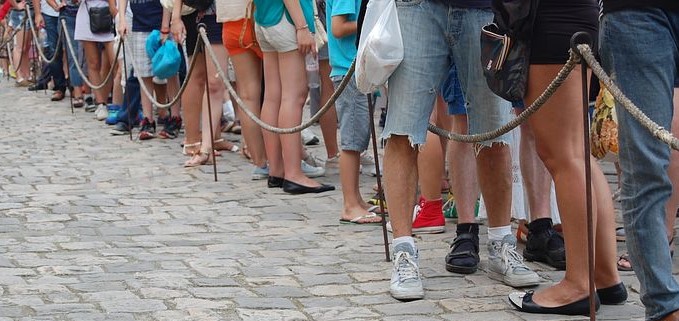
Let’s wager a guess over something that happened to you in the past few days. It probably happened several times in the past few days. It wasn’t by choice, nor were you alone.  It might even be happening right now. What is this recurring, oft-maddening event in your daily world (and mine)? Somewhere, for some good reason, in person or in the car, deliberately or unintentionally, you found yourself waiting in line.

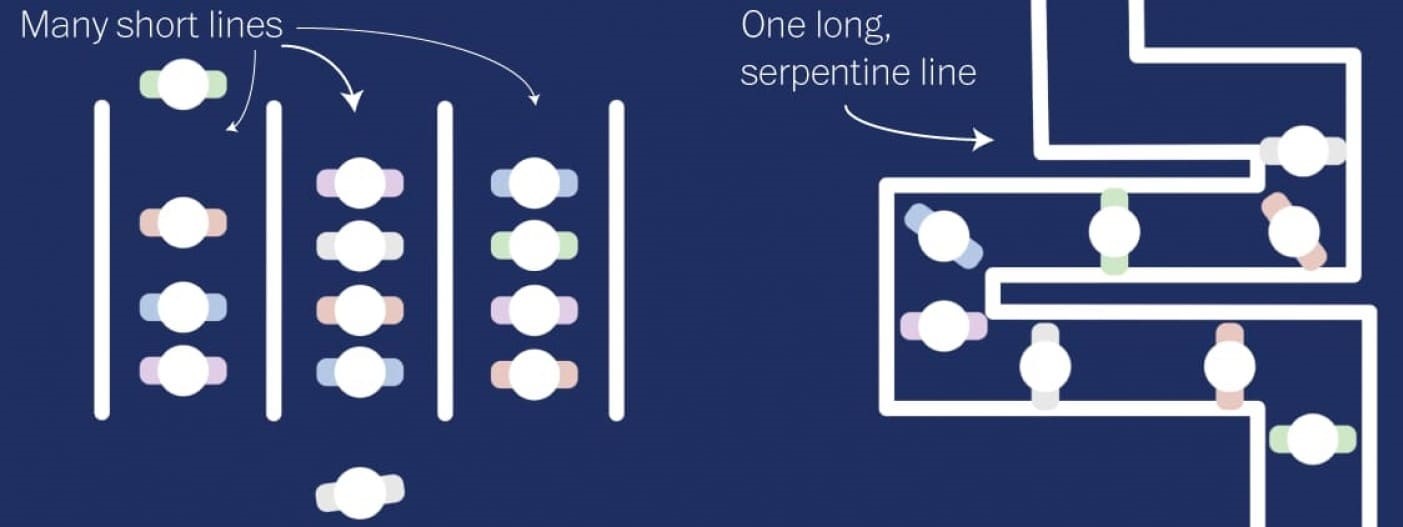
Call it a common courtesy or call it the primary by-product of consumer demand. Waiting in line is a timeless (or time-wasting) necessary evil with no satisfactory alternative.  While the world behaves efficiently with smartphones, computers and even data-consuming “IoT” appliances, those snaking, switch-backing, several-option, several-category lines of humans seem to grow ever longer.  Including traffic on the highways – another version of waiting – you’ll spend one to two years of your life in line.

Consider some of the common reasons why we wait in line:
– store cashiers
– airport security
– phone calls (on hold)
– amusement parks
– voting
– public restrooms

If I wrote this post fifty years ago, I would’ve listed the very same reasons why we wait in line.  We have options now, but let’s face it; those options are waiting-in-line in disguise.  Store cashiers now work side-by-side with an area of self-check-out machines (which draws its own line).  Airports promote pay-for lines like TSA Pre and CLEAR.  Telephone on-hold mechanisms offer callbacks instead of waiting (“for an additional $0.75”).  Disneyland installed “FastPass” lines; again, for a fee.  Voting can be done by mail (forcing your ballot to wait in line instead of you).  And public restrooms?  Okay, there’s no option to waiting for the potty.  Maybe reconsider that second beer.

The Brits refer to a line of people as a queue.  I like that (and not just because we need more words beginning with the letter “q”).  Leave it to those on the far side of the pond to class up the most mundane activity imaginable.  At least we have our phones as distractions when we “queue”.  But the old-fashioned distractions still work.  It’s why they put candy bars by the cashiers, magazines in the waiting room, mirrors by the elevators, and televisions in the airport.  Anything to help you forget you’re waiting in line.

Julio C. Negron

You’d think waiting in line is mindless – no-brainer science really – but I have experienced flaws in the system.  Recently in Lowe’s, waiting patiently in a single, central line at the self-check-out area, I was confronted by the person behind me, who demanded I “choose one side or the other” (as if logic demanded a separate line for each row of self-check-out machines).  My response to him was not one of my finer moments.  Another example – at the airport – my wife and I waited at the curb with a dozen others for the parking lot shuttle, only to discover the “front of the line” was a variable determined by the point on the curb where the driver chooses to stop his vehicle.  If you want to see what not waiting in line looks like, try to catch a parking lot shuttle at the airport.

In today’s world, we have new reasons why we wait in line:
– to purchase the latest iPhone
– at restaurants, with pagers (clever disguise for waiting in line)
on-line (i.e. for concert tickets or sports tickets at a specified time)
– Black Friday sales

Finally, we will always stand in line for our kids, whether to see Santa Claus at the mall or to buy something they simply must have.  Years ago, I remember taking my kids to the local bookstore for the latest “Harry Potter” (which they started and finished before the next sunrise).  It was the only time I’ve stood in line for the right to stand in line again.  The bookstore insisted on selling a limited number of tickets at noon, to be exchanged for the book later that same day, when the publisher allowed its release.

I believe the longest I’ve ever waited in line is five hours – to see the first Star Wars movie in 1977.  With no electronic devices to keep my friends and I company back then, five hours was even longer than it sounds, especially knowing two consecutive showings of the movie would run before I even entered the theater.  Then again, the truly morbid among us believe we are all simply waiting to die.  If that’s the case, let’s hope we’re in a really, really long line.

Tingling the Spines

When Amazon began opening bookstores a couple years back, I wondered why an uber-successful online enterprise would turn to brick-and-mortar, especially after sales of more than fifty million Kindle e-readers through its website. Turns out Amazon’s walk-in shopping experience is worth the walls. It’s retail at its most relaxing – and it has a place in the equation.  As CEO Miriam Sontz (Powell’s Books in Portland, OR) puts it, “something special occurs in a physical bookstore that is not replicable online”.

I’ve been to an Amazon Books just once (fewer than twenty locations in the U.S.), but vividly remember what made my shopping experience so compelling.  First, the manager greeted me with, “Welcome to Amazon, and what was the last book you read?”  When I told him (Kristin Hannah’s “The Nightingale”), he replied, “Oh, that’s a wonderful book.  Wasn’t it so interesting to read an account of the war in France instead of in Germany?  Have a look on Aisle 3 – you’ll find some other great WWII fiction.”

As I indeed had a look on Aisle 3, the manager moved on to other customers, prompting similar conversations.  Suddenly I realized the whole interaction was intentional.  Personalize/focus my shopping experience by discovering what I’m reading.  Pique my curiosity by allowing me to overhear what other people are reading.  A + B = Increase the odds I’ll make a purchase.

What really sets Amazon Books apart from the others is the displays.  The books are laid flat and on angled shelves, so you’re looking right at the cover as you’re standing in the aisle.  Below each book, an easy-to-read card delivers a crisp synopsis of the book, as well as a smattering of the ratings and reviews you’d find online.  Think about that tactic.  You peruse the entire colorful cover.  You take in the book title and author without cocking your head ninety degrees to the left or right.  And you know a little about the book (and whether it’s a recommended read) without turning a single page.  It’s almost like those moments in front of paintings in an art gallery.  “Displayed flat” sounds counter-intuitive in the per-square-foot world of retail, but damned if it isn’t a great way to shop.

Photo by Natasha Meininger

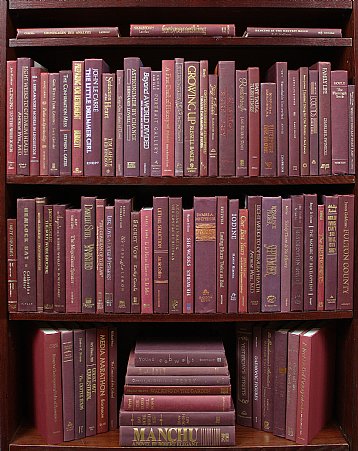
Amazon isn’t the only spine-tingler these days.  In a truly baffling trend, interior decorators and collectors are shelving books with the spines… facing the walls.  That’s right: take a book off the shelf, turn it all the way around, and place it back on the shelf.  Why?  Because “eggshell” – the typical color of the pages themselves – is aesthetically pleasing, instead of that rainbow of bright, colorful book jackets.  The linen texture is uniform, blending more confidently with whatever else is going on in the room.  Really?  Is this Feng shui on steroids?

Alas, as the Wall Street Journal reports, backward-bookshelving is no fad, .  You can purchase books on the cheap specifically for this approach.  Check out the goods at booksbythefoot.com.  BBTF sells you reclaimed books, covers removed, of various shapes and sizes, and yes; purchased “by the foot”.  You can even purchase your tomes in a color scheme (i.e. “burgundy wine” or “earth tones”).  Arrange them any way you want: facing in or out, flat or standing up, in piles or as standalones.  Any way you stack ’em they’ll look fully nondescript, suggesting you’d never go so far as to – gasp! – read them.  As Chuck Roberts (BBTF President) puts it, “Some people don’t want to have the literature as a distraction… they want books as objects on a shelf.”  You mean, like lobotomizing the intellectual meaning from the aesthetic?  Weird, just weird.

Or maybe not.  Now that I think about it, I own the complete works of Charles Dickens, painstakingly acquired years ago, one book at a time through the Franklin Press or some other mail-order rag.  My Dickens collection (above photo) sits neatly on the shelf gathering dust, just waiting for me to crack the first spine or read the first page.  But no matter; don’t they look pretty?

Some content sourced from Wikipedia, “the free encyclopedia”.



Crafts of the Hand

Several months ago, my wife and I went to dinner at one of our favorite Mexican restaurants – a place we frequent every few weeks.  As we pondered margarita options, we asked the waiter for an order of table-side guacamole, a delicious specialty and a great way to kick off the meal.  Much to our disappointment, our waiter informed us we could no longer get guac table-side; rather, it would come already prepared and straight from the kitchen.  Sigh.  Add another item to the demise of handmade food and beverages.  Rekindle the pour-over argument.

What’s the “pour-over argument”?  It’s perhaps the most contemporary example of the struggle between handicraft and automation.  At your local coffee bar, most drinks are poured-over, meaning individually-prepared using a single paper filter, adding the coffee grounds and finishing with a slow pour of the water.  If your coffee arrives with foam-art, consider it a pour-over.  The argument asks whether it’s worth the wait for an individually-prepared coffee, when a large-batch machine can produce the same result in a fraction of the time.  One estimate claims large-batch can produce 100 coffees in an hour, while a barista creates less than ten.

I’m not here to defend the pour-over, but simply to discuss it.  In fact, my first thought when I heard “pour-over” is what you see in the photo above.  Admittedly, I love the speed and consistency of Keurig’s K-Cup’s, and I’m an unashamed frequent-flier at Starbucks.  But that’s not to say there’s not a chair at the table of life for pour-over’s.  Even if the quality of handmade can’t be distinguished from large-batch (taste test, anyone?), what about the calm of watching “drink-art” creation, and the opportunity to socialize with the barista?  Perhaps it’s the fringe-benefits making pour-over’s the healthier option.

Table-side guac is just one example of “pour-over’s” threatened by today’s demand for speed and efficiency.  If I ask you to think of a product previously handmade but now produced by automation, I’m sure you can name several.  Milkshakes. Beer. Even pizza, which can now be prepared start-to-finish by a robotic chef.  But the flip-side of robots is advertisement focused on food-prep the old-fashioned way.  “Handmade” milkshakes.  “Craft” beers.  “Fresh-squeezed” lemonade.  And pour-over coffee.

Business’s bottom line loves the idea of automation.  Labor is typically your most expensive line-item, so who would argue with removing it?  Well, maybe those willing to pay for the experience.  At your finer restaurants, you can still find table-side salads (Caesar), entrees (Chateaubriand or Steak Tartare), and flaming desserts (Baked Alaska, Bananas Foster, Cherries Jubilee).  At Sunday brunches you can still enjoy made-to-order omelettes and waffles.  With those examples, I’d argue you’re not just paying for the food.  You’re also paying for a slow-down moment: a chance to enjoy a chef-artisan do his/her thing while engaging in a little conversation. As a recent Wall Street Journal article puts it, “[pour-over]… is more about delivering peace in a fast-paced time”.

Here’s my plea.  The next time you’re having something prepared in front of you – whether a simple burrito at Chipotle or an elegant Steak Diane adjacent to your white-clothed table, put away the phone, take a deep breath, and just enjoy the moment.  Have a chat with whomever is preparing your meal.  It’s an experience worth poring over.

The Final Word

This time of year, we assemble our latest collection of “best-of’s” and “…of-the-year’s”.  On Monday, America crowned its national champion in college football (Alabama). In a few weeks we’ll get the NFL’s equivalent in the Super Bowl. Last month several magazines recognized 2017 of-the-year’s in photography and current events. Soon we’ll also have best-of’s in music (Grammy) and film (Oscar). In this spirit, did you know there’s an of-the-year for words?

To be clear, “word-of-the-year” doesn’t refer to the annual expansion of the Merriam-Webster (.com) Dictionary or the Oxford Dictionaries Online. With the former, over 250 words were added last fall; with the latter, over a thousand.  Instead, word-of-the-year is a single choice, representing “lasting potential as a word of cultural significance”.  That’s how the people at Oxford see it, and thus this year’s honoree is “youthquake”.  Huh?  Maybe if you’re in Britain you’re not shaking your head like me.  “Youthquake” means “a significant cultural, political, or social change arising from the actions or influence of young people.”  “Youthquake” has been around since 1965, but back then it was only a reference to the fashion and music industries.  Today, it could (and is) being used in reference to the myriad demonstrations of change commanded by the millennial generation.

With the Academy Awards – should you not agree with, “and the winner is…” – at least you might have a favorite in the list of nominees.  But the short list for 2017’s word-of-the-year is the following bunch of odd ducks: white fragility, unicorn, kompromat, broflake, newsjacking, gorpeore, milkshare duck, and antifa.  Okay, maybe “antifa” would’ve been a good choice, but I count at least four others I’m seeing for the first time.  More to the point, what happened to better choices like “hipster” or “pregame” or “alt-right”?  Did none of those even make it into the dictionary expansion?  They’re certainly more word-of-mouth than “youthquake”.

Perhaps “youthquake” will make it across the pond in the next year or two and enter America’s daily conversations.  But the word is not off to a good start, considering several in Britain – including the CEO of a youth leadership organization – claim they’ve never heard of it.  Maybe Oxford just has an affection for the word, so they throw it out there as an “of-the-year”.  But that’s kind of like being labeled “America’s Best City To Live In”.  The mere advertisement draws a bunch of tourists and other undesirables and next thing you know you’re no longer “best”.  By the time we Americans get right with “youthquake”, Oxford and Britain will have moved on to 2018’s word-of-the-year.

Merriam-Webster’s Peter Sokolowski claims their word-of-the-year (apparently the honor is shared) “…gives us insight into the collective curiosity of the public”. M-W took a more scientific approach to it’s recipient, looking at how often certain words were looked up online, and their context with respect to current events.  M-W’s 2017 word-of-the-year?  Feminism.  Look-ups of “feminism” increased 70% over 2016, and spikes in that activity were tied to comments made by politicians in Washington D.C., “The Handmaid’s Tale” and “Wonder Woman”, and the sexual harassment revelations of the past several months.  M-W gives “feminism” two definitions, but I prefer the second: “organized activity on behalf of women’s rights and interests.”

Two years ago, Oxford made a particularly clever word-of-the-year choice in “pictograph”.  Rather than show the word, Oxford showed an emoji.  If my spell-check is any indication, it takes at least two years to embrace the current word-of-the-year recipient.  “Emoji” did not underline.  “Youthquake” most definitely did.


Out of Sight

Jake Olson is a student at the University of Southern California. He’s a backup long snapper for the celebrated Trojan football team, and aspires to play golf on the PGA Tour after college. John Bramblitt is a budding artist whose work sells in more than twenty countries. He paints primarily by touch, claiming “different colors have different textures”. Christine Ha is an award-winning chef who never had a minute of formal training, yet developed a popular cooking blog and won the 2012 edition of the television show MasterChef.  Why mention these three achievers in the same paragraph?

They are all legally blind.

Two weeks ago – unbeknownst to just about all of America – we “celebrated” White Cane Safety Day (WCSD).  A national observance since 1963, WCSD was established by the National Federation of the Blind to remind the public about the significance of the white cane.  In 1930, blind people were given the freedom to lawfully move about the U.S. on their own, provided they used the white cane to navigate their way.  The implication is prior to 1930, blind people were either confined to their homes or could not move about without the assistance of another person.  My parents explained the meaning of the white cane the first time I saw a blind person on the street, but it never occurred to me the cane signifies a legal status.

Seeing may be believing (as the saying goes), but blindness takes belief to an entirely different level.  The people I mentioned above are just a few of the countless examples of accomplishments in all walks of life, minus the sense of sight.  Surely you can name a blind person without resorting to Google. Ray Charles. Helen Keller. Andrea Bocelli. Stevie Wonder. Aldous Huxley.  And those are just the famous ones.

Speaking of the famous, I recall – somewhere in the piles of books I read as a teenager – the fictionalized biography of Louis Braille.  Just as Irving Stone did for Michelangelo in “The Agony and the Ecstasy”, the author added fiction to fact to bring the story of the famous French educator/inventor to life.  Braille’s blindness occurred in his youth: the infamous accident with the awl in his father’s workshop (surely inspiring the plea of parents, “Don’t play with that!  You’ll put your eye out!”)  Remarkably, at only fifteen years of age and already blind, Braille took the very same awl and developed a method of reading/writing for his counterparts virtually unchanged to this day.  It reminds me of Beethoven, who lost his hearing in his early twenties yet somehow composed some of the world’s most famous symphonies and piano concertos.  Belief at an entirely different level.

Convenient to my topic, a new movie debuts in theaters this week called “All I See Is You”.  Starring Blake Lively and Jason Clarke, the story concerns a marriage where a blind spouse depends on her partner to see and feel the world around her.  Dependent, that is, until a corneal transplant allows the woman to regain her sight.  As you might expect, bringing vision to the blind is not all it’s touted to be.  A similar story was told in 1999’s “At First Sight” with Val Kilmer and Mira Sorvino.

Christopher Downey is an architect who, shortly after training in the profession, lost his eyesight to a tumor wrapped around his optic nerve.  No problem, apparently.  Downey now produces drawings from a tactile printer – raised lines akin to Braille’s raised lettering system.  As if you needed another example of belief.

I used to yearn for “as far as the eye can see”, considering the eye doctor routinely issues me a prescription far less than 20/20.  Thanks to these inspirational people however, it’s fair to say my vision is actually limited by my sight.

Knight Watchman

This week’s headlines are full of speculation about Apple’s soon-to-debut iPhone X. We’re still a month away from pre-orders, yet iPhone X headlines carry the weight of those for the hurricanes and North Korea.

          Images courtesy of www.apple.com

iPhone X’s new/improved features sound impressive: “”It’s all screen”, facial recognition, surgical-grade stainless-steel, water resistance, wireless charging, superior camera functionality, and an “A11 Bionic” smartphone chip capable of 600 billion operations per second.  Sounds like a noticeable upgrade from the iPhone 7.

Despite this fanfare, my eye is still drawn to the iPhone’s most basic app: those numbers at the top of the “elegantly-rounded screen” silently telling the time-of-day.

I wear a watch.  Always have.  I wake up every morning, get dressed, pocket my wallet, handkerchief, and keys, and “wrist” my watch.  It’s a habit I’ve had since college days.  Granted, my wallet gets slimmer by the year, as the need for cash and physical cards dwindles.  My key chain is no longer a chain; not even a set of keys (rather, a small fob controlling my car without ever leaving my pocket).  Mercifully, my handkerchief hasn’t changed whatsoever (other than the purchase of a new one every couple of months).

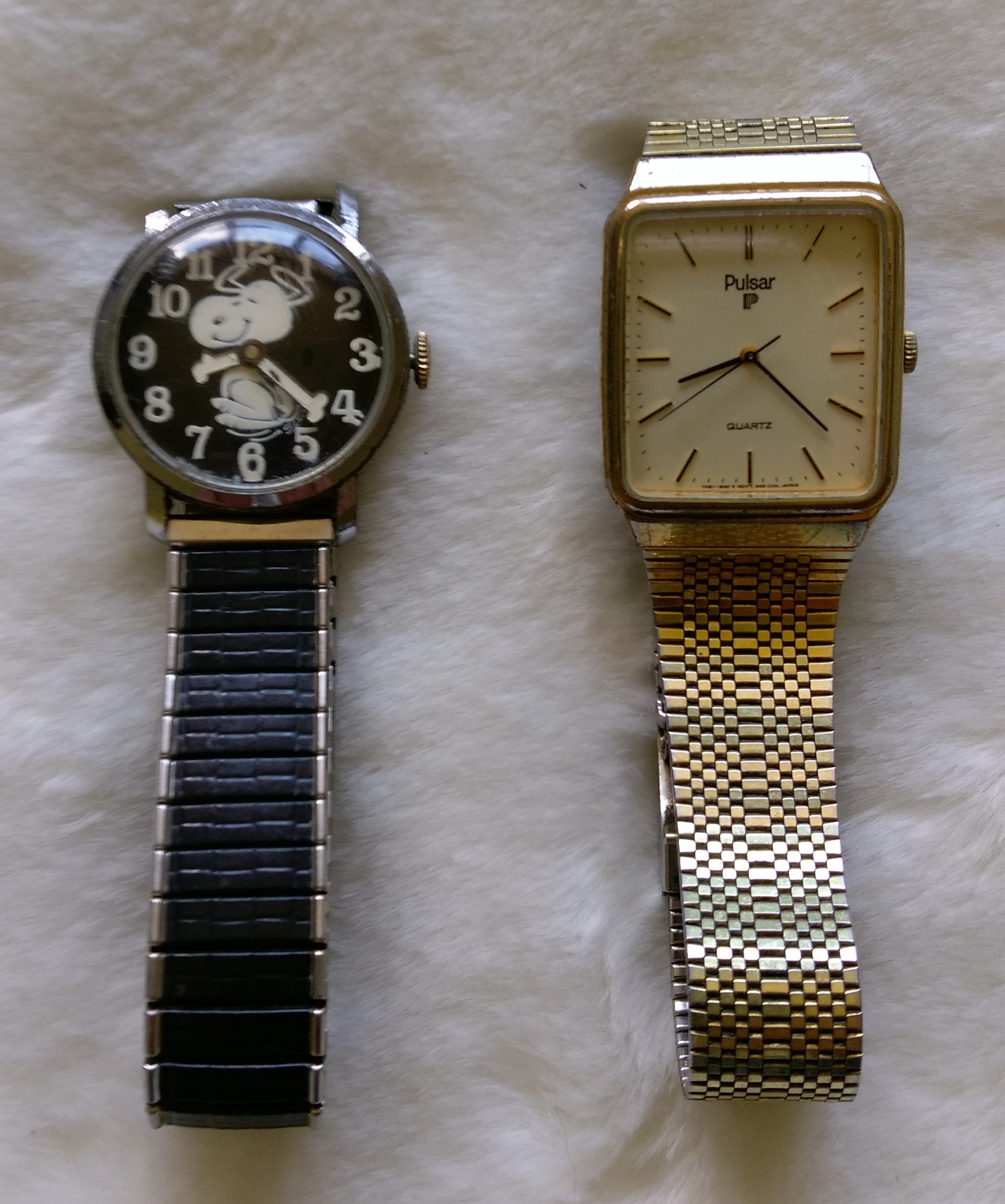
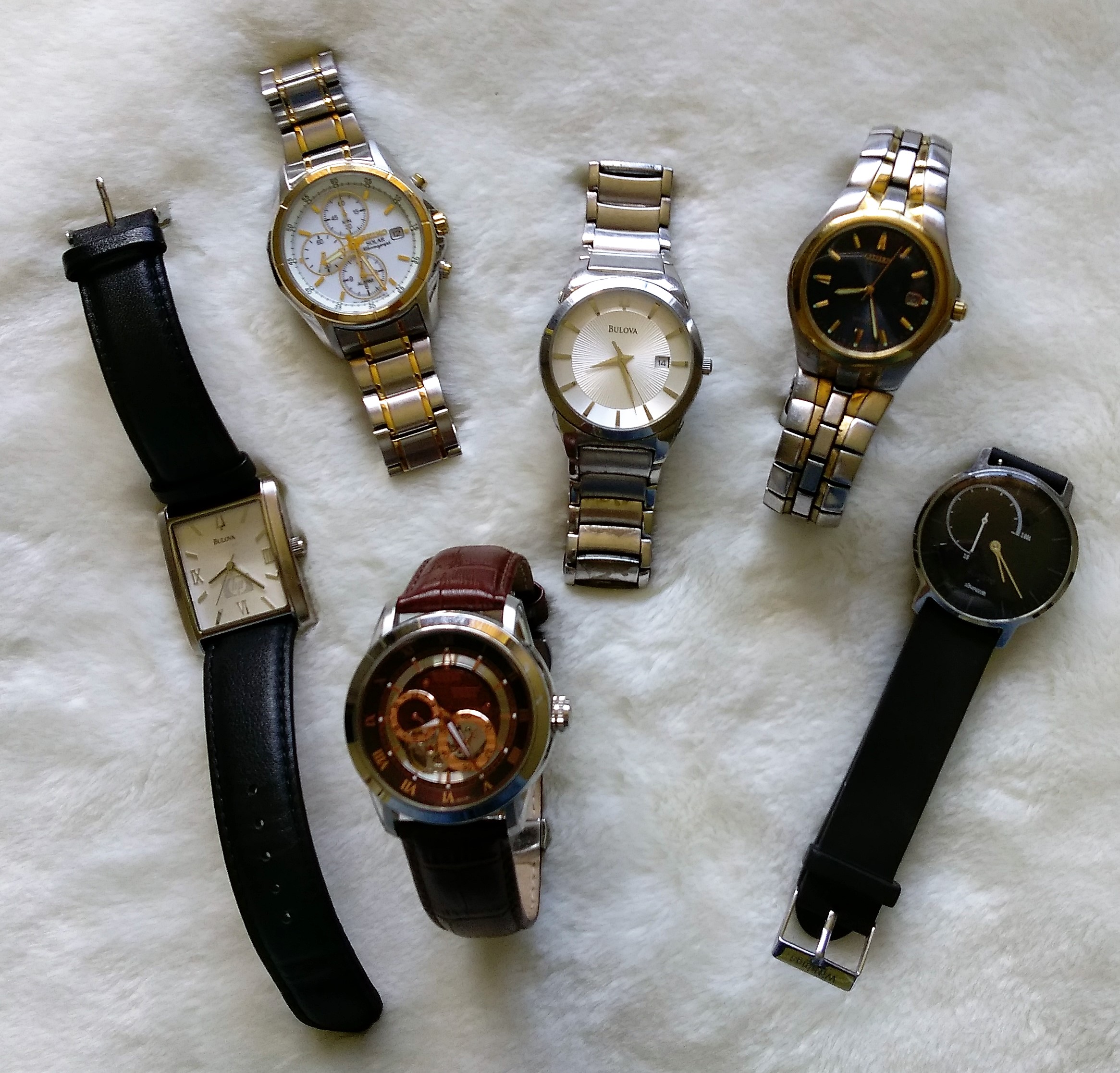
My analog watch – though threatened by technology – remains steadfastly on my wrist.  I started wearing watches when I was a kid, and several decades later I still have the first two I ever owned.  My Snoopy watch was the wind-up type, telling time with its hours and minutes “paws”.  My gold (colored) Pulsar was one of the earliest of its brand, and seemed to say, “time to grow up”.

Several years after my Pulsar I purchased (or received) another wristwatch, followed by another and another and another.  At some point in the process my watches became too nice to part with, and “replace” became “collect”.  Today, I choose from half a dozen.

Recently, I gave smartwatches a try.  I figured, why not get my time and all those other time-saving applications on my wrist?  But it just didn’t take.  Like digital-display watches, I missed the elegant mechanics of a real analog watch.  For a short time, I tried wearing an analog on one wrist and a smartwatch on the other.  Also didn’t take (and probably drew a few curious looks in the process).

On yesterday’s commute talk-radio, the discussion was the iPhone X, and the host said, “anyone 40-and-older probably still wears a watch”.  That statement applies to me (both age range and habit).  I simply cannot forego my wristwatch for a smartphone.  No knock to smartphones, mind you.  In fact, with its $1,000 price tag, the radio host asked callers to predict whether the iPhone X would sell.  All ten callers I heard said people would buy, just as they did at the $500 threshold.  To anyone who thinks $1,000 is excessive, consider this: the smartphone has become a cultural necessity; a here-to-stay personal computer appendage (gather dust, ye laptops and desktops).  And $1,000 is a reasonable price for a personal computer these days.

Here’s a more concrete argument for the $1,000 price tag.  Make a list of the iPhone’s basic apps, and consider the cost of say, five years of physical materials to replace those apps.  Note pads, address books, calendars, paper maps, wallets, cameras, telephones, stereos, calculators, newspapers, and postage stamps (a wholly incomplete list).  Watches.  Well, what do you know; you just spent a lot more than $1,000!  Any further arguments?

No arguments from me either: the X will be a good and popular buy.  But you’ll still find a watch on my wrist.

Go For a Drive

Imagine the conversation you’re having with your grandson several years from now, where you’re waxing nostalgic about a favorite car you used to own.  You’re smiling into the details, remembering how your stylish sedan hugged the open highway curves at a crisp 75 mph; how the in-dash digital receiver cranked favorite tunes via smartphone; how the feel of the steering wheel leather gave you the perfect combination of comfort and control.  Only then, your grandson interrupts you and says, “what’s a steering wheel“?

This week, the Wall Street Journal published a make-you-pause article titled “Your Next Car May Be a Living Room on Wheels”.  The subject matter is the technological luxuries in a vehicle where “driving” is no longer necessary.  Forward-facing seats rotate to face each other, perhaps around a central console.  Touchscreens – to control the vehicle; cameras – to enlarge the outside views; movie screens – simply for entertainment; each of these appear on the window glass with simple voice commands.  Microwaves, refrigerators and ice chests hide nearby for always-available snacking.  In other words, the very definition of “car” gets turned on its ear.  Your grandson won’t even know what a “dashboard” is.

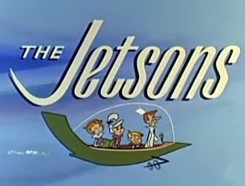
Your grandson won’t remember “The Jetsons” either – the Hanna-Barbera animated sitcom from the early 1960’s.  In a mere twenty-four episodes, “The Jetsons” gave us a peek into a fascinatingly advanced world of the future.  George Jetson and his family enjoyed luxuries only present in a 1960’s imagination, like robot housekeepers or in-home treadmills.  The Jetsons lived in a high-rise apartment building floating in space.  My favorite concept: the “aerocar”.  There were no roads in George’s world, so he and his family bopped around in a airborne car.  Per the illustration above, the aerocar is effectively a flying saucer with a transparent bubble top.  I still hear the sound of its little engine.

At least George still drives, which is the premise of this post.  No matter how advanced the mode of transportation, I want the option to navigate whenever my heart desires.  If my family and I are heading out for a Sunday jaunt, I want to be able to steer us wherever the wind blows.  Maybe that’s the provider in me, or maybe that’s just driving for the sheer enjoyment of it.  We need our steering wheels.

Flying cars are closer to reality than you might think.  Airbus, Uber and a handful of other companies have created concept “cars” that take-off and land vertically – no wings.  No rotors either, like you’d see on a helicopter.  Yet some models – like Airbus’s “Vahana” – are designed to be pilot-less.  What fun is that?  Who’s at the controls?  Sounds like going for a ride in an oversized drone.  Regardless, even with perfect technology the real hurdles with flying cars lie in regulating airborne travel.  There must be rules.  You’d better believe the environmentalists will have a seat at the table too.

In my childhood days at Disneyland, I was led to believe monorails were the future mode of transportation.  I pictured vast elevated networks of elegantly formed concrete spreading out across the country, with graceful trains slithering along topside at impressive speeds.  Alas, Disney’s monorail in Florida – at 14.7 miles – remains one of the longest of its kind.  Only two others, in Japan and China, claim more riders.  Monorails just never took.

Maglev (magnetic levitation) replaced monorails as the potential mass-transit solution of modern times.  Magnets are super-efficient, providing both lift and propulsion towards a high-speed, low-friction, no-moving-parts solution.  Assuming an aesthetically-pleasing design, even the environmentalists would be on board with zero-emissions engines.  But there’s always a negative.  In this case, costs of maglev are projected at $50-$100 million per mile.  No wonder the few installations around the world travel very short distances.

Even if we mapped America with arteries of monorails or maglev, I’d still find dissatisfaction in the notion no one’s driving the bus.  More to the point, I am not driving the bus.  But at least we’re talking about mass-transit here; an option I chose willingly over my own car.  If I’m not “licensed to drive” I’m happy to leave the controls to someone else.

Living rooms on wheels will be tough for me to swallow.  The focus has shifted from enjoyment of the drive to enjoyment of the ride.  Maybe I should’ve seen this coming when automatic transmissions became an option to stick-shift.  Certainly it hit me over the head when Uber debuted its self-driving fleet.  Sir, please step away from the controls.

Here is my futile plea for now: don’t take away my steering wheel.  Let me have the option to play pilot.  At the very least, give me a set of handlebars and a little weight-shift control.

Some content sourced from Wikipedia, “the free encyclopedia”.

North Pole Vault

One of these days I’m going to visit Norway. The allure of Arctic glaciers, fjords, and waterfalls beckons me to snowshoe north of the Baltic Sea. My wife and I toured Denmark and Sweden a few years back, but if I were to choose only one of the Scandinavian countries it would be Norway. I must have a little Viking blood in me. In fact, my AncestryDNA results say I have about 14%.

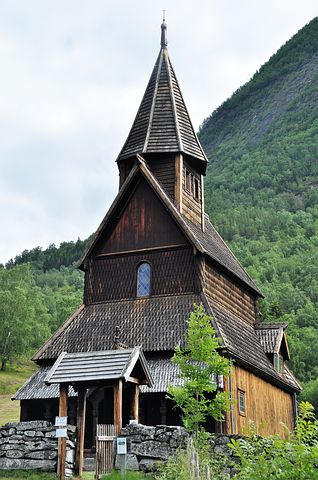
Besides its spectacular natural environs, Norway is known for hearty wooden structures that dot the land. Stave churches – quaint, timber-framed buildings from medieval times – can still be found in many of the villages.  One of the most famous is likely the most recognizable structure in Norway – the Urnes church in Songnefjorden (above photo), built back in 1130 and still standing today.

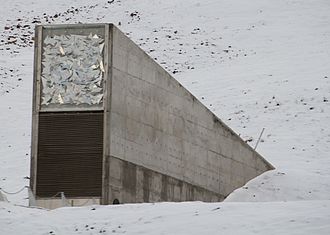
Here’s an even bolder proposition for my Norway expedition.  After I make the pilgrimage to the Urnes church, I could hop a plane four hours to the north, to the island of Spitsbergen in the remote archipelago of Svalbard.  I’m still in Norway but I’m a whole lot closer to the North Pole.  And it is here, 430 feet above sea level, I would find what may become the future most recognizable structure in Norway: the Svalbard Global Seed Vault.

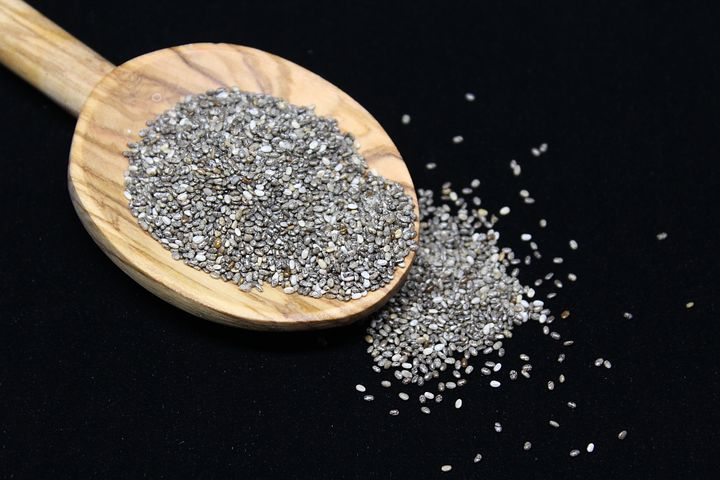
The Svalbard Seed Vault is exactly what it sounds like – a place to store seeds.  Why would a country spend more than $9 million to build a seed vault?  Because bad things happen in this world, putting our food supply at risk. After reading about Svalbard I learned there’s an entire network of seed vaults around the globe (including one right here in Colorado).  These vaults contain food crop seed samples in the event the world “runs out” someday.  But even the vaults themselves have no guarantees.  The national seed bank of the Philippines was destroyed by fire, and the seed banks in Afghanistan and Iraq were lost to the ravages of war.  That’s where Svalbard comes to the rescue.

Svalbard is the “seed vault for the seed vaults”.  Think of it as a library.  If one of the world’s vaults needs a replenishment of seeds (or some global crisis destroys the vault entirely), they “borrow” packets from Svalbard.  Once more seeds are generated, a portion of them are returned to Svalbard to restore the library.  Almost 900,000 food crop varietals are represented in Svalbard – by half a billion seeds.  The facility is the size of a football field and all those seeds don’t even make it to the fifty-yard line.  Plenty of room left for more.

Svalbard is likely the most secure seed vault on the planet because it’s buried four hundred feet inside a sandstone mountain, encased in the Arctic’s permafrost.  Svalbard recently made the news when the vault flooded from snow melt and early season rain (that’s not supposed to happen – global warming anyone?)  But the water didn’t make it any further than the vault’s entrance tunnel before it froze again.  Sounds like all those seeds will be cold, dry, and undisturbed for a long time – just as the vault intends them to be.

Here’s another reason to like Norway.  Government-constructed projects exceeding a certain cost must include artwork.  Svalbard was expensive enough, so the seed vault entrance is decorated with stainless steel, mirrors, and prisms, reflecting the polar light of the summer months.  In the winter, the entrance is illuminated with greens and turquoises and whites through fiber-optic cables.  With this installation we get to appreciate the “importance and qualities of Arctic light”.  Pretty cool.

Sadly, if my Norway sojourn ever included the Svalbard Seed Vault, I wouldn’t get past the entrance.  There’s no receptionist (nor any other staff members 0n-site).  Instead the facility is monitored from a remote location around the clock.  You have to pass through five levels of security to get to the seeds themselves.  Tourists like me have no shot.

I won’t be getting to the Arctic anytime soon after all.  As for Norway, I’ll have to be content with a visit to a Stave church or two.  But I’m grateful for the Svalbard vault all the same.  On that note, I think I’ll head over to Home Depot and buy a few seed packets for my summer garden.

Some content sourced from Wikipedia, “the free encyclopedia”.


Reinstating the “Swoosh-Curl”

The Associated Press (AP) recently posted an article: “Cursive Writing Makes a Comeback in U.S. Schools”. That caught my eye, because I didn’t know cursive writing went anywhere in the first place. I assumed most everyone – regardless of age – can sign their name in cursive. Turns out the broad adoption of Common Core curriculum standards in 2010 removed “handwriting” as an essential skill.  The teaching time once used for cursive now goes to learning the keyboard.  Ask today’s student for a signature and you’ll probably get block letters instead of “continuous flow”.
I still remember my grade-school days spending hours on paper, forming my upper and lower-case letters.  Then I graduated to cursive, and the “swoosh-curl” of the loops as I progressed across the page without lifting the pencil.  Cursive evolved from block-letter writing as a way to speed up handwriting.  If speed were the only criteria, no wonder today’s generation prefers the keyboard.  In the race between my cursive on paper and my daughter’s thumbs on the smartphone, she wins by a landslide.

Speaking of cursive, here’s an example of my very own.  Hopefully you can read it.

That’s right:  The quick brown fox jumps over the lazy dog – a sentence I wrote over and over in cursive practice.  It’s a pangram – a sentence using all the letters of the alphabet.  The quick brown fox… is the most famous pangram but there are several others, including: Pack my box with six dozen liquor jugs!

The shortcoming of my own cursive writing is my speed – or lack thereof.  It took me almost sixty seconds to write the sentence above.  You could probably write the same sentence in half the time.  But I have a couple of challenges working against me.  One, I’m left-handed, which means I’ve developed a curious writing style where I curl my hand around the point where pen meets paper.  This forces my hand to stay higher on the page and avoids ink smears, but I can’t go very fast.  Two, I have essential tremor, where my hands shake slightly when held in certain ways (like writing).  If I don’t go s-l-o-w, my cursive is downright illegible.

If cursive writing was born of block letters, then block letters were born of calligraphy.  Calligraphy is writing elevated to a visual art, where the lettering is created with wide and narrow strokes and requires the use of a special pen.  Today’s computer fonts try very hard to simulate calligraphy but there’s nothing quite like the handcrafted version.  The finest examples – using the Latin script – are found in early copies of the Bible; the so-called “illuminated manuscripts” created before the advent of the printing press.  Today you’re more likely to find calligraphy on wedding invitations, college diplomas, and other formal documents.  I have an aunt who mastered calligraphy and I wish I’d kept some of her letters and thank-you notes.  That kind of penmanship suggests a certain level of elegance and refinement noticeably absent in today’s writing.

The AP news article claims fourteen states have reinstated cursive writing into their grade-school curriculum, so here’s hoping for more continuous flow signatures.  But there’s still plenty of debate about the “usefulness” of the swooshes and curls when keyboarding is clearly king.  To those who don’t see the value, consider this: our nation’s most important documents were written in cursive.  If you can’t write the U.S. Constitution in cursive you probably can’t read it in cursive either.  That would be a shame if you were ever lucky enough to see the original in the National Archives.

Some content sourced from Wikipedia, “the free encyclopedia”.