Just Beyond the Spotlight

34.9 million people (including most of Jamaica) watched on Monday night as Usain Bolt claimed track and field legend at the Olympics by winning the Men’s 100m.  It was Bolt’s third straight gold medal in the event; remarkable considering he is eight years older now than when he won it the first time.  Like Michael Phelps and swimming, the hype leading up to Bolt’s latest victory was justified.  NBC covered every one of Bolt’s qualifying heats in prime-time, and delivered a good twenty minutes of back story before the final.  Bolt will be a household name if he is not already.
runner-311737__340_edited

The 100m run is one of several Olympic events I never miss.  It is a wondrous display of athletic power, and I’m always on edge to see who will become the “world’s fastest human”.  However, the prime-time Olympic spotlight need also shine on lesser known events and athletes.  Herein lies the oft-overlooked beauty of the Olympics: it is these “others” that emerge with the most inspiring stories.  They are not so much superstars, yet are still among the best at what they do.  A few examples for your consideration:

57 - wondrous 1

Charlotte Dujardin of Great Britain rode to a gold-medal performance in Individual Dressage.  Show Jumping may be the more popular Olympic equestrian event but Dressage is the more difficult (and defined as “the highest expression of horse training).  Dujardin and her Dutch Warmblood horse “Valegro” floated through an almost magical routine, completing one spectacular movement after another.  Dujardin and her mount were graceful, elegant, and significantly better – at least on points – than the silver medalist.  And her story became even more poignant when I learned Dujardin was engaged to be married shortly after receiving the gold medal, while Valegro has earned his last championship (of many) and will be retired from the sport.

57 - wondrous 2

Sanne Wevers of the Netherlands leaped to a gold-medal win on the balance beam in Women’s Gymnastics.  It was the first women’s gymnastics medal of any kind in her country’s history.  Wevers’ routine featured several jaw-dropping maneuvers I’d never seen before, including several spins while balanced precariously on one foot.  The judges were won over by Wever’s creativity and skill.  American television tried desperately to keep the spotlight on our own athletes (who were favored to win), but Wevers was clearly the humble star this night.  And her story was made even more poignant when the cameras turned to her twin sister Leika in the stands – also a member of the Dutch gymnastics team – as she reacted to Sanne’s upset win with tears of disbelief.

57 - wondrous 3

Molly Huddle of the United States ran what should have been a gold-medal performance in the Women’s 10,000m run.  Except she didn’t win the gold medal.  When a group of eight women broke away from the pack after several laps – most of them Kenyans and Ethiopians – Huddle broke away with them.  After twenty-five laps Huddle crossed the finish line in sixth place, breaking the American record for the event by almost nine seconds.  And her story was made even more poignant when I learned Huddle’s finishing time would have been good enough for the gold medal in three of the last four Olympics.

The Games continue for several more days.  More superstars will be at their best on prime-time television.  Just remember to look around and see what else is going on.  There are wonderful stories just beyond the spotlight.

Rings of Summer

Over the next two weeks, the world will be witness to the greatest gathering of athletes and sports mankind has to offer. The XXXI Olympiad -that’s 31st for you non-Romans – will be hosted by the city of Rio de Janeiro.  (Just saying “Rio” reminds me of “FedEx” – it’s simply not the whole enchilada).  I must admit I didn’t realize “Olympiad” refers to the four-year period between Olympic Games – not the Games themselves.  Count backwards by fours and you’ll realize the first modern Olympic games was held way back in 1896.

55 - Olympiad

You may say, non-sports-fan that you are, there is nothing seventeen days of sports competitions can do to stir your soul. But I urge you, put away the electronics and have a look, even if only for an hour or two. A moment will be there and you don’t want to miss it.

The first Olympic Games I remember well was 1976 in Montreal.  As a fourteen-year old, I was captivated watching Nadia Comaneci – also fourteen (!) – as she won three gold medals and scored seven perfect 10.0’s in women’s gymnastics.  I love this trivia item: the gymnastics scoreboard could only hold three digits, so Comeneci’s perfect scores were expressed as “1.0”.  For anyone who watched, it was one of the most electrifying performances in any sport and in any Olympics.  It was a moment to remember.

The second Olympic Games I remember well was 1980, but only because the United States boycotted the events due to Russia’s invasion of Afghanistan at the time (which is ironic given America’s involvement in that country today).

That brings us to 1984: the XXIII Olympiad in Los Angeles.  I was a senior in college, working a summer internship in Southern California.  I was witness to a city transformed.  The Games were hosted in a revitalized Coliseum (the same venue where the Olympics were held in 1932).  Ronald Reagan was President and opened the Games in person.  Sports venues were spread across the city, and the coincidence of several competitions on Fridays caused most businesses to shift to 4×10 workweeks.  American flags were everywhere.  The Olympic spirit was alive and well in the City of Angels.

I distinctly remember the torch relay at the L.A. Games, passing through the neighborhood where I grew up; John Williams’ glorious musical composition at the opening ceremonies (where dozens of white grand pianos were played simultaneously); Mary Lou Retton’s golds in women’s gymnastics; and Carl Lewis’s golds in track and field.  I also remember the women’s 3,000 meter run, highly-anticipated because America’s Mary Decker was racing South African sensation Zola Budd.  The two collided mid-race, Decker went down, and she never finished the race (Decker’s anguished face as she lay on the track is one of the Olympics’ classic photos).  There were moments in L.A.

Here’s one more Olympic moment which may surpass any I’ve mentioned above.  It was the women’s marathon.  I don’t even remember the city or the year or the woman who won the gold.  But I do remember the woman who won the bronze.  As she entered the stadium for the final meters of the race, she looked over her shoulder and saw… no one.  The bronze was hers.  She raised her arms in triumph as she finished that final lap, crying in apparent disbelief.  The unbridled joy and tears on her face as she crossed the finish line is a moment I’ll never forget.

The Olympics.  Rio de Janeiro.  Starting tomorrow.  Watch.  A moment will be there and you don’t want to miss it.

Pageant of the Masters

In the small but wealthy community of Laguna Beach, California, the crown jewel of the annual Festival of Arts is an event known as the Pageant of the Masters.  The Pageant is remarkable entertainment: ninety minutes of classical and contemporary art pieces, recreated one-by-one on stage in larger-than-life frames, using real people instead of their painted counterparts.  Makeup, lighting, and carefully choreographed sets complete each “painting”, resulting in a remarkably accurate depiction when the curtain sweeps aside.  Add in the accompanying music from the live orchestra and it is a nonpareil performance.  Thousands attend the Pageant each summer, as they have since its beginnings in 1932.

In the smaller but modest community of Augusta, Georgia, the sporting world was witness to another nonpareil performance last weekend – the Masters golf tournament.  Just like the Pageant, thousands attend golf’s Masters each April, as they have since its beginnings in 1934.  To me, the Masters is golf as a fine art.

39 - nonpareil 1

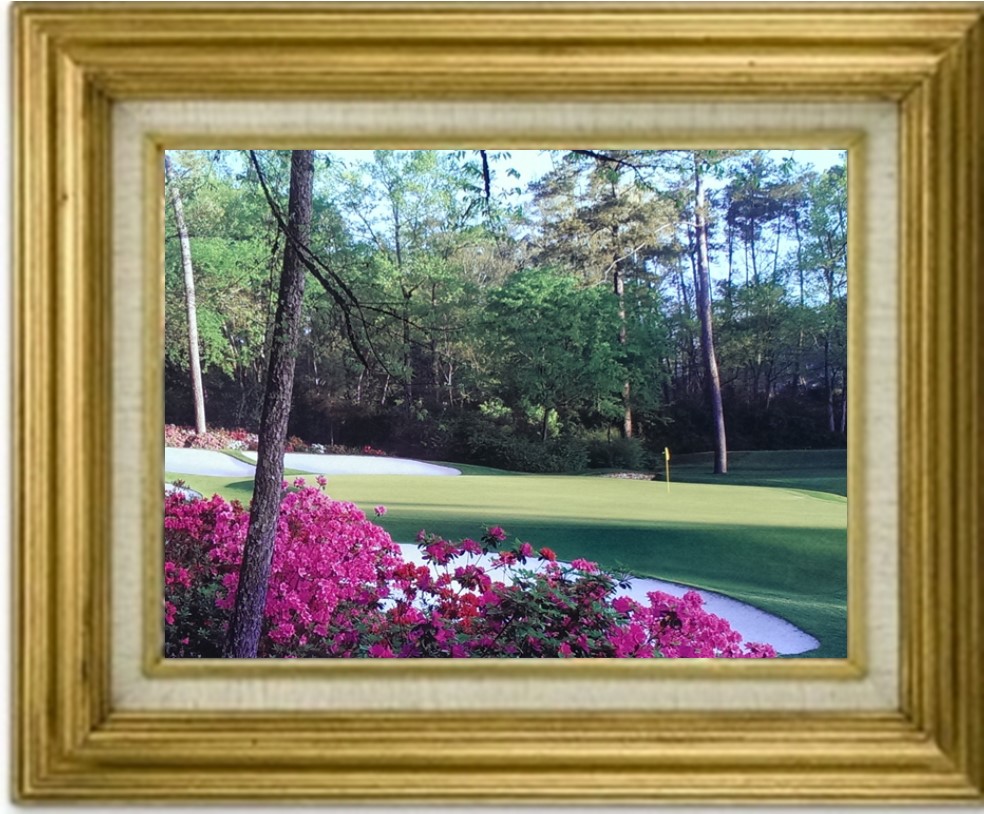
Whether or not you play golf – whether or not you even like golf – there is no denying the Augusta National Golf Club is a beautiful place.  The photos here do not do it justice, but most of us will have to settle for just that – photos.  Tickets to the Masters go on the market a year in advance (apply now for 2017!), and a four-day tournament badge runs upwards of $2,500.  Candidly, even a golf fan like myself – who has “visit Augusta National” on his bucket list – would rather watch the action on television.  The price of cable gets you far more camera angles and coverage than you could ever hope for in person.

Augusta National’s eighteen holes are so revered that each one has been given a name.  The first photo above is #12 “Golden Bell”, the shortest but perhaps trickiest of them all.  It’s a spectacular par-3 where the tee shot must clear water and then land on a small green protected by several sand bunkers.  This year’s tournament was lost on this hole.

39 - nonpareil 2

This photo is #15 “Firethorn”, a twisting par-5 that tempts you to go for the green in two – if you’re brave enough to tune out the creek that runs in front of and behind the green.  Firethorn also has the distinction of a hole where Masters tournaments have been won or lost.

39 - nonpareil 3

It’s easy to get lost in the pageantry of the Masters, whether it be the ceremonial opening tee shots from prior champions, the CBS theme song “Augusta”, the reverent tones of commentator Jim Nantz, or the endless camera shots of the color-burst of spring azaleas against the backdrop of bright green fairways.  But don’t ignore the play itself.  You’re witnessing one hundred of the world’s best golfers, competing on one of sport’s most difficult stages.  Watch them as they bend shots blindly around trees and over water, or curl in putts that move from left to right and then left again.  Augusta National is a true test of composure and will.  Masters champions are artists in their own right.  Like Laguna Beach, it really is a Pageant of the Masters.

Photos courtesy of the Official Program of the 2006 Masters Tournament

Winning the Big One

U.S. News & World Report just ranked Denver and Colorado Springs high on its list of “best places to live” in America.  Apparently the job market, cost of living, and quality of life in the Rocky Mountains leaves little to be desired.  To add to the accolades, the Broncos just won the Super Bowl.

sequestered

Before you say “Honey – pack up the kids!  We’re moving to Colorado!”, you must pause if you’re a sports fan.  Sure, that Lombardi Trophy is shiny and new and will feed Denver’s ego for the rest of the year.  But it sure is lacking for company.  If the State of Colorado had a trophy case for professional sports, the Lombardi would almost find itself in solitary confinement.  Sequestered.  You might even feel bad for it.

Denver wasn’t even supposed to win this Super Bowl.  Fans from North Carolina (and frankly, anywhere outside of Colorado) never gave us a chance.  But we’re used to it out here.  Denver and Colorado are perpetual underdogs when it comes to sports championships.

The Super Bowl win got me curious, so I spent a few hours researching Colorado’s professional sports franchises (Wikipedia is my new best friend).  I desperately wanted to use the phrase “a list of championships a mile high“.  Far from it.  To be honest I had to dig deep to find any noteworthy performances.

To spin it positive, Colorado might earn your envy for being one of only thirteen states where the four major professional sports are represented.  whoop-dee-doo.  The last time the Broncos won the Super Bowl was last century.  The one and only time the Avalanche (hockey) won the Stanley Cup was 2001.  The last time the Rockies (baseball) won the World Series was never.  But at least the Rockies made it to the World Series .  The Nuggets (basketball) started play in 1967 and fifty years later we’re still waiting for a spot in the Finals, let alone an NBA Championship.

To add a miserable exclamation point to Colorado’s track record, the Nuggets will once again miss the playoffs this year (it’s a tradition), the Avalanche are battling a half-dozen teams for the very last playoff slot in the Western Conference, and the Rockies… well, the Rockies haven’t even begun the new season yet they’re projected to finish in last place in the National League.  Go COLORADO!

My Wikipedia search – ever more desperate – moved on to college championships.  Colorado’s six D1 schools have accounted for a grand total of one football championship in their entire un-storied histories (Univ. of Colorado, 1990).  None of these schools have come anywhere close to tasting college basketball or baseball glory.  But then, mercifully, we have hockey.  On the college ice the Centennial State shines.  Denver University and Colorado College have combined for nine hockey championships; the most recent in 2005.  I need to become a better fan of the puck.

If you’re reading from California, Massachusetts, Texas, or Florida, you feel none of my pain.  Each of you can account for five, ten, even twenty professional or college sports championships in the last fifteen years alone.  But if you’re reading from Georgia or Washington D.C., you’re pitching the proverbial championship shutout.  You have my sympathies.

On the heels (hooves?) of the Broncos’ Super Bowl victory, Peyton Manning hung up his cleats for good – a justified decision.  But Peyton’s backup just signed with the Houston Texans.  In fact, several marquee Broncos have already left the state for other (better?) teams and higher salaries.  Sigh.  Back up the truck boys; the Lombardi Trophy is heading to another state soon.  Let Colorado’s next sports championship drought commence.

So go ahead sports fans – move to Colorado.  But I suggest you follow soccer.  The Colorado Rapids have only been kicking for twenty years and they’ve already made the finals twice and won the whole thing once.  Go RAPIDS!