Is It Live or Is It Memorex?

It’s the wood chipper for you, buddy.

New Year’s Day has come and gone (and a warm welcome to you, 2021), which means it’s time my wife and I take down the Christmas tree. For some, taking down the tree means disconnecting the branches from the trunk, the trunk from the base, and packing the whole thing into a cardboard box to be used again next year. For us, taking down the tree means lifting it off the stand, hauling it outside to the truck, driving it over to the drop-off lot, and donating $5 to fund the recycling. Yes, this year – as with all of my years – the Christmas tree is real, not artificial.

I’m not here today to debate real vs. artificial Christmas trees.  They both have pros and cons and your choice rests on where you live, your budget, and assorted other reasons.  For me, a real tree is simply a tradition I refuse to give up.  Picking out a tree with my family was a big deal when I was young.  There was something magical about living in sunny Los Angeles and watching dozens of pine-scented snow-dusted trees being unloaded from Canadian railcars.  Never mind we paid a little extra to have our tree “flocked” (adding a touch of spray-painted artificial snow).  It was still a real tree.

Memorex: Sound that “blows you away”.

Real vs. artificial goes way beyond Christmas trees.  When I consider one next to the other, I always think of Memorex.  In the 1970s and ’80s the Memorex Corporation produced audio cassettes, the precursor to the compact disc.  In their TV commercials Memorex included singer Ella Fitzgerald belting out a note powerful enough to shatter a wine glass.  Then they’d play a recording of Ella’s performance and the wine glass would still shatter, begging the question, “Is it live, or is it Memorex?”

Real vs. artificial also recalls Milli Vanilli, the R&B duo from the late ’80’s.  Milli Vanilli made it big with the album “Girl You Know It’s True”, then won the Grammy Award for Best New Artist.  But years later the world would find out Milli Vanilli never sang anything.  Instead they lip-synced their way to fame; their albums the voices of studio performers.  Milli Vanilli returned the Best New Artist Grammy shortly after that.

Let’s visit real vs. artificial a little closer to home; say, the kitchen.  As much as my wife and I seek whole, organic, locally produced foods, we can’t help including a few outliers.  I just went through our pantry and came up with a few good examples:

  1. Aunt Jemima syrup.  This pancake topper – destined for rebranding in the name of racial equality – is nothing but high fructose corn syrup, water, and a whole lot of chemicals.  The “Natural Butter Flavor” variety blatantly advertises “contains no butter”.  You’ll find all the pure maple syrup you want in Vermont but you won’t find a drop in a bottle of Aunt Jemima.
  2. Kellogg’s Pop-Tarts.  A long time ago Pop-Tarts contained real ingredients (else my mother wouldn’t have put ’em on the pantry shelf as kid snacks).  Today’s Pop-Tarts are enriched flour and a bunch of scary-sounding ingredients developed in a lab.  It takes half the height of the box to list everything that goes into a Pop-Tart.
  3. Kraft Mac & Cheese.  Make a bowl of pasta, top it with melted cheddar, and Voila! you have macaroni & cheese in two ingredients.  Kraft Mac & Cheese needs twenty-one to accomplish the same dish.  But man, don’t it taste great?
  4. Ritz Crackers.  More enriched flour plus lab ingredients.  (Maybe every food can be made from enriched flour?)  The Ritz Crackers box includes a warning, “Contains wheat, soy”.  Ha, if only that was all it contained.
  5. “Real” Bacon Bits.  My mother-in-law left this bottle of horror behind when she brought a salad for Christmas dinner.  But guess what?  It really is made of bacon (okay, and chemicals).  I must’ve been thinking of other brands, where the bits are actually “flavored textured soy flour”.  Oh ick.

Back to our real Christmas tree.  After the gifts were passed around and opened, we discovered one more, looking a little embarrassed behind the branches.  It was a brightly colored basket, the kind all dressed up with a cute wooden box and Christmas bow, overflowing with food items and protected in plastic wrap.

But here’s the rub.  We opened the basket and found a whole lot of nothing.  Generic cookies, coffee, candy, and a couple of cheap Christmas mugs, arranged carefully so as to suggest the basket contained much more.  To add insult to injury, none of the food items were name-brand (except for a handful of Lindor truffles).  The cookies and candy were made with a ton of artificial ingredients.  The coffee was so generically packaged it had me wondering if it was even coffee.  The whole basket made me think “Memorex”.
This is where I jump to a discussion about artificial intelligence, but your real brain needs a rest so that’s a topic for another day.  Meanwhile, my wife and I will keep heading out every Christmas to tree lots (or the woods) to find the perfect one.  “Artificial” may sneak into other parts of our lives now and again but at Christmas, we’ll always be keeping it real.

Some content sourced from Wikipedia, “the free encyclopedia”.

Busy Buzzwords

Our local news wraps its nightly broadcast by pushing little surveys you can take online. Earlier this week was, “Should the U.S. Senate vote to increase stimulus checks to $2,000?” (88% said yes). The night before, “What was your favorite holiday food this year?” (pie narrowly edged ham). What I find laughable is the participation rate – maybe 25 responses on average – yet the results are announced the following night like headline news.  25 is a minuscule sampling for a basis, like surveying a few of your neighbors and calling it good.  Yet other companies take the exact same approach.  Example: Merriam-Webster just announced its 2020 “Word of the Year”.

Merriam-Webster’s fitting “Word of the Year”

You’ll find almost 200,000 words in the English language (with more added every year).  Should pandemic take the trophy for 2020?  Well, yes, it’s hard to argue with Merriam on that one.  Not only did the COVID-19 pandemic dominate headlines and conversations, the word created the single largest spike in dictionary traffic.  On March 11th, when the World Health Organization declared COVID-19 a pandemic, the lookup of pandemic increased over 100,000% over 2019.  I can’t convert 100,000% to a quantity but I know it’s a big number.

Merriam isn’t content with just “word of the year”, however.  They also list the top ten words according to increased dictionary traffic over the previous year.  Accordingly, 2020 self-branded with coronavirus, quarantine, and asymptomatic.  I wouldn’t think any of these words – pandemic included – induces peace of mind, but in dire situations our brains have a relentless need to know more.

With the mental fatigue brought on by too much COVID talk, perhaps you’ll find Merriam’s other top-ten words more refreshing.  Antebellum made the list because the long-popular country music trio Lady Antebellum changed its name to “Lady A”; also because the movie “Antebellum” was released in September.  Mamba was a top-ten for the passing of basketball legend Kobe Bryant, his nickname in reference to his killer play.  Kraken is the newest franchise in the National Hockey League, the mascot a mythological Scandinavian sea monster.

Seattle-ites will learn to chant, “GO KRAKEN!”

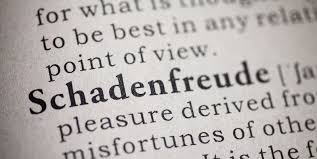
But none of these are my favorite.  How about #7, schadenfreudeSHAH-dun-froy-duh means “enjoyment obtained from the troubles of others”.  In March, schadenfreude pointed to the college admissions scandal, particularly the outing of the guilty A-list celebrities.  Schadenfreude also colored the daily coverage of President Trump by the so-called “fake news media”.

For the record, schadenfreude is German (of course it is) so let’s give it bonus points for sneaking onto a top-ten list of English words.

You may not agree with Merriam-Webster but at least its choices are based on real data – lookups that imply support from the masses.  Other organizations are much vaguer with their selection criteria.  Consider Time Magazine’s “Person of the Year”.  Time’s stated criteria is, “for better or for worse… has done the most to influence the events of the year.”  By that definition it should come as no surprise to see Adolf Hitler selected in 1938, Martin Luther King, Jr. in 1963, and Mark Zuckerberg in 2010.  However, you’ll also find almost every U.S. President on the list, as if simply inhabiting the Oval Office makes you more influential than all other persons.  President-elect Joe Biden and Vice President-elect Kamala Harris are 2020’s “Person of the Year”.  Uh, shouldn’t we at least get them inaugurated before evaluating influence?

Deserving of more “Timely” recognition…

[Note: Time’s “Person of the Year” recognition owes a debt to aviator Charles Lindbergh, who completed the first solo transatlantic flight in May of 1927.  The magazine overlooked Lindbergh’s accomplishment by never featuring him on its cover.  To make up for it, Lindbergh became Time’s inaugural “Person of the Year”.  Makes you wonder if someone else was more deserving in 1927, doesn’t it?]

One more “of-the-year” example for you.  Pantone, the “color company” best known for its Pantone Matching System (or PMS, a rather unfortunate acronym), chooses a color of the year to put the last twelve months in review.  For 2020?  Like Time Magazine, Pantone broke its own rules and went with two choices: Ultimate Gray, which suggests solid shadows cast on a wall; and Illuminating, a lemony shade hinting at “the light at the end of the tunnel”.  Illuminating might be a little premature for 2020.  Let’s go glass-half-full and call it next year’s color instead.

Is this light “Illuminating” to you?

If Merriam-Webster could choose its busy buzzwords in hindsight, 2020’s winner might not be pandemic but rather, malarkeyMalarkey came in at #11 in the top ten (come again?) because it’s a favorite of President-elect Biden.  Rather than saying, “C’mon man, you’re making that up.” (okay, he says that too) Biden prefers, “Give me a break; that’s a bunch of malarkey”.

“Malarkey” my words; you’re gonna hear the Biden favorite a lot over the next four years.

Some content sourced from The Cut article, “Pantone’s Color of the Year is ‘The Yellow Wallpaper’”, Merriam-Webster.com, and Wikipedia, “the free encyclopedia”.

Royal Beauty Bright

If I were more organized a couple of weeks ago I could’ve seen the Aurora Borealis. Maybe you’re familiar with this magnificent natural artwork: the waving colorful “northern lights” spreading across the sky like a wind-ruffled pastel blanket. The best seats for the AB are always to the north, like Alaska or the Arctic, but this year we had a similar instance just driving distance from our house in northern Wyoming. I missed it, darn it.  I’ll have to settle for a look at this week’s Christmas Star instead. Er, make that this week’s “Jupiter/Saturn overlap”.

The view from my house (directly above Pikes Peak!)

I’ve always been something of an astronomer wannabe. We have beautifully clear skies where we live and on most nights we can see more stars, constellations, and galaxies than we could possibly count. I’ve even invested in tripod-mounted high-power binoculars to get a better look at all things extraterrestrial. So I certainly didn’t miss the recent headlines about Wyoming’s “southern northern lights”, nor the nighttime blast of this week’s Christmas Star. Any astronomical event visible to the naked eye is worth noting in my iPhone calendar.

Courtesy of CBS News

Jupiter and Saturn aren’t really overlapping, of course (talk about an abundance of gas). They just look like they’re a single celestial object as seen from our Earthling vantage point. They’re still millions of kilometers apart in space, the same way stars in constellations aren’t all the same distance away from us. This blog post is a little late, as the best days to see “Jupiturn” were Sunday, Monday, and Tuesday, just after sunset and looking to the west.

Speaking of a little late, let’s talk about the Real Christmas Star (RCS). Surely you’re familiar with RCS, the singularly bright beacon from biblical times guiding the Magi to the birthplace of the baby Jesus (editor’s note: lots of “b’s” in that sentence, Dave). This star moved in a westerly path – as noted in the third verse of “We Three Kings” – like the oversized laser pointer of an invisible tour guide. This star was purported to have stopped directly over Bethlehem close to the events we celebrate on Christmas Day.  This star “with royal beauty bright” was…, was…, (spoiler alert) – well, this star wasn’t a star either.

Also not a star…

I know, I know.  We’re talking about events from over two thousand years ago.  Outside of the Bible and pure faith, how can we know the true identity of the RCS?  Well, we know because we have astrophysicists.  I’m never one to blend science and religion but I’m about to make an exception.

To keep this simple let’s address the basic questions:

  1. When did the RCS occur?  During the reign of King Herod and Emporer Tiberius.  Roman historians (and the Bible’s Book of Luke) give the approximate timeframe as 8-4 B.C.
  2. Who saw the RCS?  The Magi according to the Bible, but also Chinese astronomers according to their own records… which go back to (gulp) before 1000 B.C.
  3. What did the RCS look like?  A morning star, because it was rising.  Not a comet, not a nova, not even a supernova.  In ancient times those three were seen as indicators of negative events.  The Magi certainly wouldn’t have followed something negative.
  4. What was the RCS?  Ah, now there’s the question for the Powerball jackpot.  And that’s where our astrophysicists come to the rescue.  The RCS – like this year’s Jupiturn – was also the convergence of Jupiter and Saturn, only amplified by light from the sun, moon, and at least three other planets.  That’s putting a lot of “balls” into play, isn’t it?  Celestial alignments happen regularly over time so astrophysicists were able to project backward and offer this likely explanation of the Real Christmas Star.

The RCS alignment from two thousand years ago seems recent compared to its next occurrence.  You won’t get that kind of planet-star-satellite party again until the year 16213.  That’s fourteen thousand years from now.  You won’t be around by then.  Maybe Earth won’t be either.

I did look to the west after sunset to see the convergence of Jupiter and Saturn earlier this week.  It was bright – sure – but not as if looking directly at the sun.  And knowing it wasn’t a “star” took some of the shine off of it (ha).  Meanwhile, the Aurora Borealis is out there a little more often.  At least I’ll be alive to see its next performance.


Some content sourced from the University of Notre Dame article, “Royal Beauty Bright”.

It’s Been a Silent Night

When singer Amy Grant released “Tennessee Christmas” in 2016 it’d been years since she recorded a holiday collection. In fact, her platinum-level “A Christmas Album” arrived way back in 1983; her triple-platinum “Home for Christmas” in 1992. “Tennessee Christmas” didn’t achieve platinum, gold, or anything else for that matter.  As my brother said at the time, “She never should’ve done it.” He’s right. Amy should’ve released just “I Need a Silent Night” and called it good.

Amy Grant can still pen lyrics (even if her voice isn’t as strong as it used to be).  “I Need a Silent Night” asks us to find the true meaning of Christmas in the midst of the inevitable commercial distractions.  Instead of “December traffic” and “Christmas rush” and “Shopping and buying and standing forever in line”, Amy asks:

I need a silent night, a holy night
To hear an angel voice through the chaos and the noise
I need a midnight clear, a little peace right here
To end this crazy day with a silent night

As if we’ve been granted Amy’s wish (ha), this season has been remarkably placid.  The message of Advent is always “prepare” and that’s what we’re doing.  It’s just – unlike most years – we’re not using words like “rush” and “chaos”.  We’re experiencing more of a “silent night” instead.

Our Christmas prep never begins until after Thanksgiving (I stand on holiday principles here) but by the following Saturday I was eagerly unpacking the decorations and streaming holiday tunes.  More importantly, I also found myself saying “yes” to just about every reason for the season:

  • Since we can’t have in-person services our church offered Advent wreaths to build and display in whatever room you “go to church” in at home.  We asked for a wreath as soon as they were available.
  • A family involved in our local 4-H advertised festive bags of scented pine cones as a fundraiser for their activities.  We bought two bags and they delivered them straight to our door.  There’s nothing that says “Christmas” like the tiny voice of a five-year-old saying, “Thank you, Mr. Wilson!”
  • Our church set up a virtual giving tree where you can pick presents from a list, buy them, and return them to the church for distribution to needy families.  I bought six.
  • We’ve been baking up a kitchen storm so we decided to put together plates of cookies for our neighbors and deliver them.  Front doors were opened cautiously, to which we said, “Well, this may be the only chance we get to see you face-to-face this year.  Merry Christmas!”
  • We’ll be having drive-in Christmas Eve services this year so our church put out a big bin of ornaments, asking us to decorate them and put them on trees surrounding the parking lot.  I grabbed several.
  • Starbucks moves to Christmas drinks and goodies shortly after Halloween.  There’s this unspoken opportunity to “pay it backwards” by taking care of the car behind you in the drive-thru, and then speeding off to remain anonymous.  I’ve been doing this for weeks.
  • Colorado Springs advertises a Christmas For Kids effort where you’re assigned a needy child’s Christmas list.  You buy the gifts, wrap them up, and pass them on to case workers who make sure the kids get them in time for Christmas.  I sponsored two.

Most of these Christmastime gestures (and why should they only happen at Christmas, right?) would not find room in our “normal years”.  We’d be rushing about trying to find one last gift, throwing up Christmas lights and decorations, and hastily preparing our cards to put in the mail.  We’d be wrapping presents ’til well past midnight on Christmas Eve.  Yet this year we’re completely organized and ready, including all those meaningful extras I mentioned above.

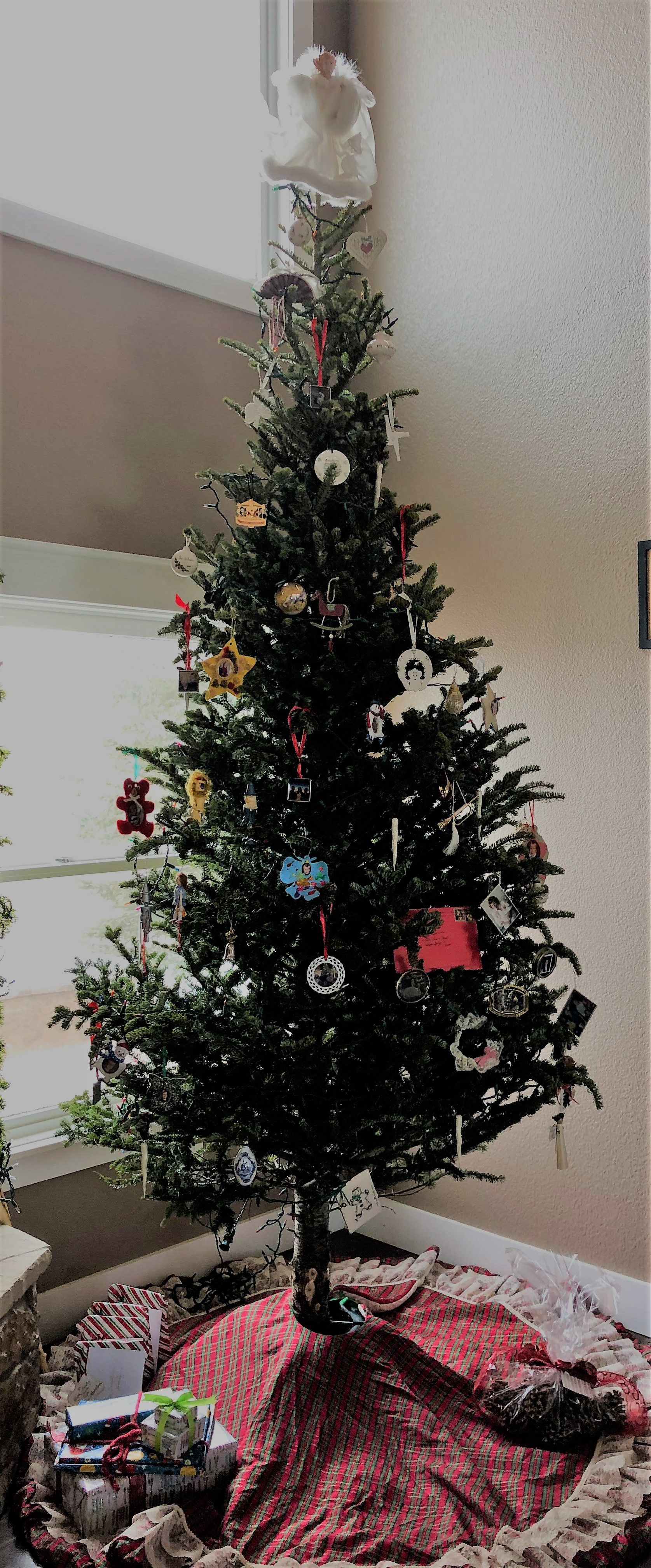
Let me “wrap” (ha) with one more holiday task we completed earlier than usual: decorating our tree.  Christmas trees must’ve been in high demand (or short supply) this year because our local lot only had one left in the 10′-12′ range we prefer.  It’s tall and thin (kind of like you see in Whoville in the original “Grinch” movie).  It’s so tall our angel at the top seems poised in the heavens, which is wonderfully appropriate this year.  She was the only decor on the tree all of last Sunday before we added everything else the following night.  So now our tree boasts the usual organized chaos of lights and ornaments.  But it’s only the angel I see.  She’s watching over us and giving us exactly what we need this year: a silent night, a holy night.

This post is in memory of Marion.

Golden Thrones

Every now and then the local news sneaks in a headline to showcase our local taxes and fees at work. A swanky new visitor center is about to open on the top of nearby Pikes Peak (14,115′) at a cost of $66M. A 250-ft. pedestrian bridge ($18.7M) spans gracefully over downtown railroad tracks, connecting a public park to our new U.S. Olympic museum complex. Increased traffic between Colorado Springs and Denver demands eighteen miles of a new interstate toll lane ($350M).

Colorado Springs must be “flush” with tax dollars

These efforts make sense and I’m happy to write the check, especially with the potential for revenue in return. But another project almost escaped my news feed and Mr. Mayor, I respectfully request a refund. We now have a fully-accessible fully-automated self-cleaning public toilet in a small park on the west side of town. Cost: $415,000.  That’s a lot of loot for a little lavatory, no?

On the surface our golden throne sounds good enough to try out.  It’s a touchless experience once you “ring the doorbell”.  The restroom door opens/closes automatically with a sanitary-sounding hiss.  Circulating air and classical music provide the white noise you need to mask unpleasant sounds.  A bathroom “host” politely pipes in over the loudspeaker to let you know you have ten minutes to do your thing.  After that – reason in itself to just go and watch from a distance – all doors open whether or not you’re buttoned up.  Talk about getting caught with your pants down.

Our city’s posh powder room comes from Exeloo (great name), an Australian company expanding its footprint into North America.  Besides the fancy features mentioned above Exeloo toilets are self-cleaning, which means they spray down and disinfect their surfaces from wall-mounted nozzles every thirty uses or so.  Makes me think the kitchens of Chinese restaurants could use the same treatment.

The (cheaper) Exeloo “Saturn”

Learning more about Exeloo didn’t make me feel better about my tax dollars.  That’s because our city purchased the fanciest model on the website.  Exeloo offers six different “loos”, with names like Jupiter, Saturn, and Orbit.  (Why – because going to the bathroom should be an out-of-this-world experience?)  Our city chose the model simply named “Fully Accessible”.  It looks at least twice as big as any of the others.

Let me contrast our wet-n-wild washroom with a more modest facility.  Just off the coast at Torrey Pines in North San Diego County you’ll find a nondescript public restroom sandwiched between the beach and the parking lot.  It has no doors.  It has no music.  It’s made entirely of cinderblocks and concrete.  A flush requires an “old-fashioned” pull of the handle, emitting just enough water to clear the bowl.  The sinks offer just a trickle of water to rinse your hands.  The mirrors aren’t mirrors at all, but big polished metal panels with just enough of a reflection.  This restroom is bombproof.

Which brings me to my point.  Why does my town need a bathroom good enough for a visit from Queen Elizabeth when cinderblock and concrete will do just as well?  The Torrey Pines toilet probably cost $4,000, not $400,000.  The next headline I’ll be reading is how a homeless person took up residence in our well-to-do water closet and now our tax dollars have to fund a full-time attendant as well.

The first time I experienced a first-class public flush was in Boston Common.  Smack dab in the middle of the grass expanse and softball diamonds we found a restroom similar to an Exeloo, only more like a double-wide RV.  It was a welcome sight after hours exploring the city on foot.  An attendant sat quietly on a nearby park bench, keeping an eye on things.  And the cherry on top of this sanitation sundae: the facility was sponsored by a non-profit called Friends of the Public Garden.  Not a tax dollar to be spent.

Could’ve had this whole house for less than our Exeloo, Mr. Mayor

Since we can’t go out to dinner or see a concert or even go to church this Christmas, I think I’ll take the family to see our sparkling Exeloo public restroom instead.  Maybe they’ve scented the circulating air to smell like Christmas cookies or pine trees.  Maybe they’ve switched out the classical music for holiday favorites.  Hopefully they’ve dressed up the attendant to look like Santa.  It’s the least they can do for my tax dollars.

Some content sourced from the 11/6/2020 Springs Magazine article, “At Least We Have a $300K Bathroom”.

The Original “Black Friday”

The first two weeks of November were jammed with “un-often” events this year.  For starters the bright light of Halloween’s blue moon spilled into the wee hours of November 1st.  During those same wee hours most of us lost Daylight Savings Time.  The very next day (Monday) marked the official arrival of Hurricane Eta to our shores. The day after that we voted in a presidential election. A week later we staged the Masters golf tournament (it’s supposed to be in April, people).  Then we had another hurricane (Iota), the first time we’ve had two in November.  Finally, we spiked positive COVID-19 tests in record numbers after months of declines.

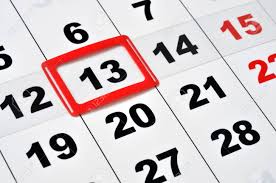
That’s a pile of rarities in a short amount of time.  So why not add one more to the heap?  Friday the 13th.  I missed it completely.  Maybe you missed it too (and you’d be forgiven with all those other distractions).  Last Friday – the 13th – came and went without an ounce of bad luck to blog about.  Ironically, the only story I can share brought good luck.  I placed a carry-out dinner order last Thursday night and the restaurant gave me someone else’s food.  When I went back for the right order they told me to keep both.  As a result my Friday the 13th dinner was unexpectedly “on the house”.

Are you superstitious?  I’m not – not in the least.  I have no problems with sidewalk cracks, leaning ladders, or black cats. I don’t lose sleep anticipating the third occurrence of a bad thing.  I gladly pick up a penny (it’s free money after all) but with no expectations of luck.  I’ve broken mirrors (deliberately, in remodel projects) and wishbones (on a whim, in turkeys).  I’ve even knocked on lots of wood (mostly doors) but hey, my life goes on as usual.

Leonardo da Vinci’s masterpiece

As for Friday the 13th’s “un-luck”, its long-ago origins are suspiciously weak.  The most common comes from the story of Jesus in the Bible: thirteen individuals at the Last Supper (Thursday) followed by Jesus’ foretold crucifixion the following day.  Other theories point to fighting gods in mythology and fighting knights in the Middle Ages.  None of these carry water in my book.  Seriously, how did misfortune come to be associated with the collision of a particular day and date?

I read up on calendar averages, thinking the 13th falling on a Friday was as uncommon as a blue moon.  Maybe the 13th favors the other days of the week instead?  Nope, try the reverse.  Over a significant number of years the 13th falls on Friday more than Saturday, Sunday, or any other day of the week.

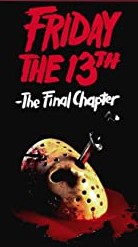
To add a helping of confusion, look no further than Spain or Greece.  These countries have an irrational fear of Tuesday the 13th.  Italy?  Friday the 17th.  Imagine watching America’s famous horror movie franchise in any of these places and wondering, “so… why do they call it ‘Friday the 13th'”?

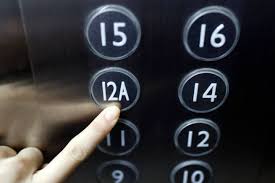
No matter my efforts to undermine this superstition, the effects are real.  Over 17 million Americans admit to a dread of Friday the 13th.  Some avoid airplane travel and others won’t even get out of bed.  Buildings remove the thirteenth floor from the stack (which is a lot of demolition for a superstition, isn’t it?)  Elevators conspicuously delete the “13” button.  Numbered seats in stadiums go 10, 11, 12… 14, 15, 16.

For some of you, Black Friday means bargains.  For others, Black Friday means “13”. If nothing else, I’ll give you a couple of words to describe the circumstance of the latter’s irrational fear.  If you’re afraid of the number 13 you have triskaidekaphobia.  If you’re afraid of just Friday the 13th you have paraskevidekatriaphobia.  (Me, I only have acrophobia.  At least your phobias sound more sophisticated.)

Fact check.  This post was published close to the midpoint between Black Friday (the 13th) and Black Friday (the retail binge).  Okay-y-y-y.  This post also contains exactly 666 words.  WHOO boy.

Let me repeat… I am NOT superstitious.

Some content sourced from Wikipedia, “the free encyclopedia”.

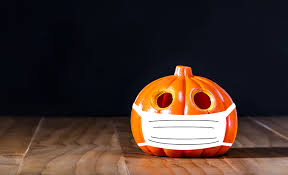
Halloween’s Element of Surprise

Same ol’, same ol’… sigh…

Our grocer dedicates an entire aisle to Halloween this time of year.  It’s a pile-on of kid costumes, yard decor, plastic jack-o’-lanterns, and party supplies.  You’ll also find massive bags of assorted small candies, enough to load up your front door bowl with a single pour.  These treats are individually wrapped and brand-familiar to carefully conform to the holiday’s “safe standards”.  In other words, there’s no element of surprise in all that sugar.

When was the last time you were treated to a little something you didn’t expect?  Here’s a good example.  My wife and I traveled to Texas last weekend to visit our son.  As we settled into the hotel room we noticed a tray on the table with two bottles of water and a couple of wrapped candies.  Not so unusual.  But then we read the little card next to the tray.  Not only was the water free of charge (hotels typically stick it to you with bottled water) but the candies were handmade salted caramels from a local culinary kitchen.  Suddenly I’m thinking, “What a nice hotel!”

Perhaps you know a few other hotels with the same gesture, as Doubletree does with its chocolate-chip cookies (see Calories of Contentment for more on that).  But unlike our Texas hotel, Doubletree always goes with the chocolate-chip cookies.  Stay there enough and you come to expect them.  No surprise.

That, in a nutshell, is what’s wrong with Halloween today.  You still get the occasional trick (TP in the trees?  Shaving cream in the pumpkins?) but the “or-treat” routine has been reduced to just that – routine.  Think about a child’s anticipation for the big night.  Hours spent making sure their costume stands out in a crowd.  Miles spent covering sidewalks and front walks.  Fingers spent on doorbells and knockers, all so they can get, what… another fun-size Hershey bar?  Where-oh-where is the element of surprise?

Mom’s Halloween treats

Back in the “ol’ days” (because I’m feeling old today) a lot of front-door Halloween treats were homemade.  People handed out family-recipe popcorn balls and caramel apples.  My mother made the frosted ginger pumpkin cookies you see here.  A guy down the street dressed as Dracula and manned a little round grill in his driveway, handing out barbecued hot dog bites on toothpicks.  You never knew what you’d walk away with until you made it to the next house.

A mini pumpkin has zero HTV

Creative treats only boosted the night’s excitement back then.  I remember catching up with friends in the darkened streets to compare the collective efforts in our bags.  More importantly, the wide variety of treats upped the ante on what one candy-ranking opinion piece referred to as “HTV” or Halloween Trade Value.  After all, the most important event of the night was the post trick-or-treat trade, right?  You’d spill the contents of your pillowcase into a big pile on the floor and the back-n-forth would begin.  “I’ll give you three rolls of Smarties and a Baby Ruth for your Charleston Chew”.  Yes, friends, those were the days.

Everything changed when Halloween lost its young-and-innocent status.  Parents inspected treat bags to filter out anything remotely suspicious.  Homemade items only made it as far as the next-door neighbor’s kids or backyard Halloween parties.  Suddenly a treat didn’t pass muster if it wasn’t recognizable and wrapped.  The creative license of trick-or-treating has expired.

But hold on now.  What about the other 364 days of the year?  Can’t the element of surprise show up on one or more of those?  Can’t we still be caught off guard… in a good way?

Here’s an attempt.  At least two companies offer monthly treats by subscription and you have no idea what’s coming.  SnackCrate describes its product as “a world of snack surprises – monthly”.  TryTreats advertises “each month’s box will feature snacks from a different country in the world.  The country you’ll receive is a secret until you receive the box!”  Kind of a spin on my ol’-days Halloween nights, don’t you think?

Speaking of treats I think the dog got wind of this topic.  The other night I prepped his dinner with the usual two cups of kibble topped with a few bits of lunch meat.  He ate the bits but left the kibble.  He’s never done that before.  Maybe he’s bored with it?  I need to shake things up.  Throw in a few doggie treats.  Add the ol’ Halloween element of surprise and get his tail wagging again.

The Ghost of Saint Francis

“Saint Francis” (Digital Art by Randy Wollenmann)

I’ve long been a fan of the Google Calendar app, even after switching my mobile from Android to Apple. Google Calendar allows the option to add “Christian Holidays” so I promptly checked the box. We’re talking Christmas and Easter of course, but how about the Feast Day of Saint Francis (last Sunday), Saint David (3/1), and Saint Patrick (3/17)? Saint Patrick sure, but why also Francis and David? There are hundreds of saints yet Google chose just three. My curiosity was piqued.

So begins my beyond-the-grave story, perfect with Halloween on the horizon. Google’s choice of saint days got me wondering if there’s a spectral connection between me (David) and Francis. So I dove into the details. Now all I can say is, be careful what you wonder about.

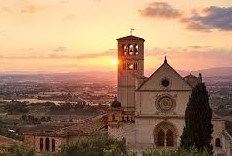
Basilica of St. Francis, Assisi, Italy

The quick history of Francis. He’s the patron saint of animals. He was an Italian living in the 1200s from the central hill town of Assisi. Francis grew up wealthy but abandoned his riches to serve the Church and the poor. But it’s the animals that make him so popular among today’s saints. He (supposedly) communicated with wolves. He often preached to flocks of birds. He built the very first Christmas crèche, including live animals alongside the manger.

Now then, my Francis ghost story. Let’s cover this spookiness from present to past. I’ve discovered a pattern of events that has me convinced Saint Francis is trying to reach out. As a matter of fact, he’s been in touch every ten years back to when I was a baby. If you agree you can see why I’m expecting another “call” in 2023.

  • 2013: I’ve told you Francis is the patron saint of animals but guess what? He’s also the patron saint of avoiding fires. In June 2013, my family and I evacuated our Colorado house for a week (horses and dogs in tow) to escape one of the worst fires in our state’s history. When we returned, our house was not only intact but had no smoke damage. Meanwhile, over 500 properties within a five-mile radius were completely destroyed.

  • (Also in) 2013: Cardinal Jorge Mario Bergoglio of Argentina was elected Pope. He promptly changed his name to Francis. There have been 266 Popes in history, but Cardinal Bergoglio is the very first to select the name “Francis”.

  • 2003: The Front Range of the Colorado Rockies experienced one of the worst blizzards in our state’s history. In a matter of hours a single storm dropped over thirty inches of snow, with drifts of five feet or more. My family and I were snow-locked in our house for over a week. 100,000 residents lost power while 4,000 travelers were stuck at the international airport in Denver. Saint Francis is also the patron saint of the environment. Was he making his presence felt with unprecedented weather?
    Assisi’s sister city

  • 1993: My family and I moved from San Francisco to Colorado. San Francisco (named for Francis) is the sister city of his birth town of Assisi. But here’s where I really paused. Francis is also the patron saint of… Colorado. And how many other U.S. states chose Francis as their patron saint? Zero.

  • 1983: I’m in my junior year in college, studying abroad in Italy. The patron saint of Italy is… Francis, of course. I also traveled to Assisi while I was there, including a visit to the church where Francis is buried. This is the only time I’ve ever been to Italy.

  • 1973: Acclaimed biographer Ira Peck writes, The Life and Words of St. Francis of Assisi. It’s a short read, with easy language intended for middle-schoolers. Where was I in 1973? Starting my first year of middle school.

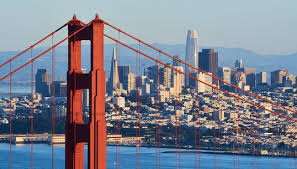
  • 1963: On March 21st, the Alcatraz Federal Penitentiary closed for good after thirty years. Alcatraz is the famous island prison in the San Francisco Bay. What does Alcatraz have to do with my ghost?  Back in 1202, a young Francis was thrown in prison for a year, captured while serving a military effort. His spiritual conversion from wealthy patron to humble priest, it is said, took place during this time in prison.

Our Saint Francis statue

And there you have it. Every ten years – starting the year after I was born – Saint Francis seems to have reached out to me. Oh, one more thing.  My wife and I have a statue of Saint Francis in our garden. “Of course you do”, says Francis.  He’s been standing quietly there for years, facing the house, just keeping his eye on us.

Francis will reach out to me again in 2023, I’m sure of it now. He’ll find another way to make his presence felt. When I read up on him I noted he’s also the patron saint against dying alone and the patron saint of needleworkers. Against dying alone? Am I destined to perish alongside several others in 2023? That’s not very nice of you, Francis.  I’d better take up knitting.

Some content sourced from Wikipedia, “the free encyclopedia”.

(Not) Paying the Piper

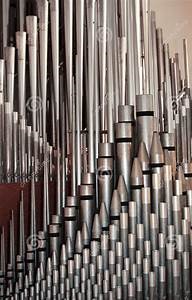
One player, many pipes

Our church is weighing creative approaches to conducting in-person services next month. Pastor Bob sent out a survey recently asking we-the-congregation to consider options like outdoor church, weekday church, and evening church – all in the name of social distancing.  We’ll also be shaking up the service “touchpoints”, like sharing the peace, passing the (offering) plate, and partaking in communion. The Big Guy doesn’t care about the where’s, when’s, and how’s, of course – just that we have church.  On the other hand, He (She?) might have something to say about the music. After all, how does a church organ sound after a three-month absence from tuning?

It’s bad enough our congregation is gloriously inharmonious when we bellow out the hymns (no choir of angels are we), but add in a fully discordant church organ and you have a complete mess. Organs need tuning like the human back needs a chiropractor: maintenance is key. When dust accumulates and seasons change, organ pipes sound noticeably different than they’re supposed to (hence the term “off-key”).  Imagine the pitch-perfect tones of a bass saxophone, but instead you get more of a sour wail.  That’s an organ pipe sans “tune-up”.

Every one needs tuning

Tuning organ pipes is serious business and can run thousands of dollars per visit.  Consider, the biggest organs have as many as 25,000 pipes.  The booming bass pipes can be thirty feet long and two feet in diameter, while the little pixie sopranos look more like metal soda straws. Each pipe must be individually tested and tuned no matter how big or small.  Tuner A presses a key on the (up to four) keyboards down below, while Tuner B adjusts the pitch of the pipe up above (sometimes on a ladder, sometimes on a suspended platform).  It’s hours and hours of monotonous – and in the case of cathedrals, death-defying work, one demanding pipe at a time.  Better love what you do.

Here’s another reason organ tuners deserve hazard pay.  Imagine you’re suspended hundreds of feet above the sanctuary floor on a swaying rope-suspended platform (I’m already saying “no”), virtually floating like the angels, and as you reach over to adjust the pitch of a mid-sized pipe, bats fly out.  Yep, that’s the kind of critters tuners encounter when an organ wants for too long (or a single pipe sounds suspiciously out-of-tune).  Squirrels even make their homes in the pipes – though don’t ask me how they don’t go plummeting to their death the moment a note is blasted from the keyboard.  Maybe they’re flying squirrels?

The view from above

In the land of COVID-19 there are no organ tuners (or very few).  Those Peter Pipers are being denied access to their church-bound “patients” because a) COVID may reside on a surface like, say, a keyboard, and b) no congregation means no offering plate means precious few payments to the Piper.  So what do stay-at-home tuners do instead?  Why, they tune their pianos of course!  Then they play those pianos hours on end.  We may come out of COVID with a whole new genre of classical music called “tuner tunes”.

Talk about a sprint from feast to famine.  An organ tuner’s busiest weeks are those leading up to Easter, often requiring extra staff and longer hours.  COVID downpoured on that parade.  Demand for pre-Easter tuning disappeared faster than Mr. Bunny himself.  In the case of one tuner – profiled in the Wall Street Journal – 100 contracts withered to less than a dozen inside of two weeks.  He furloughed his entire workforce, worried instead over simply paying the rent on his shop.

One day soon, we faithful will walk away from our laptops and wander back into church sanctuaries instead.  We’ll spread out over more services.  We’ll wave hands instead of shake hands.  We’ll drop the offering into the plate from a “safe height”.  We’ll bypass communion servers and help ourselves to the bread and wine instead.  The organist will play and the congregation will sing; both noticeably off-key.  And when that happens give a nod to the organ tuners, who will someday get the pipes pitch-perfect again. 

Just hope they don’t need an exterminator as well.

Some content sourced from the 3/25/2020 Wall Street Journal article, “As Coronavirus Shutters Churches, an Organ Whisperer Changes Key”, and Wikipedia, “the free encyclopedia”.
Confection Perfection

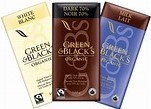
While grocery shopping the other day, my wife asked me if I’d eat something containing “77% dark chocolate”. I replied casually, “No, my limit’s more like 72%”. To those in the know, the percentages refer to the cacao content; not the broader term “chocolate”. And that level of technical shows you how far I’ve come from the 3 Musketeers bar of my youth.

Each of us taps into our particular coping mechanisms as we deal with impacts of the pandemic. My wife spends countless hours playing brain games on her iPad. More of my neighbors take daily walks than I’ve ever seen before. Me? I’m getting lost in a few rainy-day projects, but more to the subject at hand, I’m tapping into my dark chocolate stash. There’s something therapeutic about a small square of the good stuff slowly dissolving on the tongue.  Dark chocolate is medication for troubled times.  It sates my soul.

I can’t recall when I graduated from “candy bar” to “chocolate bar”, let alone dark chocolate.  Like most kids of the 1970’s, I was drawn to Milky Way, Snickers, Nestle Crunch and the like, due to an annual dose of “fun-size” every Halloween.  But somewhere I had an epiphany and realized chocolate was pretty good all by itself. The clincher: studying abroad in Italy during college.  Overnight it seemed, I graduated from the products of Hershey’s and Mars to the more refined of Perugina and Ferrero. 

The Wall Street Journal recently interviewed Thierry Muret, the executive chef chocolatier at Godiva, and after reading the article I thought, “Now there’s a dream job”.  Not so fast, Mr. Goodbar.  Turns out Monsieur Muret is an industrial chemistry grad who leans heavily on his knowledge of science to create Godiva-worthy delicacies.  Muret’s all about “molecular gastronomy”, or decomposing/recomposing the very elements of chocolate to develop new textures and tastes.  Think about that the next time you bite into a Godiva truffle.

This much I know.  Chocolate’s most common varieties are “milk”, “dark”, and “white”, and while each contains cocoa butter, they’re better defined by their other ingredients (i.e. the dairy in “milk”).  My taste for dark chocolate evolved over a lot of years, the way my coffee matured from “instant” to “espresso”, and my wine from “Chardonnay” to “Cabernet”.  The basic versions simply don’t cut it anymore.

Thanks to Monsieur Muret, this much I don’t know about chocolate.  There’s a tight temperature range (65°-75° F) where fine chocolate can be “tempered” (shaped into truffles, etc.) without altering its delicate flavor.  There’s also a tight time frame to temper, because you don’t want the temperature to fluctuate more than a degree or two.  But Muret colors outside of the lines.  He throws temperature and time frame to the wind to concoct new textures and tastes.  He once spent an entire year perfecting a single ganache.  Whoa; that’s taking it to a whole new level.

The path to chocolatier typically goes through culinary school, not the chemistry lab.  You start with a pastry degree (pastry degree?) and then specialize in chocolate/confections.  Nope, not what I studied in college – not even close.  But I do deserve a “tasting degree” for my years of experience.

If the pandemic goes on long enough, I may find the shelves of our grocery store devoid of dark chocolate.  No problem: I’ll settle for a good ol’ 3 Musketeers bar instead.  Milk chocolate (not to mention the dose of childhood nostalgia) is a passable backup coping mechanism.

The so-called experts say there’s “no high-quality evidence that dark chocolate provides health benefits”.  With coping in mind, I couldn’t disagree more.

Some content sourced from the 2/7/2020 Wall Street Journal article, “Nothing Could Be Sweeter Than Being Godiva’s Top Chocolate Chef”, and Wikipedia, “the free encyclopedia”.