An Unhealthy Modern Phenomenon

Somewhere in the wee hours of Tuesday morning I had a bizarre dream; one I retained well into my conscious hours. I was on some sort of overseas sightseeing excursion with others, and our group stopped for lunch at a historic convent. Egg salad sandwiches were handed out by the nuns and I promptly dropped mine onto the cobblestones. The dream only gets more disconnected from there but I’ll share one more noteworthy detail. My traveling companion was the actress Mary Stuart Masterson.

“Watts” on the right

Got all that?  Okay, now forget about everything except Mary Stuart.  Masterson has had a respectable (if not award-winning) career as an actress.  She was only ten years old when she first appeared on the silver screen, in the original version of The Stepford Wives.  She went on to play colorful characters in Fried Green Tomatoes and Benny & Joon.  But her most enduring performance – the one she will forever be linked with – was as “Watts”, the companion/tomboy of “Keith” in the high school rom-com Some Kind of Wonderful.  Masterson’s turn as the loyal friend who quietly wanted to be more absolutely stole the show.

As if nuns and egg salad sandwiches aren’t enough, you’re wondering why Mary Stuart Masterson was sitting next to me in my dream.  Actually it wasn’t Masterson herself; it was her movie character Watts.  Which brings me to the Cambridge Dictionary’s 2025 Word of the Year.  Would you believe Cambridge added 6,000 new words to its big book this year?  5,999 of them were runner-ups to parasocial, a word “describing a connection people feel with someone they don’t know (ex. celebrities, influencers, and other online personalities)”.

Blogger’s Note: WordPress needs to get on the ball here.  “Parasocial” is underlined here in my draft post as being an unrecognized word.

Taylor & Travis

Parasocial’s win as Word of the Year has everything to do with Taylor Swift.  Her engagement to NFL star Travis Kelce generated countless claims of “heartfelt feelings toward a couple the vast majority had never met”.  The same applies to Watts.  I don’t know the first thing about Mary Stuart Masterson herself, but I know everything about Watts from watching Some Kind of Wonderful a dozen times or more.

“Parasocial” has actually been around since the 1950’s.  In that era it referred to the innocence of television viewers connecting to television characters (or in my case, movie viewer to movie character).  But today’s version of the word is described as “an unhealthy modern phenomenon”.  Why?  Because of social media.  Because of artificial intelligence.

Ms. Masterson today

My example of Watts is one movie and one instance.  I’ll finish this post and the “encounter” will fade into my memory forever.  But social media – which brings the viewer constant feeds about the “viewed”, and artificial intelligence – which creates a sense of connection where there really isn’t one, makes it clear why there’s reason to be concerned.  Are we really so desperate as to develop foundation-less relationships with strangers?

AI has already found its place on Spotify.  Search for Xania Monet, the first artificially intelligent singer to grab a ranking on a Billboard chart (Adult R&B).  Everything about Xania was created on a keyboard.  But her face, her social media profile, and her voice suggest she’s a living, breathing human somewhere out there in the world.  I wouldn’t be surprised if you can even chat online with Xania.  If so, you’re developing a one-sided relationship (you) with someone who isn’t real whatsoever (a computer).  Seriously, who has time for this nonsense?

“Xania Monet”

Coincidence or not, one of the Cambridge Dictionary’s runner-ups for Word of the Year was “slop”, which in this day and age means “content on the internet that is of very low quality, especially when created by artificial intelligence”.  Let’s declare “slop” a lot of what’s going in parasocial relationships as well.

The real message of this dictionary winner is clear.  We need to remove the “para” from parasocial and focus on simply socializing with our fellow humans.  It’s the only path to truly fulfilling relationships.  Having said that, for some reason I’d love an egg salad sandwich right about now.

—————-

LEGO Trevi Fountain – Update #4

(Read about the start of this build in Brick Wall Waterfall)

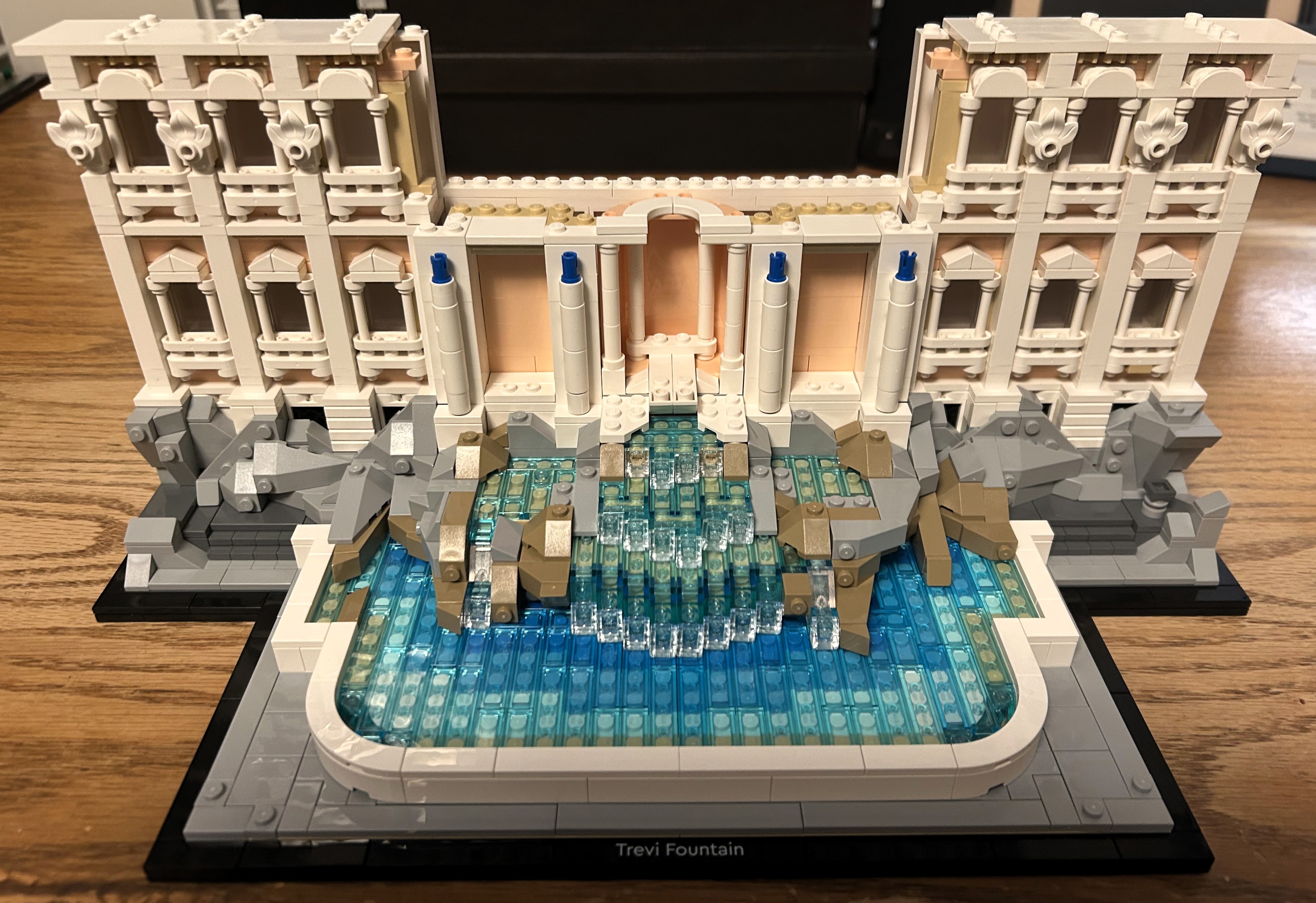
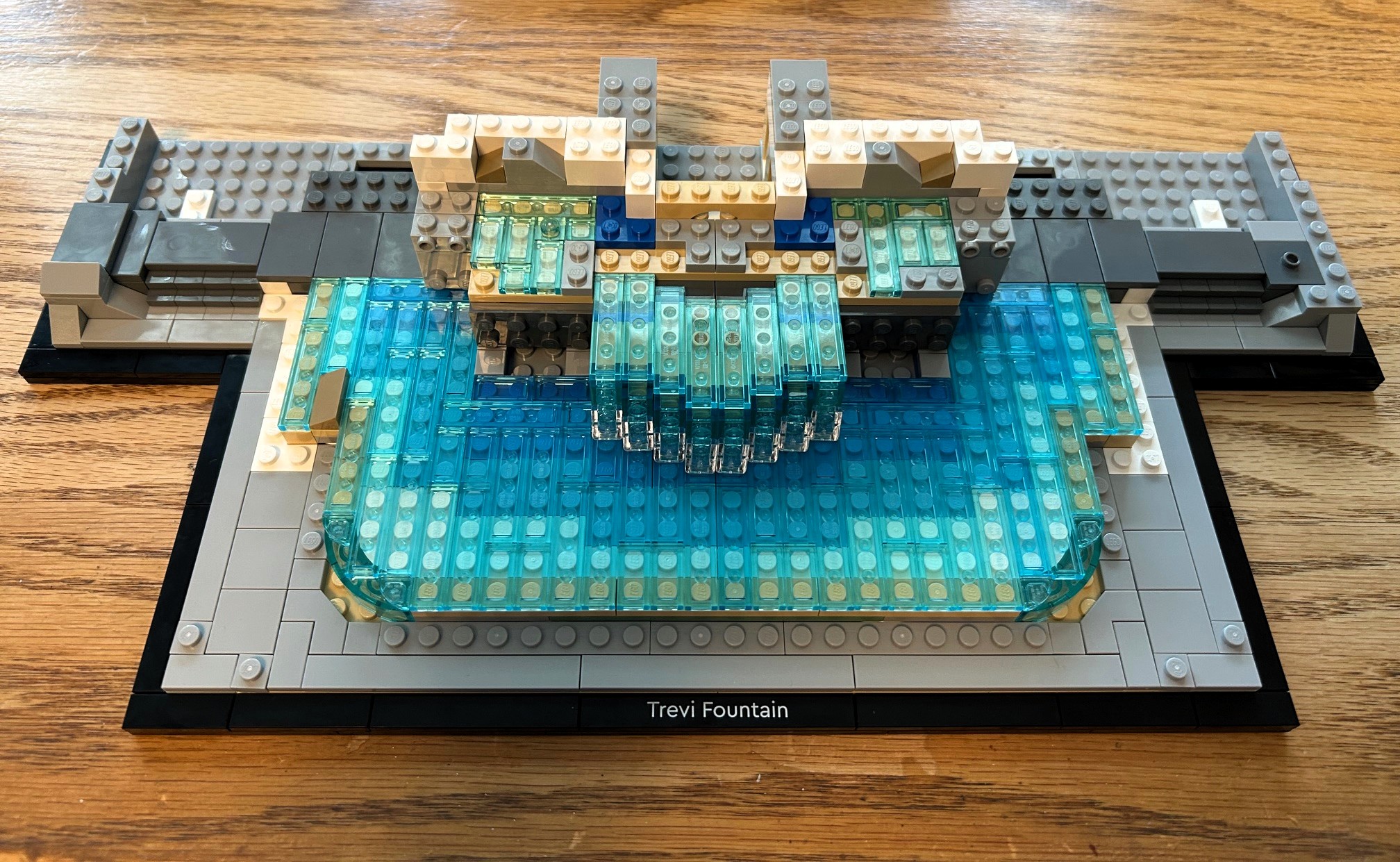
The travertine is stacking up quickly  as we continue our work on the LEGO Trevi Fountain.  Bags 7 and 8 – of 15 bags of pieces – came together like the Domenico Scarlatti piano sonatas that accompanied them – seemingly simple on the surface but more intricate and involved the further we dove in.

The Trevi Fountain has some strange elements, made even stranger when represented by chunky LEGOs.  Check out the shapes I assembled today (and don’t ask me what they’re meant to represent).  Little LEGO pieces positioned in just about every point on the compass.  My singular mistake this round – realized well after the fact – was putting the right piece in place, only the wrong color.  Then when I came across another “right piece wrong color” I knew I had them transposed.  Took a little disassembly to get everything correct.

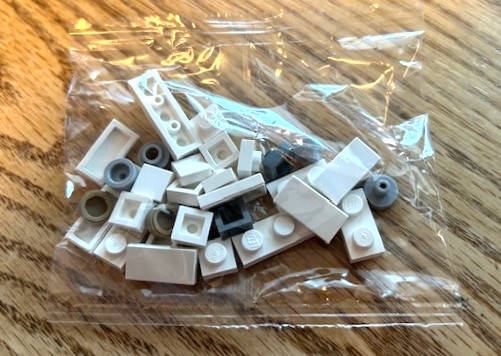
Bag within a bag

A continuing mystery of LEGO sets is bags within bags.  When I opened Bags 7 and 8, each came with a smaller bag of pieces like you see here.  It’s not like the smaller bag represents its own unit of the fountain.  You just tap into those pieces every now and then as the instruction manual demands.  Yes they’re tiny, tiny but you also find tiny pieces in the bigger bag.  Maybe someday I’ll tour the LEGO factory and solve this packaging mystery.

We worked with some surprisingly large pieces of travertine today – the entire wall of white you see behind the fountain and the white surround you now see defining the entire front of the main pool.  Would’ve taken a dozen Italians to put these monster pieces in place on the real Trevi.  And don’t miss the pink accent strips to the left and right of center (pink!)  This fountain is turning out to be more colorful than I expected.

Running build time: 3 hrs. 5 min.

Total leftover pieces: 23 (10 more extras today!)

Some content sourced from the BBC.com article, “Parasocial is Cambridge Dictionary Word of the Year”, IMDB, “the Internet Movie Database”, and Wikipedia, “the free encyclopedia”.

Cold Brew

Seemingly overnight, a new drive-thru named 7 Brew showed up next door to our local supermarket.  A quick glance as I drove by suggested their slogan: “Come for the coffee, come again for the people” is on the mark, with more employees dancing around the drive-thru lanes than making drinks in the petite building itself.  7 Brew advertises an “experience” as much as it does a menu of coffee and energy drinks.  It’s just the latest concept to steal market share from Starbucks.

7 Brew

Did you know today is “Red Cup Day” at Starbucks?  Red Cup Day is the coffeemaker’s nod to the beginning of the holiday season.  Buy a Starbucks “holiday” drink and you’ll also receive a festive reusable cup – more distinctive than the usual white ones.  The red cups suggest Christmas comes early this year, and encourage the purchase of peppermint mochas, eggnnog lattes, and iced gingerbread chais.  Somewhere in all that there might even be coffee.

I admit, the Starbucks Chestnut Praline Latte really is Christmas in a cup.  The drink tastes of the same spices you’ll use with Grandma’s cookie recipes this season.  And on a recent trip through Chicago O’Hare, my wife and I caved to a couple of Starbucks’ ever-popular Pumpkin Spice Lattes.  But here’s my point.  Starbucks is no longer my go-to for coffee drinks.  It never was my go-to either, but there were plenty of morning commutes when I couldn’t pass up a Flat White and a couple of egg bites.  Now I drive by without pause, the same way I’ve done so with McDonald’s for decades.  It begs the question: has Starbucks become passé?

There are signs suggesting we’ve already put Starbucks in the rear-view mirror, even if 38,000 locations still dot the globe.  Like 7 Brew, Starbucks has always tried to deliver an experience as much a drink.  Come on in.  Hang out for awhile.  Even if you don’t, peruse all the “merch” while you’re standing in line.  Chances are pretty good you’ll spend more on logo items and baked goods than coffee.

This year, Starbucks features a 20-oz. “Bearista” cup.  It’s a refillable glass ontainer with a straw and it’s being marketed as a collectible.  You’ll find these bears at your nearest Starbucks for $29.95.  Or maybe you won’t, because they seem to be disappearing as fast as they’re put on the shelves.  If you’re a little desperate, find one on eBay for $500 or more (coffee not included).

To me that’s a good way to describe Starbucks these days… a little desperate.  They’re closing stores without drive-thru lanes, which suggests they’re trying to reduce the money they spend on leases.  They’re laying off retail and non-retail employees, the typical corporate strategy to try to do more with less.  And they’re coming up with bear-shaped cups the size of a Starbucks “Venti”, so you’ll purchase their largest coffee when you wouldn’t have done so with a regular cup.

If you think the “bearista” is cute – and would pay $29.95 for it – how about “Hello Kitty” products?  Coming soon, you can buy a “plush” wearing a Starbucks green apron, and any one of five Hello Kitty containers, from water bottles to ceramic mugs.  Each of these runs you $30 or more (again, without the coffee).  Cats and coffee?  It’s a desperate strange marketing strategy, perhaps aimed at a generation of consumer that seeks something more trendy than coffee in a red cup.

This year, the Pumpkin Spice Latte showed up on the Starbucks menu on August 26th; hardly what I’d call “fall”.  Their Christmas-y drinks debut today, fully two weeks before Thanksgiving.  That’s stretching the seasons a little.  But let’s say I still splurge for a Grande Flat White, a couple of Egg Bites, and a slice of Iced Lemon Loaf.  I’ll pay $20 before I even consider the purchase of a “bearista” or a kitty.  It may be time to move on from the red cups.  Maybe I’ll give 7 Brew a try instead.  $7 gets you their smallest size… even pricier than Starbucks.  No guarantee you’ll find any coffee in that cup either.

(Coming next week: more updates on the LEGO Trevi Fountain!)

A Bowl of Snowflakes

Part of the appeal of Halloween – at least for us baby boomers – is the thought of innocent days (and nights) from our distant past. Not only were we kids back then, we cavorted in full costumes through our neighborhoods without a parent in sight. Every house left a light on or a door open to welcome trick-or-treating. Every street seemed safe and inviting.  And the treats were often as homemade as they were store-bought. Cookies. Lollipops. The odd neighbor doling out little sausages hot off the grill from his front yard (BBQ sauce optional). And the occasional popcorn ball.

Who doesn’t love a good popcorn ball?  Me.  I don’t.  Popcorn balls may be a nostalgic Halloween memory but they’re also an insult to popcorn.  Whoever invented them turned a savory snack into a sickly sweet one.  We’re not talking caramel-, chocolate-, or even kettle-corn sweet here;  just liquid sugar designed to act as glue to make popcorn a convenient handheld.  Awful.

I admit it, I’ve become a popcorn snob the way some people are about coffee.  There’s a way to enjoy popcorn and there’s a dozen ways not to.  It’s a snack that deserves to get it right, because getting it wrong is anything but a “treat” (like popcorn balls).

Popcorn eased its way into our after-dinner desserts by necessity.  One day (night) my wife and I sat there after the evening meal and realized we were having dessert way too often.  It was always ice cream, cookies, or whatever else we could find in the pantry.  Somehow a savory dinner necessitated a sweet dessert.  Bad habit – very bad.  Instead, make the dinner healthy enough, eat it early enough, and keep yourself off the couch watching TV.  Then dessert rarely enters the conversation.  Yeah, uh, we’re still working on that.  The dinners are healthy, but we can never get them on the table – er, couch – before 7pm.

Popcorn to the rescue. It’s a dessert that doesn’t feel like a dessert.  It’s not sweet, and with an air popper it’s all of three ingredients.  Popped corn, topped with butter and salt.  Make those first two “organic” and the last one “Celtic sea”, and it sounds like something that’s actually good for you.

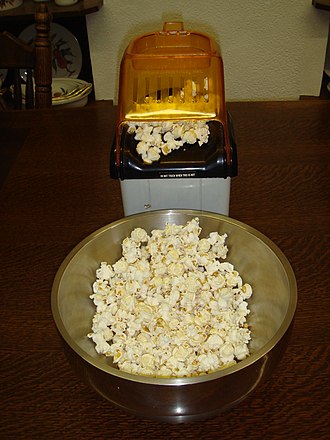
Popcorn belongs in a bowl, not in a ball.  We take the largest bowl in our kitchen, fill it almost full with popped corn, and call it dessert.  Oh, right, but that’s just for me.  Then we take the second-largest bowl in our kitchen and pop a similar serving for my wife.

Before…

Since I always aim to educate a little, here’s popcorn trivia worth remembering.  One, the corn used for popping is not the same as the kernels on the cob (so don’t get any ideas).  Two, when the kernels burst – literally inside out – you get one of two shapes; snowflakes or mushrooms.  Snowflakes are what we have at night for dessert, and what you find severely overpriced in movie theaters.  Mushrooms are what you find in a box of Cracker Jack or Fiddle-Faddle.  Think teeny-tiny popcorn balls.  As for the kernels that don’t pop?  They’re called “old maids”.  In the world of popcorn at least, you’d rather be a snowflake than an old maid.

After…

Some more fun facts.  Popcorn displaced movie candy during the WWII years because there was a shortage of sugar.  Years later it’s still the more popular concession at the theater.  On average every American consumes 58 quarts of popcorn every year.  Picture those red/white striped cardboard containers you see when you purchase popcorn from a cart.  Multiply by 58.  You eat a lot of popcorn.  But why shouldn’t you?  It’s convenient, easy-to-make, and healthy as long as you use an air popper.  Really healthy if you substitute olive oil for the butter, which a lot of people do these days.  But I say ewwwwwww to that.  Leave olive oil to the Mediterranean diet instead.

All this talk of popcorn has me thinking it’s time for dessert.  It’s easy to forego the sweet stuff when savory snowflakes beckon.  Just remember, it’s not a ball of popcorn, it’s a bowl.  A proper presentation precedes perfect popcorn.

—————-

LEGO Trevi Fountain – Update #2

(Read about the start of this build in Brick Wall Waterfall)

Let it echo throughout the streets of Rome, Dave is no Michelangelo (and yes, I know Michelangelo didn’t design the Trevi Fountain but he could sure sculpt).  In today’s effort to rise the LEGO fountain from its foundation, I made countless placement mistakes.  I got four steps into Bag 4 – of 15 bags of pieces – and realized I’d placed everything  just a little bit off on the foundation.  That meant breaking it all down, going back to the first step, and starting over.  Can you imagine my fate if I made this mistake with the real Trevi?  Placed and set the travertine just a little bit off?  The foreman would have my head! (which is no joke, at least not three hundred years ago).

“Building” water is not that easy

Frankly, everything seemed off today.  I kept getting the piece placement slightly wrong, as if I refused to learn from my last mistake.  At one point I turned two pages forward in the instruction manual instead of one, skipping a full two steps in the build.  And the below photo is what “broke the camel’s travertine”.  Tell me reader, what’s wrong with this picture?  Five little leftover pieces and one BIG piece, that’s what.  LEGO never throws in big leftover pieces.  Sure enough, I paged back through the manual, and there it was.  I’d overlooked the step where you place that arch.  Never mind that it’s buried under “pieces” of blue water now.  Leave it out and our beautiful fountain might collapse into a pile of very expensive rubble.

You know who’s laughing about all of my missteps today?  The singers in the music I chose for my accompaniment: Rossini’s The Barber of Seville.  His opera may be about money, disguises, lovers and all that, but it sounded more like getting scolded over and over through song.  You got overconfident, Dave (tra-la-la).  You’re no sculptor, Dave (la-ha-ha).  Maybe LEGO isn’t for you after all, Dave (wha-ha-ha-HA!)

The gleeful singing in “The Barber of Seville” is all in Italian, so for all I know they really did change their tune to berate my amateur building efforts.  I took that to heart.  Bags 5 and 6 are gonna have to wait until next week.  I sure hope the foreman won’t look at this decision as “getting behind schedule”.  He might have my head!

Running build time: 1 hr. 44 min.

Total leftover pieces: 10

Some content sourced from Wikipedia, “the free encyclopedia”.

Only In Iowa

If you’ve ever made graham crackers from scratch (which are miles better than the store-bought ones), there’s a step in the recipe where you have to get your hands dirty. Take a stick of butter, cut it into very small pieces, dump the pieces into the mixture of dry ingredients, and dive on in with your fingers until the dough starts to clump together. It may be the only time butter and my hands ever come in contact with each other. Which is also to say, I won’t be sculpting a butter cow any time soon.

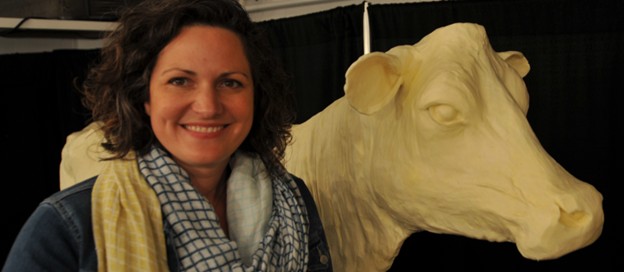
Sculptor, cow

Creating art out of food seems like an inevitable destination. I mean, back in Michelangelo’s day everyone was taking a block of marble and seeing what they could do with it. Then all but one of them quickly realized there was only one Michelangelo. The others probably turned to an easier material to work with like wood or clay. 1,000 years on, we’re sculpting food. Chocolate is a popular medium. Cakes are shaped into just about everything imaginable. But a cow made out of butter – what’s that all about?

A more fitting Hawkeye State image

We turn to Iowa to learn more about this oddity.  Most people prefer to fly over Iowa but since you’re reading and not flying, let me enlighten you.  On the list of 10 Things to Know About Iowa, there is no butter and there is no cow. There are a lot of pigs (the most of any state) and millions of acres of corn (also “the most”), and Iowa’s “Hawkeye” nickname is a reference to the birth of the red delicious apple (who knew?).  But none of this gets us to butter and cows.

The “10 Things…” list does mention the Iowa State Fair, and it is here that we find real cows by the hundreds… and a life-sized one made out of butter.  The Fair, whose 2025 edition wrapped up three weeks ago, has been making “buttered cows” since 1911, thanks to five Iowans who’ve passed the butter baton down over the years.  The latest, Sarah Pratt, has been making the cows for the last nineteen years, and only after apprenticing with the last sculptor fifteen years before that.  Some people blog; others make cows out of butter.

The 1911 original

Like papier-mâché, a butter cow is created on top of a frame built from wood, wire, and/or metal.  Then we heap on some fun statistics.  600 lbs. of “low moisture, pure cream, Iowa butter” is applied to create a cow that’s five-and-a-half feet tall and eight feet long.  The sculptor’s “studio” is a walk-in cooler set to 40ºF.  After the cow is displayed at the fair, all that butter is recycled for use on the next ten years of cows.  Unless you’d rather use it for toast, which would butter 19,200 slices.

Michelangelo didn’t stop sculpting after his famous David, of course, and neither does Sarah Pratt with her butter cows.  Also following tradition, she creates a “companion sculpture” to keep the cow company.  Sometimes the companion is an homage to Iowa, such as a John Deere tractor.  Most years the companion is a random anniversary, like the 40th anniversary of Neil Armstrong’s walk on the moon (totally random because Neil wasn’t born in Iowa).  This year the sculpture featured the characters from “Toy Story”, denoting the movie’s 30th anniversary.  You get the feeling Sarah enjoys sculpting butter so much that a life-sized cow just isn’t enough.

Woody, Buzz

For all of my research, I can’t figure out why a cow made out of butter and Iowa belong in the same sentence.  Nearby Wisconsin and Michigan are better known for dairy cows.  California tops the list of the five states producing the most butter (and Iowa isn’t one of the other four).  No matter, this tradition isn’t stopping anytime soon.  The butter cow even has a place in the Smithsonian Institution (thankfully, as a replica that will never melt).

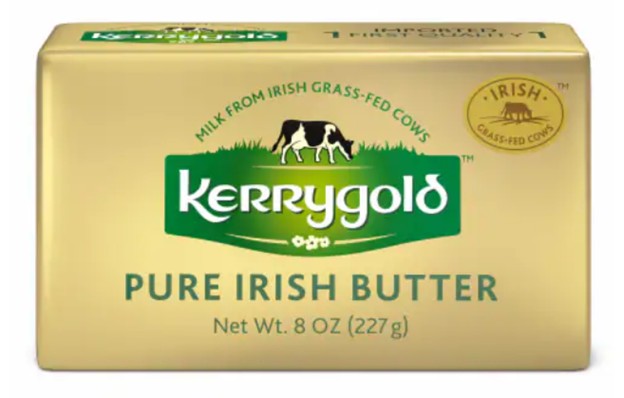
I love butter, but more on top of baked goods and in graham cracker recipes than in the shape of a cow.  I will admit to buying my butter by the brick instead of by the stick.  But now that I know about Iowa’s annual creations, I’ll never look at my morning toast again without thinking, mooooooooo.

Some content sourced from the Iowa State Fair website, the U.S. News article, “10 Things to Know About Iowa”, and Wikipedia, “the free encyclopedia”.

Ten Days to “Ben-Yays”

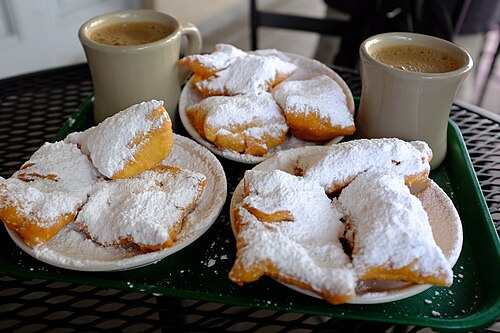
I’ve never met a French baked good I didn’t want to devour at first sight. Macarons have called my name ever since my wife and I tried them in a little shop in Strasbourg. I’ve made a surprisingly good Croquet Madame (disguised as a three-cheese breakfast pizza) considering my limited skills in the kitchen. And croissants, well, croissants speak for themselves don’t they? So when a neighbor challenged my wife and I to make beignets ten days ago, I confidently replied, “oui!”

“ben-yays”

Technically we’re not talking about a baked good today.  Beignets are fried in oil, like doughnuts.  In fact, they’re exactly like sugar doughnuts, just not as sweet.  Think Krispy Kreme’s Original Glazed without the glaze.  Small, chewy pillows of heaven.

So why would a neighbor request beignets?  Because she invited us to a college football game watch (Clemson vs. Louisiana State) and she’s one of those who turns a basic entertainment into a full-on festivity.  Louisiana State is in Baton Rouge so her menu was start-to-finish Cajun. Étouffée. Muffuletta. Red Beans and Rice. Chantilly Cake. I mean, if she’s going to make all of that how could I say non to beignets?

étoufée

Thankfully, I found an “Easy Beignets Recipe” online (note: whenever a recipe starts with “easy”, it’s anything but).  At least I already had the ingredients in my pantry.  But beignets start out like a high school science experiment.  Heat the water to exactly 105°.  Add yeast and a little sugar, because yeast “feeds” on sugar.  Then watch it all foam.  If it doesn’t foam, you killed the yeast and you have to start over. (No pressure Dave, little lives are at stake here.)

science experiment

My yeast foamed (it lives!) so I was then allowed to proceed with the more traditional ingredients.  Shortening, sugar, milk, and egg whites all mixed together, to which you add boiling water.  When the temp is exactly 105°-110° (again with the science experiment) add the foamy yeast, flour and salt, and into the refrigerator it all goes, to rise for an hour or more.

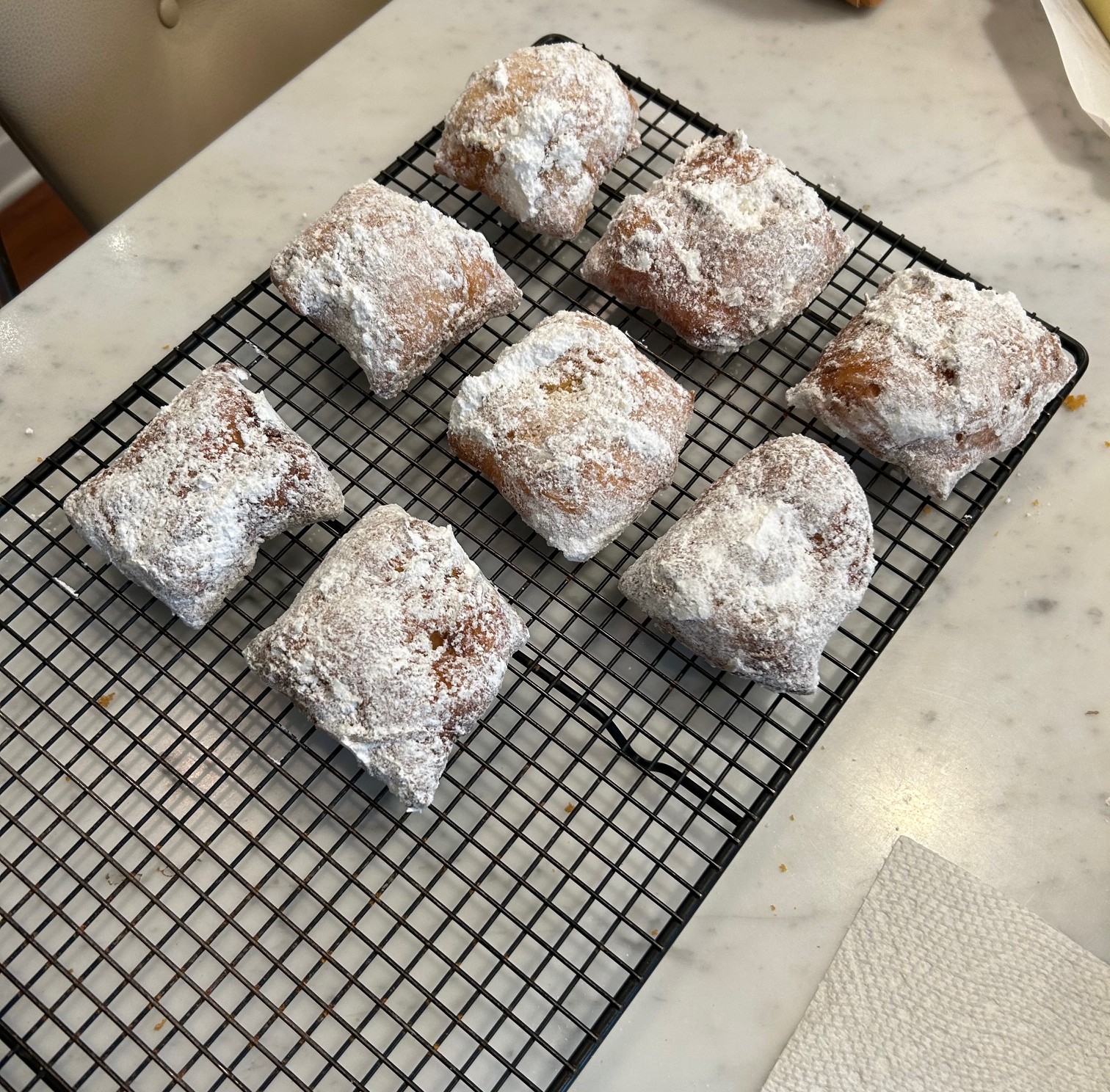
Did my foamy-yeast-shortening-and-other-stuff concoction really rise?  I have no idea.  It looked the same as it did an hour before.  But I threw caution to the wind and proceeded.  At this point my wife had to get involved, because (as the recipe warns in capital letters), THIS IS A TWO-PERSON JOB.  Maybe a three-person.  One of you slaves over a pot of boiling oil (my wife), another gently transfers the beignets to paper towels to “oil off” (me), and the third suffocates them in powdered sugar (me again).

Handle with care!

That last sentence happens very quickly.  You can’t get the timing wrong on any step or the beignets won’t taste right.  They fry for a minute or so on each side, rest for a minute on the paper towel, and don their coat of powdered sugar with just enough oil remaining to serve as the glue.

When beignets are done correctly, they’re light and flaky.  The shortening and yeast create an air pocket inside.  But you’re not really sure if this science happens until you rescue them from the boiling oil.  Remarkably, ours really did rise.  Doused in powdered sugar they really were pretty good (then my wife mixed a little cinnamon and vanilla into the dough and they were even better).

Magnifique!

There’s a reason why beignets are so much better at the famous Cafe du Monde in New Orleans than in Dave’s kitchen.  You need to eat them as soon as they’re powdered with sugar, and wash them down with a top-shelf cup of coffee. You see, beignets, sadly, have the shortest life of any baked good I know.  If you don’t eat them warm, minutes after they’re fried, they’ll shed their light and airy consistency.  An hour later they’re as cold and chewy as day-old doughnuts at 7-Eleven.  And God forbid you leave them overnight on the counter.  The next morning you’ll have nothing but rocks.

So, you ask, were our beignets a hit at our neighbor’s game watch?  Well, let’s just say the other guests were being polite by declaring, “very good!”, especially when they ate more of our frosted sugar cookies instead (our backup dessert).  Hey, our kitchen is no Cafe du Monde.  I never said it was.  It’s the reason I’m never making étoufée.  At least I have a neighbor who will be happy to do it for me.

Some content sourced from Wikipedia, “the free encyclopedia”.

Licking My Lips

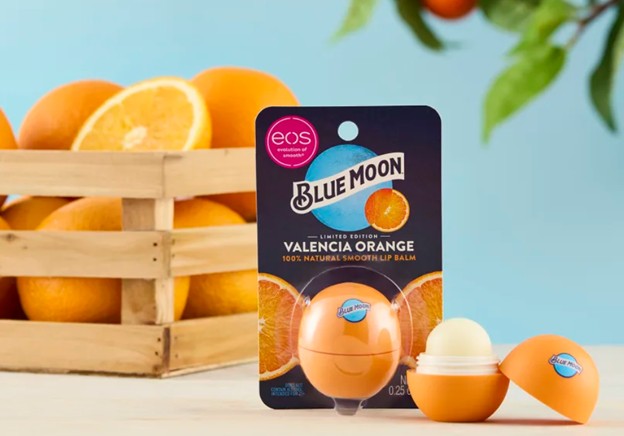
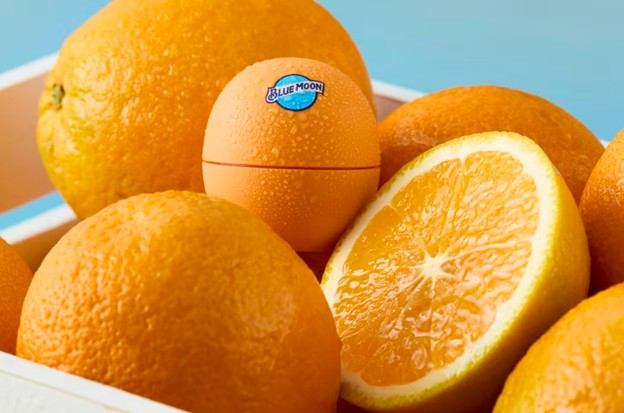
I wouldn’t normally be drawn to a company whose products target women. I’m pretty well stocked when it comes to lip balms, lotions, and shaving cream. But here comes EOS (“Evolution of Smooth”), a newish company using organic ingredients and bright, colorful packaging to entice its buyers. Now I’m enticed too because EOS just came out with an orange product. Or should I say, a product in an orange. You could say it’s something that only comes ’round once in a blue moon.

Evolution of Smooth may be trying to target men as well.  Why else would they concoct a lip balm that tastes like Blue Moon?  If you haven’t had so much as a sniff of beer, Blue Moon is an everyday man’s brew produced by the Canadian-American conglomerate Molson Coors.  It’s a Belgian-style wheat beer: high on the wheat but not so much on the malted barley.  And now it’s a flavor of EOS lip balm inside of a plastic orange.

If you order a Blue Moon off the menu, the bottle or glass should arrive garnished with an orange slice.  It’s a nod to the orange peel component of the beer; an ingredient giving the witbier its subtle citrus flavor.  I should know because I’ve had more Blue Moons than any other beer out there.  When you live in Colorado as long as I did (almost 30 years) sooner or later you’ll tour the Molson Coors facility in Golden, just west of Denver.  They bus you around town first (a quaint holdover from the era of the Pikes Peak Gold Rush) before depositing you at the doors of the rather industrial-looking facility. 

Golden, Colorado

When you get down to touring – walking through the massive brewery, seeing the step-by-step production process, and sort-of-but-not-really believing the beer’s water content flows straight from the nearby Colorado Rockies – you’ll get a better appreciation of just how much effort goes into a single bottle.  But like most breweries a beer fan anticipates the final stop – the tasting room – where you’re offered brands and flavors not yet released to the public.  It was here I discovered Blue Moon, back in 1995 when it was just a concept beer.

Fancy homes boast of well-stocked, temp-regulated walk-in wine cellars with dozens of the finest bottles on display.  I boast of a 24″x 24″x 36″ below-counter drink cooler, purchased on sale at The Home Depot for $225.  I may not have dozens of the finest bottles on display, but in my house you’ll always find a half-dozen bottles of Blue Moon at the ready.

My “wine cellar”

To be clear, I’m any occasional beer drinker at best.  I can make a six-pack last a month.  The only time a beer really appeals to me is after an afternoon of hard, sweaty, gnat-filled yard work.  I’ll come back into the house after hours of that kind of fun and Blue Moon beckons. And even if I consumed more than a half-dozen bottles a month I certainly wouldn’t be put off by the price.  A six runs you $11.99 at Target.

I do know how good a beer can really taste.  Make your way to Dublin, Ireland sometime, tour the downtown Guinness Storehouse brewery (which trumps the Molson Coors experience in every way imaginable), and have a fresh pint in the top floor tasting room as you gaze out the floor-to-ceiling windows at the fairy-tale surroundings below.  You’ll never want to leave.  You’ll also realize that Guinness you’ve been having in America doesn’t measure up to the one you can have on Irish soil.

Dublin, Ireland

Any beer connoisseur reading this post is laughing at my reverence to Blue Moon.  It’s a product whose color, strength, and lack of history bears little resemblance to the storied lagers of the world.  It’s like the cosmopolitan offerings among the “real” alcoholic drinks on the bar menu.  Light on ingredients and better meant for women.

No, Blue Moon isn’t necessarily meant for women (I hope), but maybe EOS’ latest lip balm is a clever way to get them interested.  It certainly got my attention, and the thought of the taste of Blue Moon on my lips the entire time I’m working outside sounds amazing.  No bottle or glass to juggle while I run the lawn mower.  No garnish of an orange slice necessary.  $4.99 instead of $11.99.  Good call, EOS.  I’m in.

Some content sourced from the CNN Business article, “Blue Moon… is being turned into a lip balm”, and Wikipedia, “the free encyclopedia”.

Chugga Chugga Chew Chew

Technology isn’t always our friend. Recent studies show plastic water bottles shed as many as 24,000 “micro-bits” of plastic into the consumer’s body. These bits measure 1/1000th of a meter across. But more recent studies – studies we didn’t have the technology for even five years ago – reveal the same bottles sheds another 200,000 “nano-bits”. At 1/1,000th the width of a human hair, these infinitesimal particles are so small they pass through the membranes of the body’s organs, leading to heaven knows what kind of damage. “Gulp!”

We love our water bottles!

Let’s leave this horror movie of science-you-didn’t-want-to-know behind and go with glass or metal containers instead.  But it’s virtually impossible to avoid ingesting plastic particles anyway.  And many people make a habit of it every day… with chewing gum.  Gum contains the same microplastics as water bottles.  No surprise there.  You shouldn’t really ingest any of the ingredients in chewing gum.

When you’re a kid however, you don’t care about ingredients (let alone bits of plastic).  Gum chewing is a habit I absolutely subscribed to in childhood.  I still remember the barber who cut my hair when I was single-digits old.  The reward for being a good boy in the chair was to help myself to one of those little wrapped chunks of Bazooka bubble gum.  Bubble gum has a distinctive flavor I can still recall decades later.  The pink stuff also has the built-in game of blowing big, sticky bubbles.

gumballs

After Bazooka came Bubble Yum, a trendy alternative because it was a softer chew from the get-go and packaged in larger chunks.  Bubble Yum came in several flavors.  But for me, chewing gum evolved from “bubble” to “sugarless” in a heartbeat, thanks to one too many trips to the dentist.  Choosing from the “prize shelf” after my fillings, I always went for the pack of Dentyne instead of the toys.  Dentyne was the dentist’s way of encouraging less sugar (and more saliva).  Dentyne was my way of thinking it was still okay to chew gum.

Somewhere between Bubble Yum and Dentyne came those slim packs of “stick gum”, including Doublemint, Juicy Fruit, Clove, and for this licorice aficionado, Black Jack.  I also consumed my fair share of Chiclets.  But my gum habit eventually evolved to more of  a”breath mint” chew.  The one I remember best was “Freshen Up”, the green chunk of gum encasing the small dose of mouthwash gel.  You’d get this mind-blowing burst of mint the moment you bit into it.  Pretty novel for chewing gum.

What I never saw coming – which ground my chewing gum habit to an abrupt halt – was TMJ, also known as (the more scary-sounding) “dysfunction of the temporomandibular joint”.  In plain English, TMJ is sustained pain in the jaw muscles from overuse.  It’s nasty, and if you’re not careful it can be chronic.  For me it was relieved by backing off on the chewing gum… as well as breakfast bowls of Grape Nuts.  If you’ve had TMJ yourself, you know it’s a little unnerving (pun intended) because there’s no guarantee you’re ever gonna get rid of it.

Every now and then someone offers me a piece of gum and I politely decline.  I’m not interested in the return of jaw pain and besides, I’ve developed a preference for breath mints instead.  As for you, whether you chugga chugga (your water) or chew chew (your gum), don’t forget about those nasty nano-plastics.  Just like Mr. TMJ, they’re not your friend.


LEGO Notre-Dame de Paris – Update #11

(Read about the start of this “church service” in Highest Chair)

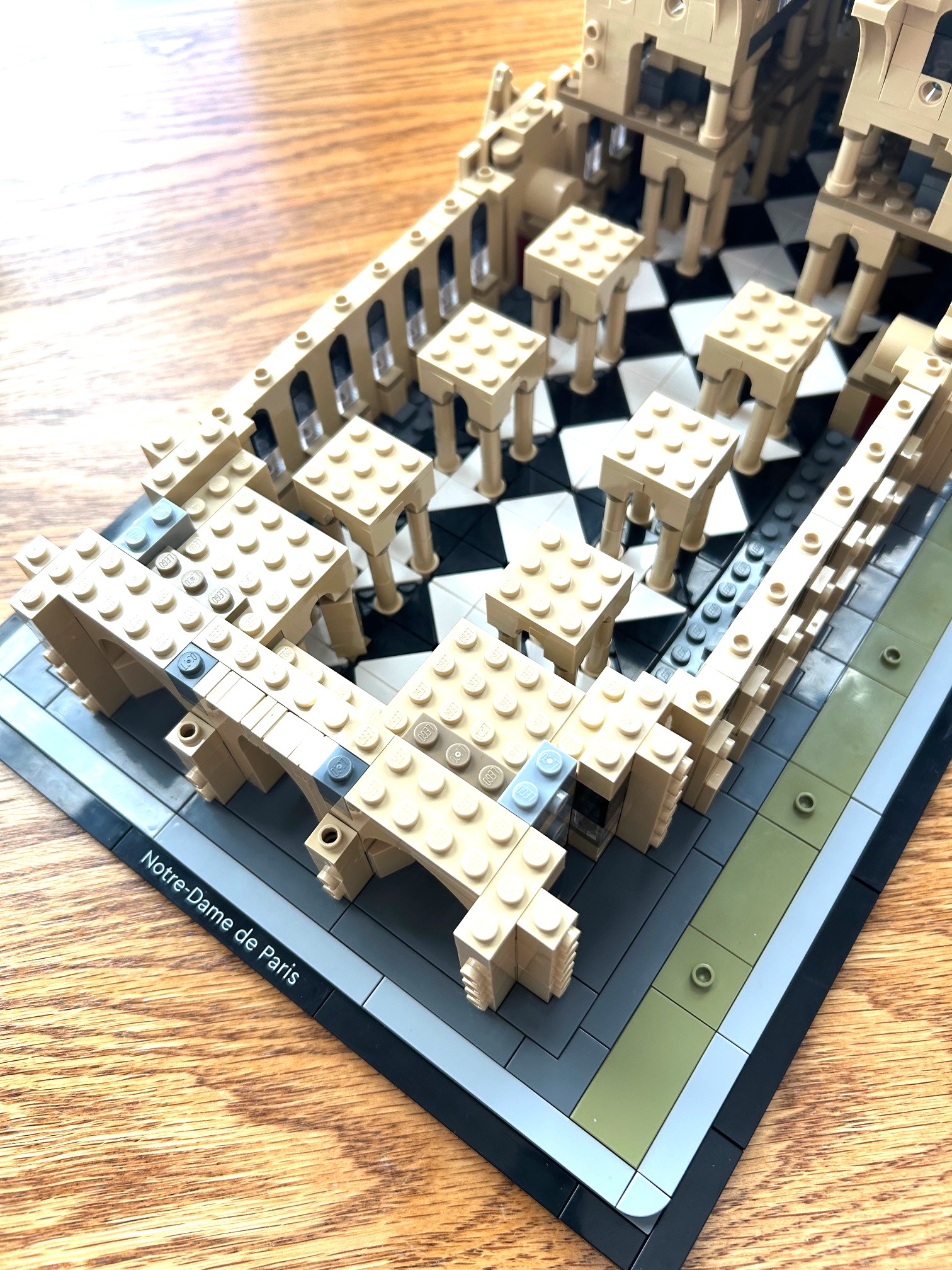
Today we “leveled the praying field” 🙂   Bags 19, 20, and 21… of 34 bags of pieces, brought the height of the nave to virtually the same as the chancel.  It’s safe to say the lion’s share of the remaining pieces will be (tiny and) focused on building the roof structure and west end bell towers.

Arches and more arches

Dropping a piece down, down, down into the sanctuary – which I managed to do twice today through the top square openings you see here – is no laughing matter.  You might say, “Just flip the model over and shake them out, Dave” but I’m way too far along to risk it falling apart.  Instead, I had to reach down with my giant fingers, gently pinch, and then pull back like a construction crane.  I hope I didn’t scare the parishioners in the process.

We built framed windows today, (plastic) glass and all!  These can be seen in the final photo, on the west end of the cathedral above the doors.  We also built – in somewhat assembly-line fashion – another fourteen of the cathedral’s distinctive flying buttresses.  But the most tedious, time-consuming task of all was the arched windows you see along the upper walls of the nave in the first photo.  Each is assembled from a dozen finger-numbing pieces.

Uniform height

Finally, a word about weight.  I picked up the cathedral the other day and went, “Holy cow!” (ha).  Turns out this beast weighs a robust three pounds already.  That’s a lot of plastic.  And given today’s blog topic I’m thankful the model isn’t edible. 

Running build time: 10 hrs. 28 min.

Total leftover pieces: 28 (no new ones!)

Some content sourced from the CNN Health article, “Chewing gum can shed microplastics into saliva…”, and Wikipedia, “the free encyclopedia”.

Crop of the Cream

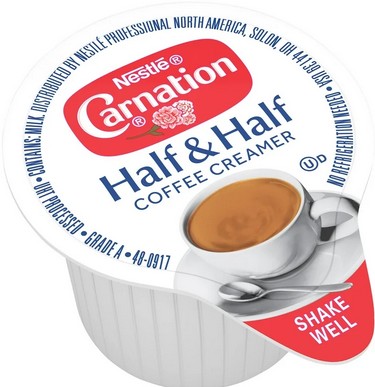
One of the essentials you’ll find in our refrigerator is a container of “half & half”.  The 50/50 concoction of milk and light cream creates the perfect texture in our morning cup of coffee.  Anything leaning more towards nonfat just doesn’t cut it for us.  Earlier this week I noticed (with a wry smile) our half & half was parked right next to a tall, red can of Reddi Wip.  Talk about your polar opposites.  In the Jeopardy category of “Cream”, it doesn’t get much different.

Today’s topic is brought to you by the makers of Häagen-Dazs.  My wife brought home a couple of containers of their ice cream the other night, and right after dinner I was eager to dig in.  The little tubs were smaller than what I was used to but I figured it was a good way to curb consumption.  After the first bite however, I realized something wasn’t quite right.  Or maybe it was very right.  Turns out, I was enjoying the coffee flavor of Häagen-Dazs’ “cultured crème”.  In other words, yogurt instead of ice cream.

Häagen-Dazs describes its new product as “a unique blend of dairy cultures that offer a smoother taste experience unlike the slightly sour flavor of traditional yogurt.”  Okay, that’s a mouthful (ha).  It’s a tasty mouthful but it’s also just another spin on food products with creamy consistencies.  We foodies are all about “mouth feel” aren’t we?

You probably have more cream-based products in your refrigerator/freezer than you realize.  Go take a look.  It wouldn’t surprise me to learn you also have a can of Reddi Wip (at least you Americans), as well as a tub of sour cream, several sticks of butter, several flavors of ice cream, and whatever version of “creamer” you prefer in your coffee.

Cream itself is, of course, the higher fat layer skimmed from the top of raw milk.  It’s sold in several grades depending on the butterfat content.  IMHO the Canadians have the most straightforward set of descriptors, as follows:

  • 40% milk fat: manufacturing cream (not available as retail)
  • 33-36%: whipped cream (for topping)
  • 15-18%: table cream (for coffee)
  • 10%: half and half (for cereal, sauces, and soups)
  • 3-10%: light cream (lower-fat alternative to any of the above)

Other countries complicate the matter, but often for the better.  The French have their crème fraîche, which belongs in the 40% category above and makes for a nice unsweetened topping on a very sweet dessert.  The Swiss produce a “double cream” that hits closer to 45% and is probably as thick as yogurt.  And the Brits are famous for their “clotted cream”, which tops the milk fat charts at 45% and spreads on a scone like butter.

Whether “cream” or “crème” (or even “crema”), the word enhances the appeal of a food product.  Consider cream pie versus just “pie”.  Cream puff instead of just “puff”.  Want a cookie, or how about a cookie with cream filling?  And anything with buttercream frosting – versus just “frosting” – is more decadent.  Heck, I’d even try “plant cream” if you asked me to (the vegan spin on dairy).

For my money, any product with “Häagen-Dazs” printed on the label is worth a try.  Their ice cream products are the cream of their crop but it’s safe to say I’ll be buying more of their cultured crème cups.  Not a bad substitute for less healthy dessert options.  And just the latest entry in the crop of the cream.


LEGO Notre-Dame de Paris – Update #10

(Read about the start of this “church service” in Highest Chair)

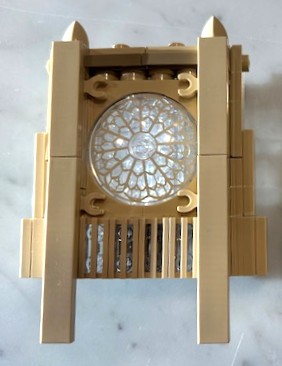
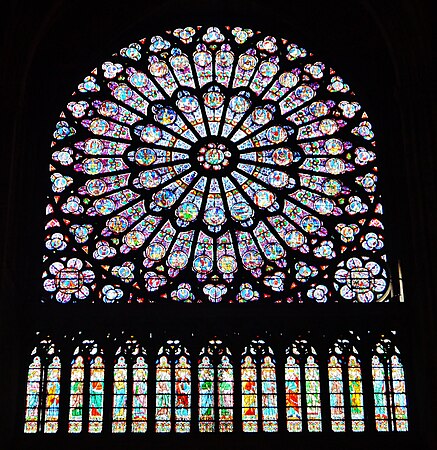
Roses are red, violets are… hang on, hang on; back up the truck.  In Notre-Dame de Paris, roses are stained-glass windows.  Bags 17 and 18… of 34 bags of pieces, focused almost entirely on the construction of the cathedral’s spectacular wheel-like windows.  Today we worked away from the model to completely build two of the three roses, then installed them above the north and south walls of the cathedral’s transept.  The LEGO versions aren’t nearly as intricate as the real windows but each one is still made up of thirty tiny pieces.

LEGO’s rose windows are necessarily simplified, but that’s not to take away from the craftsmanship of the windows in Notre-Dame de Paris.  The transept roses are forty-two feet in diameter (about the width of a basketball court).  The artwork of their dozens of panes of stained glass contains scenes from the life of Christ, the twelve apostles, as well as martyrs, virgins, angels, saints, and more.  It’s a wonder these windows were created way back in the year 1250.  It’s also a wonder they’ve lasted through wars and such, undamaged, for almost 800 years now.

Besides the rose windows, we added more structure to the rising walls of the nave today, the area on the left side of the photo covered in gray.  I point this out because the sanctuary is getting more and more closed in as we anticipate more of the roof structure above.  Lest I’m fooled into thinking we’re almost complete, the fact is we have another sixteen bags of pieces to go!

Running build time: 8 hrs. 58 min.

Total leftover pieces: 28

Some content sourced from the Häagen-Dazs Cultured Crème website, and Wikipedia, “the free encyclopedia”.

Fruit of the Bloom

On Monday I noticed a lot of the wearing o’ the green because, of course, Americans celebrate St. Patrick’s Day as if we are somehow Irish. It’s a fitting burst of color as winter slowly but inevitably surrenders the seasonal baton. Soon you’ll find a full-on rainbow of blooms in every garden you pass. For now however, let’s drink and dance in honor of another bright color this week: pink. More to today’s topic, cherry pink.

If you’re tuning in from Washington D.C. you already know where I’m going with this one.  Today is the first day of spring, and the beginning of the Cherry Blossom Festival in our nation’s capital: four weeks of seemingly countless opportunities to celebrate the flowering of the graceful trees on the banks of the Potomac.  If you’d asked me a week ago what the bloomin’ fuss is all about, I’d have said the festival’s significance is as shallow as the water in the Lincoln Memorial Reflecting Pool.  But now I’m properly informed.  There’s more to this story than just pretty in pink.

“Yoshino” cherry blossom

In the early 1900s, America and Japan were unconditionally friendly countries (years before that little dust-up in the 1940s).  To acknowledge the friendship, Tokyo’s mayor shipped 3,000 Japanese cherry trees to Washington D. C.  There’s a longer, more convoluted history behind this gesture, including players from both countries making repeated efforts to populate the city with trees, but the details are about as interesting as pushing a bill through Congress.  Suffice it to say cherry trees were planted along the river, up and down the avenues, and in numbers worthy of an annual festival starting in the 1930s.

I love cherries; always have.  I think the flavor itself appealed to me before the fruit, in the popular junk food of the 1970s.  Hostess Fruit Pies.  Life Savers.  Slurpees from 7-11.  Or the proverbial maraschino on top of an ice cream sundae.  As much as I got my fill of those, I could never get my fill of my mother’s homemade cherry pie, and I mean homemade.  The cherries were passed down from her mother each year, picked, jarred, and ready to go.  The crust was made from scratch, including the signature latticework on top.  It’s a wonder the butter wasn’t churned from the milk of a family cow.

Alas, no longer on the menu

It’s also a wonder I’ve never been to D.C.’s Blossom Festival, considering my unabashed affection for the fruit.  I’m sure I’d find a couple dozen new ways to enjoy cherries besides the usuals.  I’d happily scarf down a serving of flambéed Cherries Jubilee over ice cream, or the cherry-filled sponge cake of a Black Forest gateau.  For the more adventurous there’s a savory Hungarian soup made with sour cherries.

“Petals and Paddles” race

Of course, there’s a lot more to the Blossom Festival than just food.  You’ll find parades, concerts, and kite-flying, with every shade of pink you can imagine.  Tour the historic Anderson House, filled with art and floral displays (featuring the cherry blossom, of course).  Compete in a “Petals and Paddles” boat race across the tidal basin surrounded by the trees.  Or get wet in “Pink in the Pool”, a family-friendly swim party replete with colorful beach balls.  There’s even an “Opening Ceremony” event on the first Saturday, (already sold out by the time I checked the website).  The weeks-long agenda proudly declares “events are primarily free” but I beg to differ. Tickets to the first several on the list were decidedly pricey.

For all I’ve just written, it’s a wonder the word “cherry” appears less than ten times in the hundreds of posts I’ve published on Life In A Word.  One time I referred to the children’s game “Hi Ho! Cherry-O”.  Another I talked about Cherry Coke.  The rest were the same things I mention here – ice cream sundaes, Slurpees, and so on.  So let’s add the Blossom Festival to the list, shall we?  With four weeks of celebrating, it’s safe to say life is a lot more than just a bowl of cherries.


LEGO Notre-Dame de Paris – Update #9

(Read about the start of this “church service” in Highest Chair)

What was once a giant box of LEGO pieces is finally starting to resemble a cathedral!  Bags 15 and 16… of 34 bags of pieces, focused entirely on the body (nave) of the structure.  We’re now building in the years 1220-1225, when the walls of the nave rise to the same height as the semicircular chancel at the east end.

Under construction
Fully fortified

The parishioners look rather tiny, now that we’re working so far above them.  And notice all those free-standing columns from last week aren’t so free-standing anymore.  We’ve capped them with structural elements to support what is still to be built up above.  Also notice we’ve closed in the west end of the cathedral, which patiently awaits the addition of the soaring bell towers.

West end “front doors”

Okay, it’s time to address the elephant in the room; an elephant that gets bigger with every update.  A few of you have sounded the alarm on my running count of leftover pieces.  It’s a fair concern, considering the LEGO Grand Piano also started as thousands of pieces but only amounted to a handful of extras.

extras

Here’s the truth of it: the twenty-six leftovers shown here amount to just a handful as well.  Every one of them is among the tiniest pieces in the entire cathedral.  It probably cost LEGO pennies to add in these “bench players”.  And given the tendency of pieces to run away I’m grateful to have them.  Heck, by the time the cathedral is finished maybe I’ll have enough leftovers to build a small elephant. 

Running build time: 7 hrs. 57 min.

Total leftover pieces: 26

Some content sourced from the National Cherry Blossom Festival website, and Wikipedia, “the free encyclopedia”.

Eggs-asperating Prep

Every now and then I get a hankering to bake something, which nine of ten times means chocolate-chip cookies. That tenth time I’ll venture into breads or cakes but they’re usually too time-consuming for my “taste”. Thus I’ll buy a perfectly prepared croissant before I ever labor to make one on my own. Maybe the same should be said for so-called perfectly prepared eggs.

Eggs-spensive!

We’re all talking about eggs these days, the same way we talked about gas during the “Energy Crisis” of the late 1970s. Eggs are scarce and evermore expensive, which translates to being more choosy about how we use them at home. I like eggs for breakfast every other day and I’m not likely to change that habit on account of rising prices. My dog may have to forego the occasional scrambled egg on top of his kibble, but until I pay as much for a dozen eggs as I do to fill my gas tank, I’ll still be buying them.

I prefer mine soft-boiled

What I won’t be doing is cooking my eggs any differently than I did last week or last month, even if scientists now claim the “perfect method” (their words) to do so.  I prefer my eggs soft-boiled, which means a pot, some water, a $2.99 submersible egg timer from Wal*Mart, and less than ten minutes of prep after the water is boiled.  It’s a quick, mindless process I can pull off even before my morning coffee.

Would you prefer a more time-consuming method instead, with only slightly better results?  Okay.  Take two pots of water and heat one to boiling (212 F for us Americans, 100 C for most of the rest of you) and the other pot to “lukewarm” (86 F, 30 C).  Drop your eggs into the boiling water for two minutes, then transfer them to the lukewarm water for two minutes.  Repeat seven more times.  That’s right, seven more times.  On your calculator as well as mine, that’s 32 minutes until breakfast is ready, and you’re too busy to do other stuff while you’re waiting.

If I dedicate 32 minutes to egg-making, I’m expecting something much more grand and decadent.  An omelette at the least.  A scramble with a load of cut-up veggies.  “Benedict”, including the hollandaise sauce.  Heck, I’d even don my French chef’s hat and try sous vide eggs, which are…. oh, never mind – those take an hour or more.

The second is soft-boiled; the fourth is supposedly “perfect”

The thought of “perfect” eggs in 32 minutes instead of soft-boiled in less than 10 is exasperating.  If I wanted to go all science on you, I’d explain why 32-minute eggs allow the albumen and yolk to cook perfectly together, even though each has a different composition.  I’d also explain why this method retains the maximum nutritional benefit of eating eggs (protein and so on).  But c’mon, do you really care about those details when you’re just looking for grub to get your day started?  Heck, the prep of my 10-minute eggs even allows me to feed the dog and clean up last night’s dishes while I wait.

The “perfect eggs” news article is interesting enough but I had to laugh when the writer inserted the standard “… be forewarned that consuming raw or undercooked eggs may increase your risk of foodborn illness”…”  Wait, I thought these eggs were perfectly cooked.  Now you’re hinting the process may cause food poisoning?  Sorry Mr. Scientist, I’ll stick to my $2.99 Wal*Mart egg timer method instead.


LEGO Notre-Dame de Paris – Update #7

(Read about the start of this “church service” in Highest Chair)

Maybe LEGO’s engineers got impatient with the construction of the east-end chancel of Notre-Dame de Paris, because Bags 10 and 11… of 34 bags of pieces, laid out the rest of the foundation of the entire cathedral.  Indeed, when we finished today’s rather brisk build (24 minutes!) we put down enough marble to allow the capacity 1,500 parishioners to “take a pew”.

24 minutes was barely a French coffee break back in the day when Notre-Dame was actually built.  In fact, we’re now twenty years into the construction: AD 1182.  With the chancel complete enough to host church services, we’ll spend the next twenty years (or rather, the builders did) rising the transcept (the “cross” bar, remember?) and first bays of the nave (the cross “long” bar).

Speaking of “bars”, note that I added LEGO’s signature “title bar” to the near edge of the model today (photo below).  LEGO wants you to know what cathedral you’re looking at, even though I’m teaching you enough detail so you won’t need a title bar.  But don’t be fooled; you won’t find a title bar in the foundation of the real Notre-Dame de Paris.

Today’s build was quick but not without the usual antics.  Once again I installed a piece incorrectly – a tiny bit of marble.  Once again I reached for the LEGO lever but it couldn’t lever out this kind of piece.  So I resorted to my paper clip “crowbar” instead and ZING!!! – the piece went flying across the room and ricocheted (another word with French roots – nice, no?) off the wall.  Good thing I managed to find it or several of Notre-Dame’s parishioners would trip on their way out.

Running build time: 5 hrs. 56 min.

Total leftover pieces: 24

Some content sourced from the CNN Science article, “Scientists developed a new method for the perfect boiled egg…”.