Fruit of the Bloom

On Monday I noticed a lot of the wearing o’ the green because, of course, Americans celebrate St. Patrick’s Day as if we are somehow Irish. It’s a fitting burst of color as winter slowly but inevitably surrenders the seasonal baton. Soon you’ll find a full-on rainbow of blooms in every garden you pass. For now however, let’s drink and dance in honor of another bright color this week: pink. More to today’s topic, cherry pink.

If you’re tuning in from Washington D.C. you already know where I’m going with this one.  Today is the first day of spring, and the beginning of the Cherry Blossom Festival in our nation’s capital: four weeks of seemingly countless opportunities to celebrate the flowering of the graceful trees on the banks of the Potomac.  If you’d asked me a week ago what the bloomin’ fuss is all about, I’d have said the festival’s significance is as shallow as the water in the Lincoln Memorial Reflecting Pool.  But now I’m properly informed.  There’s more to this story than just pretty in pink.

“Yoshino” cherry blossom

In the early 1900s, America and Japan were unconditionally friendly countries (years before that little dust-up in the 1940s).  To acknowledge the friendship, Tokyo’s mayor shipped 3,000 Japanese cherry trees to Washington D. C.  There’s a longer, more convoluted history behind this gesture, including players from both countries making repeated efforts to populate the city with trees, but the details are about as interesting as pushing a bill through Congress.  Suffice it to say cherry trees were planted along the river, up and down the avenues, and in numbers worthy of an annual festival starting in the 1930s.

I love cherries; always have.  I think the flavor itself appealed to me before the fruit, in the popular junk food of the 1970s.  Hostess Fruit Pies.  Life Savers.  Slurpees from 7-11.  Or the proverbial maraschino on top of an ice cream sundae.  As much as I got my fill of those, I could never get my fill of my mother’s homemade cherry pie, and I mean homemade.  The cherries were passed down from her mother each year, picked, jarred, and ready to go.  The crust was made from scratch, including the signature latticework on top.  It’s a wonder the butter wasn’t churned from the milk of a family cow.

Alas, no longer on the menu

It’s also a wonder I’ve never been to D.C.’s Blossom Festival, considering my unabashed affection for the fruit.  I’m sure I’d find a couple dozen new ways to enjoy cherries besides the usuals.  I’d happily scarf down a serving of flambéed Cherries Jubilee over ice cream, or the cherry-filled sponge cake of a Black Forest gateau.  For the more adventurous there’s a savory Hungarian soup made with sour cherries.

“Petals and Paddles” race

Of course, there’s a lot more to the Blossom Festival than just food.  You’ll find parades, concerts, and kite-flying, with every shade of pink you can imagine.  Tour the historic Anderson House, filled with art and floral displays (featuring the cherry blossom, of course).  Compete in a “Petals and Paddles” boat race across the tidal basin surrounded by the trees.  Or get wet in “Pink in the Pool”, a family-friendly swim party replete with colorful beach balls.  There’s even an “Opening Ceremony” event on the first Saturday, (already sold out by the time I checked the website).  The weeks-long agenda proudly declares “events are primarily free” but I beg to differ. Tickets to the first several on the list were decidedly pricey.

For all I’ve just written, it’s a wonder the word “cherry” appears less than ten times in the hundreds of posts I’ve published on Life In A Word.  One time I referred to the children’s game “Hi Ho! Cherry-O”.  Another I talked about Cherry Coke.  The rest were the same things I mention here – ice cream sundaes, Slurpees, and so on.  So let’s add the Blossom Festival to the list, shall we?  With four weeks of celebrating, it’s safe to say life is a lot more than just a bowl of cherries.


LEGO Notre-Dame de Paris – Update #9

(Read about the start of this “church service” in Highest Chair)

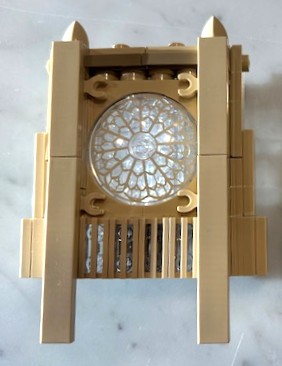
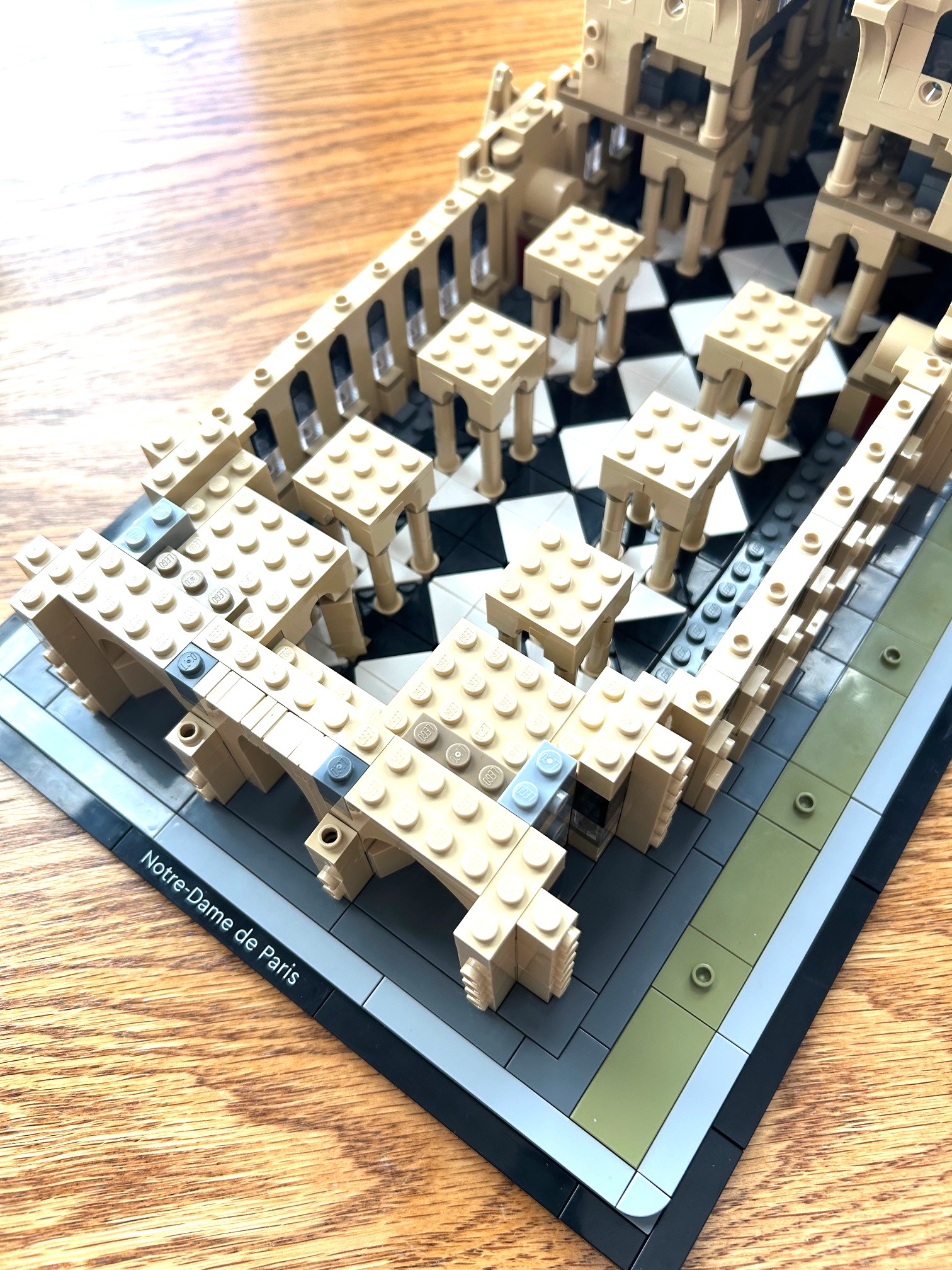
What was once a giant box of LEGO pieces is finally starting to resemble a cathedral!  Bags 15 and 16… of 34 bags of pieces, focused entirely on the body (nave) of the structure.  We’re now building in the years 1220-1225, when the walls of the nave rise to the same height as the semicircular chancel at the east end.

Under construction
Fully fortified

The parishioners look rather tiny, now that we’re working so far above them.  And notice all those free-standing columns from last week aren’t so free-standing anymore.  We’ve capped them with structural elements to support what is still to be built up above.  Also notice we’ve closed in the west end of the cathedral, which patiently awaits the addition of the soaring bell towers.

West end “front doors”

Okay, it’s time to address the elephant in the room; an elephant that gets bigger with every update.  A few of you have sounded the alarm on my running count of leftover pieces.  It’s a fair concern, considering the LEGO Grand Piano also started as thousands of pieces but only amounted to a handful of extras.

extras

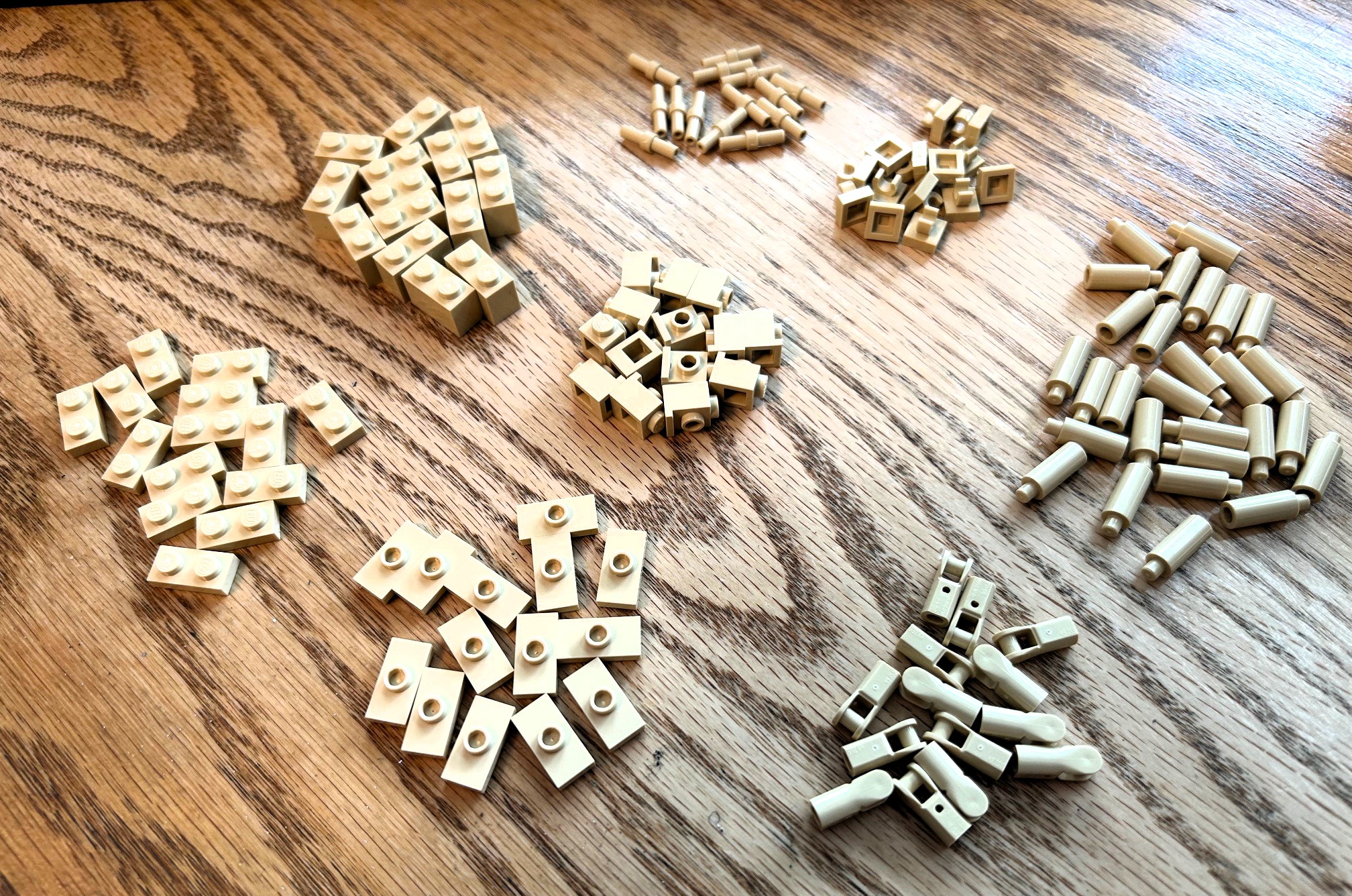
Here’s the truth of it: the twenty-six leftovers shown here amount to just a handful as well.  Every one of them is among the tiniest pieces in the entire cathedral.  It probably cost LEGO pennies to add in these “bench players”.  And given the tendency of pieces to run away I’m grateful to have them.  Heck, by the time the cathedral is finished maybe I’ll have enough leftovers to build a small elephant. 

Running build time: 7 hrs. 57 min.

Total leftover pieces: 26

Some content sourced from the National Cherry Blossom Festival website, and Wikipedia, “the free encyclopedia”.

Eggs-asperating Prep

Every now and then I get a hankering to bake something, which nine of ten times means chocolate-chip cookies. That tenth time I’ll venture into breads or cakes but they’re usually too time-consuming for my “taste”. Thus I’ll buy a perfectly prepared croissant before I ever labor to make one on my own. Maybe the same should be said for so-called perfectly prepared eggs.

Eggs-spensive!

We’re all talking about eggs these days, the same way we talked about gas during the “Energy Crisis” of the late 1970s. Eggs are scarce and evermore expensive, which translates to being more choosy about how we use them at home. I like eggs for breakfast every other day and I’m not likely to change that habit on account of rising prices. My dog may have to forego the occasional scrambled egg on top of his kibble, but until I pay as much for a dozen eggs as I do to fill my gas tank, I’ll still be buying them.

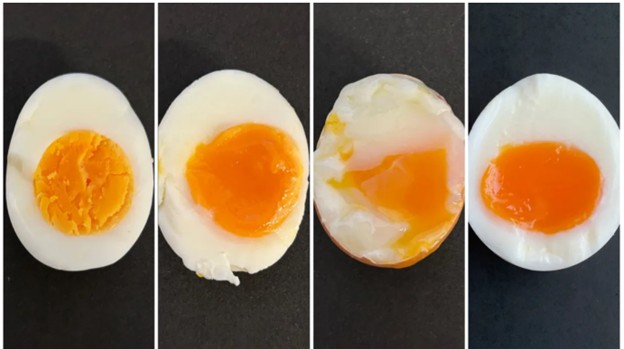
I prefer mine soft-boiled

What I won’t be doing is cooking my eggs any differently than I did last week or last month, even if scientists now claim the “perfect method” (their words) to do so.  I prefer my eggs soft-boiled, which means a pot, some water, a $2.99 submersible egg timer from Wal*Mart, and less than ten minutes of prep after the water is boiled.  It’s a quick, mindless process I can pull off even before my morning coffee.

Would you prefer a more time-consuming method instead, with only slightly better results?  Okay.  Take two pots of water and heat one to boiling (212 F for us Americans, 100 C for most of the rest of you) and the other pot to “lukewarm” (86 F, 30 C).  Drop your eggs into the boiling water for two minutes, then transfer them to the lukewarm water for two minutes.  Repeat seven more times.  That’s right, seven more times.  On your calculator as well as mine, that’s 32 minutes until breakfast is ready, and you’re too busy to do other stuff while you’re waiting.

If I dedicate 32 minutes to egg-making, I’m expecting something much more grand and decadent.  An omelette at the least.  A scramble with a load of cut-up veggies.  “Benedict”, including the hollandaise sauce.  Heck, I’d even don my French chef’s hat and try sous vide eggs, which are…. oh, never mind – those take an hour or more.

The second is soft-boiled; the fourth is supposedly “perfect”

The thought of “perfect” eggs in 32 minutes instead of soft-boiled in less than 10 is exasperating.  If I wanted to go all science on you, I’d explain why 32-minute eggs allow the albumen and yolk to cook perfectly together, even though each has a different composition.  I’d also explain why this method retains the maximum nutritional benefit of eating eggs (protein and so on).  But c’mon, do you really care about those details when you’re just looking for grub to get your day started?  Heck, the prep of my 10-minute eggs even allows me to feed the dog and clean up last night’s dishes while I wait.

The “perfect eggs” news article is interesting enough but I had to laugh when the writer inserted the standard “… be forewarned that consuming raw or undercooked eggs may increase your risk of foodborn illness”…”  Wait, I thought these eggs were perfectly cooked.  Now you’re hinting the process may cause food poisoning?  Sorry Mr. Scientist, I’ll stick to my $2.99 Wal*Mart egg timer method instead.


LEGO Notre-Dame de Paris – Update #7

(Read about the start of this “church service” in Highest Chair)

Maybe LEGO’s engineers got impatient with the construction of the east-end chancel of Notre-Dame de Paris, because Bags 10 and 11… of 34 bags of pieces, laid out the rest of the foundation of the entire cathedral.  Indeed, when we finished today’s rather brisk build (24 minutes!) we put down enough marble to allow the capacity 1,500 parishioners to “take a pew”.

24 minutes was barely a French coffee break back in the day when Notre-Dame was actually built.  In fact, we’re now twenty years into the construction: AD 1182.  With the chancel complete enough to host church services, we’ll spend the next twenty years (or rather, the builders did) rising the transcept (the “cross” bar, remember?) and first bays of the nave (the cross “long” bar).

Speaking of “bars”, note that I added LEGO’s signature “title bar” to the near edge of the model today (photo below).  LEGO wants you to know what cathedral you’re looking at, even though I’m teaching you enough detail so you won’t need a title bar.  But don’t be fooled; you won’t find a title bar in the foundation of the real Notre-Dame de Paris.

Today’s build was quick but not without the usual antics.  Once again I installed a piece incorrectly – a tiny bit of marble.  Once again I reached for the LEGO lever but it couldn’t lever out this kind of piece.  So I resorted to my paper clip “crowbar” instead and ZING!!! – the piece went flying across the room and ricocheted (another word with French roots – nice, no?) off the wall.  Good thing I managed to find it or several of Notre-Dame’s parishioners would trip on their way out.

Running build time: 5 hrs. 56 min.

Total leftover pieces: 24

Some content sourced from the CNN Science article, “Scientists developed a new method for the perfect boiled egg…”.

You Can Say That Again

When I was a kid, I remember (or was told) I used creative pronunciations for common words. Instead of cinnamon I’d say cimm-anin. Instead of spaghetti it was bis-ketti. The library was the lie-berry. Maybe back then my excuse was in just learning to talk but I can’t play that card as an adult. So when someone says Feb-YOU-air-ee instead of Feb-ROO-air-ee, or Shur-BERT instead of Shur-BET, I tend to wince.

We’ve made it to the time of year where we reflect on the previous one, and we do so in year-in-review lists. “Most Influential People of 2024”. “Best Television Shows of 2024”.  “Significant World Events of 2024”.  And how about this one?  Most Mispronounced Words of 2024.  Thanks to Babbel, maker of language-learning platforms, the hard audio evidence doesn’t lie.  Babbel came up with ten words people mispronounced over and over last year.

I could print Babbel’s list here, but it’d be a waste of your time so I’ll just hyperlink it instead.  Eight of the words I never ever used in 2024 (and never will), and the only reason I spoke the other two was because they’re the last names of politicians featured in 2024 headlines.  To be honest, the list made me question Babbel’s approach to learning languages.  Are these the words promoting a budding English speaker’s proficiency?

Babbel also listed mispronounced words from other languages, including one of my favorites: espresso.  Not sure how we Americans get that one wrong time after time, but we do.  Maybe the myriad “ex-” words in the English language have us saying EX-presso but the concentrated coffee drink sounds exactly as it reads: ES-presso.  Keep that in mind and your next Italian barista will be happy to serve you.

As long as we’re speaking Italiano let’s get another one right – al dente.  When you want your pasta cooked just right; “not too soft but firm to the bite”, you describe it as ALL den-tay, not ALLA dawn-tay.  I only know this because I learned Italian when I was in college.  If I didn’t know better myself I’d probably go with AL dent.

Notre-Dame de Paris

As long as we’re talking foreign language mispronunciation, let’s correct another one.  Notre-Dame de Paris, the medieval Catholic cathedral in the middle of Paris (and the middle of the River Seine), can be mispronounced so many ways it’s almost as devastating as the fire from which it was resurrected.  On the surface it sounds something like NOH-tur daym day PEAR-iss, which is “English-French” at its absolute worst.  In actual French it sounds like this: NOH-tr dam due PAH-ree, where the two “r”s almost sound like “l”s.

You never saw it coming but today’s language lesson is a segue to the topic I’ll be covering for the next several weeks and months.  Notre-Dame de Paris is a magnificent structure and a renowned work of architecture.  It’s also a new model created by the good people at LEGO.  And speaking of good people (great, actually), my wife put that LEGO model under the Christmas tree for me this year.

For those who enjoyed the long journey of my building the LEGO Grand Piano (which I chronicled in Let’s Make Music!), and the shorter journey of the LEGO Fallingwater House (Perfect Harmony), I’ll be at it again as I attempt to rise Notre-Dame de Paris from the “ashes” of 4,383 plastic pieces.  Won’t you join me on this foray into all things FRON-says?  (That’s “French” for those of you who mispronounce it.)  You’ll learn about the world’s cathedrals along the way, many of which took hundreds of years to construct.  Let’s hope my own build of Notre-Dame de Paris is a whole lot shorter than that.

Some content sourced from the CNN World article, “These are the most mispronounced words of 2024”, and Wikipedia, “the free encyclopedia”.

Choc’ Full and Wheat Thin

Chocolate aficionado that I am, the recent headline of the possible buyout of The Hershey Company instantly grabbed my attention. Hershey has been around for well over a hundred years; the American brand most associated with chocolate (no matter what you think of their products). But one detail caught my attention even more than the chocolate. Mondelez, the purported buyer of Hershey, also makes Wheat Thins snack crackers. Suddenly this announcement is downright riveting.

If you don’t have a box of them in your pantry right now, you’re at least familiar with Wheat Thins.  The flat, square, unashamedly crunchy crackers have been around forever (that is, if 1947 is the same as forever).  Wheat Thins are packaged in the bright yellow box with the distinctive red Nabisco logo in the upper corner.  The box top encourages you to “Open for 100% Awesome” and boy do I ever.  I sometimes wonder whether Nabisco has baked more Wheat Thins or Oreos over the course of their respective existences.  As a kid I would’ve hoped that winner would be Oreos.  These days I nosh more like an adult and prefer the ultimate snack cracker.

Imposter crackers

Here’s where you come at me with your own “ultimates”.  Maybe your pantry is stocked with Cheez-it crackers instead of Wheat Thins.  Maybe “everything sits on a Ritz” in your house.  Or you like Premium saltines because they’re, well, saltier.  Are you’re one of those inexplicables who actually prefer table water crackers?  You must’ve really liked communion wafers as a kid.  Nothing says “Styrofoam” like the taste of a table water cracker.

Frequent companion

Wheat Thins was (were?) introduced to my palate at a very young age.  My dad was obsessed with them.  I can’t think of a time I entered our pantry where the big yellow box wasn’t present.  My dad would eat them right out of the box instead of bothering to pair with cheese or dip.  My dad was never one to talk with food in his mouth, but I swear I can still hear him holding conversations with my mother while simultaneously crunching a mouthful of Wheat Thins.  Apparently obsessions are hereditary.

Wheat Thins are described as “100% Whole Grain”, which is a sly way to throw you off the canola oil, sugar, cornstarch, and other garbage you’ll find on the ingredients list.  Admittedly there were several years where I strayed from Wheat Thins.  At the time our pantry morphed into a collection of decidedly more healthy options, and many, many boxes of Wheat Thins gathered dust on grocery store shelves.  We indulged in almond, baked, and organic wheat crackers instead, as if any of them held a candle to Wheat Thins.

King of snack crackers

I can’t say exactly when they made their comeback, but suddenly Wheat Thins is a pantry staple again.  Probably because I missed their “indescribably delicious taste”; a spot-on advertisement because I can’t describe what makes a Wheat Thin so delicious.  Whatever the attraction, the recommended serving size of “16 pieces” is laughable.  Heck, I grab that many in one handful.  On that note, I’m eternally grateful to Nabisco for creating a “Party Size” box of Wheat Thins (and I’m perfectly content to be the only one at the party).

Wrong, wrong, wrong!

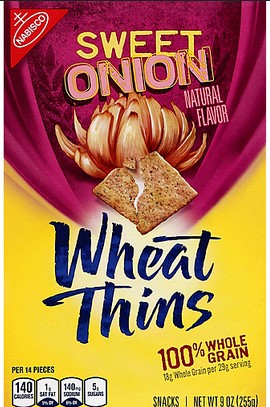
To be clear, we’re only talking about the “original” here.  I was horrified to learn there are over twenty spins on the taste of Wheat Thins, including “lime”, “chipotle”, and (gag) “dill pickle”.  Then Nabisco went completely off the rails and created sweet versions of Wheat Thins, including “honey” and “lightly cinnamon”.  Those last two have been discontinued because, c’mon, did they really think the king of sweet crackers – the graham – could be dethroned?

Like a lot of food products I was raised with, Wheat Thins are not as “original” as they claim to be today.  They just aren’t.  I can’t say how many of them I’ve eaten in my life but let’s go with a billion, shall we?  That makes me an unquestionable Wheat Thins expert.  And I’m here to tell you the taste may be the same but the consistency is suspect.  Wheat Thins are a little crunchier these days than they used to be.  If they’d just let me into their factories I bet I could figure out exactly which ingredient they swapped out (in the interest of profit margin, of course).

If I were you (wait… reverse that; if you were me), keep an eye on Mondelez.  You know them by their former name: Kraft Foods.  Mondelez is quietly consuming the entire snack aisle.  Chips Ahoy, Triscuit, Sour Patch, Toblerone, Dentyne, even Tate’s Bake Shop (another “thin” delight) all belong to this foody conglomerate.  Hershey Kisses (and Reese’s Peanut Butter Cups!) may soon join the list.  But if someday we all wake up and finally realize these products are terrible for us, I hope the one cracker Mondelez is still making on the day it closes its doors is Wheat Thins.  I’m not sure I can live without them.

Some content sourced from the CNN Business article, “Hershey’s stock explodes higher on report Mondelez offered to buy it”, and Wikipedia, “the free encyclopedia”.

Flop O’ the Mornin’

Parked prominently within my wife’s impressive collection of teas are colorful boxes of English Breakfast and Irish Breakfast. The first is described as “expertly blended… a smooth classic” (strength: 4 tea leaves) while the second is “brilliantly blended… bold & robust” (3 tea leaves). Maybe those descriptions are right on the money but I’m a coffee drinker so what do I know? What do I know? I know I’d never let English breakfast or Irish breakfast anywhere near my dining table.

Sorry to disappoint but we’re not talking about tea at all today.  Instead, we’re talking about the food that goes with the tea.  Or rather, the food that should go with the tea.  In my world, the sanctity of breakfast is second only to the cornucopia of the Thanksgiving meal.  There’s a certain well-defined menu of dishes that screams BREAKFAST!!! and nobody in the Western Hemisphere (or at least, in the New World) would disagree.  Even so, I must acknowledge the “illegal aliens”; the dishes that try to crash the morning party when they really belong on the lunch or dinner table.  Or in the trash.  Or at least on the other side of the Atlantic.

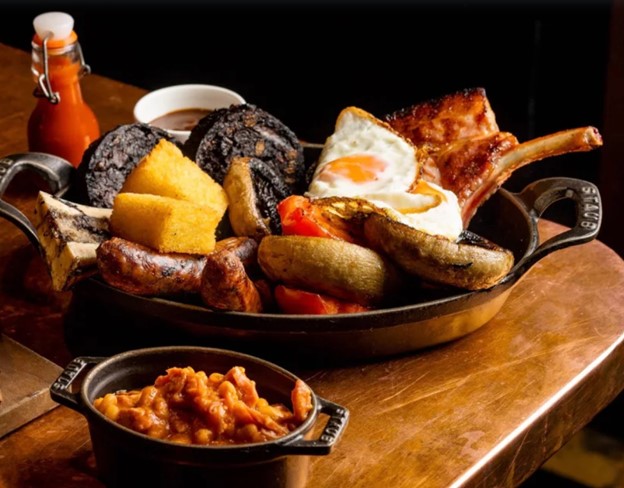
The “Full English”

In its various forms, the full English breakfast starts out promising.  You’ll find eggs, bacon, and sausage almost without fail; even hash browns on occasion.  But the plate shatters after that.  You have a tomato, cut in half, fried, and doused with salt and pepper.  You have baked beans in tomato sauce (which aren’t even sweet the way Americans think of VanCamp’s or Bush’s). Finally, you have the horror known as black pudding, which can only be described through the hyperlink above instead of the words of this post, for fear I’ll lose my lunch – er, breakfast.

Unlike the teas, the full Irish breakfast is virtually identical to the full English, with the singular exception of white sausage instead of black.  Again, the definition will remain behind hyperlinked for the sake of a clean keyboard.  I was in Dublin on business years ago and took the “try anything once” approach with white pudding.  Bad, bad, very bad decision.

White pudding (not for the faint of stomach)

If I were born in England or Ireland I probably wouldn’t rain on the breakfast parade on the other side of the pond.  But here’s the thing: even if you like a savory tomato or “pudding” for breakfast, the entire plate is greasier than the wheel bearings in your car.  There’s not even anything to mop up said grease (like the slices of dry toast we Americans prefer).  I can’t imagine having much pep in my step after a weighty meal like this.

Denny’s is very helpful to reestablish breakfast order. If you walk into one of their restaurants and order the “Build Your Own Grand Slam”, you can construct your plate from four of the following: Eggs (7 different ways), pancakes (9 different), bacon (2), sausage, potatoes (3), toast (countless), muffin, biscuit, ham slice, or seasonal fruit.  With all those combos you could eat breakfast at Denny’s every day of the year and no version would be the same as another.  But more to the point, Denny’s offers breakfast items decidedly “All American”.  Add in waffles, hot/cold cereal, baked goods, and hash browns, and you’re looking at everything deserving of the list.

Where real “full breakfast” is served

American breakfast menus do include a few trendy alternatives these days (even at Denny’s).  You can keep it simple with a fruit smoothie, breakfast sandwich, or avocado toast.  These all-in-ones strike me more like convenience foods than full breakfasts.  Yes, you paint yourself a little healthier just for ordering them.  But let’s hang in there a few generations and see if they still show up on breakfast menus.  More likely they’ll just be memories the way porridge or salted meats have become breakfast history.

For the record, my wife’s English and Irish tea boxes sit largely untouched, except for the few bags she’s brewed.  They’re untouched for good reason.  Just the words on the box have me thinking of tomatoes, baked beans, and pudding.  Someone bring me a blueberry waffle stat.

Some content sourced from the CNN Travel article, “The Full English: How a greasy feast came to define and divide a nation”, and Wikipedia, “the free encyclopedia”.

Parts Party

I’ve always been fascinated – mesmerized even – by the mechanics of assembly line manufacturing. A product takes form from a single part, then moves down the line to where another part is added. Then another part, another, and another, until at long last the completed product presents itself at the very end for packaging. Assembly lines are becoming more and more automated, which begs the question: When will humans be removed from the process altogether?

“The Rouge”

On a recent trip to Detroit with my brothers, we were lucky enough to snag tickets to a tour of the Ford River Rouge Complex, where the F-150 truck (gas engine) is mass-produced. Ford has over 65 manufacturing plants worldwide but I think “The Rouge” is the only one you can tour. And boy is it worth it. You walk away with a lot more admiration for a fully-built F-150 than when you first set foot in the building.

The tour begins on the bridge at the lower left

Ford doesn’t allow you to take photos inside The Rouge (and they keep a close eye on visitors) else I’d include a few here. The tour starts with a couple of promotional videos in comfortable theaters, followed by an elevator trip to the top of the visitors center for a look down at the vast campus. Then things get serious. You put away your phones, listen to the rules and regulations about behaving inside the factory, and off you go.

Ford F-150

Here are the eye-popping numbers. The F-150 travels the length of a four-mile assembly line as it grows from parts to finished product. That line includes over two hundred stops to add parts (which aren’t really stops because the truck is always being pulled along). A fully-functioning F-150 rolls off The Rouge assembly line every 52 seconds, which translates to a remarkable 650 new vehicles per ten-hour working shift. And finally, the whole process is far from automated. 6,000 workers assemble the vehicles, each a specialist in the given part, calibration, or inspection the truck demands.

Of course, an F-150 has far more than two hundred parts. Some of those assembly line stops are for the installation of major components. The entire dashboard, for example, or most of the engine are installed in a single stop. But you also have workers who do nothing more than take a rubber mallet and pound on rear taillight covers. Think about it.  Can you imagine hammering on taillight covers 650 times a day?  It’s mindless, it’s repetitive, and you have to wonder about the toll it takes on the human body.

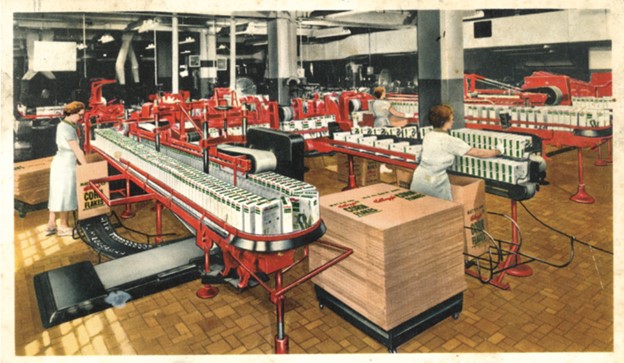
Cereal-making “back in the day”

Assembly line work can be more fun and less repetitive than building cars.  My family and I visited the Kellogg’s (cereal) factory in Battle Creek, Michigan in the early 1970s.  The smell of cooked corn flakes might’ve turned a kid’s nose but the tour was the next best thing to Willy Wonka’s.  You’d don a Kellogg’s paper hat and read the colorful brochure story about how “this little kernel went to Kellogg’s… first it was milled… then it was flavored…”.  Then you’d walk the assembly line of breakfast cereal, from cooking all the way to box filling.  The best part was at the very end, where you’d get free samples of all your Kellogg’s favorites, and postcards so you could brag about the place to your friends.  Alas, like many manufacturing facilities, safety and espionage concerns brought an end to the Kellogg’s tours in the mid-1980s.

At least I could watch assembly lines on TV after that.  How It’s Made was my kind of show.  The Canadian documentary spent years creating virtual factory tours so viewers could see the ins and outs of manufacturing processes.  In a single episode you’d watch the dizzying mechanics behind the creation of everything from candies to clothing to cars.  How It’s Made kind of gave you access where access wasn’t allowed.

Speaking of no access, the electric-engine version of the Ford F-150 – the “Lightning” – is produced in a plant where no tours are permitted (back to the espionage thing).  Instead, you watch a short video of the process after you’ve completed The Rouge tour.  How are the two F-150 assembly lines different?  Several thousand humans.  The Lightning production is almost entirely automated, with robotic machines hovering over the vehicles as they come together.  Our tour guide said the assembly line is eerily quiet, since a robot doesn’t require a banging mallet to add on a taillight cover.

For all my fascination with assembly lines and automation, I wonder whether “loss of humanity” is really the way to go.  All those jobs at The Rouge would disappear.  Machines would be one step closer to taking over the world.  Suddenly “handmade” sounds better than ever.

Some content sourced from the Michigan Blue article, “Visiting the Kellogg’s Factory”, and Wikipedia, “the free encyclopedia”.


Apple Pie meets Maple Syrup

On a visit to Detroit with my brothers last weekend, I was surprised to discover just how close the city streets are to the edge of the United States. Walk out of Detroit’s downtown Renaissance Center through the south doors (yes, I did just say “south”), cross Atwater Street, and you’ll find yourself standing on the edge of the Detroit River staring at Canada on the other shore.  Almost has you thinking in metric, “eh?”

Canada is south of the U.S. – who knew?

Here’s something I probably learned in middle school and promptly forgot: the border between Canada and the U.S. runs right through the middle of Lake Erie (and the Detroit River). It’s as if Americans and Canucks had a long drawn-out discussion about who deserved the lake more, and then clinked glasses of Budweiser and Molson with, “Okay, you get half and we get half”.  The same thing happened with three of the other four Great Lakes (America somehow got all of Lake Michigan) and that’s why – at least in Detroit – Canada lies to the south.

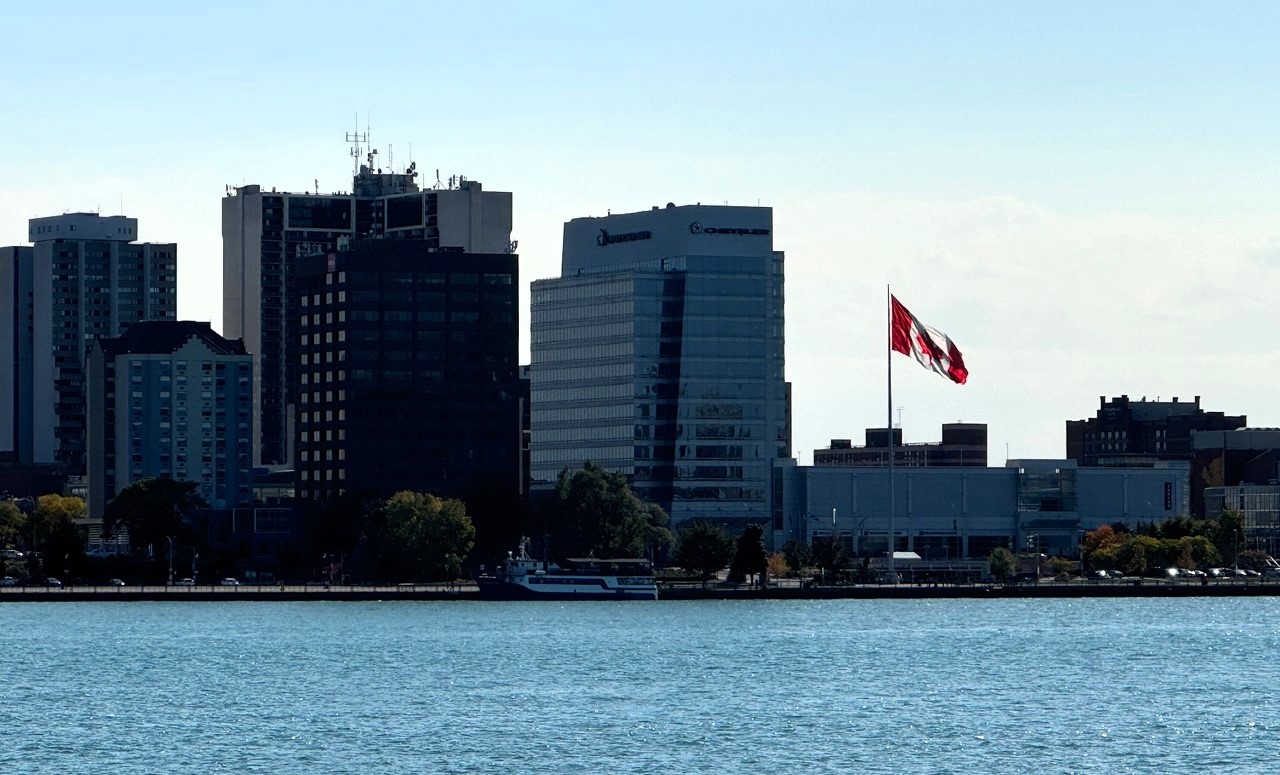
The view of Canada from Detroit

Not that you’d know it’s Canada, mind you.  Aside from the giant red and white flag billowing on the far shore, the streets, buildings, cars; everything looks exactly the same as America.  You might as well be looking at Saint Paul from Minneapolis.  And Windsor (the Canadian town you see) is so close you might as well swim for it.  The Detroit River is only a mile wide at this juncture.  I kind of wondered what would happen if I did swim for it.  Would a flurry of border patrol boats appear out of nowhere to haul me in?

Instead, my brothers and I kept it legal and drove across the Ambassador Bridge (there’s the Detroit-Windsor tunnel if you prefer).  It felt a little strange to hand over passports just to go to dinner.  And once we sat down at our Windsor table we were greeted with a hearty “Happy Thanksgiving!”  Thanksgiving?  Had we gone through some sort of time warp?  Oh, right – Canada celebrates Thanksgiving in October.

The view of Detroit from Canada

Naturally we asked our server how Canadians celebrate Thanksgiving.  She thought about it for a moment and said, in her wonderful Inland North accent, “Oh, y’know, we gather with our families and have the meal.”  That’s it?  Not even an embarrassingly-large, dozens-of-dishes, eat-’til-you-burst meal?  Just food with family?  But in fact, Canadian Thanksgiving is pretty much the same as “down south”.  Explorers crossed the ocean, landed safely in the New World, established a settlement, held a feast of thanks, blah-blah-blah.

Pumpkins make sense for Canadian Thanksgiving

Despite our server’s succinct description, the Canadian Thanksgiving meal includes most of the dishes we enjoy on this side of the Detroit River (including turkey).  Canucks also celebrate with parades, Oktoberfests, and other festivals.  There’s even a “Thanksgiving Classic” courtesy of the Canadian Football League.  Makes me wonder if the Detroit Lions somehow found a way to play that football game along with every (U.S.) Thanksgiving Day game since 1934.

Ambassador Bridge

As we crossed back over the bridge after dinner, two thoughts entered my mind.  One, the waterfront houses on the Canadian side of the Detroit River have a view of the United States all day long instead of seeing their own country.  That seems a little odd.  And two, I wondered whether goods and services in Windsor (or beyond) would be worth leaving the U.S. for, instead of just purchasing the same in Detroit.  You’d have to pay the bridge/tunnel toll both ways for a little Canadian Bacon (or backbacon), which might compromise the benefit.  You’d most certainly run out of pages for the stamps on your passport.

Earlier I said something about “almost” thinking in metric.  No, you really do have to think in metric in Canada.  As soon as we crossed over the Detroit River, our car’s GPS changed directions into kilometers (clicks) and meters.  Suddenly the next turn was “100 meters” away instead of “300 feet”.  Believe me, it’s a little disorienting watching the meters count down (slower) than the feet you expect.  After several bottles of wine at dinner (liters?), at least we could still navigate back to the bridge.  Otherwise this post might be coming to you from “up north”.

Some content sourced from Wikipedia, “the free encyclopedia”.
Tricks of the Trader

Our town, like so many others, offers the choice of grocery shopping at a national-brand market or at one with a more local vibe. We spend our dollars at Publix (1,300 stores across eight Southeastern states) but also splurge at The Fresh Market (161 stores) when we’re after something a little more unique. Having said that, our town lacks another popular market and it begs the question: What is the appeal of Trader Joe’s?

Chattanooga, TN

This post was originally headed in a different direction.  Trader Joe’s made the headlines because of its popular cloth “mini-tote” bags; so popular they were reselling on eBay for $500.  That led me to think, America has an obsession with miniatures and let’s make that today’s topic.  But no, I can’t get Trader Joe’s itself out of my mind, so let’s walk through their aisles for a few minutes.

Very popular!

The cloth bags are a great place to start.  Did you know Trader Joe’s was the first grocer to offer reusable shopping bags, beginning in 1977?  The trend didn’t catch on with other stores for another fifteen years.  Even better, “TJ’s” encourages use by refunding you $0.05 per bag or entry into a weekly raffle for a $25 gift card.

The above paragraph was brought to you by the food-and-drink enthusiast website Tasting Table.  Their 25 Facts About Trader Joe’s… is a convincing sell, maybe getting you to dash over to your nearest TJ’s for a look inside.  But a company’s commitment to sustainability isn’t enough to draw me in over and over.  There must be something else at play.

Maybe it’s more about TJ’s “revolving door of new products”.  They frequently discontinue one product in favor of another, so what you find on the shelves is constantly changing.  They limit certain items to seasons (right now you’ll find pumpkin-spice everything).  And their product line is impressively diverse for a medium-sized grocery store, which probably attracts more than your run-of-the-mill shopper.

I suppose you could make the same argument for a restaurant.  Shaking up the menu is a good idea every now and then (hence “specials”).  Leave the core set of entrees alone but occasionally introduce new ones to see if they’ll take.  Yet it’s not a perfect analogy for Trader Joe’s.  My impression is, nothing on TJ’s shelves is safe for the long haul because all products are under constant scrutiny.

How about “affordable prices”?  Here’s where I take my hat off to TJ’s.  The advertised price of a given product at Trader Joe’s is the one-and-only price.  No discounts, coupons, gift card offers, special promotions, or even online ordering to cloud the cost to the consumer.  And since 80% of what TJ’s sells can only be purchased at their stores, price-shopping the competition is a waste of time.

Stuffed animals are hiding at TJ’s

TJ’s probably draws in young families because the shopping experience is fun.  The nautical theme is apparent in its decor, as well as on its “crew member” uniforms.  A stuffed animal hides somewhere in the store – find it and win a prize.  And a bell rings (again, the nautical thing) to alert employees to open new check-out lines or answer customer questions.  I like that approach a whole lot more than simply announcing the need over a loudspeaker.

You can try a lot of things at Trader Joe’s (Costco on steroids?), you can call the store ahead of time to reserve popular items, and you can usually get a refund on anything you regret buying (regardless of reason, proof of purchase, or the amount of the product you’ve consumed).  What I highlight in italics here is impressive for a grocery store yes, but it still doesn’t make me a return customer.

At the end of the day (or a list of “25 Facts…”) I go to a grocery store because it carries the items I need.  To put it another way, I am brand-loyal and fairly routine in what I buy.  Perhaps that is the genius of Trader Joe’s.  It draws people in again and again because, well, they want to be more creative in the kitchen.  Try out new things.  Emerge from the doldrums of the same thing on their plates every other week.  And who can argue with variety as the spice of life?

Oakland, CA

Maybe, collectively, 25 facts explain Trader Joe’s success.  Or maybe someone from out West will chime in and solve the mystery.  After all, California was the birthplace of Trader Joe’s (Pasadena), and the number of stores in the state has ballooned to over 200.  There should be plenty of TJ’s experts out there to explain what the fuss – er, repeat business is all about.  Then, just then, I might get into my car to drive the hour and change it’ll take me to get to my nearest location.

Some content sourced from Wikipedia, “the free encyclopedia”.

Dental Essential

When I filled a prescription at my supermarket’s pharmacy recently, the line of customers snaked down an aisle of toiletries. I surfed on my phone for a few minutes as I waited but eventually took note of the products on display around me. To the right, endless shampoos, conditioners, sprays, and other hair care items. To the left, nothing but rows and rows of toothpaste.

If you’re a Millennial or older, I’ll bet you’ve brushed a time or two with Crest or Colgate.  Both products have dominated the toothpaste market since their humble beginnings in the 1950s.  I was raised on Crest and saw no reason to change brands as a young adult.  But these days, like most anything I put into my mouth I’m a little more selective.

The shelves of toothpaste in my supermarket caught my attention for two reasons.  First, the options from a single manufacturer these days are daunting.  Crest may have only eight product lines (like “Gum Health” or “Kids”) but that translates to a total of fifty-seven unique tubes of paste.  Wow.  So you’re telling me you’d know which one would be perfect for you?

My second observation: there are surprisingly few players in the game for a product each of us uses at least twice a day.  Crest and Colgate dominate the shelf space; I’d put the number at 85%.  The other 15% – at least in my supermarket – goes to products from Sensodyne and Arm & Hammer.  Sensodyne targets those of you with sensitive teeth.  Arm & Hammer promotes, naturally, the perceived benefits of baking soda.

The truth is, there are dozens of toothpastes besides Crest and Colgate.  Just think of it like a chessboard: you have the two kings and then you have the rest of the pieces.  Those pieces include a few that make me nostalgic.  For a short time I had a “brush” with Pepsodent; its unique taste flavored with sassafras.  My dentist’s recommendations during my cavity-prone years included Mentadent and Aim (neither of which took hold).  And honorable mention goes to Pearl Drops, which I never tried but was the first product to add sex appeal to brushing your teeth.

I don’t know anyone who uses Pepsodent or Pearl Drops anymore, but I also think Crest and Colgate are finally getting serious challengers.  Today’s generation (and those behind it) is more enlightened.  In fact, my own choice for my toothbrush – Earthpaste – has to be purchased at a specialty store or online.

I’ve talked about Earthpaste before, in Polishing the Pearls. That post was more about the ingredients in toothpaste than the products themselves.  But ingredients certainly matter.  Crest contains between fifteen and twenty (and some are better left in a science lab).  Earthpaste contains just five, including bentonite clay, salt, and essential oils.  I have no problem putting any of those in my mouth, including the “dirt” of bentonite clay.

The truth is, if you can stand the bitter taste you can just brush with baking soda.  It’s a short list of ingredient that actually benefit your dental hygiene.  And for me, the habits I’ve locked in besides brushing far outweigh the importance of which toothpaste I choose.  Daily flossing (at night).  Oral rinses.  Toothpicks for my close-together teeth.  Recent trips to the dentist would suggest I’ve got a good regimen going.

As for you Gen X, Y, Z and especially Alpha members, there’s a palpable point to this post.  99% of humans will continue to brush with toothpaste.  Crest and Colgate still dominate the market seventy-odd years after their debuts (at least in America).  It seems to me there’s room for another low-ingredient high-health product like Earthpaste.  I’d fire up that home chemistry lab before someone else beats you to it.  There’s potential prodigious profit in the production of paste!

Some content sourced from Wikipedia, “the free encyclopedia”.

For Whom the Road Tolls

Because we raised our kids in Colorado, vacations to visit our extended families were often by airplane, since my relatives were in California and my wife’s were in Florida. It was the rare trip where we could see any of them by taking the car. So when my wife and I drove from South Carolina to Pennsylvania recently to visit my brother and his wife, we were reminded of what makes travel by car different than by plane. Toll roads, for instance.

Take your pick of payment

I have memories of toll roads my kids will never have. They’re old enough to remember passing through the booths and handing coins or bills to the collector. But they won’t remember the unmanned alternative, which was to toss exact change into a big plastic basket, listen to the coins process through the mechanics below, and hope/pray the gate to the toll road would raise. That automated approach seems almost quaint compared to today’s electronic alternatives.

I say alternatives (plural) because yes, that’s what we have with today’s toll roads. It confounds me. Why in heaven’s name haven’t we developed a painless, seamless, and most importantly, nationally coordinated approach to toll road payments? To some extent (nineteen states) we have a solution – E-ZPass, which by subscription and sticker allows convenient passage.  But even E-ZPass is not a perfect system.

Not so E-Z

For the rest of the country’s tolls – and for most of our round-trip drive between South Carolina and Pennsylvania – we have the clunky alternative. You pass through a now-unmanned (“un-personned?”) toll booth, where a camera grabs your license plate with a noticeable flash. Then, somewhere down the road (ha) a paper bill arrives in your mailbox. By my count I have four or five of these bills coming my way. It’s been ten days since we’ve returned home and I have yet to receive even one.

The cookie recipe is still on the back of the package

[Trivia detour:  Nestlé’s famous Toll House chocolate chip cookies aren’t named after toll booths but rather for an inn in Massachusetts where baker Ruth Wakefield came up with the recipe.  Wakefield and Nestlé struck a deal in the 1940s: her recipe printed on their bags in exchange for a lifetime supply of chocolate.  How very “Willy Wonka”, eh?]

Here is my unequivocally efficient approach to paying tolls across our many-highway’d nation. When you first get a driver’s license, you also sign up for a bank account-linked program which allows seamless paying of ALL tolls across the land – roads, bridges, tunnels, whatever – through a single readable sticker on your windshield. If you somehow don’t pay the tolls because of say, “insufficient funds”? Well sorry, your driver’s license doesn’t get renewed until you settle up at the DMV.

A $3 toll gets you through Baltimore’s Harbor Tunnel

My system is so logical it’s probably the reason I’ve never been pegged for a government job. In Colorado and elsewhere they almost have it right with the E-ZPass system – a sticker linked to a bank account. The problem is, they hold a minimum balance in a middleman (middle person?) account to guarantee payment of tolls.  I object, your honor. Why should Colorado have forty-odd dollars of my hard-earned money at all times when they can just settle up unpaid tolls whenever I renew my license?

Warning: cash-cow crossing

Then again, I have a beef with the tolls themselves, and that is, they pay for far more than the maintenance of the roads. You can’t tell me $10 per vehicle per crossing of the Golden Gate Bridge (GGB) is needed just to maintain the bridge. Here’s the jaw-dropping math for you.  112,000 cars cross the GGB every day.  That’s over forty million cars per year.  That puts the annual toll-taking at over four hundred million dollars.  $400M for bridge maintenance?  Sorry, fair traveler, you’re voluntarily lining the coffers of California (and San Francisco) every time you cross. “If I’m elected” (as we’ll hear countless times in the next two months), I’ll limit toll-taking to whatever it costs to maintain the bridge, road, or tunnel.  Not a dollar more.

On our return trip from Pennsylvania, I was amused to pass through one toll both with an actual human toll-taker. Those cordial people are still out there, collecting cash one car at a time. The woman in our instance happily returned us $19.25 on a $20.00 bill (and who’s happy to do that anymore?).

Time to bake cookies!

I was also amused… no, “gratified” is the better word; to pull into the parking lot of a South Carolina “rest area” shortly before we got home, for the use of a perfectly safe, clean, toll-free restroom on a toll-free highway. Maybe rest areas and their restrooms are the reason tolls cost more than the maintenance of the roads? Probably not. That would equate to a logical explanation for a government expenditure, which is an oxymoron.

Some content sourced from Wikipedia, “the free encyclopedia”.