Middling Name

Sixteen years after her debut album Some Hearts, Carrie Underwood released a collection of Christian songs called My Savior, a genre for which her signature was long overdue. My Savior was the perfect companion for the drive to and from Easter church last Sunday. On the other hand, Carrie dabbles in hard-driving, anger-cleansing rants like “Last Name”, which is a convenient segue to today’s topic. What (and why) is your middle name?

Hard to believe, but only 75% of Americans had a middle name in 1970.

Think about it for a sec… when was the last time you used your middle name?  When you pulled out your driver’s license?  Your Social Security card?  When you signed an important document?  Most likely it was for your last airplane ticket.  After all, the name you enter into the reservation has to match the name on the form of identification you provide.

Middle names originated in the Middle Ages (and boy do I love that coincidence). European countries – and much later America – picked up on Italy’s tradition of “double” first names.  Since Italian descendants were often named after parents and grandparents, you had a whole lot of Leonardos and Marcos wandering around.  “Secondary first” names helped distinguish Leo III from Leo IV.  Kind of like George H. W. Bush and George W. Bush.

I don’t know anyone – and I mean anyone – who uses their middle name by way of introduction, let alone conversation.  Outside of family members you might know the middle name of a friend or two but that’s about it.  Whatever practical purpose middle names served seems to have come and gone.

Unless you’re me, of course.  “David Wilson” is about as common as “John Smith” (and the reason you readers will never be able to hunt me down… bah-ha-ha!)  Just how common is my name?  Years ago I joined Hertz’s #1 Club and proudly stated my name at the counter for my first rental.  The agent tapped away and then said, “Sorry, but we have over 400 David Wilson’s in our database.  Could you be more specific?”  Then I gave her my middle name (Scott), to which she said, “Okay, so now I still have five of you”.  Sigh…

Girls = “Marie”, Boys = “James”

Scott was a common middle name back when I was born.  In fact, Scott ranked in the top ten boys’ middle names of the 1960s. (See if your middle name is/was a top tenner here.)  Maybe that’s why my parents chose Scott, because I’m not aware of any ancestors with the name.  Then again, Ancestry.com tells me I’m 12% Scottish.  Hey, my parents could’ve gone with “Scot” instead!

Early in my career, my colleagues and I decided to use our middle names in a desperate attempt to sound cooler.  We started referring to each other by first initial and middle name.  Hence I was “D. Scott” around the office (which sounds oh-so pompous in hindsight).  Didn’t last very long and my signature never changed.  I’ve always been a first-name, middle initial, last-name kind of guy with the pen.

Wouldn’t be as elegant without the “S”, don’t you agree?

Chances are your middle name was given to you because it sounded good alongside your first name.  Such was the case with our oldest son Mark.  We came up blank with middle names when he was born, so my wife got in touch with a college friend, whose husband was also Mark.  Mark Christopher.  The middle name sounded great to us so we promptly “adopted” it.  Not that our Mark will ever meet his namesake.

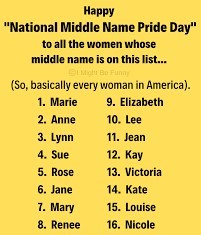
Speaking of my wife, her middle name is Marie; the same middle name given to both of her sisters (and later on to our daughter).  Marie and Ann are the most popular American female middle names of all time (for the males: Lee, Edward, and Michael).  Check those decade lists again – Marie and Ann were tops in 1950 and again for the next forty years.  Ann dropped off a little after that but Marie continues to be the most popular to this day.

Here in the South, a lot of people combine first and middle names.  Hence, Sarah is better known as Sarah Beth and Billy is better known as Billy Bob.  At least they’re using their middle names.  Some of today’s parents are choosing names like “Symphony” and “Rembrandt” to go in the middle.  As if their kids will actually use those names someday, right?  With that in mind, I’d like to thank my parents for (middle) naming me “Scott”.  Sounds just fine to me.

Some content sourced from The Atlantic article, “Middle Names Reveal More Than You Think”, and the Fox8.com article, “The most common middle names from the last 12 decades”.

Season Before the Sun

Every now and then I come across a little fact that makes me feel my age.  Fifty years ago this month a one-hit wonder named Terry Jacks released the single “Seasons In The Sun”, which parked at #1 on the music charts for three weeks and burned itself into my twelve-year old brain forever.  Any teen from back then will never forget the We had joy, We had fun lyrics.  Ironically it wasn’t a happy song (as in …goodbye Papa, it’s hard to die…) but not to worry.  Today I want to talk about the season before the sun instead.

Whether you celebrate Easter (this Sunday), the vernal equinox (a week ago Tuesday), or college basketball’s March Madness (on-going), the hints are everywhere: spring is beginning to, uh, spring.  For my wife and I, the season means strawberries, when the best of the fruit is available for the next sixty days.  For others it means the kids are out of school for a week.  But surely there’s no better indication of spring than flowers.  The bright bursts put winter’s doldrums behind us while the sun shines more often.  Flowers signify new beginnings.

Oz is full of poppies

Guys don’t talk about flowers much (unless we’re gardeners) but it doesn’t mean we haven’t had our share of close encounters with them.  My first was probably with dandelions (yes, they’re flowers) and the childhood fascination of blowing the blooms into countless flying bits.  Growing up in Southern California also meant going to the Rose Parade, where the bigger floats average more than 50,000 flowers. Senior prom was probably the one and only time I bought flowers in high school.  Call a wrist corsage awkward if you will, but hey, it beats the terror of pinning flowers on a girl’s dress.

dicey

Speaking of awkward, when I first met my wife in college I decided to be coy and send flowers, forcing her to make the next move.  But fate played a part when the bouquet was delivered to the wrong dorm, the flowers wilting at the front desk for days.  I didn’t hear from her for a while and she didn’t hear from me, and that meant we were thinking nasty thoughts about each other. “Ungrateful” (my end). “Loser” (hers).  Another girl finally let her know about the flowers and it’s a good thing she found out.  A marriage was saved!

pricey

If you’re thinking my spend on flowers is below average, I’m confident I made up for it in a single day: at my daughter’s wedding.  Her bouquet, her bridesmaids’ bouquets, down the aisle, around the altar, at the centers of the reception tables, and on and on – the blooms were everywhere.  Let’s just say the cost of all that color was probably enough to buy a small car.

I’ve brought home several flower bouquets over the years, whether to my wife or to my mother.  What used to be an in-shop, DIY experience is now pretty much Amazon, where you click your way through the colorful screens of 1-800 FLOWERS or FTD to create the perfect arrangement.  And as you know, you rarely get the exact look you choose from the photos.  The fine print protects the companies by stating something like “depending on availability”.

I like to bake (which is not the same as “to cook”), so when someone says “flower” I’m thinking “flour”.  After all, flour is to baking as flowers are to spring.  Flowers wouldn’t taste good in my chocolate-chip cookies, but you do find them in other foods.  Top your soup with a squash blossom, your tea with chamomile flowers, or your salads with calendulas, pansies, or marigolds. Not for me; no thanks.  When it comes to flowers as food additives I might be tempted to say, “the bloom is off the rose”.

The Masters is full of azaleas

Okay, so I went through the lyrics of “Seasons In The Sun” again and noticed …now that the spring is in the air, with the flowers everywhere… , so… what do you know?  Terry and I are talking about the same season after all.  At least this one lyric brings a little joy and fun to an otherwise depressing song.  It’s what this kid born in the 1960s might call “flower power”.

Blogger’s note: “Seasons In The Sun” really was #1 on the music charts exactly fifty years ago this month.  My wife and I bought strawberries last weekend, which had me thinking about seasons, which had the song bouncing around in my brain.  But the fifty-years thing is an eerie coincidence, don’t you agree?  Maybe a higher flower power is at work here.

Some content sourced from Wikipedia, “the free encyclopedia”.

Where’s Wendy?

The 96th edition of the Academy Awards came and went last Sunday without much fanfare. Mercifully, Monday’s reviews were more about who won, instead of tabloid headlines like wardrobe malfunctions or acceptance speeches gone wrong. I only watched the opening monologue, and not because I cared about what Jimmy Kimmel had to say. Rather, I wanted to see if I could spot a seat filler.

Back in my days as a mid-level manager in corporate America, dozens of resumes came across my desk for prospective employees.  Their sections on “previous experience”  sometimes caught my eye, if only for the really strange stuff people do with their time. Innovation Sherpa. Hacker. Direct Marketing Demigod. Happiness Hero.  I wouldn’t sign up for any of those “jobs” but hey, at least they come with a paycheck.  The only compensation a seat filler gets is a free ticket to the show.

Seat fillers are out there… somewhere…

If the title isn’t self-evident, a seat filler is someone who attends a televised event (like the Academy Awards) and stands in the shadows of the outside aisles until a “real” attendee gets up to get a drink, use the restroom, socialize, or whatever.  The seat filler then dashes over to occupy the seat until the person returns, so the panning cameras give the television audience the impression the event is always filled to capacity.

I could spend several hundred words talking about the myriad ways live TV manipulates a viewer’s perception (flashing “APPLAUSE!” signs come to mind) but seat fillers may be the most absurd of all.  Thousands upon thousands of people apply for these opportunities, with only a handful chosen for a given event.  As if remaining nameless among the Hollywood elite isn’t humbling enough, seat filling is last-minute employment with all expenses paid by… you.

Imagine opening the email.  Congratulations!  You’re going to the Grammy Awards!  There’s the good news.  The bad news is, now you have to book an expensive flight and hotel, buy or rent a dress-code-worthy tux or formal gown, and plead for last-minute approval from your employer for a few days off.  Assuming you do make it to the Grammy Awards, you’re subject to a strict set of behaviors.  Surrender your ID and smartphone.  DON’T walk on the red carpet.  DON’T talk to celebrities (unless they talk to you first).  And plan on being on your feet for hours, in a covert location where you can’t even see the show, waiting for the command from the Manager of Seat Fillers to “fill that seat!”

As one filler described the experience, maybe there really is a breathless kind of rush when you plop down next to someone like Taylor Swift or Beyoncé.  But let’s get real here; celebrities see a seat filler coming from a mile away.  How many of them are going to engage with a smile, let alone a word of acknowledgement?  Even if you did manage to exchange a sentence or two, you’re going to ask yourself, “Why did I say that to Taylor?” for the rest of your days.

HURRY!  She’s not in her seat!

Without your phone, you won’t be able to capture your seat-filling fifteen minutes of fame.  You’ll be lucky if you nab a copy of the event program (which can be purchased online anyway).  Seat filling is a the very definition of “anonymous”, and it’ll be hard to convince your friends and family you were even there.  Unless the TV camera points your way at just the right time, of course.

As for my careful study of the Academy Awards audience on Sunday night, it seemed like a fun game at the time.  Pause the picture when the camera pans the people, then walk up to the screen and play a sort of “Where’s Waldo?” (or Wendy) to spot the seat fillers.  But I quickly realized the error of my ways.  I can’t even recognize the actors.  They’re either the too-old versions of the ones I remember (sorry people, the Botox doesn’t help) or they’re the too-young versions of actors I’ve never seen in anything at all.

Suffice it to say, I will never be a seat filler.  If I ever go to an awards show it’s because I’m a “real” attendee who deserves to be there (in other words, another lifetime).  In this life, I’ll consider more appealing employment prospects for my retirement. Beverage Dissemination Officer. Golf Ball Diver. Professional Sleeper.  Hey, at least those pay.

Some content sourced from the Business Insider article, “I was a seat filler at last year’s Grammys…”, and Wikipedia, “the free encyclopedia”.

First-Name Basis

It’s only Tuesday as I type, but I’ve already cleared my calendar for Friday. After all, I have a very important day ahead of me. So important in fact, I need to organize a parade, raise a flag, and prepare unique dishes for the expected throng of adoring fans. But why am I wasting words on the details? You already know we’re celebrating Saint David’s Day in a few days, don’t you?

They’ll be celebrating in Wales, at least, just as they do every first day of March.  You’ll find my cathedral there too, way down in the southwest corner of the country.  Well, St Davids Cathedral, I mean.  And the funny thing is, he’s not the David you’re thinking of, the one from the Bible who took down Goliath as a boy and became king as a man.  This David helped to spread Christianity throughout the UK, united the Welsh people against a warring England, and performed several miracles.  David’s a big deal in Wales.

David’s parade (not Patrick’s)

St. Patrick’s an even bigger deal, of course.  At least Patrick rates a celebration in the U.S.  But admit it, you’re not celebrating Patrick’s spread of Christianity throughout Ireland, nor his miracle of removing all snakes from the land.  You’re thinking more about what garment of green to wear, four-leaf clovers, beer, and maybe, just maybe, this is the year you participate in your local St. Paddy’s Day 5k.

Nice cathedral, Dave

This business of saints is interesting to me because, well, it’s not as defined as I was led to believe.  The rules and processes to put “Saint” in front a first name are a little vague.  Suffice it to say, you need to be a model citizen, as well as a teacher, person of influence, and someone who cares little for the material goods and comforts of this world.  I know a lot of people who fill this bill, but add in “wonder worker” or “source of benevolent power” and the list drops to zero.

Do you know the way to… ?

Saints are also on my mind because I grew up in California and, well, they’re all over the place out there.  Francisco to the north.  Diego to the south.  Barbara somewhere in the middle.  My childhood home was right down the street from Monica.  My brother lives in Fernando’s valley.  99.9% of the state’s residents think of those as “places”, but firstly they were people.  You’ll find “San’s” and “Santa’s” all over the Golden State.

Saints get a little watered down when you consider the Catholic Church’s take on them.  More than 10,000 have been recognized over time.  Even more to the point, Catholics acknowledge anyone making it to heaven to be a saint.  I’d hope that count is way more than 10,000 by now.  Maybe it’s the reason we have patron saints: the cream of the crop, the ones regarded as “heavenly advocates of particular nations, families, or people”.  My patron saint isn’t David by default, but I sure like his name.

Eat Welsh Rarebit when you celebrate on Friday (grilled cheese on toast, zero rabbit)

Admittedly, my mind wanders somewhere other than historical figures when I think of saints.  Our dog is a Saint Bernard, one of those gentle giants you picture with a brandy brandy around the neck.  A few years ago we went on a cruise, with a stop in the Baltic Sea port of Saint Petersburg.  “St. Elmo’s Fire” is a luminous phenomenon caused by an atmospheric electric field. (also a pretty good movie from the 1980s).  And so on.

You can read a bit more about Saint David and his cathedral in one of my very first blog posts: unsung.  You’ll discover that his town of Pembrokeshire – the smallest kingdom enclave in the UK – is right across St. George’s Channel from the Irish town of Kildare, where you’ll find St. Brigid’s Cathedral, my wife’s namesake.  The blog post is really about Brigid but at least David gets a mention towards the end.  Even if you don’t “read a little more”, remember, Friday’s the big day.  Parades, flags, and fun food, all for a darned decent guy.  Makes me blush anytime somebody says, “Dave, you’re a saint.”

Some content sourced from Wikipedia, “the free encyclopedia”.

Teeny-Weeny Towns

My daughter forwarded a video about a suburb of Knoxville known as Safety City. In this little town you’ll find roads and traffic signals, businesses and shops, but no cars. Sidewalks are for pedestrians while streets are reserved for bicyclists and other “non-motorized vehicles”. Everything in “SC” is an easy walk, whether to the post office, football stadium, movie theater, or dinner at Applebee’s. Oh, and I almost forgot to mention… everything in Safety City is miniature.

Safety City in Knoxville

Safety City is a novel concept because it reduces the real-life aspects of a town down to a dimension children can relate to.  And relate they do.  Entire classes bus over to Safety City to experience vehicular, pedestrian, bicycle, and fire safety at a young age.  So much more effective than traffic school on a blackboard!

I’ve always been a fan of miniatures; a feeling hearkening back to my childhood.  Anyone who read Gulliver’s Travels knows “miniature”, as in the inhabitants of the (literally) small town of Lilliput.  Anyone who ever held a snow globe imagined those little places and figures inside the glass coming to life.

Diorama

I wonder if grade-school children still make dioramas.  What a cool concept for a kid.  Within the confines of a shoebox you create a miniature world of your liking: buildings, people, animals, trees, etc.  Then you cut a peephole in the center of one end of the box and cover the open top with tissue paper.  When you look through the hole you see your little diorama world, with the light filtering through from above.  It gives your creation a startling sense of reality.

“HO”-scale model railroad

Model trains certainly fueled my interest in miniatures.  I remember several friends who collected the popular “HO”-scale sets (1:87, or about 2″-high trains).  They could buy so many accessories (endless tracks, buildings, trees, and figures) they could create an HO-scale world big enough to fill a two-car garage.  Go figure, the only train set I ever owned was the “G”-scale, where the train’s a good 8″-10″ in height.  Not so miniature.

Speaking of model trains, one of my favorite episodes of the old television series The Twilight Zone was called “Stopover in a Quiet Town”.  A couple wakes up in a strange house after a night of partying, can’t get the phone or the lights to work, and find the refrigerator stocked with plastic food.  They walk outside, only to discover the surrounding town is utterly still – no people, no sounds, no movement.  Then the train whistles and pulls into the station, so they hop aboard, hoping to be taken back to somewhere familiar.  But the train merely travels in a wide oval and returns to the same station where it picked them up.  As the couple steps off the train, the giant hand of a child reaches down to grab them, while a mother’s voice can be heard saying, “Be careful with your pets, dear…”  Twilight Zone indeed.

Replicas of miniature cities can be found everywhere, whether Knoxville’s Safety City, Disneyland’s Storybook Land (viewed from canal boats), or Legoland’s Billund Resort, Denmark’s largest tourist attraction outside of Copenhagen.  There’s even a “top ten” of the world’s miniature cities, including “Miniaturk”, 122 famous buildings of Turkey in a park-like setting in Istanbul; “Tobu World Square” in Japan, which showcases the world’s UNESCO world heritage sites in the presence of 140,000 miniature people, and The Museum of Roman Civilization (which I’ve seen myself), a remarkable recreation of ancient Rome’s “Golden Age” thirty-six years in the making.

Legoland

Maybe all this talk of miniatures has you thinking of the recent trend of tiny homes.  Those are an entirely different concept; not at all “miniature”.  A tiny home is like a full-scale house with most of the air sucked out of it.  The components are still full-scale but the spaces are decidedly smaller than normal.  Tiny homes kind of look like shoeboxes to me.  Maybe we should add peepholes on the ends so we can watch the inhabitants try to make a living in their cramped quarters.

Some content sourced from Wikipedia, “the free encyclopedia”.

Game, Set, Matches

The LEGO Eiffel Tower is the tallest of its model kits and undoubtedly the largest of its Architecture Series. At a deliberate count of 10,001 pieces, this behemoth is a whole lot more detailed than LEGO’s 2014 original, which clocked in at a mere 321 pieces. So imagine my awe (okay, and shock) when I learned about another Eiffel Tower model; one with a staggering 700,000 pieces. Suddenly 10,000 seems like a nice, reasonable number.

Matchstick model

It’s true, of course.  A Frenchman recently converted 700,000 matches into a model of the Eiffel Tower, in an attempt to break the world record for, naturally, “tallest matchstick Eiffel Tower”. (Is there a world record for everything these days?)  I suppose I can get past the 700,000 matches – even if I can’t picture that many in one model – but what I can’t fathom is the eight years Richard Plaud sacrificed to build his creation. I’m picturing Monsieur Plaud waking up each morning, bidding adieu to his wife after a croissant and some French press coffee, and heading off to his studio to play with matches, a giant bottle of glue in hand.  Day after day after day.

Our Frenchman’s accomplishment wouldn’t be so interesting if there weren’t a little drama thrown in for spice.  Turns out his 23.6-foot model may not earn the world record after all.  Why?  Because Plaud cut the heads off the matchsticks as he built.  When he got tired of cutting, he contacted a French “matchmaker” (ha) and asked if he could place a massive order of headless matches.  And there’s the rub, fellow model builders.  Guinness is disputing Plaud’s claim of the world record because the materials used can’t be purchased by you or me, should we try to build our own matchstick Eiffel Tower (but would we?)

Meanwhile, a 21.6-foot Eiffel Tower model built by Toufic Daher (coolest name ever) retains the world record.  Daher’s model was completed in 2009 using six million (headed) matches.  I have no idea how long it took him to build, but seriously, how long does it take to simply pick up six million little sticks, let alone shape and glue them into a replica of the Eiffel Tower?

“La Dame de fer”

Gustave Eiffel (another cool name) surely had no idea people like Plaud and Daher would be obsessed with his tower 135 years after the fact, in pursuit of world records.  Frankly (“France-ly?”) Eiffel’s “Iron Lady” is impressive enough to stand on her own wrought-iron feet.  After all, she’s among the most recognizable structures in the world.  She surpassed the Washington Monument when she opened to the public in 1889, as “tallest human-made structure” (sadly, seventy years before Guinness started tallying world records). Today she still merits an entry in the world record book, albeit for a different reason:”Most Visited Monument with an Entrance Fee”.

There’s a touch of iron-y to this post.  As much as I’m making blog fodder of these Eiffel Tower model builders, I’m tempted to become one myself.  Not with headless matchsticks; the LEGO version.  Several years ago I completed the LEGO U.S. Capitol Building (1,032 pieces), followed by the LEGO Grand Piano (3,662 pieces), and more recently, LEGO Fallingwater (811 pieces).  I keep an eye on the LEGO catalog for other models of interest but not one calls to me… except La Dam de fer.  But then I pause to ask myself, am I really willing to dive into a project that’s effectively one hundred bags of one hundred pieces each, where ever single piece dark grey?  Stay tuned.

LEGO’s version

As for our French ami Richard Plaud, his eight years of pick-up sticks may not have been in vain after all.  Guinness admits they might’ve been a little quick to dismiss his claim.  In their words, they wanted to make sure “the playing field is level for everyone”.  Playing field?  Ah, so this Eiffel Tower model-building is a game, is it?  For Plaud at least, I’d call it game, set, matches.

Some content sourced from the USA Today article, “8 years down the drain?…”, and Wikipedia, “the free encyclopedia”.

Dreamy Las Vegas

DID YOU HEAR?  The price of Super Bowl tickets dropped this week!  That’s right, you and me will pay less for seats today than those jump-the-gun fans who got theirs ten days ago.  The game’s in three days so we’ve got no time to lose!  Let’s make our travel plans!

I’m gonna surprise my wife.  I mean, I’m the bigger football fan, yes, but she’ll be so proud of me for getting our game tickets for less!  And to celebrate “all things her” I figure, why not splurge on the rest of the trip since I’m saving money on the game?  Once in a lifetime, I’m telling myself.  Heck, by the time the Super Bowl comes to Vegas a second time she and I could be dead!

FIRST, new luggage.  I want the two of us to be those people, where just a glance at their bags has you thinking, “Whoa, who are they?”.  So, a quick trip to Tumi for a couple of their hard-shell packing cases ($1,500 per) and matching carry-on’s ($750).  Getting the gold finish too, because you’ve got to look the part if you’re going to Vegas.

SECOND, airfare.  I got me an itinerary lickety-split on Expedia, flying American.  Leave Thursday, return Tuesday. Turns out we can’t get there direct since we live in the middle of nowhere but at least we can fly first class, for just $6,826, with only $600 in taxes and fees.  Score!

THIRD, transportation to the hotel.  I’m not about to show up at the front doors with Tumi luggage in a rental car so it’s limo service for us!  My choice: a modest SUV for two (well, three, including our private driver).  I know, I know, I could’ve gone with the BMW stretch limo that seats twenty-five, but what are my wife and I gonna do – run laps around the inside of it?  Besides, the SUV is described as “… for the VIP who prefers discretion” and that’s a great way to describe my wife.  Round-trip: $375, with $75 in tips.

NOW THEN, the hotel.  Gotta be big and flashy, right?  Can’t be going to Vegas and the big game and staying at a Motel 6.  Let’s go with the Bellagio.  I don’t need a suite but I’d sure like a view of those lovely fountains.  The hotel website quotes five nights for a “1 King Bed Fountain View” at $10,113, including $3,144 in resort fees.  Yeah, I winced a bit with the five-figure quote but then the website flashed, Jackpot! This is today’s low rate! so I felt much better. The website also added a ten-minute timer on the rate but no worries – I booked it in less than five!  Makes the $300 room service dinners seem like nothing, doesn’t it?

Bellagio Hotel

In the days leading up to the game I’ll pamper my wife a little.  In fact, since I love the view of those Bellagio fountains so much, guess what?  I can order up a couples massage right there in the room! Only $650 for the two of us, including $110 of gratitude to the masseuses.  Then we’ll be nice and relaxed for a dinner at, say, the Eiffel Tower Restaurant at the Paris Hotel (and another view of those fountains).  We’ll start with Casco Bay scallops ($32), followed by mixed greens ($38) and the “Queen’s Cut Beef Tenderloin Filet Mignon” ($138), with a plate of accompaniments and sauces ($42).  We’ll finish up with a couple of the house special “Eiffel Tower soufflés” ($44), and wash it all down with a nice enough bottle of red ($80).  Another $110 in tax and tips calls it a night.

Paris Las Vegas

Now wait a sec’. Since when does anyone in Vegas “call it a night” after dinner?  So I thought about taking my wife to a big-name concert at the new Sphere but then it hit me. ‘O’ by Cirque du Soliel is right there in the Bellagio hotel!  Two orchestra-center seats: $657, and only $93 tax/fees!

FINALLY… what I’ve been building to for hundreds of words now – Super Bowl XVIII.  I’ve never been to Allegiant Stadium before and this’ll probably be my only visit, so…  No, I didn’t go completely off the rails (like seats on the fifty or a sky box) but I do want to see the plays up close and personal so it’s got to be lower bowl, at least the 20-yard line.  Oh man, what a relief!  I found the last pair of tickets in Section C137 for $29,000 out the door (only $5,000 in service fees!)  A flame emoji and a blinking “selling fast” sign had me sweating but I managed to get ’em before the next guy!  Don’t forget, these same tickets would’ve cost me even more just a week ago.  Can I find a bargain or what?

(Yawn… stretch…)

Oh, uh… hey… it’s Dave, your, uh, “weekly blogger”.  Holy cow, let me tell you, I just woke up from the craziest dream.  I was headed to the Super Bowl last-minute, see, and everything about the trip was the best Vegas had to offer.  Hotel, dinner, show, game tickets – the works.  Now that I’m awake, I’m wondering what all that fun would’ve cost me.  $53,598 comes to mind for some reason but I’m sure I didn’t “spend” anywhere near that amount.  Just a crazy dream.  Anyway, sorry to write and run but I’ve got to return a call to my bank, asking about unusual activity on my credit card.

Some content sourced from the CNN Business article, “Super Bowl ticket prices have dropped but they still cost a fortune”, and Wikipedia, “the free encyclopedia”.

Renaissance Man

In the second movement of Antonin Dvořák’s New World Symphony, the orchestra settles down as the English horn begins its soft, wailing solo. You’ve heard this famous lullaby in one version or another, but never more powerfully than in the “Largo” movement of Dvořák’s symphony, with the strings and woodwinds providing the sweeping background (~45 seconds into the following video). It’s one of my favorite classical pieces, and my performance is flawless every time I play it.  Play it in my head, that is.

I’ve developed a satisfying habit over the years which you might share (or at least, be willing to try).  Think about something that interests you, or an activity in which you like to participate.  Over time you’ve developed a fair understanding of your subject, though your level of knowledge and skill would never qualify you as a professional.  But what if it did?  What if you suddenly had the smarts or the talent to find yourself among the world’s best?  Wouldn’t your life be wildly different?

My years of piano lessons never propelled me anywhere close to the ranks of “professional” or “best”.  I never even advanced beyond the piano’s foundation to pursue an instrument like the English horn.  To do so would’ve meant a wholly different direction in life.  More practice and lessons instead of time spent with friends or years in the Boy Scouts.  A different college or at least a different degree.  Competitions.  Travel.

Music eventually gave way to an interest in sports and soon I found myself on the basketball court more than in front of the piano keyboard.  I’d practice endlessly at our backyard hoop, imagining myself making game-winning shot after shot.  I did play a couple of years of JV ball in high school and went to college games at nearby UCLA.  But my skills never developed to the varsity-, let alone college-level.  Was I infatuated with basketball at the time?  Yes, but I also knew early on I’d never be one of the greats.

You’re starting to see a pattern here and it continued in college.  I studied architecture (“I’ll be the next Frank Lloyd Wright!”) but only spent the first few years of my career in the field.  I had a good run with info technology companies (“Bill Gates!”) but never developed the level of expertise to be labeled a “techy”.  I write these weekly blog posts (“John Grisham!”) but have no plans for the next Great American Novel.

Here’s my point, and maybe you never saw it coming.  I find all of this dabbling and dreaming incredibly satisfying.  My interest in a subject or activity wanes well before it becomes an obsession, and then I simply move on to the next thing vying for my attention.  Why do I behave this way?  Two reasons.  First, I prefer to be a jack of all trades (or a master of none, if you will), not a virtuoso.  Second, more importantly, I am far too content with my life as it is to ever be tempted by the sacrifices necessary for the pursuit of singular success.

Michelangelo’s “David” 🙂

There’s a complimentary phrase for people like me: Renaissance Men.  We hearken back to the great thinkers and artists who came along just after the Middle Ages; Leonardo da Vinci and Michelangelo, for example, with “unquenchable curiosity” and “feverishly inventive imaginations”.  Mind you, I can’t paint like da Vinci or sculpt like Michelangelo, but my curiosity and imagination may run just as rampant.  The modern Renaissance Man, in a nutshell, has “broad interests” and “superficial talents”.  Me to a tee.

Playing in my head

The next time I hear Dvořák’s “New World Symphony”, I’ll think about playing the English horn.  Maybe I’ll sign up for lessons and eventually get good enough to play the “Largo” movement.  Maybe then I’ll join the local orchestra so I get the chance to perform in front of a live audience!  Yeah… probably not. Long before my much-anticipated stage debut, some other activity will vie for my attention and off I’ll go.

Some content sourced from Wikipedia, “the free encyclopedia”.

Calling… Into Question

When I first started piano lessons as a kid, my teacher gave me a little book of scales and keyboard exercises called “Teaching Little Fingers to Play”. I came across that book again recently, and the title made me think about smartphones. Our grandchildren will get their very first phones one of these days, on which they’ll be teaching their little fingers – not their little voices – to play.  Maybe the first word they should type is T-R-O-U-B-L-E.


Travis Tritt also wrote “T-R-O-U-B-L-E “, one of his country music hits from the 1990s.  The song’s chorus starts out with Well hello, T-R-O-U-B-L-E, Tell me what in the world, You doin’ A-L-O-N-E.  Kind of describes kids and their smartphones, doesn’t it?  They let their fingers do the talking instead of their voices.  It’s hardly a personal relationship with whoever’s on the other end, but more like the one you and I’ve developed through our back-and-forth blog comments.

If you’re an adult with kids who have smartphones, you’ve probably had the following conversation at some point in their lives: Daughter: I talked to Jacob today.  Dad:  Did you actually TALK to Jacob?  Daughter: Well no, we were texting but you know what I mean.  Sigh…

Telephones in transition

In a sense (or several senses), smartphones weaken our human connections instead of strengthen them.  Think about it: before the traditional telephone our default means of communication was face-to-face (sight).  Then the telephone comes along and we go ear-to-ear instead (sound).  Then the smartphone replaces ear-to-ear with typing (touch).  On the one hand it’s technical evolution; on the other, social regression.

Have a conversation with most members of Gen Z and you’ll want to type A-W-K-W-A-R-D.  The dialogue (if there actually is a dialogue) doesn’t flow.  They’re hesitant to offer insights or ask questions because they can’t back up the cursor and retype to get their words just right.  There are moments of uncomfortable silence; lots of them.

Moments of silence used to be a good thing.  Flashback to my teens, when a relationship with a girl meant spending a lot of time on the phone, defined as a corded handset held up to the ear (instead of a speakerphone where you multi-task).  Those conversations were priceless to a young person.  Phone calls helped to overcome shyness, and were practice to express feelings or ask a girl out on a date.  Sometimes we’d just stay on the line in silence, enjoying the fact we were the only person in each other’s moment.

The style I grew up with

Phone calls also helped me learn to talk to adults (and credit to my parents for not making them for me).  I still remember those first few dials to people or businesses, nervous over the fact it was me initiating the conversation.  What do I say?  Won’t I sound stupid?  I hope my voice doesn’t crack.

Texting absolutely has its merits, as a recent article in The Atlantic argued.  When exchanging brief, useful information, texting is dreamily efficient because there’s none of the “water cooler” effect.  As they say, get in, get out, and move on.  But when it comes to opinions, recommendations, or more detailed information, phone calls are essential, if only to allow the voice to add emphasis and/or emotion.  The Atlantic article made several arguments in support of the “gauche” phone call but surprisingly, “developing conversational skills” didn’t show up until the final paragraph.

Budding conversationalist

When I moved away from Colorado after almost thirty years, I left behind a particularly close friendship, one where we’d see each other weekly for an outdoor jog together.  But thanks to Zoom, I didn’t really leave it behind.  Once I got to South Carolina we looked at our calendars and booked a monthly videocall, where we could have the same conversations we had on the trail, with added ability to share photos, links, and documents in the moment.  Our conversations are as spontaneous as they were when we were face-to-face.  It’s a great way to keep in touch and maintain a relationship because technically… it’s a phone call.

Maybe Gen Z will figure this out before Gen A takes its rightful place as America’s youth.  If you can’t be face-to-face, at least pick up the phone and have a voice call.  Keep the topics light and spontaneous.  Let the conversation flow, and don’t get distracted by typing, emojis, or multi-tasking.  Build the relationship.

Dare I say it, there’s another word to be spelled on this topic: A-I.  I can envision a day when you’re talking to a friend, only you really aren’t because he or she has created an avatar who looks, talks, and thinks just like they do.  Heck, maybe their avatar is talking to your avatar, and you’re not even around to witness the conversation!  I’d call that another way to spell T-R-O-U-B-L-E.

Christmas Customs Crisis?

In the 1971 movie Fiddler on the Roof, the musical numbers are familiar even fifty years after the fact. Songs like “Matchmaker, Matchmaker” and “Sunrise, Sunset” play in my head in the voices of those long-ago performers. But it’s the opening number – “Tradition” – I hear most clearly, in the robust voice of actor Topol. The lyrics, covering the expected roles of father, mother, son, and daughter, speak to maintaining things as they always were. Which brings me to Christmas, and my family’s somewhat threatened traditions.

The easy way out here would be to list mine and ask you for yours.  We’d probably have some traditions in common and others we’d be hearing about for the first time.  Instead let me ask, are any of them robust enough to make it through the long haul?  As fast as the world is changing, you have to wonder what Christmas celebrations will look like ten and twenty years from now.  Seriously, do you expect hard-copy Christmas cards in the 2030s?  (Will you even have a mailbox?)

The Christmas tree is a good place to start.  As I’ve blogged about before, our tree is always real (versus artificial), purchased from a nearby lot after choosing the best fit for the house and budget.  This year however, I admit to a pause when I saw the price tags on the branches.  I swear the cost of Christmas trees doubled from 2022.  Economics says it’s a case of supply and demand, but in this case both are declining.  Tree farms surrender to developers.  The preference for artificial trees has risen steadily over the past fifteen years (to 77% of us now).  So less trees and less demand.  My 2030 Christmas may include an artificial tree whether I like it or not.

Christmas dinner faces a similar challenge.  The beef tenderloin we prefer for our celebration is a once-a-year luxury but it’s about to become a never-a-year purchase.  Even at a big box like Costco a trimmed tenderloin sets you back $40 a serving.  You start to wonder if burgers wouldn’t be just as satisfying simply for the money saved.  Even better – snacking throughout the day, and then your Christmas dinner appetite will be satisfied by a few side dishes and dessert?

Christmas (Eve) church already faced its toughest test (COVID) but did it really survive?  I remember the service we attended in 2020… from the “comfort” of our car with the preacher and the choir at the edge of the church parking lot.  The next two Christmases brought parishioners back indoors… but in far fewer numbers.  I admit to getting comfortable with “laptop church” every now and then, but Christmas Eve will be in person as long as there are sanctuaries and services.

Christmas carols may be the one tradition where serious change is in order.  Maybe you heard; Brenda Lee’s 1958 version of “Rockin’ Around the Christmas Tree” hit #1 on the Billboard Hot 100 this year .  That’s “staying power” (maybe staying a little too long) but it also suggests we’re not creating enough new music.  And how many versions of “Baby It’s Cold Outside” are we going to make before we decide not to change the lyrics but rather to ditch the song once and for all?  Bing Crosby, Nat King Cole, and Karen Carpenter will always have a place on Christmas playlists. The rest are getting old and it’s time for more “new”.

Christmas lights don’t leave much room for debate.  Not only will they be shining brighter than ever in the 2030s, they’ll be holographic, animatronic, and experiential.  Instead of a drive-thru Christmas display, the display will probably drive through you.  You’ll also have the option of enjoying your neighbors’ displays from the comfort of your living room (using the “mixed reality” headset you got for Christmas).

Finally, Christmas movies have pretty much run their course because you can only spin so many stories around the holiday (and anything on the Hallmark Channel doesn’t qualify as a movie).  Having said that, I’ll go to my grave watching It’s A Wonderful Life every December.  Even if there are no Christmas cards, tree, or dinner, and I’m tortured with yet another version of “Baby It’s Cold Outside”, I know I can always find tradition and the true meaning of Christmas alongside Jimmy Stewart, in a little town called Bedford Falls.

Merry Christmas!

Some content sourced from Wikipedia, “the free encyclopedia”.