Caffè Companions

My wife made a batch of rolled sugar cookies last week, cut into traditional Christmas shapes like bells, wreaths, and stockings. It’s the first time in a long time for these cookies, inspired by the assistance of our young and attentive granddaughters. Though the cookies never donned their frosted/decorated costumes, they sure tasted great all by themselves. Kind of like the biscotti I’m giving up in 2026.

Are you a fan of biscotti?  They’re the small, oblong cookies that resemble tiny slices of sourdough bread.  They’re hard and dry, with just a smattering of almonds or almond extract for extra flavor.  Biscotti are meant to accompany a drink, just as two of them do every morning with my coffee.  Biscotti ward off the nausea I feel when I down my vitamins on nothing but a cup of joe.  Nice excuse for daily cookies, eh?

“Cantucci” (not biscotti)

When the calculator (which doesn’t lie) reveals you ate over seven hundred biscotti over the course of 2025, you quickly come to your senses and declare a resolution for the coming New Year: Shift biscotti from “habit” to “occasional treat”.  Yep, it’s time to cut down on carbs.
Before we seal the lid on the cookie jar however, biscotti deserve a little more attention to set the record straight.  First and foremost, the pint-sized pastries I consume with my morning caffè are not technically biscotti; they’re cantucci.  Cantucci contain ingredients like milk, butter, and flavorings, none of which are found in an authentic Italian recipe for biscotti.

Here’s another distinction.  Biscotti were never meant to be partnered with coffee.  They were (and still are) served alongside a glass of sweet wine as a light Italian dessert.  Americans pair cantucci with cappuccino at upper-crust hotels and coffeehouses.  You’re supposed to dunk to make them softer (and take the edge off the coffee) but I prefer to eat them just the way they are.

Biscotti translates to… not “biscuits”, but “twice-baked”, which is exactly how they’re made.  First baked as a full loaf; then baked again as individual cookies. Now then, another Italian translation for you: Nonni means “grandmother”.  Nonni’s also means a brand of biscotti (whoops, make that cantucci) you’ll find in your grocery store… and in my pantry.  The Nonni’s version is an unashamed dessert cookie, with a layer of chocolate, caramel, or lemon frosting to add to the appeal.  My advice: Nonni’s need to be put on a hard-to-reach shelf else they’ll become a habit just like the ones with my morning coffee.

In some Western European cultures biscotti are thrown into savory dishes, which I’m not going to get into because I find the idea unappealing.  Biscotti are classy little sweet treats in my book – one of the two items in my “grown-up milk and cookies”.  Alas, in 2026 it’ll just be “grown-up milk” for me… that is, as long as I stay away from my wife’s sugar cookies.

—————-

LEGO Trevi Fountain – Update #7

(Read about the start of this build in Brick Wall Waterfall)

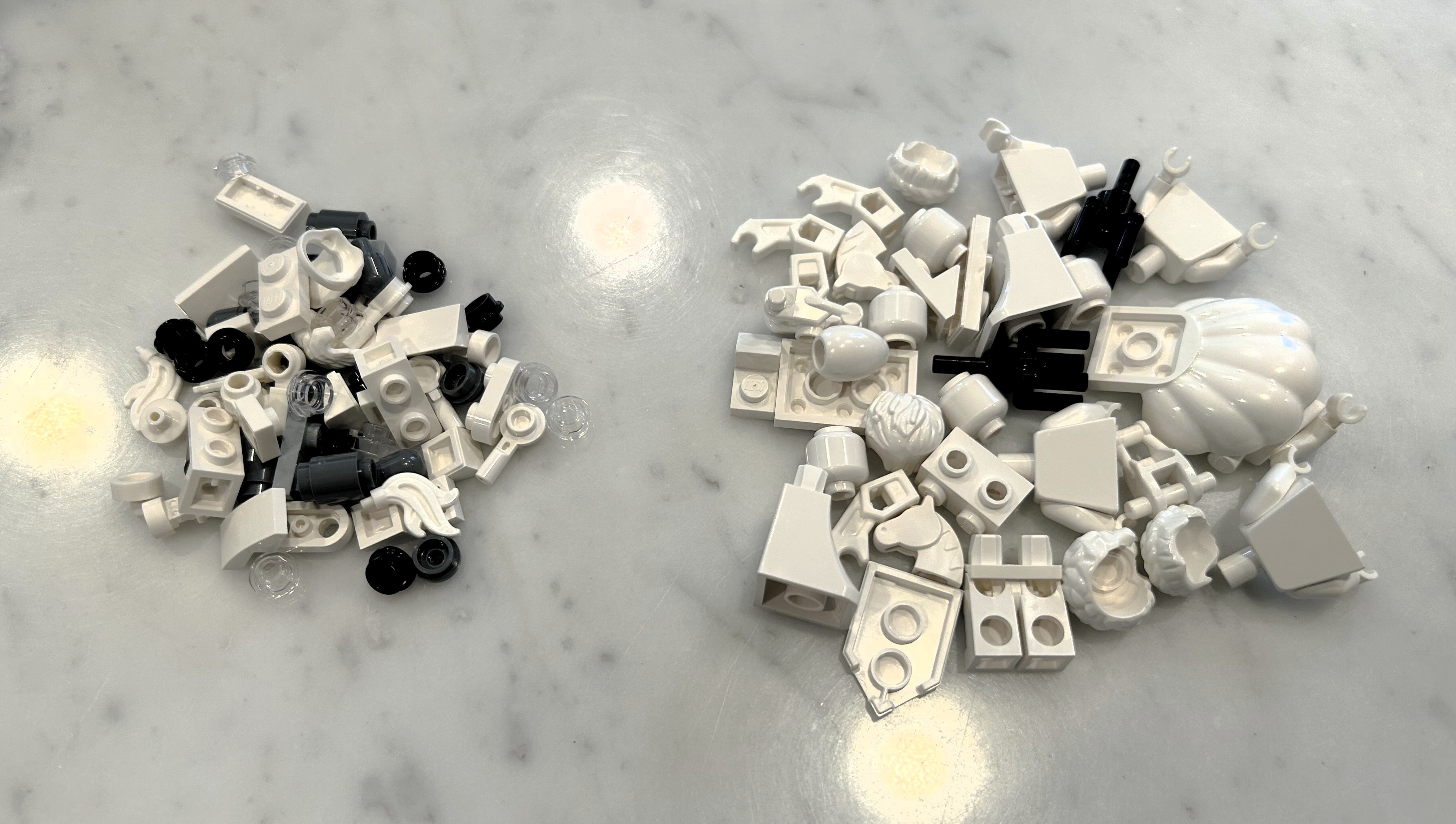
Today we took a mini road trip, as I chose to build the fountain’s Bags 12 and 13 – of 15 bags of pieces – on the kitchen counter (instead of upstairs in the home office).  Kind of fitting considering the counter is topped with white marble.  Kind of annoying considering the laundry machine and dishwasher were running nearby the whole time, interrupting Arcangelo Corelli’s moving “Christmas Concerto” in G Minor.

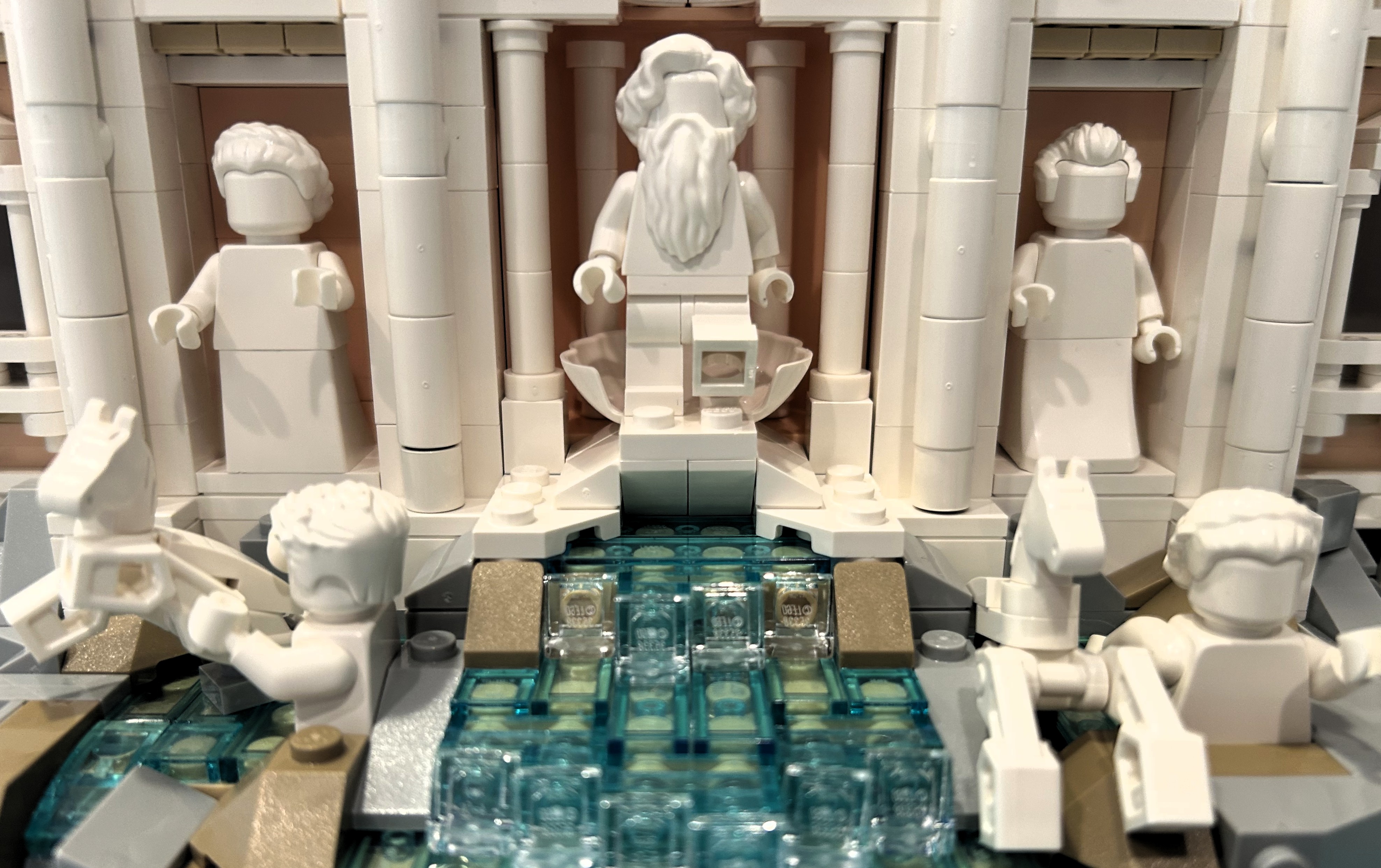
Trevi statues are TINY!

Maybe it was the change of venue but some strange stuff happened today.  To begin with, I couldn’t find the very first piece in the build at all, until I looked closer at the instruction manual drawing and realized I was after a tiny statue.  Once I found him I was off and running, though I found it sad that one of his companion statues ended up being a leftover piece.

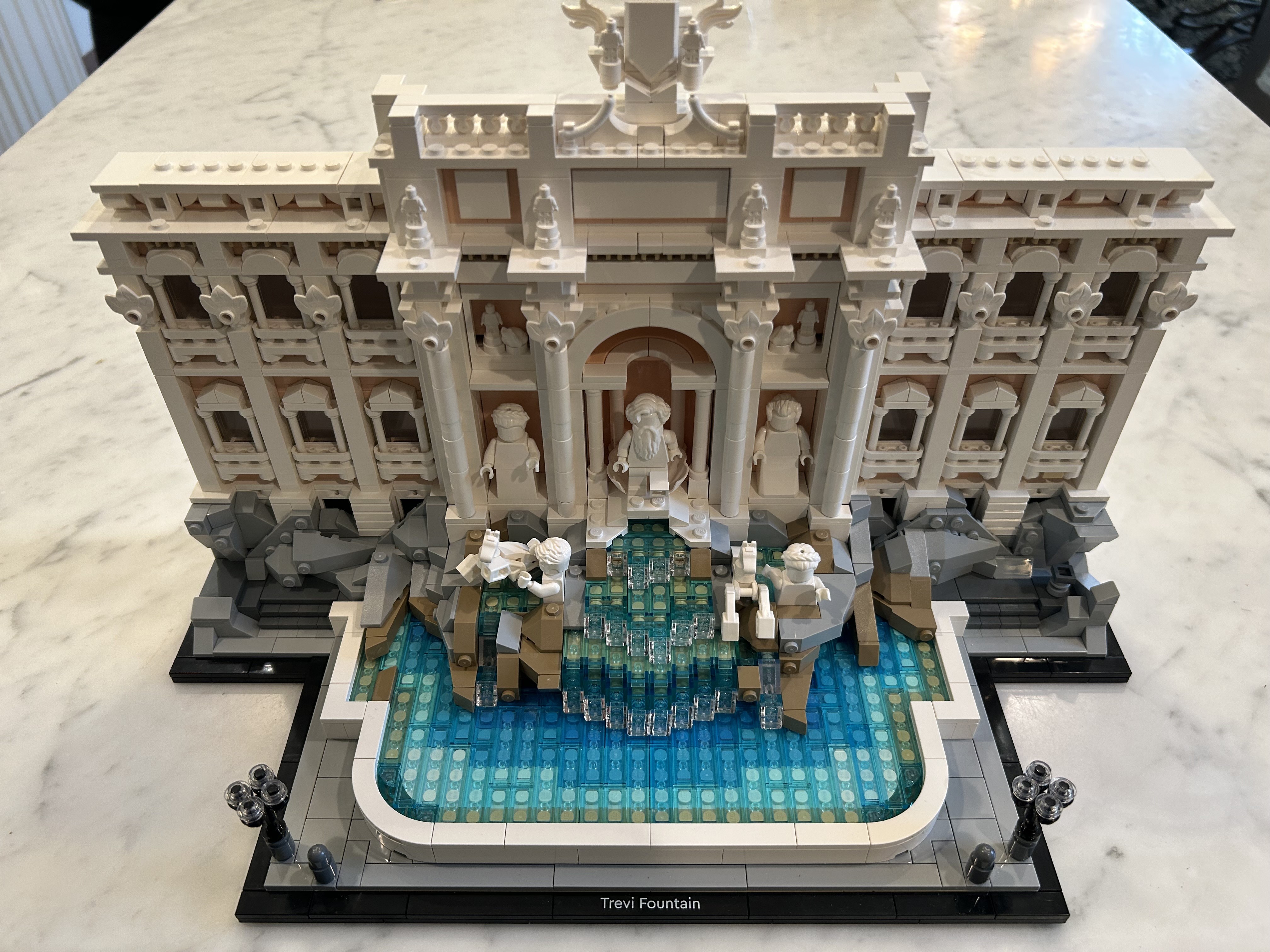
Thought you should know: the back side of the LEGO Trevi is a sheer wall of white.

Now for the strange stuff.  I assembled a flat L-shaped piece on top of another flat L-shaped piece, only to discover they weren’t supposed to go together that way.  No amount of fingernail dexterity could pry those two apart.  Fortunately I found myself in the kitchen.  Sharp knives everywhere!  It took a careful pry without cutting myself but I finally got those two unmarried.  Never let it be said building LEGO models isn’t a dangerous sport.

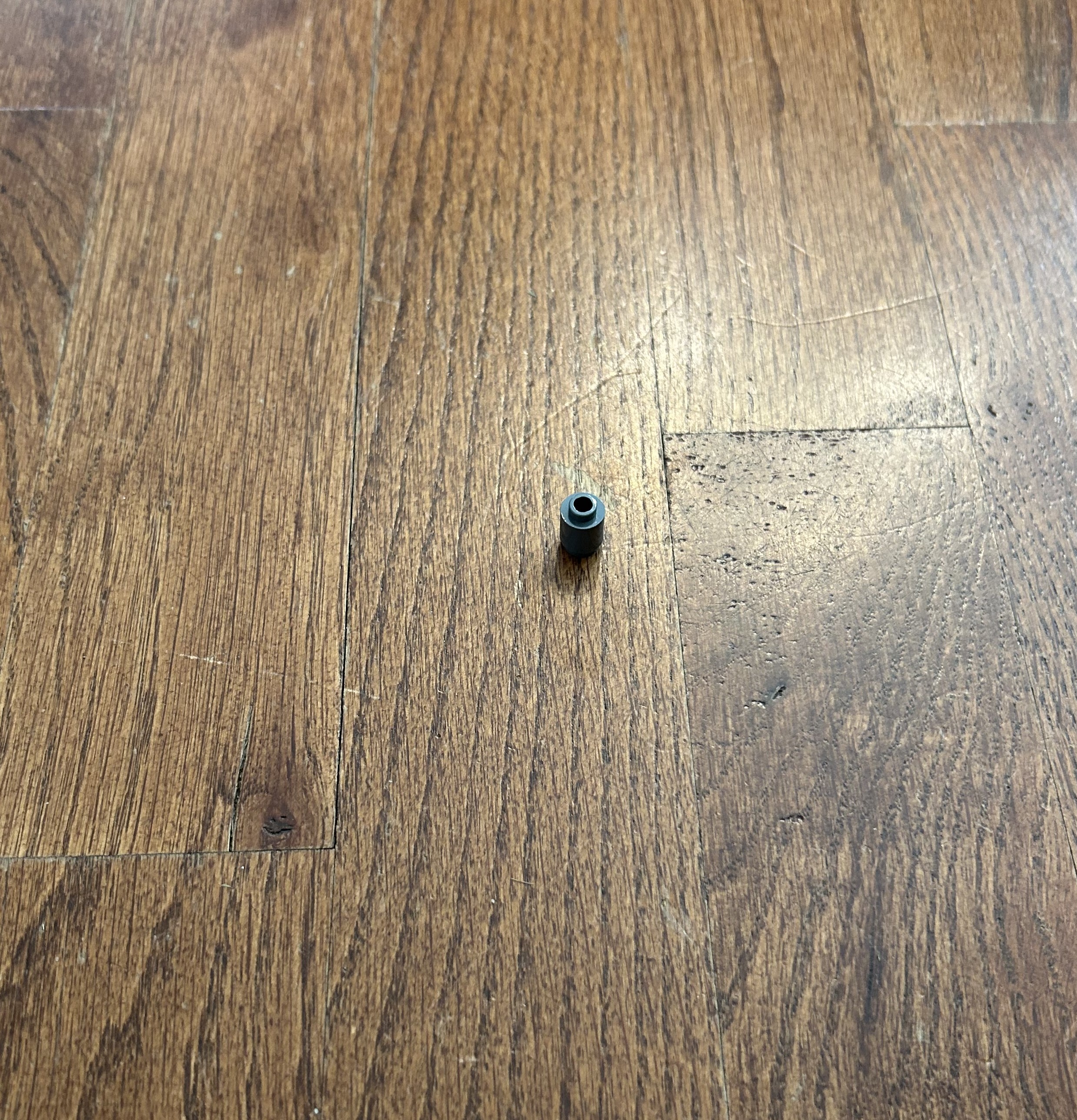
That little brown round one (nestled top left) was missing from Bag 13!

More strange stuff.  LEGO left a piece out of Bag 13.  Okay, technically they left it out.  “Technically” because in my growing pile of leftover pieces I found its twin.  But considering LEGO never leaves out pieces, I had to wonder:  Did the little guy just wander over to my leftover pile when I wasn’t looking?  Or is he somewhere in the trash right now, along with the cellophane bag of Bag 13?  Maybe he’s resting quietly on the kitchen floor just waiting to stub my toe?  Who knows.  I’m just thankful I had a “replacement” from my leftovers.  And I don’t think I’ll be building LEGO models in the kitchen anymore.

Next week: The Trevi is completed!

Running build time: 6 hrs. 52 min.

Total leftover pieces: 35 (including a lonely little statue)

Some content sourced from Wikipedia, “the free encyclopedia”.

Priceless Hatches

I’m enjoying a couple of soft-boiled eggs right now, my every-other-day breakfast entrée. The timer I use to prepare them sits right in the pot of water, indicating when the eggs are cooked to perfection. I pay a little more than average for my eggs, to producer Vital who advertises “pasture-raised – tended by hand by farmers who care”. On the other hand, if I wanted to pay a lot more than average I’d simply go to a rare goods auction and buy one from Fabergé.

“Gatchina Palace” Egg

You wouldn’t have a Fabergé egg for breakfast, of course.  No one would ever sink their teeth into a priceless work of art (well, maybe a banana), let alone one of only fifty that were ever created.  One of the Fabergés – the “Winter Egg” – went under the auction block last week, with the winning bid confirmed in a mere three minutes.  The buyer’s purchase of a single Fabergé for $30.2 million dollars is a new record; noteworthy considering how many times the eggs have changed hands in the last 140 years.

“Catherine the Great” Egg

I can’t say why we Westerners even know about Fabergé eggs.  Most hide in private collections or in museums you’ve never been to.  The eggs were created in St. Petersburg, Russia in the late 1800s by jeweler House of Fabergé for the reigning tsars of the time.  One or two eggs were produced every year as exquisite Easter gifts, from 1885 through 1917.  Most are jeweled with diamonds and other precious gems, and hinge open to reveal delicate animals or scenes within.

The Winter Egg (1913) is described as “the most spectacular, artistically inventive and unusual” of all fifty Fabergés, which is quite a statement when any one of the eggs deserves the same praise.  The Winter Egg took almost a year to design and create, and the value is evident in the details.  4,500 tiny rose-cut diamonds are married to a platinum snowflake motif to create the impression of a block of ice dusted with frost.

“Winter” Egg

The Winter Egg hinges opens to reveal a hanging basket of wood anemones, made from white quartz and rare green “Tsavorite” garnets.  I can’t imagine working with these expensive materials on such a small scale but maybe that’s because I don’t have the delicate fingers of a woman.  The Winter Egg was designed and created by Alma Pihl, the only female jeweler in the House of Fabergé.

“Imperial Coronation” Egg

On a cruise around the Baltic Sea several years ago, my wife and I were fortunate to spend a couple of days in St. Petersburg, touring Catherine Palace and Peterhof among the cities other sights.  When we returned to the ship we were greeted by a local jeweler, who offered replicas of the Fabergés (for less than $32M, thank goodness).  We chose the Imperial Coronation Egg (1897), inspired by the color of Tsar Alexander III’s robe.  The Coronation Egg houses a replica of the imperial carriage, made with gold and platinum and detailed with rubies and diamonds (the original egg that is, not ours).

After learning a single egg can set you back $32M, I now look at my breakfast eggs a little differently.  $10.99 a dozen?  That used to be top of the heap.  Now it’s just pocket change.

—————-

LEGO Trevi Fountain – Update #6

(Read about the start of this build in Brick Wall Waterfall)

There’s a moment in every LEGO build where you look at what you’ve constructed and think, Hey, I’m almost done!  That moment was today.  Bags 10 and 11 – of 15 bags of pieces – brought the structure of the Trevi Fountain to new, practically finished heights.  The tiny, tiny pieces I worked through (so many of them I was afraid to count) resulted in the uppermost level of the backdrop you see in the final photo.

Bag 10

From my magic hat of Italian composers I somehow chose Claudio Monteverdi for my musical accompaniment today.  You don’t know Monteverdi and apparently I don’t either.  Had I realized his contribution to classical music was mostly opera (hard pass) I would’ve reached into the hat again.  Alas, I was subjected to Monteverdi’s L’Arianna “lament” – equal parts sorrow, anger, fear, and so on.  Those singers sure didn’t sound happy as I snapped together LEGO pieces, but honestly who knows?  I don’t speak “sung” Italian.

mirrored element

Here’s an expectation with a symmetrical LEGO build.  If you construct an element that goes on one side of the model you’ll be mirroring it on the other side before you know it.  A hundred or more pieces went into the windowed wall you see here, and a hundred more went into its twin soon after.  It’s repetitive yes, but at least you go faster the second time around since you just had practice.

A word about the little devils in this photo.  Because they’re cylindrical they can roll.  Because they roll they can hide under something.  Something like a LEGO instruction manual.  Once again I was fooled into thinking I was missing pieces… until I thought to look under the manual.  Sure enough, there they sat just smirking at me.  So I promptly arrested and cuffed them, hauled them away, and now they’re jailed in the backdrop you see here, without possibility of parole.

We’re just four bags of LEGO pieces from “turning on the water” of the magnificent Trevi.  I’ll admit to peeking into the box at those upcoming bags.  They are small, all four of them.  Perhaps I’ll wrap the fountain construction in a single go next week.  Even if not, conveniently, the final block of travertine would be laid the following week, just in time for Christmas.  Now that’s what I call a gift!

Running build time: 5 hrs. 42 min.

Total leftover pieces: 32 (tiny, tiny pieces)

Some content sourced from the CNN Style article, “Faberge egg fetches record $30.2 million at rare auction”, and Wikipedia, “the free encyclopedia”.

Cold Brew

Seemingly overnight, a new drive-thru named 7 Brew showed up next door to our local supermarket.  A quick glance as I drove by suggested their slogan: “Come for the coffee, come again for the people” is on the mark, with more employees dancing around the drive-thru lanes than making drinks in the petite building itself.  7 Brew advertises an “experience” as much as it does a menu of coffee and energy drinks.  It’s just the latest concept to steal market share from Starbucks.

7 Brew

Did you know today is “Red Cup Day” at Starbucks?  Red Cup Day is the coffeemaker’s nod to the beginning of the holiday season.  Buy a Starbucks “holiday” drink and you’ll also receive a festive reusable cup – more distinctive than the usual white ones.  The red cups suggest Christmas comes early this year, and encourage the purchase of peppermint mochas, eggnnog lattes, and iced gingerbread chais.  Somewhere in all that there might even be coffee.

I admit, the Starbucks Chestnut Praline Latte really is Christmas in a cup.  The drink tastes of the same spices you’ll use with Grandma’s cookie recipes this season.  And on a recent trip through Chicago O’Hare, my wife and I caved to a couple of Starbucks’ ever-popular Pumpkin Spice Lattes.  But here’s my point.  Starbucks is no longer my go-to for coffee drinks.  It never was my go-to either, but there were plenty of morning commutes when I couldn’t pass up a Flat White and a couple of egg bites.  Now I drive by without pause, the same way I’ve done so with McDonald’s for decades.  It begs the question: has Starbucks become passé?

There are signs suggesting we’ve already put Starbucks in the rear-view mirror, even if 38,000 locations still dot the globe.  Like 7 Brew, Starbucks has always tried to deliver an experience as much a drink.  Come on in.  Hang out for awhile.  Even if you don’t, peruse all the “merch” while you’re standing in line.  Chances are pretty good you’ll spend more on logo items and baked goods than coffee.

This year, Starbucks features a 20-oz. “Bearista” cup.  It’s a refillable glass ontainer with a straw and it’s being marketed as a collectible.  You’ll find these bears at your nearest Starbucks for $29.95.  Or maybe you won’t, because they seem to be disappearing as fast as they’re put on the shelves.  If you’re a little desperate, find one on eBay for $500 or more (coffee not included).

To me that’s a good way to describe Starbucks these days… a little desperate.  They’re closing stores without drive-thru lanes, which suggests they’re trying to reduce the money they spend on leases.  They’re laying off retail and non-retail employees, the typical corporate strategy to try to do more with less.  And they’re coming up with bear-shaped cups the size of a Starbucks “Venti”, so you’ll purchase their largest coffee when you wouldn’t have done so with a regular cup.

If you think the “bearista” is cute – and would pay $29.95 for it – how about “Hello Kitty” products?  Coming soon, you can buy a “plush” wearing a Starbucks green apron, and any one of five Hello Kitty containers, from water bottles to ceramic mugs.  Each of these runs you $30 or more (again, without the coffee).  Cats and coffee?  It’s a desperate strange marketing strategy, perhaps aimed at a generation of consumer that seeks something more trendy than coffee in a red cup.

This year, the Pumpkin Spice Latte showed up on the Starbucks menu on August 26th; hardly what I’d call “fall”.  Their Christmas-y drinks debut today, fully two weeks before Thanksgiving.  That’s stretching the seasons a little.  But let’s say I still splurge for a Grande Flat White, a couple of Egg Bites, and a slice of Iced Lemon Loaf.  I’ll pay $20 before I even consider the purchase of a “bearista” or a kitty.  It may be time to move on from the red cups.  Maybe I’ll give 7 Brew a try instead.  $7 gets you their smallest size… even pricier than Starbucks.  No guarantee you’ll find any coffee in that cup either.

(Coming next week: more updates on the LEGO Trevi Fountain!)

Swimming Upstream

I can think of a dozen name brands I gotten hooked on for years, only to see them suddenly disappear from the shelves, never to return. Breakfast cereals. Hair spray. Cars. And what do we do when this happens? Simply find another brand and get used to it – easy-peasy. But when your streaming television service drops an essential channel, you can’t just jump to the next provider. Try that and you’ll hit your head on the cage they have you securely locked into.

Even if you’re not a sports fan, you’re probably tuned into my topic today.  YouTube TV – which provides me the five channels of streaming television I care about (and 95 forgettable others), dropped ESPN from its lineup.  It wasn’t like they warned us months ago they were renegotiating with Disney (ESPN’s parent), and that these talks weren’t going so well.  Instead they alerted us last Thursday just before midnight – with an email coyly titled “An update on our partnership with Disney”.  Then, the following morning, ESPN was gone.  On Halloween.  How fitting.

Without going into the weeds on why ESPN was dropped, let’s just call it the proverbial contract dispute.  Disney wants one number.  YouTube TV wants another.  A stalemate akin to what we’re seeing in Washington right now.  Yes, what D.C. is blocking is so much more important than a television sports channel.  But when you’re a die-hard college football fan you can relate to losing an “essential service”.

Getting my ESPN back is not like choosing another breakfast cereal.  If only it were that easy.  Instead, we have to shift to an entirely different grocery aisle.  Make that an entirely different supermarket.  As soon as YouTube TV dropped ESPN, Disney was only too happy to promote its own streaming service.  Sign up for Disney+, including ESPN and Hulu!!!  Only $29.95 per month – a savings of $5/month!!!  Only twelve months of subscription required!!!

All those exclamation points are a ruse, as if this is a service I can’t live without.  Disney Channel?  Not my thing.  Hulu?  I’m already getting enough entertainment on Netflix.  I just want ESPN please.  And apparently I should be happy to pay a minimum of $360 for it, in addition to my monthly $80 for YouTube TV.

Bless our tech-savvy children.  We turn to them for all things electronic.  I checked in with one of my sons – who is every bit the college football fanatic I am – and he came to my rescue.  Fubo – a streaming service looking like a twin to YouTube TV – offers a free one-week trial that includes ESPN.  It’s kind of like Congress signing a stopgap spending bill to keep the government open.  Now I have another seven days to figure out what to do.

YouTube TV promises a credit if the lack of negotiations with Disney continues long enough (sorry, the same does not apply to our government).  But I can’t necessarily wait for that credit.  In one week I’ve got to decide if I’m a YouTube TV guy or a Fubo one.  Can’t have both (at least, according to my budget).

Of course, it feels almost inevitable that Fubo will run into a contract dispute with Disney as well.  So even if I go that route I could lose ESPN again.  Maybe I’m getting forced into a Disney+ subscription after all?  But another $360/year?  No way.  I’d sooner get on a plane and go watch my college football games in person.  Er, assuming the FAA doesn’t cancel my flights.  Swimming upstream indeed.  Sigh…

—————-

LEGO Trevi Fountain – Update #3

(Read about the start of this build in Brick Wall Waterfall)

We resumed our fountain build this week with more confidence than the last, accompanied by the merriment of Paganini’s Violin Concerto No. 1.  Bags 6 and 7 – of 15 bags of pieces – were filled with tiny, tiny finger-numbing LEGOs, and at times I wondered just what the heck I was putting together.  Didn’t look like the makings of a fountain to me.

Tiny, tiny!

According to LEGO, water is white and blue.  I suppose the white is meant to be rushing water (as in “waterfall”) while the blue is calm water (as in “pool”).  We shall see.  But check out the look of the fountain in the final photo.  Anyone else see a monster’s mouth with white teeth?

Strange creations

Since this is my fifth LEGO model, it’s high time I make the following proclamation:  LEGO never leaves out a piece.  Never.  I still have moments where I’m searching through a pile of pieces in vain for the one I need.  I almost get to the feeling of “it’s not here”.  But suddenly there the little guy is, staring up at me as if to say, “What took you so long?”  Some day I’d love to see how LEGO pulls this off.  Thousands of pieces in every box, not a single one of them left out.  That’s some logistical magic going on there.

I’m proud to say I made zero mistakes on the build this time around, a dramatic improvement from a week ago.  Okay, that’s not entirely accurate.  I left a piece off the back of the fountain, but immediately discovered my error when I added a section and realized there was nothing to support it.  Fixed in a jiffy, but the merry instruments on Paganini’s violin concerto sounded even more gleeful as they saw my confidence take a hit.

Running build time: 2 hrs. 27 min.

Total leftover pieces: 13

Chain (Saw) Reaction

When your kids celebrate you on Mother’s Day, you get flowers and chocolates; maybe even a homemade breakfast. When your kids celebrate you on Father’s Day, you get a gift card to Home Depot or Lowe’s, which is awesome. My kids are perceptive enough to know there’s always something I need for the workshop, so that little plastic rectangle of credit always brings a smile. But what I need is always trumped by what I want. Like power tools.

A polesaw is one of the cooler power tools out there (especially if you have a use for it).  A polesaw is essentially a chain saw mounted on top of twelve feet of plastic pipe.  At the bottom is the trigger.  It’s like the world’s longest rifle, only you’re spinning chain saw blades instead of firing bullets.  Picture the head and neck of a very thin giraffe.  Or something out of a horror movie you’d watch this Halloween.

Polesaws are perfect for cutting down those overhead tree branches you cannot reach.  You avoid the whole fall-off-the-ladder thing, which is fine with me since I’ve done it before.  And with today’s super-batteries, you’re not tethered to a cord or a gas tank.  Which brings me to my real story.

After purchasing my brand new Craftsman polesaw at Lowe’s – and barely fitting it into the back of my SUV – I headed on home eager to try it out.  Charge up the battery, unsheathe the chain saw blade, and get to chopping down branches.  When I did get home however, I realized my most basic of blunders: I had no battery.  Right there on the box in plain English: TOOL ONLY.  BATTERY AND CHARGER SOLD SEPARATELY.  Talk about “buzz kill”.

A few days later I made it back to Lowe’s.  Found the battery (the last one!), as well as an employee to escort me to check-out to make sure I paid.  I get it – those batteries are expensive – more than the pole saw itself in fact.  Okay, so now I have my pole saw and my battery.  When I got home again however, I discovered my next blunder.  It’s just a battery.  It’s not a battery and a charger.  Without a charger, a battery is just a bunch of chemicals housed in a case.  Good grief, Charlie Brown! (with a whack on the forehead)

“giraffe”

The next time I went to Lowe’s – where they now know me on a first-name basis – I found the charger.  But here’s the problem. The charger comes with a battery, versus being sold all on its own.  In other words, I have to buy a battery I don’t need.  Okay, so I’ll return the first one.  But after another employee escort to  check-out and a little thought, I realized my biggest blunder of them all.  I’d already unpacked and installed the first battery on the polesaw.  Now I have a polesaw, a battery, a charger… and another battery I can no longer return.  Needless to say, I’m well past the amount of my Father’s Day gift card by now.

I like to end every story with good news.  The polesaw advertises “325 cuts per battery charge”.  In other words, I’m never gonna need that second battery.  Sure looks lonely sitting there on the workbench.  Guess I just found me an excuse to buy another Craftsman power tool!

—————-

LEGO Trevi Fountain – Update #1

(Read about the start of this build in Brick Wall Waterfall)

Our LEGO Trevi Fountain already feels like it’s flowing after just 3 bags – of 15 bags of pieces.  You know this is going to be quick construction when I’m showing evidence of “brick wall” and “waterfall” just twenty percent into the build.

Rhapsody in Blue

The rust on my LEGO skills was apparent from the first bag.  I assembled the first two pieces incorrectly, thought I was missing a piece (which you always find later), and questioned why I ended up with an extra piece (which is LEGO’s way of saying, “in case you lose one”).  Bag 2 had similar challenges.  And Bag 3 was a little more difficult because you get lost in all those dreamy shades of blue.  There was a moment when I placed an entire section of the fountain too far forward, corrected it, and thought, “Wow, Travertine is hard to move!”

For my fountain-building accompaniment, I thought it would be appropriate to listen the to the works of classical Italian composers.  For today’s portion, I went with Vivaldi’s “The Four Seasons”.  Bag 1 took me through “Spring” while Bag 2 took me through “Summer”.  Bag 3 required the other two seasons.  But as you can see, I already have a four-seasons pool I could throw coins into!

Running build time: 1 hr. 5 min.

Total leftover pieces: 2

Brick Wall Waterfall

If you were to spend an entire year in Rome, you could visit five churches every day and still miss out on some of the more than 1,600 within the city limits. You could also visit five piazzas (public squares) and never see all 2,000. If monuments are your thing, Rome has so many that instead of an actual count they simply say “more than any other city in the world”. And then we have Rome’s fountains. You could dip your hand in five a day and never see them all in a year. So here’s a better idea.  Just spend a few hours at the Trevi and assume all of the others are second best.

Fontana di Trevi

I wouldn’t decree “best fountain in all of Rome” if I hadn’t been there and seen it for myself.  I spent a college year in the Eternal City studying architecture, and you can’t help noticing the other elements of the city while you’re at it.  Like fountains on every street corner.  The Trevi Fountain was walking distance from the hotel/dorm we Americans lived in, so you can bet I stood before the Trevi’s gushing waterfalls many a day.  Even a few nights.

Most people assume “Trevi” is an Italian word.  It’s actually two words mashed into one. Tre = three, vie = ways.  The Trevi is located at the intersection of three streets.  It’s also the terminus for an aqueduct from ancient times.  Water is picked up from a source outside of the city, carried over fourteen miles through the aqueduct, and deposited “with a splash” at the Trevi, to be further dispersed to the city underground.

Here’s a little more trivia on the Trevi.  It was designed and built in the 1700s, on the back wall of a palace.  It’s primary material is travertine stone (pricey!) quarried from nearby Tivoli.  Besides the columns, arches, and niches along the wall, you have quite the trove of imagery going on over the water, with mythological creatures like tritons and hippocamps.  I have no idea who the sculpted figures gazing down from either side are, but the big guy front and center is Oceanus, a pre-Olympian god.

If you’re a top-five tourist attraction in Rome, you must be pretty darned attractive for a city with countless places to visit.  Maybe it’s the coin thing.  Why do tourists stand with their backs to the fountain and toss three coins over their shoulder into the water (right hand, left shoulder)?  Because legend says they’ll return to Rome some day if they do.  “Legend” is really just Hollywood, from the movie Three Coins in the Fountain.  But if you really know your Trevi trivia, you say the tossed coins follow the ancient tradition of honoring the gods of the waters, granting you safe passage home.  

I’ve talked about the Trevi before, in Too Many Roads Lead to Rome.  The fountain has become so popular you now need a ticket and a specific time to stand in front of it.  But what I haven’t done before is build the Trevi.  Last spring, the “architects” at LEGO immortalized the fountain in a 731-piece model, which I will construct over the next several blog posts.  I haven’t put my hands on a piece of LEGO since Notre-Dame du Paris last January (which still beckons me to add its lighting kit).  I might be a little rusty at this.  The fountain might leak a little.  But I’m up for a dip in this brick wall waterfall if you are.

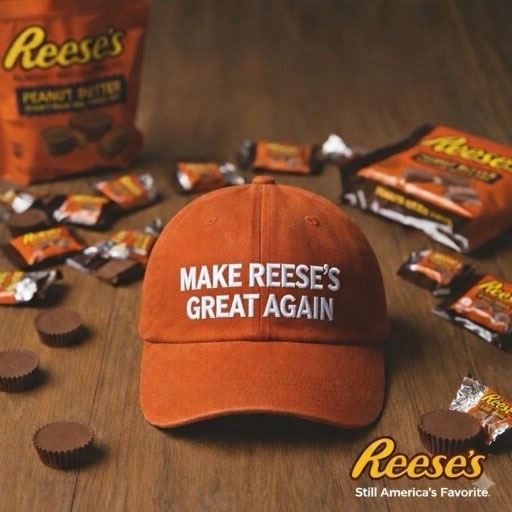
Author’s Note: The title of this post was inspired by the strange-but-sweet Dickie Roberts: Former Child Star.  The movie included a little ditty my thirty-one year old daughter can still recite to this day: “Brick wall, waterfall, Dickie thinks he got it all but he don’t, and I do, so BOOM with that attitude. Peace punch, Cap’n Crunch, I’ve got something you can’t touch. Bang-bang choo-choo train, wind me up I do my thing. No Reese’s Pieces, 7-Up, you mess with me, I’ll mess you up.”

Some content sourced from the TripAdvisor.com article, “Everything you need to know about the Trevi Fountain coins”; IMDB, “the Internet Movie Database”; and Wikipedia, “the free encyclopedia”.

Horses on Circular Courses

In 1972, Billy Preston topped the Billboard Hot 100 chart with the catchy “Will It Go Round In Circles”. A year later, The Spinners spent five weeks at #1 on Billboard’s R&B chart with “I’ll Be Around”. More recently, Kacey Musgraves’ debut single “Merry Go ‘Round” won the Grammy Award for Best Country Song.  All of which is to say, if I’m asked to celebrate “National Carousel Day” I have a great choice of theme songs for the occasion… played on endless loop, of course.

A double-decker!

National Merry-Go-Round Day (I prefer “Carousel”) was this past July 25th, as it has been every year since 2014.  Did you skip it like I did?  The holiday claims to “celebrate the carousel’s history and joy, particularly marking the first U.S. patent by William Schneider in 1871.”  And to celebrate, we’re meant to visit a local carousel, go for a spin, and post pictures of ourselves doing so online.  So we drop everything we’re doing on July 25th and climb on a wooden horse?  National M-G-R Day doesn’t even rate as a Hallmark holiday (and don’t waste your time trying to find a card to prove me wrong).

Contrary to my opinion about M-G-R Day, I think carousels are charming and a bit of innocent fun (other than those brass rings, which we’ll get to in a second).  Carousels inspired memorable scenes in Mary Poppins and BigCarousel was the Rodgers and Hammerstein musical that Time magazine deemed “the best of the 20th century”.  The “Carousel of Progress” was (and still is) one of the more unique attractions at Disneyland.  And of course, carousels led to those pipe and metal spinners we all played on at the park when we were kids.

Carousel is derived from the French word for “little battle”, which hints at why we’re riding them at all today.  In 17th century Europe, equestrian tournaments included “ring jousting”, where the rider attempts to spear a ring-on-a-string with his joust as he flies by.  To practice this sport without wearing out the horses, a clever soul invented the carousel, complete with wooden horses on poles and a real horse to pull the device in circles.  Eventually carousels made their way into carnivals, and then to the prominent locations where you find them today.

Care for a ring?

Now you also understand why early carousels had ring dispensers.  They were a nod to ring jousting!  The dispensers were filled with iron rings along with a few brass ones.  If you were lucky enough to ride an outside horse and grab a brass ring (which is harder than it sounds as your horse goes up and down), you could exchange the ring for a prize or another loop on the carousel.  For good reasons – safety being one – ring dispensers have been removed from most carousels today.

The people who came up with National M-G-R Day should’ve probably gone with “International”, because many of the world’s most distinguished carousels spin outside of the United States.  The Carousel El Dorado in Tokyo, Japan, built in 1907, is the oldest amusement park ride still in operation in the country.   The Lakeside Park Carousel in Ontario, Canada (1905) includes a self-playing organ that uses rolled sheets of music, rewinding one while playing the next.  The Letná Carousel in Prague, Czechia (1892!) is one of the oldest in Europe, remodeled in 2022 but still housed in its original wooden pavilion.

Looff Carousel (1911)

America has its share of prominent “gallopers” as well.  The Looff Carousel in Santa Cruz, CA is one of the few remaining with a ring dispenser, and entertains with the music of three organs.  The Over-The-Jumps Carousel in Little Rock, AR (1924) simulates the natural movement of a horse instead of just going up and down on a pole.  And the Flying Horse Carousel in Westerly, Rhode Island (1876!) is exactly as advertised.  The horses are attached to the center spindle instead of the wooden platform, creating a better sensation of flying through the air.

Dorothea Laub Carousel (1910)

Okay, I have a confession.  I had the perfect opportunity to celebrate National M-G-R Day just days after it happened this year.  My wife and I traveled to San Diego with our children and grandchildren for a beach vacation and found ourselves in Balboa Park, home of the Dorothea Laub Carousel (brass ring dispenser!)  If we hadn’t already worn out the little ones on a long walk through the Japanese Friendship Garden we might’ve made it to the wooden horses.  But I’m not losing sleep about it.  After all, National M-G-R Day will come ’round again next year.

Some content sourced from Wikipedia, “the free encyclopedia”.

Ellen Makes Her Move

When we moved into our current house (and even the one before it), we made the classic mistake of saying, “We’re never moving again”.  After all, picking up and going from one place to the next can be a real pain in the you-know-what, especially with pets and vehicles to relocate on top of the furniture and clothes. But at least we’re only talking about moving houses. What if you had to move an entire town?

Ellenton, SC

If you live in an RV or a tiny home, you’d think nothing of pulling up stakes and going somewhere else.  You have the wheels or the flatbed to make it happen.  But moving an entire town means a population of people and a collection of structures.  it sounds like something that could only happen on a Hollywood movie set.  Unless you’re the U.S. government with its sights set on Ellenton, South Carolina.

Ellenton train depot

Ellenton first appeared on a map the way a lot of small towns did back in the day.  The railroad was interested in running new tracks through the farms of the area and a deal was made to acquire the land, including a plot for the train station.  In Ellenton’s case, the railroad developer was smitten with the primary landowner’s daughter (Ellen).  The relationship never blossomed but he did name the budding town after her.  Thus we have “Ellen’s Town”, shortened to “Ellenton”.

Ellenton grew quickly in the late 1800s, from a host of agricultural productions to a working, living community of 600 residents.  Eventually you’d find churches, schools, a post office, a general store, a dairy, and even a milling company and a cotton gin.  But what nobody saw coming was the potential of the area for the construction of a massive facility know as the Savannah River Site (SRS).  In the 1950’s in Cold War America, the U.S. government decided Ellenton and its surrounds were the perfect riverside location for plutonium and tritium production, for the development of the hydrogen bomb.  Ellenton “won the lottery” over a hundred other locations.

I can’t imagine sitting in Ellenton’s town hall back when the announcement was made.  Someone who drew a very short straw had to stand in front of the residents and say, “Sorry folks, we’re going to tear down your town so we need you to find somewhere else to live”.  Then the government wrote checks for the properties and businesses and simply walked away.  Eminent domain in capital letters.

I’ll admit I thought the government really did move Ellenton to another location.  I pictured a cartoon image of the world’s largest spatula, sliding under Ellenton’s streets and buildings like an entire sheet cake, then dropping the whole mess several miles away.  But I really thought the government moved Ellenton because we live right down the street from a town called New Ellenton.  Turns out, New Ellenton is simply where a good chunk of the original residents chose to call home.  The government had nothing to do with it.

Maybe the government didn’t move the living but the law required they move the dead.  By the time Ellenton and several other small towns were acquired and shut down, the SRS property encompassed 310 square miles.  That meant the relocation of 130 cemeteries, amounting to over 6,000 grave sites.  They didn’t get every last one, so it’s fair to say old Ellenton still has a few residents.

The black-and-white photos I share here – from the Ellenton website – give the town a charming, old-timey feel.  The few residents alive today hold reunions to share the memories of a place they can no longer see or even visit.  Some of Ellenton’s stories make it sound very cozy.  I wish I could say the same about New Ellenton, which is nothing more than a couple miles of highway with gas stations and bars scattered on either side.  Frankly, the only reason you drive through New Ellenton is because you’re on your way to somewhere else.

I wouldn’t be nostalgic for Ellenton if the government didn’t make it disappear.  Kind of reminds me of Brigadoon, the Scottish village that magically appeared out of the mist every hundred years.  Maybe Ellenton will appear out of a nuclear winter on the hundredth anniversary of it’s own demise.  In the meantime, a songwriter captured the story of the town in a rather sad ballad.  “The Death of Ellenton” was never a big hit, but the town it celebrates sure took one.

Some content sourced from the WJBF website article, “Hometown History: The Forgotten Town of Ellenton”; the Ellenton SC website (including all photographs); and Wikipedia, “the free encyclopedia”.

Only In Iowa

If you’ve ever made graham crackers from scratch (which are miles better than the store-bought ones), there’s a step in the recipe where you have to get your hands dirty. Take a stick of butter, cut it into very small pieces, dump the pieces into the mixture of dry ingredients, and dive on in with your fingers until the dough starts to clump together. It may be the only time butter and my hands ever come in contact with each other. Which is also to say, I won’t be sculpting a butter cow any time soon.

Sculptor, cow

Creating art out of food seems like an inevitable destination. I mean, back in Michelangelo’s day everyone was taking a block of marble and seeing what they could do with it. Then all but one of them quickly realized there was only one Michelangelo. The others probably turned to an easier material to work with like wood or clay. 1,000 years on, we’re sculpting food. Chocolate is a popular medium. Cakes are shaped into just about everything imaginable. But a cow made out of butter – what’s that all about?

A more fitting Hawkeye State image

We turn to Iowa to learn more about this oddity.  Most people prefer to fly over Iowa but since you’re reading and not flying, let me enlighten you.  On the list of 10 Things to Know About Iowa, there is no butter and there is no cow. There are a lot of pigs (the most of any state) and millions of acres of corn (also “the most”), and Iowa’s “Hawkeye” nickname is a reference to the birth of the red delicious apple (who knew?).  But none of this gets us to butter and cows.

The “10 Things…” list does mention the Iowa State Fair, and it is here that we find real cows by the hundreds… and a life-sized one made out of butter.  The Fair, whose 2025 edition wrapped up three weeks ago, has been making “buttered cows” since 1911, thanks to five Iowans who’ve passed the butter baton down over the years.  The latest, Sarah Pratt, has been making the cows for the last nineteen years, and only after apprenticing with the last sculptor fifteen years before that.  Some people blog; others make cows out of butter.

The 1911 original

Like papier-mâché, a butter cow is created on top of a frame built from wood, wire, and/or metal.  Then we heap on some fun statistics.  600 lbs. of “low moisture, pure cream, Iowa butter” is applied to create a cow that’s five-and-a-half feet tall and eight feet long.  The sculptor’s “studio” is a walk-in cooler set to 40ºF.  After the cow is displayed at the fair, all that butter is recycled for use on the next ten years of cows.  Unless you’d rather use it for toast, which would butter 19,200 slices.

Michelangelo didn’t stop sculpting after his famous David, of course, and neither does Sarah Pratt with her butter cows.  Also following tradition, she creates a “companion sculpture” to keep the cow company.  Sometimes the companion is an homage to Iowa, such as a John Deere tractor.  Most years the companion is a random anniversary, like the 40th anniversary of Neil Armstrong’s walk on the moon (totally random because Neil wasn’t born in Iowa).  This year the sculpture featured the characters from “Toy Story”, denoting the movie’s 30th anniversary.  You get the feeling Sarah enjoys sculpting butter so much that a life-sized cow just isn’t enough.

Woody, Buzz

For all of my research, I can’t figure out why a cow made out of butter and Iowa belong in the same sentence.  Nearby Wisconsin and Michigan are better known for dairy cows.  California tops the list of the five states producing the most butter (and Iowa isn’t one of the other four).  No matter, this tradition isn’t stopping anytime soon.  The butter cow even has a place in the Smithsonian Institution (thankfully, as a replica that will never melt).

I love butter, but more on top of baked goods and in graham cracker recipes than in the shape of a cow.  I will admit to buying my butter by the brick instead of by the stick.  But now that I know about Iowa’s annual creations, I’ll never look at my morning toast again without thinking, mooooooooo.

Some content sourced from the Iowa State Fair website, the U.S. News article, “10 Things to Know About Iowa”, and Wikipedia, “the free encyclopedia”.

Ten Days to “Ben-Yays”

I’ve never met a French baked good I didn’t want to devour at first sight. Macarons have called my name ever since my wife and I tried them in a little shop in Strasbourg. I’ve made a surprisingly good Croquet Madame (disguised as a three-cheese breakfast pizza) considering my limited skills in the kitchen. And croissants, well, croissants speak for themselves don’t they? So when a neighbor challenged my wife and I to make beignets ten days ago, I confidently replied, “oui!”

“ben-yays”

Technically we’re not talking about a baked good today.  Beignets are fried in oil, like doughnuts.  In fact, they’re exactly like sugar doughnuts, just not as sweet.  Think Krispy Kreme’s Original Glazed without the glaze.  Small, chewy pillows of heaven.

So why would a neighbor request beignets?  Because she invited us to a college football game watch (Clemson vs. Louisiana State) and she’s one of those who turns a basic entertainment into a full-on festivity.  Louisiana State is in Baton Rouge so her menu was start-to-finish Cajun. Étouffée. Muffuletta. Red Beans and Rice. Chantilly Cake. I mean, if she’s going to make all of that how could I say non to beignets?

étoufée

Thankfully, I found an “Easy Beignets Recipe” online (note: whenever a recipe starts with “easy”, it’s anything but).  At least I already had the ingredients in my pantry.  But beignets start out like a high school science experiment.  Heat the water to exactly 105°.  Add yeast and a little sugar, because yeast “feeds” on sugar.  Then watch it all foam.  If it doesn’t foam, you killed the yeast and you have to start over. (No pressure Dave, little lives are at stake here.)

science experiment

My yeast foamed (it lives!) so I was then allowed to proceed with the more traditional ingredients.  Shortening, sugar, milk, and egg whites all mixed together, to which you add boiling water.  When the temp is exactly 105°-110° (again with the science experiment) add the foamy yeast, flour and salt, and into the refrigerator it all goes, to rise for an hour or more.

Did my foamy-yeast-shortening-and-other-stuff concoction really rise?  I have no idea.  It looked the same as it did an hour before.  But I threw caution to the wind and proceeded.  At this point my wife had to get involved, because (as the recipe warns in capital letters), THIS IS A TWO-PERSON JOB.  Maybe a three-person.  One of you slaves over a pot of boiling oil (my wife), another gently transfers the beignets to paper towels to “oil off” (me), and the third suffocates them in powdered sugar (me again).

Handle with care!

That last sentence happens very quickly.  You can’t get the timing wrong on any step or the beignets won’t taste right.  They fry for a minute or so on each side, rest for a minute on the paper towel, and don their coat of powdered sugar with just enough oil remaining to serve as the glue.

When beignets are done correctly, they’re light and flaky.  The shortening and yeast create an air pocket inside.  But you’re not really sure if this science happens until you rescue them from the boiling oil.  Remarkably, ours really did rise.  Doused in powdered sugar they really were pretty good (then my wife mixed a little cinnamon and vanilla into the dough and they were even better).

Magnifique!

There’s a reason why beignets are so much better at the famous Cafe du Monde in New Orleans than in Dave’s kitchen.  You need to eat them as soon as they’re powdered with sugar, and wash them down with a top-shelf cup of coffee. You see, beignets, sadly, have the shortest life of any baked good I know.  If you don’t eat them warm, minutes after they’re fried, they’ll shed their light and airy consistency.  An hour later they’re as cold and chewy as day-old doughnuts at 7-Eleven.  And God forbid you leave them overnight on the counter.  The next morning you’ll have nothing but rocks.

So, you ask, were our beignets a hit at our neighbor’s game watch?  Well, let’s just say the other guests were being polite by declaring, “very good!”, especially when they ate more of our frosted sugar cookies instead (our backup dessert).  Hey, our kitchen is no Cafe du Monde.  I never said it was.  It’s the reason I’m never making étoufée.  At least I have a neighbor who will be happy to do it for me.

Some content sourced from Wikipedia, “the free encyclopedia”.