Caffè Companions

My wife made a batch of rolled sugar cookies last week, cut into traditional Christmas shapes like bells, wreaths, and stockings. It’s the first time in a long time for these cookies, inspired by the assistance of our young and attentive granddaughters. Though the cookies never donned their frosted/decorated costumes, they sure tasted great all by themselves. Kind of like the biscotti I’m giving up in 2026.

Are you a fan of biscotti?  They’re the small, oblong cookies that resemble tiny slices of sourdough bread.  They’re hard and dry, with just a smattering of almonds or almond extract for extra flavor.  Biscotti are meant to accompany a drink, just as two of them do every morning with my coffee.  Biscotti ward off the nausea I feel when I down my vitamins on nothing but a cup of joe.  Nice excuse for daily cookies, eh?

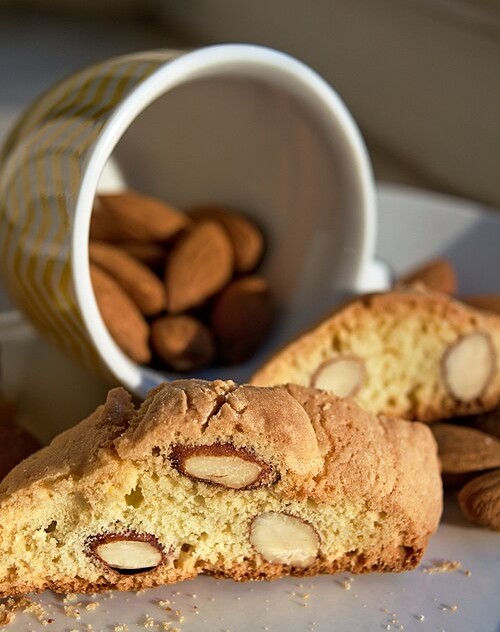
“Cantucci” (not biscotti)

When the calculator (which doesn’t lie) reveals you ate over seven hundred biscotti over the course of 2025, you quickly come to your senses and declare a resolution for the coming New Year: Shift biscotti from “habit” to “occasional treat”.  Yep, it’s time to cut down on carbs.

Before we seal the lid on the cookie jar however, biscotti deserve a little more attention to set the record straight.  First and foremost, the pint-sized pastries I consume with my morning caffè are not technically biscotti; they’re cantucci.  Cantucci contain ingredients like milk, butter, and flavorings, none of which are found in an authentic Italian recipe for biscotti.

Here’s another distinction.  Biscotti were never meant to be partnered with coffee.  They were (and still are) served alongside a glass of sweet wine as a light Italian dessert.  Americans pair cantucci with cappuccino at upper-crust hotels and coffeehouses.  You’re supposed to dunk to make them softer (and take the edge off the coffee) but I prefer to eat them just the way they are.

Biscotti translates to… not “biscuits”, but “twice-baked”, which is exactly how they’re made.  First baked as a full loaf; then baked again as individual cookies. Now then, another Italian translation for you: Nonni means “grandmother”.  Nonni’s also means a brand of biscotti (whoops, make that cantucci) you’ll find in your grocery store… and in my pantry.  The Nonni’s version is an unashamed dessert cookie, with a layer of chocolate, caramel, or lemon frosting to add to the appeal.  My advice: Nonni’s need to be put on a hard-to-reach shelf else they’ll become a habit just like the ones with my morning coffee.

In some Western European cultures biscotti are thrown into savory dishes, which I’m not going to get into because I find the idea unappealing.  Biscotti are classy little sweet treats in my book – one of the two items in my “grown-up milk and cookies”.  Alas, in 2026 it’ll just be “grown-up milk” for me… that is, as long as I stay away from my wife’s sugar cookies.

—————-

LEGO Trevi Fountain – Update #7

(Read about the start of this build in Brick Wall Waterfall)

Today we took a mini road trip, as I chose to build the fountain’s Bags 12 and 13 – of 15 bags of pieces – on the kitchen counter (instead of upstairs in the home office).  Kind of fitting considering the counter is topped with white marble.  Kind of annoying considering the laundry machine and dishwasher were running nearby the whole time, interrupting Arcangelo Corelli’s moving “Christmas Concerto” in G Minor.

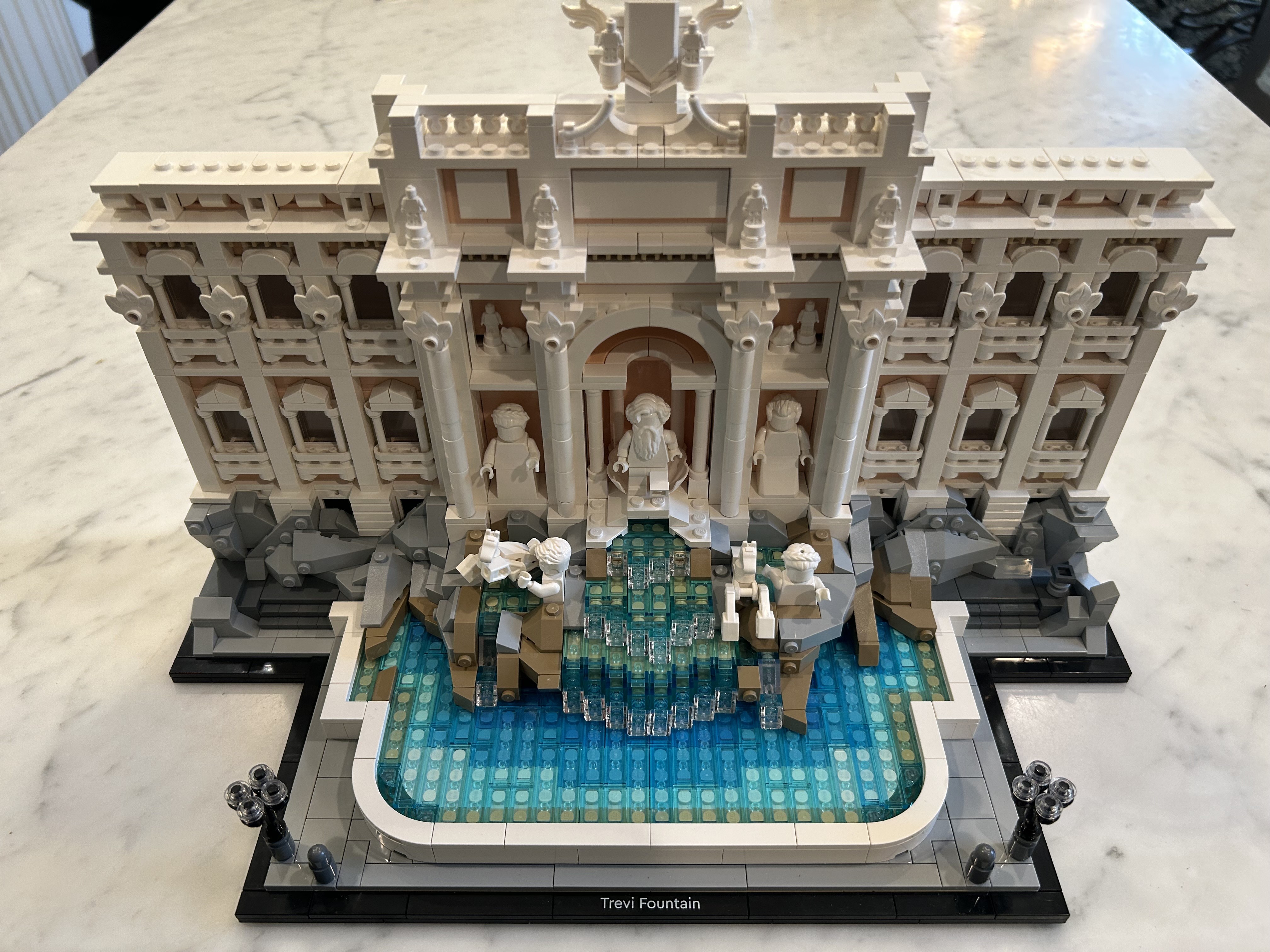
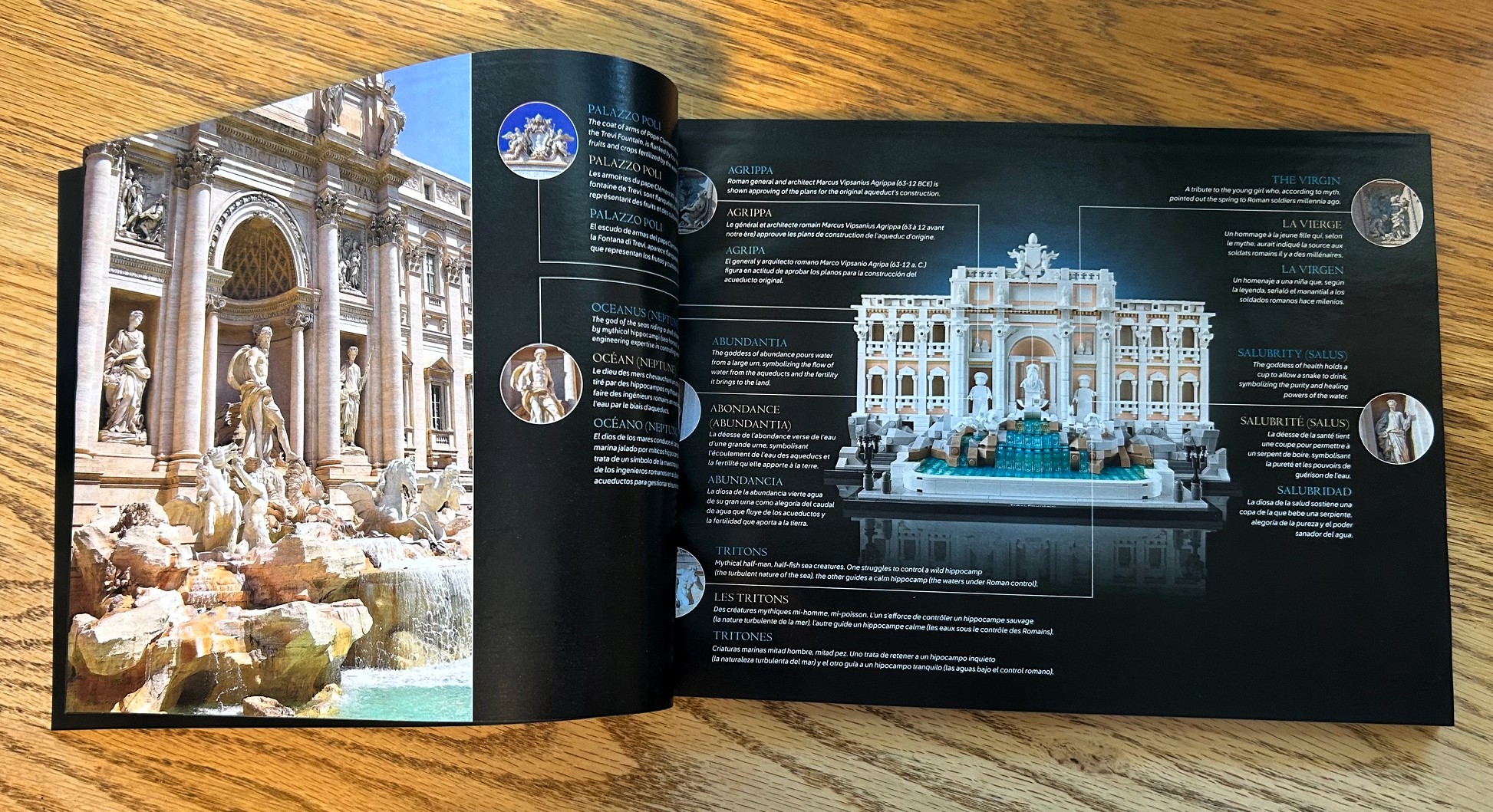
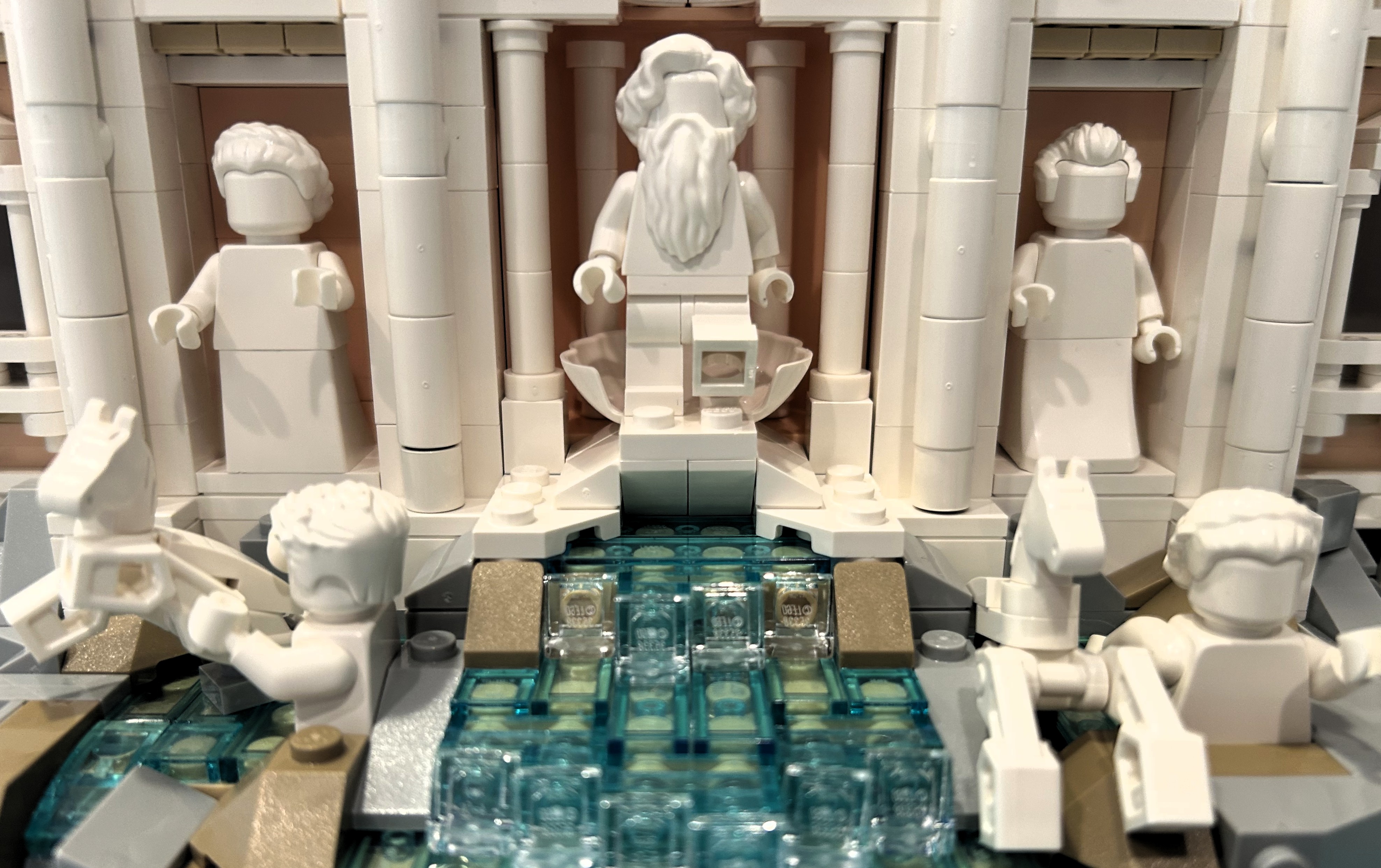
Trevi statues are TINY!

Maybe it was the change of venue but some strange stuff happened today.  To begin with, I couldn’t find the very first piece in the build at all, until I looked closer at the instruction manual drawing and realized I was after a tiny statue.  Once I found him I was off and running, though I found it sad that one of his companion statues ended up being a leftover piece.

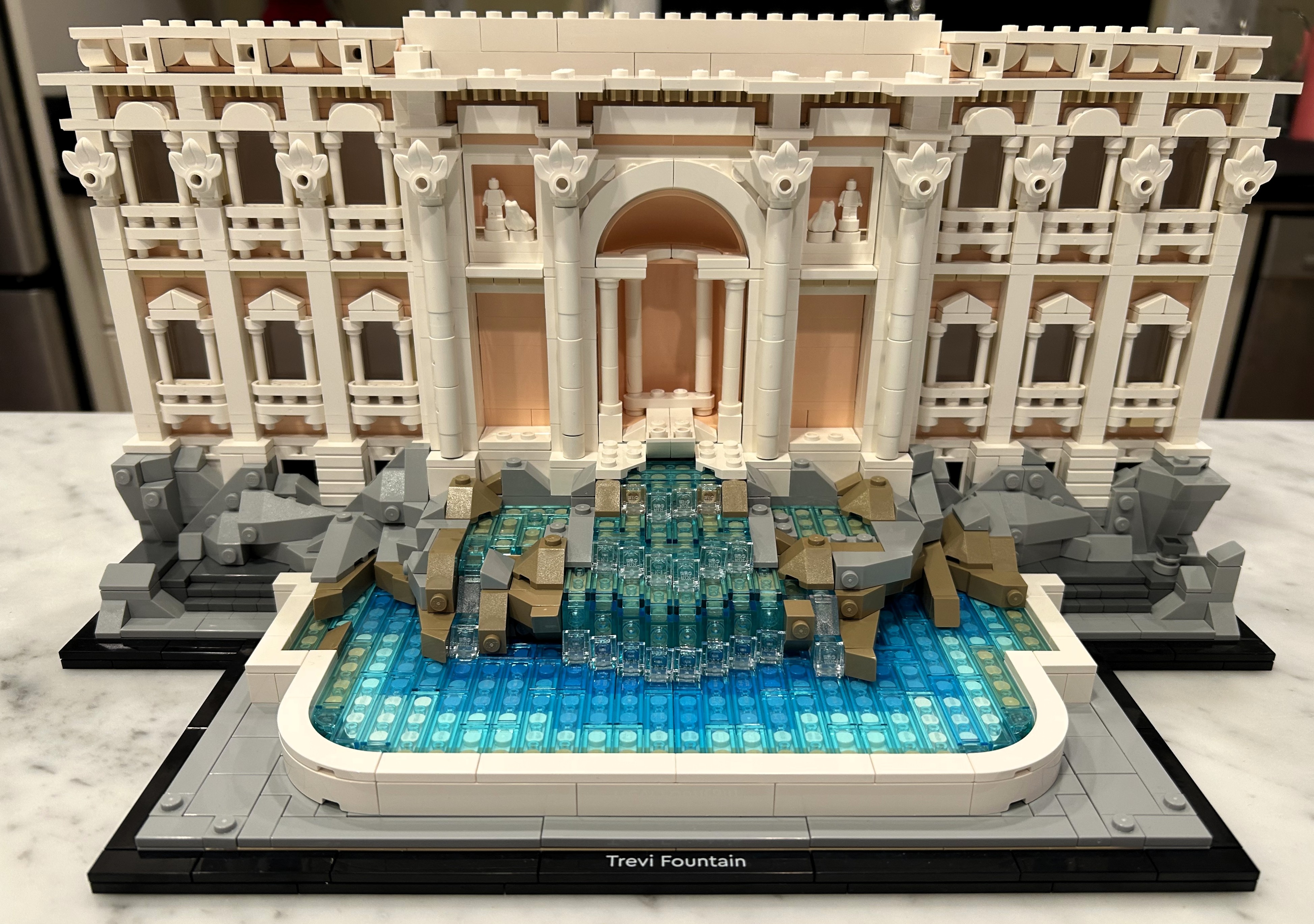
Thought you should know: the back side of the LEGO Trevi is a sheer wall of white.

Now for the strange stuff.  I assembled a flat L-shaped piece on top of another flat L-shaped piece, only to discover they weren’t supposed to go together that way.  No amount of fingernail dexterity could pry those two apart.  Fortunately I found myself in the kitchen.  Sharp knives everywhere!  It took a careful pry without cutting myself but I finally got those two unmarried.  Never let it be said building LEGO models isn’t a dangerous sport.

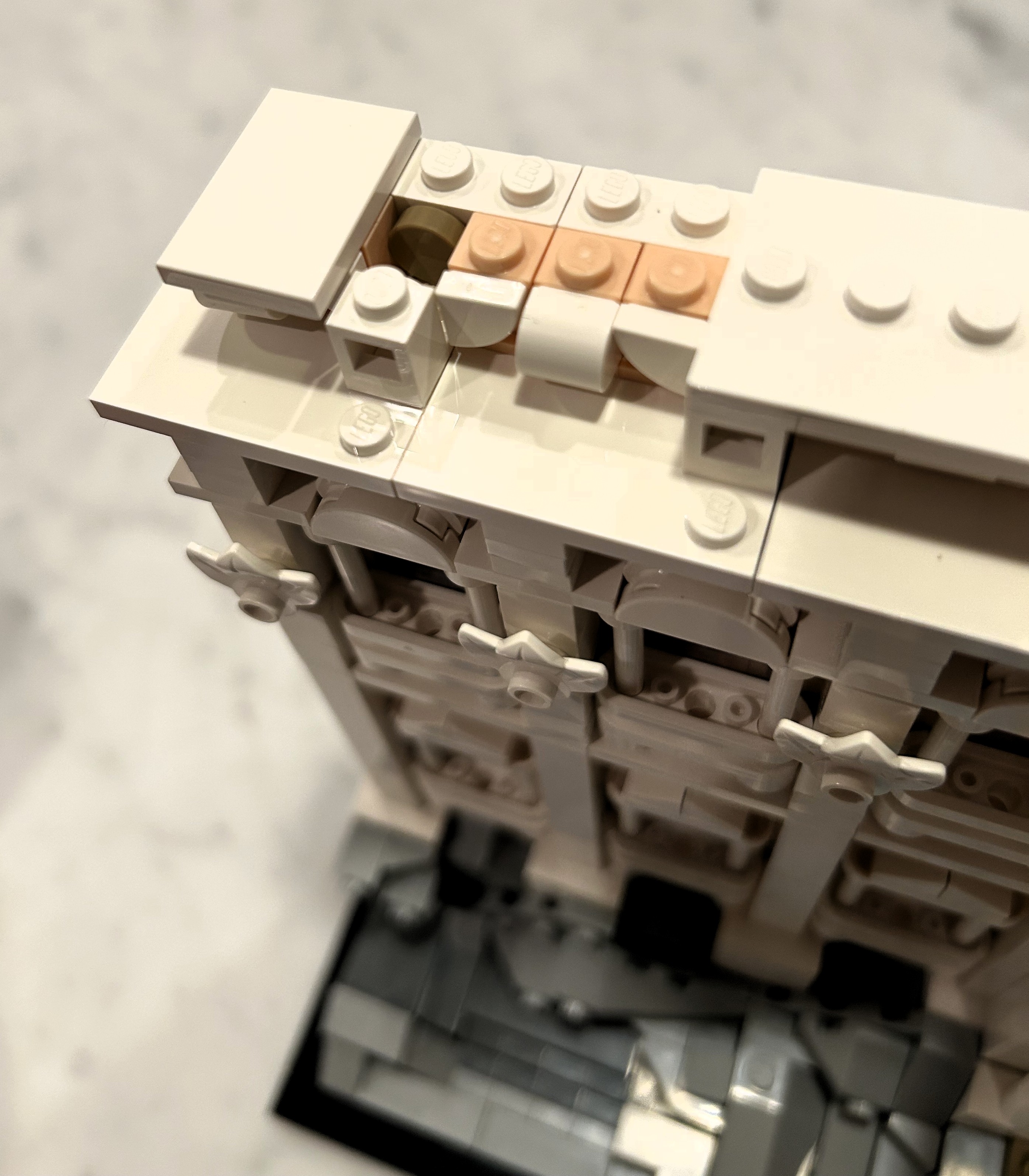
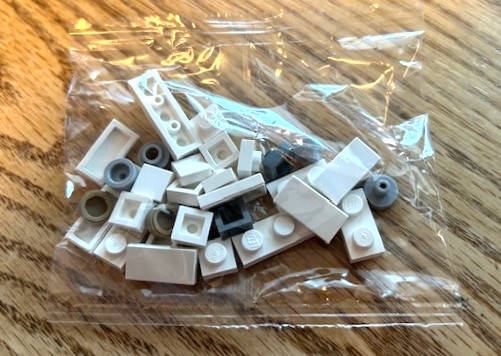
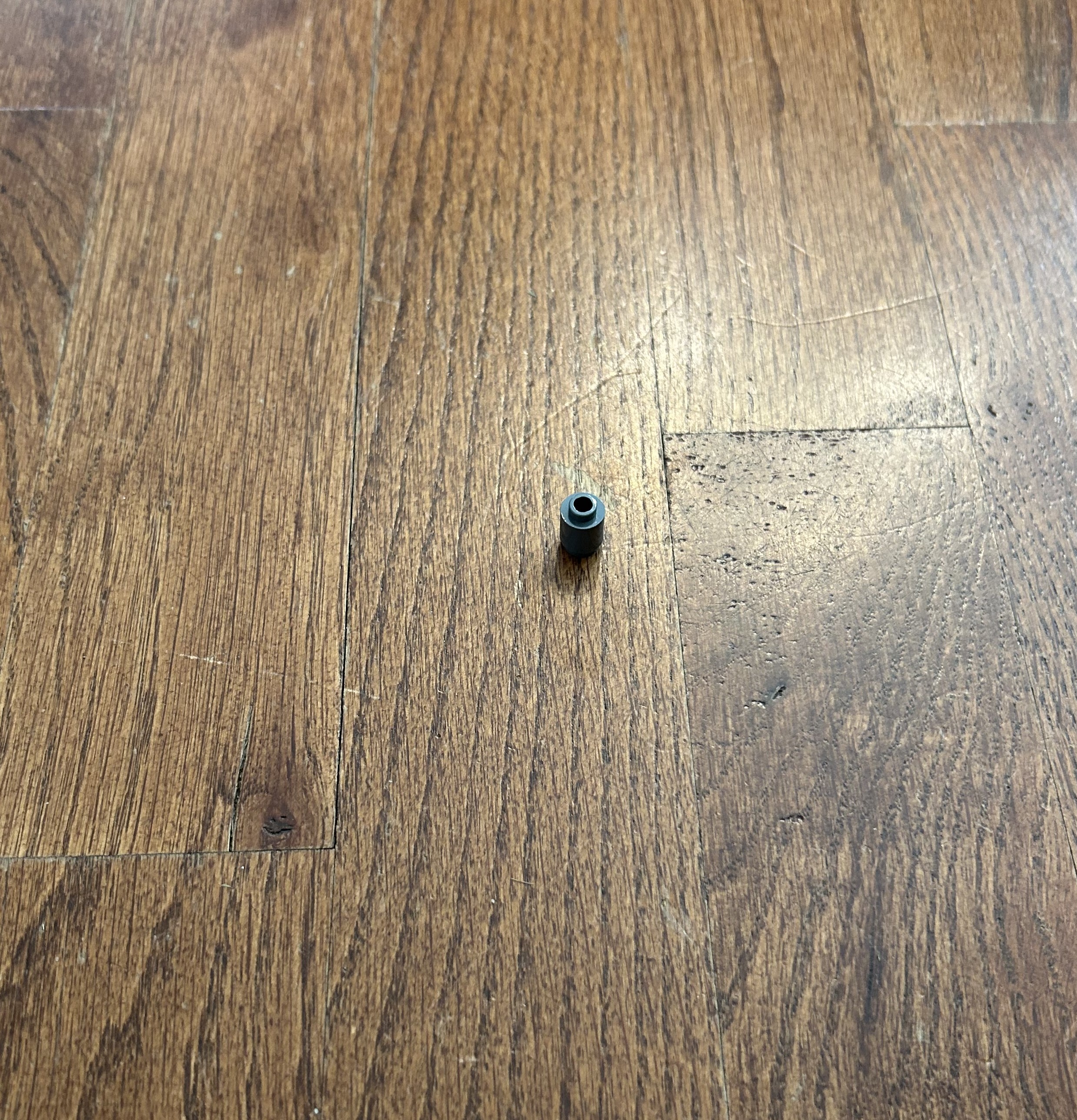
That little brown round one (nestled top left) was missing from Bag 13!

More strange stuff.  LEGO left a piece out of Bag 13.  Okay, technically they left it out.  “Technically” because in my growing pile of leftover pieces I found its twin.  But considering LEGO never leaves out pieces, I had to wonder:  Did the little guy just wander over to my leftover pile when I wasn’t looking?  Or is he somewhere in the trash right now, along with the cellophane bag of Bag 13?  Maybe he’s resting quietly on the kitchen floor just waiting to stub my toe?  Who knows.  I’m just thankful I had a “replacement” from my leftovers.  And I don’t think I’ll be building LEGO models in the kitchen anymore.

Next week: The Trevi is completed!

Running build time: 6 hrs. 52 min.

Total leftover pieces: 35 (including a lonely little statue)

Some content sourced from Wikipedia, “the free encyclopedia”.

Priceless Hatches

I’m enjoying a couple of soft-boiled eggs right now, my every-other-day breakfast entrée. The timer I use to prepare them sits right in the pot of water, indicating when the eggs are cooked to perfection. I pay a little more than average for my eggs, to producer Vital who advertises “pasture-raised – tended by hand by farmers who care”. On the other hand, if I wanted to pay a lot more than average I’d simply go to a rare goods auction and buy one from Fabergé.

“Gatchina Palace” Egg

You wouldn’t have a Fabergé egg for breakfast, of course.  No one would ever sink their teeth into a priceless work of art (well, maybe a banana), let alone one of only fifty that were ever created.  One of the Fabergés – the “Winter Egg” – went under the auction block last week, with the winning bid confirmed in a mere three minutes.  The buyer’s purchase of a single Fabergé for $30.2 million dollars is a new record; noteworthy considering how many times the eggs have changed hands in the last 140 years.

“Catherine the Great” Egg

I can’t say why we Westerners even know about Fabergé eggs.  Most hide in private collections or in museums you’ve never been to.  The eggs were created in St. Petersburg, Russia in the late 1800s by jeweler House of Fabergé for the reigning tsars of the time.  One or two eggs were produced every year as exquisite Easter gifts, from 1885 through 1917.  Most are jeweled with diamonds and other precious gems, and hinge open to reveal delicate animals or scenes within.

The Winter Egg (1913) is described as “the most spectacular, artistically inventive and unusual” of all fifty Fabergés, which is quite a statement when any one of the eggs deserves the same praise.  The Winter Egg took almost a year to design and create, and the value is evident in the details.  4,500 tiny rose-cut diamonds are married to a platinum snowflake motif to create the impression of a block of ice dusted with frost.

“Winter” Egg

The Winter Egg hinges opens to reveal a hanging basket of wood anemones, made from white quartz and rare green “Tsavorite” garnets.  I can’t imagine working with these expensive materials on such a small scale but maybe that’s because I don’t have the delicate fingers of a woman.  The Winter Egg was designed and created by Alma Pihl, the only female jeweler in the House of Fabergé.

“Imperial Coronation” Egg

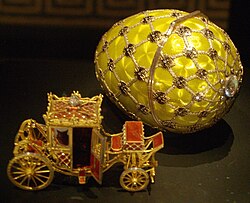
On a cruise around the Baltic Sea several years ago, my wife and I were fortunate to spend a couple of days in St. Petersburg, touring Catherine Palace and Peterhof among the cities other sights.  When we returned to the ship we were greeted by a local jeweler, who offered replicas of the Fabergés (for less than $32M, thank goodness).  We chose the Imperial Coronation Egg (1897), inspired by the color of Tsar Alexander III’s robe.  The Coronation Egg houses a replica of the imperial carriage, made with gold and platinum and detailed with rubies and diamonds (the original egg that is, not ours).

After learning a single egg can set you back $32M, I now look at my breakfast eggs a little differently.  $10.99 a dozen?  That used to be top of the heap.  Now it’s just pocket change.

—————-

LEGO Trevi Fountain – Update #6

(Read about the start of this build in Brick Wall Waterfall)

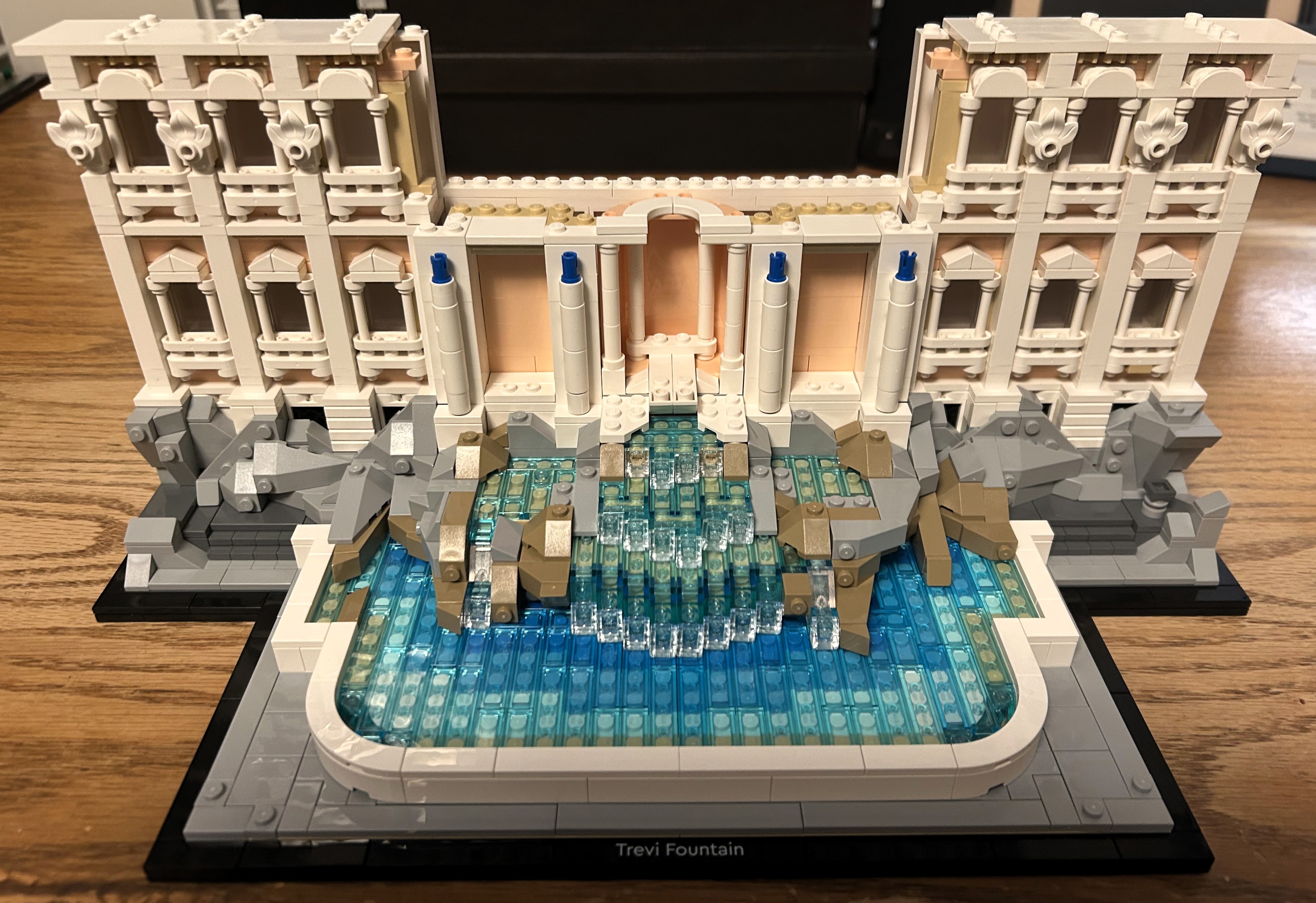
There’s a moment in every LEGO build where you look at what you’ve constructed and think, Hey, I’m almost done!  That moment was today.  Bags 10 and 11 – of 15 bags of pieces – brought the structure of the Trevi Fountain to new, practically finished heights.  The tiny, tiny pieces I worked through (so many of them I was afraid to count) resulted in the uppermost level of the backdrop you see in the final photo.

Bag 10

From my magic hat of Italian composers I somehow chose Claudio Monteverdi for my musical accompaniment today.  You don’t know Monteverdi and apparently I don’t either.  Had I realized his contribution to classical music was mostly opera (hard pass) I would’ve reached into the hat again.  Alas, I was subjected to Monteverdi’s L’Arianna “lament” – equal parts sorrow, anger, fear, and so on.  Those singers sure didn’t sound happy as I snapped together LEGO pieces, but honestly who knows?  I don’t speak “sung” Italian.

mirrored element

Here’s an expectation with a symmetrical LEGO build.  If you construct an element that goes on one side of the model you’ll be mirroring it on the other side before you know it.  A hundred or more pieces went into the windowed wall you see here, and a hundred more went into its twin soon after.  It’s repetitive yes, but at least you go faster the second time around since you just had practice.

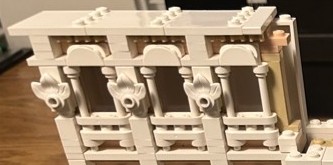
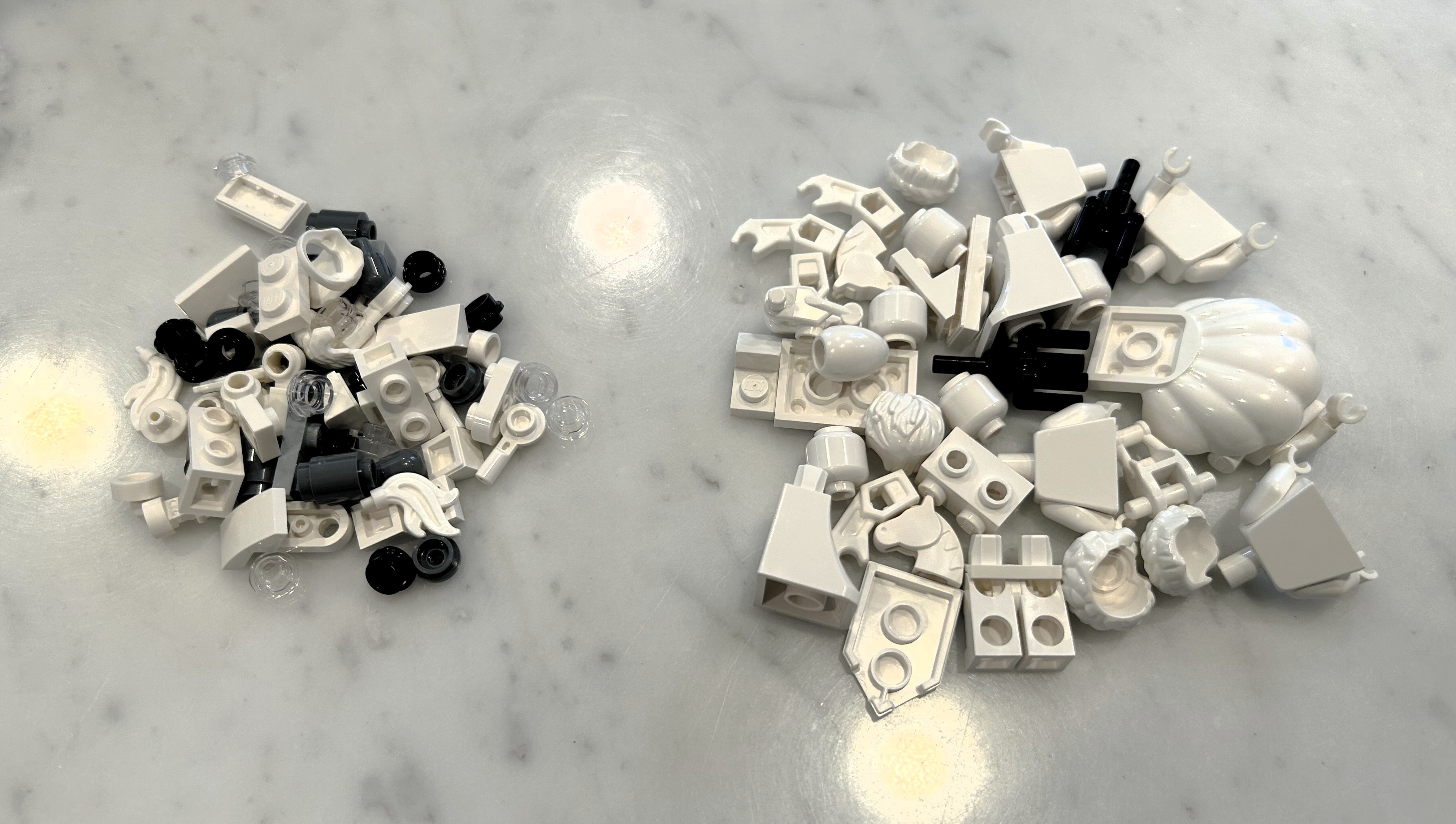
A word about the little devils in this photo.  Because they’re cylindrical they can roll.  Because they roll they can hide under something.  Something like a LEGO instruction manual.  Once again I was fooled into thinking I was missing pieces… until I thought to look under the manual.  Sure enough, there they sat just smirking at me.  So I promptly arrested and cuffed them, hauled them away, and now they’re jailed in the backdrop you see here, without possibility of parole.

We’re just four bags of LEGO pieces from “turning on the water” of the magnificent Trevi.  I’ll admit to peeking into the box at those upcoming bags.  They are small, all four of them.  Perhaps I’ll wrap the fountain construction in a single go next week.  Even if not, conveniently, the final block of travertine would be laid the following week, just in time for Christmas.  Now that’s what I call a gift!

Running build time: 5 hrs. 42 min.

Total leftover pieces: 32 (tiny, tiny pieces)

Some content sourced from the CNN Style article, “Faberge egg fetches record $30.2 million at rare auction”, and Wikipedia, “the free encyclopedia”.

Failing Asleep

I’m almost done with Dan Brown’s latest novel, The Secret of Secrets. The tagline on the front cover: “Author of The Da Vinci Code” was a good add, because that romp through Europe was written over twenty years ago. This romp, alas, is not really much of one. The story ping-pongs relentlessly between explanation and action – making for restless reading – but at least the premise is intriguing. What if the human conscience could operate outside of the human body? What if “you” could exist in both a spiritual and a physical form at the same time? Well, maybe I do, at least when I’m trying to fall asleep.

When you get to be my age – somewhere between “middle” and “senior” – you wake up at least once a night.  Not for an outdoor stroll under the stars and not for a midnight snack.  You wake up “to take care of business”.  It’s an inevitable phenomenon as we get older, especially for us guys.  And when I stumble out of the bathroom I also grab a quick drink of water.  That one-two punch wakes me up, at least enough to get the gears turning and thoughts churning.  Getting back to sleep can be a real challenge.  There are nights I log many minutes memorizing the look of our bedroom ceiling.

Counting sheep has never been my thing, nor the “white noise” of those bedside appliances, but some new strategies have been an interesting experiment.  The first is known as cognitive shuffling.  It’s word play, where you take the letters of a word and spin off new words on each letter for a few seconds.  I start with “piano” (my Wordle starter!) and then go “pepper, portray, people, ponder”, “illuminate, inch, icicle, ignite”, and so on.  What does this do?  It puts the mind in a random state, where you can’t concentrate on stressors like paying bills or fixing stuff.

The next sleep strategy is called “sensory grounding”, which means coming up with lists of things you can smell, touch, taste, hear, and see.  It’s kind of like cognitive shuffling so I’ve never given it a try.  Nor have I tried the breathing techniques, the calming playlists, or getting out of bed and writing down my thoughts on paper (to “release them from my mind”).  All of those seem like a lot of effort just to fall asleep again.

Finally though, there’s a technique called “mental walk-throughs”.  This one is more fun than word games and works pretty well for me.  Think of somewhere you’ve been, preferably a long time ago.  Maybe the neighborhood you grew up in, a house you lived in, or a store you enjoyed spending time in.  Now take a virtual walk through one of those (and here’s where I sense my mind separating from my body).  Look in several directions to see what surrounds you.  Think about how you feel as you’re taking it all in.  Trust me, it’s nostalgic, it’s calming, and it’s calming enough to put you back to sleep.

I read somewhere that The Secret of Secrets is already being made into a movie.  That was fast.  The ink hasn’t even dried on the critic’s reviews, but I guess having the The Da Vinci Code in your back pocket promises another profitable venture.  Maybe I’ll buy a ticket and go see the show.  It’d be another effective strategy to help me fall asleep.

—————-

LEGO Trevi Fountain – Update #5

(Read about the start of this build in Brick Wall Waterfall)

LEGO decided I needed a big helping of humility this week.  Bag 9 – of 15 bags of pieces – brought me to my knees in one heart-pounding moment.  Just as I was cruising to the final steps of the build (in a brisk forty-five minutes), my pulse went into overdrive as I realized the module I’d just constructed wouldn’t attach to its rightful place on the fountain.  It just wouldn’t click in.  In the land of LEGO this is very bad news.  You might as well unfurl a big banner saying: Start over, Dave.

Today’s challenge

If you’ve built IKEA furniture, you know those do-it-yourself sets are engineering marvels.  Everything goes together perfectly; not a piece out of place.  So it is with LEGO.  If one part of the model doesn’t “click” comfortably with another, you’ve done something seriously wrong and that, my friends, summarizes today’s build in a nutshell.  The pile of parts above resulted in the module you see below… only it’s wrong… just slightly off from the way it’s supposed to look.  My penalty: disassemble all those pieces back to the first step to figure out where I’d gone astray.

Just like the second time through Antonio Salieri’s Sinfonia in D Major, I took another forty-five minutes to reconstruct what I’d already built.  The scene at my desk was an interesting disharmony of orchestral beauty, pinched fingers, and nasty thoughts.  Thankfully (and with no surprise), once I got the build exactly as it was supposed to be, everything clicked together the way you see it here.

Bag 10 had to be laughing at me from inside the box.  Bag 10 was scheduled to be opened and completed along with Bag 9 today  Then it watched me fumble the football early on in the build.  Yo, Bag 10, why didn’t you say anything?  You’re a mean one (just like Mr. Grinch) but “I’ll get you my pretty”.  Your time is coming… er, just next week instead of this one.

Running build time: 4 hrs. 33 min.

Total leftover pieces: 25

Some content sourced from the CNN Health article, “If worries keep you from falling back asleep, experts know what to try”. 

An Unhealthy Modern Phenomenon

Somewhere in the wee hours of Tuesday morning I had a bizarre dream; one I retained well into my conscious hours. I was on some sort of overseas sightseeing excursion with others, and our group stopped for lunch at a historic convent. Egg salad sandwiches were handed out by the nuns and I promptly dropped mine onto the cobblestones. The dream only gets more disconnected from there but I’ll share one more noteworthy detail. My traveling companion was the actress Mary Stuart Masterson.

“Watts” on the right

Got all that?  Okay, now forget about everything except Mary Stuart.  Masterson has had a respectable (if not award-winning) career as an actress.  She was only ten years old when she first appeared on the silver screen, in the original version of The Stepford Wives.  She went on to play colorful characters in Fried Green Tomatoes and Benny & Joon.  But her most enduring performance – the one she will forever be linked with – was as “Watts”, the companion/tomboy of “Keith” in the high school rom-com Some Kind of Wonderful.  Masterson’s turn as the loyal friend who quietly wanted to be more absolutely stole the show.

As if nuns and egg salad sandwiches aren’t enough, you’re wondering why Mary Stuart Masterson was sitting next to me in my dream.  Actually it wasn’t Masterson herself; it was her movie character Watts.  Which brings me to the Cambridge Dictionary’s 2025 Word of the Year.  Would you believe Cambridge added 6,000 new words to its big book this year?  5,999 of them were runner-ups to parasocial, a word “describing a connection people feel with someone they don’t know (ex. celebrities, influencers, and other online personalities)”.

Blogger’s Note: WordPress needs to get on the ball here.  “Parasocial” is underlined here in my draft post as being an unrecognized word.

Taylor & Travis

Parasocial’s win as Word of the Year has everything to do with Taylor Swift.  Her engagement to NFL star Travis Kelce generated countless claims of “heartfelt feelings toward a couple the vast majority had never met”.  The same applies to Watts.  I don’t know the first thing about Mary Stuart Masterson herself, but I know everything about Watts from watching Some Kind of Wonderful a dozen times or more.

“Parasocial” has actually been around since the 1950’s.  In that era it referred to the innocence of television viewers connecting to television characters (or in my case, movie viewer to movie character).  But today’s version of the word is described as “an unhealthy modern phenomenon”.  Why?  Because of social media.  Because of artificial intelligence.

Ms. Masterson today

My example of Watts is one movie and one instance.  I’ll finish this post and the “encounter” will fade into my memory forever.  But social media – which brings the viewer constant feeds about the “viewed”, and artificial intelligence – which creates a sense of connection where there really isn’t one, makes it clear why there’s reason to be concerned.  Are we really so desperate as to develop foundation-less relationships with strangers?

AI has already found its place on Spotify.  Search for Xania Monet, the first artificially intelligent singer to grab a ranking on a Billboard chart (Adult R&B).  Everything about Xania was created on a keyboard.  But her face, her social media profile, and her voice suggest she’s a living, breathing human somewhere out there in the world.  I wouldn’t be surprised if you can even chat online with Xania.  If so, you’re developing a one-sided relationship (you) with someone who isn’t real whatsoever (a computer).  Seriously, who has time for this nonsense?

“Xania Monet”

Coincidence or not, one of the Cambridge Dictionary’s runner-ups for Word of the Year was “slop”, which in this day and age means “content on the internet that is of very low quality, especially when created by artificial intelligence”.  Let’s declare “slop” a lot of what’s going in parasocial relationships as well.

The real message of this dictionary winner is clear.  We need to remove the “para” from parasocial and focus on simply socializing with our fellow humans.  It’s the only path to truly fulfilling relationships.  Having said that, for some reason I’d love an egg salad sandwich right about now.

—————-

LEGO Trevi Fountain – Update #4

(Read about the start of this build in Brick Wall Waterfall)

The travertine is stacking up quickly  as we continue our work on the LEGO Trevi Fountain.  Bags 7 and 8 – of 15 bags of pieces – came together like the Domenico Scarlatti piano sonatas that accompanied them – seemingly simple on the surface but more intricate and involved the further we dove in.

The Trevi Fountain has some strange elements, made even stranger when represented by chunky LEGOs.  Check out the shapes I assembled today (and don’t ask me what they’re meant to represent).  Little LEGO pieces positioned in just about every point on the compass.  My singular mistake this round – realized well after the fact – was putting the right piece in place, only the wrong color.  Then when I came across another “right piece wrong color” I knew I had them transposed.  Took a little disassembly to get everything correct.

Bag within a bag

A continuing mystery of LEGO sets is bags within bags.  When I opened Bags 7 and 8, each came with a smaller bag of pieces like you see here.  It’s not like the smaller bag represents its own unit of the fountain.  You just tap into those pieces every now and then as the instruction manual demands.  Yes they’re tiny, tiny but you also find tiny pieces in the bigger bag.  Maybe someday I’ll tour the LEGO factory and solve this packaging mystery.

We worked with some surprisingly large pieces of travertine today – the entire wall of white you see behind the fountain and the white surround you now see defining the entire front of the main pool.  Would’ve taken a dozen Italians to put these monster pieces in place on the real Trevi.  And don’t miss the pink accent strips to the left and right of center (pink!)  This fountain is turning out to be more colorful than I expected.

Running build time: 3 hrs. 5 min.

Total leftover pieces: 23 (10 more extras today!)

Some content sourced from the BBC.com article, “Parasocial is Cambridge Dictionary Word of the Year”, IMDB, “the Internet Movie Database”, and Wikipedia, “the free encyclopedia”.

Chain (Saw) Reaction

When your kids celebrate you on Mother’s Day, you get flowers and chocolates; maybe even a homemade breakfast. When your kids celebrate you on Father’s Day, you get a gift card to Home Depot or Lowe’s, which is awesome. My kids are perceptive enough to know there’s always something I need for the workshop, so that little plastic rectangle of credit always brings a smile. But what I need is always trumped by what I want. Like power tools.

A polesaw is one of the cooler power tools out there (especially if you have a use for it).  A polesaw is essentially a chain saw mounted on top of twelve feet of plastic pipe.  At the bottom is the trigger.  It’s like the world’s longest rifle, only you’re spinning chain saw blades instead of firing bullets.  Picture the head and neck of a very thin giraffe.  Or something out of a horror movie you’d watch this Halloween.

Polesaws are perfect for cutting down those overhead tree branches you cannot reach.  You avoid the whole fall-off-the-ladder thing, which is fine with me since I’ve done it before.  And with today’s super-batteries, you’re not tethered to a cord or a gas tank.  Which brings me to my real story.

After purchasing my brand new Craftsman polesaw at Lowe’s – and barely fitting it into the back of my SUV – I headed on home eager to try it out.  Charge up the battery, unsheathe the chain saw blade, and get to chopping down branches.  When I did get home however, I realized my most basic of blunders: I had no battery.  Right there on the box in plain English: TOOL ONLY.  BATTERY AND CHARGER SOLD SEPARATELY.  Talk about “buzz kill”.

A few days later I made it back to Lowe’s.  Found the battery (the last one!), as well as an employee to escort me to check-out to make sure I paid.  I get it – those batteries are expensive – more than the pole saw itself in fact.  Okay, so now I have my pole saw and my battery.  When I got home again however, I discovered my next blunder.  It’s just a battery.  It’s not a battery and a charger.  Without a charger, a battery is just a bunch of chemicals housed in a case.  Good grief, Charlie Brown! (with a whack on the forehead)

“giraffe”

The next time I went to Lowe’s – where they now know me on a first-name basis – I found the charger.  But here’s the problem. The charger comes with a battery, versus being sold all on its own.  In other words, I have to buy a battery I don’t need.  Okay, so I’ll return the first one.  But after another employee escort to  check-out and a little thought, I realized my biggest blunder of them all.  I’d already unpacked and installed the first battery on the polesaw.  Now I have a polesaw, a battery, a charger… and another battery I can no longer return.  Needless to say, I’m well past the amount of my Father’s Day gift card by now.

I like to end every story with good news.  The polesaw advertises “325 cuts per battery charge”.  In other words, I’m never gonna need that second battery.  Sure looks lonely sitting there on the workbench.  Guess I just found me an excuse to buy another Craftsman power tool!

—————-

LEGO Trevi Fountain – Update #1

(Read about the start of this build in Brick Wall Waterfall)

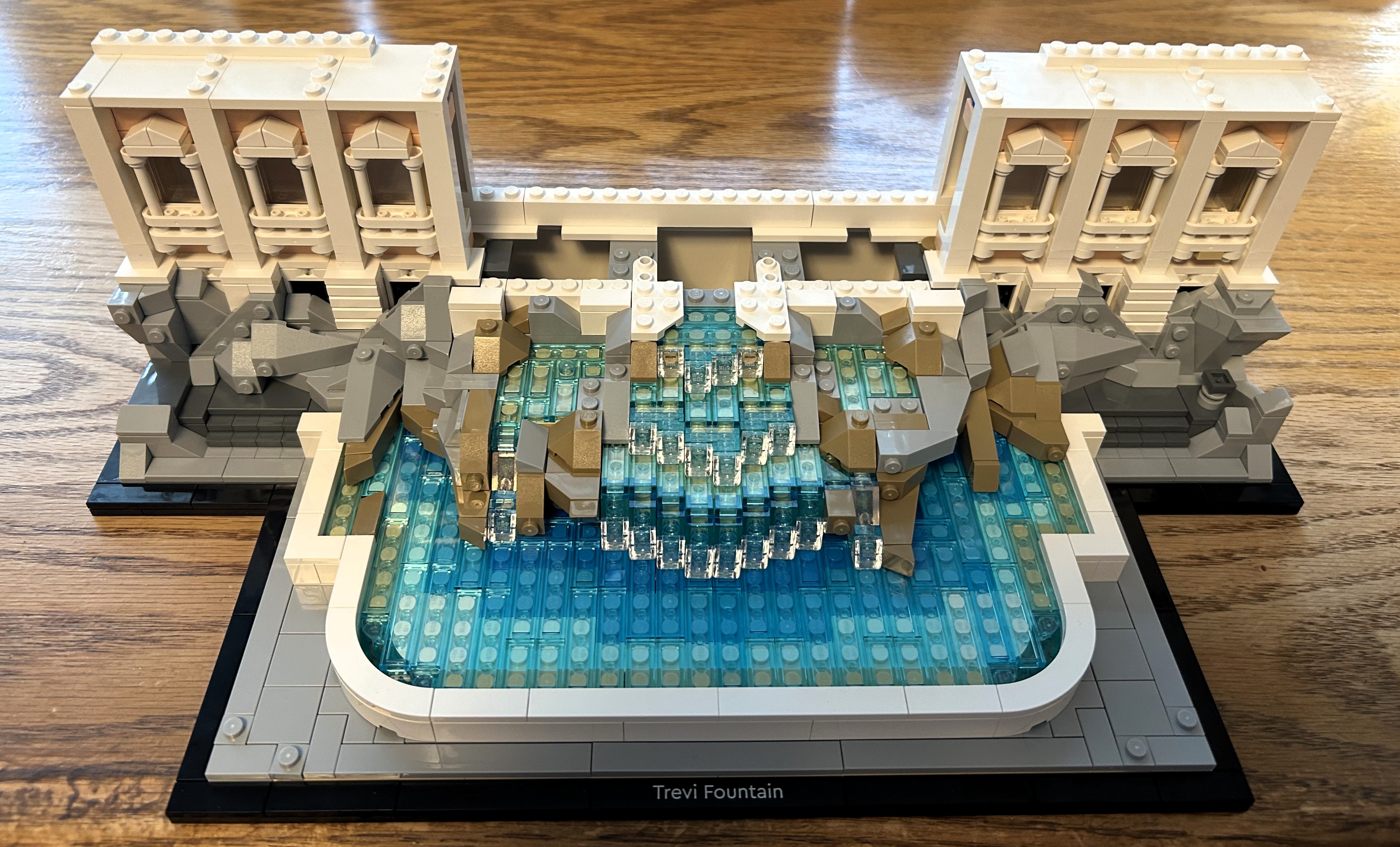
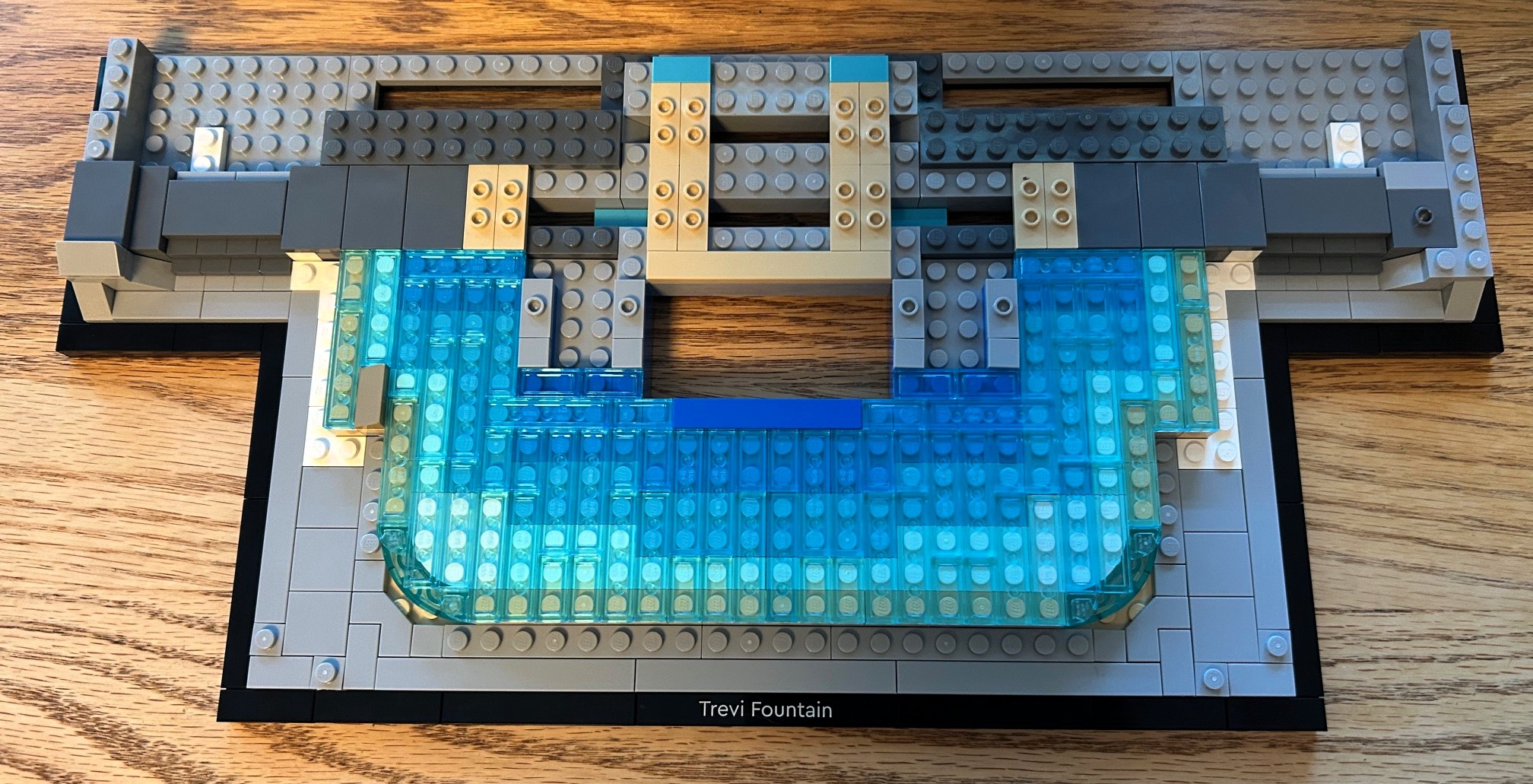
Our LEGO Trevi Fountain already feels like it’s flowing after just 3 bags – of 15 bags of pieces.  You know this is going to be quick construction when I’m showing evidence of “brick wall” and “waterfall” just twenty percent into the build.

Rhapsody in Blue

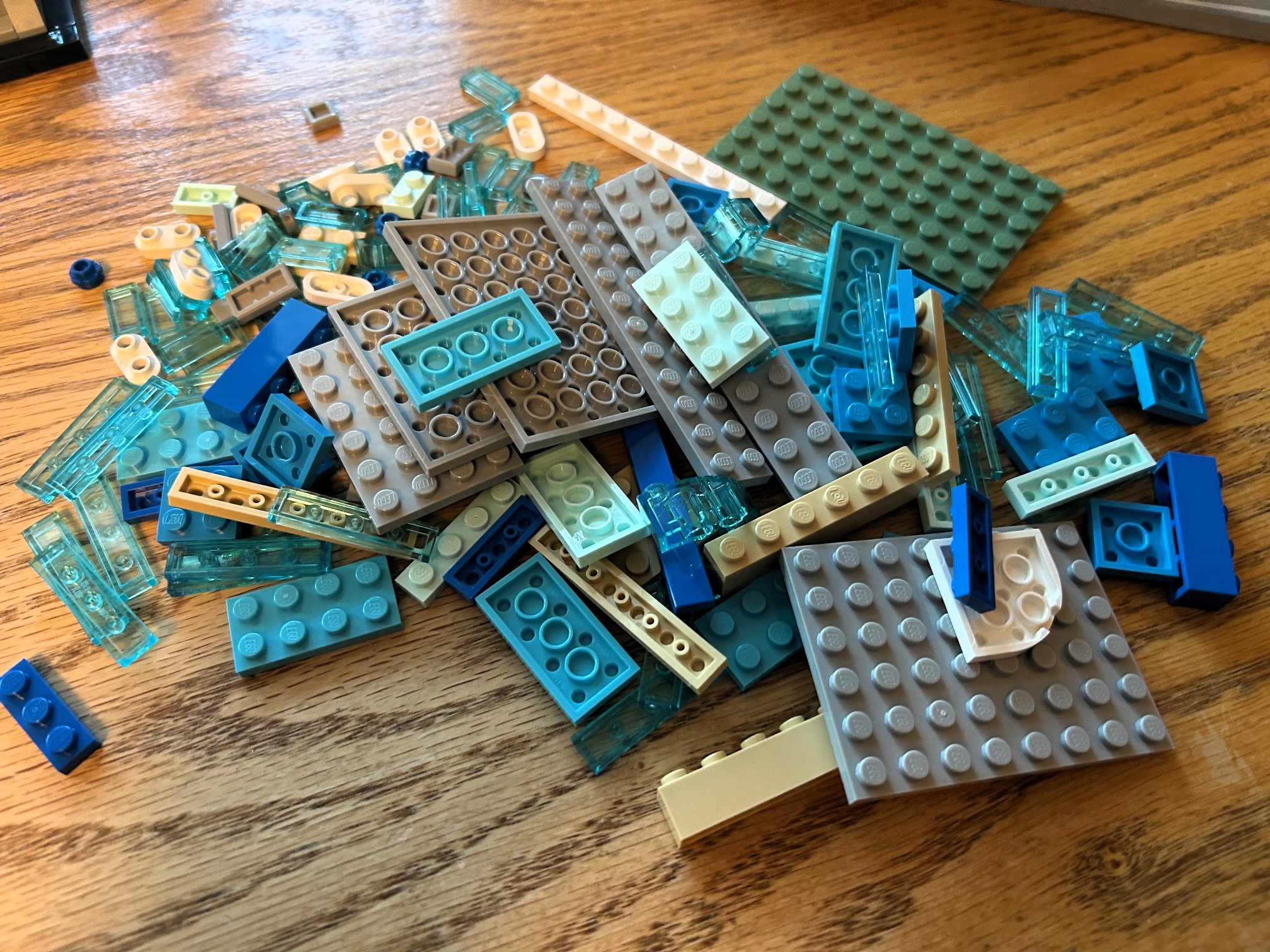
The rust on my LEGO skills was apparent from the first bag.  I assembled the first two pieces incorrectly, thought I was missing a piece (which you always find later), and questioned why I ended up with an extra piece (which is LEGO’s way of saying, “in case you lose one”).  Bag 2 had similar challenges.  And Bag 3 was a little more difficult because you get lost in all those dreamy shades of blue.  There was a moment when I placed an entire section of the fountain too far forward, corrected it, and thought, “Wow, Travertine is hard to move!”

For my fountain-building accompaniment, I thought it would be appropriate to listen the to the works of classical Italian composers.  For today’s portion, I went with Vivaldi’s “The Four Seasons”.  Bag 1 took me through “Spring” while Bag 2 took me through “Summer”.  Bag 3 required the other two seasons.  But as you can see, I already have a four-seasons pool I could throw coins into!

Running build time: 1 hr. 5 min.

Total leftover pieces: 2

Brick Wall Waterfall

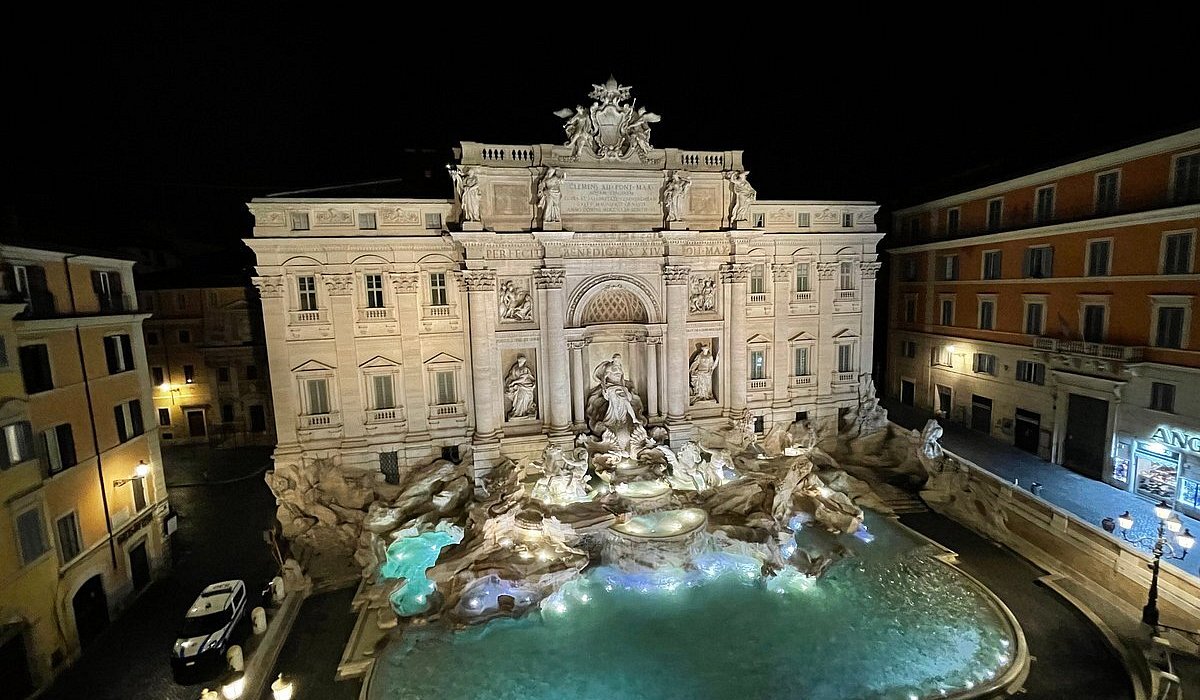
If you were to spend an entire year in Rome, you could visit five churches every day and still miss out on some of the more than 1,600 within the city limits. You could also visit five piazzas (public squares) and never see all 2,000. If monuments are your thing, Rome has so many that instead of an actual count they simply say “more than any other city in the world”. And then we have Rome’s fountains. You could dip your hand in five a day and never see them all in a year. So here’s a better idea.  Just spend a few hours at the Trevi and assume all of the others are second best.

Fontana di Trevi

I wouldn’t decree “best fountain in all of Rome” if I hadn’t been there and seen it for myself.  I spent a college year in the Eternal City studying architecture, and you can’t help noticing the other elements of the city while you’re at it.  Like fountains on every street corner.  The Trevi Fountain was walking distance from the hotel/dorm we Americans lived in, so you can bet I stood before the Trevi’s gushing waterfalls many a day.  Even a few nights.

Most people assume “Trevi” is an Italian word.  It’s actually two words mashed into one. Tre = three, vie = ways.  The Trevi is located at the intersection of three streets.  It’s also the terminus for an aqueduct from ancient times.  Water is picked up from a source outside of the city, carried over fourteen miles through the aqueduct, and deposited “with a splash” at the Trevi, to be further dispersed to the city underground.

Here’s a little more trivia on the Trevi.  It was designed and built in the 1700s, on the back wall of a palace.  It’s primary material is travertine stone (pricey!) quarried from nearby Tivoli.  Besides the columns, arches, and niches along the wall, you have quite the trove of imagery going on over the water, with mythological creatures like tritons and hippocamps.  I have no idea who the sculpted figures gazing down from either side are, but the big guy front and center is Oceanus, a pre-Olympian god.

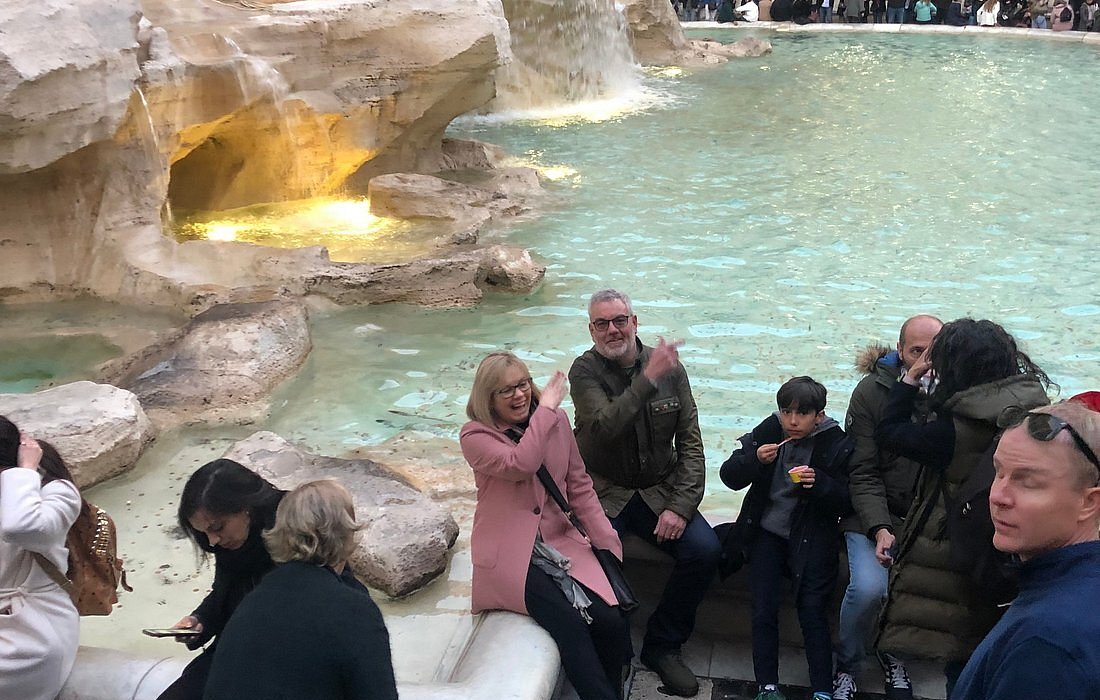
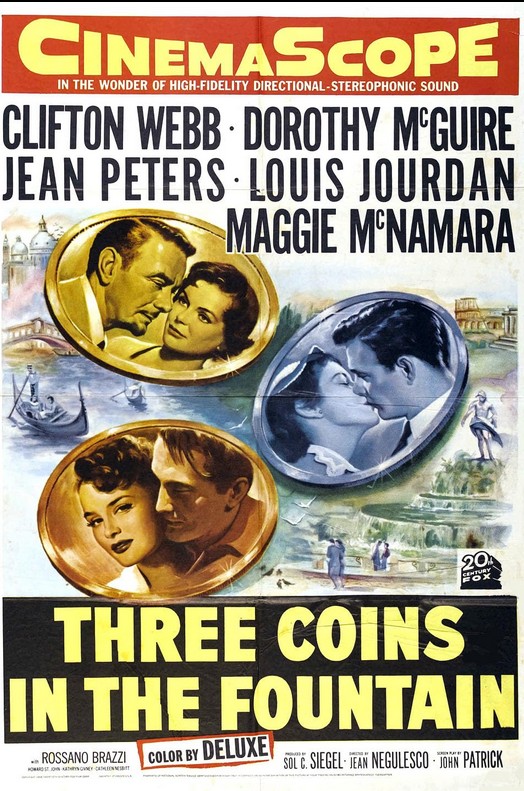
If you’re a top-five tourist attraction in Rome, you must be pretty darned attractive for a city with countless places to visit.  Maybe it’s the coin thing.  Why do tourists stand with their backs to the fountain and toss three coins over their shoulder into the water (right hand, left shoulder)?  Because legend says they’ll return to Rome some day if they do.  “Legend” is really just Hollywood, from the movie Three Coins in the Fountain.  But if you really know your Trevi trivia, you say the tossed coins follow the ancient tradition of honoring the gods of the waters, granting you safe passage home.  

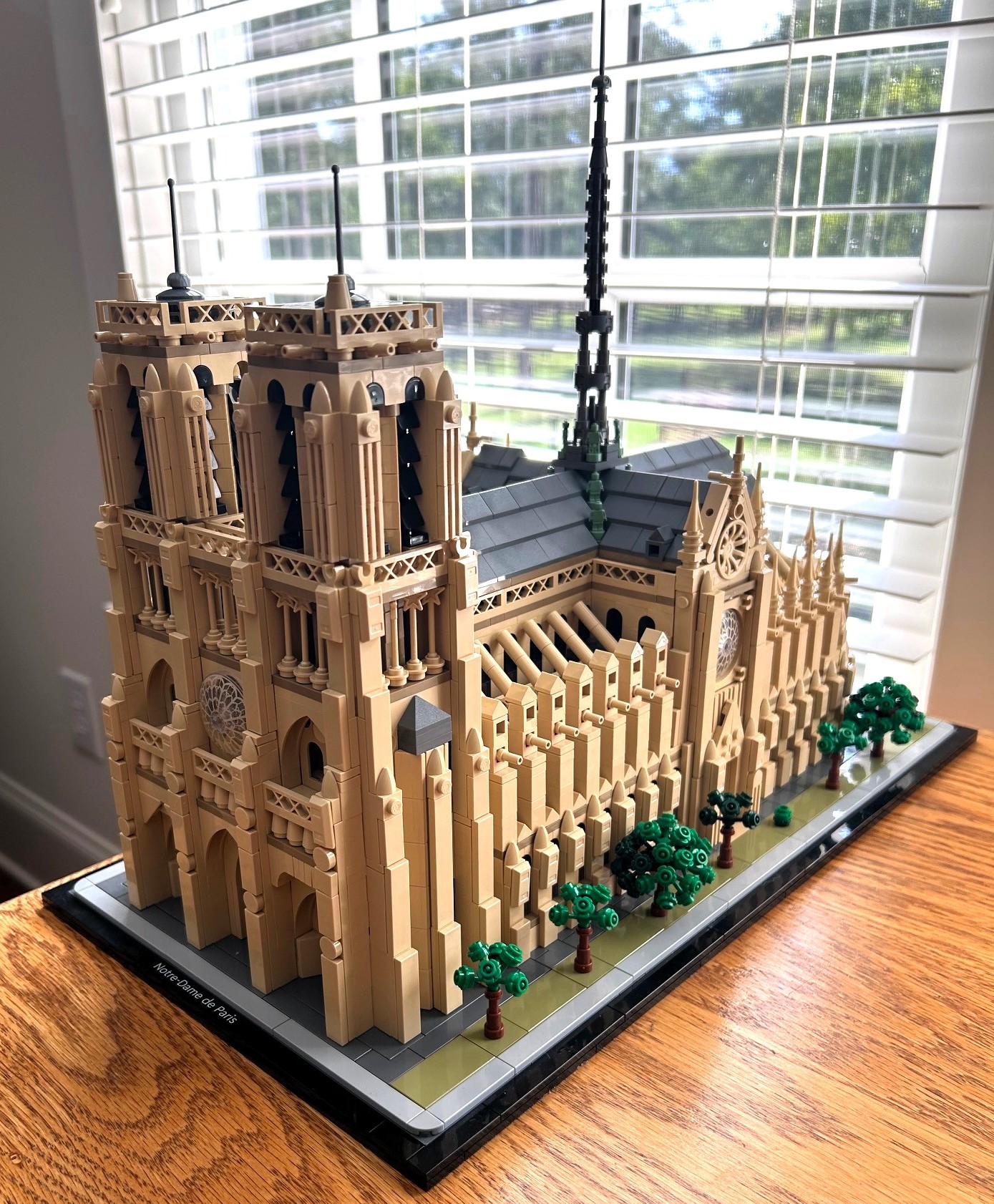
I’ve talked about the Trevi before, in Too Many Roads Lead to Rome.  The fountain has become so popular you now need a ticket and a specific time to stand in front of it.  But what I haven’t done before is build the Trevi.  Last spring, the “architects” at LEGO immortalized the fountain in a 731-piece model, which I will construct over the next several blog posts.  I haven’t put my hands on a piece of LEGO since Notre-Dame du Paris last January (which still beckons me to add its lighting kit).  I might be a little rusty at this.  The fountain might leak a little.  But I’m up for a dip in this brick wall waterfall if you are.

Author’s Note: The title of this post was inspired by the strange-but-sweet Dickie Roberts: Former Child Star.  The movie included a little ditty my thirty-one year old daughter can still recite to this day: “Brick wall, waterfall, Dickie thinks he got it all but he don’t, and I do, so BOOM with that attitude. Peace punch, Cap’n Crunch, I’ve got something you can’t touch. Bang-bang choo-choo train, wind me up I do my thing. No Reese’s Pieces, 7-Up, you mess with me, I’ll mess you up.”

Some content sourced from the TripAdvisor.com article, “Everything you need to know about the Trevi Fountain coins”; IMDB, “the Internet Movie Database”; and Wikipedia, “the free encyclopedia”.
Finial Touch

In early January you walked into my blog, took a seat in a pew up front, and witnessed the longest church service in the history of France. From the first LEGO piece I laid as the cornerstone – a now-hidden flat black rectangle – to this week’s placement of the oversized finial on top of the roof, you watched – for almost two hundred years – the slow, somewhat steady rise of Notre-Dame de Paris. Time sure flies, doesn’t it?  But at last we’ve made it to the end (or at least, the year 1345), where the pastor dismisses the congregation with a “Go in peace!”(which sounds much better than “Go in pieces!”)

Notre-Dame de Paris

Some reflection is in order today, especially since we’re talking about a building of faith. Our cathedral adventure over the last 19 weeks took us through 4,383 LEGO pieces and 393 steps of the instruction manual, snapped together in fifteen hours, resulting in a five-pound plastic model that – “thank heavens” – really does look like the famous French cathedral on the Seine River in Paris.

[Builder/blogger note:  I chose my Spotify classical music playlist while I finished up the cathedral.  The first selection was entirely fitting: Edward Elgar’s “Pomp and Circumstance”, because this really did feel like a graduation of sorts.  But the second selection was eerily more fitting: the final chorus of Handel’s “Messiah”.  Ha-a-a-a-a-llelujah indeed!]

Some of the photos here aren’t much different than last week’s, but only because bags 31-34… of 34 bags of pieces, were all about embellishment: capstones, pinnacles, tabernacles, finials, statuary, and all the other little architectural flourishes unique to a cathedral (plus a little landscape on the sidewalk).  You know those cake decorator videos where a white cake sits on a spinner and you get to witness the slow, mesmerizing development of frosting, flowers, and such?  That was me this week; spinning, applying, and fully decorating my cake… er, cathedral.

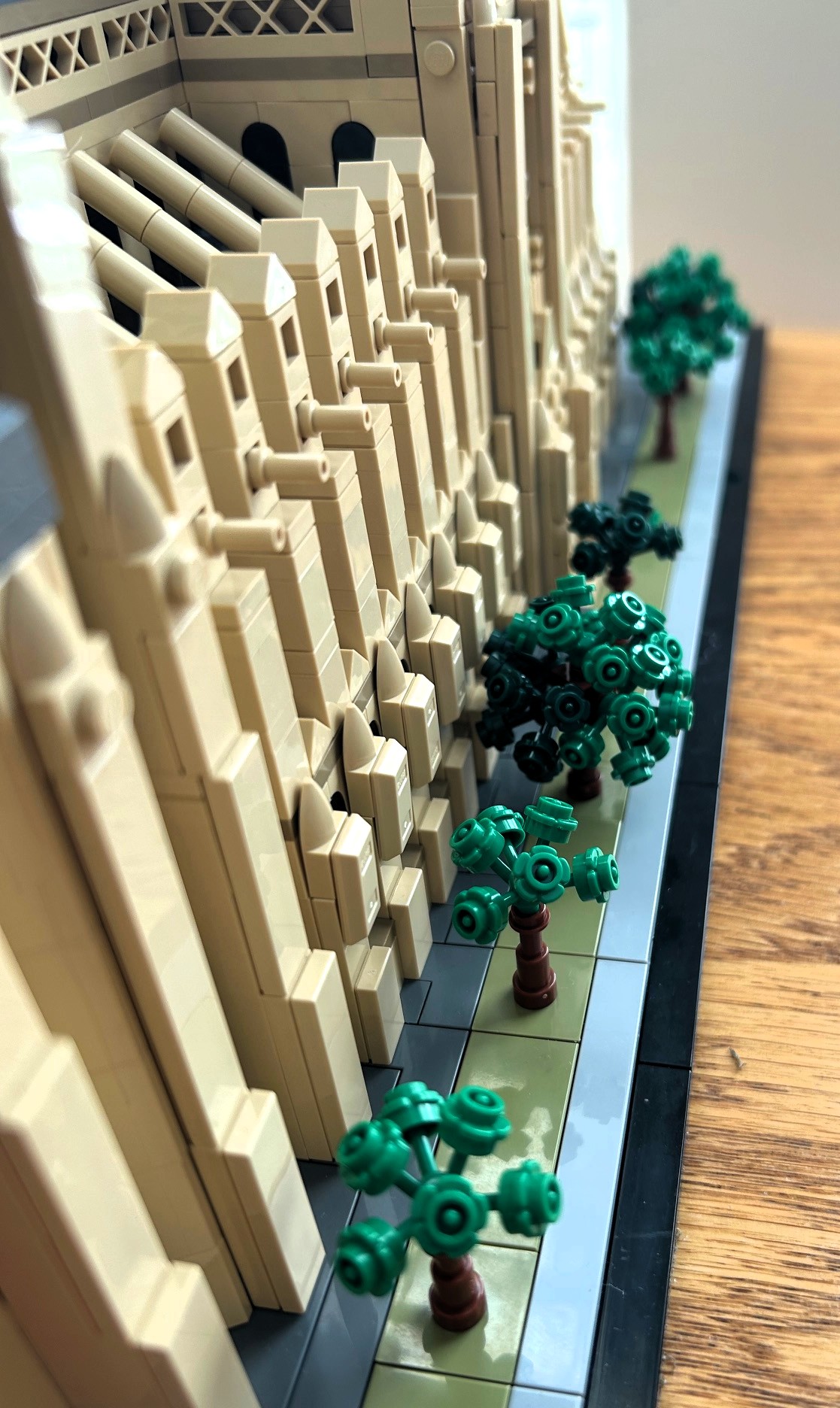
Here’s a good photo of some of this decor (and click on any of the photos to see everything better).  To the far left you can see several of the pinnacles; the little spires all in a row high up.  There are 30 pinnacles on the entire cathedral.  To the right you can see a couple of the tabernacles (14 of those); the open box-like structures above the tiny drainpipes.  And running along the first floor you can see capstones; the helmet-like headers on either side of the open bays.  There are more capstones on Notre-Dame de Paris than any other decorative element (68!)

Here’s a look at the cathedral’s famous flying buttresses, the exterior structural elements keeping the building from falling in on itself.  There are 28 buttresses, including 14 running around the chancel and apse on the east end.  Just below the tabernacle boxes you see the drainpipes.  There are 46 of those.  During a good rainstorm this view would include an elegant line of waterfalls.

Remember those curious “stars on flagpoles” (or “magic wands”)?  Here they are again, all grouped together just below the part of the towers housing the bells.  There are 24 of them.  You can also see one of the cathedral’s three majestic rose windows front and center.  Finally, note the round “medallions” just under the curved arches on either side of the rose window.  You’ll find 24 of those on Notre-Dame de Paris as well; several stamped proudly with a “LEGO” logo.

Okay, one more example of embellishment.  Here you can see the 12 disciples in green, symmetrically positioned around the base of the finial (all facing inward).  When I pulled these little guys out of the plastic bag I thought they were scale figures for down on the sidewalk, but instead they are the statuary I referred to when I first talked about the cathedral back in January.

I’d be remiss if I didn’t say something about the model’s landscape elements.  LEGO has come a long way since the boxy trees surrounding LEGO Fallingwater.  These little “growees” are pretty sophisticated.  Consider the tree in the middle. (Click on the photo for more detail).  It’s made up of 37 LEGO pieces, including the trunk, branches, and leaves.  Furthermore, the branches up against the cathedral are a darker green because, of course, that part of the tree is typically shaded.

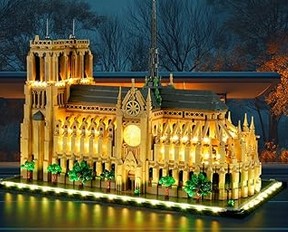
Now then, before you “go in peace” I must mention one more thing; the so-called surprise I teased in last week’s post.  Notre-Dame de Paris is such an elegant structure it deserves to be seen by day… and by night.  Thanks to the good people at Briksmax, I am able to do just that: light up the cathedral from one end to the other.  That’s the good news.  The bad?  I’m looking at another 2 instruction manuals and another 230 steps to get it done.  Are you kidding me?

Briksmax lighting

When I purchased the lights I figured they would be simply and cleverly inserted in and around the completed structure, but NO-O-O-O-O-O!!! (cue horror-movie music).  In order to light up Notre Dame de Paris I must deconstruct the model.  Again I say, are you kidding me?  Here I finally complete my cathedral and now you want me to take it apart again?  Sorry good readers; it’s just not something I can stomach right now.  I’m going to sit and admire my completed cathedral while you settle for admiring the Briksmax photo above.  You don’t place the finial on the roof of the catheral with a flourish, only to then remove the entire roof.  Another church service for another time.

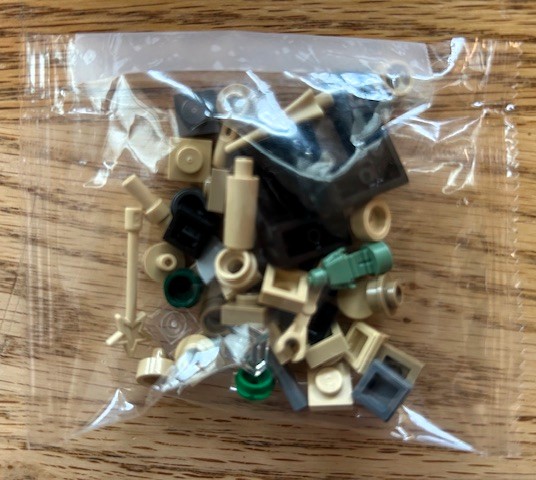
I leave you with one last look at our poor, unused, leftover pieces, all 48 of them in plastic-bagged captivity (but still trying to escape).  I think they all ganged up and cried, “RUN FOR IT!”, because the 49th leftover – a tiny cluster of leaves from one of the trees – went skittering off the desk and onto the carpet below, where it immediately hushed and hid. I still haven’t found it, but no worries.  The next time I walk into my office I’ll probably step on it with a satisfying crunch.

Running build time: 15 hrs. 6 min.

Total leftover pieces: 49

My Unforeseeable Future

In the not-so-distant year of 2062, forecasters predict we will have perfected the invention of “nanofabricators” – machines capable of producing food, clothing, electronics and such, not from assembly-line parts but from the very atoms of those parts. It’s a mind-blowing concept: technology that creates virtually anything by manipulating the structure of raw materials at the molecular level. Too bad I won’t be around to see it.

Is it making your dinner?

When you reach your mid-sixties, the harsh reality is that predictions of what life on Earth will look like in the future focus on a period of time beyond the years you’ve been given.  The experts tend to look fifty years ahead or more, so, sorry Dave, you just won’t be here when all these wonders take place.  It’s a little strange to think about a world without you in it.  Sure, you can also imagine the years before you were born, when your parents and grandparents were living life without you, but those were simpler times devoid of the technology we take for granted today.

Driver’s license not necessary

Consider self-driving cars. Fifty years ago I was a teenager and couldn’t wait to get my driver’s license (the very definition of “freedom” back then). But had you told me, “Hey Dave, you’re not going to need that little card in fifty years because cars will drive themselves”, I would’ve given you a strange look and accused you of watching too many science-fiction movies. Yet here we are.

I hit on this topic today because I’m still processing the fact we have humanoids who can run half-marathons (my post from last week).  When the world’s technology exceeds your expectations, you push the pause button and wonder if you’re getting left behind (or just getting old).  Am I suddenly more inclined to believe those fifty-year forecasts?  You bet I am.  And nanofabricators are just the tip of the inventive iceberg.

Ping-pong partner

Nanobots (does everything in a post-Dave world start with “nano”?) are in the works as well.  A nanobot is a robot so tiny you might not be able to see it with the naked eye.  I was introduced to the concept in Michael Crichton’s sci-fi novel Prey.  Imagine a pile of nanobots sitting in the corner of a window in your house.  Once a day those nanobots spill out over the glass like a wave, consuming any dirt or other matter like little vacuums.  Perfectly clean windows!  Of course, “Prey” takes the technology in a more sinister, out-of-control direction and a bestseller is born.

[Blogger’s note: You’ll find “nanobot” in your favorite online dictionary. At least in some lab environment out there, nanobots are already here.]

With Prey in mind, Hollywood isn’t helping us to embrace these fifty-year forecasts.  Virtually every movie (or book) about yet-to-be-here technology takes the concept in a not-so-nice direction. (The Terminator comes to mind.)  The fact is, nobody’s going to buy a ticket just to watch a happy application of future tech on the big screen.  Something always has to go “worng” (to quote Westworld).

I hope you’ll be around in fifty years to see and experience some of the wonders our forecasters predict today.  Brace yourself: you’ll have a “wearable” of some sort (watch, eyeglasses, implant).  One of you will have bionics in a limb or organ that wasn’t functioning properly.  Some of you will live up in space or deep down in the ocean instead of on terra firma.  It’s a wonderous world I’ll never get to see, but I’ve made peace with it.  At least I won’t be around in 2182, when Asteroid Bennu (we name asteroids?) will be on a collision course with Earth.


LEGO Notre-Dame de Paris – Update #14

(Read about the start of this “church service” in Highest Chair)

The service is rapidly coming to a close. I sense the inevitable benediction and dismissal of the congregation as our work on LEGO Notre-Dame de Paris wraps up. The remaining pieces in Bag 28 brought the cathedral’s bell towers to an even (if not finished) height, while Bags 29 and 30 – of 34 bags of pieces – added more detail to those towers, as well as some elegant structure above the transept doorways.

Bell tower detail

We worked high off the ground today; quite a bit higher than the roof line of the cathedral. My shaking fingers had a sense of vertigo as I added the little drainpipes, railings, and such you see here. I imagined one of those towering mechanical cranes dropping the LEGO pieces into place until, of course, I remembered I was working in the thirteenth century. The word “crane” hadn’t even been invented yet.

Again with the missing pieces.  For the first time since I laid the cornerstone I thought I threw a piece away, along with the plastic bag it came in.  I searched in vain on my office desk, only to decide I’d be going through the garage trash later on.  Then lo and behold, just as I was completing today’s build, there sat the missing piece right in front of me as if to say, “What the heck is wrong with you?  I was right here in plain sight!”

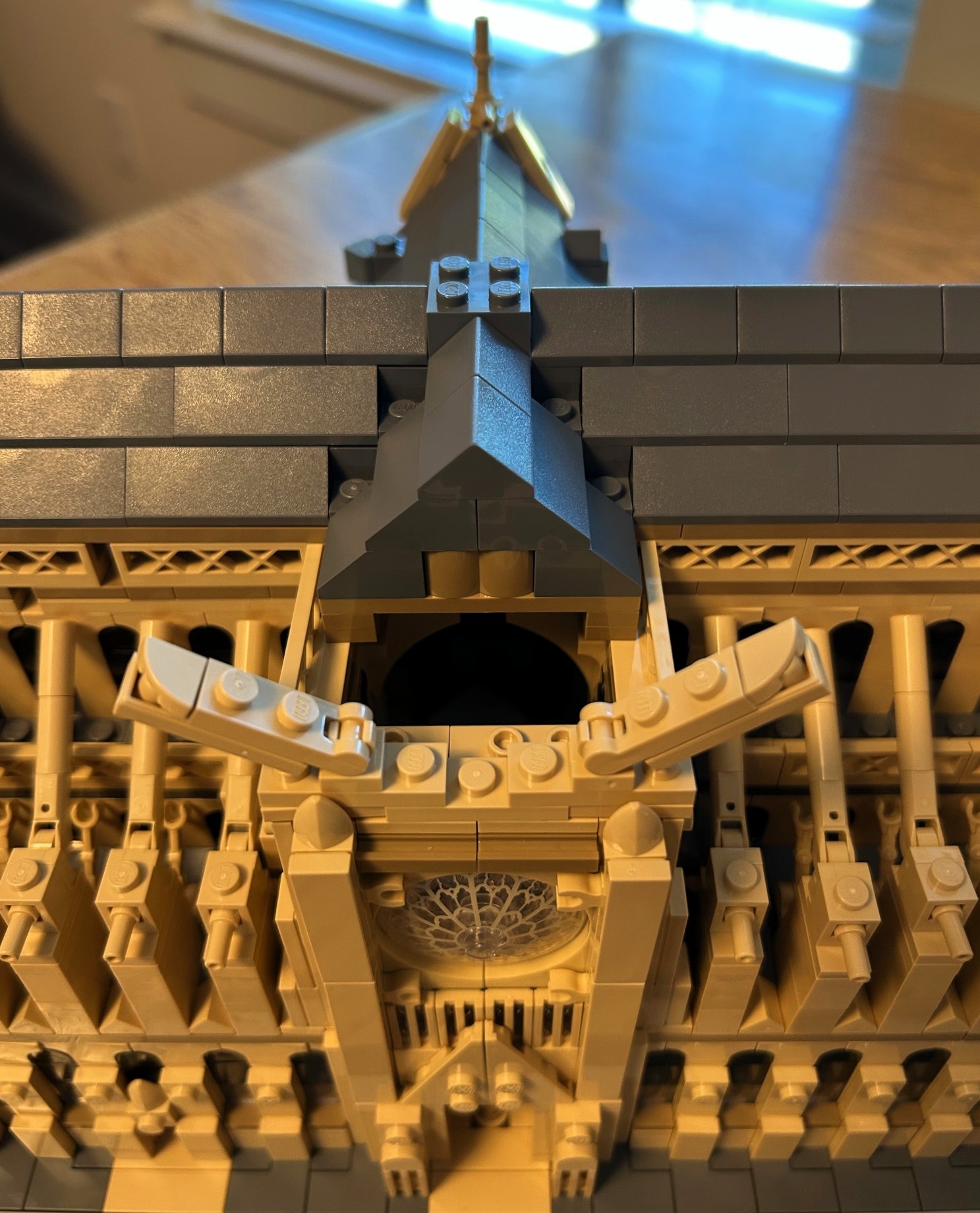
My hat is off to LEGO’s engineers today.  Look at the process above where I completed the structure above the transept doorways.  Those two long LEGO pieces in the first photo are designed to hinge open, simply to allow easier placement of the central cap piece in between.  Then you close those long pieces around the cap like a hug and voila – second photo – the transept is complete.

Our work really is almost done.  Just four small bags of pieces remain – two for the top structure of the bell towers (and a little ornamentation around the cathedral roof), and two for landscape elements to soften the edges of the model.  Don’t walk out of the sanctuary just yet.  The final product includes a surprise!

Running build time: 13 hrs. 58 min.

Total leftover pieces: 40

Some content sourced from the FutureTimeline.net website, the CNN Science article, “Near-Earth asteroid Bennu could hit Earth in 157 years…”, and Wikipedia, “the free encyclopedia”.
Running Amuck

Last Saturday our little town hosted a festive 10k run.  High school cheerleaders pom-pommed us away from the starting line while hundreds of residents waved flags and tossed water bottles along the way. The finish in the town square was packed with people, and included the music, food, and fun you’d find at a carnival.   As I struggled to complete the last couple of “k’s” I struck up a conversation with a nearby runner to distract myself from the effort.  She was pleasant enough, with just the right pace, and she was even a human being.  At least, I think she was.

Suddenly, shockingly, we’ve come to this.  The entry form for your next running race may ask you to identify as 1) human being, or 2) human-oid .  If you choose the latter, you’re saying you still have the physical form and characteristics of a human being.  You just happen to be a robot.

Ten days ago this eerie scenario really played out in Beijing.  A half-marathon took place with thousands of human participants, but the spotlight was clearly on the twenty-one humanoids who also showed up at the starting line.  These robots were accompanied by operators running close behind them, but make no mistake; absent of the wires or other attachments you might expect with a remote-controlled device.  They were running free, with the look and gait of any other runner in the race.

I’m wondering how any of the human runners kept their focus as they ran this race.  I’d want to pace myself against one or two of these machines and just admire their every step.  The humanoid winner, Tiangong Ultra, finished the half-marathon in 2 hours and 40 minutes, or about five miles an hour.  Trust me: five miles an hour is not a walk; it’s a run.

I’ll have to search for the video online, because a still of a running humanoid doesn’t do the accomplishment justice.  I just can’t get over the fact we now have robots who run.  Granted, the Beijing half-marathon wasn’t what you’d call a “run in the park” for these technological marvels.  Only six of the twenty-one finished the race.  Others fell down or exhausted their battery packs.  Still others lost their heads or spun out of control.  If there had been a humanoid hospital nearby, its ER would’ve been a machine-shop hotbed of activity.

My perception of all things “robot” is clearly outdated.  I’m more inclined to picture self-guided vacuum cleaners and assembly-line automatons than race-running humanoids.  Case in point: I’ll never forget the grade-school novel, Andy Buckram’s Tin Men.  It was a wonderfully imaginative tale about a boy who created a family of robots from a pile of cans, and his unexpected adventures when those robots came to life courtesy of a lightning strike.  The book was written in the 1960s and was a work of fiction.  Of course it was.

I’ll also never forget the movie Silent Running (1972), a future shock story of a destroyed Earth, with spaceships housing giant terrariums cared for by lovable lifelike service robots.  Or Westworld – the 1973 original, not the HBO series  – an adult amusement park of sorts where robots catered to the guilty pleasures of their human customers (until collectively the robots decided to run amuck).

C-3PO

C-3PO from the original Star Wars trilogy (1977) might’ve been the first humanoid to get me wondering if such technology was possible.  Blade Runner (1982) took the concept an interesting step further, with humanoids desperate to demonstrate their emotional capacity.  Less than fifty years later we’re still working on that emotions bit, but I certainly wouldn’t have bet we’d have humanoids who could run.

Let’s be clear – we’re at least another fifty years removed from any technology that remotely suggests “human”.  Even if Siri and Alexa appear to read your mind and hold meaningful conversations with you, they’re not going to jump out of your smartphone tomorrow and land on two legs.  Even if  your little robot dog wags its tail, lies down, and rolls over, it’s not going to take a bite out of your leg when it doesn’t get enough attention.  Your Roomba might suck up the lion’s share of dust and dirt in your house but it’s not coming for your valuables.

I sleep peacefully at night knowing the nightmares of Westworld and Blade Runner continue to be the stuff of (evil) Hollywood imaginations.  Virtual reality will remain virtual, and robots will continue to be nothing more than subservient devices for years to come.  But admittedly, you can’t help but question “years to come” when you see a humanoid run a half-marathon.


LEGO Notre-Dame de Paris – Update #13

(Read about the start of this “church service” in Highest Chair)

I’m not sure I’ve ever stopped the construction of a LEGO model smack-dab in the middle of a bag of pieces.  Imagine our priest at Notre-Dame de Paris, pausing midway/mid-sentence into his homily only to say to his congregation, “I’m tired.  Let’s pick this up next week, shall we?”

Cathedral roof structure

Bags 25-28 – of 34 bags of pieces, were a study in opposites.  In a crisp fifteen minutes, Bag 25 assembled to the roof structure you see here, covering the remainder of the nave (the sanctuary) and transept (the cross section).  Even Bag 26 wasn’t a stretch as we built the “cores” of the uppermost cubes of the cathedral towers.

Two bags = hundreds of pieces.  Seriously.

But that’s when I should’ve stepped on the brakes.  The instruction manual told me to break open Bags 27 and 28 together and this is what stared up at me.  If you think the pile on the right adds up to a lot of pieces, you are correct about both piles and you’re probably underestimating the number.  These tiny, tiny pieces come together slowly to complete the uppermost cubes of the cathedral towers.  One cube took 75 minutes.  Why so long?  186 pieces each.  No kidding – zoom in on the top of the completed tower below and you’ll get some sense of how intricate it is.  Now you understand why we paused in the middle of the homily.  I just didn’t have the energy to build up the other tower.  Next week!

(Click the photo for more detail)

Since we’re close to the end of the build, let me admit to looking ahead in the process.  The remaining six bags are small, and the pieces inside of them are minuscule.  If I had visions of finishing off the cathedral in a flurry of construction, they’ve been dashed by the thought that I’m still a good five hundred pieces from the finish line.  Sigh… this church service is getting a little long.

Running build time: 13 hrs. 0 min.

Total leftover pieces: 32

Some content sourced from the Smithsonian Magazine article, “Humanoid Robots Just Raced Alongside Human Runners…”, and Wikipedia, “the free encyclopedia”.
Pretty In Pink (and Green)

Here in the South, the arrival of spring has been declared with aplomb. You can already watch the grass grow, and it seems to need cutting every other day.  But even more apparent, the blooms are everywhere. Pink azaleas (a staple at last weekend’s Masters golf tournament) run rampant. The roses have never been redder. And the giant flower heads of white hydrangeas will soon spring forth. This Easter week therefore, it seems appropriate for this blog to pay a visit to another cathedral: Saint Mary of the Flowers in Florence, Italy.

Santa Maria dei Fiore

My LEGO creation of the cathedral of Notre-Dame de Paris is quickly coming to a close, so I need to tour you through at least one or two more cathedrals before I’m done.  The first, you may recall, was Saint John Lateran in Rome (read about that one in Tucked-Away Place to Pray).  Today we’re a three-hour drive to the north, at Santa Maria dei Fiore.  It’s no surprise my tour of the world’s prominent cathedrals continues in Italy.  To be honest, the whole tour would do just fine if it never left the country.

West facade and bell tower

Florence is the capital city of the Italian region of Tuscany, known for its stunning landscapes, world-class wines, and Renaissance art and architecture.  Approaching the city from any direction, you cannot help but notice Santa Maria dei Fiore.  The cathedral is not only one of the largest in the world, but its exterior is finished with marble panels of pink and green, giving the structure a light, airy contrast to the surrounding buildings.  The church is crowned by a distinctive dome, which captures your attention even before the church itself.

Inside shell of the dome

The architect in me wants to highlight Santa Maria dei Fiore for the remarkable engineering that went into this massive structure.  I could spend an entire post talking about the design of the dome alone.  Consider, its structure is actually one inside of another.  The brick-clad concrete shell you see from the outside is connected to the one you see from the inside by “chains” of stone, iron, and wood.  With this approach, Santa Maria dei Fiore doesn’t require the flying buttresses so prominent in Notre-Dame de Paris (a structural element the Italians regarded as “ugly makeshifts”).  And the dome’s four million bricks – which might seem heavy-handed (ha) – are a much lighter material than stone or tile.

There’s more to this cathedral than its dome, of course.  The plan, a traditional Latin cross, includes three rounded apses surrounding the altar, each used as a chapel.  The nave (sanctuary) is the length of two football fields; a vast interior space with single aisles on either side.  The structural arches soar 75 feet above the seemingly endless marble floor.  And perhaps most unusual, Santa Maria dei Fiore is actually a complex of three buildings.  You enter the adjacent octagonal Baptistry of St. John through sets of bronze doors (which are replacements for the famous originals now residing in a nearby museum).  And the slender free-standing Giotto’s Campanile (bell tower) is a decorated work of art in itself.  All three structures blend together with those distinctive pink and green marble tiles.

Baptistry of St. John

If you’re ever fortunate enough to visit Saint Mary of the Flowers, be sure to purchase the ticket to climb to the top of the dome.  Filippo Brunelleschi – the architect -included a narrow staircase between the two shells so you can reach the uppermost cupola for a spectacular view of Florence and the surrounding countryside. Brunelleschi designed other structures in his lifetime; churches, chapels, hospitals, and such, but the Florence Cathedral is his crowning achievement.  It’s no wonder you’ll find his tomb right inside the entrance, alongside the more prominent players in Santa Maria’s storied history.


LEGO Notre-Dame de Paris – Update #12

(Read about the start of this “church service” in Highest Chair)

Oh my stars, the build was challenging today!  Bags 22, 23, and 24 – of 34 bags of pieces, focused almost exclusively on the west facade and the rising of the bell towers.  We added the final rose window (above the west entrance) and reinforced the upper reaches of the nave in anticipation of adding the roof.

Magic wands?

So here’s a detail I didn’t expect.  In Notre-Dame’s towers, just below the uppermost structure (where the bells live – still to be built), you have – how else can I say it? – “stars on flag poles”.  Forty stars on flag poles, to be precise.  When I dumped out Bag 24, I thought, “What the…?” as the pile of magic wands you see here appeared.  Did LEGO mistakenly add pieces from a Harry Potter model into mine?  A Disney perhaps?  Nope.  Look at the final photo.  Every one of those stars is planted at the west end of the cathedral like palm trees; most of them in the bell towers.  Nice detail, Notre-Dame.  As for installing them?  It’s tough enough to push little poles into LEGO holes one-by-one-by one, but then you have to rotate the stars precisely forty-five degrees from the plane of the cathedral walls.  The engineers at LEGO are having a barrel of laughs at my expense.


(Click for more detail)

By the way, we’ve made it to the year 1245 as we build the bell towers, almost a hundred years after laying the first cornerstone at the opposite end.  And we are almost done.  By the numbers we have ten bags of pieces to go, but by the look of the model we’re closer than that.  They must be small bags of pieces.  Whatever.  I just hope they don’t contain any more stars on flagpoles.

Running build time: 12 hrs. 01 min.

Total leftover pieces: 32

Some content sourced from Wikipedia, “the free encyclopedia”.