Game Over

Tag the Dallas Cowboys with “politically correct” for their actions Monday night. The National Football League staged fifteen games last weekend – and thirty protests – but it wasn’t until the final contest Monday night where we saw something bordering on considerate. With the Cowboys, we witnessed unified “free speech” and regard for the American flag; neither action compromising the intent of the other.

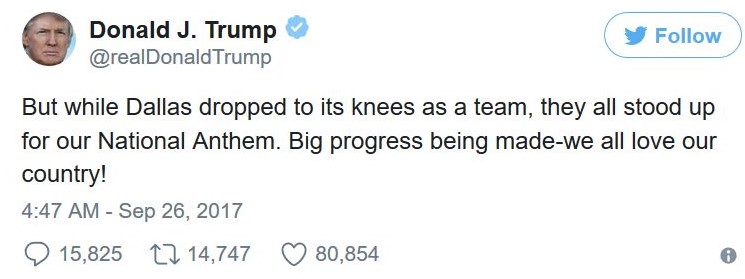
If you missed Monday night’s game you would’ve been misled by Tuesday’s headlines, including, “Jerry Jones Leads Cowboys in Taking a Knee…”.  Jones – the Cowboys’ owner, president, and general manager – did take a knee, but he did so alongside his players and coaches; a unified show of disagreement with President Trump’s comments.  More importantly, Dallas knelt prior to the national anthem, so as not to confuse protest with allegiance to country.  During the anthem, the team stood with arms locked together and helmets removed.  I’m okay with that approach.  Even President Trump is okay with that approach.

As for the other twenty-nine teams, it was myriad versions of disunity and disrespect before kickoffs.  (NPR’s website lists them all here).  Random players knelt during the anthem while other stood – a visibly mixed message.  Owners and coaches stayed away for the most part, suggesting the same divisiveness alluded to by the President.  The Pittsburgh “Kneelers”, Seattle Seahawks, and Tennessee Titans – in total contempt of country – stayed off the field entirely during the national anthem.

Athletes exercising their right to free speech in sports venues is a distraction and nothing more, at least to the average fan.  The football field is simply not an effective platform for politics.  I, along with millions of others, tune in to watch the game, so anything outside the action itself (i.e. commercials) is irritating.  It’s the same reason I no longer watch awards shows; I don’t want the inevitable helping of political commentary along with the acceptance speeches.  The day the same thing happens in movie theaters is the day I buy my last ticket.  Sports and other entertainment venues should be escapes from the endless newsreel of the real world.

With the NFL, I’d argue the protests are not just irritating, but damaging.  Based on the number of emails Sports Illustrated received from disgruntled fans after last weekend, viewership is already taking a significant hit.  The NFL can’t afford to lose viewership.  The league is having enough trouble dealing with losses of sponsorship, and lawsuits tied to chronic traumatic encephalopathy (CTE).  Forget about viewers; one of these days the NFL might not have players.

Tyler Eifert, a tight end for the Cincinnati Bengals and a graduate of my alma mater Notre Dame, contributed one of the better player perspectives in his essay, “Why I Stand“.  His words could’ve been mine when he said, “I am not questioning anyone’s reasons or rights to protest, but instead the method.  This entire protest about raising awareness for racial inequality has gotten lost in the media and turned into a debate about whether to sit or stand for the national anthem… I stand because I love my country.  I stand because I want to honor the people putting their lives on the line for me on a daily basis…”  Tyler Eifert gets it.  The American flag stands for the freedom allowing him to play football in the first place.

Kneeling in front of the flag (or absence from the field altogether) is trickling into other sports as well.  Oakland Athletics catcher Bruce Maxwell became the first pro baseball player to join the anthem protests by taking a knee before his team’s game.  The Minnesota Lynx joined arms on the court before the WNBA finals began on Sunday, while the Los Angeles Sparks returned to their locker room during the anthem.  Even high-schoolers are kneeling.  Until we see something more constructive, these actions have little merit.

NFL player protests will cease, especially if franchise owners enforce a league-sanctioned code of conduct they currently choose to ignore.  The country is no less divided because of these demonstrations.  Rockies baseball manager Bud Black says, “…for me to be arrogant enough to say that the other half of the country is wrong or that I’m definitely right, I think (that) is the wrong thing to do. … I’m proud to be an American. And I’m also thankful to have the First Amendment, so I see it both ways. I have my opinions, but that does not mean they are right, so I’ll keep them to myself.”

I wish NFL players would keep their opinions to themselves, at least on game days.  Sports fans are switching off their televisions in record numbers, including me.  I have better things to do with my Sunday afternoons.

Fade to black.

Education Opulence

At New York City’s exclusive Trinity School on the Upper West Side, kindergartners look forward to a year of “…building self-confidence, independence, and responsibility”, coupled with “forming friendships, dealing with a variety of social situations, and discovering the joy and excitement of learning…” Sounds like a solid choice for early schooling, until you consider the daunting application process and the need for financial aid. Your child’s chances of acceptance are only 1 in 5, and a year of Trinity grade-school will cost you $50,000.

Trinity isn’t in a class(room) of its own with its hefty private-school tuition.  At least forty-five other independents in Manhattan carry a similar price tag, according to a recent Wall Street Journal article.  Perhaps Trinity boasts of its 300-year history, evolving from noble roots “providing free education for the poor in the New Colony”.  Certainly, Trinity basks in its high enrollment of graduates into Ivy League-caliber universities.  But history and performance are not prerequisites for the high costs.  The Upper East Side’s Wetherby-Pembridge School opened just two weeks ago with no tangible credentials.  The cost of a year at W-P for a three-year old?  $45,500.

Remarkably, fifty grand in tuition doesn’t even cover the full cost of a year of education.  Many of NYC’s independent schools fund-raise and conduct aggressive capital campaigns.  Without state-of-the-art facilities and salaries befitting doctorate-level educators, private schools risk losing students to the more “affordable” options in town.

Elite K-12 academies also find themselves in a moral dilemma.  While their tuition costs rise faster than the rate of inflation (23% in just the last five years), their enrollment becomes inevitably less reflective of the society around them.  The Bank Street School for Children “views diversity as essential to its academic program”, but struggles to deliver on that value when virtually all its students come from the top 1% of incomes.  Even the rich are forced to compromise to keep up with tuition payments.  Many forego vacations, club memberships, and expensive hobbies for the sake of their child’s top-dollar education.

When our kids were born in the San Francisco Bay Area almost thirty years ago, my wife and I had differing opinions on the best options for K-12 education.  My wife graduated from a private Catholic high school in Chicago, while I graduated from public schools in Los Angeles.  We had good reason to consider either option with our own kids.  Our research included several independent schools, including the prestigious Menlo School in Atherton, and the (Catholic) Woodside Priory School in Portola Valley.  Even then private-school tuition was beyond our reach, not to mention the implied commitments (tithing, volunteering).  We moved to Colorado before we gave Bay Area schools a chance (and our kids graduated from Colorado’s public schools), but it’s safe to say they would’ve gone to public schools no matter where we lived.  Today, Menlo and Priory cost $45,000/year.

With another nod to Manhattan’s Upper East Side, our daughter recently talked us into watching the television series “Gossip Girl”, which ran from 2007-2012 on The CW network.  Gossip Girl explores the lives of New York’s upper-class adolescents, with most of the drama taking place in and around the “Constance Billard School for Girls” and “St. Jude’s School for Boys”.  Gossip Girl’s story lines are hit or miss, but the characters’ appetites for the uber-wealthy lifestyle are on full display.  Stretch limousines, lavish parties, jet-set European vacations, and top-dollar wardrobes would imply $50,000 for a year of K-12 tuition is a drop in the bucket.  Gossip Girl may be a fictional world, but opulent education is real, and a gold ring lying beyond most of our grasps.

Manhattan’s private-school world is a little too ostentatious for my tastes.  I received a perfectly good education in public schools, after all.  Trinity School’s website includes a welcome from the “Head of School” who proudly claims, “students and teachers work together to create a dazzlingly dynamic mosaic of human excellence”.  With that glittering generality, no wonder the five-figure price tag.

Knight Watchman

This week’s headlines are full of speculation about Apple’s soon-to-debut iPhone X. We’re still a month away from pre-orders, yet iPhone X headlines carry the weight of those for the hurricanes and North Korea.

          Images courtesy of www.apple.com

iPhone X’s new/improved features sound impressive: “”It’s all screen”, facial recognition, surgical-grade stainless-steel, water resistance, wireless charging, superior camera functionality, and an “A11 Bionic” smartphone chip capable of 600 billion operations per second.  Sounds like a noticeable upgrade from the iPhone 7.

Despite this fanfare, my eye is still drawn to the iPhone’s most basic app: those numbers at the top of the “elegantly-rounded screen” silently telling the time-of-day.

I wear a watch.  Always have.  I wake up every morning, get dressed, pocket my wallet, handkerchief, and keys, and “wrist” my watch.  It’s a habit I’ve had since college days.  Granted, my wallet gets slimmer by the year, as the need for cash and physical cards dwindles.  My key chain is no longer a chain; not even a set of keys (rather, a small fob controlling my car without ever leaving my pocket).  Mercifully, my handkerchief hasn’t changed whatsoever (other than the purchase of a new one every couple of months).

My analog watch – though threatened by technology – remains steadfastly on my wrist.  I started wearing watches when I was a kid, and several decades later I still have the first two I ever owned.  My Snoopy watch was the wind-up type, telling time with its hours and minutes “paws”.  My gold (colored) Pulsar was one of the earliest of its brand, and seemed to say, “time to grow up”.

Several years after my Pulsar I purchased (or received) another wristwatch, followed by another and another and another.  At some point in the process my watches became too nice to part with, and “replace” became “collect”.  Today, I choose from half a dozen.

Recently, I gave smartwatches a try.  I figured, why not get my time and all those other time-saving applications on my wrist?  But it just didn’t take.  Like digital-display watches, I missed the elegant mechanics of a real analog watch.  For a short time, I tried wearing an analog on one wrist and a smartwatch on the other.  Also didn’t take (and probably drew a few curious looks in the process).

On yesterday’s commute talk-radio, the discussion was the iPhone X, and the host said, “anyone 40-and-older probably still wears a watch”.  That statement applies to me (both age range and habit).  I simply cannot forego my wristwatch for a smartphone.  No knock to smartphones, mind you.  In fact, with its $1,000 price tag, the radio host asked callers to predict whether the iPhone X would sell.  All ten callers I heard said people would buy, just as they did at the $500 threshold.  To anyone who thinks $1,000 is excessive, consider this: the smartphone has become a cultural necessity; a here-to-stay personal computer appendage (gather dust, ye laptops and desktops).  And $1,000 is a reasonable price for a personal computer these days.

Here’s a more concrete argument for the $1,000 price tag.  Make a list of the iPhone’s basic apps, and consider the cost of say, five years of physical materials to replace those apps.  Note pads, address books, calendars, paper maps, wallets, cameras, telephones, stereos, calculators, newspapers, and postage stamps (a wholly incomplete list).  Watches.  Well, what do you know; you just spent a lot more than $1,000!  Any further arguments?

No arguments from me either: the X will be a good and popular buy.  But you’ll still find a watch on my wrist.

Carefree Highways

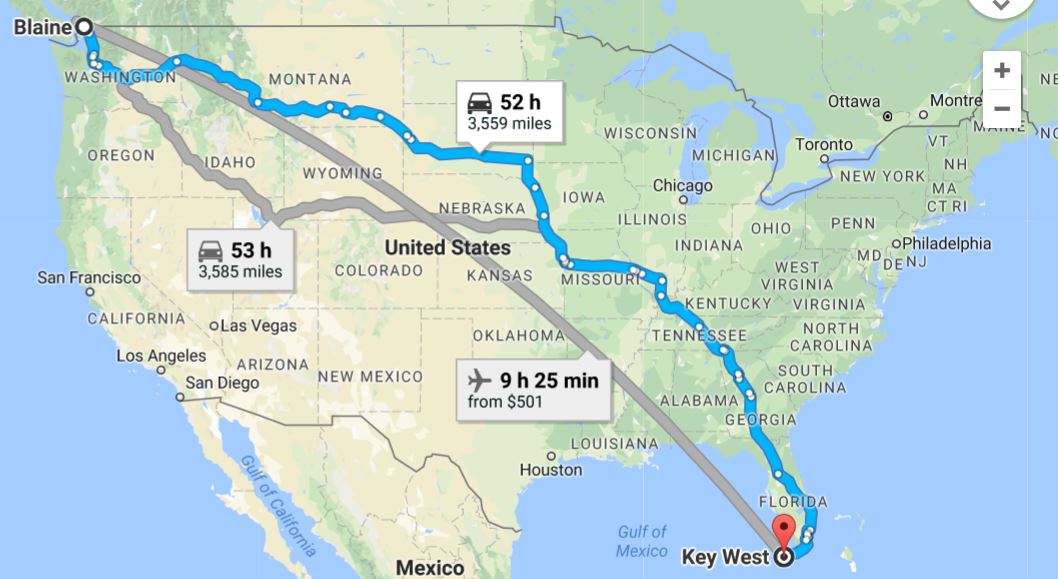
Here’s a connect-the-dots challenge, tapping what’s left of your road-trip driving fever from Labor Day weekend. Pull up Google Maps, pick two towns on opposite edges of the continental United States, and see if you can discover the longest driving trip. The only rules: you must start and end with U.S. cities, and your answer must be the blue line (not the grey line alternatives).

My first guess on Google Maps (above) is effectively the longest drive between the borders of Mexico and Canada.  San Ysidro in California wouldn’t exist if not for the busy border crossing just to the south.  Van Buren in Maine wouldn’t exist if not for a small group of Nova Scotia citizens exiled from Canada in 1785.  As you can see, my southwest to northeast traverse gets me 3,291 miles of driving and takes more than two days (including a wealth of bathroom stops).  In the process, I pass through ten U.S. states and three Canadian provinces.  Label this trip a long-distance segue from “Ole!” to “Eh?”

My second guess chooses a sun-starved soul north of Seattle, seeking some beach time in the Florida Keys (though someone named Irma would object right about now).  Our friend finishes his oyster stew in tiny Blaine, WA; points his car to the southeast, and arrives in Key West, FL two-and-a-half days later, just in time for a twilight margarita with Jimmy Buffett.  His drive also passes through ten states (like my first guess) but lasts 3,559 miles.  If our friend finished in Miami he’d drive the same distance as my first guess, but Highway 1 – further south through the Florida Keys – buys him a 160-mile tiebreaker.

A recent Wall Street Journal article asserts we Americans are endlessly romanced by the allure of the open road (a “four-wheeled traipse” if you will), and the Labor Day holiday conveniently marks the end of the summer travel season.  Thus, you get a lot of drivers on the first weekend in September – 600,000 in Colorado alone, or 11% of the state’s population.  That translates to over 3.5 million road-trippers across the entire United States.  Traffic jam, anyone?


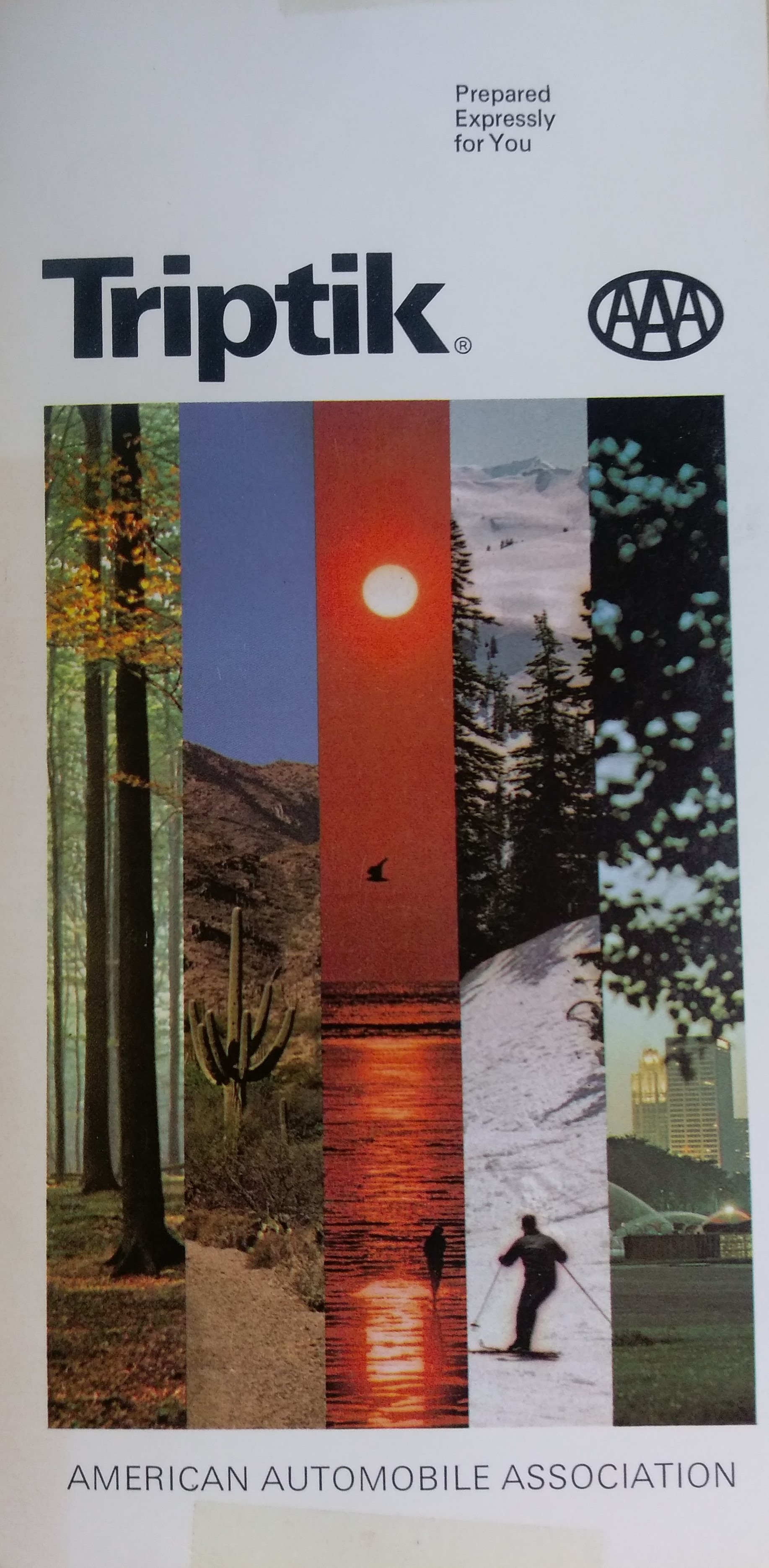
In the prehistoric times of street-corner pay phones and folding road maps (read: 1970’s), the American Automobile Association (AAA) offered a service called “Triptik”.  Go to an AAA office, tell ’em where you want to go, and they’d hand you a step-by-step book of maps “prepared expressly for you”.  My parents gave me a Triptik – and all the station wagon gas I needed – as a high-school graduation present.  My buddy and I created a Western States round-trip starting in Los Angeles, driving as far north as Montana, as far east as South Dakota, and returning through the Southwestern states.  Our aim was to hit as many national parks as possible.  We spent a few nights in motels (on our own dime), but most nights in sleeping bags in the back of the station wagon.  No agenda, no worries – just a couple of teenagers making a ton of memories on the open road.

On the topic of road trips, I owe a nod to America’s beloved “Main Street” – U.S. Route 66.  Though nowhere close to the longest road trip in the U.S., Route 66 is certainly the most renowned.  Built in 1926, the “Mother Road” ran from Chicago to the Pacific Ocean west of Los Angeles – fully 2,448 miles.  Early 1900’s migration to the Western U.S. owes some of its success to 66, and all those road-trippers “got their kicks” at the hundreds of restaurants and motels born along the highway.  It wasn’t until 1985 – sixty years later – the last remnants of Route 66 were replaced by newer segments of the U.S. Interstate Highway System.

Now then; time to solve the Google Maps challenge (with a twist).  The winner of the point-to-point American road trip is some nearby version of my second guess above: Washington to Florida.  However, for my money I’d much prefer the drive from Oregon to Massachusetts (above).  The twist?  You can do it all on one ridiculously long highway!  U.S. Route 20 – “The Big Daddy” – starts in little Newport, Oregon (pop. 10,000) and ends in Boston (pop. 673,000).  You’ll cover 12 states and 3,154 miles before you hit the checkered flag.  It’ll take you almost two days without stopping, but please stop.  Along the way you’ll find the Idaho Potato Museum, Yellowstone National Park, “Carhenge” (a Stonehenge homage made entirely of autos!), Iowa’s Field of Dreams, Hall of Fame’s for RV’s/motor-homes, rock & roll, and baseball; and most importantly, the Jell-O Gallery Museum, your one-stop-shop + tribute to the jiggly dessert.  C’mon, how you gonna top that road trip (with a dollop of whipped cream?)

Some content sourced from Wikipedia, “the free encyclopedia”.

Any Way You Slice It

Labor Day is right around the corner, but I call your attention to a couple of tastier holidays this time of year. Last Thursday was Peach Pie Day and a month henceforth will be Strawberry Cream Pie Day.  October will usher in Pumpkin Pie Day, as well as Boston Cream Pie Day.  In November, we’ll celebrate Bavarian Cream Pie Day.  Next May we’ll celebrate Apple Pie Day (and that one should be designated an American holiday).

These pie-eyed celebration days come and go with little more than crumbs for fanfare, but any attention to pie is a good thing in my book.  Whether sweet or savory, fruit or cream, single or double-crust, bite-size (“cutie pies”?) or multiple-serving-size; you can never have too many fingers in pie.

Pie is literally a part of my DNA.  My grandmother used to make delicious Cornish pasties, those hearty beef stew pocket-pies favored by generations of coal miners, each containing an entire meal within their flaky golden-brown crust.  My mother raised my brothers and I on the fruit pies her own mother taught her to make.  My favorites were cherry, peach, and mince; piping hot and a la mode (or in the case of mince, “a la hard sauce”).  I can still picture my mother adorning her creations with strips of dough – elegant top-crust latticework too pretty to consume.  She made it look easy as pie.

They say the signature of a great pie is its crust – ironic because history says pie crust was never meant to be eaten.  With the advent of flour in ancient Roman times, pie crust served a practical purpose: to contain and preserve the food within, especially for a soldier or sailor or some other kind of several-days traveler.  It wasn’t until bakers turned their attention to the crust when “real pie” was born.  Can you imagine the first time someone tasted a savory buttery crust, melded with hot fruit filling, cooled by the freshness of vanilla ice cream?  The whole is clearly greater than the sum of its parts.

   Royer’s Round Top Cafe, Texas

Any Texans reading this post will likely direct me to the Hill Country in the southeast, to little Marble Falls or tiny Round Top.  Both towns boast of serving “the best pies in the Lone Star State”, be that the Blue Bonnet Cafe in the former or Royer’s Cafe in the latter.  Blue Bonnet has a “Pie Happy Hour” and a regionally-renowned German Chocolate Pie.  (My favorite cake as a pie?  Sounds like a slice of heaven.)  Royer’s has something called a “Texas Trash Pie” (pretzels, graham crackers and coconut) and I can get one with a few clicks of my mouse.  Don’t tempt me.

No nod to pie would be complete without saluting Hostess Fruit Pies and Kellogg’s Pop Tarts – staples of the American childhood.  Hostess enticed you with those colorful wrappers and the promise of “real fruit filling” (though my favorite was actually the chocolate).  No matter the flavor, you consumed a brick’s worth of glazed sugar, chewy crust, and gooey fruit filling.  It’s a wonder we didn’t sink to the bottom of our swimming pools and bathtubs.


Kellogg’s Pop Tarts were svelte by comparison; a deck of large playing cards.  My mother favored the non-frosted fruit variety to keep our pantry “healthy”, but she snuck the brown-sugar cinnamon tarts into the basket too.  I ate hundreds of those.  Someone needs to invent a brown-sugar cinnamon pie.

Any Hollywood-types reading this post would remind me the ultimate pie movie is “Waitress” (now a Broadway musical), or “Michael”, where in one glorious scene Andie McDowell surveys a table’s worth of pie and gleefully sings, “Pie, pie, me-oh-my, I love pie!”

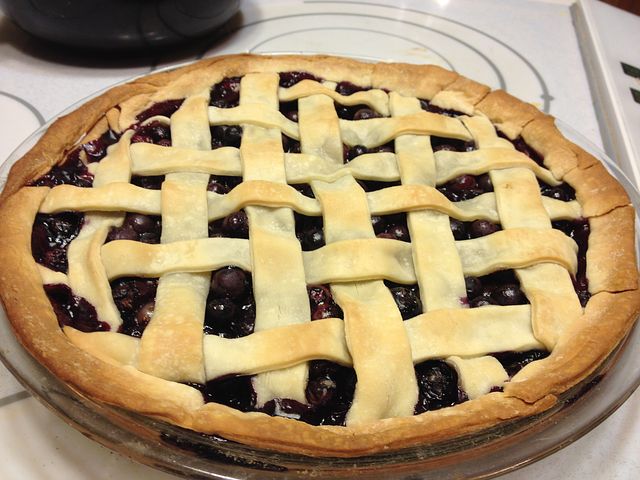
Thanks to a new local restaurant, I don’t have to travel to Texas to find amazing pie.  3.14 Sweet & Savory Pi Bar is as inclusive as it sounds.  Choose from a dozen or more “Pot Pi’s” for your entree (my favorite is the Irish-stew-inspired “Guinness Sakes”); then sprint to dessert by choosing from over twenty temptations (hello “Blueberry Fields Forever” Pi).

For the record, cake gets its share of celebrations as well.  Last Wednesday was “Sponge Cake Day” and November 26th is “National Cake Day”.  For me, those days will come and go like any other.  Those who celebrate cake should eat some humble pie and admit which dessert deserves the higher praise.  But hey, no time to debate; a chicken pot pie is in the oven and calling my name.

American Tune-Up

Each of the fifty United States is represented by more than just a flag. America’s state symbols include animals, birds, trees, flowers, and songs. As a kid growing up in California I memorized these items, and years later I’ve still got them.  The “Golden State” has the Grizzly Bear, the Valley Quail, the Redwood, the Poppy, and “I Love You, California”.  Imagine my interest then, when Brooklyn Magazine took an updated stab at the state songs, publishing “The Musical Map of the United States”.

Image courtesy of Brooklyn Magazine, October 2016

Brooklyn Mag’s map is more than meets the eye (see here).  It’s not a collection of easy ditties you and I might come up with: Beach Boys for CA, John Denver for CO, Frank Sinatra for NY.  Instead, it’s a broad spectrum of lesser-known tunes, attached to the states by writers who chose them.  Read their stories and listen to their song choices.  It’s like 50+ blogs in one, plus a playlist if you want to shift the whole shebang to your smartphone.

Here’s a sampling of the Map’s creativity.  The writers chose Kenny Knight’s “America” for Colorado, a “dusty, country rock gem” with lyrics befitting its patriotic title (even if the song itself twangs along modestly).  For California, the writers needed two songs – Joni Mitchell’s “California”, and Dr. Dre’s “The Next Episode”.  The former artist is Canadian; the latter raised in the gangland streets of Compton near Los Angeles.  You’ll find Mitchell’s folk music as appropriate as Dre’s rap for such a diverse state.

As I studied the Map, I realized each of us possesses our own musical geography, accumulating map dots as we move through life.  My own map began on the 8-track player of my father’s Cadillac in the 1960’s, crooning along with Perry Como as he claimed, “the bluest skies you’ve ever seen (are) in Seattle”.  By the 1970’s, I’d moved on to a hard-earned collection of 45-rpm records (“singles”), focusing on Top 40 bubble-gum one-hit wonders like Paper Lace’s “The Night Chicago Died” and Terry Jack’s “Seasons in the Sun”.  Also in the 70’s – courtesy of my brother’s extensive LP collection (and a stereo capable of a sonic boom) – I mapped to all kinds of rock, including Emerson Lake, & Palmer, The Eagles, Elton John, and Linda Ronstadt.

By the 1980’s, I’d graduated to cassette tapes and the easy-listening music of John Denver, Olivia Newton-John, and Barry Manilow (to which some would say, two steps forward three steps back).  Later in the ’80’s, I embraced compact discs with a budding affection for country music (Alabama), continuing to this day (Thomas Rhett).

Throw in a handful of downloads from my kids (Katy Perry, Meghan Trainor), sprinkle the whole mess with classical symphonies and concertos – a carryover from childhood piano lessons – and you have my musical map.  I’ll bet yours is wildly different.

Even the world of sports has a musical map, as Steve Rushin wrote in an excellent piece in this week’s Sports Illustrated (“Cheer and Trebling”).  You can’t hear the whistling of “Sweet Georgia Brown” without thinking Harlem Globetrotters, just as you can’t make it through baseball’s seventh inning without singing “Take Me Out to the Ballgame”.  You won’t leave Yankee Stadium without Sinatra’s “New York, New York”, just as you won’t hear John Williams’ spectacular “Fanfare” without thinking Olympic Games.  Moments of silence at sporting events are literally reserved for the dearly departed.  Otherwise it’s all marching bands, pipe organs, and loudspeaker instrumentals.

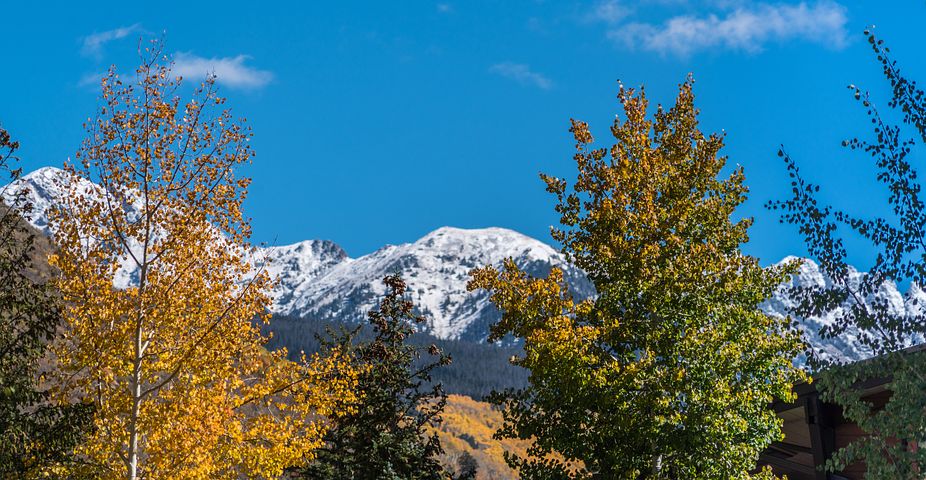
My now-home state Colorado has a set of symbols like California.  The “Centennial State” has the Bighorn Sheep, the Lark Bunting, the Blue Spruce, the Columbine, and John Denver’s “Rocky Mountain High”.  But the song could just as easily be Katharine Lee Bates’ “America the Beautiful”, inspired by the Rocky Mountain peak I can see as I type.  The song could also be Kenny Knight’s “America”.

You listen.  You choose.  There are no right or wrong answers here.  Remember, even Google Maps gives you several options as you navigate your way.

Patriot State

Back when my wife and I lived on the West Coast, we had a neighbor who planted a “victory garden” in their front yard.  The houses on our block were small and close together, so the postage-stamp spaces in front allowed for modest landscaping at best.  There we were, nineteen neatly-mowed little lawns and one wildly out-of-control victory garden.  One of these things was not like the others.

Thankfully, victory gardens carry more significance than the presence of hippies next-door (who knows what was in that garden).  Victory gardens were originally planted during World War I to reduce pressure on the public food supply.  The gardens were also considered a morale booster for citizens supporting the war effort back home.  In that context, it’s nice to see an occasional victory garden around my neighborhood today.

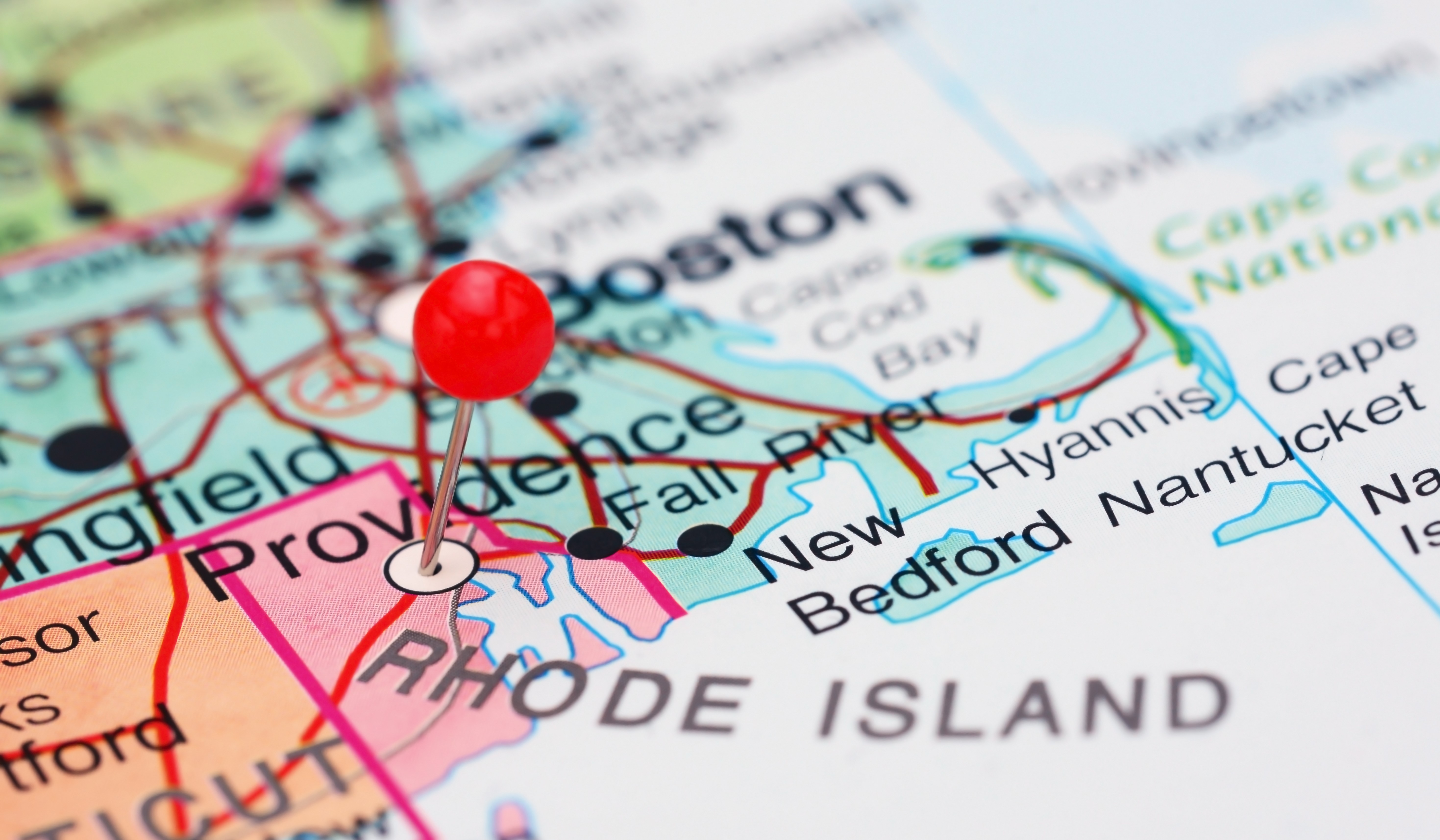
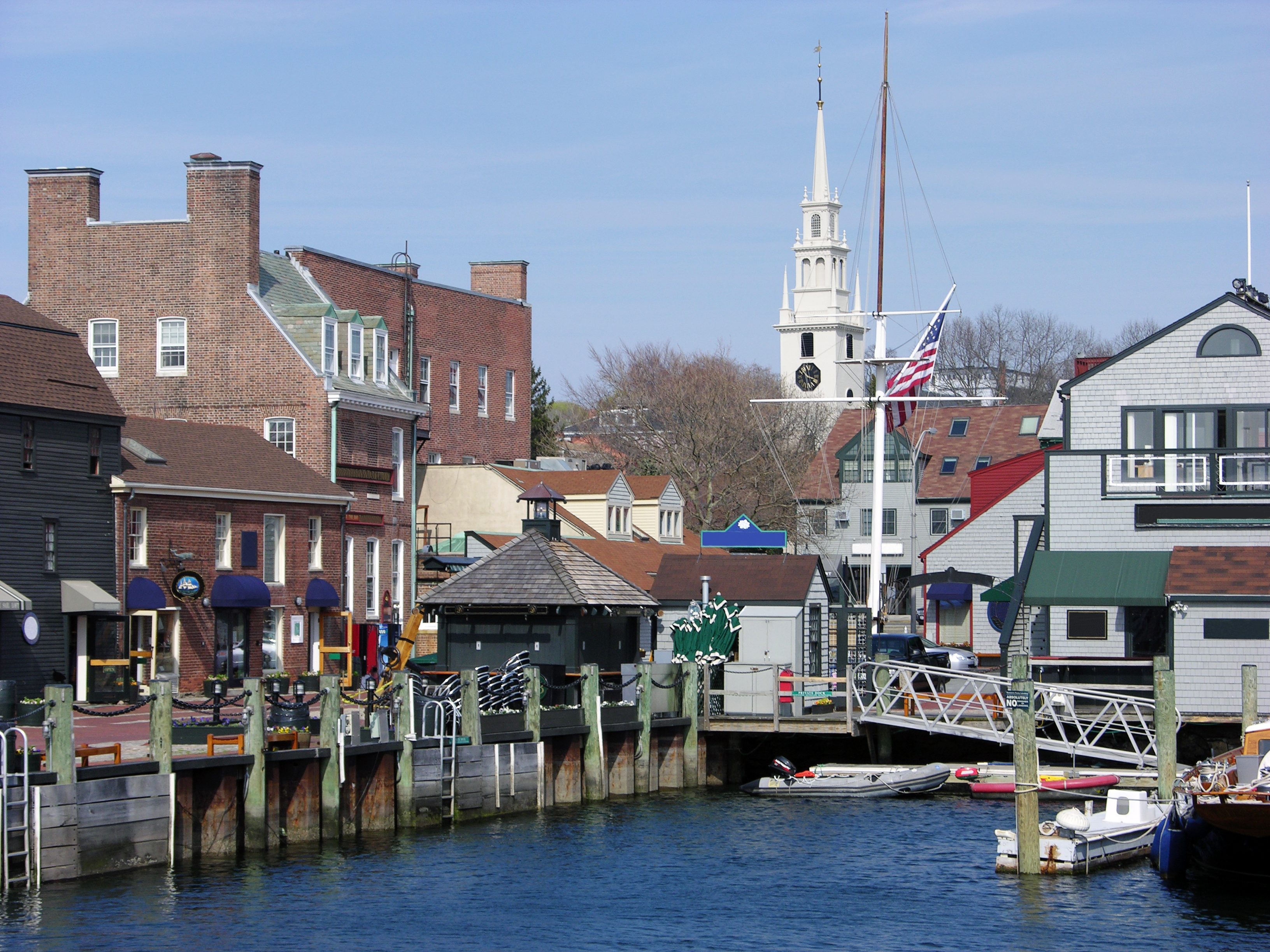
Three days ago – the second Monday in August – the United States celebrated Victory Day, commemorating Japan’s surrender to the Allies at the end of World War II.  On second thought I shouldn’t say “United States”, because forty-nine of fifty states ignore V-Day altogether.  The only state still recognizing Victory Day?  Small but steadfast Rhode Island.  Since 1975, when Arkansas dropped its “World War II Memorial Day”, Rhode Island stands alone.

“The Ocean State” has good reason to continue its jubilant celebrations.  92,000 of its residents served in WWII alone (more than 1 in 10), and almost 2,200 were killed.  Rhode Island is the smallest U.S. state in size and the eighth-least populated, yet the proportion of participants in “The Good War” was far higher than most other states.  Perhaps that’s because Rhode Island hosted several armed encampments.  Perhaps that’s because of patriotism born from the first of the thirteen colonies to declare independence.

Victory Day was originally labelled V-J Day or “Victory over Japan Day”.  President Truman declared the holiday shortly after the atomic bombs dropped in Hiroshima and Nagasaki.  The original V-J Day was September 2nd, 1945 (marking the formal end date of WWII), but revised to August 14th to recognize the actual day of Japanese surrender.  V-J Day came shortly after V-E Day (“Victory in Europe” Day), signifying Nazi Germany’s formal surrender to the Allies the previous May.

Victory Day became infinitely more famous when Life Magazine published Albert Eisenstaedt’s photo of an anonymous sailor and nurse celebrating the moment of Japanese surrender in downtown New York City.  Today a massive statue of the “Unconditional Surrender” (more affectionately referred to as the “Kissing Sailor”) can be seen in San Diego’s downtown waterfront, adjacent to the USS Midway aircraft carrier.

Thirty-six countries besides the United States celebrate some form or another of a Victory Day.  Why not our other forty-nine states?  Are we (as in the recent events in Charlottesville) determined to erase the nice/not-so-nice history defining the freedoms Americans enjoy today?  Victory Day recognizes the triumph of good over evil, not the Confederate brand of freedom.  Note a critical detail as well: Japan struck first, in its late-1941 assault on Hawaii’s Pearl Harbor.  America was not the aggressor.

Maybe someday I’ll get to Rhode Island so I can a) witness the celebration of Victory Day, and b) thank the residents for keeping a most important moment in U.S. history alive.  In the meantime I’ll count on George Bailey every Christmas to remind me, immortalized in the movie “It’s A Wonderful Life”.  George was deaf in one ear so he couldn’t serve in WWII alongside his brother Harry.  Instead he stayed on the home front, running “paper drives… scrap drives… rubber drives.”  And, “… like everybody else on V-E Day, he wept and prayed… on V-J Day, he wept and prayed.”

Some content sourced from Wikipedia, “the free encyclopedia”.
Color of Courage

I am a civilian living in a “military town”, considering the number of Army and Air Force bases in and around Colorado Springs.  The contemporary Air Force Academy campus (USAFA) to the west is the dead giveaway, but the Army’s Fort Carson to the south is larger in terms of acreage and personnel.  Fort Carson is also the largest employer of any kind in this part of the state.  Then there’s Peterson Air Force Base to the east (co-located with our municipal airport), Schriever Air Force Base to the slightly-further east, and Cheyenne Mountain Air Force Station hiding in the foothills to the west (which may or may not have missiles pointed towards North Korea).

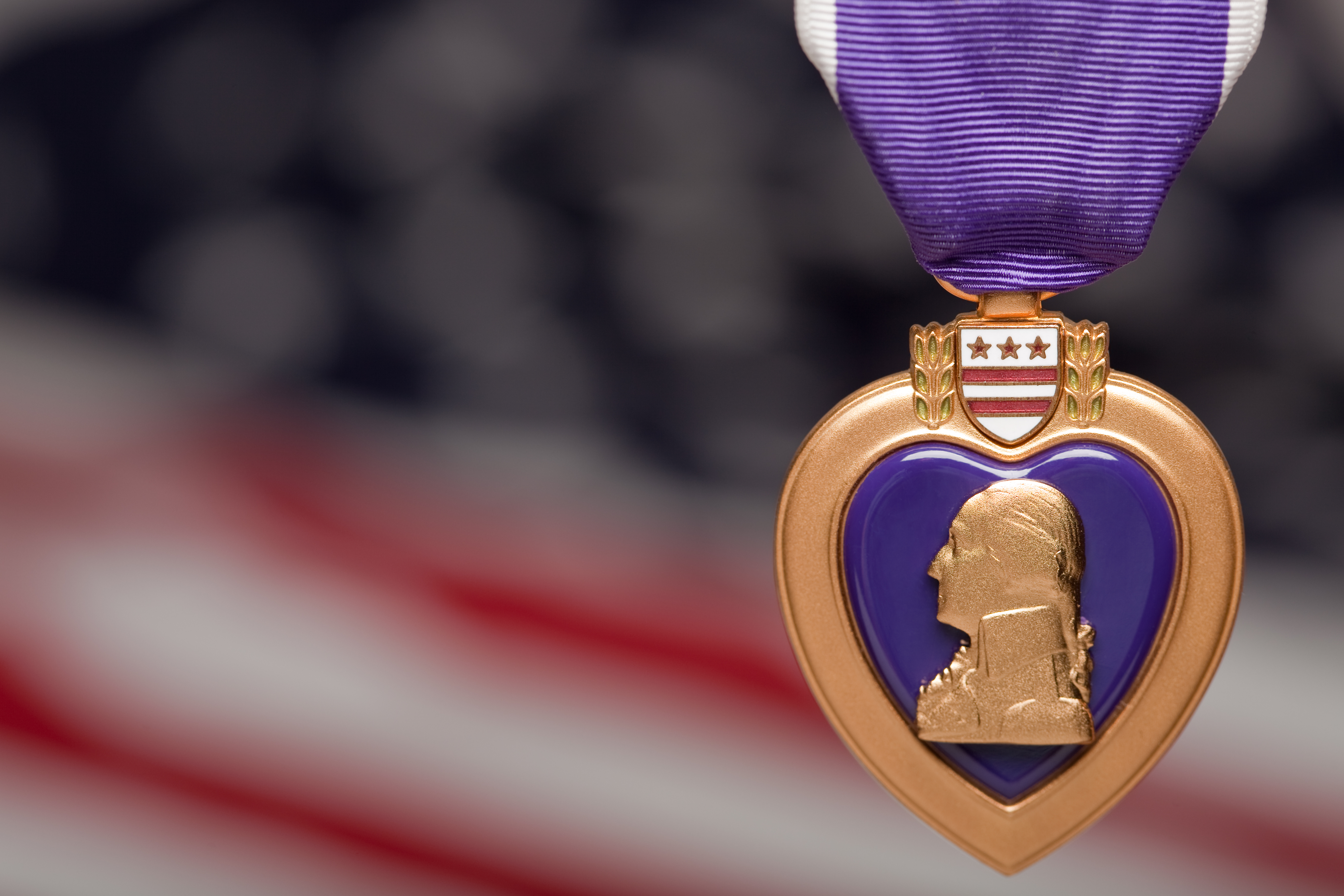
All this presence-of-the-defense in Colorado Springs prompts the question whenever I purchase: “military or civilian?”.  You get a deserved discount if you are the former.  I am the latter so I pay full price.  Safe to say I will also never be awarded the Purple Heart.

This past Monday (August 7th) was “Purple Heart Day” – on the list of U.S. Holidays and Observances – honoring the date the award was created in 1782.  The Purple Heart was not given between 1783 and 1931 – the span of time between the Revolutionary War and World War I – so it has “only” been awarded a total of 86 years since the days of George Washington.  That still amounts to countless acts of valor (over 1.8 million by some estimates).

I have the utmost respect for the men and women in uniform, so I am awed by those who receive the Purple Heart.  “Those” includes my father-in-law, who served and was injured in the Korean War back in the early 1950’s.  “Those” include various notables, including Kurt Vonnegut, Pat Tillman, Rod Serling, and Norman Schwarzkopf.  “Those” include Curry T. Haynes, who died less than a month ago.  Haynes served in the Army in the Vietnam War and received a total of ten Purple Hearts for the injuries he suffered.  That’s more decorations than any other recipient.

Ponder for a moment: Over a million Purple Hearts were awarded during WWI alone.  Another 350,000 were awarded during the Vietnam War.  All in defense of freedom.

Because decorations were not always documented (Purple Hearts were often awarded on the spot; even attached to the hospital beds of recipients), there is no accurate total.  Instead, the Military Order of the Purple Heart commemorated a network of roads, highways, and bridges in the states of Purple Heart recipients.  Whenever you see a sign like the one above, be reminded of the high (and frequent) price paid for your freedom.

Between 1942 and 1997, civilians serving in the armed forces were eligible to receive the Purple Heart.  Nine firefighters in the Honolulu Fire Department were decorated during the attack on Pearl Harbor.  After 1997, Congress passed legislation limiting awards to men and women in uniform.  Civilians now receive the Defense of Freedom Medal for similar sacrifices.

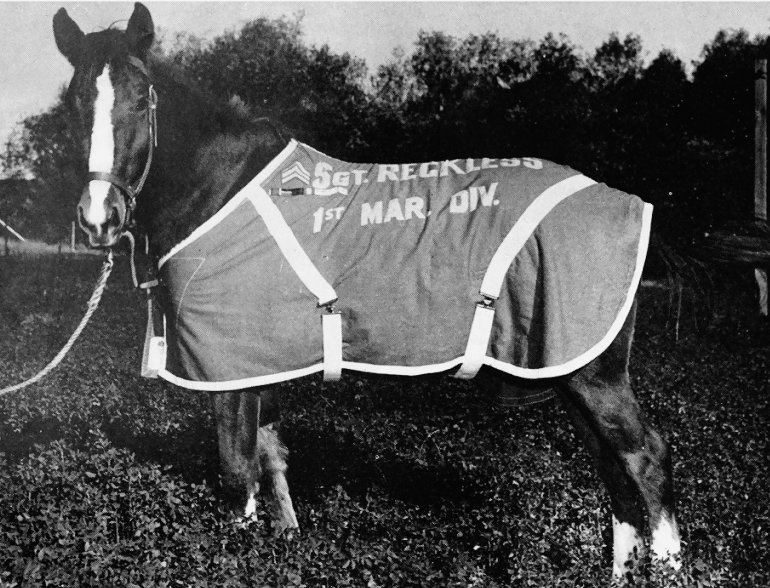
    Sergeant Reckless photo – by Andrew Geer

Animals are also eligible for the Purple Heart.  The most impressive: the decorated war horse Reckless, a thoroughbred mix rescued from the race track and trained by members of the Marine Corps.  Reckless served in the Korean War, frequently carrying supplies and ammunition to the front line.  Remarkably, Reckless memorized her routes so she could deliver unattended.  During one battle, she made 51 trips in a single day between supply depot and front line.  Reckless was wounded twice and thus received two Purple Hearts.  She was promoted to the rank of sergeant shortly after the war ended.  A plaque and photo of Reckless can be seen at the Marine Corp base Camp Pendleton in California.

As I began with, I’m a civilian living in a military town.  I am surrounded by my Colorado peers who serve or have served in the armed forces.  I may not be one of them, but at least I can tip my hat on the streets, especially to those who wear the Purple Heart.

Some content sourced from Wikipedia, “the free encyclopedia”.

Midwest Cookie Madness

I wonder how many modern-day brides still wear “something old, something new, something borrowed, something blue” on their wedding day.  This time-honored gesture of good luck includes a nod to 1) continuity, 2) optimism for the future, 3) borrowed happiness, and 4) purity, love, and fidelity.  But some brides would rather not mess with the dress, understandably distracted by other wedding-day traditions.  Like 18,000 homemade cookies.

Thirty-one years ago, after my wife and I exchanged our rings, we sliced into an impressive three-tiered wedding cake at the reception; miniature bride and groom perched on the smallest layer at the top.  Per tradition we took that smallest layer home, stored in our freezer and shared on our one-year anniversary: a toast to continued good luck and prosperity.  Had we been raised in Ohio or Pennsylvania however; our guests might’ve been drawn to the cookie table instead.  So says a recent article in the Wall Street Journal.

Thousands of cookies at a wedding reception?  Sounds to me like the latest quirk of the my-wedding-is-more-memorable-than-yours game (besting cupcake towers and chocolate fountains).  On the contrary, cookie tables are almost as traditional as wedding cake, dating back several generations.  They are the reception obsession of some Italians, Catholics, Greeks, and Scandinavians.

Cookie tables are traditional in Ohio and Pennsylvania as well, and these communities take their baking seriously.  There’s even a Facebook page to exchange recipes, ideas and guidelines (see here).  Cookie tables may soon become a wedding reception norm from coast to coast.

Here’s a “taste” of cookie table guidelines.  Every item must be homemade by family members; or if purchased, only specially-ordered from your neighborhood bakery.  Cherished recipes (i.e. “lady locks” and “buckeyes”) must carry over from generation to generation, no matter how time-intensive the preparation.  Cookies must be as fresh as possible, leading to a flurry of baking in several houses days before the wedding (and lack of freezer space in those houses).  Even the layout of the table itself has rules; considering the number of cookie varieties and which varieties deserve prominent placement.  Finally, the table “reveal” must be decided: 1) Already on display as guests arrive?  2) Revealed by the bride and groom with a dramatic pull of a curtain?  3) Self-serve, or closely guarded by tuxedo-ed cookie stewards?

Cookie tables have one advertised – if not followed – rule-of-thumb.  The ratio of cookies to guests should be around 12:1. That number allows a guest to sample several cookies at the reception, and take several more home for later.  If I apply the 12:1 ratio to the 18,000-cookie wedding (a real-life example), there should have been 1,500 guests.  In fact, there were only 360.  According to the mother of the groom, “…my goal was to have a spectacular cookie table…”  I’m sure the guests thought it was spectacular, helping themselves to an average of 50 cookies each.

Competition plays a role with cookie tables, with the goal of “mine is better than yours”.  One example boasted of “…tens of thousands of cookies, filling nine banquet tables… six people worked for two days on the display”.  Another boasted of “reserved varieties, prepared especially for (and only for) family members of the bride and groom”.  Even the take-home boxes get a personal touch.  With all this attention to cookies, wedding cake – or any other dessert for that matter –  stands in the shadows (like the bride and groom themselves?)

When my son or daughter gets married, perhaps my family will extend the tradition to Colorado and prepare a cookie table.  With my baking skills, I’ll commit to an impressive 3:1 ratio, five different varieties (provided I’m allowed to use store-bought refrigerator dough), and guests will delight in a consistency I can only describe as week-old-but-slightly-burnt.  I guarantee it’ll be memorable.

Sugar Cured

Coke. Zero. Sugar. Three little words; one new drink. In a nod to those who eschew sugar (and detest calories), Coca-Cola proudly offers its latest beverage. Coke was the original, of course. Coke Zero was the low-cal offering for men (Diet Coke was perceived as a “women’s” drink). And now the soda junkie may opt for Coke Zero Sugar, with the claim of original taste but no calories and no sugar.  For my money, let’s hope the sugared varieties still have a shelf life.  Otherwise my cure for headaches just went out the window.

Coke cures headaches?  Well, why not?  Those of us who experience the recurrent forehead fevers will jump on just about any bandwagon to chase away the relentless pain, and a Coke seems relatively harmless compared to the more potent options out there.  But truth be told, a can of Coke is only half the solution.  Chase the Real Thing with a Snickers bar and you have the coup de grace of headache cures. The combined overdose of caffeine, sugar, salt, and protein packs a punch more powerful than half a bottle of Excedrin tablets.

When I was a kid, headaches were my constant companion.  I could sense the pain unfolding well before it up and knocked on my forehead door.  In full bloom, my headaches could only be cured by retreating to a dark, quiet room and sleeping them off.  But try falling asleep when someone’s rapping a hammer against your brain.  The mental/physical anguish of the battle surely coined the phrase “toss-and-turn”.

My mother and my doctor (seemingly one and the same) drew frustratingly repetitive conclusions.  My headaches were not strong enough or persistent enough to prescribe migraine medication.  My headaches were likely brought on by “not enough of this or “too much of that.  Not enough sleep or not enough water.  Too much sun or too much sugar.  Too much sugar?  And now I’m promoting a headache cure with sugar as an essential ingredient?  Sorry Mom – it works.

At one point in my life my headaches were so bad I believed I could generate one by merely thinking about them.  My mother used to say, “don’t get too excited; you might get a headache”.  Ironically, her good intentions were dashed by the very mention of what she was trying to get me to avoid.  But the conjuring really did happen – on more than one occasion.  Think about a headache = get a headache.

Headaches are attributed – at least in part – to dilated blood vessels.  (Dilated blood vessels are attributed to way too many conditions to list here.)  The brain’s response to dilation is to summon a pain companion; a vehicle to announce, “something’s wrong”.  You see, for all its intelligence the brain lacks its own pain receptors, so it seeks another part of the body to act as its surrogate.  Enter: the headache.  Fascinating perhaps, but no fun for the recipient.  There were times I would’ve traded all of my worldly possessions (which admittedly didn’t amount to much) in exchange for the removal of headache pain.  On that note, I don’t want to even think about how a migraine headache feels (after all, I might get one).

Forty-five million Americans suffer from some form of headaches.  Thankfully, I’m no longer a member of that vast club.  Whether from corrective eye surgery I had as a teenager or better control of the “not enough of” or “too much of”, the pots-and-pans forehead pain endured as a kid simply doesn’t visit anymore.  I’m very thankful for that.  I’d like to think I’ve done my time with those miserable toss-and-turn episodes.  But as a former Boy Scout, I know it’s wise to be prepared.  If my brain gets into a “for old time’s sake” mood, I’ll have a can of Coke and a Snickers bar at the ready.