Priceless Hatches

I’m enjoying a couple of soft-boiled eggs right now, my every-other-day breakfast entrée. The timer I use to prepare them sits right in the pot of water, indicating when the eggs are cooked to perfection. I pay a little more than average for my eggs, to producer Vital who advertises “pasture-raised – tended by hand by farmers who care”. On the other hand, if I wanted to pay a lot more than average I’d simply go to a rare goods auction and buy one from Fabergé.

“Gatchina Palace” Egg

You wouldn’t have a Fabergé egg for breakfast, of course.  No one would ever sink their teeth into a priceless work of art (well, maybe a banana), let alone one of only fifty that were ever created.  One of the Fabergés – the “Winter Egg” – went under the auction block last week, with the winning bid confirmed in a mere three minutes.  The buyer’s purchase of a single Fabergé for $30.2 million dollars is a new record; noteworthy considering how many times the eggs have changed hands in the last 140 years.

“Catherine the Great” Egg

I can’t say why we Westerners even know about Fabergé eggs.  Most hide in private collections or in museums you’ve never been to.  The eggs were created in St. Petersburg, Russia in the late 1800s by jeweler House of Fabergé for the reigning tsars of the time.  One or two eggs were produced every year as exquisite Easter gifts, from 1885 through 1917.  Most are jeweled with diamonds and other precious gems, and hinge open to reveal delicate animals or scenes within.

The Winter Egg (1913) is described as “the most spectacular, artistically inventive and unusual” of all fifty Fabergés, which is quite a statement when any one of the eggs deserves the same praise.  The Winter Egg took almost a year to design and create, and the value is evident in the details.  4,500 tiny rose-cut diamonds are married to a platinum snowflake motif to create the impression of a block of ice dusted with frost.

“Winter” Egg

The Winter Egg hinges opens to reveal a hanging basket of wood anemones, made from white quartz and rare green “Tsavorite” garnets.  I can’t imagine working with these expensive materials on such a small scale but maybe that’s because I don’t have the delicate fingers of a woman.  The Winter Egg was designed and created by Alma Pihl, the only female jeweler in the House of Fabergé.
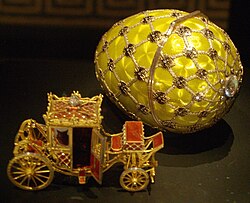
“Imperial Coronation” Egg

On a cruise around the Baltic Sea several years ago, my wife and I were fortunate to spend a couple of days in St. Petersburg, touring Catherine Palace and Peterhof among the cities other sights.  When we returned to the ship we were greeted by a local jeweler, who offered replicas of the Fabergés (for less than $32M, thank goodness).  We chose the Imperial Coronation Egg (1897), inspired by the color of Tsar Alexander III’s robe.  The Coronation Egg houses a replica of the imperial carriage, made with gold and platinum and detailed with rubies and diamonds (the original egg that is, not ours).

After learning a single egg can set you back $32M, I now look at my breakfast eggs a little differently.  $10.99 a dozen?  That used to be top of the heap.  Now it’s just pocket change.

—————-

LEGO Trevi Fountain – Update #6

(Read about the start of this build in Brick Wall Waterfall)

There’s a moment in every LEGO build where you look at what you’ve constructed and think, Hey, I’m almost done!  That moment was today.  Bags 10 and 11 – of 15 bags of pieces – brought the structure of the Trevi Fountain to new, practically finished heights.  The tiny, tiny pieces I worked through (so many of them I was afraid to count) resulted in the uppermost level of the backdrop you see in the final photo.

Bag 10

From my magic hat of Italian composers I somehow chose Claudio Monteverdi for my musical accompaniment today.  You don’t know Monteverdi and apparently I don’t either.  Had I realized his contribution to classical music was mostly opera (hard pass) I would’ve reached into the hat again.  Alas, I was subjected to Monteverdi’s L’Arianna “lament” – equal parts sorrow, anger, fear, and so on.  Those singers sure didn’t sound happy as I snapped together LEGO pieces, but honestly who knows?  I don’t speak “sung” Italian.
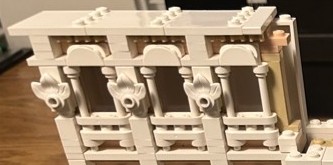
mirrored element

Here’s an expectation with a symmetrical LEGO build.  If you construct an element that goes on one side of the model you’ll be mirroring it on the other side before you know it.  A hundred or more pieces went into the windowed wall you see here, and a hundred more went into its twin soon after.  It’s repetitive yes, but at least you go faster the second time around since you just had practice.

A word about the little devils in this photo.  Because they’re cylindrical they can roll.  Because they roll they can hide under something.  Something like a LEGO instruction manual.  Once again I was fooled into thinking I was missing pieces… until I thought to look under the manual.  Sure enough, there they sat just smirking at me.  So I promptly arrested and cuffed them, hauled them away, and now they’re jailed in the backdrop you see here, without possibility of parole.
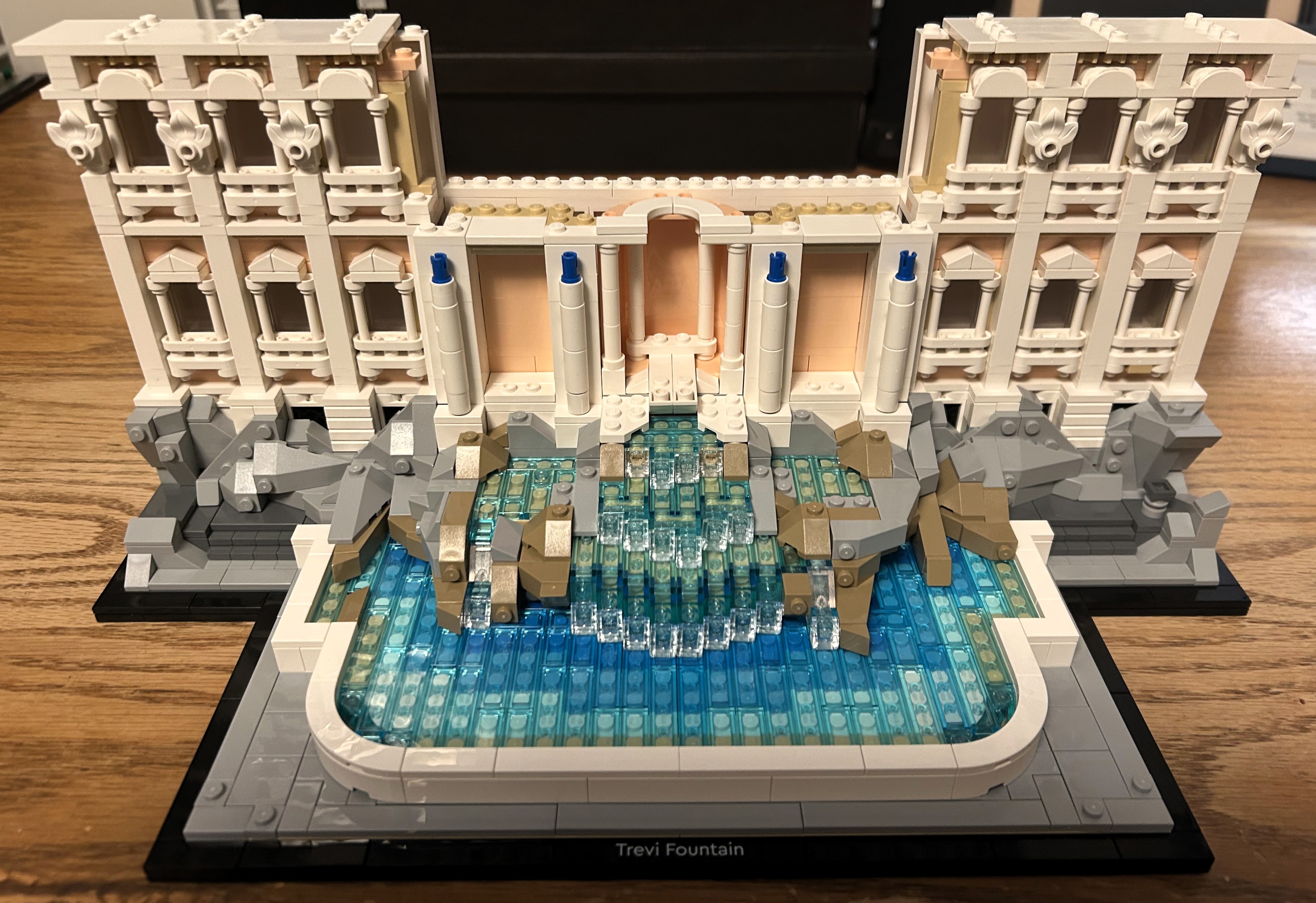
We’re just four bags of LEGO pieces from “turning on the water” of the magnificent Trevi.  I’ll admit to peeking into the box at those upcoming bags.  They are small, all four of them.  Perhaps I’ll wrap the fountain construction in a single go next week.  Even if not, conveniently, the final block of travertine would be laid the following week, just in time for Christmas.  Now that’s what I call a gift!

Running build time: 5 hrs. 42 min.

Total leftover pieces: 32 (tiny, tiny pieces)

Some content sourced from the CNN Style article, “Faberge egg fetches record $30.2 million at rare auction”, and Wikipedia, “the free encyclopedia”.

Survivor: Siberia

Very few shows capture my attention like CBS’s Survivor.  What started as a fairly contrived reality television competition has evolved over many years to a fascinating cat-and-mouse game of wits.  Survival of the environmental extremes pales in comparison to the mental madness brought on by deliberate deceit, misunderstood conversation, and naked errors in judgment.  The lack of sleep by itself (on some nights strategic, on others unavoidable) would have me stepping out of the game well before the final day.

Like most reality shows Survivor is edited to manipulate the viewing experience to be as entertaining as possible.  You only see what the producers want you to see.  Given hundreds of hidden cameras, I can only imagine how much film ends up on the “cutting room floor”.  Regardless, Survivor is undeniably popular in America (with similar competitions in fifty other countries).  The current season – the thirty-fourth – is watched by over ten million viewers.  There have been over five hundred episodes.  And the format of the game is relatively unchanged from the first competition seventeen years ago.

When “The Hunger Games” movies came out in 2012, I remember how I couldn’t help drawing several parallels to Survivor.  In both cases you have contestants battling until only one remains; the recipient of untold riches.  In both cases the contestants have but a few items of comfort and are forced to endure the harsh conditions of their surroundings.  Also in both cases, you have a game manipulated behind the scenes by the powers that be, to maximize the entertainment value for its viewers (even at the “expense” of contestants).

So now let’s talk about Game2: Winter, the latest spin on reality TV competition from Russia.  Brace yourself.

Game2: Winter (G2W) is a hybrid of Survivor and “The Hunger Games”.  Take fifteen men and fifteen women, drop them into a remote location in Siberia (which is anywhere in Siberia come to think of it), wait nine months and see who survives.  Each entrant must be declared “mentally sane” to qualify (kind of an oxymoron for a G2W player, don’t you think?) and chooses up to 100kg of equipment from a warehouse en route to Siberia.  Clothing.  Tools.  Weapons.  Whatever they feel they need to survive.  Each entrant also gets a satellite-linked panic button.  That comes in handy when they encounter the hungry wolves and bears in the region – assuming the production crew can get to them fast enough.

With a particular nod to “The Hunger Games”, G2W will be televised 24/7.  Oh, and the contestants can do anything they feel is necessary to win the game.  Anything.  The Russian government has gone on record to say players will be prosecuted for crimes (i.e. murder, rape, physical violence), and the producers say they won’t interrupt such activities.  2,000 cameras have been strategically located to capture the “entertainment”.

Games2: Winter premieres this July.  The extremes of Siberia (100 degrees in the summer, -40 in the winter), the lack of adequate food/shelter, and the resident wildlife make you wonder if anyone will survive, let alone commit a crime along the way.  But apparently the $1.6 million prize is worth the risk in Russia.  G2W has a lengthy waiting list for its thirty contestants.  To them I say: I hope one of you will outwit, outplay, and ultimately outlast the others.  I certainly hope it doesn’t take nine months, nor something worthy of prison time.  May the odds be ever in your favor, even if I know they won’t be in Siberia.

Some content sourced from Wikipedia, “the free encyclopedia”.

Patriot Games

Tomorrow a chessboard will be auctioned off in New York City, with an opening bid somewhere north of $75,000.  For that kind of money you’d picture a one-of-a-kind treasure beautifully crafted from the finest materials; perhaps inlaid with gold.  The chess pieces themselves would be intricately carved ivories or bronzes.  On the contrary, the auction block chessboard looks like most others: alternating light and dark wood squares with nondescript wooden pieces.  Not much to look at – unless you know its epic history.

70-allegory-1

In 1972, in what was later dubbed “Match of the Century”, American Bobby Fischer and Russian Boris Spassky met in Reykjavik, Iceland to play a total of twenty-one games of chess over a three month period.  The match recognized history’s eleventh World Chess Champion, with Fischer emerging as the eventual winner.  With the title Fischer claimed a purse that in today’s dollars would be almost $1.5 million.  The chessboard in tomorrow’s auction was used in Fischer/Spassky games 7 through 21, replacing a stone board used for the earlier games.

The significance of the Fischer/Spassky match goes entirely beyond the crowning of another World Chess Champion.  In the 1970’s the United States and its NATO allies, and Russia (then the Communist-ruled U.S.S.R) and its Eastern Bloc allies, were in the throes of a “Cold War” that defined the post-World War II tension between dominant world powers.  The sociopolitical cultures of these “western” and “eastern” countries could not have been more different.  Thus the chess match was seen as an allegory; especially with Fischer – the first American to ever compete for the title, taking on Spassky – the current World Chess Champion and one of five consecutive Soviets to hold the trophy dating back to the 1940’s.  It was as if a feisty newcomer was speaking loudly for the first time.  As former world champion Garry Kasparov described the outcome, “… the lone American genius challenges the Soviet chess machine and defeats it.”

The Fischer/Spassky competition attracted more worldwide attention than any chess match before or since.  All twenty-one games were televised (though the third game had to be illustrated with move-by-move graphics since Fischer insisted on temporarily moving away from the cameras).  In the years following the match, “Bobby Fischer Teaches Chess” became the best selling chess book ever published.  The opening scene of the James Bond film “From Russia With Love” depicted a chess match with moves patterned after Spassky’s .  Chess became supremely popular among American kids (maybe because Fischer was already playing in national championships at the age of fourteen).

70-allegory-2

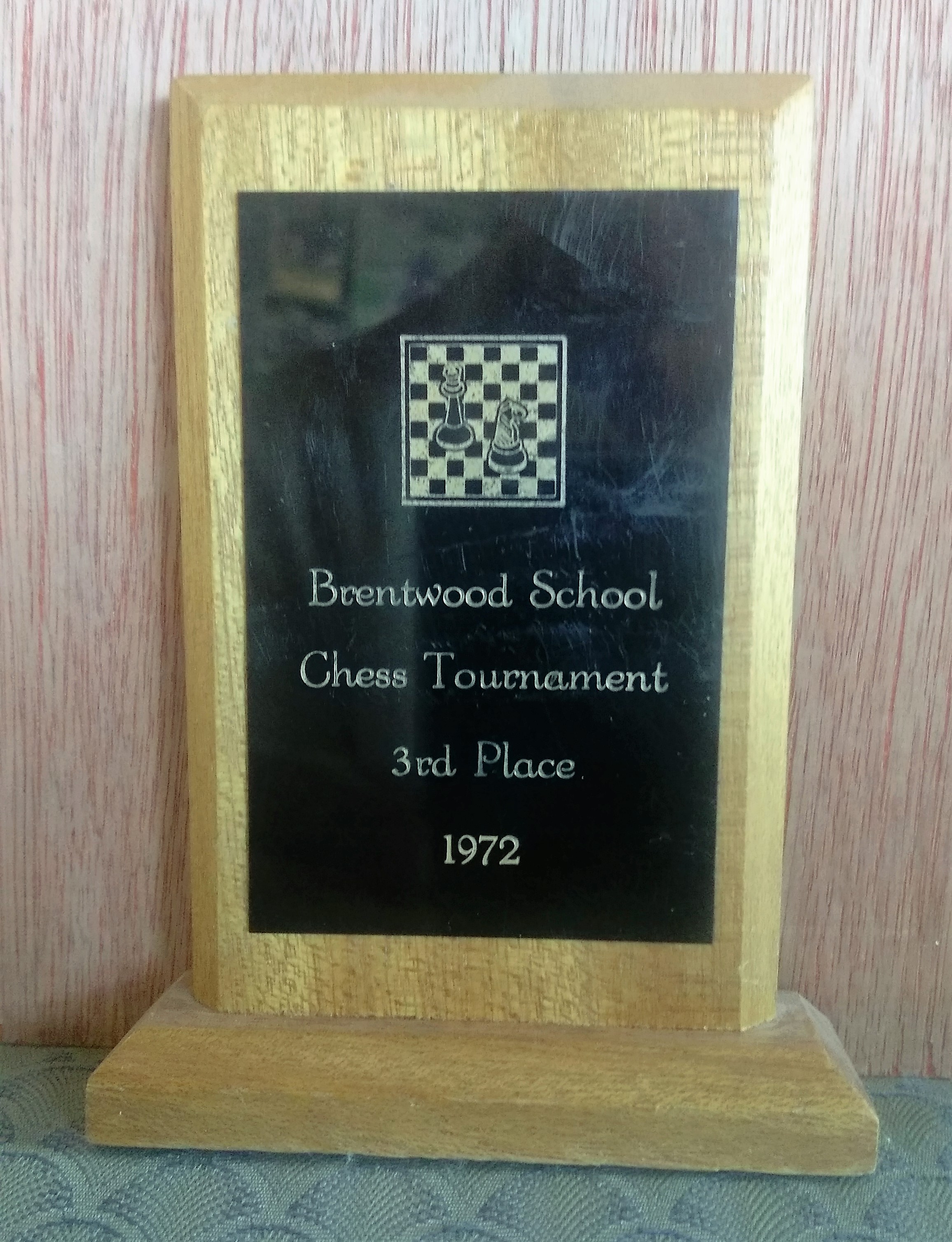
I have a personal connection with the Fischer/Spassky match, as shown in the photo above.  I learned chess at an early age thanks to the determination of my grandfather.  He insisted on a game every time we were together, and most times he beat me.  Today I have one of his chess sets as a precious keepsake.  But my grandfather also urged me to participate in a school-wide chess tournament, and the trophy you see was the result.  From then on my grandfather teased me by saying he wouldn’t play anymore unless it was for the trophy.

Notice the date of the school tournament; inside the same year as the Fischer/Spassky match.  By wonderful coincidence I was competing at a time when chess was most prominent on the world stage.

My chess game never really matured from those grade school years – and Fischer and Spassky likewise descended into relative obscurity – but a marked impression was made by watching their 1972 match on television.  Now whenever I see a chessboard I’m reminded the game is not just kings and queens surrounded by their armies.  The successful bidder at tomorrow’s auction will hold an emblem of history – from a time when the world’s chess pieces were as divided as never before.

Some content sourced from Wikipedia, “the free encyclopedia”.