Going for a Spin, Spin, Spin

My wife and I enjoy popcorn after dinner, probably because we’re watching more movies at home these days. It’s easy prep thanks to our Presto air popper. Dump in the kernels, plug in the popper, and “presto”; a delicious snack in an instant.  Of course, one of these days our air popper will break and we’ll have to buy another one. Unlike our KitchenAid stand mixer, which will spin,spin,spin until the end of time.

KitchenAid’s classic stand mixer

If your kitchen is like ours, the cupboards are full of appliances that only make an occasional appearance.  Our Breville panini press hasn’t made a “melt” in months.  Our Marcato pasta maker last saw action in the early 2000s.  And our George Foreman grill is retired for good, because it’s just as easy to fire up the barbecue.  But our KitchenAid stand mixer spins to our “Aid” time and again, always ready to make bread dough, cake batter, or cookies.

Stand mixers date to the early 1900s.  KitchenAid’s version came along in the 1930s, and it wouldn’t surprise me to learn some of the original models are still spinning almost a hundred years later.  The appliance is just that good.  The KitchenAid was designed to be as simple, efficient, and robust as possible, and with only one task in mind: to spin ingredients in dizzying circles until they’re thoroughly mixed.  Sure, you can add dozens of specialized attachments but none change what the stand mixer does at its core.  Spin, spin, spin.
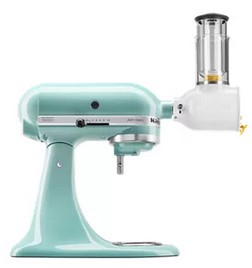
with slicer/shredder attachment

When I make a batch of cookies, I stand back in wonder as our KitchenAid does its thing.  As I add the ingredients, the paddle blade works harder and harder to blend them together.  By the time I get to the last of a dozen ingredients; say, chocolate chips, the mixer is practically bouncing across the counter as it struggles to plow through the dough.  You’d expect the mixer to break down at any second in an explosion of flying gears and sizzling smoke.  But it never does.

I know a lot of people who own a KitchenAid stand mixer, and I’ve never heard of one that stopped working.  Even if it did break, the appliance is designed for easy repair.  The parts can be swapped out individually and quickly, eliminating the need for a repair person or a new mixer.  It reminds me of the old Maytag washers, and how their repairman was described as “the loneliest guy in town”.

Like most appliances, Maytags aren’t what they used to be.  We yearn for the models from the 1980s or earlier, which could wash anything and never break down.  Today’s Maytags are a shadow of their former selves.  They don’t do as good of a job, and every five years you’re thinking about replacing them.  Not so the KitchenAid stand mixer.  I have no doubt ours will be a part of our kids’ inheritance someday.

Speaking of kids, our daughter has her own KitchenAid and it sits proudly on her kitchen counter.  Counter space in the kitchen is precious so only a few appliances deserve to be full-time residents.  A coffeemaker.  Some sort of toaster oven.  And a KitchenAid stand mixer, which somehow manages to look appliance-elegant with its curves and swoops.

Color “ice”, with copper bowl

“Mixmasters” (a popular nickname for the KitchenAid) aren’t cheap.  Most models run about $300 USD for the basic setup.  Consider though, it’s the only stand mixer you’re ever going to need.  KitchenAid even admitted they expanded their color selection and limited-edition models in an effort to generate more repeat customers.  (This year – and only this year – you can buy one in “iridescent periwinkle blue”.)

Our Colorado kitchen had a very cool below-counter cabinet, designed specifically for a heavy stand mixer.  You opened the door, pulled a shelf handle, and your Mixmaster rose effortlessly out of the cabinet on special hinges, snapping into place at counter level.  An appliance has to be awfully special to justify a custom cabinet.  Or a spot in the Smithsonian Museum, where the KitchenAid stands as a part of the Julia Child exhibit.

Right there on Julia’s countertop

I don’t need to go to the Smithsonian to see a stand mixer (nor do you).  I have my KitchenAid right here in the kitchen cabinet.  I can put down the laptop and whip up a batch of cookies anytime I want.  Like, right now.  Time for my Mixmaster to spin, spin, spin again, just like it’s done a thousand times before.

Some content sourced from The Atlantic article, “KitchenAid Did it Right 87 Years Ago”, and Wikipedia, “the free encyclopedia”.

Halloween’s Element of Surprise

Same ol’, same ol’… sigh…

Our grocer dedicates an entire aisle to Halloween this time of year.  It’s a pile-on of kid costumes, yard decor, plastic jack-o’-lanterns, and party supplies.  You’ll also find massive bags of assorted small candies, enough to load up your front door bowl with a single pour.  These treats are individually wrapped and brand-familiar to carefully conform to the holiday’s “safe standards”.  In other words, there’s no element of surprise in all that sugar.

When was the last time you were treated to a little something you didn’t expect?  Here’s a good example.  My wife and I traveled to Texas last weekend to visit our son.  As we settled into the hotel room we noticed a tray on the table with two bottles of water and a couple of wrapped candies.  Not so unusual.  But then we read the little card next to the tray.  Not only was the water free of charge (hotels typically stick it to you with bottled water) but the candies were handmade salted caramels from a local culinary kitchen.  Suddenly I’m thinking, “What a nice hotel!”

Perhaps you know a few other hotels with the same gesture, as Doubletree does with its chocolate-chip cookies (see Calories of Contentment for more on that).  But unlike our Texas hotel, Doubletree always goes with the chocolate-chip cookies.  Stay there enough and you come to expect them.  No surprise.

That, in a nutshell, is what’s wrong with Halloween today.  You still get the occasional trick (TP in the trees?  Shaving cream in the pumpkins?) but the “or-treat” routine has been reduced to just that – routine.  Think about a child’s anticipation for the big night.  Hours spent making sure their costume stands out in a crowd.  Miles spent covering sidewalks and front walks.  Fingers spent on doorbells and knockers, all so they can get, what… another fun-size Hershey bar?  Where-oh-where is the element of surprise?

Mom’s Halloween treats

Back in the “ol’ days” (because I’m feeling old today) a lot of front-door Halloween treats were homemade.  People handed out family-recipe popcorn balls and caramel apples.  My mother made the frosted ginger pumpkin cookies you see here.  A guy down the street dressed as Dracula and manned a little round grill in his driveway, handing out barbecued hot dog bites on toothpicks.  You never knew what you’d walk away with until you made it to the next house.

A mini pumpkin has zero HTV

Creative treats only boosted the night’s excitement back then.  I remember catching up with friends in the darkened streets to compare the collective efforts in our bags.  More importantly, the wide variety of treats upped the ante on what one candy-ranking opinion piece referred to as “HTV” or Halloween Trade Value.  After all, the most important event of the night was the post trick-or-treat trade, right?  You’d spill the contents of your pillowcase into a big pile on the floor and the back-n-forth would begin.  “I’ll give you three rolls of Smarties and a Baby Ruth for your Charleston Chew”.  Yes, friends, those were the days.

Everything changed when Halloween lost its young-and-innocent status.  Parents inspected treat bags to filter out anything remotely suspicious.  Homemade items only made it as far as the next-door neighbor’s kids or backyard Halloween parties.  Suddenly a treat didn’t pass muster if it wasn’t recognizable and wrapped.  The creative license of trick-or-treating has expired.

But hold on now.  What about the other 364 days of the year?  Can’t the element of surprise show up on one or more of those?  Can’t we still be caught off guard… in a good way?

Here’s an attempt.  At least two companies offer monthly treats by subscription and you have no idea what’s coming.  SnackCrate describes its product as “a world of snack surprises – monthly”.  TryTreats advertises “each month’s box will feature snacks from a different country in the world.  The country you’ll receive is a secret until you receive the box!”  Kind of a spin on my ol’-days Halloween nights, don’t you think?

Speaking of treats I think the dog got wind of this topic.  The other night I prepped his dinner with the usual two cups of kibble topped with a few bits of lunch meat.  He ate the bits but left the kibble.  He’s never done that before.  Maybe he’s bored with it?  I need to shake things up.  Throw in a few doggie treats.  Add the ol’ Halloween element of surprise and get his tail wagging again.

Ribbons and Bows

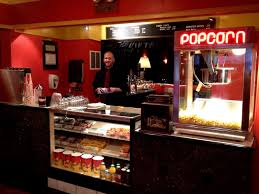
My wife and I went to the movies the day after Christmas. The theater lobby looked a little forlorn after the holiday rush. There weren’t many patrons besides the two of us. The employees wandered here and there without seemingly much to do. The concessions were woefully under-stocked. In fact, as we stood at the counter, we realized there were no nachos, no hot dogs, and not a single bottle of water to be found. Did all those “Star Wars” groupies buy up everything before us?  Did a link go missing in the supply chain? Can we blame the aliens?  Ah, but popcorn.  At least they had popcorn.

I can’t see a movie without cradling a big ol’ tub of theater popcorn.  Don’t ask me what chains the two together, but popcorn and movies are a heaven-on-earth marriage.  It’s like that Kacey Musgraves Christmas song about a ribbon without a bow.  The movie might be Oscar-worthy but there’s a big something missing without popcorn.  The next time you watch “Field of Dreams”, consider the ball field is surrounded by acres and acres of corn.  As if you need a metaphor.

Popcorn wasn’t always an option at the movies.  In the early 1900’s, the theater-going experience was different.  The auditoriums were much smaller.  The carpets and seats were lush and expensive.  The patrons tended towards upper-crust.  And the movies themselves… had no sound.  Any one of those reasons made popcorn a poor concession choice.  Theaters didn’t want kernels ground into their pricey floor coverings.  Patrons didn’t want a snack associated with the lower-class circuses and sporting events of the time.  Most importantly, no one wanted to hear crunching and munching while trying to read the subtitles of a silent movie.

The Great Depression – and “talkies” – ushered in the union of popcorn and movies.  A broader cross-section of patrons sought the theater for an inexpensive distraction to the hard times.  Popcorn was easy to mass-produce, and the smell and pop created an effective lure for the concession stand.  Crunching and munching was no longer a concern up against soundtracks.  And popcorn was affordable, even to those who could barely scrape together enough for the movie itself.

Do you prefer “mushroom” or “butterfly”?

There’s a little science behind popcorn to get it from husk to Hollywood.  Growers developed the appealing “butterfly bud”, with several “ears” to trap the butter and salt.  Growers also worked to shape popcorn to take up as much room in the bag as possible (less air), giving a more satisfying feel to the overall weight.  They coined terms like “expansion rate” and “mouth feel” and “finger control” – anything to make you buy more of the fluffy stuff.

All this talk of popcorn reminds me of a children’s book about a farmer who grew acres and acres of corn.  He’d store his corn in giant metal silos next to his field.  One summer day, the silos got so hot the corn inside started to pop.  The farmer heard the sound and climbed on the roof of one of the silos to see what was going on.  Suddenly the silo burst open, and the roof started rising above all that popcorn.  Up, up, up went the farmer.  When the popping finally stopped, the farmer was high up in the sky with no way to get down.  His neighbors came from miles around to try to help him.  The fire department’s ladders weren’t long enough.  The town had no helicopter.  Finally, the people talked it over and realized all they had to do was start eating the popcorn straight from the silo.  Down, down, down came the farmer until he was safe.

As much as I love popcorn, I only seem to eat it at the movies.  When my son was in college, he admitted to going to the theater, buying popcorn at the concession stand, and… leaving the building.  Who does that?  Then again, there’s nothing wrong with the idea (high price aside).  It’s like having turkey when it’s not Thanksgiving.  Or dessert before dinner.  Seems a little off, but really, why not?

As for me, I’ll continue to enjoy my popcorn with my movie.  I’ll pay the ridiculous price for the shrinking bag, and still eat too much.  The only problem with this scenario?  Finding decent movies anymore.  They seem to be fewer and further, at least on the big screen.  Thank goodness for Netflix and my air popper.

Some content sourced from the Wall Street Journal article, “How AMC Gets Its Popcorn From Stalk to ‘Star Wars'”, and from the Smithsonian Magazine article, “Why Do We Eat Popcorn at the Movies?”