In the not-so-distant year of 2062, forecasters predict we will have perfected the invention of “nanofabricators” – machines capable of producing food, clothing, electronics and such, not from assembly-line parts but from the very atoms of those parts. It’s a mind-blowing concept: technology that creates virtually anything by manipulating the structure of raw materials at the molecular level. Too bad I won’t be around to see it.

When you reach your mid-sixties, the harsh reality is that predictions of what life on Earth will look like in the future focus on a period of time beyond the years you’ve been given. The experts tend to look fifty years ahead or more, so, sorry Dave, you just won’t be here when all these wonders take place. It’s a little strange to think about a world without you in it. Sure, you can also imagine the years before you were born, when your parents and grandparents were living life without you, but those were simpler times devoid of the technology we take for granted today.

Consider self-driving cars. Fifty years ago I was a teenager and couldn’t wait to get my driver’s license (the very definition of “freedom” back then). But had you told me, “Hey Dave, you’re not going to need that little card in fifty years because cars will drive themselves”, I would’ve given you a strange look and accused you of watching too many science-fiction movies. Yet here we are.
I hit on this topic today because I’m still processing the fact we have humanoids who can run half-marathons (my post from last week). When the world’s technology exceeds your expectations, you push the pause button and wonder if you’re getting left behind (or just getting old). Am I suddenly more inclined to believe those fifty-year forecasts? You bet I am. And nanofabricators are just the tip of the inventive iceberg.

Nanobots (does everything in a post-Dave world start with “nano”?) are in the works as well. A nanobot is a robot so tiny you might not be able to see it with the naked eye. I was introduced to the concept in Michael Crichton’s sci-fi novel Prey. Imagine a pile of nanobots sitting in the corner of a window in your house. Once a day those nanobots spill out over the glass like a wave, consuming any dirt or other matter like little vacuums. Perfectly clean windows! Of course, “Prey” takes the technology in a more sinister, out-of-control direction and a bestseller is born.
[Blogger’s note: You’ll find “nanobot” in your favorite online dictionary. At least in some lab environment out there, nanobots are already here.]
With Prey in mind, Hollywood isn’t helping us to embrace these fifty-year forecasts. Virtually every movie (or book) about yet-to-be-here technology takes the concept in a not-so-nice direction. (The Terminator comes to mind.) The fact is, nobody’s going to buy a ticket just to watch a happy application of future tech on the big screen. Something always has to go “worng” (to quote Westworld).
 I hope you’ll be around in fifty years to see and experience some of the wonders our forecasters predict today. Brace yourself: you’ll have a “wearable” of some sort (watch, eyeglasses, implant). One of you will have bionics in a limb or organ that wasn’t functioning properly. Some of you will live up in space or deep down in the ocean instead of on terra firma. It’s a wonderous world I’ll never get to see, but I’ve made peace with it. At least I won’t be around in 2182, when Asteroid Bennu (we name asteroids?) will be on a collision course with Earth.
LEGO Notre-Dame de Paris – Update #14
(Read about the start of this “church service” in Highest Chair)
The service is rapidly coming to a close. I sense the inevitable benediction and dismissal of the congregation as our work on LEGO Notre-Dame de Paris wraps up. The remaining pieces in Bag 28 brought the cathedral’s bell towers to an even (if not finished) height, while Bags 29 and 30 – of 34 bags of pieces – added more detail to those towers, as well as some elegant structure above the transept doorways.

We worked high off the ground today; quite a bit higher than the roof line of the cathedral. My shaking fingers had a sense of vertigo as I added the little drainpipes, railings, and such you see here. I imagined one of those towering mechanical cranes dropping the LEGO pieces into place until, of course, I remembered I was working in the thirteenth century. The word “crane” hadn’t even been invented yet.
Again with the missing pieces. For the first time since I laid the cornerstone I thought I threw a piece away, along with the plastic bag it came in. I searched in vain on my office desk, only to decide I’d be going through the garage trash later on. Then lo and behold, just as I was completing today’s build, there sat the missing piece right in front of me as if to say, “What the heck is wrong with you? I was right here in plain sight!”
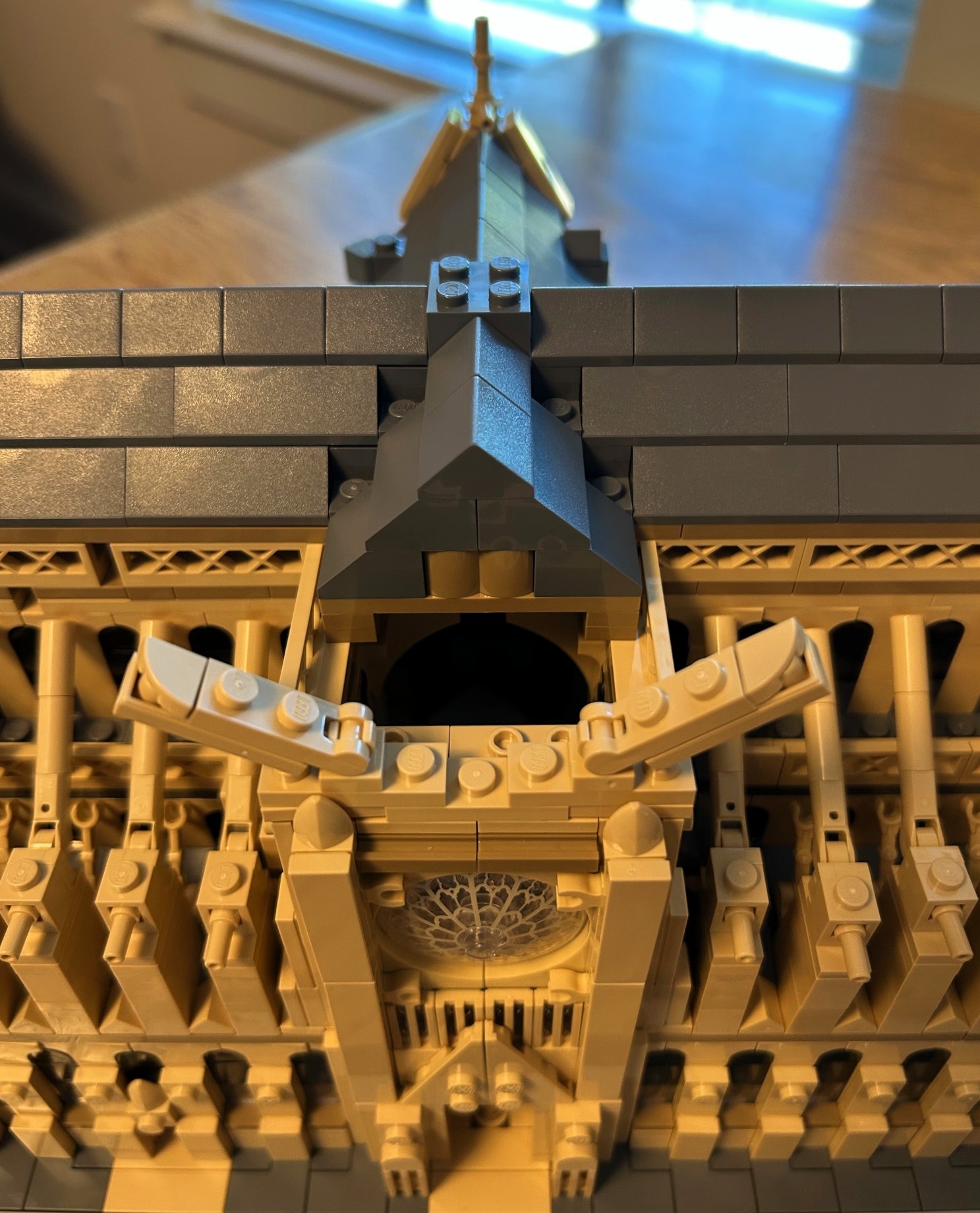
 My hat is off to LEGO’s engineers today. Look at the process above where I completed the structure above the transept doorways. Those two long LEGO pieces in the first photo are designed to hinge open, simply to allow easier placement of the central cap piece in between. Then you close those long pieces around the cap like a hug and voila – second photo – the transept is complete.
 Our work really is almost done. Just four small bags of pieces remain – two for the top structure of the bell towers (and a little ornamentation around the cathedral roof), and two for landscape elements to soften the edges of the model. Don’t walk out of the sanctuary just yet. The final product includes a surprise!
Running build time: 13 hrs. 58 min.
Total leftover pieces: 40
Some content sourced from the FutureTimeline.net website, the CNN Science article, “Near-Earth asteroid Bennu could hit Earth in 157 years…”, and Wikipedia, “the free encyclopedia”.





 Life In A Word