Horses on Circular Courses

In 1972, Billy Preston topped the Billboard Hot 100 chart with the catchy “Will It Go Round In Circles”. A year later, The Spinners spent five weeks at #1 on Billboard’s R&B chart with “I’ll Be Around”. More recently, Kacey Musgraves’ debut single “Merry Go ‘Round” won the Grammy Award for Best Country Song.  All of which is to say, if I’m asked to celebrate “National Carousel Day” I have a great choice of theme songs for the occasion… played on endless loop, of course.
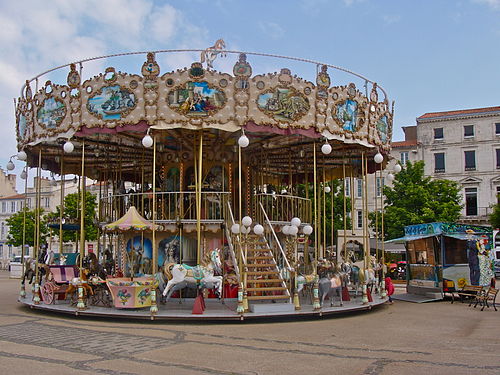
A double-decker!

National Merry-Go-Round Day (I prefer “Carousel”) was this past July 25th, as it has been every year since 2014.  Did you skip it like I did?  The holiday claims to “celebrate the carousel’s history and joy, particularly marking the first U.S. patent by William Schneider in 1871.”  And to celebrate, we’re meant to visit a local carousel, go for a spin, and post pictures of ourselves doing so online.  So we drop everything we’re doing on July 25th and climb on a wooden horse?  National M-G-R Day doesn’t even rate as a Hallmark holiday (and don’t waste your time trying to find a card to prove me wrong).
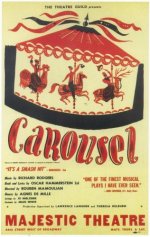
Contrary to my opinion about M-G-R Day, I think carousels are charming and a bit of innocent fun (other than those brass rings, which we’ll get to in a second).  Carousels inspired memorable scenes in Mary Poppins and BigCarousel was the Rodgers and Hammerstein musical that Time magazine deemed “the best of the 20th century”.  The “Carousel of Progress” was (and still is) one of the more unique attractions at Disneyland.  And of course, carousels led to those pipe and metal spinners we all played on at the park when we were kids.

Carousel is derived from the French word for “little battle”, which hints at why we’re riding them at all today.  In 17th century Europe, equestrian tournaments included “ring jousting”, where the rider attempts to spear a ring-on-a-string with his joust as he flies by.  To practice this sport without wearing out the horses, a clever soul invented the carousel, complete with wooden horses on poles and a real horse to pull the device in circles.  Eventually carousels made their way into carnivals, and then to the prominent locations where you find them today.
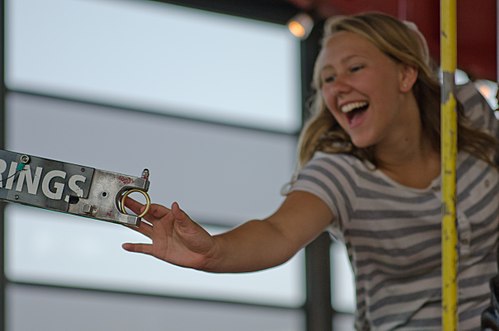
Care for a ring?

Now you also understand why early carousels had ring dispensers.  They were a nod to ring jousting!  The dispensers were filled with iron rings along with a few brass ones.  If you were lucky enough to ride an outside horse and grab a brass ring (which is harder than it sounds as your horse goes up and down), you could exchange the ring for a prize or another loop on the carousel.  For good reasons – safety being one – ring dispensers have been removed from most carousels today.

The people who came up with National M-G-R Day should’ve probably gone with “International”, because many of the world’s most distinguished carousels spin outside of the United States.  The Carousel El Dorado in Tokyo, Japan, built in 1907, is the oldest amusement park ride still in operation in the country.   The Lakeside Park Carousel in Ontario, Canada (1905) includes a self-playing organ that uses rolled sheets of music, rewinding one while playing the next.  The Letná Carousel in Prague, Czechia (1892!) is one of the oldest in Europe, remodeled in 2022 but still housed in its original wooden pavilion.
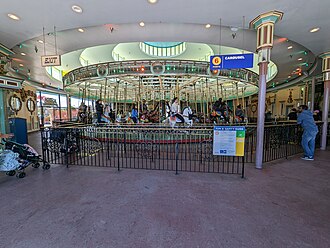
Looff Carousel (1911)

America has its share of prominent “gallopers” as well.  The Looff Carousel in Santa Cruz, CA is one of the few remaining with a ring dispenser, and entertains with the music of three organs.  The Over-The-Jumps Carousel in Little Rock, AR (1924) simulates the natural movement of a horse instead of just going up and down on a pole.  And the Flying Horse Carousel in Westerly, Rhode Island (1876!) is exactly as advertised.  The horses are attached to the center spindle instead of the wooden platform, creating a better sensation of flying through the air.
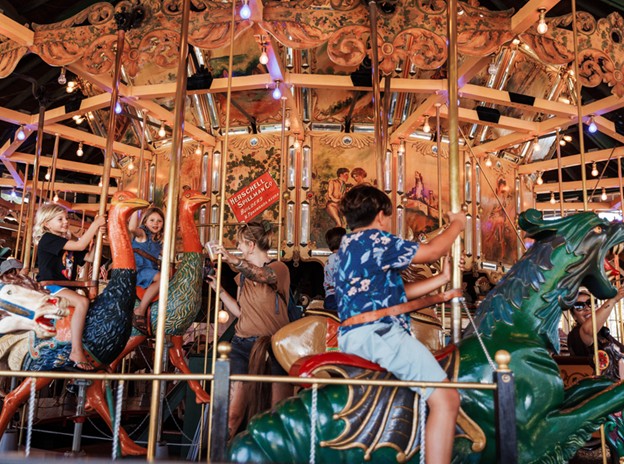
Dorothea Laub Carousel (1910)

Okay, I have a confession.  I had the perfect opportunity to celebrate National M-G-R Day just days after it happened this year.  My wife and I traveled to San Diego with our children and grandchildren for a beach vacation and found ourselves in Balboa Park, home of the Dorothea Laub Carousel (brass ring dispenser!)  If we hadn’t already worn out the little ones on a long walk through the Japanese Friendship Garden we might’ve made it to the wooden horses.  But I’m not losing sleep about it.  After all, National M-G-R Day will come ’round again next year.

Some content sourced from Wikipedia, “the free encyclopedia”.
Noble Neigh-Sayers

She’s only fourteen months and our granddaughter has already developed a keen interest and affection for our horses. As soon as she gets to the house she hightails it to the living room windows to see if our big boys are grazing in the nearby pasture. She calls them “Neigh-Neighs”; just about the cutest couplet of words you’ll ever hear from the lips of a small child. Makes me think she’d be utterly over the moon if she ever caught a glimpse of the Neigh-Neighs… er, horses at the Spanish Riding School in Vienna.

If you asked me to describe the nerve-wackiest moment of our Viking River Cruise last month, it would’ve been nine months beforehand when I went online to book the sightseeing excursions.  One of those tours – “Behind the Scenes at the Lipizzaner Stallions” – was, at least for us, the excursion of the entire trip.  If the Lipizzaners were sold out, well, there’s a good chance we would’ve a) cancelled the whole cruise, or b) emptied a nearby ATM of Euros, in hopes a couple of our fellow travelers would give up their reserved seats.  Lucky for us we didn’t have to do either.

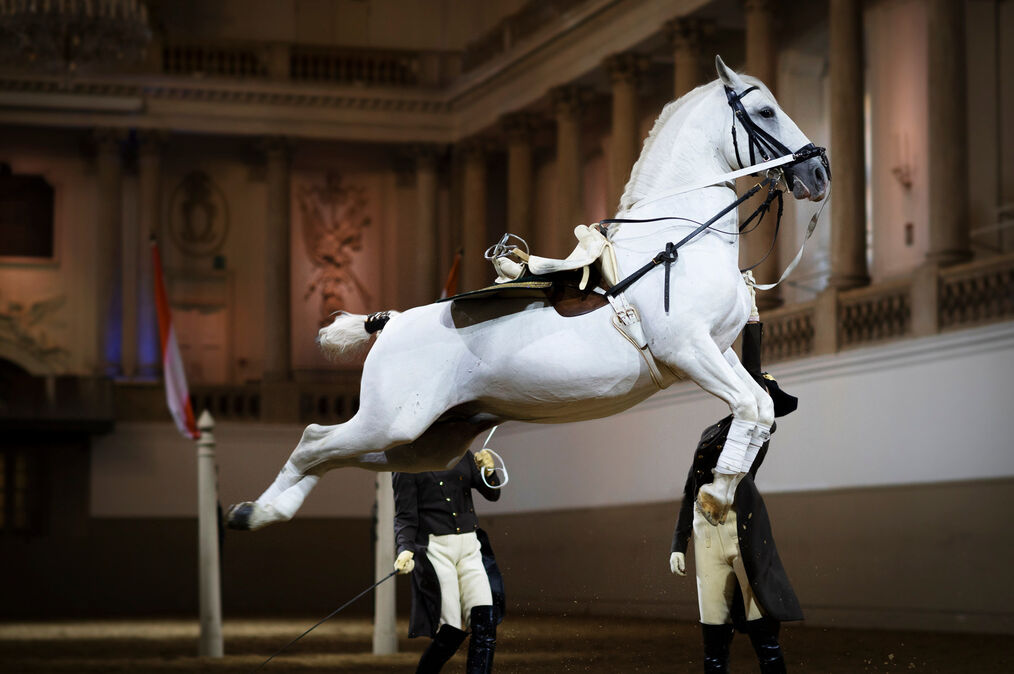
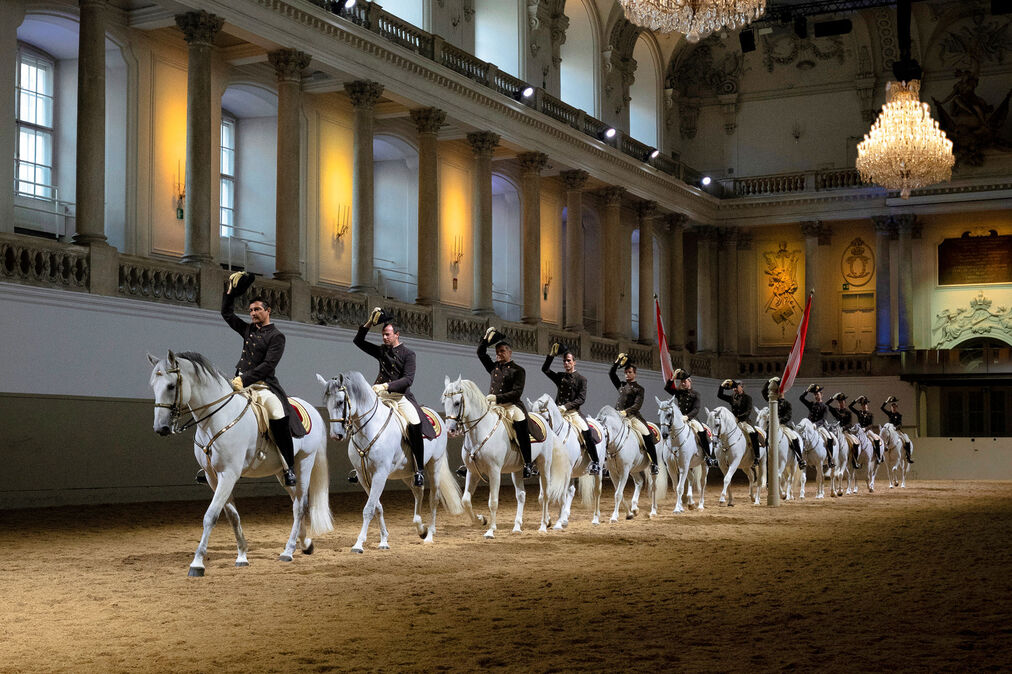
Maybe you’ve heard of them before.  The Lipizanners are a renowned breed of riding horse developed in sixteenth-century Austria.  All these years later they’re among the world’s most famous animals, both for their uniform look and unparalleled skill in the movements of classical dressage.  Five of these movements – known as “airs above the ground” – require horse and rider (sans stirrups) to completely leave the ground.  It’s a performance you’ll only see at prestigious academies like Vienna’s Spanish Riding School, and not in, say, the Olympic dressage competition later this month in Paris.

Spanish Riding School – central hall

So how was this remarkable performance?  I wish I could tell you.  We were in Vienna on a Tuesday and the Lipizzaners only show on Saturdays and Sundays.  But we knew this was the case heading into our trip.  The draw of the excursion was more about a behind-the-scenes look at the riding school facility, learning about the care and training, and of course, a peek at the horses themselves.  The Spanish Riding School is located in the former Imperial Palace of the Habsburg Monarchy, smack-dab in the middle of downtown Vienna.  Were it not for the smell of hay and manure you wouldn’t even know the stable was right through the stone walls adjacent to the sidewalk.

Tack room

But oh my, what a stable!  Each of the 68 resident stallions enjoys a roomy private stall (with a fancy nameplate), as well as outdoor courtyards for fresh air and exercise.  Those weekend performances take place in the spectacular sky-lit central hall, which still contains the royal box from the Habsburg era.  The tack room contains custom-made saddles, bridles, and reins representing a small fortune in leather craftsmanship.  And hay storage, manure removal, and other supporting aspects are somehow completely out of sight.  The Lipizzaners have it as good as we’ve ever seen for horses, at least in an urban setting.

Lipizzaner foals at the Piber breeding farm

Speaking of the Lipizzaners, the Spanish Riding School is just a part-time residence.  They spend a good portion of the year in nearby Heldenberg, enjoying the peace and quiet of the countryside instead of the hustle and bustle of the city.  Their breeding farm in Piber – even further removed from Vienna – is nicknamed “The Cradle of the Famous White Horses”.  And as you might expect, most of the young Lipizzaners go straight from Piber to the easy life in Heldenberg, without so much as a glance at the Spanish Riding School.  Only a select few achieve the look and confirmation worthy of this elite level of training and performance.

A couple weeks ago I described the Viennese Coffee House experience as an Element of Intangible Cultural Heritage.  So it is with the Spanish Riding School.  UNESCO has deemed the Vienna facility, the Lipizzaners, and their horse/rider performances as “an essential component… of [Austrian] cultural diversity and creative expression”.

Horses can fly?  Who knew?

I can understand why most visitors to Vienna would choose to see the Lipizzaners in their “Sunday best” instead of lounging in their stalls.  But I encourage you to see both.  A visit with these beautiful animals up close and personal is a unique experience (even if most tourists don’t seem to know how to behave around horses).  You’ll learn why the Spanish Riding School hosts one black stallion among the dozens of whites.  You’ll learn the historical significance of the trained movements of the Lipizzaners, as well as how to identify a rider’s ranking based on his uniform and equipment.  My granddaughter would have plenty of reasons to give this tour a “neigh-neigh”, but your own response is more likely to be “yay-yay!”

Some content sourced from the website of the Spanish Riding School, and Wikipedia, “the free encyclopedia”.

Big Shoes to Fill-y

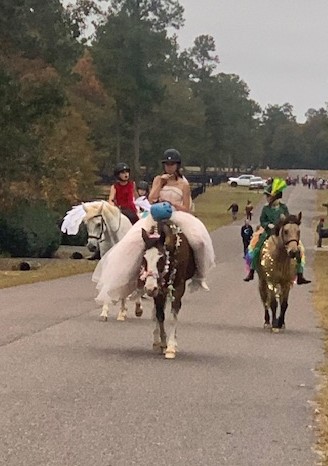
Last Sunday, the day before Halloween, our neighborhood hosted a lively parade. Kids of all ages dressed in adorable to “a-horror-full” costumes, to trick-or-treat past each driveway… on horseback. In a bit of a role reversal, we residents walked treats out to the horses and riders (because trust me, a stallion trotting up your front walk is not recommended). Candy for the kids, cookies for the parents who walked beside them, and carrots for the hardworking horses. As you would expect, a steady “clip-clop” filled the air for hours. Yet it could’ve been a lot quieter.

Here’s an idea I never ever would’ve thought of.  Take a pair of sneakers, break them down into their component parts, and reassemble them to fit a horse’s hoof.  Making a statement of purely fashion (vs. function), Horse Kicks allow your equine to sport two pairs of your favorite New Balance, Adidas, or Nikes. These giant “tennis shoes” are built on top of a pre-made protective boot so they really do support an animal weighing a thousand pounds or more.  Order yours today for only $1,200.

Sorry, I’m not buying.  I don’t think sneakers are a good look on horses, any more than when paired with formalwear on a human.  If a filly could talk, she would say, “Get those ridiculous things off of me!”, even though ladies love shoes.  Sneakers are best left to walkers and athletes, while steel horseshoes, as they have for thousands of years, fill a horse’s bill as comfortably as a couple of pairs of flip-flops (er, “clip-clops?”)

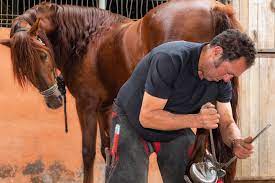
I can’t imagine the effort it takes for Horse Kicks to create their shoes (besides the seventeen hours of assembly time) but they don’t work nearly as hard as a traditional horseshoer.  That person, a farrier, might as well be an ironworker.  Watch one in action sometime as he/she trims a horse’s hoof or hammers the steel shoes to achieve the perfect fit.  It’s the kind of backbreaking work that can lead to early retirement.

Occasionally a horse throws a shoe, which is probably the origin of horseshoes as a game.  The first time I “threw a shoe”- besides getting it nowhere near the stake – I remember thinking, “Man, these are kind of heavy”. (A horse wouldn’t agree.)  And weight matters in the game because the shoe needs to fly a long way, like forty feet, for the chance for a “ringer”.  Yes, horseshoes is basic (and predates similar games like ring toss, cornhole, and bocce) but it has its finer points.  You flip a shoe to determine who goes first.  After players throw two shoes each you’ve completed an “inning”.  And a “dead ringer” really is a horseshoes term (too complicated to explain here), not just someone who looks like someone else. 

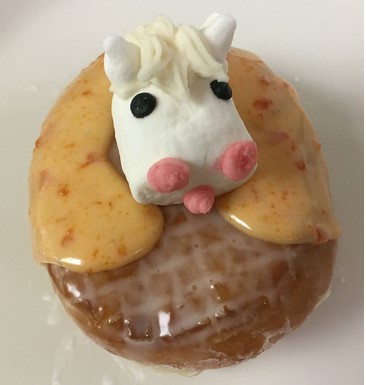
[Snack break.  Speaking of horseshoes, if you’re looking for “the best darn donuts in Colorado” you should check out Horseshoe Donuts, where we used to live just north of Colorado Springs.  You’ll pay upwards of $25/dozen but trust me, these shoes… er, doughnuts are huge and worthy of expensive tastes.  Most are shaped like traditional rings but the raised, glazed variety are giant horseshoes.]

Even if I never buy a pair of Horse Kicks, that doesn’t mean you shouldn’t.  You’ll probably see several on display this weekend at the Breeder’s Cup races in Lexington, KY (close to where they’re created).  Part of the company’s initiative is to “bring awareness to the Bluegrass State”.  And 10% of the proceeds go to central Kentucky charities.  All of which makes Horse Kicks a worthy product.  Not that I expect to see any in next year’s neigh-h-h-h-borhood trick-or-treat parade.  It’ll be, as usual, clip-clops in steel flip-flops.

Some content sourced from the CNN Style article, “You can now buy $1,200 sneakers — for horses”, and Wikipedia, “the free encyclopedia”.

Feeding Frenzy

Thanks to a whole lot of snow in Colorado I was pretty much housebound this week.  I was also reminded of the number of mouths I’m expected to feed. That total is nine… if I count the four horses, two cats, and one dog besides my wife & me. Now that I think about it, a horse eats enough for two so let’s bump the number to eleven mouths. And nine of those belong to animals.

A year or so ago I wrote a post called Sign Me Up!, where I marveled at the rapidly growing world of subscription-based services.  Among my own subscriptions I listed a magazine, a newspaper, and digital music, I also included Chewy, the online pet food supplier whose mission is “to be the most trusted and convenient online destination for pet parents (and partners), everywhere.”  At the time I was just trying Chewy out, not willing to go all-in with a subscription.  Today?  I’m fully on board and wondering why I didn’t sign up sooner.

Even the U.S. Post Office celebrates “fur babies”

Every time a Chewy pet food box shows up at my front door my first thought is, “Why didn’t I come up with this idea?”  Chewy’s concept is wonderfully simple… and wildly successful.  First, create a list of the world’s major suppliers of dog and cat food.  Second, negotiate bulk purchases of their products at a discount.  Third, set up a small network of fulfillment centers.  Finally, sell to customers with some of the discount, keeping the rest for your own operation and profit.  It’s a middleman’s recipe for millions.  Er, make that billions.

If you think this post is a plug for Chewy you’re darned tootin’ it is.  Chewy offers over 2,000 brands of pet food to 15 million subscribed customers.  97% say they’re satisfied.  Chewy’s net sales in 2019 were $4.8 billion dollars.  Nosh on that impressive number for a second.  $4.8 billion sounds like the GDP of a small country.  A small country with a lot of pets.

Foresight is everything here.  Ten years ago I wouldn’t have believed there were 200 brands of pet food, let alone 2,000.  If I go back to my childhood (way more than ten years ago) I can name exactly four pet food brands or products of the day: Purina, Friskies, Alpo, and a curious General Mills creation called Gaines Burgers (“The canned dog food… without the can!”)  Well, I also remember a variety box of dog biscuits called “Fives”, but that’s because I snacked on them every now and then when there wasn’t anything else in the pantry.  Fives were fit for human consumption.  At least, I think they were.

The pet food demand of the 1970s wouldn’t have sustained a subscription service like Chewy.  On the other hand, today’s market is a feeding frenzy, especially with more people opting for “fur babies” over children.  And don’t think Chewy hasn’t noticed all the doggy daycare and emotional support.  Now they also deliver food for your fish, your bird, your snake, and all those farm animals grazing on your backyard lawn (alpacas, anyone?)  Chewy even offers a pharmacy of over-the-counter meds when your pet is in some way under the weather.

Hello, “Chewy”!

I was going to wrap up this plug by smugly suggesting Chewy cater to our horses, but of course they already do.  I can’t subscribe to hay bales yet (I’m sure they’re working on that) but I can buy grain, treats, blankets, tack, and fly spray.  So instead, let me speculate it probably won’t be long before Chewy gets into the “human” food delivery business as well, to compete with Amazon, Wal*Mart, and Target.  With Chewy’s millions of subscribed customers, the new offering would take off like a bull in a china shop.  Or better, like a big, furry bad boy in a Star Wars movie.

Tough Nuts to Crack

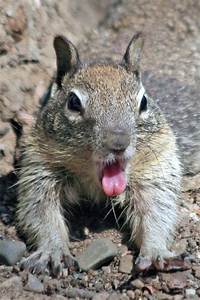
My wife and I live on horse property here in Colorado: flat, open acreage with high-desert grass in all directions. When you’re out in the pastures it can feel like you’re alone on top of God’s green earth. But make no mistake; there’s a bustling world just below the surface. Every day it seems, one or more of our eight billion ground squirrels darts out of a hole, stands at attention, and gives me the cold-eyed stare down, as if to say, “you think this is your property, huh?”

Okay, so eight billion ground squirrels is a bit of an exaggeration (let’s go with seven billion).  And they’re not really our ground squirrels (although some definitions of real estate would disagree).  The fact of the matter is, we’re cohabitating with tons of rodents, and I often wonder which of us is in charge.

“Admit it – you think I’m cute.”

To be clear, we’re not talking about prairie dogs (the larger members of the squirrel family) nor chipmunks (the smaller), but rather those gregarious in-between’ers with the bold racing stripes down the back.  Ground squirrels have short tails, beady eyes, and perky little ears on top of smallish heads.  They forage for nuts and seeds (of which we have precious few) or insects in a pinch, and they can dig holes like champs.  Ground squirrels rise up on their hind legs in an instant when they sense danger, standing straight as a board and totally aware (an annoyingly cute habit).  They vanish into the earth with an alarming screech when they sense the slightest movement.

“Ah-ten…TION!”

But I digress.  I’ve seen enough of these little furballs to know who’s responsible for the Swiss cheese look of our land.  I saw one of them disappear down a hole once, then pop up fifty yards away mere seconds later.  And damn these little critters are bold.  One time I was looping the lawn on my John Deere ride-on mower when a squirrel stared me down from right there amongst the blades until I practically ran him over.  Picture that famous photo of the Tiananmen Square protestor in China; the one who refused to back down from the approaching tank.  That was me and the squirrel.

Bring it…

We have an understanding, the groundies and I (or so I thought).  I willingly cede them the pastures while they keep a distance from the lawn and patio.  Their holes are too small to cripple the horses, and it’s not like we have a grove of walnut trees just beckoning them to the buffet.  But the lawn?  Now that’s sacred territory, friends.  I used to think my lawn had a force field around the perimeter, keeping the ground squirrels at bay.  No longer.  I recently discovered two of their holes smack dab in the middle of the green.  In an instant I was thinking, “payback time, you, you rodents, you”.  I grabbed a big coil of garden hose, thrust the nozzle down one of the holes like a big ol’ snake, and turned on the water full-blast.  Then I watched the other hole with a smirk, waiting for my little traitor to come flying out atop a geyser of water.

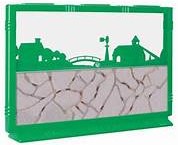
Alas, Old Faithful never happened, not even like you see in cartoons.  Thirty minutes of fill-‘er-up and then I gave up and turned off the water.  Not only did I not flush out a ground squirrel, I didn’t even fully flood wherever those holes led to.  Which got me to wondering, just how big is this underground Habitrail?  Can you picture one of those sand-filled ant farms you used to get as a kid?  Is the foundation of our house resting precipitously on a network of squirrel tunnels and my water-dousing only accelerating its collapse?  Let’s hope I don’t tumble out of bed one night and wonder what just happened.  I will admit to this: a little while after me and the garden hose, I was at the kitchen sink when a groundie popped right up from one of those holes in the lawn.  He didn’t even look wet, but boy did he look pissed.  He stared right at me through the window with his beady little eyes, as if to say, “YOU. You killed my family”.  Nah.  More likely he was saying, “nyah, nyah, nyah – you didn’t get me”.  Probably stuck out his teeny-tiny tongue while he was at it.

I’m not one to take up arms, but ground squirrels have me thinking about a BB gun.  I’m just an average shot but the little critters make easy targets with their stand-and-freeze habits.  Maybe I could fashion a coat out of several dozen squirrel pelts and parade around the(ir) pastures.  But seriously now, how many BB’s would it take to make a dent in our Chip ‘n Dale population?  Ten thousand?  Twenty?  For crying out loud, that’s less than one-quarter of one percent (of seven billion).  The squirrels seem to be winning.

I’m going about this all wrong.  I need something stronger.  Do they sell nuclear bombs at Wal*Mart?

Some content sourced from Wikipedia, “the free encyclopedia”.

Horsing Around

My wife runs an equestrian facility on our property – boarding, training, therapy and recreational riding for those who enjoy horses.  It’s a lot of activity and it’s a whole lot of work to maintain.  When our barn help doesn’t show up, that’s where I come in.  I don’t ride but I can do the work.  I suppose you could say I’m a horse of a different color.  My wife and I knock out the myriad chores in about four hours (morning and evening combined), and I get a kick (hoof?) out of all of the terms and phrases that are uniquely “equine”.  Consider the five essential aspects of daily horse care:

78-myriad-1

Grain – Are you “feeling your oats” today?  That’s a reference to horses (of course!) and the boost of energy derived from their daily dose of grain.  “Grain” means a lot more than “oats” these days.  Grain is a general barn term to include the endless supplements for the specific needs of a horse (i.e. fiber boost, joint care, digest assist, immune system boost, metabolic stimulation).  Solid, liquid or “mash” (something in between the first two), grain is measured in bins, sacks, and baggies; scoops, cans, and cups, and even tiny bits like pinches, eye-droppers, and capfuls.  When all is measured and done – voila! – your horse has a complete pan to feast on.  So remember – grain is not just grain.  That’s putting the cart before the horse.

78-myriad-2

Grass – Have you ever been the recipient of a “haymaker”?  That’s a powerful, forceful punch (which means someone must’ve been really mad at you).  But a haymaker is also a machine that dries grass, thus creating “hay”.  And horses need a lot of hay.  You could start with a handful but your horse will probably demand a flake or a cube, and if he’s really hungry he will devour an entire bale.  But I’m talking the 50 lb. bale you see stacked in the fields.  If you want to seriously hay your horses (and take a two-week vacation), opt for large bales – round or square – which can weigh up to a ton.  Your horse will think he’s found an all-you-can-eat-buffet.

78-myriad-5

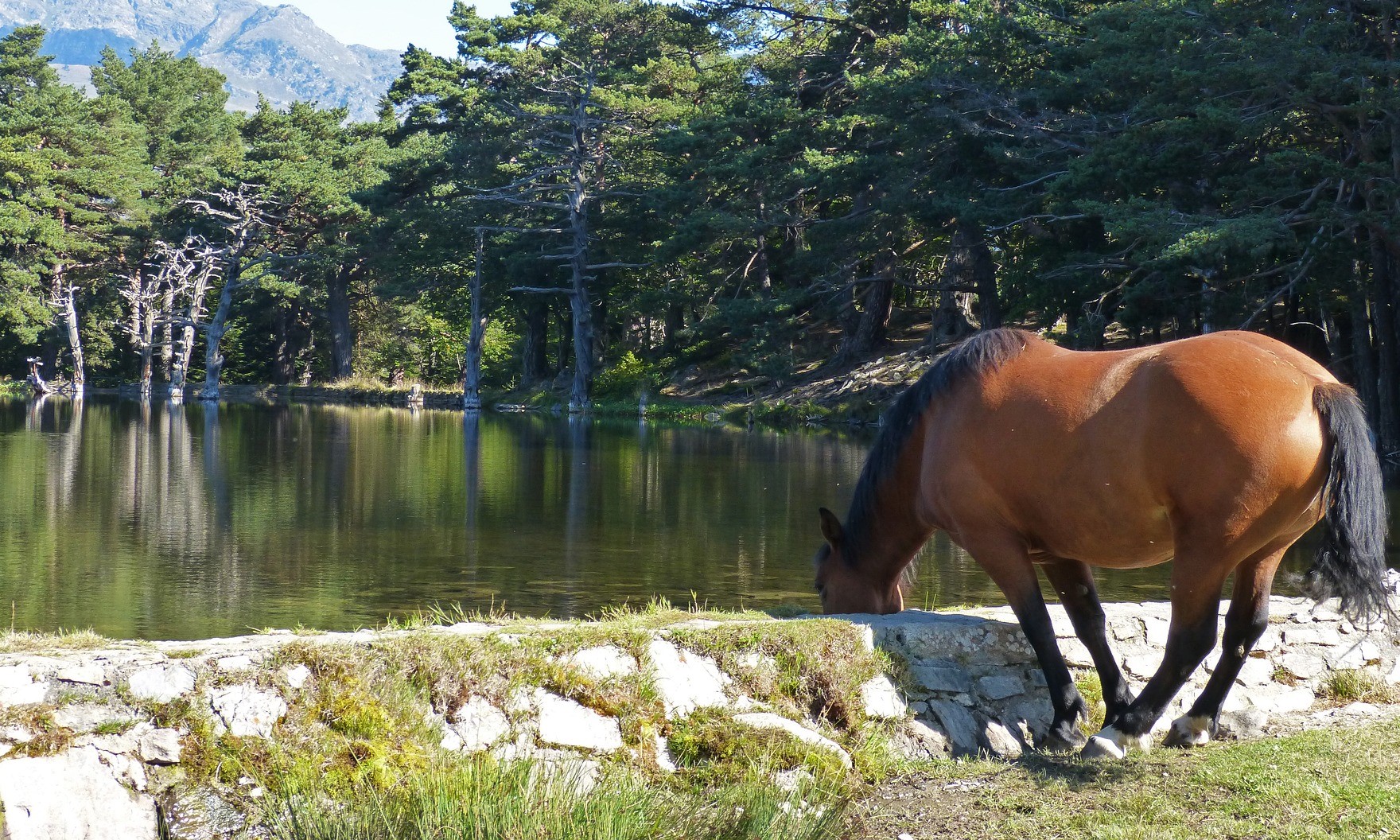
Water – You can lead a horse to water but you can’t make him drink.  When a horse does drink however, he’ll take in a gallon or more at a time; a glassful simply won’t do.  Watering horses requires everything from a hose to a pan to a pail to a bucket to a tank to a trough.  If you want to get really crazy you can even install a cistern (or a water tower) and then you never have to worry where your water’s coming from (even if your well dries up).  Finally, don’t forget the fishnet to keep the water clean.  Horses muck it up while they’re munching on hay.

78-myriad-3

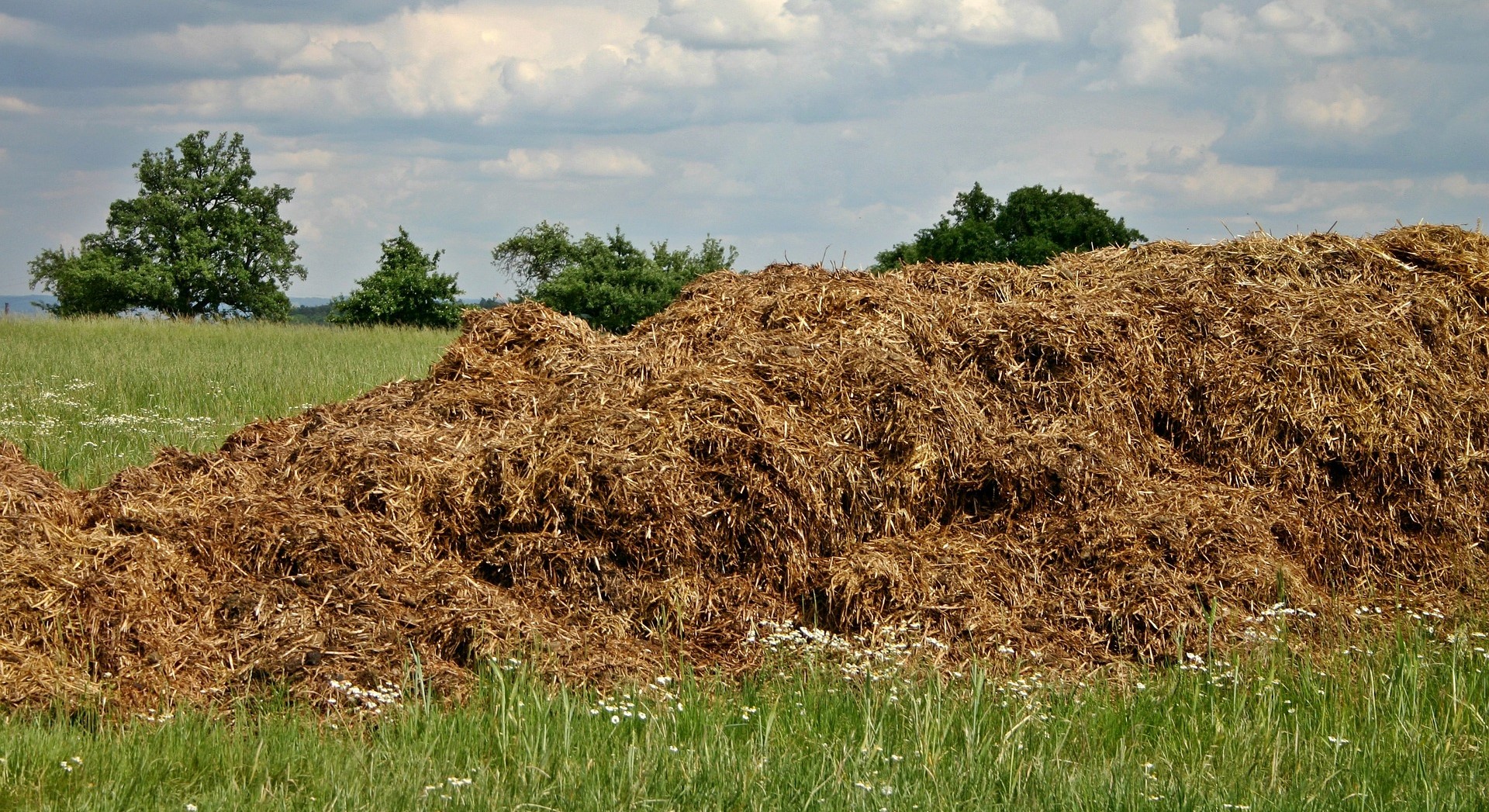
Cleaning – Speaking of mucking it up, are you a “muckety-muck”?  I hope not because that means you’re an arrogant, self-important person.  But come join me in barn chores and I’ll show you all the “muck” you could ever want.  A horse processes grain, hay, and water into a mountain of manure, and unfortunately for me a horse does his business wherever he pleases.  That means a lot of cleaning.  You’re going to need a muck rake for starters (and a hoe if it’s cold enough outside because then manure sticks to the ground).  You’re also going to need a muck cart – the wheels underneath the muck tub where you’ll deposit all of that manure.  Lastly your manure needs a final destination.  That would either be a manure pile (which is eventually removed by a manure hauler), or your pastures themselves, by means of a manure spreader.  Not to beat a dead horse, but your goal is to get all those “apples” as far away from the barn as possible.

78-myriad-6

Enclosures – If it came straight from the horse’s mouth, y0ur equine would demand to be put out on pasture and never ever brought in.  That’s because he wants to graze all day and night, which is almost never a good idea.  So a horse “comes in”, which means he retires to a pen or a stall.  If he’s really lucky, his stall has a run, and sometimes he can hang with other horses in a paddock before he’s moved back to pasture.  If he wants a place to go when he needs some alone time or gets tired of the rain he goes into a loafing shed.  And when he’s actually ridden he goes to an indoor or outdoor arena, or perhaps for a trail ride (which is sometimes just called “down the road”).

78-myriad-4

There’s a lot more equine-speak where that came from but it’s time I got off my high horse.  If you’re in the market for a horse I hope everything I’ve talked about here is enlightening.  To me it’s just horse sense.