For Whom the Road Tolls

Because we raised our kids in Colorado, vacations to visit our extended families were often by airplane, since my relatives were in California and my wife’s were in Florida. It was the rare trip where we could see any of them by taking the car. So when my wife and I drove from South Carolina to Pennsylvania recently to visit my brother and his wife, we were reminded of what makes travel by car different than by plane. Toll roads, for instance.
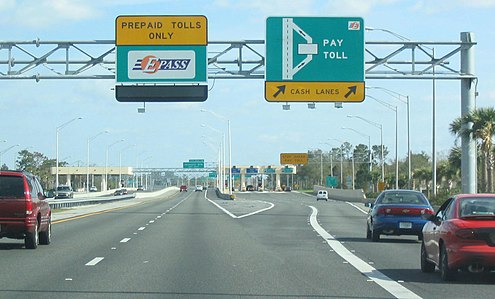
Take your pick of payment

I have memories of toll roads my kids will never have. They’re old enough to remember passing through the booths and handing coins or bills to the collector. But they won’t remember the unmanned alternative, which was to toss exact change into a big plastic basket, listen to the coins process through the mechanics below, and hope/pray the gate to the toll road would raise. That automated approach seems almost quaint compared to today’s electronic alternatives.

I say alternatives (plural) because yes, that’s what we have with today’s toll roads. It confounds me. Why in heaven’s name haven’t we developed a painless, seamless, and most importantly, nationally coordinated approach to toll road payments? To some extent (nineteen states) we have a solution – E-ZPass, which by subscription and sticker allows convenient passage.  But even E-ZPass is not a perfect system.

Not so E-Z

For the rest of the country’s tolls – and for most of our round-trip drive between South Carolina and Pennsylvania – we have the clunky alternative. You pass through a now-unmanned (“un-personned?”) toll booth, where a camera grabs your license plate with a noticeable flash. Then, somewhere down the road (ha) a paper bill arrives in your mailbox. By my count I have four or five of these bills coming my way. It’s been ten days since we’ve returned home and I have yet to receive even one.

The cookie recipe is still on the back of the package

[Trivia detour:  Nestlé’s famous Toll House chocolate chip cookies aren’t named after toll booths but rather for an inn in Massachusetts where baker Ruth Wakefield came up with the recipe.  Wakefield and Nestlé struck a deal in the 1940s: her recipe printed on their bags in exchange for a lifetime supply of chocolate.  How very “Willy Wonka”, eh?]

Here is my unequivocally efficient approach to paying tolls across our many-highway’d nation. When you first get a driver’s license, you also sign up for a bank account-linked program which allows seamless paying of ALL tolls across the land – roads, bridges, tunnels, whatever – through a single readable sticker on your windshield. If you somehow don’t pay the tolls because of say, “insufficient funds”? Well sorry, your driver’s license doesn’t get renewed until you settle up at the DMV.

A $3 toll gets you through Baltimore’s Harbor Tunnel

My system is so logical it’s probably the reason I’ve never been pegged for a government job. In Colorado and elsewhere they almost have it right with the E-ZPass system – a sticker linked to a bank account. The problem is, they hold a minimum balance in a middleman (middle person?) account to guarantee payment of tolls.  I object, your honor. Why should Colorado have forty-odd dollars of my hard-earned money at all times when they can just settle up unpaid tolls whenever I renew my license?

Warning: cash-cow crossing

Then again, I have a beef with the tolls themselves, and that is, they pay for far more than the maintenance of the roads. You can’t tell me $10 per vehicle per crossing of the Golden Gate Bridge (GGB) is needed just to maintain the bridge. Here’s the jaw-dropping math for you.  112,000 cars cross the GGB every day.  That’s over forty million cars per year.  That puts the annual toll-taking at over four hundred million dollars.  $400M for bridge maintenance?  Sorry, fair traveler, you’re voluntarily lining the coffers of California (and San Francisco) every time you cross. “If I’m elected” (as we’ll hear countless times in the next two months), I’ll limit toll-taking to whatever it costs to maintain the bridge, road, or tunnel.  Not a dollar more.

On our return trip from Pennsylvania, I was amused to pass through one toll both with an actual human toll-taker. Those cordial people are still out there, collecting cash one car at a time. The woman in our instance happily returned us $19.25 on a $20.00 bill (and who’s happy to do that anymore?).
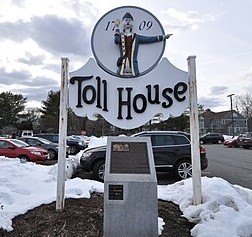
Time to bake cookies!

I was also amused… no, “gratified” is the better word; to pull into the parking lot of a South Carolina “rest area” shortly before we got home, for the use of a perfectly safe, clean, toll-free restroom on a toll-free highway. Maybe rest areas and their restrooms are the reason tolls cost more than the maintenance of the roads? Probably not. That would equate to a logical explanation for a government expenditure, which is an oxymoron.

Some content sourced from Wikipedia, “the free encyclopedia”.

Dots ‘n’ Dashes

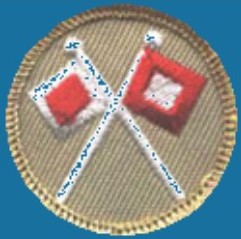
Back in my days in the Boy Scouts, they had a merit badge called “Signaling”. To earn the badge you had to build a basic communication device (buzzer, blinker) and demonstrate a knowledge of Semaphore – visual signaling by flags – and Morse – audible signaling by “dots” and “dashes”. Today most people wouldn’t have a clue about Semaphore, and their only familiarity with Morse might be from the frantic telegraph typing in the movie Titanic.  Dots ‘n’ dashes have stepped down, more associated with the mundane pavement markings of the streets we drive.  Well hey, at least they’re still signaling devices.

“Dashing through the… street…”

Let’s talk about street dashes first.  The highway to our rural neighborhood was recently restriped, mostly dashes but occasionally a solid for safety’s sake.  Some lanes were shifted, and they just covered up the old stripes with blackish paint similar to the asphalt below.  But my car was not fooled, no sir.  It still sees the old striping.  Anytime I pass over those areas my car’s “lane-keeping assist” emits an audible warning and tries to bump me back onto the road, when in fact I’m just passing over covered-up stripes.  That’s annoying.  Either car tech needs to improve or road striping needs to come up with a better cover.  Until one or the other happens I’m all over the road.

Here’s an even better story about dashes.  Long ago, my parents were driving my brothers and me back from my grandparents’ house.  We were cruising along a paved winding road late at night when all of a sudden my dad gets to wondering about those highway dashes.  He starts to guess – if you measured one, how long would a dash be?  Talk about useless information, right?  But then, right in the middle of a darkened highway, no cars in the rear-view mirror, my father stops the car, gets out, and starts measuring a dash, foot-in-front-of-foot like he’s taking a sobriety test.  Then he gets back into the car and announces proudly, “six feet”.  Think about that the next time you pass those stripes at forty miles an hour.  (But please, don’t get out and actually measure one).

California highways are usually dotted, not dashed.

Now let’s talk about street dots.  You know, those round, non-reflective raised pavement markers used to designate lanes and borders and such?  They’re actually called Botts’ dots.  It’s a name I’ve known since childhood because I grew up in California where they were invented.  California has over 25 million of the little guys marking its endless streets.  And if you must know, Botts’ dots were named for their inventor, Elbert Dysart Botts (and how’s that for a mouthful?)

Kinda cute, right?

Botts’ dots might’ve never been a thing were it not for their total makeover.  At first they were glass discs attached to the road with nails. (How’d you like to have that job?  Whack, whack, whack!).  But then they started popping loose, and people got flat tires from the nails and the broken glass.  So Botts (or a coworker) devised a hard plastic to replace the glass and an asphalt-friendly epoxy to replace the nails.  Now the dots – and the speeding cars above them – stay where they’re supposed to.

But now Botts’ dots have a whole new challenge.  We face a future with self-driving cars.  Turns out, Botts’ dots mess with that technology.  The car may or may not recognize a dot as the border of a lane.  That’s not good when you put your steering wheel in the hands of a robo-chauffeur.  But can you imagine the task of removing 25 million Botts’ dots?  That’s worse than hammering them in one by one!

Botts’ dots may go the way of the telegraph.

Over here in rural Colorado, I got pretty excited about the prospect of California surrendering all of its Botts’ dots.  We can use ’em.  You see, out here we have mostly two-lane highways divided by dashes, or occasionally solid lines instead of the dashes (don’t pass!), or very occasionally the luxury of a defined left-turn lane.  But “dash-it-all” when it snows.  You not only lose the striping, you lose the road.  At least a Bott’s dot would make noise and give you a jolt to let you know you’re not about to cruise into somebody’s cow pasture.

Alas, my dream of millions of Botts’ dots flying over the Rocky Mountains died before it was born.  Turns out the asphalt epoxy of a Botts’ dot cannot compete with the combined weight and speed of a snowplow.  The dots’d go flying every which way from the snowplow blade, like hundreds of tiny shuffleboard discs.  Ping! Ping! Ping!

Signaling merit badge was retired by the Boy Scouts in 1992 (yet another reminder of my advancing age).  Looks like the Botts’ dot is headed for a similar scrap heap, at least if self-driving cars become more mainstream.  Meanwhile, you’ll find me out in my neighborhood navigating the painted dashes.  Even if I do prefer the dots.

Some content sourced from Wikipedia, “the free encyclopedia”.