Solitary Singles

A recent study of lifestyles determined the eight healthy habits that can add the most years to a human life. It’s a list of what to do (four) and what not to do (another four) to live longer. All eight are fairly commonsense, but one in particular stood out to me: Surround yourself with positive social relationships.  You’ll increase your chances of a longer life by five percent, and you won’t be able to claim COVID-y words like “lonely” and “isolated”.

Let’s not make this a sad blog post, okay?  I could spend the rest of my paragraphs talking about loneliness and isolation, but why bother when so many musicians have already done so before me?  “Lonely” songs go back decades.  In 1960, one of the biggest solitary singles was Roy Orbison’s Only The Lonely.  The same year, Elvis released Are You Lonesome Tonight?  And anybody who remembers the Beatles’ Eleanor Rigby (1966) knows Eleanor’s story is all about loneliness.

The 1960s is a little too far back for my purposes.  I’d rather focus on two more recent songs you know (from popular re-recordings) and another one you might know.  One thing’s for sure; all three play in my brain now and again, but especially when I’m “Alone” or “All by Myself”.

Alone

The power ballad made famous by Heart (and then Celine Dion) is not so much about being alone but about wanting to be with a particular someone else… but not being able to.  “Alone’s” lyrics voice the frustration of a romantic longing.  It’s more about how do I get you alone than actually being alone.  There’s even this suggestion of before versus after: Till now I always got by on my own.  But the song’s final lines – nothing but repeating, wailing, unsatisfied “alones” – gets me every time.  Heart’s version of “Alone” spent three weeks at #1 on the U.S. Billboard Hot 100 and still makes an occasional appearance on the radio.

All by Myself

Even though this was another Celine Dion’s hit (what’s with all the loneliness, Celine?), no one who lived through the 1970s would ever take “All by Myself” away from Eric Carmen.  The song hit #2 on Billboard’s Top 100 and sold more than a million copies (back when listeners actually purchased music).  “All by Myself” is also categorized as a power ballad; “a style of music that often deals with romantic or intimate relationships… usually in a solemn but poignant manner”.  The second verse is a good example:

Livin’ alone
I think of all the friends I’ve known
But when I dial the telephone
Nobody’s home

Like “Alone”, there’s no happy ending to “All by Myself”. In fact, the lyrics are disconsolate from start to finish (yet somehow they work).  Also, trivia buffs, you’ll hear the song’s melody in the second movement of Sergei Rachmaninoff’s classical Piano Concerto No. 2 in C minor, which is odd but intentional.

Alone Again (Naturally)

I find it fascinating when a song sounds happy but really isn’t.  Maybe that’s why Gilbert O’Sullivan’s “Alone Again (Naturally)” has stayed with me all these years.  It’s easily the “loneliest” song of the three I cover today, and seems to take pride in being so from start to finish.  “Alone Again” manages to pack suicide, being left at the altar, wondering if there’s a God, and losing one’s parents into a single set of lyrics, layered on top of a merry duet of piano and guitar.  The song spent six weeks at #1 on the U.S. Billboard Top 100 and was re-recorded by several others, including two American Neils (Diamond and Sedaka).  But it’s Irishman O’Sullivan’s rendition I’ll always hear in my head.

Regarding those healthy habits I mentioned earlier, I think my report card’s looking pretty good.  So good in fact, I can enjoy these chart-topping “lonely” songs without getting down.  I hope you can do the same.

Some content sourced from the CNN article, “These 8 habits could add up to 24 years to your life, study says”, and Wikipedia, “the free encyclopedia”.
Loony Binge

I know very little about Oscar Wilde, except he was a 19th-century Irish playwright famous for “The Picture of Dorian Gray”. Wilde lived to be just 46, producing his best works in the last ten years of his life. He was often quoted, lacing words of wisdom with pretty good wit. Here’s one of Wilde’s best: “Everything in moderation, including moderation”.

Poisonous snakes?

Perhaps you caught this story from last week’s headlines: “Man Dies from Eating More Than A Bag of Licorice a Day”.  (I mean, who wouldn’t catch a story like that, right?)  It seems a Massachusetts construction worker with a daily candy habit switched from red to black licorice, and a few weeks later he went into cardiac arrest.

After futile attempts to revive our candy man, medics discovered he was experiencing ventricular fibrillation, meaning the lower chambers of his heart stopped pumping blood.  So he died.  From licorice.  You’ve heard of death by chocolate, but seriously, death by candy?

The New England Journal of Medicine says black licorice contains glycyrrhizic acid, which in ample amounts tanks the body’s potassium levels.  Low potassium levels contribute to heart arrhythmia (and heart arrhythmia is never a good thing).  Can’t say I’ve heard of glycyrrhizic acid until now (bet you haven’t either) but it doesn’t matter.  All I took from this story was: black licorice = death.  That’s disturbing because I love black licorice.

Check out my previous post connoisseur for a “taste” of my licorice obsession.

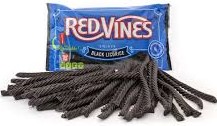
Whips, twists, nibs, wheels, shoelaces – licorice comes in all shapes and sizes.

Not gonna lie; the moment I read this not-so-dandy candy story I pulled open my desk drawer (left side, second one down) and grabbed the bag of black licorice sitting innocently in front.  Then I reviewed the ingredients very slowly and very carefully.  “Corn syrup, sugar, modified potato starch, caramel color, carnauba wax…” (and several other ingredients I really shouldn’t be eating).  But nowhere did I find “licorice root extract”, the bearer of that nasty acid.  Whew.

Let’s be honest – the real message here isn’t “don’t eat black licorice”.  Rather, it’s Oscar Wilde and his “everything in moderation”.  Our poor construction worker, according to family members, consumed “one to two large bags of black licorice every day for three weeks”.  If it wasn’t the glycyrrhizic acid, something else in the candy would’ve done him in.  Or maybe the gallons of water he drank to wash it all down.

Yep, that’s a real thing too (water intoxication).  Drink too much and you can succumb to an “imbalance of electrolytes” and die.  Then again, 99% of us avoid stupid dares or sustained exercise where you lose track of how much water you take in.  But then there’s the other 1%.  Stay away from those people.

Nine of ten of you don’t like black licorice (easy guess) so you’re not breathing a sigh of relief alongside me.  But you may not be innocent of other binge-worthy foods.  Take your pick: popcorn, potato chips, nuts, trail mix, or peanut butter (especially those little PB-filled pretzel-bite thingies – oooooo).  “You can’t eat just one”, am I right?  You probably can’t even put the container down.  And don’t get me started on Chinese food, where I seem to get hungrier the more I eat of it.

The good news is, you’re not heading for potassium deficiencies or cardiac arrest with these binge foods, but it’s fair to say they contribute to the downward spiral of unhealthy eating.  One day you wake up and find yourself sprawled atop a mountain of junk food asking, “how did I get here?”

Since we’re talking about killer (or diet-killing) foods, let me throw another one out there: coconuts.  Yes, you think coconut oil, milk, and extract are all the healthy rage these days, and you’d be… right.  But I’m talking about tropical islands and swaying palm trees.  There lies (er, hangs) the reason coconuts are called “the killer fruit”.

Urban legend perhaps, but they say falling coconuts kill several people every year.  At least ten cases have been documented since the early 2000s.  In Queensland, Australia they remove coconut palms from their beaches for this reason.  Don’t say I didn’t warn you.  Coconuts kill.

Then there’s death by chocolate.  (Chocolate kills too, you ask?)  Okay, so maybe I’m referring to a sinful dessert instead, minimally described as “chocolate with chocolate on top of chocolate”.  The American pub “Bennigan’s” offers the undisputed king of Death by Chocolate: a chocolate crumb-crusted chocolate cake, paired with two scoops of (chocolate) ice cream, topped with two Twix bars and covered with chocolate sauce, accompanied by a side dish of heated chocolate topping.  Woof.  Maybe chocolate kills after all.

How about a smile, Oscar?

Here’s one more ingredient in my desk drawer licorice: anise oil.  Anise gives you the same flavor as licorice root extract but without the occasionally fatal side effects.  Maybe it’s a cheaper or easier-to-come-by substitute?  Unfortunately, anise oil can cause pulmonary edema (also never a good thing).  Maybe I need to reevaluate my licorice habit after all.

I’ll leave you with another Oscar Wilde quote: “Life is too important to be taken seriously”.  With all due respect to our Massachusetts licorice-aholic, I couldn’t agree more.  So I will continue to eat black licorice, and I will continue to enjoy black licorice.  In moderation, of course.

Some content sourced from the 10/13/2014 ShortList article, “20 Pieces of Wisdom From Oscar Wilde, the 9/25/2020 Ars Technica article, “Rare case of black licorice poisoning kills man in Massachusetts”, and Wikipedia, “the free encyclopedia”.