Get Your Feet Wet!

I love urban plazas where water jets through an array of holes at ground level, creating fountains and arcs at random. Watching kids run and play in the midst of these unpredictable showers brings a smile. It’s also a creative way to cool off. Down in Texas, where it always seems to be hot, they’ve created an entire garden of water, where you can get your feet wet in all sorts of ways. Welcome to Fort Worth’s Water Gardens.

Fort Worth Water Gardens

Maybe you don’t think of an outdoor venue as “architecture” but the fact is you don’t need walls and a ceiling to define space.  The Water Gardens are a perfect example.  This city block oasis pops up (er, down), unexpectedly as you pass through the urban grid of Fort Worth.  Most of the park is hidden below street level but you can’t miss the rising mist and symphony of moving water.  It’s a celebration of sorts, urging you to join in on the fun.  The few photos I share here don’t begin to do it justice.

The Water Gardens challenge my logical brain because there’s no rhyme or reason to their haphazard design.  Maybe that’s the point.  Wander, gaze, and “soak in” their five acres.  The Gardens are a multi-faceted experience of water.  Phillip Johnson (one of America’s foremost architects), and John Burgee (a graduate of my own university) designed the Water Gardens to include “… pathways, wayside stops, events, and hideaways to draw out the experience, to convey more of the sense of a Central Park… than its limited acreage would’ve suggested possible.”  That may be saying a lot about a little, but consider the Gardens’ offerings:

Quiet Pool

The “Quiet Pool” sits at the base of twenty-foot walls.  Water descends almost silently down the stone from a trough above.  Deep in the Gardens by the pool itself, you’re so far below ground level it’s as if the city has somehow been relocated far, far away.

Aerated Pool

The “Aerated Pool” is a nod to the water jets I mentioned above.  Forty nozzles create an “orchard” of water in this smaller pool, the tops of the “trees” reaching back to the ground level of the city above.

The “Mountain” is a series of stepped concrete terraces, descending to a corner of the park removed from the water elements.  Sitting on the Mountain is almost like being blindfolded.  You can hear the rush of the Water Gardens nearby; you just can’t see them.

Active Pool. Watch your step!

The “Active Pool” is the largest and most distinctive feature of the Water Gardens, literally a canyon through which the water streams and falls, terminating in a pool thirty-eight feet below the ground.  A series of open steps dares you to descend through the water from top to bottom (check out this video for a sense of the experience).  The Active Pool gained notoriety in the final scene of the movie Logan’s Run, as the inhabitants of the dystopian city climb into the outdoors for the very first time.

The major elements of the Water Gardens are tied together by a central plaza, where you can experience everything from one location.  But to do so would betray the Gardens’ intent.  They’re meant to be a moving experience, much as the water itself rushes, mists, and pools throughout.

Architecture is structured, while landscape is unstructured.  Blend the two and the result can be unlike anything you’ve seen before.  The Water Gardens beckon you to escape, to wander, to contemplate, and most importantly, to get your feet wet.  Will you accept their invitation?

Now for the latest on LEGO Fallingwater…

____________________

LEGO Fallingwater – Update #2  (Read how this project started in Perfect Harmony)

The instruction manual for LEGO Fallingwater includes about ninety pages for the assembly, so I figured I’d divide the build into nine equal parts.  In the spirit of today’s topic, I proceeded to “dive in”.

Heaven help me.

You see, the 3,000+ pieces of the LEGO Grand Piano were separated into twenty-one numbered bags.  Build one bag at a time – easy-peasy.  On the other hand, the 800+ pieces of the LEGO Fallingwater model are separated arbitrarily into nine bags, with no indication of what piece is where.  It’s like opening a jigsaw puzzle and realizing every piece looks almost exactly the same.

This scene is even scarier when you click to zoom in…

I took a photo of my desk so you could see how much chaos I created on my first day.  Did I open all nine bags in search of pieces?  Yes, I did.  Did I consider just dumping all of the pieces into a big pile so I could search in one place? Yes (but I was afraid there was good reason they’re separated into nine bags).  Did I build part of the model wrong and have to backtrack?  Absolutely (and thank goodness for that little orange wrench you see next to the scissors.  It came with the LEGO Grand Piano and unsnaps pieces that are snapped together incorrectly).

Ten pages (or 11%, or 49 minutes) into the build, this is what we have.  We’re looking at Fallingwater from the same angle as the photo above, only all we’ve got is the lowest perimeter foundation wall and a spill of waterfall and creek emerging from the front corner.  Not very exciting.  Tune in next Thursday as the construction continues.  Now for another nod to Frank Lloyd Wright…

Romeo and Juliet Windmill

For all of his famous residential and commercial projects, Frank Lloyd Wright had plenty of lesser-known designs, such as the Romeo and Juliet Windmill in Wyoming, WI.  The tower was commissioned by Wright’s aunts, to pump water to a nearby school where they taught.  You might describe its shingle-clad look as quaint but in fact, the design is intentional.  The taller piece in the rear (“Romeo”) serves as structural support to counter the prevailing winds of the area.  Romeo also contains the mechanics of the windmill and water pump.  The cupola-topped octagonal piece in front (“Juliet”) is largely ornamental and softens the look of the tower when observed from further down the hillside.  Neither part of the tower can really stand on its own, hence the name “Romeo and Juliet”.

Some content sourced from the website for Fort Worth Parks and Trails, and from Johnson/Burgee: Architecture, and Wikipedia, “the free encyclopedia”.
Crowned Jewel

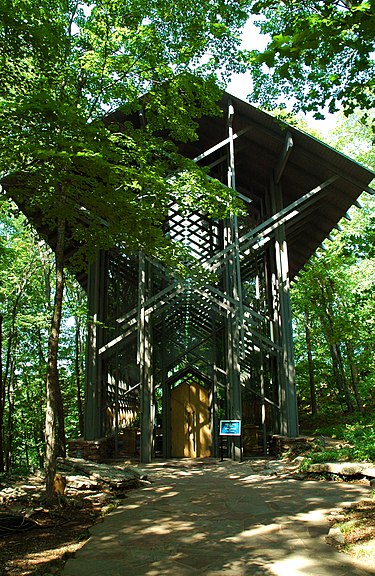
A little south and a little west of our downtown proper, you’ll find a wide street with stately old homes. The homes sit to the back of their properties, playing second fiddle to lines of majestic oak trees closer to the street. Overhead, the tree branches are densely intertwined, barely allowing the sun to peek through, creating a cozy, comforting canopy as you drive through. It’s a look that could’ve inspired the design of Thorncrown Chapel in Eureka Springs, Arkansas.

Thorncrown Chapel

When I gushed about Fallingwater in last week’s Perfect Harmony, I thought it would be appropriate to revisit some of my favorite American architecture as I share the adventure of my LEGO model build.  Were it not for my architecture degree in college I probably wouldn’t be aware of these beautiful structures.  Instead, all these years later I can recall my favorites from memory.  They’re a diverse bunch but I think they exemplify almost-perfect spaces, thanks to the work of the architect behind the scenes.

Thorncrown Chapel is an appropriate choice to lead off my list.  Just like Fallingwater, the chapel’s intent is to bring the outside in so that worship (or weddings, or any other celebration) feels as if you’re one with nature, yet with the conveniences and comfort of an enclosed space.  Thorncrown was built in 1980 (by coincidence, my freshman year of college).  Its architect, E. Fay Jones, turned a childhood interest in treehouses into a decorated career, including an apprenticeship under Frank Lloyd Wright.  Fay Jones’ designs “focused primarily on the intimate rather than the grandiose“.  Hence, chapels.

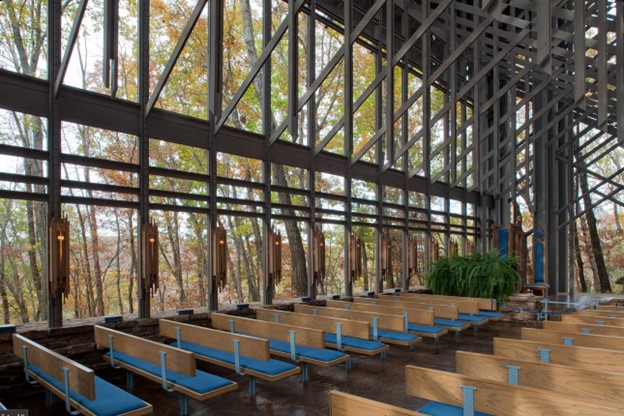
As a disciple of Wright (and the only one to win the American Institute of Architect’s [AIA] prestigious Gold Medal), it’s no surprise Fay Jones’ Thorncrown Chapel design is reminiscent of Wright’s Prairie School houses, with its broad overhanging eaves, horizontal lines,  and deliberate integration with the landscape.  Thorncrown contains 425 individual windows.  Those with stained glass bring in so much colored light the chapel’s interior is often described as “jewel-like”.

As with Fallingwater, Thorncrown is constructed of organic materials, including Southern pine and flagstone from the surrounding area.  The chapel seats 100 and is non-denominational, intended more for meditation for those who make the pilgrimage to Eureka Springs (in other words, go see it!)  For all of the beautiful structures you’ll find in America over the last forty years, the AIA has given Thorncrown the distinction of “best American building constructed since 1980”. 

Sainte-Chapelle

Despite my longtime familiarity with Thorncrown, I never thought to wonder how it got its name.  Turns out, Thorncrown’s design was not only inspired by Frank Lloyd Wright but also by Sainte-Chapelle, the Gothic church in Paris, France.  And at some point in its history, Sainte-Chapelle supposedly housed the crown of thorns worn by Jesus Christ.

If your wanderings ever bring you to the northwest corner of Arkansas, take time to visit this crowned jewel of a chapel.  Whether it strikes you as a treehouse or a miniature cathedral, being in church will never feel so comforting and cozy.

Now then, let’s turn our attention to (LEGO) Fallingwater, shall we?

____________________

Fallingwater – Update #1

As with the LEGO Grand Piano, the first step in the build is to simply open the box and assess the contents.  Here’s what is immediately apparent about the LEGO Fallingwater model:

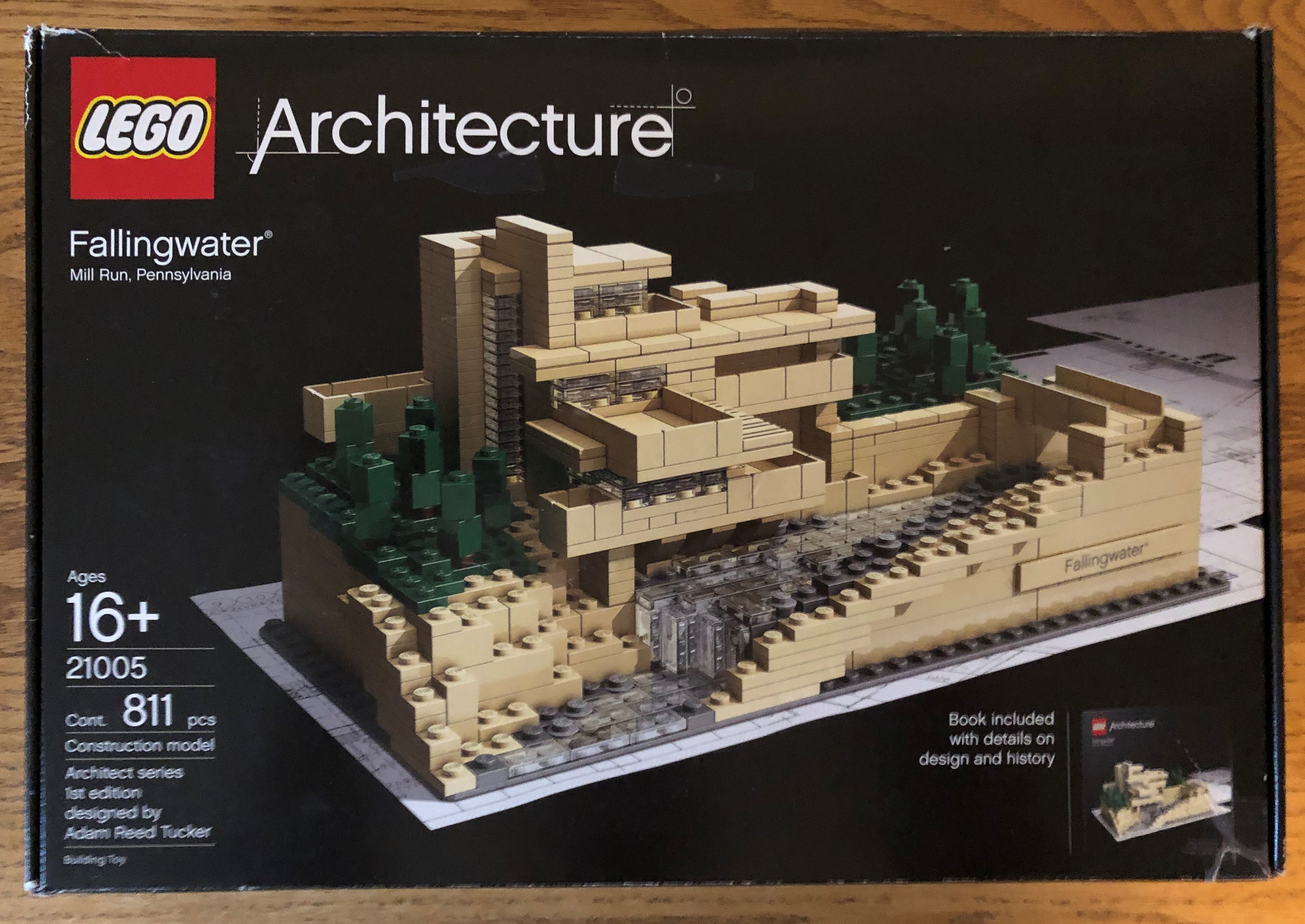
  1. The finished product will look much more like LEGO than the Grand Piano looks like a miniature piano.  I can’t pinpoint the date LEGO first produced its Fallingwater model but it must’ve been years before the Grand Piano, with pieces more in line with basic LEGO blocks.  I mean, check out the photo below.  Would you believe this inventory of boring little pieces comes together as a house over a waterfall?
  2. The Fallingwater model will be completed much faster than the Grand Piano.  The design is intricate, yes, and we’re still talking about thousands of pieces, but the instruction manual hints at a much easier assembly.  I won’t have those heartstopping moments like I did with the Piano, where I realized I’d built a section backwards.  (Then again, my LEGO-building confidence may be getting the best of me.)
  3. The Piano was interesting to look at even as it was coming together.  Fallingwater… not so much.  Under construction it’ll look like haphazard piles of LEGO bricks.  Not exactly riveting to you the reader.  Instead, as I did with the Piano and classical music, I’ll cover a few of Frank Lloyd Wright’s other designs, so you gain a better appreciation for the diversity of his life’s work.

Next week, “groundbreaking”!

Some content sourced from the official Thorncrown website, and Wikipedia, “the free encyclopedia”.
Perfect Harmony

In the toe of my wife’s Christmas stocking this year, I nestled a small gift to help her sleep. It’s a travel version of one of those sound machines, where you can dial up anything from rain to ocean waves to lull you off to Never Never Land. You can even mimic a waterfall, which would be my personal choice. After all, it’s the same sound the Kaufmann family enjoyed for years at their stunning retreat in the Pennsylvania forest, southeast of Pittsburgh. Seeing this famous house is an entry on my bucket list. Yes, one of these days I will make the trek to Fallingwater.

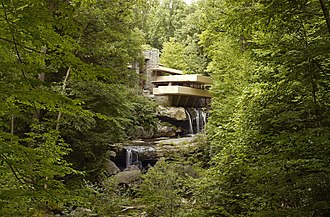
If you’re old enough to remember, “I’d Like to Teach the World to Sing”, you know the song’s about more than just apple trees and honey bees.  It’s about “perfect harmony”, which is how anyone would describe Fallingwater.  This beautiful structure is exactly as named: a house on top of a waterfall.  It is considered one of architect Frank Lloyd Wright’s greatest achievements.  The design is a melding of interior and exterior spaces, a principle borrowed from the Japanese.  Fallingwater is a building, yes, but it’s more often described as “… harmony between man and nature”.

If you know anything about Wright, you know he was an eccentric architect.  When the Kaufmann’s called to stop by his studio for a progress report, Wright hadn’t even begun the drawings.  Yet by the time they arrived two hours later, Wright had completed the entire design.  This production under pressure reminds me of author Ray Bradbury’s Fahrenheit 451, a novel written in just nine days and considered one of Bradbury’s greatest works.

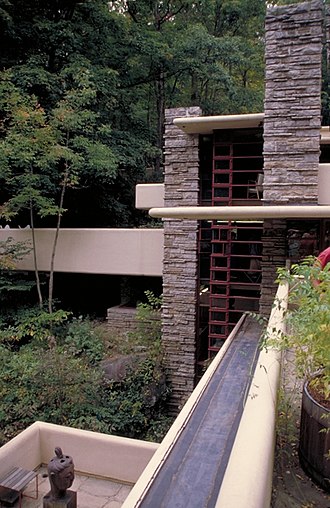
The genius of Fallingwater’s design is in the details, or perhaps the lack of them.  The house is constructed of reinforced concrete, stone, and glass.  Its interior spaces are small and dark, encouraging more time spent outdoors.  The sound of water can be heard everywhere, whether from the stream and waterfall below or from the natural spring allowed to drip along one of the hallways.  Fallingwater’s distinctive cantilevered terraces are meant to resemble nearby rock formations, extending in every direction to the forested surroundings.  Its dramatic perch on top of the waterfall is hidden from the approach to the house, lending to a sense of modesty.

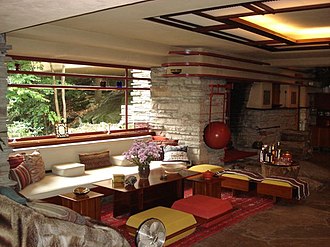
Fallingwater brings the outdoors in wherever possible, and its best example may be a ledge-shaped rock in the living room, left undisturbed in its original location.  The surrounding stone floor is waxed while the ledge is left plain and dull, creating the look of a rock protruding from a stream.  A stair descends from the same room, several steps down to a platform whose function is to simply admire the stream.  From photos, you’d believe Fallingwater was constructed entirely offsite and dropped gently within the forest by pushing aside a few tree branches.

Today, Fallingwater is a National Historic Landmark.  You can tour the house and grounds with the purchase of a ticket at the visitor’s information website.  If I were to visit, it’d be a ten-hour drive from where I live.  That’s not going to happen anytime soon.  Instead, I will build Fallingwater; literally.  It is a model in the LEGO Architecture series and I am lucky to own a copy.  As I tell my family, there are only two LEGO models I’ve ever wanted to build: the Grand Piano (completed last year and blogged about here), and Fallingwater.  It’s a new year and it’s time to get started.

I’ll bring you along for the ride as my miniature Fallingwater takes shape in my home office.  You can look for updates at the end of the next several posts.  Eight hundred pieces from now, when all is said and done, I may borrow that little sleep aid I gave my wife for Christmas.  After all, no house built on top of a waterfall would be complete without the sounds to go with it.  Remember, we’re talking (er, singing) about perfect harmony here.

Some content sourced from Wikipedia, “the free encyclopedia”.