Connection Protection

The college my wife attended many years ago was a small Midwestern campus, maybe twenty buildings in all. Because of the extreme winter temps, the college had the foresight to install tunnels between the primary buildings, allowing for warm, comfortable walks from say, the dorms to the central dining hall. It’s the same concept my wife and I discovered in Nuremberg, Germany last month, only this tunnel complex was on a much larger scale.  And getting from Point A to Point B wasn’t its only intent.

Nuremberg, Germany

You’ll find Nuremberg in the center of Bavaria, the forested southwest region of Germany.  The city served as the final destination on our recent Viking River Cruise on the Danube.  Like Salzburg, Austria a few days before, Nuremberg is known for its “Old City” area (now surrounded by modern-day sprawl).  Once inside those towering protective walls, it’s like you’ve stepped back into the Middle Ages.  If there’s a more preserved city of the period, with its moats, castles, towers, and bridges, I’m not aware of it.

A walking tour of Nuremberg is impressive enough with the history, architecture, and stories, but what trumps everything about it is what lies beneath the city.  My wife and I signed up for an excursion called “Flavors of Nuremberg”, expecting to enjoy a culinary sampling of regional delights.  Indeed we did.  Our first stop was for a plate of Nuremberg’s famous white sausages (with a tall beer to wash them down). This could have been lunch alone, but we pressed on for more.

Our next stop was for Lebkuchen, or gingerbread.  It’s even more famous than the white sausages.  Here are two things to know about Nuremberg gingerbread.  One, it contains no ginger.  Two, it’s not nearly as sweet as its American counterpart (typical).  Okay, let’s add a Three: Lebkuchen is absolutely delicious.  We packed a pile of gingerbread cookies into our suitcases to give to family members (but most of them ended up in our own pantry).

Our final stop – of course -was at a Nuremberg brewery for several glasses of local beer.  But what I wasn’t prepared for was how we would get to our beer  Instead of just walking through the front door of Hausbrauerei Altstadthof, our guide took us to the top of a stone staircase, set right into the middle of a nondescript Nuremberg street.  The stair was surrounded by modest iron rails but otherwise would’ve been something you’d walk by without pause.  Our guide explained how the original brewery was located on this spot centuries ago, marked by a plaque in the street.

What followed might have been my favorite moment of the tour.  Our guide excused himself to “go get the key”, so he could unlock the imposing door at the bottom of the stairs.  The key was held by some nearby merchant and our guide had the credentials to borrow it.  I find that charming, versus typing on a computer keypad or gaining the approval of a German guard.  You just open the door with an old brass key.

Our guide returned, beckoned us down the stairs, opened the door, and away we went.  Or should I say, down we went.  Even after passing through the door fifteen feet below street level, we continued down what must’ve been the equivalent of three more floors of stairs.  Our guide stayed behind to lock the door behind us, so we kind of descended on our own.  The walls closed in and it got darker as we went.  Suddenly beer was the last thing on my mind.

Which way do we go, Mr. Guide sir?

What followed was the equivalent of rats in a maze.  Seriously, if I planned to gulp fresh air or glimpse daylight ever again, I was entirely dependent on the movements of our tour guide over the next forty-five minutes.  He’d turn here or turn there, beckon us down one tunnel or push us through another, and he stopped several times to click on or click off the bare bulbs weakly lighting our way.  We passed through several intersections where we could’ve spun off in half a dozen directions, to be hopelessly lost under the city forever.  We saw what looked like dungeons and prison cells.  Suddenly I really wanted a beer.  Above ground.

Dungeon, or just storage?

Our guide stopped us would-be-spelunkers at several junctures to explain the fascinating history of Nuremberg’s miles-long network of hand-dug tunnels, originally used in the making of beer, then used as the city’s prison, and finally, remarkably, used to hide the thousands of residents the Nazis sought during WWII.  It’s an amazing history I can’t begin to do justice in this post, but you can read more about it here.  Suffice it to say, us tourists had a taste of what it’d be like to live in suddenly protective, seemingly endless tunnels for months on end.  Not for the faint of heart.

Watch your step!

At long last, we carefully ascended another long, irregular staircase, and our guide unlocked the final door at the top, where we burst into the sunshine and fresh air of Hausbrauerei Altstadthof‘s colorful outdoor biergarten.  It was a surreal moment, being thrust back into modern-day civilization from the medieval tunnels below.  The several beers that followed not only quenched my thirst but also calmed my nerves.  This “flavors” city tour was unquestionably the most adventurous excursion of the entire river cruise.

Relief in a glass

There was a time, when we lived in Colorado, where my wife and I considered connecting our house to our nearby barn.  We thought, why not string together a series of shipping containers below ground, to act as a tunnel to keep us warm during the frigid winter months?  After our subterranean tour of Nuremberg, I wondered what we were thinking.  Better to just hoof it through the snow than to get lost in the grounds of Colorado forever.

Do-Re-Mi… Oh My!

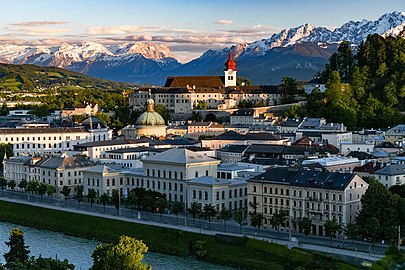
Salzburg, Austria, a day-trip destination from our recent Viking River Cruise, is a popular draw for tourists.  On most days you’ll find more internationals roaming Salzburg’s Old Town than you’ll find Austrians themselves.  The compact city is famous for its historic buildings: churches, palaces, and fortresses dating back 1,000 years or more.  Mozart was born here.  But try as they might, Austrians will never be able to separate Salzburg from what attracts many to its streets: The Sound of Music.

I can think of only one movie we forced our kids to sit down and watch while they still lived under our roof.  Close to Christmas one year (an arbitrary connection because of the lyrics of “My Favorite Things”), the five of us spent three hours together in front of our not-so-big-screen TV watching the somewhat true story of the von Trapp family.  I’ve lost track of the number of times I’ve followed Maria, the Captain, and those seven engaging children as they outwit the Nazis.

For all of the movies I’ve watched in my life (and I’ve watched quite a few), The Sound of Music stands alone.  I’d describe it as a jewel you display in an elegant glass box on the shelf, taken down every once in a while to appreciate up close. The Sound of Music is a feel-good story – if not accurate – produced in 1965 at the end of the Hollywood’s Golden Age.  It remains the most successful movie musical of all time (adjusted for inflation), but I question whether today’s movie-goers would appreciate it as much as I do.

Salzburg, Austria

Most tours of Salzburg include references to buildings and locations included in The Sound of Music.  Our own tour – cut well short because of the flooding of the Danube – was a brisk walk around the Old Town, with only an occasional mention of the movie.  What surprised me was not how little of The Sound of Music was actually filmed in Salzburg (most was done on sound stages back in the States) but rather the Austrians’ utter disdain for the movie.

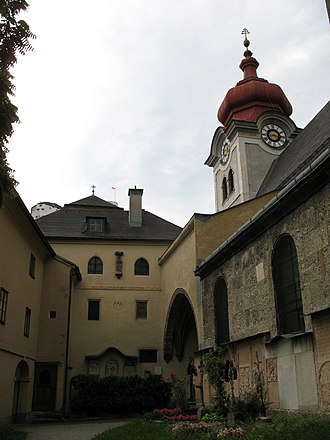
Salzburg’s Nonnberg Abbey

Consider, when it was first released The Sound of Music was only twenty years removed from the end of WWII.  The Nazi overtones of the film didn’t sit well with citizens of Austria and Germany.  Reviews (and box-office receipts) were not favorable in either country.  Coupled with the liberties the producers took with the story, you can see why Salzburg residents don’t exactly “Climb Ev’ry Mountain” to claim the movie as their own.

You’ll find endless trivia about The Sound of Music at IMDB.com and elsewhere.  Most facts are meant to point out discrepancies between the film and the actual story.  Here are fifteen of “My Favorite Things”:

1) Julie Andrews was cast as Maria, of course, but only because Audrey Hepburn declined the part.  Hepburn also denied Andrews the opportunity to play Eliza Doolittle in the movie version of My Fair Lady.  Each played the opposite role in the original stage adaptations on Broadway.

2) Andrews kept getting knocked off her feet in the famous opening scene where she sings and spins in an Alpine meadow.  She couldn’t keep her balance because the hovering helicopter used to film the scene generated too much wind.

Not as easy as it looks!

3) Andrews’ hair was meant to be worn longer but a bad color job forced the pixie cut, which Andrews kept for most of her acting career

4) Christopher Plummer was not a fan of The Sound of Music.  He reluctantly agreed to the part of Captain von Trapp and regretted every moment on set, especially those with the children.  He described working with Julie Andrews as “being hit over the head with a big Valentine’s Day card, every day”.  He nicknamed the movie The Sound of Mucus.  Much later he acknowledged the film’s worldwide success, as well as the Oscar-nominated talent of Andrews.

5) Plummer regularly drowned his acting sorrows in Salzburg bars and restaurants.  As a result his outfits needed to be resized towards the end of filming to accommodate his added weight.

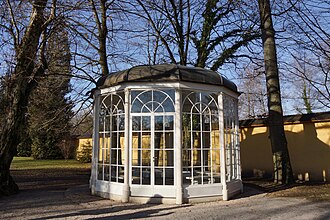
The gazebo (moved from its original location). The interior scenes were filmed In a much larger stage set reproduction.

6) The von Trapp children are Rupert, Agathe, Maria, Werner, Hedwig, Johanna, and Martina… not Liesl, Friedrich, Louisa, Kurt, Brigitta, Marta, and Gretl.  Also, none of the nine leads are Austrian (which certainly didn’t help the appeal of a film based in Salzburg).

7) Auditions for the parts of the von Trapp children included the four eldest Osmond brothers (not Donny), Kurt Russell, and Richard Dreyfuss.

8) Kym Karath, who played Gretl, the youngest of the von Trapp children, created her fair share of challenges.  She had a cold during much of the filming.  She almost drowned in the scene where the boat overturns in the lake because she didn’t know how to swim.  And she ate enough sweets on set to where her weight was too much for Christopher Plummer.  As a result, in the final scene walking over the Alps, Plummer is carrying a stand-in actress instead of Karath.

9) Nicholas Hammond, who played Friedrich, was not a natural blonde so his hair was bleached for the movie.  The coloring process caused some of his hair to fall out, which is why you see him wearing a “Tyrolean Traditional Alpine” hat when he’s seen singing “Do-Re-Mi”.

10) The day after the real von Trapp family left Austria (by train to Italy and then to the U.S., not on foot over the Alps to Switzerland), the Germans shut down all of Austria’s borders.

Salzburg’s Schloss Leopoldskron, where lakefront and garden scenes were filmed

11) The real Maria von Trapp is on screen at the beginning of the movie.

12) The real Maria also claims, if you can blieve it, her own personality was livelier than Andrews’ on-screen version.

13) The real Maria taught Julie Andrews how to yodel.  Watch the lesson here.

14) The film’s production demanded 4,500 extras, including those in the sold-out theater for the music festival.  The audience sings “Edelweiss” as if they know the song, but only because they spent time beforehand learning the words.

15) Despite the aforementioned Austrian disdain, The Sound of Music is played nonstop on the televisions of most Salzburg hotels.

Maybe all of this trivia changes your opinion of The Sound of Music.  Not mine.  There are countless reasons this film includes the tagline, “The Happiest Sound In All The World”.  The Sound of Music will always be that jewel in a glass box, waiting patiently to be enjoyed once more.  Suffice it to say, I’ll never say “So Long, Farewell” to the adventures of the von Trapp family.

Some content sourced from the Internet Movie Database (IMDb), and Wikipedia, “the free encyclopedia”.

Goulash by the Gallon

My mother used to make Beef Stroganoff when I was a kid; an easy one-pot concoction to satisfy a hungry family of seven. Mom’s recipe was a far cry from the elegant Russian original of beef strips in a sauce of sour cream and mustard. Hers started with Campbell’s Cream of Mushroom soup, added in whatever leftover beef and spices were found in the kitchen, and finished with soft egg noodles, all mixed together. It wasn’t my favorite dish, but as I recently discovered it’s a whole lot more satisfying than Hungarian Goulash.

This isn’t “Beef Stroganoff”, Dave

A month ago I didn’t know the first thing about Hungarian Goulash.  Now I know way too much about it.  That’s what happens when you visit Budapest.  Everything is about goulash.  And paprika.  Even goulash itself is about paprika.  But I’m getting ahead of myself here (kind of like I did with the last few blog posts, which were further down the Danube).

Before our plane landed in Hungary for the start of our Viking river cruise, I imagined goulash as a more traditional version of Mom’s Beef Stroganoff.  I expected a hearty casserole of meat, vegetables, and noodles, drenched in a rich, creamy sauce.  As it turns out, goulash isn’t even a poor man’s version of Stroganoff.  No “spoiler alert” here because you’re not missing much.  Goulash is plain ol’ broth-based soup.

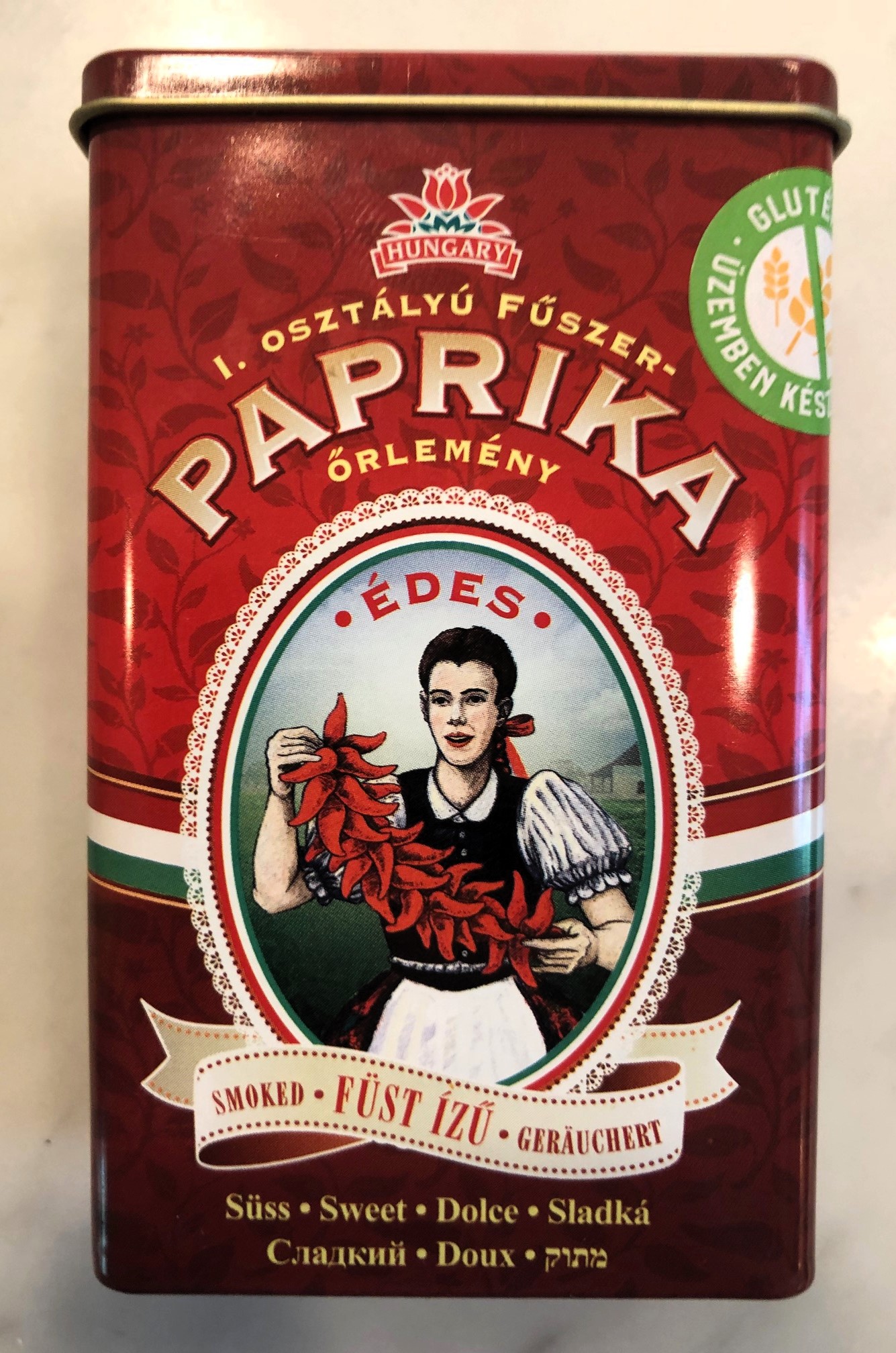
Check out the list of ingredients here.  Besides the ground caraway (ground “carraway”?), the only item standing out to me is the paprika, and only because paprika is synonymous with Hungary.  You find the peppery spice everywhere (and in everything) over there, in grades of sweet, mild, pungent, and strong.  Choose wisely; a small spoonful of the “strong” knocks your socks off even if you like it hot.

On a guided walking tour of Budapest (which included an hour inside the exquisite Parliament Building), we stopped for lunch in a basement restaurant for our first sampling of goulash.  The soup was served family-style with bread so we all ladled a helping.  In short, Hungarian Goulash didn’t “have me at hello”.  I was underwhelmed from the get-go.  I looked around the table at our fellow travelers and noticed the same reaction.  We struggled to come up with something distinctive or even complimentary about our meal.

Pálinka shots

Later on, we ventured into the countryside for a “Hungarian Folklore Dinner”.  As soon as we stepped off the bus, the place practically screamed “tourist trap”.  They greet you at the door with a shot or two of pálinka (fruit brandy), no doubt to dull the senses for what lies ahead the rest of the night.  Then they seat you at long picnic tables with people who look like, well, travelers from all of the other Danube river boats.  The gypsy folk dancing was impressive – I’ll grant them that – but the cauldron of goulash set unceremoniously in the center of the table was no more tasty than the helping we had at lunch.

Our goulash guide

The next day, we took another trip into the countryside for a walk through the several acres of an “open-air museum”, an interesting collection of buildings and settings from Hungary’s storied history.  The tour included lunch (hold tight, I know what you’re thinking), but even before lunch we stopped at an outside kitchen for a “special treat” – a demonstration on how to make goulash! (You’ll see I earned a diploma for my efforts.)  Then we were hustled into a nearby dining room for our third helping of goulash in twenty-four hours.  Part of the restaurant was already set up for a wedding reception later that afternoon.  Wonder what they were having for dinner…

Lest you dismiss Budapest over the goulash that seems to be oozing out of the city walls, let me set the menu, er, record straight.  It’s a beautiful city, whether you choose to tour the Buda or the Pest side of the Danube River.  The buildings are illuminated at night, the same way you’ll see Paris during the Summer Olympics in two weeks.  And Hungary’s history is adventurous and remarkable, with many more chapters than you’ll find in America’s.  But sorry comrades; the goulash (and the paprika) can only be described as superfluous.

One of the highlights of a Viking river cruise is the nightly dinner menu.  In addition to standing entrees, Viking chefs design “sampling menus” made up of the food of whatever city or region you happen to be passing through.  In Vienna it was the veal cutlet wienerschnitzel.  In Nuremberg it was the famous white sausage Weisswurst (correction: it would’ve been Weisswurst had our ship actually made it to Nuremberg).  And in Budapest it could’ve been Chicken Paprikash.  Instead, it was Hungarian Goulash… again.  Make that four helpings in two days.  I should’ve misbehaved so our captain could’ve sent me to my room without supper.

Some content sourced from Wikipedia, “the free encyclopedia”.

Monk Fruit

Let’s talk about apricots. If you read my last post, apricots are the last topic you’d expect in a series about a Viking River Cruise.  But fate played a hand when our ship only got a taste of the Danube River (while others were literally underwater), so I suppose we needed to satisfy our appetites on something else instead.  Like apricots.

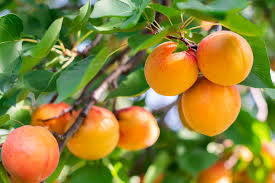
Apricots are petite and peach-like

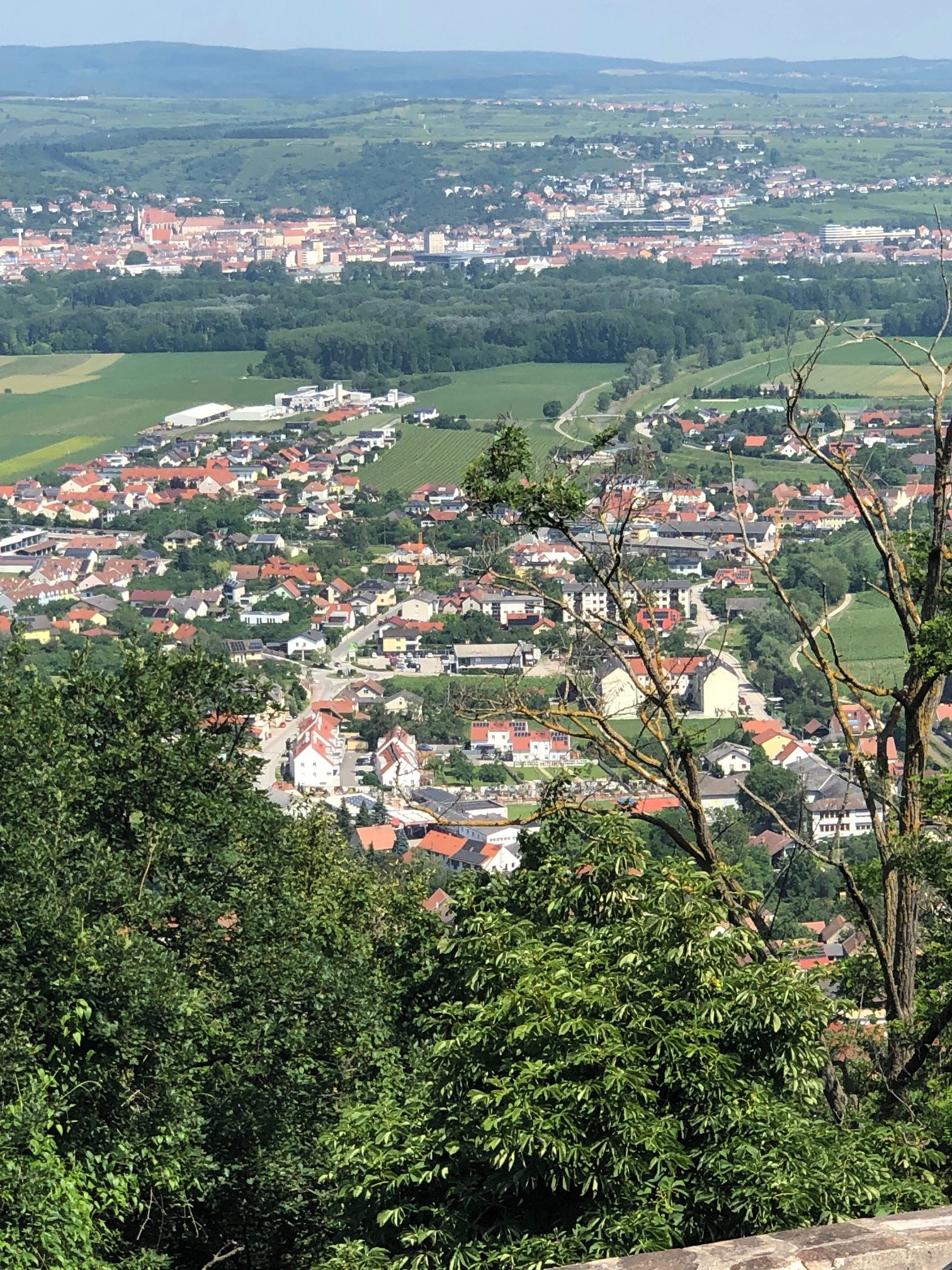
I don’t associate apricots with Austria at all (how about all the “a” words in that sentence there, huh?)  Austria is more about snowy Alps, Mozart, and the hills coming alive in The Sound of Music.  So it was something of a surprise to find myself on a hot, sunny day, standing in an apricot orchard in Krems, Austria. Almost floating above this little riverside town, you’ll find the fruit trees on the property of a Benedictine monastery known as Göttweig Abbey.

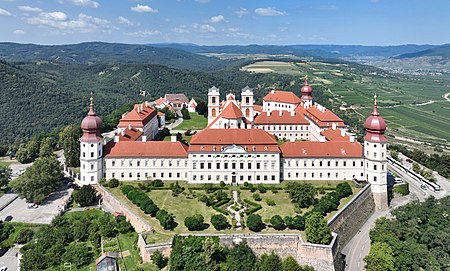
Göttweig Abbey, near Krems, Austria

Göttweig is an impressive complex of buildings, and even more impressive for its lengthy history.  The Abbey was built in the 1100s, rebuilt larger after devastating fires in the 1500s and 1700s, and survived relatively intact after the Nazi occupation of WWII.  Its library contains 150,000 books and papers, and its main structure houses the largest Baroque staircase in Austria.  But who cares about all that, I hear you saying.  Tell me about the apricots, Dave!

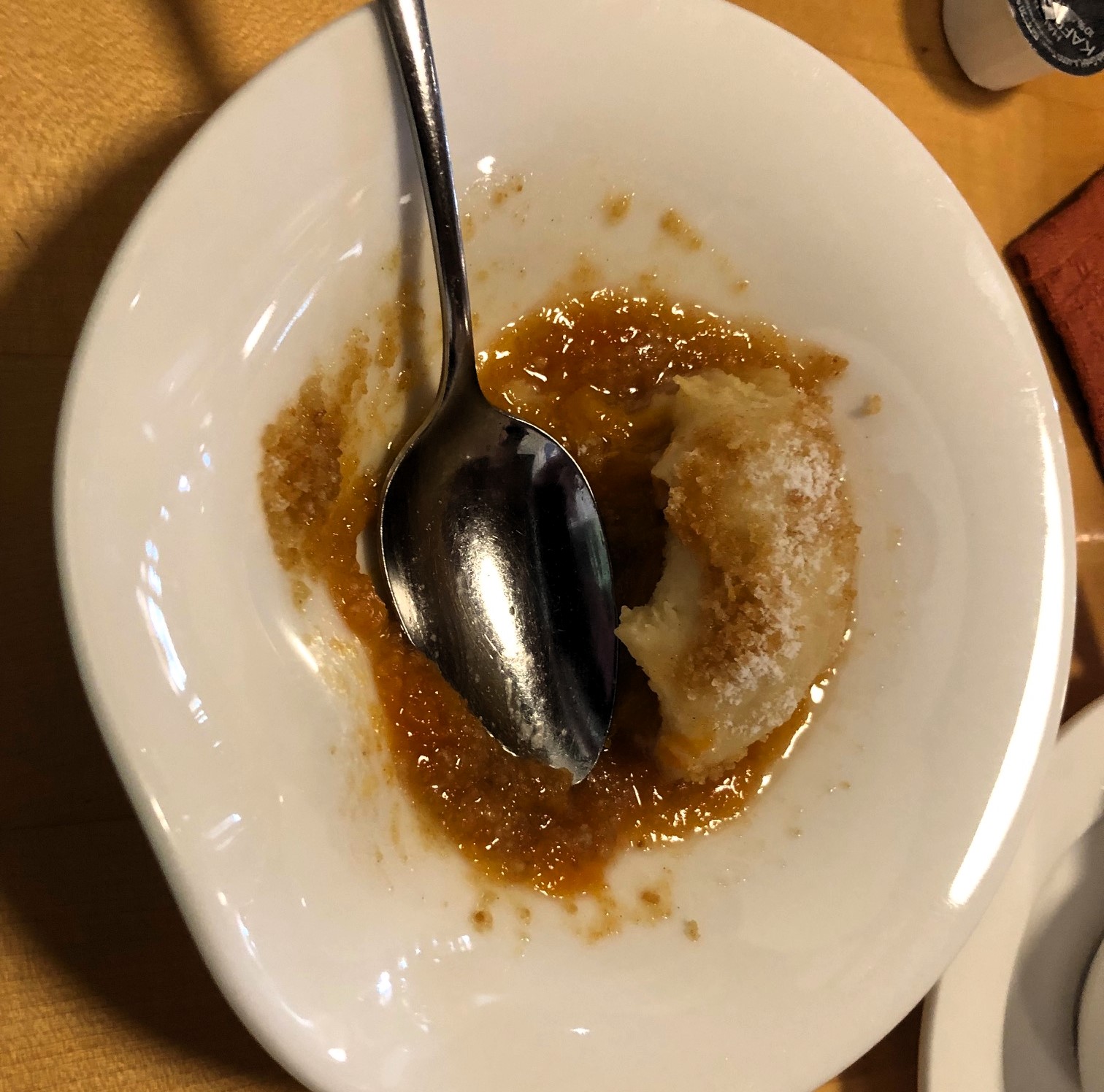
The last of my apricot dumpling

Let it be said; Göttweig brought apricots back to life for me.  The Abbey tour starts in its apricot orchard, where we saw the trees up close, on the verge of harvest time.  The tour ended with a short class on making apricot dumplings (unquestionably as scrumptious as they sound: a whole pitted apricot wrapped in puff pastry, topped with vanilla-apricot sauce, served hot).  And the gift shop… oh my, the gift shop.  Shelf after shelf of everything apricots, from syrups to jams to cookies to candy.  Even better, you’ll find a tasting bar for several varieties of Göttweig apricot wine and brandy (also available for purchase, of course).

The Abbey’s apricot orchard

When the tour took us to a little theater for a short film on Göttweig’s history, one of the monks (at least, I think he was a monk) served us apricot juice in tall glasses as a refreshment.  It was the proverbial nectar of the gods… and I time-traveled to my childhood instantly.  My mother served apricot juice at breakfast occasionally, and I remember never really caring for its sweet/tart taste.  Guess I’ve grown up since then.  This juice was so delicious my wife and I are already in hot pursuit for a bottle here in the States.  Not something you’ll find in your ordinary grocery store.

[Blogger’s note: Don’t take “Göttweig” for a spin on Google Translate.  Our tour guide said they’ve never known the meaning of the word.  Google Translate doesn’t either (but its guess is a little ironic).]

The Abbey’s main entrance

Here’s a strange word you should associate with apricots: drupe.  It’s another word for stone fruit; as in, fruit where the flesh surrounds the pit.  So apricots are drupes, as are cherries, peaches, nectarines, and plums.  Even dates join this pit-y party.

Here’s another word you should associate with apricots: orchard.  There’s nothing more frustrating with the English language than two words with essentially the same definition.  So it is with orchard and grove.  Technically there’s a difference.  If your apricot trees are planted in neat rows with the intent of commercial production, you have an orchard.  If you’re walking through the forest and come across a natural stand of apricot trees, you’re in a grove.  But c’mon, if all that is true then why do we say “apple orchard” but “orange grove”?  Sigh…

Not quite ready for harvest

I wouldn’t care if I had an orchard or a grove as long as I had apricot trees.  I’m not really a peach or plum fan, but man I love the taste of apricots.  As a kid I also loved them dried, because they were so sweet they might as well have been candy.  But the adult version of me chooses the fresh fruit instead.  And now the juice.

The views from the Abbey are spectacular

Some of you more adventurous (and/or Christian) souls may be interested to know Göttweig Abbey lies on one of the routes of the Camino de Santiago, the soul-searching network of the Way of St. James.  A tall glass of apricot juice would be most refreshing along the 1,100-mile pilgrimage to the coast of Spain.  Of course, you don’t need to walk that far for the taste of apricots.  Just mosey down to your local grocery store, because they’re in season now.  Maybe you too will discover newfound appreciation for “monk fruit”.

Some content sourced from Wikipedia, “the free encyclopedia”.

Go(ing) With the Flow

In the camping days of my youth, I’d get a kick out of dropping little sticks into the water and watching them float lazily downstream.  I’d imagine them as little boats, navigating uncharted waters on their way to some exotic destination.  I’d see how far those sticks could go, sometimes removing obstructions to create clear channels.  Perhaps it’s no surprise then, all these years later, I’m drawn to the adventure of Viking River Cruises.

Maybe you’ve seen their commercials.  Viking River Cruises advertise by showing you one of their elegant white ships cruising slowly down a pristine river, with dramatic terrain sloping up and away from the shorelines.  Viking “longships” are low, flat, and narrow; a  wholly refined version of my stick in the stream.  Take your pick: the Nile in Egypt, the Rhine in Germany, or the Mississippi in America, to name a few.  Viking has you covered when it comes to cruising the world’s rivers.

My wife and I just completed our second Viking cruise (well, “completed” doesn’t really cut it but I’ll get to that in a moment).  Our first, in 2019, down the Rhine River from the Netherlands through Germany to Switzerland, was so satisfying we were ready to sign up for another as soon as we were done.  Then the world went a little off the rails so we had to wait until the waters calmed again, so to speak.  A week ago then, we returned from Viking’s Danube River cruise; Hungary through Austria to Germany.

There are at least two reasons why Viking River Cruises don’t appeal to those who seek a vacation on the water.  First, you’ll find little more to do on the ship besides eat and sleep.  Yes, you’ll find live music in the lounge and an occasional cooking demonstration by the head chef, but for the most part a Viking ship is a floating hotel.  Second, the daily excursions off the boat are fast-paced guided looks at whatever is worth seeing, with only a little free time at the end for shopping and such.  Best to bring a comfortable pair of walking shoes to keep up.

Those same reasons are why Viking cruises do appeal to us.  We’ve been on one of those floating-city ocean cruises before (Carnivalick), and everything from the buffet to the entertainment felt cheap and mass-produced.  A Viking river ship caters to only two hundred passengers, in rooms as nice as most anywhere we’ve stayed on shore.  As for the excursions, the tour guides are carefully chosen for their knowledge and personalities, adding so much more to the tour than if you were to go it alone.  Yes, you’re only getting a “taste” of each locale, but this means you see a lot in eight days of cruising, leaving you to choose if and where you might come back to for more in-depth looks.

Eight days is plenty of time to be on the river (at least in our book) but Viking offers several options twice as long, including a fifteen-day Grand European Tour covering the Rhine and the Danube.  You can also add “land-based” days to either end of a cruise, exploring the cities from where you embark and disembark.  Finally, Viking tailors its menus (and I do mean menus, not buffets) to the cuisine of the region you travel through.  From our experience, the food is excellent.

Passau, Germany (one of our destinations)

If this sounds like a ringing endorsement for a Viking River Cruise, let me silence that bell for just a moment.  Perhaps the only thing Viking can’t control is the water itself.  Unbeknownst to most Americans, the Danube River flooded its banks earlier this month, forcing the powers that be (and who exactly are those powers?) to “close” the river.  Residents in destinations downriver found themselves wading through four feet of water.  River ships couldn’t fit under low-flying bridges, let alone dock at the shores.  As a result, our cruise came to a premature halt in Vienna, Austria, with the remaining itinerary carried out with busses and hotels.

I’ll take the next several posts to dive deeper into our “Romantic Danube” Viking cruise.  We missed out on the time we expected on the river, but the destinations were no less impressive.  Budapest is a heck of an interesting city.  Gottweig Abbey (outside the Austrian town of Krems) is keeping apricots relevant.  So stick with me the next few weeks and you’ll find out more about what the Danube has to offer.  After all, river cruising is a whole lot more adventurous than floating a stick down a stream.