Celestial Silver Dollar

I walk the dog late at night, just to be sure he doesn’t nudge me awake in the wee hours of the morning. The walk can be a chore when I’m tired but most nights it’s a quiet, peaceful stroll through our pitch-black horse pastures. We’re usually blessed with clear skies here in South Carolina, which means the stars and planets put on a display worthy of a paid ticket to an observatory. Regardless, the moment I’m out the door I’m in search of my other faithful companion: the moon.
Through the trees

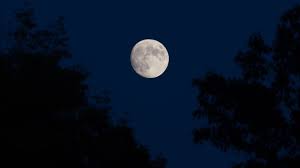
The “heavens” offer a plethora of topics to blog about (which I have: Saturn in Of Rings and Romans or Starlink satellites in Celestial Strings of Pearls, for example) but I’m overdue with a few words about the moon. Our nearest galactic neighbor is a constant wonder to me.  The moon (or is it “The Moon”?) is the reason we have ocean tides here on Earth and solar eclipses far, far away.  The moon has been the target of some of the most impressive space technology and exploration in history.  But let’s put the science aside, shall we?  Today I’d rather just muse about the moon as its sits in the night sky, like a shiny silver dollar laid out on top of a black velvet cloth.

My favorite moons are full – the perfectly round ones – but the shadowed partials can be just as beautiful.  Depending on the season and the atmosphere, the moon takes on countless looks.  Some nights it rises giant above the trees, as if invisible binoculars rest before my eyes.  Other nights the moon sits as an elegant crescent, a perfectly white slice of melon.  Still other nights the moon doesn’t rise at all, or at least, not until well after I’m in bed.  It’s a guessing game every time the dog and I head out into the dark.

I also make a game of trying to guess when the moon is full just by looking at it.  On the nights just before or after it occurs the moon can still appear as full.  So you have to look very carefully at the edges to decide if it’s perfectly round or not.  Conveniently, the moon is full about once a month, or at least, once every month in 2024.  Next year or the year after, perhaps we’ll get a “blue”: that second full moon in a calendar month.  Doesn’t happen very often, of course.

Here’s a fascinating fact about the moon.  It’s locked into place by the earth’s gravity, meaning it’s always showing you the same face.  Try to picture the earth taking a trip around the sun (once a year or so), while it’s spinning on its own axis (once a day), while the moon is spinning around the earth.  Technically the moon is rotating, just not on its own axis.  So you never get to see “the dark side”.

Here’s another fact that makes me pause.  If you drive across the United States from coast to coast and back again, you’re driving about 6,000 miles.  Do that same drive thirty times and you’ve driven to the moon.  Suddenly our celestial silver dollar doesn’t seem so far away, does it?

The next full moon (from my perspective), nicknamed “The Wolf”, is a week from this posting, on Thursday, January 25th.  It’ll be the first full one of the new year.  Good timing really, because some of you readers don’t make it to my blog until several days after the fact.  If you’re exactly a week late, walk outside tonight after dark.  A spectacular scene in the heavens awaits.

Some content sourced from Wikipedia, “the free encyclopedia”.

Two for the Money

Not so long ago people would say to me – my grandpa included – “a penny for your thoughts”. I always liked that phrase, though I was never paid for whatever was on my mind. Today you don’t hear it so much, because nothing is worth just a penny anymore. You’d be better off giving a dollar. Or two dollars.  Maybe then you’d find out what people think.

The other day I was in the drive-thru lane at my bank, and the teller cashed a twenty, returning a small stack of bills – a $1, a $5, a $10… and two $2-dollar bills.  I’ve seen plenty of the first three, but when was the last time you came across the double-dollar? U.S. currency may be downright boring compared to the colorful equivalents in other countries, but today I say this: the uncommon $2 is a cool bit of cash.

America’s paper money prints in just seven options today, from the $1 on up to the $100-dollar bill.  Fifty years ago you could find several larger denominations ($100,000!), but the big boys were dropped from circulation to deter organized crime.  Even today, the $50 and the $100 get second looks for fear of counterfeits.  The lion’s share of circulating bills is the $1 on up to the $20.  But the one that earns a second look? The $2.

What makes the $2 so tony?  Try finding one.  I asked my bank how many they have in the drawer at any given time.  They said none.  In fact, I didn’t just get my couple of $2’s – I had to ask for them – and the teller had to go back to the vault to find them.  The $2 just isn’t in demand anymore – hasn’t been for a long time.  The U.S. Mint stopped printing $2’s in 1966, but thanks to America’s bicentennial, started the presses again in 1976.  The most recent printing of the $2 was 2016 – almost 200 million – but it’s a drop in the bucket compared to the rest of the U.S. currency clan.  If you could shake the globe over a big basket, you’d find 40 billion U.S. bills in circulation right now.  But the overlooked $2 represents less than 0.5% of the lot.

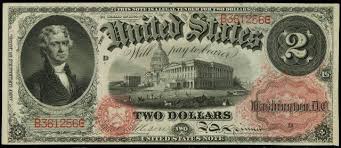
I like the $2 because of its unique look.  Thomas Jefferson is on the front – oval-framed as in a portrait (only George on the $1 has the same look).  The words “Federal Reserve Note” curve gracefully over TJ’s head; on all other bills those words are in a mundane straight line.  Finally, the $2 is the only bill without a building on the back, like the Lincoln Memorial or the White House.  Instead, you have an edge-to-edge top-to-bottom rendition of the signers of the Declaration of Independence (replacing TJ’s Monticello home from earlier versions).

The two-dollar bill has several chapters of urban legend much more colorful than other denominations.  Apple co-founder Steve Wozniak purchases $2’s in uncut sheets; then has them perforated and glued like a Post-It pad.  He enjoys tearing off several for tipping.  U.S. Air Force pilots of the U-2 spy plane keep a $2 in their flight suit; a sort of badge of distinction. $2’s are often used by gun rights activists to show support for the Second Amendment. The website Where’s George? keeps track of the circulation of over five million registered $2’s.

Despite my enthusiasm for the buck-buck, it’s not without its challenges.  The $2 is not accepted at most vending machines.  The common misconception the $2 is no longer circulating leads to suspicion of counterfeiting.  Two years ago at Christa McAuliffe Middle School in Texas, a 13-year-old was denied lunch privileges for using a $2 at the cafeteria window.  A man in Baltimore was jailed for using $2’s to pay for a purchase at Best Buy.

My couple of $2’s will stay with me a little while, at least until the novelty wears off.  Maybe I’ll spend one of them just to see what happens.  Maybe I’ll return the other to the bank vault for safekeeping.  Today’s lesson; there’s more to American money than fives, tens, and twenties.  $2’s have a place at the U.S. currency table as well, just as they did when first minted in 1862.

Some content sourced from Wikipedia, “the free encyclopedia”.