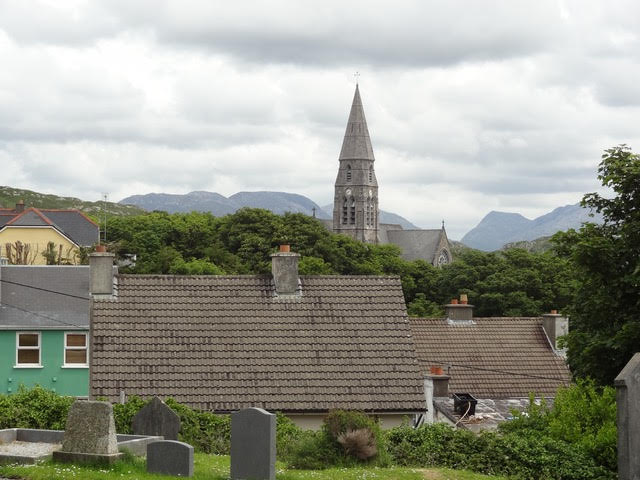
Tucked-Away Place to Pray

In trying economic times like these, it wouldn’t surprise me to hear about people using credit cards to pay their bills. After all, when you have more month at the end of the money you do what you must to stay above water. But it’s a bit of a fool’s game isn’t it, creating one debt to eliminate another?  Its what we call robbing Peter to pay Paul. And speaking of the Christian apostles, let’s talk about robbing John to pay Peter.
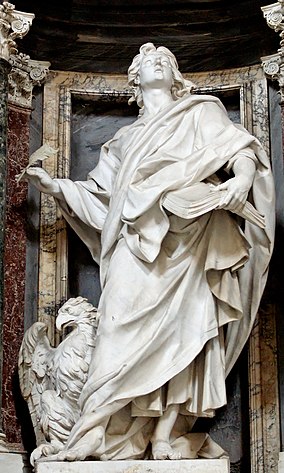
St. John

As promised when I began construction of the LEGO model of Notre-Dame de Paris last month (read about how I started this project in Highest Chair), I’d like to pay homage to a few of the world’s prominent cathedrals along the way.  These magnificent structures are places of worship at heart but oh-so-much more besides.   Each can be completely different in look and location.  My goal here is to not have you walk away from Notre-Dame thinking “seen one, seen them all”.

What better place to start than at the most significant cathedral in the world?  I’ll give you three hints.  It’s located in the middle of Rome.  It serves as the seat of Rome’s bishop (who just happens to be Pope Francis).  And it’s named for one of the most influential figures in the Bible.  Okay, time’s up, let’s have it.  Did you guess St. Peter’s?
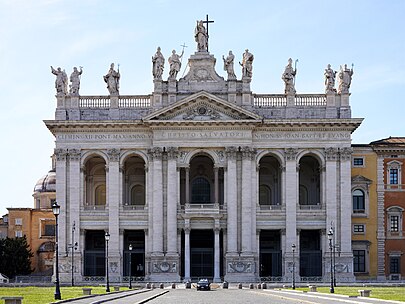
Cathedral of Saint John Lateran

If St. Peter’s was your guess, you’d be… incorrect, and in fact, incorrect three times over.  The St. Peter’s you’re thinking of – the “largest and greatest” church in the world – is not even a cathedral (but merely a basilica).  St. Peter’s is not even in Rome, since the Vatican is technically its own country.  Finally, St. Peter’s is not the seat of the pope (or any other bishop), even though Francis does live close by.  Instead, the award for most significant cathedral goes to Saint John Lateran.

The Lateran cathedral is about a 5K jog from St. Peter’s Square.  In fact, if you were to make the walk from one church to the other you’d pass by several of Rome’s highlights.  The Pantheon.  The Trevi Fountain.  Piazza Venezia.  The Forum.  The Colosseum.  Eventually you’d be standing in front of the imposing facade you see above.
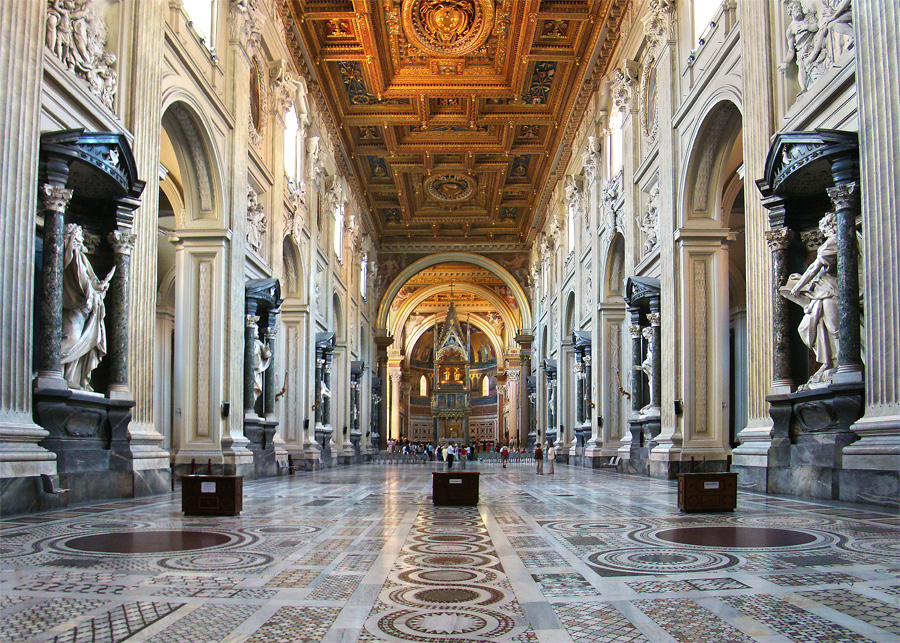
Click the photo to see the tiny tourists!

Saint John Lateran is old – even by Rome’s standards – first established in the mid-300s.  It sits on the site of the former Lateran family palace.  The cathedral survived several fires, earthquakes, and periods of deterioration, eventually retreating into the shadow of the grander St. Peter’s.  In the 1700s the Lateran received a complete overhaul, including the facade you see today.  But it has always served as the cathedral of Rome.  In fact, a plaque near its ancient bronze doors deems (in Latin): “… mother and head of all churches in the city and the world.”
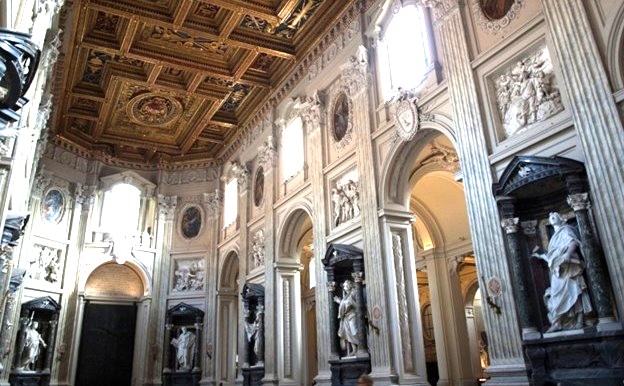
Apostles guard the cathedral

Like Notre-Dame de Paris, the Lateran boasts a lot more than just the structure itself.  Giant statues of the twelve apostles line the interior of the sanctuary.  Six popes are buried here.  The ancient Egyptian obelisk in front of the church is the world’s tallest.  Finally, the Lateran claims to have hosted significant relics of Christianity over its many years, including the Ark of the Covenant, the wooden table where Jesus hosted the Last Supper, and (for the less faint of heart) the skulls of St. Peter and St. Paul.
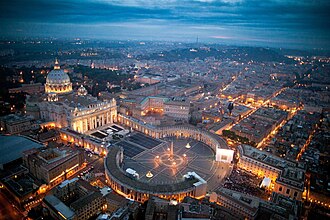
St. Peter’s Basilica and Square

It goes without saying; a trip to Rome isn’t complete without a visit to St. Peter’s and its surrounds.  The sheer size and elegance of the basilica is unparalleled and worth several hours (if not days) of your time.  But now you know; Saint John Lateran also deserves your attention.  It’d be a shame to travel all the way to Italy and back without claiminng a visit to the most significant cathedral in the world.


LEGO Notre-Dame de Paris – Update #6

(Read about the start of this “church service” in Highest Chair)

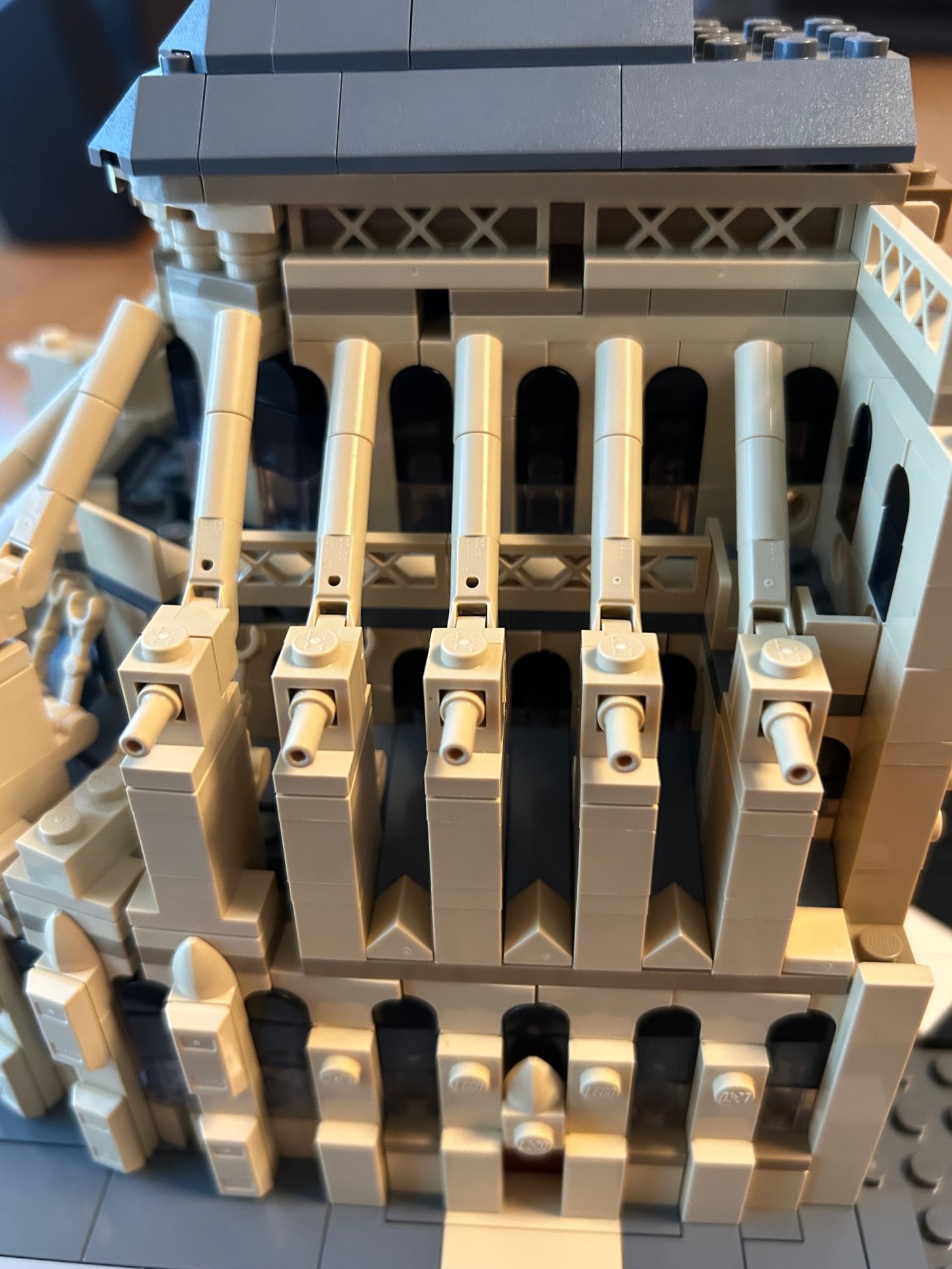
The model-building word of the day, boys and girls, is structure.  Bag 9… of 34 bags of pieces, brought us face-to-face with the finished look of Notre-Dame de Paris’s iconic flying buttresses, installed carefully around the walls of the cathedral’s east end.  Most of those “pasta bits” I showed you in our last visit amounted to fourteen (or about half) of the cathedral’s buttresses. They look like tiny cannons, don’t they?

before
after

Remember, the structural support of this cathedral is on the exterior, allowing for tall, thin walls, and more uninterrupted open space inside.  Someone could come up with the ten coolest structural elements for buildings and I’d have buttresses “fly” to the top of the list.

If Notre-Dame’s parishioners felt a sudden sense of security and stability, it’s because the giant hand of Dave was buttressing the very walls around them as they worshiped.  And if these structural elements aren’t elegant enough, they also house horizontal pipes to drain the water from the cathedral roof. 

Chancel w/ flying buttresses
Side buttresses w/ low drainpipes

I keep referring to the cathedral’s “east end”, but now that we’re starting to see the finished product we should use proper terms for church architecture.  We’ve effectively completed the chancel, which is the altar and surrounds to the east of the transept.  Picture a giant Christian cross laying on the ground.  The top of the cross is the chancel and the crossbar is the transept.  The lower length of the cross, where most of the parishioners sit, is the nave.  At the very bottom of the nave will be the bell towers.

Gotcha!

Today’s build was not without its adventures.  A small black piece escaped to my home office floor early on, prompting a prolonged hands-and-knees search.  I swear I heard the piece clatter to the floor yet neither hands nor knees made the encounter.  I was perplexed.  Finally, with the aid of my handy-dandy iPhone flashlight, I found the crafty little devil way, way back in the dark central recess of my desk.  This little guy was clearly making a move to freedom.  Sorry, bud; it’s time to come home.

Are you lost?

Finally, I thought the adjacent photo was worth including.  Pretty much every single LEGO piece of Notre-Dame de Paris is unique in size and shape.  Except this one.  How does a singular “trademark” LEGO block end up amongst thousands of irregular pieces?  Sadly, this piece was installed one level below the dark gray roof line of the chancel, which means you’ll never see it in the finished product.  So I figured it deserved its moment of glory here instead.

Running build time: 5 hrs. 32 min.

Total leftover pieces: 23

Some content sourced from Wikipedia, “the free encyclopedia”.
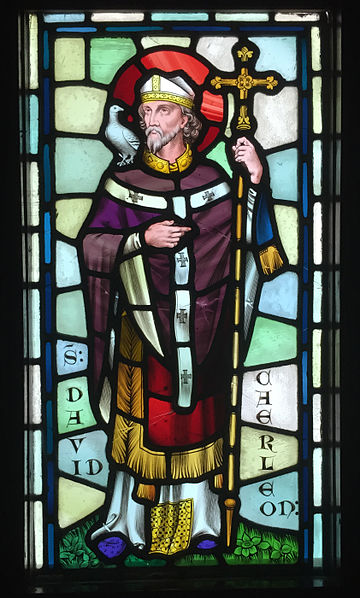
First-Name Basis

It’s only Tuesday as I type, but I’ve already cleared my calendar for Friday. After all, I have a very important day ahead of me. So important in fact, I need to organize a parade, raise a flag, and prepare unique dishes for the expected throng of adoring fans. But why am I wasting words on the details? You already know we’re celebrating Saint David’s Day in a few days, don’t you?

They’ll be celebrating in Wales, at least, just as they do every first day of March.  You’ll find my cathedral there too, way down in the southwest corner of the country.  Well, St Davids Cathedral, I mean.  And the funny thing is, he’s not the David you’re thinking of, the one from the Bible who took down Goliath as a boy and became king as a man.  This David helped to spread Christianity throughout the UK, united the Welsh people against a warring England, and performed several miracles.  David’s a big deal in Wales.

David’s parade (not Patrick’s)

St. Patrick’s an even bigger deal, of course.  At least Patrick rates a celebration in the U.S.  But admit it, you’re not celebrating Patrick’s spread of Christianity throughout Ireland, nor his miracle of removing all snakes from the land.  You’re thinking more about what garment of green to wear, four-leaf clovers, beer, and maybe, just maybe, this is the year you participate in your local St. Paddy’s Day 5k.

Nice cathedral, Dave

This business of saints is interesting to me because, well, it’s not as defined as I was led to believe.  The rules and processes to put “Saint” in front a first name are a little vague.  Suffice it to say, you need to be a model citizen, as well as a teacher, person of influence, and someone who cares little for the material goods and comforts of this world.  I know a lot of people who fill this bill, but add in “wonder worker” or “source of benevolent power” and the list drops to zero.

Do you know the way to… ?

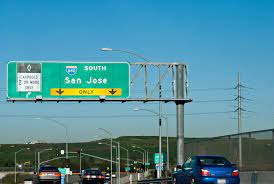
Saints are also on my mind because I grew up in California and, well, they’re all over the place out there.  Francisco to the north.  Diego to the south.  Barbara somewhere in the middle.  My childhood home was right down the street from Monica.  My brother lives in Fernando’s valley.  99.9% of the state’s residents think of those as “places”, but firstly they were people.  You’ll find “San’s” and “Santa’s” all over the Golden State.

Saints get a little watered down when you consider the Catholic Church’s take on them.  More than 10,000 have been recognized over time.  Even more to the point, Catholics acknowledge anyone making it to heaven to be a saint.  I’d hope that count is way more than 10,000 by now.  Maybe it’s the reason we have patron saints: the cream of the crop, the ones regarded as “heavenly advocates of particular nations, families, or people”.  My patron saint isn’t David by default, but I sure like his name.

Eat Welsh Rarebit when you celebrate on Friday (grilled cheese on toast, zero rabbit)

Admittedly, my mind wanders somewhere other than historical figures when I think of saints.  Our dog is a Saint Bernard, one of those gentle giants you picture with a brandy brandy around the neck.  A few years ago we went on a cruise, with a stop in the Baltic Sea port of Saint Petersburg.  “St. Elmo’s Fire” is a luminous phenomenon caused by an atmospheric electric field. (also a pretty good movie from the 1980s).  And so on.

You can read a bit more about Saint David and his cathedral in one of my very first blog posts: unsung.  You’ll discover that his town of Pembrokeshire – the smallest kingdom enclave in the UK – is right across St. George’s Channel from the Irish town of Kildare, where you’ll find St. Brigid’s Cathedral, my wife’s namesake.  The blog post is really about Brigid but at least David gets a mention towards the end.  Even if you don’t “read a little more”, remember, Friday’s the big day.  Parades, flags, and fun food, all for a darned decent guy.  Makes me blush anytime somebody says, “Dave, you’re a saint.”

Some content sourced from Wikipedia, “the free encyclopedia”.

Refuge and Reassurance

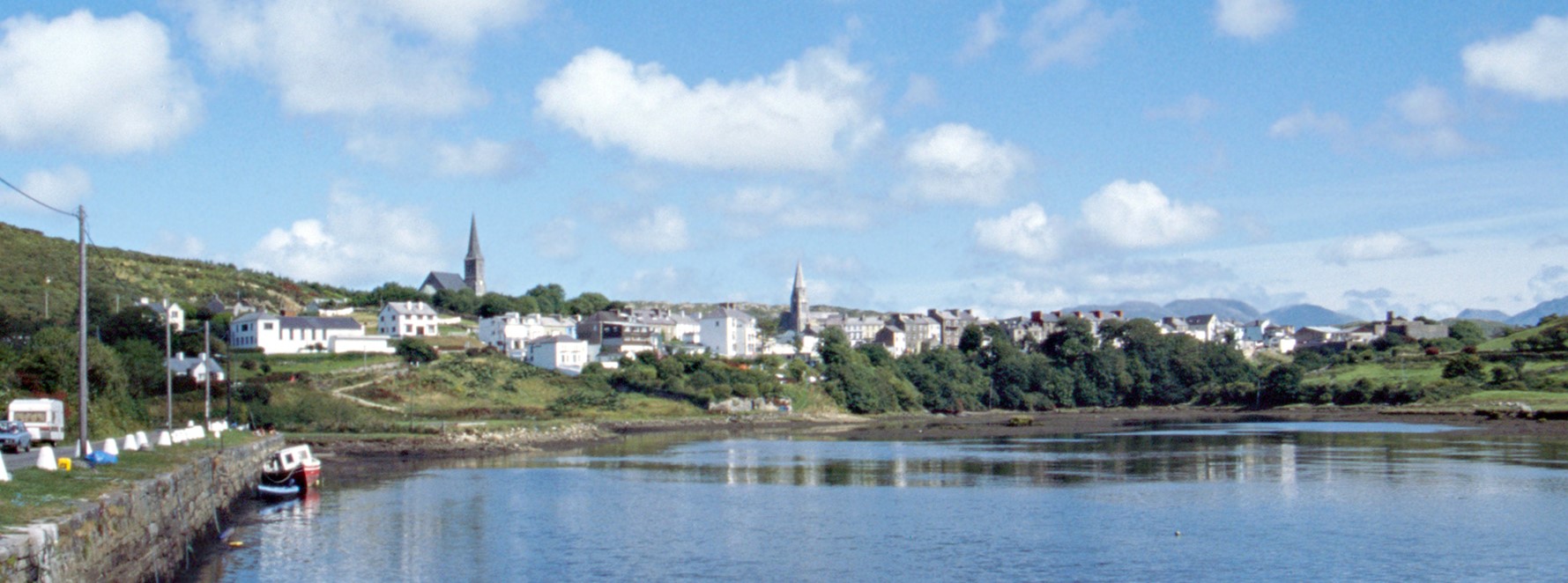
When the world goes off the rails like it did this week in Las Vegas, the very human reaction is fight or flight. Fight as in help to those who were impacted.  Flight as in shelter; consolation from an incomprehensible tragedy. My own flight, in extreme instances like this one, sometimes takes the form of fond memories of a journey my wife and I made five years ago, to a remote village on the west coast of Ireland called Clifden.

For those who travel to Ireland, Clifden is rarely on the itinerary.  It’s a four-hour cross-country drive from Dublin, and the final ninety minutes meander along a two-lane road through the forested expanse of Connemara National Park.  Clifden has a modest history for all of its two hundred years on the map.  The town evolved from farmers and fishermen who lived in the region, its commerce bolstered by the heir of a nearby castle.  Like most towns in Ireland, Clifden suffered the blight of the potato famine and the onslaughts of rebels from the north.  Its only claim to fame is the location of Marconi’s first wireless telegraphy station to the near south, broadcasting messages across the Atlantic to Nova Scotia in 1905.  Today Clifden has 2,000 inhabitants, still looking the part of “two churches, two hotels, three schools, and 23 pubs” it boasted in the early 1800’s.

As my wife and I discovered, Clifden is the very definition of “off the beaten path”.  We stumbled upon its welcoming neighborhood very much by chance.  Our intended stop was Galway that day, but once in the city-center (and having survived a five-lane roundabout), we yearned for something smaller and less urban.  Heading north along the coast and with dusk turning to dark, we experienced the thrill of the uncertainty of locating our as-yet-unknown destination.

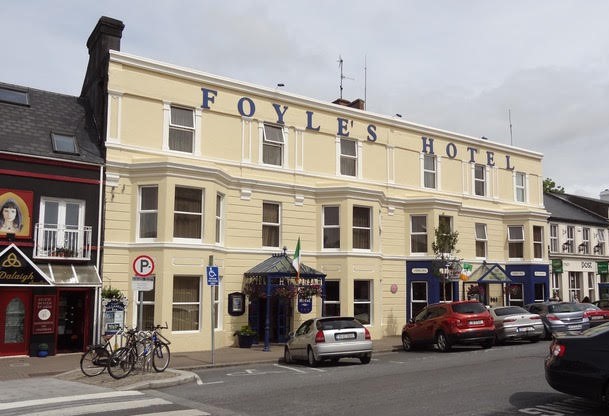
After a middle-of-the-road stop for a funeral procession (popular guy, judging from the dozens of people descending upon the nearby church), and then passing by the dignified Kylemore Abbey, little Clifden emerged from the coastal fog.  We stopped into the first bed-and-breakfast we could find, but there were no rooms at such a late hour.  Instead, we were directed to the larger/older Foyle’s Hotel a couple of streets away.  What a blessing in disguise.  Foyle’s was the perfect introduction to the charms of Clifden.  A turn-of-the-century grand dame with wide hallways, creaking stairs, and no elevator, we felt like we’d stepped back in time a century or more.  Dinner was served in an elegant main-level salon just off the reception area, soft music playing in the background.  Our spacious room looked down on the center of town from one of the second-floor windows you see here.

The next morning, we took to Clifden on foot, wandering its quaint, narrow, up-and-down streets.  We stopped in at Walsh’s Bakery for breakfast, walking away with a few of the more tempting choices from the case. We then stopped in at St. Joseph’s Catholic Church, one of the two spires accenting Clifden’s modest skyline. We climbed to the higher part of town for a look down to the lazy harbor activity along the quay.  More than any sight or sound, we simply embraced Clifden for what it was; a quiet seaside village; is inhabitants contentedly going about their business.  In contrast to bright and busy Dublin, Clifden summoned a much-needed deep breath and a moment of halcyon reflection.

Perhaps our travels will bring us back to Clifden someday.  But the more I consider the idea the less inclined I am to make it happen.  Our idyllic experience was predicated on the chance decisions making our visit happen in the first place, the wandering road leading us to its cobblestone streets, and the saving grace of vacancy at the Foyle’s Hotel.

In Gaelic, Clifden means “stepping stones”.  That’s a nice coincidence, since my fond memories seem to guide me back to a more content frame of mind.  I keep the following illustration in my home office.  With just a glance I can find reassuring refuge once again.

Some content sourced from Wikipedia, “the free encyclopedia”.