Horses on Circular Courses

In 1972, Billy Preston topped the Billboard Hot 100 chart with the catchy “Will It Go Round In Circles”. A year later, The Spinners spent five weeks at #1 on Billboard’s R&B chart with “I’ll Be Around”. More recently, Kacey Musgraves’ debut single “Merry Go ‘Round” won the Grammy Award for Best Country Song.  All of which is to say, if I’m asked to celebrate “National Carousel Day” I have a great choice of theme songs for the occasion… played on endless loop, of course.
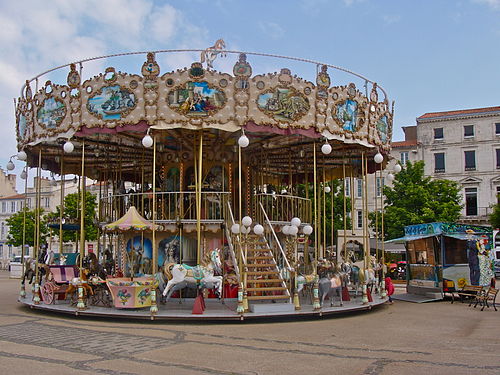
A double-decker!

National Merry-Go-Round Day (I prefer “Carousel”) was this past July 25th, as it has been every year since 2014.  Did you skip it like I did?  The holiday claims to “celebrate the carousel’s history and joy, particularly marking the first U.S. patent by William Schneider in 1871.”  And to celebrate, we’re meant to visit a local carousel, go for a spin, and post pictures of ourselves doing so online.  So we drop everything we’re doing on July 25th and climb on a wooden horse?  National M-G-R Day doesn’t even rate as a Hallmark holiday (and don’t waste your time trying to find a card to prove me wrong).
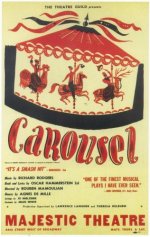
Contrary to my opinion about M-G-R Day, I think carousels are charming and a bit of innocent fun (other than those brass rings, which we’ll get to in a second).  Carousels inspired memorable scenes in Mary Poppins and BigCarousel was the Rodgers and Hammerstein musical that Time magazine deemed “the best of the 20th century”.  The “Carousel of Progress” was (and still is) one of the more unique attractions at Disneyland.  And of course, carousels led to those pipe and metal spinners we all played on at the park when we were kids.

Carousel is derived from the French word for “little battle”, which hints at why we’re riding them at all today.  In 17th century Europe, equestrian tournaments included “ring jousting”, where the rider attempts to spear a ring-on-a-string with his joust as he flies by.  To practice this sport without wearing out the horses, a clever soul invented the carousel, complete with wooden horses on poles and a real horse to pull the device in circles.  Eventually carousels made their way into carnivals, and then to the prominent locations where you find them today.
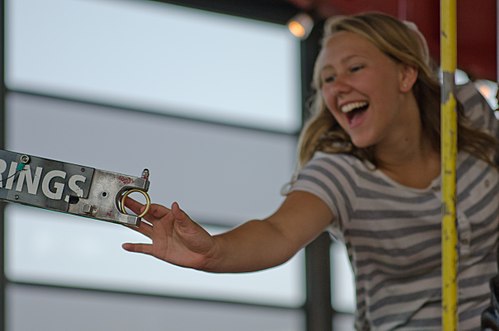
Care for a ring?

Now you also understand why early carousels had ring dispensers.  They were a nod to ring jousting!  The dispensers were filled with iron rings along with a few brass ones.  If you were lucky enough to ride an outside horse and grab a brass ring (which is harder than it sounds as your horse goes up and down), you could exchange the ring for a prize or another loop on the carousel.  For good reasons – safety being one – ring dispensers have been removed from most carousels today.

The people who came up with National M-G-R Day should’ve probably gone with “International”, because many of the world’s most distinguished carousels spin outside of the United States.  The Carousel El Dorado in Tokyo, Japan, built in 1907, is the oldest amusement park ride still in operation in the country.   The Lakeside Park Carousel in Ontario, Canada (1905) includes a self-playing organ that uses rolled sheets of music, rewinding one while playing the next.  The Letná Carousel in Prague, Czechia (1892!) is one of the oldest in Europe, remodeled in 2022 but still housed in its original wooden pavilion.
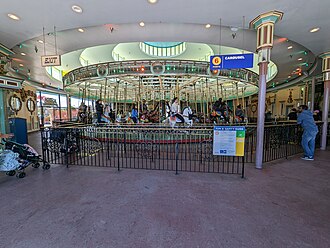
Looff Carousel (1911)

America has its share of prominent “gallopers” as well.  The Looff Carousel in Santa Cruz, CA is one of the few remaining with a ring dispenser, and entertains with the music of three organs.  The Over-The-Jumps Carousel in Little Rock, AR (1924) simulates the natural movement of a horse instead of just going up and down on a pole.  And the Flying Horse Carousel in Westerly, Rhode Island (1876!) is exactly as advertised.  The horses are attached to the center spindle instead of the wooden platform, creating a better sensation of flying through the air.
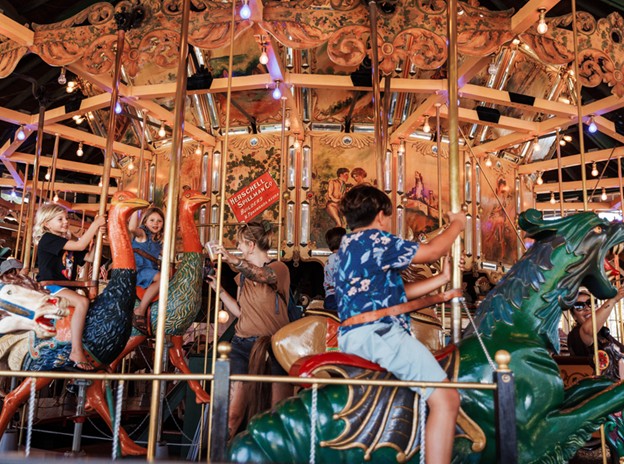
Dorothea Laub Carousel (1910)

Okay, I have a confession.  I had the perfect opportunity to celebrate National M-G-R Day just days after it happened this year.  My wife and I traveled to San Diego with our children and grandchildren for a beach vacation and found ourselves in Balboa Park, home of the Dorothea Laub Carousel (brass ring dispenser!)  If we hadn’t already worn out the little ones on a long walk through the Japanese Friendship Garden we might’ve made it to the wooden horses.  But I’m not losing sleep about it.  After all, National M-G-R Day will come ’round again next year.

Some content sourced from Wikipedia, “the free encyclopedia”.
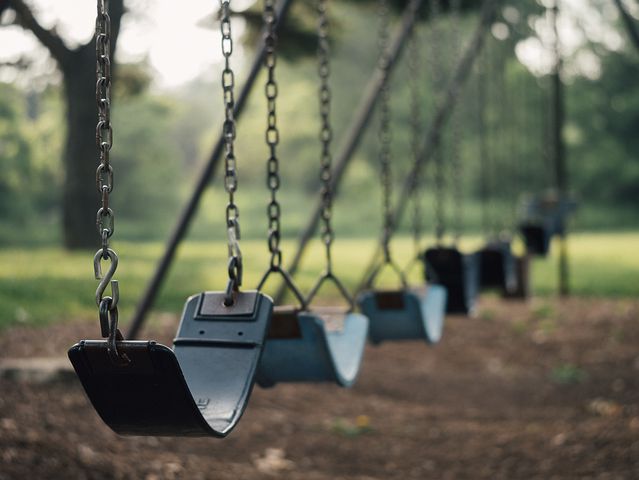
To and Fro

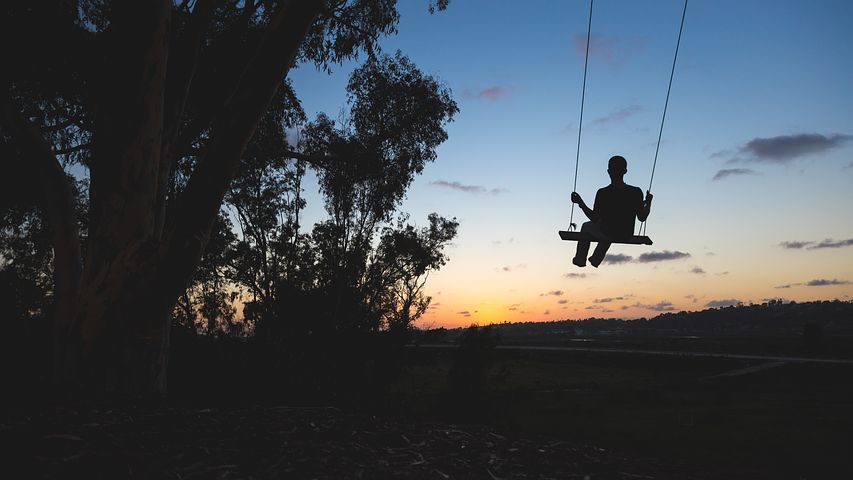
The band Lonestar penned a catchy tune back in 2003 called “My Front Porch Looking In”. The lyrics included the happy antics of the little family inside the house, implying the view “looking in” beat anything to the outside.  That song enters my mind every now and then, especially with the view from my home office looking out over our property. Which got me to wondering, whatever happened to the front-porch swing?

Swings have withstood the test of time, in a world increasingly complex and sophisticated.  The playground swings of my childhood – those chain-and-cloth contraptions suspended from a simple framework of iron pipes – are still in abundance in countless parks and schoolyards today.  Just last week – as my daughter chose an apartment in a large complex in Los Angeles, I noticed the grounds were scattered with small open spaces, each with benches and fountains… and lots of swings.

I can still remember my early days aboard a swing.  Once you figured out how to get your body to generate the momentum, there was no turning back from the addicting to-and-fro.  The reckless objective was to see how high you could go – to the point where you’d almost fall out as you stared down at the sand from the sky above.  If you really pushed it you could get high enough to cause the chains to lose their slack, resulting in a nasty jolt of the chains before you came plunging back to earth.  Finally, there was the I-dare-you launch, where you completed the forward swing with a propel of the body skyward, then dropping to the sand.  I often wondered if you could throw in a gymnastic somersault before you stuck your landing.  Never tried it.

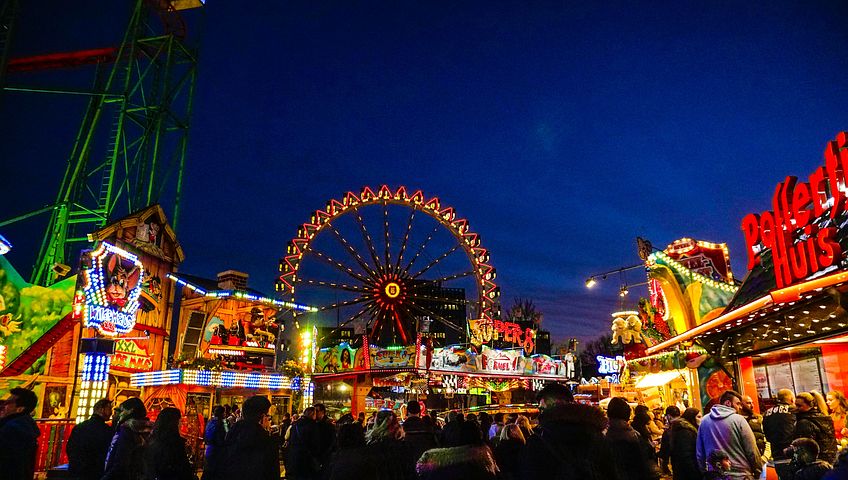
Just yesterday I passed a large carnival in a city park, with those bright, colorful thrill rides popping up higher than the trees.  Sure enough, they had one of those massive swings, where a dozen or more riders are suspended in a circle and twirled up into space.  That first rotation is a little unsettling, but I expect the rest is as relaxing as a merry-go-round.

Swings may still be in parks, but they seem to have gone missing from the front porch.  Therein lies my favorite “swing memory”.  My grandparents’ modest one-story house included a smooth concrete landing just outside the front door, facing a small lawn.  On this spot lived one of those wonderful old mechanical porch swings.  Picture a rocking couch really, with soft cushions and a cloth surround to keep in the shade and cool.  Over time the swing developed a bit of a smell from years of rain and morning dew, but we kids didn’t care.  Our feet easily touched the ground, creating the frantic engine of the to-and-fro.  When two or three of us would sit side-by-side (arms folded so as not to – ewww – touch each other), we would rock the swing so hard it’s mechanics would protest as loudly as my grandmother.  Sometimes we would lie down sideways and swing with just a push of the hands on the concrete.

No doubt, the appeal of the swing stems from those first few years of life, when all of us were rock-a-bye babies.  Just watching or listening to the cadence of something going to-and-fro is almost as appealing as the physical feel.  So when I see an adult on a swing, I’m not surprised.  When I see the long line of rocking chairs at a Cracker Barrel restaurant, I’m not surprised.  And when I find anything that goes back-and-forth, it gives me a sense of calm.

My front porch suddenly seems to be missing something.  I should get a swing.


Running for Roses

On the treadmill this week, surrounded by dozens of others tackling their workouts, an idea formed in my head. Whether it’s running, sprinting, or even dancing on the treadmill (the new trend these days), there’s a subconscious sense of competition with those around you.  Someone wants to leave the room believing they “won” their workout.

Flash back to state fair or neighborhood carnival memories for a second. Those light-bright terror-filled rides drew me in as a kid, but how about the midway games?  That’s where I dropped some serious cash. Ring toss. Shooting galleries. Fishing pond. Skee ball.

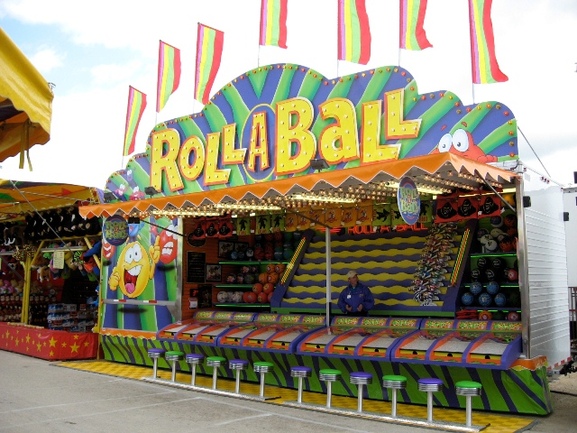
In my book, the most memorable of the midway games was the Roll-A-Ball horse race. A larger-than-average booth with a dozen open stools invited you to have a seat. Along the back was a massive tote-board with horses lined up top to bottom. You had a brief sense of mounting a thoroughbred and trotting into the starting gate. The game began (with an obnoxious bell), and each “jockey” rolled a ball up a small wooden board and into holes.  The further away the hole the faster your horse galloped across the board.  The closer the hole the less the gallop but also the quicker the ball came back to you.  First horse across the finish line won (another obnoxious bell).  Some versions of the game had you shoot targets with water guns instead of Roll-A-Ball.

Here’s a video of the Roll-A-Ball horse race in action.

There’s a ton of frantic energy with Roll-A-Ball.  You play while nervously glancing at the tote-board to see how your horse is coming along. Whenever someone hits a high-score hole their horse surges to the lead. Towards the end you’re aiming for the further holes in a desperate attempt to make up furlongs.  As if the distraction of carnival sounds isn’t enough, thundering hoof beats blare every time a horse makes a move.

With Roll-A-Ball in mind, let’s go back to the gym.  I propose we combine the horse-race concept with the treadmill workout.  Place a big tote board at the front of the room. Assign each treadmill to a runner on the board.  Then create several competitions as everyone works out simultaneously. Who has been running the longest? Who is running the fastest? Who is covering the most distance?  The runners advance across the tote-board according to the individual efforts on the treadmills.  Tote-board results change constantly as runners join or leave the game.

Would people “play”?  You bet they would.  Runners are competitive by nature as they vie to “medal” or win their age category or even just improve their “personal best”.  Runners are entering 5K’s and 10K’s, half-marathons and marathons in record numbers.

Me?  I run because it makes me feel good.  But don’t think I don’t notice the results of my workout spelled out in big, bold numbers on the treadmill display. Total Time. Total Miles. Average Speed. Calories Burned.  Sometimes I race against my former self.  Sometimes I increase my pace to match the faster runner three treadmills over. Sometimes I run longer to outlast the creeper who chose the treadmill right next to me when several others were open.

Competition leads to better workouts so the racing element is a slam-dunk.  Add a “join” option to the treadmill display and you instantly pop up on the tote-board.  Quit whenever your workout is done.  Even if you don’t “win” I’d bet dollars to doughnuts you’d get a better workout than if you were running in isolation.

Mark my words, someone more innovative than me will take this idea and “run with it”.  Gyms will cough up the purchase price because racing games would attract more memberships.  And maybe, just for a moment, runners will feel like they’ve stepped off the treadmill and back into the carnival of their childhood.