
I wouldn’t normally be drawn to a company whose products target women. I’m pretty well stocked when it comes to lip balms, lotions, and shaving cream. But here comes EOS (“Evolution of Smooth”), a newish company using organic ingredients and bright, colorful packaging to entice its buyers. Now I’m enticed too because EOS just came out with an orange product. Or should I say, a product in an orange. You could say it’s something that only comes ’round once in a blue moon.
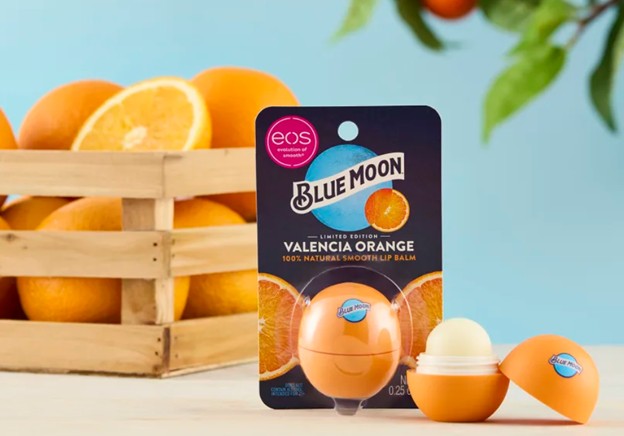 Evolution of Smooth may be trying to target men as well. Why else would they concoct a lip balm that tastes like Blue Moon? If you haven’t had so much as a sniff of beer, Blue Moon is an everyday man’s brew produced by the Canadian-American conglomerate Molson Coors. It’s a Belgian-style wheat beer: high on the wheat but not so much on the malted barley. And now it’s a flavor of EOS lip balm inside of a plastic orange.
 If you order a Blue Moon off the menu, the bottle or glass should arrive garnished with an orange slice. It’s a nod to the orange peel component of the beer; an ingredient giving the witbier its subtle citrus flavor. I should know because I’ve had more Blue Moons than any other beer out there. When you live in Colorado as long as I did (almost 30 years) sooner or later you’ll tour the Molson Coors facility in Golden, just west of Denver. They bus you around town first (a quaint holdover from the era of the Pikes Peak Gold Rush) before depositing you at the doors of the rather industrial-looking facility.

When you get down to touring – walking through the massive brewery, seeing the step-by-step production process, and sort-of-but-not-really believing the beer’s water content flows straight from the nearby Colorado Rockies – you’ll get a better appreciation of just how much effort goes into a single bottle. But like most breweries a beer fan anticipates the final stop – the tasting room – where you’re offered brands and flavors not yet released to the public. It was here I discovered Blue Moon, back in 1995 when it was just a concept beer.
Fancy homes boast of well-stocked, temp-regulated walk-in wine cellars with dozens of the finest bottles on display. I boast of a 24″x 24″x 36″ below-counter drink cooler, purchased on sale at The Home Depot for $225. I may not have dozens of the finest bottles on display, but in my house you’ll always find a half-dozen bottles of Blue Moon at the ready.

To be clear, I’m any occasional beer drinker at best. I can make a six-pack last a month. The only time a beer really appeals to me is after an afternoon of hard, sweaty, gnat-filled yard work. I’ll come back into the house after hours of that kind of fun and Blue Moon beckons. And even if I consumed more than a half-dozen bottles a month I certainly wouldn’t be put off by the price. A six runs you $11.99 at Target.
I do know how good a beer can really taste. Make your way to Dublin, Ireland sometime, tour the downtown Guinness Storehouse brewery (which trumps the Molson Coors experience in every way imaginable), and have a fresh pint in the top floor tasting room as you gaze out the floor-to-ceiling windows at the fairy-tale surroundings below. You’ll never want to leave. You’ll also realize that Guinness you’ve been having in America doesn’t measure up to the one you can have on Irish soil.

Any beer connoisseur reading this post is laughing at my reverence to Blue Moon. It’s a product whose color, strength, and lack of history bears little resemblance to the storied lagers of the world. It’s like the cosmopolitan offerings among the “real” alcoholic drinks on the bar menu. Light on ingredients and better meant for women.
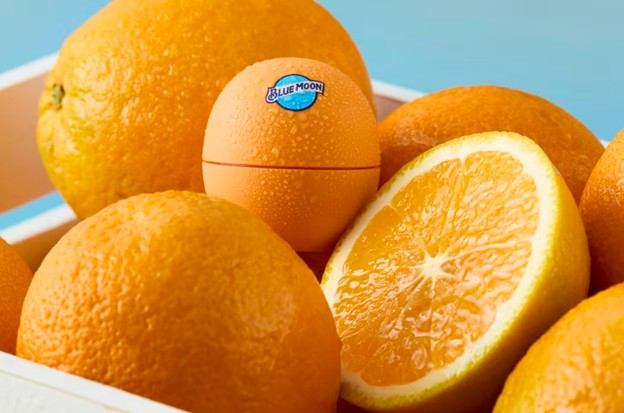 No, Blue Moon isn’t necessarily meant for women (I hope), but maybe EOS’ latest lip balm is a clever way to get them interested. It certainly got my attention, and the thought of the taste of Blue Moon on my lips the entire time I’m working outside sounds amazing. No bottle or glass to juggle while I run the lawn mower. No garnish of an orange slice necessary. $4.99 instead of $11.99. Good call, EOS. I’m in.
Some content sourced from the CNN Business article, “Blue Moon… is being turned into a lip balm”, and Wikipedia, “the free encyclopedia”.


 Life In A Word