
I’m enjoying a couple of soft-boiled eggs right now, my every-other-day breakfast entrée. The timer I use to prepare them sits right in the pot of water, indicating when the eggs are cooked to perfection. I pay a little more than average for my eggs, to producer Vital who advertises “pasture-raised – tended by hand by farmers who care”. On the other hand, if I wanted to pay a lot more than average I’d simply go to a rare goods auction and buy one from Fabergé.

You wouldn’t have a Fabergé egg for breakfast, of course. No one would ever sink their teeth into a priceless work of art (well, maybe a banana), let alone one of only fifty that were ever created. One of the Fabergés – the “Winter Egg” – went under the auction block last week, with the winning bid confirmed in a mere three minutes. The buyer’s purchase of a single Fabergé for $30.2 million dollars is a new record; noteworthy considering how many times the eggs have changed hands in the last 140 years.

I can’t say why we Westerners even know about Fabergé eggs. Most hide in private collections or in museums you’ve never been to. The eggs were created in St. Petersburg, Russia in the late 1800s by jeweler House of Fabergé for the reigning tsars of the time. One or two eggs were produced every year as exquisite Easter gifts, from 1885 through 1917. Most are jeweled with diamonds and other precious gems, and hinge open to reveal delicate animals or scenes within.
The Winter Egg (1913) is described as “the most spectacular, artistically inventive and unusual” of all fifty Fabergés, which is quite a statement when any one of the eggs deserves the same praise. The Winter Egg took almost a year to design and create, and the value is evident in the details. 4,500 tiny rose-cut diamonds are married to a platinum snowflake motif to create the impression of a block of ice dusted with frost.

The Winter Egg hinges opens to reveal a hanging basket of wood anemones, made from white quartz and rare green “Tsavorite” garnets. I can’t imagine working with these expensive materials on such a small scale but maybe that’s because I don’t have the delicate fingers of a woman. The Winter Egg was designed and created by Alma Pihl, the only female jeweler in the House of Fabergé.
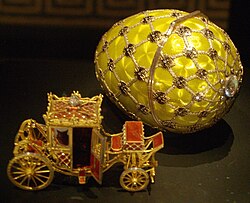
On a cruise around the Baltic Sea several years ago, my wife and I were fortunate to spend a couple of days in St. Petersburg, touring Catherine Palace and Peterhof among the city’s other sights. When we returned to the ship we were greeted by a local jeweler, who offered replicas of the Fabergés (for less than $32M, thank goodness). We chose the Imperial Coronation Egg (1897), inspired by the color of Tsar Alexander III’s robe. The Coronation Egg houses a replica of the imperial carriage, made with gold and platinum and detailed with rubies and diamonds (the original egg that is, not ours).
 After learning a single egg can set you back $32M, I now look at my breakfast eggs a little differently. $10.99 a dozen? That used to be top of the heap. Now it’s just pocket change.
—————-
LEGO Trevi Fountain – Update #6
(Read about the start of this build in Brick Wall Waterfall)
There’s a moment in every LEGO build where you look at what you’ve constructed and think, Hey, I’m almost done! That moment was today. Bags 10 and 11 – of 15 bags of pieces – brought the structure of the Trevi Fountain to new, practically finished heights. The tiny, tiny pieces I worked through (so many of them I was afraid to count) resulted in the uppermost level of the backdrop you see in the final photo.

From my magic hat of Italian composers I somehow chose Claudio Monteverdi for my musical accompaniment today. You don’t know Monteverdi and apparently I don’t either. Had I realized his contribution to classical music was mostly opera (hard pass) I would’ve reached into the hat again. Alas, I was subjected to Monteverdi’s L’Arianna “lament” – equal parts sorrow, anger, fear, and so on. Those singers sure didn’t sound happy as I snapped together LEGO pieces, but honestly who knows? I don’t speak “sung” Italian.
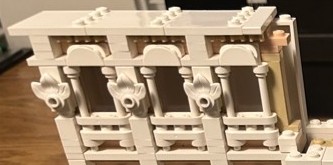
Here’s an expectation with a symmetrical LEGO build. If you construct an element that goes on one side of the model you’ll be mirroring it on the other side before you know it. A hundred or more pieces went into the windowed wall you see here, and a hundred more went into its twin soon after. It’s repetitive yes, but at least you go faster the second time around since you just had practice.
 A word about the little devils in this photo. Because they’re cylindrical they can roll. Because they roll they can hide under something. Something like a LEGO instruction manual. Once again I was fooled into thinking I was missing pieces… until I thought to look under the manual. Sure enough, there they sat just smirking at me. So I promptly arrested and cuffed them, hauled them away, and now they’re jailed in the backdrop you see here, without possibility of parole.
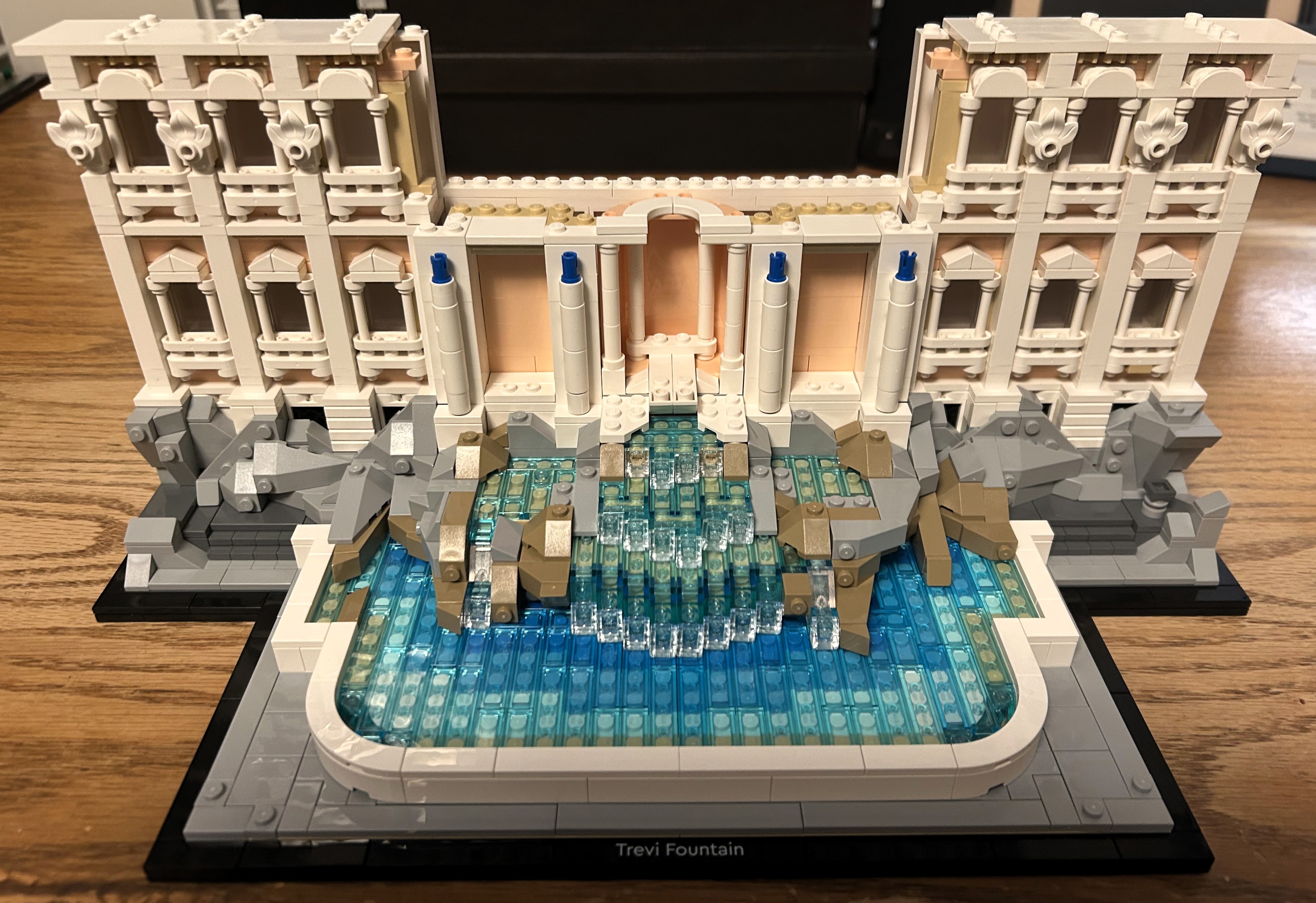 We’re just four bags of LEGO pieces from “turning on the water” of the magnificent Trevi. I’ll admit to peeking into the box at those upcoming bags. They are small, all four of them. Perhaps I’ll wrap the fountain construction in a single go next week. Even if not, conveniently, the final block of travertine would be laid the following week, just in time for Christmas. Now that’s what I call a gift!
Running build time: 5 hrs. 42 min.
Total leftover pieces: 32 (tiny, tiny pieces)
Some content sourced from the CNN Style article, “Faberge egg fetches record $30.2 million at rare auction”, and Wikipedia, “the free encyclopedia”.





 Life In A Word