
I can think of a dozen name brands I gotten hooked on for years, only to see them suddenly disappear from the shelves, never to return. Breakfast cereals. Hair spray. Cars. And what do we do when this happens? Simply find another brand and get used to it – easy-peasy. But when your streaming television service drops an essential channel, you can’t just jump to the next provider. Try that and you’ll hit your head on the cage they have you securely locked into.
 Even if you’re not a sports fan, you’re probably tuned into my topic today. YouTube TV – which provides me the five channels of streaming television I care about (and 95 forgettable others), dropped ESPN from its lineup. It wasn’t like they warned us months ago they were renegotiating with Disney (ESPN’s parent), and that these talks weren’t going so well. Instead they alerted us last Thursday just before midnight – with an email coyly titled “An update on our partnership with Disney”. Then, the following morning, ESPN was gone. On Halloween. How fitting.
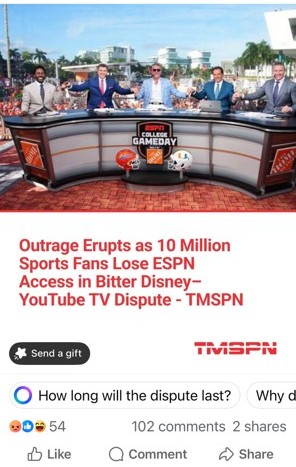 Without going into the weeds on why ESPN was dropped, let’s just call it the proverbial contract dispute. Disney wants one number. YouTube TV wants another. A stalemate akin to what we’re seeing in Washington right now. Yes, what D.C. is blocking is so much more important than a television sports channel. But when you’re a die-hard college football fan you can relate to losing an “essential service”.
Getting my ESPN back is not like choosing another breakfast cereal. If only it were that easy. Instead, we have to shift to an entirely different grocery aisle. Make that an entirely different supermarket. As soon as YouTube TV dropped ESPN, Disney was only too happy to promote its own streaming service. Sign up for Disney+, including ESPN and Hulu!!! Only $29.95 per month – a savings of $5/month!!! Only twelve months of subscription required!!!
 All those exclamation points are a ruse, as if this is a service I can’t live without. Disney Channel? Not my thing. Hulu? I’m already getting enough entertainment on Netflix. I just want ESPN please. And apparently I should be happy to pay a minimum of $360 for it, in addition to my monthly $80 for YouTube TV.
Bless our tech-savvy children. We turn to them for all things electronic. I checked in with one of my sons – who is every bit the college football fanatic I am – and he came to my rescue. Fubo – a streaming service looking like a twin to YouTube TV – offers a free one-week trial that includes ESPN. It’s kind of like Congress signing a stopgap spending bill to keep the government open. Now I have another seven days to figure out what to do.
 YouTube TV promises a credit if the lack of negotiations with Disney continues long enough (sorry, the same does not apply to our government). But I can’t necessarily wait for that credit. In one week I’ve got to decide if I’m a YouTube TV guy or a Fubo one. Can’t have both (at least, according to my budget).
 Of course, it feels almost inevitable that Fubo will run into a contract dispute with Disney as well. So even if I go that route I could lose ESPN again. Maybe I’m getting forced into a Disney+ subscription after all? But another $360/year? No way. I’d sooner get on a plane and go watch my college football games in person. Er, assuming the FAA doesn’t cancel my flights. Swimming upstream indeed. Sigh…
—————-
LEGO Trevi Fountain – Update #3
(Read about the start of this build in Brick Wall Waterfall)
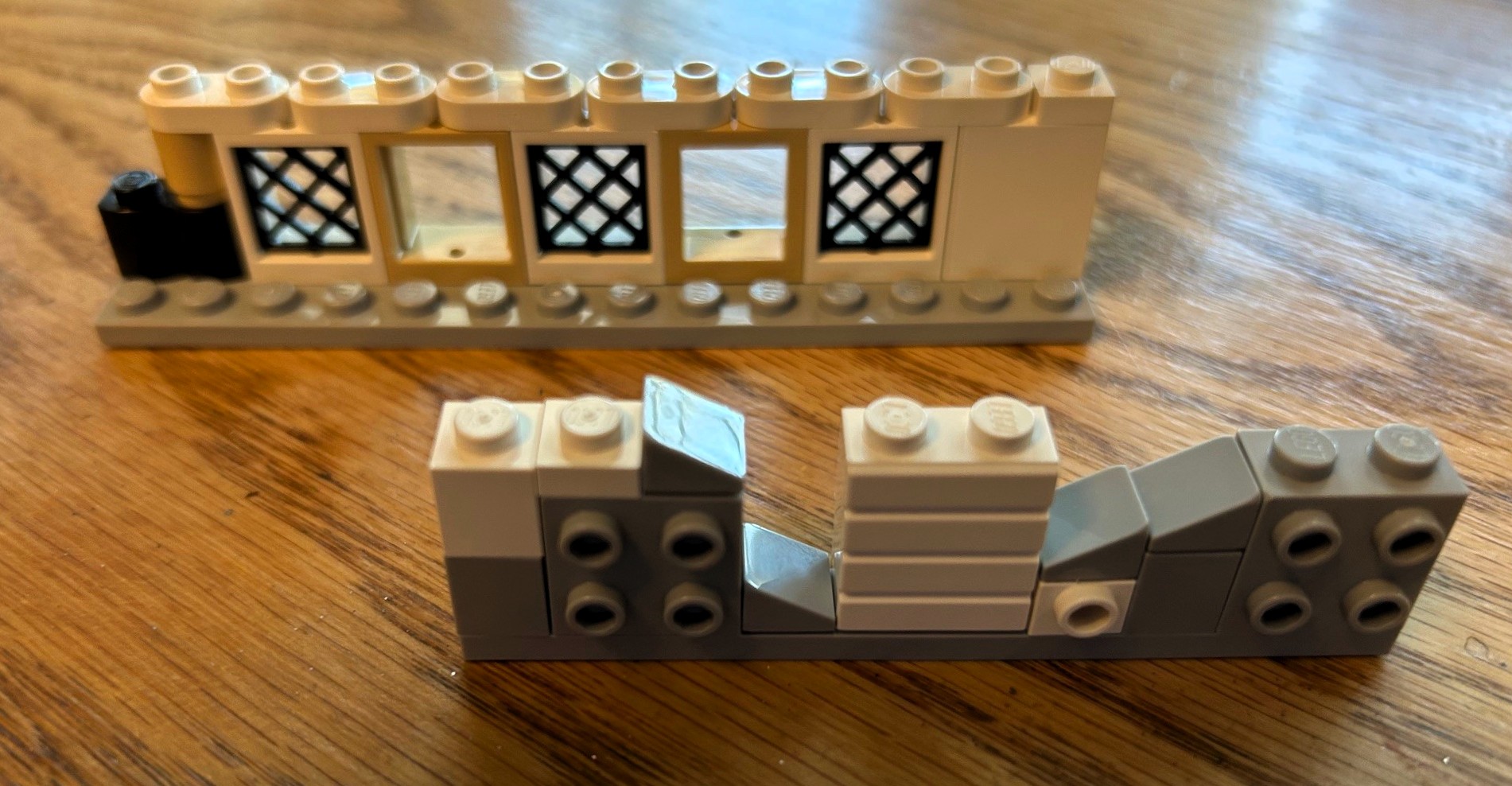
We resumed our fountain build this week with more confidence than the last, accompanied by the merriment of Paganini’s Violin Concerto No. 1. Bags 6 and 7 – of 15 bags of pieces – were filled with tiny, tiny finger-numbing LEGOs, and at times I wondered just what the heck I was putting together. Didn’t look like the makings of a fountain to me.

According to LEGO, water is white and blue. I suppose the white is meant to be rushing water (as in “waterfall”) while the blue is calm water (as in “pool”). We shall see. But check out the look of the fountain in the final photo. Anyone else see a monster’s mouth with white teeth?
Since this is my fifth LEGO model, it’s high time I make the following proclamation: LEGO never leaves out a piece. Never. I still have moments where I’m searching through a pile of pieces in vain for the one I need. I almost get to the feeling of “it’s not here”. But suddenly there the little guy is, staring up at me as if to say, “What took you so long?” Some day I’d love to see how LEGO pulls this off. Thousands of pieces in every box, not a single one of them left out. That’s some logistical magic going on there.
 I’m proud to say I made zero mistakes on the build this time around, a dramatic improvement from a week ago. Okay, that’s not entirely accurate. I left a piece off the back of the fountain, but immediately discovered my error when I added a section and realized there was nothing to support it. Fixed in a jiffy, but the merry instruments on Paganini’s violin concerto sounded even more gleeful as they saw my confidence take a hit.
Running build time: 2 hrs. 27 min.
Total leftover pieces: 13











 Life In A Word