Tripping on Trips

I should pay more attention to the actual cost of things. A movie ticket is fifteen dollars… until you add in concessions, preferred seating, and online processing. A dinner out can be reasonable… until you add in the taxes and tip. And rental car companies add so many fees to the base rate it’s like you’ve just been bumped to a new tax bracket. With that in mind let’s visit the airport today, or more specifically, getting to the airport.
How do I get here?

Flying is expensive; always has been.  But it’s easy to overlook the cost of the airport itself.  Maybe you already know, a portion of the ticket you just bought goes to a landing fee (LF) – what the airline pays the airport for the privilege of pulling up to the gate.  Maybe you also know another portion goes to a passenger facility charge (PFC), which supposedly goes to improvement projects in the name of airport safety and security.

I don’t trust PFCs.  I think they really go to things like art exhibits, children’s play areas, pet relief areas, and smoking lounges.  I mean really, how much less would that plane ticket be if all you had for an airport was a ticket counter, some security and restrooms, and a gate to board your plane? 

You pay dearly for this space

The airport needs more than LF’s and PFC’s to pay its bills, of course.  It’s the reason you pay so much for parking.  I mean, think about it.  Once the parking garage is built it requires little to operate.  Mechanical systems and a few employee salaries yes, but certainly nothing in the neighborhood of say, $30/car/day.  Which brings me to my current conundrum.
By taxi? Cost-prohibitive

Most of you don’t have the following challenge.  When you fly, you’re close enough to the airport to where you can get a ride from a friend or take mass transit.  Me?  I have a choice of three major airports here in the South… but each of them is a two to three hour drive from my house.  Which begs the question, how does Dave get from his house to the airport and back for the least amount of money?

  1. Simple but Expensive.  Dave drives his car to the airport, parks, and drives his car back to his house after he gets back.  Works for short trips but what if I’m gone for three weeks (starting next Saturday)?  Parking at Atlanta-Hartsfield is $30/day (and that’s long-term). Throw in a tank of gas for the car and I’m north of $700 just for the airport to/from.
  2. Simpler but Even More Expensive.  This idea unexpectedly sent me in the wrong direction (financial, not travel).  I put in for a quote for car and driver from a service right here in our little town.  They got back to me almost immediately.  Little did I know my car is a limo and my driver wears a tuxedo.  My wife and I can “sit back and enjoy their ride” for $520 each way.  Gratuity not included.

  3. Slightly Less Expensive.  Here’s a fun option/comparison.  Drive to nearby (tiny) Augusta Regional Airport and fly to Atlanta.  The two round trip tickets plus parking?  Less than the cost of the drive and parking at Atlanta. If flights out of Augusta were ever on time I might actually consider it.
  4. Clever But… Drive to nearby (tiny) Augusta Regional Airport, rent a car, drive to Atlanta, and return the car.  Repeat the procedure in reverse when I return.  No.  The rental car companies want $300+ for Augusta to Atlanta.  Multiply that by two to get back home.
    By shuttle? “Cozy”
  5. Less Expensive but More Cozy.  We have shuttle services nearby; van companies where you share the ride to the airport with strangers.  $200 gets us the trip to Atlanta and back.  Okay, but now we’re driving our car just to get driven by a van just to get flown in a plane.  Seems like a lot.  And you leave when the shuttle service says you leave; not when you really want to.

Five solutions in and I still haven’t made it to Atlanta with any sense of fiscal satisfaction.  I’m starting to think I should just skip the airplane and drive all the way to our destination.  Or ride my bike with a pile of luggage on my back.  But wait!  There’s always 6. Entirely Less Expensive.  Convince local son-in-law to drive us to Atlanta (and back).  He can’t charge me more than the options I presented here, can he?  Er, not if he doesn’t read this blog post first.  I better call him… stat.
Dave meets “Evy”

Renting a car at the airport used to be so hassle-free. You’d book the vehicle online, walk or bus to the parking lot, and bypass the counter by signing up for the company’s free membership program. All of that still happens, so what’s the difference today? You never know what vehicle you’re going to get, even if you choose the make/model ahead of time. And if you’ve never driven an electric vehicle (“Evy”) before, renting one is a real adventure.

Blame it on my laptop keyboard.  As I pecked my way through a recent Avis reservation, I inadvertently chose “Mystery Car” instead of “full-size sedan”.  Mystery car?  What the heck does that mean?  It means more flexibility for the rental car agency.  “Mystery car” means Avis gives you whatever it feels like giving you from its leftover inventory.  Maybe you get what you wanted.  Maybe you get a luxury vehicle for even less.  Or maybe you get Evy like I did.

I admit, I am not with the times of the latest vehicle technology.  I couldn’t tell you the first thing about operating Evy, let alone how she works under the hood.  So there I stood in the Avis parking lot, faced with the prospect of my first miles behind her wheel.  The rental companies should put a beginner’s guide on the driver’s seat for people like me.  I mean, imagine my hesitation (panic?) when I pushed Evy’s start button and nothing happened?  Something happened, of course.  The engine “started”; it just didn’t make any noise.  Yep, this was going to be a different kind of ride.

My first issue with Evy (or at least, the Genesis I rented) is the inexplicable need to make the dashboard wildly different than a conventional vehicle.  You don’t find the basic needs (ex. headlights, windshield wipers) where you expect to.  I actually considered talking to the vehicle instead of pushing random buttons, especially after my seat suddenly firmed up and vibrated when my I let my posture slip a little (“driver safety feature!”)  Seriously, all I’m asking for is dashboard buttons and levers where I expect them to be.

Once I found a modicum of comfort with Evy, the real challenge dawned on me: I have to recharge her before I go back to the airport.  And this, my friends, proved to be a challenge worthy of reality TV.  Those who already know Evy are welcome to say, “Oh c’mon Dave, it’s not that hard!” but truth be told, my charging station experience was just as daunting as the first time I pulled up to a gas pump as a teenager.

Credit Genesis, you can look up the nearest charging station right there on the dashboard.  The search gave me a choice of three.  The first station was in an Urgent Care clinic parking lot… and wasn’t working.  I’ve read that 15% of EV charging stations don’t work so now I’m a believer (EV Charging Flaw #1).

The next charging station option was in a McDonald’s parking lot.  When I arrived, both slots were occupied (EV Charging Flaw #2 – not enough to go around).  I have no problem waiting in line at gas stations but charging Evy takes a lot longer.  So I chose to drive another mile to the third option, a charger in a bank parking lot.  Nope.  No station to be found from one end of the lot to the other.  Genesis needs to update its locator software.

So back to McDonald’s I steamed went (and not for a Happy Meal, mind you).  The charging stations were still occupied, which begs the question, where do you form a line?  If I parked behind either car I’d be blocking their exit.  I’d also be blocking the McDonald’s drive-thru lane.  The only option was the parking space adjacent to the charging stations, with hopes of quickly maneuvering into an available charger before the next person pulls up (EV Charging Flaw #3).

This story only gets worse from here, so let’s keep it brief.  Once a station was finally available, I pulled in only to realize I had to face the car the other way for the charging cable to reach (EV Charging Flaw #4).  Then I tapped my credit card on the charger, only to find you have to download an app to make the station work; no cash or credit accepted (EV Charging Flaw #5).

Fifteen minutes later (because that’s what it takes when you only have one bar of wireless service – grrrrr) I got the app installed, the charging cable connected without electrocution (in pouring rain), and ta-dah… NOTHING!  Nada!  Zilch!  No “PRESS HERE TO CHARGE” or some other obvious way to get things started.  Instead, by the good graces of my EV-knowledgeable brother over the phone, I learned I had to zoom in on the tiny app map, identify the McDonald’s location of my charging station, and tap it (EV Charging Flaw #6).  Suddenly Evy’s gods smiled down on me through the thunderstorm and declared “Charge”.

To say I was giddy to make it back to the airport a day later without a dead Evy is an understatement.  To say I was the target of a sick joke when my very next Avis rental – same day, different airport – was a hybrid is undeniable.  But hey, at least a hybrid gives you the option of gasoline, so you get to fuel up the “old-fashioned way”.  Which brings me, humbly, to declare Dave Flaw #1:  Get to know Evy very, very well before your life – or at least your transportation – depends on her.

“Thoughtless Driving”

One of the inconveniences of living in a small town is the proximity to airports. In western South Carolina we actually have a choice of six, including tiny Augusta Regional just beyond the nearby Savannah River. But whether Augusta or one of the larger airports hours away on the East Coast, the drive to get there is mostly two-lane blacktop, speeding along and then slowing down through the small towns along the way. Correction. You’re supposed to slow down through the small towns.

Blame it on puzzle apps. My wife and I were just thirty miles into our eastward trek to Charleston International when we hit the pretty-much-forgotten small town of Springfield, SC. The speed limit sign suggested 25 through its residential streets. I chose 38 instead. Okay, I didn’t intentionally choose 38. I simply elected to ignore the laws of little Springfield, in favor of focusing on the puzzles my wife was trying to solve on her iPad. Maybe I missed the speed limit sign, but I did see the spinning blue/red lights on the police car sitting quietly in a church parking lot.

Here’s something all four of my life’s speeding violations have in common. As soon as each of them happened, I pulled over pretty much the moment the cop reached for his lights. My thought process went, “Hey, I’m breaking the law”, followed by “Hey, that cop noticed me breaking the law” and finally, “I think I’ll just pull over immediately and save him or her any further trouble”.

38 mph in a 25; yeah, that’s pretty bad. Totally deserved the ticket. At least it wasn’t another school zone this time. My last two speeding tickets, one in the middle of 1992 and the other around 2013, were earned as I passed by primary schools with loads of children on their playgrounds. Even worse, the 1992 ticket was collected from the driver’s seat of a midlife crisis two-door convertible Alfa Romeo Spider. Bet the cop loved ordering youngish me to traffic school in lieu of the ticket.

Speaking of “in lieu”, my Springfield, SC cop (who had nothing better to do because there’s nothing at all to do in Springfield) gave me a no-brainer choice in settling my flagrant speeding violation. Option 1: Pay the fine as advertised and earn four points against my driver’s license (“Ouch!”) Option 2: Pay an additional 30% on the fine and avoid the points entirely (not-so-“Ouch!”) Maybe Springfield’s not a bad little town after all… even if the ticket mocked my violation with a description of “thoughtless driving”.

Here’s the nice thing about making peace with a speeding violation before the cop even reaches the driver’s side window: you have a pleasant conversation. Officer: Do you know why I pulled you over?  Me: Why yes sir, I do, and here’s my driver’s license and registration. Officer: Okay Mr. David, let me spell out your options here (spells out options).  Me: Why thank you sir, I’ll take Option 2, if you please. Officer: Okay then Mr. David, pay the fine online and enjoy the rest of your day.  Me: And you too, officer!  It was almost as if a friendship was born over a speeding ticket.

I can’t talk about three of my speeding tickets without a mention of the fourth.  I made it through my high school driving years before ever getting pulled over – but just barely. It was on a graduation trip, where my parents loaned me their car and paid for enough gas to get me and a buddy a driving tour of the Western U.S. And right there in the middle of Colorado, streaking up the interstate towards the Rockies, I earned the blue/red lights for the very first time.

I will always remember two things about that first ticket. First, the officer gave me a personal escort to a nearby mailbox so he could watch me mail the check for the violation (no online or credit card option in 1980). Second, I turned to my buddy afterwards and said, “My parents are gonna kill me!”… which wasn’t true at all, but it’s how most teenagers feel after they get a speeding ticket in their parents’ car.

I doff my hat to those who make the effort to plead down a speeding ticket. I also admire those who continue driving after a violation, as if they don’t think the police car in the rear-view mirror intends to pull them over. Me, I embrace the fines for my brushes with the law.  It’s easy to claim accountability when you’ve only had four instances. And for the foreseeable future, I’ll be the most well-behaved driver behind the wheel.  You just won’t find me anywhere near Springfield, SC.

Boundaries

My wife and I took a “triangle trip” last week to see her family and then our son, flying from Augusta (GA) to Denver to Dallas, before returning to Augusta again. There’s nothing round-trip about an itinerary like that; just three one-way flights in a row. Like any other frolic in the friendly skies however, the journey served up easy fodder for a blog post. Hectic airports? Uncomfortable turbulence? Delayed flights? Yes, yes, and yes.  But for today’s post, step up to the podium my fellow passengers, for it is you who have earned my writing wrath.

We’re in familiar territory here.  I’ve written about my flying annoyances in Sitting in the Catbird Seat and First Class is now un-American (among others). But those musings focused on airplane seats and airplane sections.  Today is about airplane occupants.  Some of them are making the national headlines for their ridiculous antics.  The others all seem to have ended up on my flights.  Allow me to introduce my new “friends”.

Which one is the child?

On the flight from Augusta to Denver, a family of three filed into the row directly in front of us; wife on the aisle, young child in the middle, husband on the window.  As they settled into their seats, the kiddo started rapid-firing questions:  Dad, when are we going to take off?  Mom, where do I put my jacket?  Dad, I can’t get my seat belt on!  Do we get snacks? Dad? Hey, DAD!!!

Kids are loud.  I remember my first flight too, and the drive-you-crazy curiosity of a six year old.  But I certainly didn’t expect the parents to answer in baby talk.  Oh Stevie, the biggy wiggy pilot way up in the fwont of the plane decides when we get to fly up, up, up in the sky!  Maybe if you’re a weely weely good boy he’ll give you a wittle pair of wings to put on your backpack!

Or how about… Now Stevie, yelling at Mr. Seat Belt isn’t very nice. Look, there’s a wittle buckle and a wittle other end!  Let’s make it a game!  See if you can snap those bad boys together!

This is why I never leave home without noise-cancelling headphones.

“Hola!”

On the flight from Denver to Dallas, we had our choice of “uncomfortable”.  First, we trudged to the back of the plane, in front of and back of a large group of men who a) chose to be loud and laughy, and b) chose to speak across the aisle/rows in Spanish (even though the smattering of English made it clear they were fluent in both).  At first I thought my nearby amigos were just being a little obnoxious.  But the longer they kept it up, the more I thought I probably ought to know what they’re saying just in case…

This is why I never leave home without Google Translate.

Also on Denver to Dallas, a small child several rows forward spent the whole flight wailing I want Mommy!  I want Mommy!  I want Mommy!  We were too far behind to see or hear what her traveling companion was doing (if anything) to make her feel better, but eventually some kind of alarm went off in my head.  What if this child was being abducted?  After all we were heading to Dallas, which could be considered a gateway to the world for that sort of thing.  I alerted the flight attendant, who assured me everything was okay.  And it was.  Turns out the child belonged to one very overwhelmed father, solo-parenting (or not) a total of three kids.

This is why I never leave home without my wife.

I haven’t even mentioned the usual annoyance.  Since my wife prefers the window seat I graciously accept the middle.  So why is it my neighbor in the aisle seat always takes the armrest?  Doesn’t he or she realize I’m squeezed between two bodies?  Over the last two decades the average airline seat width has shrunk from 18.5″ to 17″.  If the passenger on either side of the middle takes the armrests that means I’m reduced to 15″, while each of them gets 18″.

This is why I never leave home without my elbows.

If you ever fly with me, I’m the guy with his head down reading his Kindle.  I’ll be polite and, for the most part, leave you alone.  But don’t be fooled.  I’ll only have one eye on my e-reader.  The other – and both ears – will be tuned into whatever you’re up to in your seat.  Please respect your boundaries.

Games of the Travel Gods

Blondie is the trend-setting American rock band from the 1970’s. A blondie is also a rich vanilla dessert bar. But just for today, Blondie is the newspaper comic strip that, remarkably, still runs after 92 years. Blondie is the female lead and Dagwood is her food-loving husband. Which brings me to today’s topic. A Dagwood is a tall, multi-layered sandwich… the perfect image for my travel nightmare from last Friday.

It all started with a bridge.  Make that seventeen bridges.  As my wife and I were motoring mid-morning towards the Charlotte airport, en route to my niece’s wedding in Los Angeles, the Maps app colored the interstate yellow here and there.  No big deal; traffic slowed, then quickly started up again.  All of a sudden, middle of nowhere, we came to a complete stop.  Five minutes passed without movement.  Ten.  When I finally looked down at the Map app twenty minuets later, our section of the interstate was colored black.  Wait, black?  Never seen that color before.

My car is somewhere beyond the vanishing point

For future reference, Map app black means “not an option” (or better still, “you’re dead”).  Five miles of the upcoming interstate were closed off for nine days to repair all those bridges.  We didn’t “eye-spy” so much as a detour sign before we joined the monstrous backup.  When cars began leaking into the grass median and making U-turns, I sensed the presence of the travel gods, selecting a dawdling pawn for their vicious game.

Heading back the way we came, the first detour we encountered was the same idea as a hundred other drivers.  The off-ramp was backed up forever.  Instead, we continued miles further, finally exiting onto a two-lane highway to what can only be described as a drive through the backwoods of the back country of America’s uh… backside.  Tight little curvy roads sprouting driveways to nowhere, bars with bars on the windows, churches with desperate Easter pleas like “It’s not about the Bunny, it’s about the Lamb”, and one-stop-sign towns you really don’t want to stop in.  Eventually we emerged unscathed (physically, not mentally), flung back to a point on the interstate that wasn’t colored Map app black.

The travel clock ticks faster now.  When the travel gods remind you bags must be checked forty-five minutes before departure, beads of sweat start to pop.  The Dagwood sandwich gains another layer.

Our daughter (who I now refer to as “GPS Goddess”) expertly phone-guided us all the way into the Charlotte Airport hourly parking garage ($24 USD/day), where she offered a not-so-confident “you’ll make it” before hanging up.  And so we dashed, from one end of the garage to the other, down the elevator, across the lanes of buses and taxis, through the under-construction section of the terminal sidewalk, finally bursting through the sliding doors to the American Airlines self check-in kiosks to declare our victory.  Which was premature.

Just like the black of the Map app, I’ve never seen a self check-in kiosk dispense a piece of paper saying “See Counter Agent”.  Uh-oh.  Sure enough, we missed the deadline to check luggage.  Our bags were also too big to gate check or they would’ve pushed us through.  I thought we were done.

But at the ticket counter, I deflected phrases like “You can’t travel without your luggage, sir” or “We’re not finding any other flight options, sir” with “I have faith in you, American Airlines!” and “You can do this!”, and darned it they didn’t find an itinerary to get this “sir” (and his “ma’am”) to Los Angeles.  Through Boston.  Uh, sorry miss, isn’t Boston taking us in the wrong direction?  She told me not to argue.  Add another layer to the sandwich.

Cut to the Charlotte boarding gate.  Flight to Boston delayed.  Then again.  Then again.  In a phrase that sounds comical (just not at the time), the gate agent calmly informed passengers “the control tower can’t seem to locate our flight crew”.  But then they did, then we boarded, and suddenly we’re flying to Boston… knowing we have, oh, ten minutes to catch our connection once we land.

For the record, you can make a connecting flight in Boston in ten minutes.  You need five of those minutes to let the achingly slow passengers in front of you deplane.  You need the other five minutes to hustle down the concourse (ignoring the bathrooms that beckon for good reason), cursing the loudspeaker blasting your name with “Flight XXX to Los Angeles, this is your final call.  We’re about to close the doors”.

Which is exactly what the gate agents did, right behind us as we sprinted down the jetway, but not before shouting, “Don’t worry, your baggage has a much better chance of making the connection than you do!”  [Wrong.  Turns out only one of our bags made the flight.  The other would arrive (mercifully) the next morning, just in time to change into wrinkled formalwear before the wedding.]

Hoping I looked more like the guy on the left

On the Boston-Los Angeles flight, sitting in the very last row (where you meet/greet every single passenger headed to the bathroom) I let out a slow breath and assessed the good and bad of our whirlwind journey.  The good: we’d make the wedding after facing a dozen trip-blocks.  The bad: the Boston-LA flight ended up having to go wide-right over Canada to avoid some nasty weather in the Midwest.  Add an hour to an already long, seriously turbulent flight.  We could’ve headed the other direction and made it to Ireland in less time.

In total, the travel gods played their game for twenty-one hours, leaving us bleary-eyed by the time we walked into the wedding venue the next afternoon.  (Hey, at least they got married.  After all, the wedding was on April Fools’ Day.  A no-show at the altar would’ve been just another layer on the sandwich.)

Here’s a little Blondie trivia.  Dagwood was the heir to the Bumstead locomotive fortune, but when he married Blondie the deal was off.  I didn’t know that.  I only knew about his namesake – the tall, multi-layered sandwich.  Otherwise I might’ve thought to take the train to Los Angeles instead.

Some content sourced from Wikipedia, “the free encyclopedia”.

Selfish Shopping

The hustle and bustle of the holiday season is on full display this week.  We’ve reached the critical timeframe – ten days out – where packages must be sent if they’re getting to destinations by Christmas.  We’re making lists, not just for Santa but also for last-minute purchases.  Now here’s the good news, weary shopper: no matter where you’re spending your holiday dollars, self-checkout is often an option.

If you’re like me, you beeline to self-checkout when you’re done shopping.  You still have “the control”, as people like to say (who also prefer to drive instead of fly).  With self-checkout you believe you can scan and bag faster than those who are paid to do so.  Maybe, but consider the decisions you have to make in the process::

  1. When do you choose self-checkout?  Most of the time, (especially if the checker-bagger lines are long) but what if you have a lot of items?  Self-checkout is awkward with a full shopping basket (ignore the stares).  One time my wife and I snagged side-by-side registers, put the cart between them, and scanned away.  Against the rules, you say?  What rules? 🙂
  2. Where do you stand in line?  This is touchy territory, shopper.  If you face the typical arrangement where one set of registers sits opposite the other, with enough open space in between, you can get separate lines for each set… which gets ugly when a person assumes he/she is entitled to the next available register on either side.  Prepare for battle.
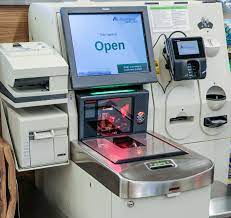
  3. Which register do you choose?  Murphy’s Law of Self-Checkout: One of the registers doesn’t work.  You just assumed it was available because you couldn’t see the “out of order” screen until you were right in front of it.  Now you have to turn around and reclaim your place in line.  Again, ignore the stares.
  4. When do you alert the self-checkout human assistant (oxymoron?)  How many times have you gotten ahead of the system only to hear, “unexpected item in bagging area” or “please wait for assistance”?  Here’s a tip: don’t wait for assistance.  Most of the time the register is trying to catch up and just needs a little more time.  Congrats, you’re faster than a computer.

Hard to believe, but retail self-checkout just celebrated forty years.  We shoppers been doing what one writer describes as “quasi-paid unforced labor under surveillance” since the 1980s.  I remember how I wasn’t thrilled about the concept when it debuted.  Back then I thought, “Why do I have to do the checking out when someone else is paid to do it for me?”

I was even more annoyed when the airlines put up their “selfish” kiosks and dared travelers to check themselves in and print their own boarding passes.  How quickly we adapt.  Today I’ll choose self-checkout any time I’m given the option (even though surveys say 67% have a bad experience).  In fact, we’ve been conditioned to self-checking out ever since the debut of the bank ATM in the late 60s.  DIY checkout will only get more prevalent as companies reduce labor costs.  One of these days I can picture a self-checkout Starbucks, with a fully mechanical barista standing by to whip up your skinny latte.  Don’t bet against it.

Reasons we choose self-checkout (web.mit.edu)

Self-checkout is about to enter a new arena: clothing stores.  But what about those security devices attached to the sleeves or pant legs?  And how will they know if we slip an extra pair of shoes into the box? The bigger concern, however, may be image.  How will Saks or Bloomingdales look with a bank of self-checkout registers next to their fancy cosmetic counters?  Not the pretty picture of luxury shopping we’ve come to expect.

Image doesn’t matter to me so much, but my time does.  If self-checkout returns a few minutes to my day, I say sign me up.  But somewhere we’ve got to draw the line, people.  At the rate we’re going, human interaction will soon be the exception, not the rule.  It’s also not the direction a world in need of more face time should be heading.

With that, I put down the keyboard for the remainder of 2022.  Remember, the holidays are anything but “selfish”, and everything about face time.  Merry Christmas!

Some content sourced from the CNN Business article, “Self-checkout annoys some customers…”

Changing Planes

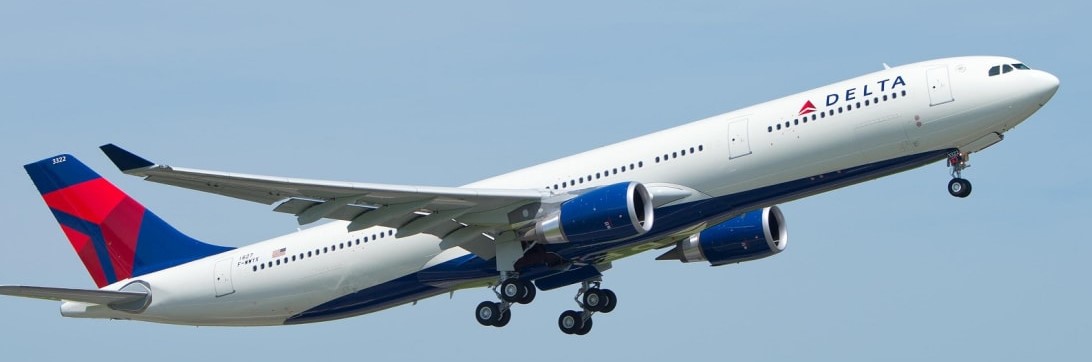
My wife & I are boarding more flights than usual as we anticipate our upcoming relocation to South Carolina. “More than usual” deserves context I suppose, since so many of us skipped airports altogether the last couple of years. Flying is different now – some ways better, others not so much (and unquestionably more expensive). Regardless, I was happy to learn our favorite choice of airline before AND after the emergence of COVID just earned the label “world’s best” for 2021. Care to guess which one?

I already gave you the subtlest of hints in my blog title.  With mathematics at least, the world’s best airline is also known as “an incremental change in a variable”, which makes its logo – the triangle – a fitting symbol.  Its slogan is the uber-confident “world’s most trusted airline” but I prefer one of its older ones:

Maybe Delta Air Lines is your airline of choice too.  If not, you’re wondering where your favorite ranks among the world’s best.  I’ve never heard of Cirium (have you?) but the data-mining company spends its days converting 300 terabytes of aviation performance metrics into annual best-in-class rankings. (300 TB meant nothing to me until I crunched a few numbers.  A ten-page Word doc is about 2 MB  By my calcs Cirium is sorting through five million pages of data.  I’d say their rankings are legit, wouldn’t you?)

Let’s end the suspense.  Here are the top ten airlines measured by “operational performance”, for 2021:

  1. Delta (“Platinum Award” winner)
  2. Alaska
  3. American
  4. United
  5. Spirit
  6. Frontier
  7. Southwest
  8. JetBlue
  9. Air Canada
  10. Allegiant

Delta should put a lot of stock in this win, and not just because 9 of its 10 aircraft arrived on time in 2021 (10% better than second-place Alaska).  It’s more about the impact of the passenger experience to the result.  Is the boarding process efficient?  Is the flight crew rested and available?  Is the aircraft properly maintained? How is baggage handled? How are unruly passengers dealt with (a more recent trend)?  Every one of these details number-crunches to a measure of on-time arrivals.  And no one does it better than Delta.

I may be biased but my own experiences seem to back up the numbers.  My wife & I have flown Delta several times since 2019 (including a trip to Europe) and every one of those journeys met or surpassed our expectations.  I’m not saying Delta goes over the top to gain customer loyalty (though a warm chocolate-chip cookie would help).  They simply do what I expect.  Arrive on time and make the journey as pleasant and efficient as possible.  Is that too much to ask?

Sadly, my affection for Delta is bolstered by my dissatisfaction with its competitors. I’m surprised to see American and United make the top five.  My family and I have had several lousy experiences with American, including delayed or canceled flights and could-care-less customer service agents.  Meanwhile, United may know how to arrive on time, but their coach seats should be labeled “cattle class” (not unlike Spirit and Frontier).  Drop down the tray table and open your laptop.  I challenge you to type comfortably.

Southwest could’ve been higher in Cirium’s rankings but I’m sure their logistical issues last year contributed to the number.  Scores of their canceled flights were attributed to “weather challenges” during an unprecedented upheaval in the workforce.  I’ll forgive the bald-faced excuse.  When Southwest is running on “all engines” their brand of customer service is second to none – which keeps me coming back for more.

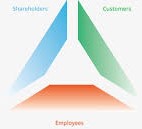
From my days in corporate America, I remember an equilateral triangle as the symbol of a successful company, giving balance to customers, employees, and shareholders.  Looks a lot like the Delta logo, doesn’t it?  More than just a nod to the Greek letter (Delta) or a throwback to its origins in the Mississippi (“Delta”, that is).  Even the dictionary definition of delta belongs in the conversation. Positive change befits operational excellence.

If my wife & I were relocating to Salt Lake City or Atlanta (or one of Delta’s other hubs), we’d be changing planes and flying more often with the “triangle”. Just this week my wife enjoyed another Delta flight she described as “perfect except for a few inconsiderate passengers” (which seems to be the norm these days). Delta celebrates one hundred years of passenger flights in 2029 so it’s safe to say they’re guided by experience.  The Cirium ranking is just a numbers-crunching confirmation of what I already know.  Delta is ready when I am.  Or, to put it mathematically, Δ = (S)atisfaction + (L)oyalty.

Some content sourced from the CNN Travel article, “The world’s best-performing airline has been revealed”, and Wikipedia, “the free encyclopedia”.

——————–

Lego Grand Piano – Update #18

(Read about how this project got started in Let’s Make Music!)

Today’s section of the symphony could’ve, maybe should’ve used a stand-in pianist.  Bag #18 – of 21 bags of pieces – assembled a little more than half of the piano’s top lid.  I show the structure on its side in the first photo because that’s how I built it, from the ground, er… desk up.  I imagined myself as a tiny mason, building a wall brick-by-little-brick, working right-to-left, then over to the right again.  You – my faithful reader – could’ve handled this part of the construction easily.  In Lego terms, it’s a wall made with various lengths of rectangle pieces.  That’s it.

Not a wall, but part of the hinging piano lid.

Know what I love about this adventure? (which is rapidly coming to a close!) You don’t always see what’s coming.  I knew I was building the top lid, but it was hard to see how it fit the piano until I set it on its side when I was done (second photo).  More to my point, I have three bags of pieces remaining.  One is the remainder of the piano lid.  One is the free-standing bench for the pianist.  Which leaves… you see? I still have no idea what’s coming.

Running Build Time: 13.0 hours.  Musical accompaniment: Berlioz’s Symphonie fantastique. Leftover pieces: None!

The top lid rests in its future location.

Conductor’s Note: The story behind Louis-Hector Berlioz’s Symphonie fantastique is more interesting than the piece itself (seriously).  At the somewhat tender age of 24, Berlioz fell in love with an Irish Shakespearean actress, who kept him at bay until she finally agreed to be his –  seven years later. Maybe the length of Berlioz’s pursuit extinguished the flame because the romance didn’t last.  But Berlioz wasn’t left empty-handed.  He composed the Symphonie fantastique to depict the idealized version of his Irish lover. I just didn’t find his music fantastique.

Wait For It

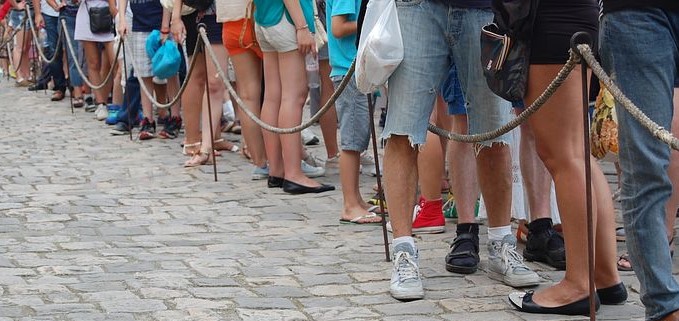
Let’s wager a guess over something that happened to you in the past few days. It probably happened several times in the past few days. It wasn’t by choice, nor were you alone.  It might even be happening right now. What is this recurring, oft-maddening event in your daily world (and mine)? Somewhere, for some good reason, in person or in the car, deliberately or unintentionally, you found yourself waiting in line.

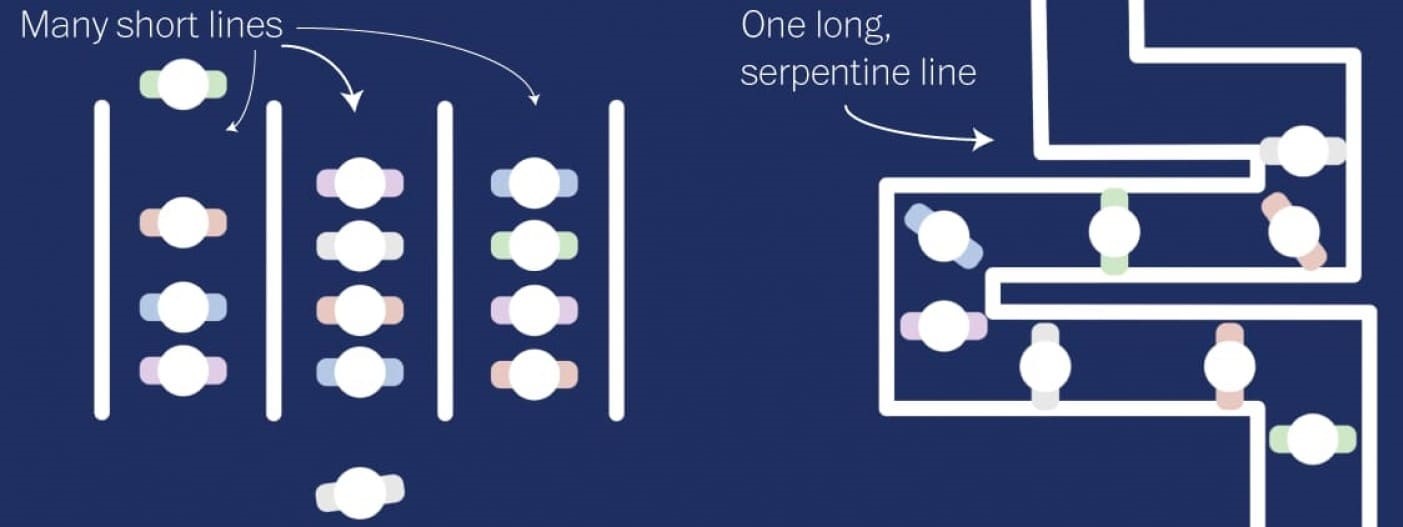
Call it a common courtesy or call it the primary by-product of consumer demand. Waiting in line is a timeless (or time-wasting) necessary evil with no satisfactory alternative.  While the world behaves efficiently with smartphones, computers and even data-consuming “IoT” appliances, those snaking, switch-backing, several-option, several-category lines of humans seem to grow ever longer.  Including traffic on the highways – another version of waiting – you’ll spend one to two years of your life in line.

Consider some of the common reasons why we wait in line:
– store cashiers
– airport security
– phone calls (on hold)
– amusement parks
– voting
– public restrooms

If I wrote this post fifty years ago, I would’ve listed the very same reasons why we wait in line.  We have options now, but let’s face it; those options are waiting-in-line in disguise.  Store cashiers now work side-by-side with an area of self-check-out machines (which draws its own line).  Airports promote pay-for lines like TSA Pre and CLEAR.  Telephone on-hold mechanisms offer callbacks instead of waiting (“for an additional $0.75”).  Disneyland installed “FastPass” lines; again, for a fee.  Voting can be done by mail (forcing your ballot to wait in line instead of you).  And public restrooms?  Okay, there’s no option to waiting for the potty.  Maybe reconsider that second beer.

The Brits refer to a line of people as a queue.  I like that (and not just because we need more words beginning with the letter “q”).  Leave it to those on the far side of the pond to class up the most mundane activity imaginable.  At least we have our phones as distractions when we “queue”.  But the old-fashioned distractions still work.  It’s why they put candy bars by the cashiers, magazines in the waiting room, mirrors by the elevators, and televisions in the airport.  Anything to help you forget you’re waiting in line.

Julio C. Negron

You’d think waiting in line is mindless – no-brainer science really – but I have experienced flaws in the system.  Recently in Lowe’s, waiting patiently in a single, central line at the self-check-out area, I was confronted by the person behind me, who demanded I “choose one side or the other” (as if logic demanded a separate line for each row of self-check-out machines).  My response to him was not one of my finer moments.  Another example – at the airport – my wife and I waited at the curb with a dozen others for the parking lot shuttle, only to discover the “front of the line” was a variable determined by the point on the curb where the driver chooses to stop his vehicle.  If you want to see what not waiting in line looks like, try to catch a parking lot shuttle at the airport.

In today’s world, we have new reasons why we wait in line:
– to purchase the latest iPhone
– at restaurants, with pagers (clever disguise for waiting in line)
on-line (i.e. for concert tickets or sports tickets at a specified time)
– Black Friday sales

Finally, we will always stand in line for our kids, whether to see Santa Claus at the mall or to buy something they simply must have.  Years ago, I remember taking my kids to the local bookstore for the latest “Harry Potter” (which they started and finished before the next sunrise).  It was the only time I’ve stood in line for the right to stand in line again.  The bookstore insisted on selling a limited number of tickets at noon, to be exchanged for the book later that same day, when the publisher allowed its release.

I believe the longest I’ve ever waited in line is five hours – to see the first Star Wars movie in 1977.  With no electronic devices to keep my friends and I company back then, five hours was even longer than it sounds, especially knowing two consecutive showings of the movie would run before I even entered the theater.  Then again, the truly morbid among us believe we are all simply waiting to die.  If that’s the case, let’s hope we’re in a really, really long line.

Bad Check

Last week I flew to Indiana for a conference, connecting briefly through Chicago O’Hare.  After finally touching down and exiting the tiny plane, I noticed a cluster of passengers right there in the jet bridge, waiting for luggage to be brought up the stairs.  I headed to the baggage claim area instead, where the rest of us watched the carousel lumber round and round.  The minutes passed interminably as the belt continued its relentless rotation; passengers leaving one-by-one with their bags.  Suddenly everything came to a grinding halt, and the carousel let out its big, mechanical sigh.  I found myself in the quiet and solitary confinement of an empty claim area.  My luggage?  Nowhere to be found.

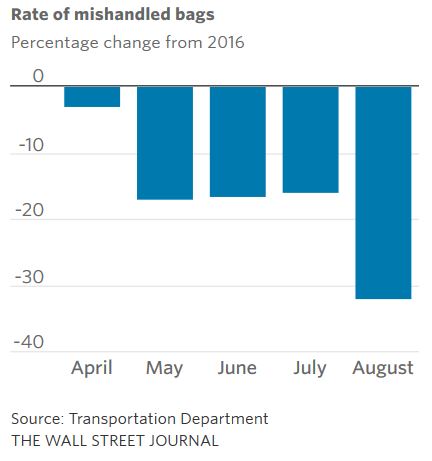
The airlines advertise a ton of performance statistics, but here’s a new one on me: rate of mishandled bags.  For every passenger who files a lost-luggage report, the carrier gets a ding.  That ding is well-deserved, representing the stress of lost luggage, the hassle of filing a report in one of those stuffy little offices, and the inevitable delay reuniting with your bag.  Not that it happens very often.  According to the following chart – part of a Wall Street Journal article – American Airlines reports a mere 2.8 incidents of lost luggage per 1,000 passengers.  But hold the phone, folks – there’s more to the losing than meets the eye.  Turns out American (and most other airlines) avoid a lost-luggage ding if they alert you to the “mishandled” bag.  Today’s smart tags make it easy to track the bag (even if it’s heading in a different direction than you are).  So that bit of information – proactively communicated in a text or email – avoids a bad stat.  And that’s why the chart below shows a dramatic improvement in August.  American Airlines started its proactive notification process the month prior.

I don’t choose my airline according to “rate of mishandled bags” (or any other statistic for that matter – it’s all about the ticket price), but I have observed the adjusted behavior of others.  Carry-on baggage is all the rage now, in brand-new shapes and sizes.  Look around next time you board a plane and count how many passengers violate the airline’s carry-on policy.  The person with the roll-y suitcase and oversized backpack is probably one bag over the limit.  The person with the valise slightly larger than the space “under the seat in front of you” probably should’ve checked it.  But chances are the flight attendant won’t make a fuss, at the risk of negative publicity.

Speaking of backpacks, the oversized versions seem to be all the rage these days; far surpassing the number of “wheelies” and “over-the-shoulder’s” so common with past generations.  It’s like everyone’s back in high school again.

Here’s another trend.  Passengers carry-on instead of checking, knowing there isn’t enough room in the overhead bins.  Once the bins are full, they surrender their bags at the end of the jet bridge instead, for attendants to tromp down the stairs and into the belly of the plane.  After landing, the process works in reverse (thus the cluster of passengers on my recent flight).  But credit to these travel warriors; they avoid $50 of baggage fees, as well as smashing bags into overhead bins (which always brings to mind square pegs and round holes).

One more trend.  Airlines are shifting the baggage-check process into the hands of travelers.  At self-check-in, the kiosk now dispenses a bag tag along with the boarding pass.  You attach the tag to the bag.  You haul the bag to the belt, where – in some cases – you place the bag on the belt.  Congratulations – you’re an airline employee working free of charge.  You might even be helping the airline avoid a mishandled bag stat.

My own lost-luggage story had a happier-than-expected ending.  At the baggage service office, the attendant took my tag into the back, reappearing moments later with my bag.  Turns out my suitcase flew on another plane, arriving at my same destination before I did (explain that bit of magic, please).  Crisis averted, but instead I lost my excuse to go purchase a suitcase of new clothes.