
Hello, I’m Veronica
The sky is not completely dark at night. Were the sky absolutely dark, one would not be able to see the silhouette of an object against the sky.


-
Sleeping with the Fishes
With Chinese New Year and Mardi Gras celebrations going on this month, you can bet the decibel levels around the world are higher than normal. Orbit the globe and all you’d have to do is step outside your rocket to catch the sounds of fireworks and blasting dance music. In this “Year of the Pig”, I find it funny my zodiac animal is the ox. By Chinese definition I’m “hardworking, intelligent, and reliable”. But forget about my “oxen” qualities for now. Today I want to explore my alter-identity as a dolphin.
(Work with me a little, okay? Don’t dump me at Sea World or a performance of “The Little Mermaid”; just hear me out. My dolphin identity has more legs than my ox.)

First, a question. How’s your sleep these days (er, these nights)? Getting your 7-8 hours, are you? Do you hit the pillow at night and next thing you know it’s sunshine and chirping birds? Do you wake refreshed and ready to tackle the day? If it’s “yes” to every question, you and your body clock are finely tuned. To spin it with science, you “respect your circadian rhythms”. But here’s where it gets interesting. Body clocks aren’t wound the same way person to person, nor are they set to the same time. One size most definitely does not fit all. We are Timexes, Seikos, Bulovas, and Rolexes. So which chronotype are you?
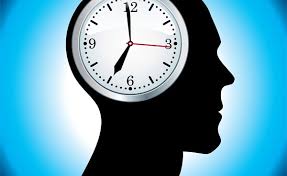
Chrono-what, you say? If I steered this post towards a biology lesson, you’d start nodding off right about now (not the way to treat your body clock). Instead, let’s keep it simple. Chronotype is essentially your preference for waking early or sleeping in. We all have a degree of one or the other, and we’ve had it since birth.
Let’s find out more about the “animal” within. Take the following test from Dr. Michael Breus (“America’s Sleep Doctor!”) – thepowerofwhenquiz.com – and less than a minute from now you’ll know your chronotype. You’ll also understand more about your propensity for sleep. No question – I hesitated when I came up dolphin (c’mon, Dr. Breus – I could’ve been a lion, a bear, or a wolf!), but admittedly the description is spot-on. I’m a light sleeper. Naps don’t help me. Attention to detail impacts my productivity (and my sleep). I hit the sack at the same time every night and wake up at the same time every morning. That’s me. And that’s the dolphin chronotype.
[Note: the Breus test wants your email to get your animal. Do it, and then unsubscribe. Otherwise the good doctor spams your inbox with books, courses, supplements, and other stuff. You just want your animal.]
To test the validity of chronotypes, I took the Breus test again… posing as my wife. If my answers for her were correct, she’s a bear (the most common chronotype). She’s not a light sleeper (Mardi Gras could be booming down the hall and she wouldn’t hear a thing). She works hard in the day, relaxes at night, and often goes to bed later than I do. She can sleep later into the morning if she so chooses. She needs a couple of hours to be fully alert after she rises. That’s my wife. And that’s the bear chronotype.

Unfortunately, chronotypes are not as dependable as they sound. For one, they shift as we age. For two, they can’t always be respected (i.e. jobs and lifestyle drive us off our body clocks). Finally, sleep is influenced by myriad factors having nothing to do with chronotypes (i.e. diet and exercise; light levels and sound levels; your dog, who always insists on going out at 3am.) But chronotypes are built into your DNA, so it behooves you to get to know them a little better.
One last wink of sleep trivia before we part. You know those nights when you wake up unexpectedly, and you feel completely, utterly out of it? Like, you can’t even see straight, let alone carry a conscious thought – as if you haven’t slept at all? That moment is called your circadian nadir; when your drive for wakefulness is at its lowest point. It happens about two hours before your natural wake-up time. For me – a dolphin – it’s not as disorienting a moment as most. But I still feel pretty out of it. After all, I’ve been sleeping with the fishes.

Some content sourced from the Wall Street Journal article, “Can a Night Owl Become a Morning Person?”
-
Beyond Repair
Most days, we leave our homes to spend time in other kinds of buildings. We park our cars in the front lot, approach the doors, pass over the threshold, and join the unique subculture within the structure before us. If we work in an office building, we navigate a maze of hallways and elevators before our final destination. If we traverse an airport, we draw on the stress and frenzy of countless others. If we worship in church, we assume the quiet reverence of the congregation. And if we enter a hospital for surgery, as I did last Thursday, we expect… we expect… well, we don’t know what to expect in a hospital, do we?
 My recent hospital visit deserves a few words. After all, the only other time I donned the peek-a-boo gown was a-way back in my teens. This time around (and with medicine advanced another forty years), I was keenly interested in the start-to-finish experience. My surgery – a routine out-patient procedure – took less than an hour, during which I was entirely unconscious. You’ll be spared the details since I can’t remember a single one of them. Let’s just say I’m beyond (the) repair now and recovering nicely.
The hospital experience itself actually began at the doctor’s office, a week prior. In that “consult”, not only did I learn what I didn’t want to know about my procedure (i.e. worst-case scenarios), I also learned I’d be checking into the hospital at 6am. Cock-a-doodle-doo, that meant the alarm clock buzzed at 5am. Remarkably, I wasn’t my surgeon’s first procedure of the morning. Call me grateful – he warmed up on somebody else instead.
I almost forgot to mention the hospital’s “pre-surgery phone call”, which they calendar between the consult and the surgery. I thought this conversation was going to be a financial beat-down (as in, “You are able to pay what your insurance doesn’t, yes?”). Instead the nurse went through a list of do’s and don’t’s in the forty-eight hours leading up to my hospital visit. Mostly don’t’s. Don’t use anything in the shower besides antibacterial soap. Don’t take your vitamins. No more nightly
bottleglass of wine. No food or water after 10pm the night before. She might as well have said, “Just come to the hospital now; you can wait in the lobby for the next three days”.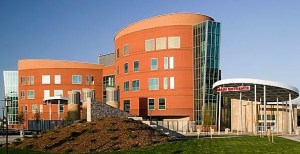
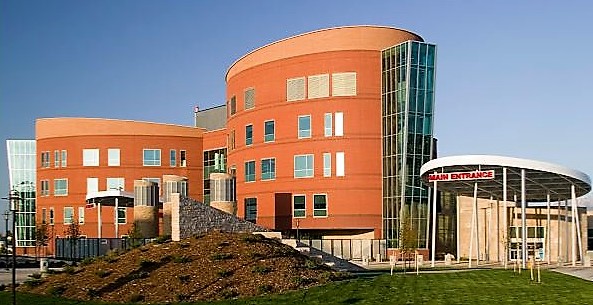
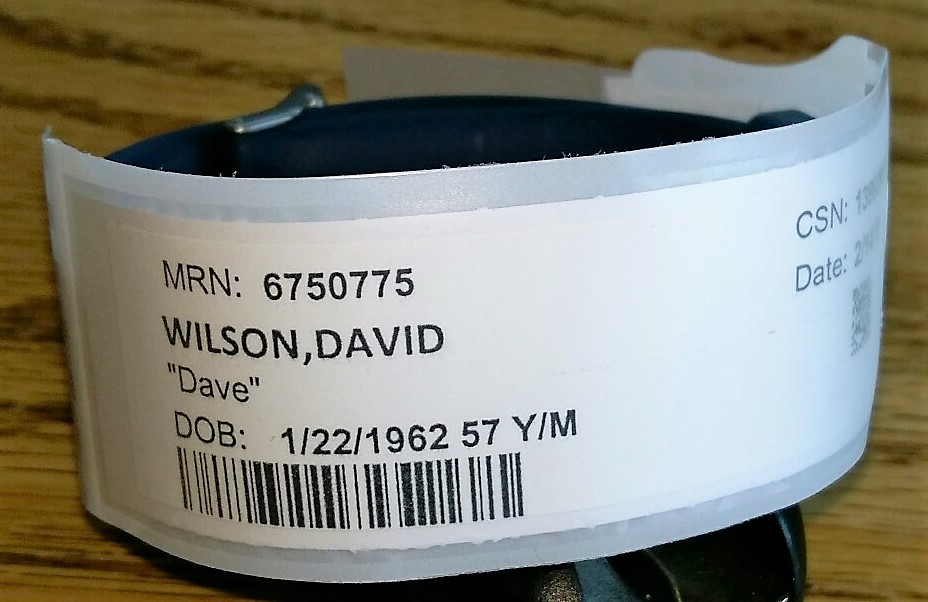
Colorado Springs’ stylish UCHealth Memorial Hospital North Emergency rooms aside, hospitals are surprisingly low-key at 6am. My wife and I staggered down the dark sidewalk into the main lobby (after finally locating a parking space not labelled, “For Doctors Only”). The only movement in the vast space was a couple of bleary-eyed attendants at the registration desk and the barista getting the coffee stand warmed up. Thanks to the “pre” phone call, registration was a breeze. The guy didn’t even ask for ID (though who would “steal” an out-patient procedure?). He just confirmed why I was there, slapped on the plastic bracelet, and sent me down the elevator to the “surgery reception area” one floor below. For the record, I’d like all my future surgeries to be above ground. The basement is way too close to the morgue.
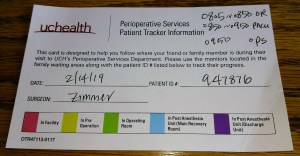
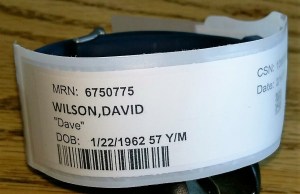
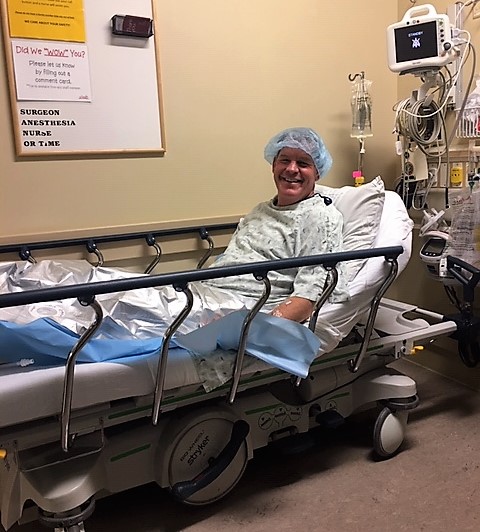
“Surgery reception” is where things get interesting. After they scan your bracelet (my every move now tracked) they escort you to the pre-op room where you receive the following: 1) A surprisingly comfortable and non-peek-a-boo hospital gown, 2) A stack of six antibacterial wipes each the size of a paper towel, 3) A laminated card with a diagram of the body, 4) A plastic bag for clothes/valuables, 5) A disposable shower cap, 6) A “blanket” (basically a large square of space-age tin foil), and – brace yourself – 7) Two oversized cotton swabs with a generous gob of red goo on each.
The wipes serve as a do-it-yourself bath without the water. The laminated card points each wipe to a different part of your body. The shower cap ensures you look your Sunday-best for surgery (photo below). Finally, the swabs are for your nostrils. Who knew – your best chance of infection comes from the nose? The red goo creates a barrier, and… right… too much information.
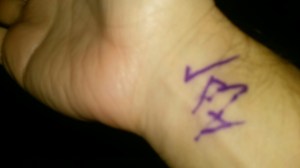
Dad! You got a tattoo! Thanks to a generous dose of the happy gas (a beautiful thing), the remainder of my start-to-finish hospital experience is hazy recollections. I remember a quick visit from the surgeon, and the tattoo he drew on my arm. (I never thought I’d be thankful for a tattoo. That check mark and initials remind Doc which side of me he’s cutting into!) Soon after I was wheeled into surgery and shifted onto the table beneath the white lights. As for the happy gas, it went into my IV (no mask), so I never saw it coming. One instant I’m lobbing a few questions at the anesthesiologist, and the next it’s, “nighty-night, Dave”. I may remember chatting up the nurse in the recovery room. I may remember fresh coffee and a scone (I love my wife). I definitely don’t remember getting dressed, heading down the corridor in a nurse-powered wheelchair, and dropping into the passenger seat of my car. Mission – er, surgery – accomplished.
If this were a Yelp review, I’d give my hospital visit five stars. I can’t come up with criticisms but then again, the happy gas conveniently dissolved a good chunk of the experience. Let me just say this instead. I now have a small, high-tech mesh installed, making me better, stronger, and faster the rest of my days. The hospital bill won’t be six million dollars, but my new body just might. In other words, Steve Austin reborn.
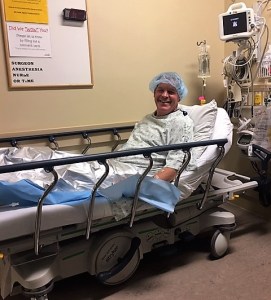
Dressed for success
-
Danger, Will Robinson!
A strategic goal of the Federal Trade Commission (FTC) goes as follows: Protect consumers from unfair and deceptive practices in the marketplace. Unfair and deceptive practices seem to be the strategic goals of several other organizations out there, so I’m glad the FTC seeks to “protect” me. For example, they held a competition called the “Robocall Challenge”, looking for solutions to reduce those pesky and sometimes illegal phone calls we all receive. The competition winners – two software programs designed to intercept and divert – split the $50,000 first prize. The problem? The Challenge was conducted over five years ago, yet robocalls are more rampant than ever today.

courtesy of nbcconnecticut.com The telemarketing calls of old seem quaint compared to the lifeless computer-generated voices of the last several years. Used to be, you’d answer the phone to a real voice; a sunny greeting in oft-broken English or heavy accent. The caller would say, “Yes, is this David Wilson, please?” or, “Hello Mr. Wilson, how are you doing today?” Who do you know who starts a phone conversation with wording like that? (Even better, when they’re looking for my wife Brigid – pronounced with a soft “g” – they mangle her name in ways I’ve never heard before.)
At least the old telemarketers sold you products or services too good to be true (“Congratulations – you’ve won a seven-day Hawaiian cruise!”), and at least they were human. Today’s robocalls are scams disguised as threats. Pay this tax bill immediately or the IRS will break down your door and haul you off to prison. Upgrade your Microsoft operating system now because your warranty’s about to expire. Buy this health insurance plan because yours doesn’t cover anything. I might listen to these pitches if they came from a real person, but the synthesized voice of a robocall triggers the involuntary reflex “hang up”.

courtesy of cio.com For me, the most effective solution to robocalls is simply not answering in the first place. If the Caller ID doesn’t convince me it’s a real call, I let it go to voice mail. Sure, my provider offers a call-blocking service, but they charge a fee. Why would I pay good money to manage a situation I didn’t ask for in the first place? The same goes for the better call-blocking applications out there. They’ll make them go away, but it’s gonna cost you.
By the way, not answering in the first place also stops robocall breeding. Just by picking up the receiver or hitting “Answer”, you’ve identified yourself as a number that works, which means the robocall provider sells your number to other providers, and that means more robocalls. Picking up the phone is why Americans received 16.3 billion robocalls in 2018… and that was just January-May.

courtesy of komando.com Robocalls are a nuisance – sure, but at least they’re not threats to the human race itself. That prospect turns my dreams into nightmares every so often. Whether vast supercomputers, unfeeling combat robots, or microscopic drones, you have to admit – we’re on the precipice of technologies just itching to get beyond our control. Fiction does a great job exploring the possibilities. Read Michael Crichton’s “Prey” (self-replicating nanotechnology), Daniel H. Wilson’s “Robot Uprisings” (just what the title suggests), or simply watch the brilliant 2014 film, “Ex Machina”. The final scene – when Ava walks confidently into the public domain and the credits roll – is perhaps the most chilling moment of the entire movie.

courtesy of IMDB.com As if to mock this post, my brother-in-law – visiting here at the house as I speak – just received a call on his mobile phone. Another robocall, and probably another scam disguised as a threat. Maybe the call wasn’t by accident, but rather a triggered response from a nanobot keeping an eye on my keystrokes. A subtle message, as if to say: we’re here and we’re watching. Sure, I can plead “no-mo-robo” (which is also the name of a call-blocking company), but I know the robots are only growing in numbers. Better make room then – another highly-intelligent species is quietly joining the party here on Earth.
-
Slipping Away
Every time we travel to California – this past weekend, for example – I have to be reminded about their statewide ban on single-use plastic carryout bags. You think I’d remember – Cali put the kibosh on the bags three years ago. Still, we fill our basket with groceries, head to the check-out, and the cashier goes, “want to purchase bags?” Argh. I should store a couple of reusables in my suitcase; the very ones I keep in my car in Colorado.

Plastic straws followed plastic bags, of course. Four months ago, the Golden State placed “discouragement” on the plastic variety (you must ask for them now). We sat down to a meal and our waitress brought glasses of water – with paper straws (argh again). Admittedly, “legal” sippers are pretty good. No reduction to mush like breakfast cereal sitting too long in milk. Other than the cost (several times more than plastic), and the fine ($25/day for un-requested plastic), paper straws are hardly inconvenient.

Now then, the real topic for today. California is looking to “strike up the ban” yet again – on paper receipts; the little critters we receive after credit card transactions. Say it isn’t so, West Coasters! Bags and straws I can deal with, but a ban on paper receipts? That’s just stealing another book from my old-school library.

According to a Wall Street Journal op-ed, the facts are these: paper receipts generate 686 million pounds of waste per year. (Can someone please quantify 686 million pounds – say, number of filled swimming pools?) Paper receipts also generate 12 billion pounds of carbon dioxide. (Again, quantify – number of breathing humans?) Also, paper receipts contain Bisphenol A (BPA); not exactly an appetizing compound. In other words, don’t eat your receipts just because the food was lousy.
Without paper receipts, my personal budget maintenance takes a blow. I keep everything in Quicken, so give me points for electronic accounting. But I also use paper receipts – an old-fashioned double-check mechanism. I enter the transaction from the receipt; then cross-check against the Visa statement (Jacob Marley reincarnated?) Why do I do this? Because once upon a time a waiter decided to triple my tip after I’d signed the bill and left the restaurant. Later, my paper receipt didn’t reconcile with my Visa statement. Busted. I promptly called the manager, who investigated and lo-and-behold, discovered a pattern of gouging. The waiter was fired. More points for me!

Now here’s the irony in my triple-the-tip story. What if the restaurant didn’t use paper receipts? What if I processed my transaction through Square or an iPad, self-swiping my card and choosing the percentage tip? For starters (and finishers) there wouldn’t have been gouging because there wouldn’t have been a waiter. It would be like standing over the shoulder of the processor at Visa – instant reconciliation. In effect, my story is a vote for no paper receipts.
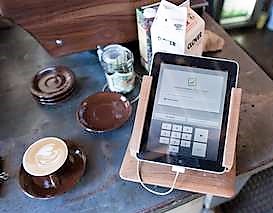
Truth be told, I’m already evolving – slowly – from paper receipts. When given the choice (Home Depot comes to mind), I select “email receipt” or “no receipt” more often than “paper”. Unlike robo-calls, I accept the unsolicited side effects of electronic commerce (i.e. email spam). In a nod to maintaining control, I select self-check-in at airports and self-check-out at markets.
More likely, I’m caving on paper receipts because I’ve already done so with a laundry list of other paper products. My written letters have (d)evolved into email. My paper-printed books have dissolved into bits/bytes on my Kindle e-reader. My to-do lists now reside in a phone app. Bills arrive in my online inbox instead of my streetside mailbox.

Phil Dyer, one reader of the Wall Street Journal piece, commented, “California will soon attempt to regulate earthquakes”. 49 of 50 U.S. states just LOL’d. Me, not so much. After all, I never thought I’d see the day where I’d give up my paper receipts.
-
Super Dough
The beauty of the Super Bowl is its broad entertainment value. There’s something for everybody in the five hours between The Star Spangled Banner and the Vince Lombardi trophy. For sports fans, there’s a highly-anticipated football clash. The Super Bowl is not football at its best or most dramatic, but this year’s coast vs. coast, old coach+QB vs. young coach+QB match-up creates more than the usual intrigue.

If you’re not into football, you’re at least enjoying the musical entertainment. Maroon 5 will be there after all (rumor had it they were pulling out), and the band acknowledges “… it’s the biggest stage you could ever play…” Even if you’re not a fan of the 5, you get Gladys Knight (but no Pips) singing the national anthem before kick-off.
If neither live sports nor live music is your bag (and that’s a small rock you live under), you’re watching the commercials instead. I admit – especially as a sports fan – there’s as much press for the Super Bowl ads as there is for the Super Bowl itself. It’s the only sports broadcast I know where viewers fast-forward through the game to get to the commercials.

Courtesy of Anheuser-Busch InBev No wonder advertisers are so worked up for this Sunday. The Super Bowl is routinely the single-most tuned-in-to entertainment of the year. Viewership has quadrupled over the last fifty years. The 2018 Super Bowl drew over 100 million viewers; 25% more than second-place. And what came in second? The Super Bowl post-game show, of course (74 million viewers). Say what you will about the NFL; people watch. The four most-watched television shows in 2018 were NFL games, followed by a “This Is Us” episode… airing immediately after the Super Bowl.

Courtesy of Frito-Lay Sunday’s line-up of Super Bowl commercials includes the usual products: cars, drinks (alcoholic), more drinks (non-alcoholic), foods (snack), more foods (fast), even more foods (avocados), and technology. Of course, they’re all designed to get you to remember, long after the game is over. Whether it’s a celebrity, a laugh, or a cute animal, it’s all about permanent placement of the product in your brain. But even if you don’t remember, consider this: the commercials will be watched millions more times on YouTube. Add in the Internet and the considerable cost of Super Bowl advertising is a little easier to swallow.
Speaking of cost, this year’s commercials will set producers back $5 million a spot, for a mere thirty seconds of air time. That’s just the bill to CBS. Production costs run as much as another $5 million. Try counting “one-one-thousand, two-one-thousand” every time you watch a commercial this year. You’re squandering $333,333 for every “-one-thousand” you utter. That’s what I call super dough, and it’s only rising (ha). The car companies account for 25% of the take (remember that the next time you negotiate the purchase of a vehicle), but Anheuser-Busch InBev is the “King of Advertising”, spending over $600 million on Super Bowl commercials since 1995. Yes, Clydesdale horses are cute. More importantly, they sell a lot of beer.

Courtesy of Anheuser-Busch InBev To pique your ad anticipation, Town & Country Magazine’s website includes a list of the “50 Best Super Bowl Commercials” (including the videos). The ads are listed chronologically, starting a-way, way back in 1967. It’s entertaining to see what products and companies paid big for Super Bowl advertising fifty years ago. Some are no longer around. I’m guessing their advertising agencies aren’t either.

Courtesy of Apple Mark my words. Monday morning after the Super Bowl the water-cooler talk will not be about the game. It will be about the commercials. Which one was your favorite? Which one left you scratching your head? Which one was $5 million up in flames? And most importantly, which one will still be talked about years from now? Even this sports fan has to admit: the game will soon be forgotten, but not the ads.
Some content sourced from the Wall Street Journal article, “Why Advertisers Pay Up for a Super Bowl Spot”; and from Wikipedia, “the free encyclopedia”.








About Me
The sky is not completely dark at night. Were the sky absolutely dark, one would not be able to see the silhouette of an object against the sky.
Follow Me On
Subscribe To My Newsletter
Subscribe for new travel stories and exclusive content.
 Life In A Word