
Hello, I’m Veronica
The sky is not completely dark at night. Were the sky absolutely dark, one would not be able to see the silhouette of an object against the sky.


-
Soft Spots
ESPN broadcast college football’s national championship Monday night. As the game moved to lopsided late in the second quarter my mind drifted to details besides the football itself. Hard Rock Stadium in Miami Gardens, FL is a striking facility, especially at night from the vantage point of the Goodyear Blimp. 15,000 football fans spaced randomly into 65,000 seats (thanks, COVID) looks awfully sparse. And speaking of awful(ly), the television commercials… well, let’s just agree college football ain’t the same thing as the Super Bowl, folks.

Home of the NFL’s Miami Dolphins Super Bowl commercials are more entertaining than the game itself, unlike the advertisement drivel I saw Monday night. Super Bowl plugs cost $5 million for thirty seconds while Monday night’s spots were six figures at best. Finally, Super Bowl ads are desperate to be memorable (even if you can’t remember the product itself), which is why you have office pools for “best commercial”. You’re not gonna have an office pool for what I watched on Monday night. This was the reverse of the Super Bowl: great football, lousy commercials.
 To say Monday night’s commercials paled in comparison to Super Bowl ads is like saying Sprite’s a little clearer than Coke. These product pushes were awful. For starters, you had what seemed like five advertisers over a four-hour broadcast. Dos Equis showed up every fifteen minutes. Their beer (excuse me, their lager) ads included a closeup of a glassful, with a commentator calling the movement of the bubbles as if they were players on a football field. Really? I hope his was a big paycheck.
Then you had AT&T, who seems to be promoting the lovely Milana Vayntrub (as salesperson “Lily”) as much as their products. Perhaps they’ve watched too many Progressive Insurance ads with Stephanie Courtney (as salesperson “Flo”)?

Don’t recognize Milana? You will soon… Finally, ESPN promoted itself. Normally I’d harp on the host network for advertising some of its own programs even though they paid millions to broadcast the game. But part of me thinks ESPN really does need the promos. COVID took a big bite out of sports over the last year, as well as a big bite out of ESPN’s workforce. When the network brought us Korean baseball and American cornhole competitions I thought, “Okay, the end is near”.
 But forget ESPN because I need to be a Davey-downer (i.e., slam) on one more commercial. I’ve been building to this moment since the first paragraph. Gatorade just launched it’s first new beverage in twenty years: “Bolt24”. It’s low-cal and loaded with electrolytes, so naturally the target audience is athletes. And Gatorade also selected athletes to push its product. Enter Serena Williams. She’s one of those athletes I’m on the fence about. Her athletic skills and accomplishments on the tennis court are unquestionable. She’s garnered enough championships to earn her place in the tennis player “GOAT” discussion (greatest of all time).
But Serena also has her not-so-role-model moments. She does not take losing well. She does not welcome constructive criticism. Countless broken rackets, lectures (threats?) to chair umpires, and disqualifications would have you wondering if there isn’t a permanent child lurking within the adult. Wah wah wah. But the Bolt24 ad was the last straw in my Serena drink. Why? Because the tagline goes, “you know you’ve made it when the whole world knows you by one name”. Oh, so when I say just “Serena advertises Bolt 24”, you knowingly say in response, “oh, her?”
Yeah, I get the pitch. Bolt24 is a one-word drink. Serena Williams is almost the only Serena I can think of (besides Serena van der Woodsen, the entitled main character of the TV series Gossip Girl). But I just can’t buy into the loftiness of the catchphrase. Get the world to recognize you by first name only and “you’ve made it”? Sting. Madonna. Cher. Bono. Enya. See the pattern? It’s an actor/singer thing. Also, an athlete thing. Lebron. Tiger. O.J. (Maybe that last one should just be “Juice”?)
Okay then, shutting down my rant now. Holier-than-thou personas don’t deserve any more press. I like to keep “Life in a Word” positive; simple; modest. Like me. You know… Dave.
Some content sourced from Wikipedia, “the free encyclopedia”.
-
Is It Live or Is It Memorex?

It’s the wood chipper for you, buddy. New Year’s Day has come and gone (and a warm welcome to you, 2021), which means it’s time my wife and I take down the Christmas tree. For some, taking down the tree means disconnecting the branches from the trunk, the trunk from the base, and packing the whole thing into a cardboard box to be used again next year. For us, taking down the tree means lifting it off the stand, hauling it outside to the truck, driving it over to the drop-off lot, and donating $5 to fund the recycling. Yes, this year – as with all of my years – the Christmas tree is real, not artificial.
I’m not here today to debate real vs. artificial Christmas trees. They both have pros and cons and your choice rests on where you live, your budget, and assorted other reasons. For me, a real tree is simply a tradition I refuse to give up. Picking out a tree with my family was a big deal when I was young. There was something magical about living in sunny Los Angeles and watching dozens of pine-scented snow-dusted trees being unloaded from Canadian railcars. Never mind we paid a little extra to have our tree “flocked” (adding a touch of spray-painted artificial snow). It was still a real tree.

Memorex: Sound that “blows you away”. Real vs. artificial goes way beyond Christmas trees. When I consider one next to the other, I always think of Memorex. In the 1970s and ’80s the Memorex Corporation produced audio cassettes, the precursor to the compact disc. In their TV commercials Memorex included singer Ella Fitzgerald belting out a note powerful enough to shatter a wine glass. Then they’d play a recording of Ella’s performance and the wine glass would still shatter, begging the question, “Is it live, or is it Memorex?”
Real vs. artificial also recalls Milli Vanilli, the R&B duo from the late ’80’s. Milli Vanilli made it big with the album “Girl You Know It’s True”, then won the Grammy Award for Best New Artist. But years later the world would find out Milli Vanilli never sang anything. Instead they lip-synced their way to fame; their albums the voices of studio performers. Milli Vanilli returned the Best New Artist Grammy shortly after that.
Let’s visit real vs. artificial a little closer to home; say, the kitchen. As much as my wife and I seek whole, organic, locally produced foods, we can’t help including a few outliers. I just went through our pantry and came up with a few good examples:
- Aunt Jemima syrup. This pancake topper – destined for rebranding in the name of racial equality – is nothing but high fructose corn syrup, water, and a whole lot of chemicals. The “Natural Butter Flavor” variety blatantly advertises “contains no butter”. You’ll find all the pure maple syrup you want in Vermont but you won’t find a drop in a bottle of Aunt Jemima.
- Kellogg’s Pop-Tarts. A long time ago Pop-Tarts contained real ingredients (else my mother wouldn’t have put ’em on the pantry shelf as kid snacks). Today’s Pop-Tarts are enriched flour and a bunch of scary-sounding ingredients developed in a lab. It takes half the height of the box to list everything that goes into a Pop-Tart.
- Kraft Mac & Cheese. Make a bowl of pasta, top it with melted cheddar, and Voila! you have macaroni & cheese in two ingredients. Kraft Mac & Cheese needs twenty-one to accomplish the same dish. But man, don’t it taste great?
- Ritz Crackers. More enriched flour plus lab ingredients. (Maybe every food can be made from enriched flour?) The Ritz Crackers box includes a warning, “Contains wheat, soy”. Ha, if only that was all it contained.
- “Real” Bacon Bits. My mother-in-law left this bottle of horror behind when she brought a salad for Christmas dinner. But guess what? It really is made of bacon (okay, and chemicals). I must’ve been thinking of other brands, where the bits are actually “flavored textured soy flour”. Oh ick.
Back to our real Christmas tree. After the gifts were passed around and opened, we discovered one more, looking a little embarrassed behind the branches. It was a brightly colored basket, the kind all dressed up with a cute wooden box and Christmas bow, overflowing with food items and protected in plastic wrap.
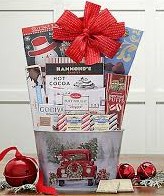 But here’s the rub. We opened the basket and found a whole lot of nothing. Generic cookies, coffee, candy, and a couple of cheap Christmas mugs, arranged carefully so as to suggest the basket contained much more. To add insult to injury, none of the food items were name-brand (except for a handful of Lindor truffles). The cookies and candy were made with a ton of artificial ingredients. The coffee was so generically packaged it had me wondering if it was even coffee. The whole basket made me think “Memorex”.
 This is where I jump to a discussion about artificial intelligence, but your real brain needs a rest so that’s a topic for another day. Meanwhile, my wife and I will keep heading out every Christmas to tree lots (or the woods) to find the perfect one. “Artificial” may sneak into other parts of our lives now and again but at Christmas, we’ll always be keeping it real.
Some content sourced from Wikipedia, “the free encyclopedia”.
-
Busy Buzzwords
Our local news wraps its nightly broadcast by pushing little surveys you can take online. Earlier this week was, “Should the U.S. Senate vote to increase stimulus checks to $2,000?” (88% said yes). The night before, “What was your favorite holiday food this year?” (pie narrowly edged ham). What I find laughable is the participation rate – maybe 25 responses on average – yet the results are announced the following night like headline news. 25 is a minuscule sampling for a basis, like surveying a few of your neighbors and calling it good. Yet other companies take the exact same approach. Example: Merriam-Webster just announced its 2020 “Word of the Year”.

Merriam-Webster’s fitting “Word of the Year” You’ll find almost 200,000 words in the English language (with more added every year). Should pandemic take the trophy for 2020? Well, yes, it’s hard to argue with Merriam on that one. Not only did the COVID-19 pandemic dominate headlines and conversations, the word created the single largest spike in dictionary traffic. On March 11th, when the World Health Organization declared COVID-19 a pandemic, the lookup of pandemic increased over 100,000% over 2019. I can’t convert 100,000% to a quantity but I know it’s a big number.
Merriam isn’t content with just “word of the year”, however. They also list the top ten words according to increased dictionary traffic over the previous year. Accordingly, 2020 self-branded with coronavirus, quarantine, and asymptomatic. I wouldn’t think any of these words – pandemic included – induces peace of mind, but in dire situations our brains have a relentless need to know more.
 With the mental fatigue brought on by too much COVID talk, perhaps you’ll find Merriam’s other top-ten words more refreshing. Antebellum made the list because the long-popular country music trio Lady Antebellum changed its name to “Lady A”; also because the movie “Antebellum” was released in September. Mamba was a top-ten for the passing of basketball legend Kobe Bryant, his nickname in reference to his killer play. Kraken is the newest franchise in the National Hockey League, the mascot a mythological Scandinavian sea monster.
Seattle-ites will learn to chant, “GO KRAKEN!” But none of these are my favorite. How about #7, schadenfreude? SHAH-dun-froy-duh means “enjoyment obtained from the troubles of others”. In March, schadenfreude pointed to the college admissions scandal, particularly the outing of the guilty A-list celebrities. Schadenfreude also colored the daily coverage of President Trump by the so-called “fake news media”.
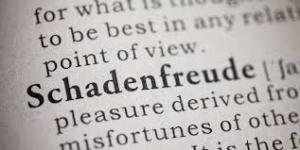 For the record, schadenfreude is German (of course it is) so let’s give it bonus points for sneaking onto a top-ten list of English words.
You may not agree with Merriam-Webster but at least its choices are based on real data – lookups that imply support from the masses. Other organizations are much vaguer with their selection criteria. Consider Time Magazine’s “Person of the Year”. Time’s stated criteria is, “for better or for worse… has done the most to influence the events of the year.” By that definition it should come as no surprise to see Adolf Hitler selected in 1938, Martin Luther King, Jr. in 1963, and Mark Zuckerberg in 2010. However, you’ll also find almost every U.S. President on the list, as if simply inhabiting the Oval Office makes you more influential than all other persons. President-elect Joe Biden and Vice President-elect Kamala Harris are 2020’s “Person of the Year”. Uh, shouldn’t we at least get them inaugurated before evaluating influence?

Deserving of more “Timely” recognition… [Note: Time’s “Person of the Year” recognition owes a debt to aviator Charles Lindbergh, who completed the first solo transatlantic flight in May of 1927. The magazine overlooked Lindbergh’s accomplishment by never featuring him on its cover. To make up for it, Lindbergh became Time’s inaugural “Person of the Year”. Makes you wonder if someone else was more deserving in 1927, doesn’t it?]
One more “of-the-year” example for you. Pantone, the “color company” best known for its Pantone Matching System (or PMS, a rather unfortunate acronym), chooses a color of the year to put the last twelve months in review. For 2020? Like Time Magazine, Pantone broke its own rules and went with two choices: Ultimate Gray, which suggests solid shadows cast on a wall; and Illuminating, a lemony shade hinting at “the light at the end of the tunnel”. Illuminating might be a little premature for 2020. Let’s go glass-half-full and call it next year’s color instead.

Is this light “Illuminating” to you? If Merriam-Webster could choose its busy buzzwords in hindsight, 2020’s winner might not be pandemic but rather, malarkey. Malarkey came in at #11 in the top ten (come again?) because it’s a favorite of President-elect Biden. Rather than saying, “C’mon man, you’re making that up.” (okay, he says that too) Biden prefers, “Give me a break; that’s a bunch of malarkey”.
“Malarkey” my words; you’re gonna hear the Biden favorite a lot over the next four years.
Some content sourced from The Cut article, “Pantone’s Color of the Year is ‘The Yellow Wallpaper’”, Merriam-Webster.com, and Wikipedia, “the free encyclopedia”.
-
Royal Beauty Bright
If I were more organized a couple of weeks ago I could’ve seen the Aurora Borealis. Maybe you’re familiar with this magnificent natural artwork: the waving colorful “northern lights” spreading across the sky like a wind-ruffled pastel blanket. The best seats for the AB are always to the north, like Alaska or the Arctic, but this year we had a similar instance just driving distance from our house in northern Wyoming. I missed it, darn it. I’ll have to settle for a look at this week’s Christmas Star instead. Er, make that this week’s “Jupiter/Saturn overlap”.

The view from my house (directly above Pikes Peak!) I’ve always been something of an astronomer wannabe. We have beautifully clear skies where we live and on most nights we can see more stars, constellations, and galaxies than we could possibly count. I’ve even invested in tripod-mounted high-power binoculars to get a better look at all things extraterrestrial. So I certainly didn’t miss the recent headlines about Wyoming’s “southern northern lights”, nor the nighttime blast of this week’s Christmas Star. Any astronomical event visible to the naked eye is worth noting in my iPhone calendar.

Courtesy of CBS News Jupiter and Saturn aren’t really overlapping, of course (talk about an abundance of gas). They just look like they’re a single celestial object as seen from our Earthling vantage point. They’re still millions of kilometers apart in space, the same way stars in constellations aren’t all the same distance away from us. This blog post is a little late, as the best days to see “Jupiturn” were Sunday, Monday, and Tuesday, just after sunset and looking to the west.
Speaking of a little late, let’s talk about the Real Christmas Star (RCS). Surely you’re familiar with RCS, the singularly bright beacon from biblical times guiding the Magi to the birthplace of the baby Jesus (editor’s note: lots of “b’s” in that sentence, Dave). This star moved in a westerly path – as noted in the third verse of “We Three Kings” – like the oversized laser pointer of an invisible tour guide. This star was purported to have stopped directly over Bethlehem close to the events we celebrate on Christmas Day. This star “with royal beauty bright” was…, was…, (spoiler alert) – well, this star wasn’t a star either.

Also not a star… I know, I know. We’re talking about events from over two thousand years ago. Outside of the Bible and pure faith, how can we know the true identity of the RCS? Well, we know because we have astrophysicists. I’m never one to blend science and religion but I’m about to make an exception.
To keep this simple let’s address the basic questions:
- When did the RCS occur? During the reign of King Herod and Emporer Tiberius. Roman historians (and the Bible’s Book of Luke) give the approximate timeframe as 8-4 B.C.
- Who saw the RCS? The Magi according to the Bible, but also Chinese astronomers according to their own records… which go back to (gulp) before 1000 B.C.
- What did the RCS look like? A morning star, because it was rising. Not a comet, not a nova, not even a supernova. In ancient times those three were seen as indicators of negative events. The Magi certainly wouldn’t have followed something negative.
- What was the RCS? Ah, now there’s the question for the Powerball jackpot. And that’s where our astrophysicists come to the rescue. The RCS – like this year’s Jupiturn – was also the convergence of Jupiter and Saturn, only amplified by light from the sun, moon, and at least three other planets. That’s putting a lot of “balls” into play, isn’t it? Celestial alignments happen regularly over time so astrophysicists were able to project backward and offer this likely explanation of the Real Christmas Star.
The RCS alignment from two thousand years ago seems recent compared to its next occurrence. You won’t get that kind of planet-star-satellite party again until the year 16213. That’s fourteen thousand years from now. You won’t be around by then. Maybe Earth won’t be either.
 I did look to the west after sunset to see the convergence of Jupiter and Saturn earlier this week. It was bright – sure – but not as if looking directly at the sun. And knowing it wasn’t a “star” took some of the shine off of it (ha). Meanwhile, the Aurora Borealis is out there a little more often. At least I’ll be alive to see its next performance.
Some content sourced from the University of Notre Dame article, “Royal Beauty Bright”.
-
It’s Been a Silent Night
When singer Amy Grant released “Tennessee Christmas” in 2016 it’d been years since she recorded a holiday collection. In fact, her platinum-level “A Christmas Album” arrived way back in 1983; her triple-platinum “Home for Christmas” in 1992. “Tennessee Christmas” didn’t achieve platinum, gold, or anything else for that matter. As my brother said at the time, “She never should’ve done it.” He’s right. Amy should’ve released just “I Need a Silent Night” and called it good.
Amy Grant can still pen lyrics (even if her voice isn’t as strong as it used to be). “I Need a Silent Night” asks us to find the true meaning of Christmas in the midst of the inevitable commercial distractions. Instead of “December traffic” and “Christmas rush” and “Shopping and buying and standing forever in line”, Amy asks:
I need a silent night, a holy night
To hear an angel voice through the chaos and the noise
I need a midnight clear, a little peace right here
To end this crazy day with a silent night As if we’ve been granted Amy’s wish (ha), this season has been remarkably placid. The message of Advent is always “prepare” and that’s what we’re doing. It’s just – unlike most years – we’re not using words like “rush” and “chaos”. We’re experiencing more of a “silent night” instead.
Our Christmas prep never begins until after Thanksgiving (I stand on holiday principles here) but by the following Saturday I was eagerly unpacking the decorations and streaming holiday tunes. More importantly, I also found myself saying “yes” to just about every reason for the season:
 Since we can’t have in-person services our church offered Advent wreaths to build and display in whatever room you “go to church” in at home. We asked for a wreath as soon as they were available.
- A family involved in our local 4-H advertised festive bags of scented pine cones as a fundraiser for their activities. We bought two bags and they delivered them straight to our door. There’s nothing that says “Christmas” like the tiny voice of a five-year-old saying, “Thank you, Mr. Wilson!”
- Our church set up a virtual giving tree where you can pick presents from a list, buy them, and return them to the church for distribution to needy families. I bought six.
- We’ve been baking up a kitchen storm so we decided to put together plates of cookies for our neighbors and deliver them. Front doors were opened cautiously, to which we said, “Well, this may be the only chance we get to see you face-to-face this year. Merry Christmas!”
- We’ll be having drive-in Christmas Eve services this year so our church put out a big bin of ornaments, asking us to decorate them and put them on trees surrounding the parking lot. I grabbed several.
 Starbucks moves to Christmas drinks and goodies shortly after Halloween. There’s this unspoken opportunity to “pay it backwards” by taking care of the car behind you in the drive-thru, and then speeding off to remain anonymous. I’ve been doing this for weeks.
- Colorado Springs advertises a Christmas For Kids effort where you’re assigned a needy child’s Christmas list. You buy the gifts, wrap them up, and pass them on to case workers who make sure the kids get them in time for Christmas. I sponsored two.
 Most of these Christmastime gestures (and why should they only happen at Christmas, right?) would not find room in our “normal years”. We’d be rushing about trying to find one last gift, throwing up Christmas lights and decorations, and hastily preparing our cards to put in the mail. We’d be wrapping presents ’til well past midnight on Christmas Eve. Yet this year we’re completely organized and ready, including all those meaningful extras I mentioned above.
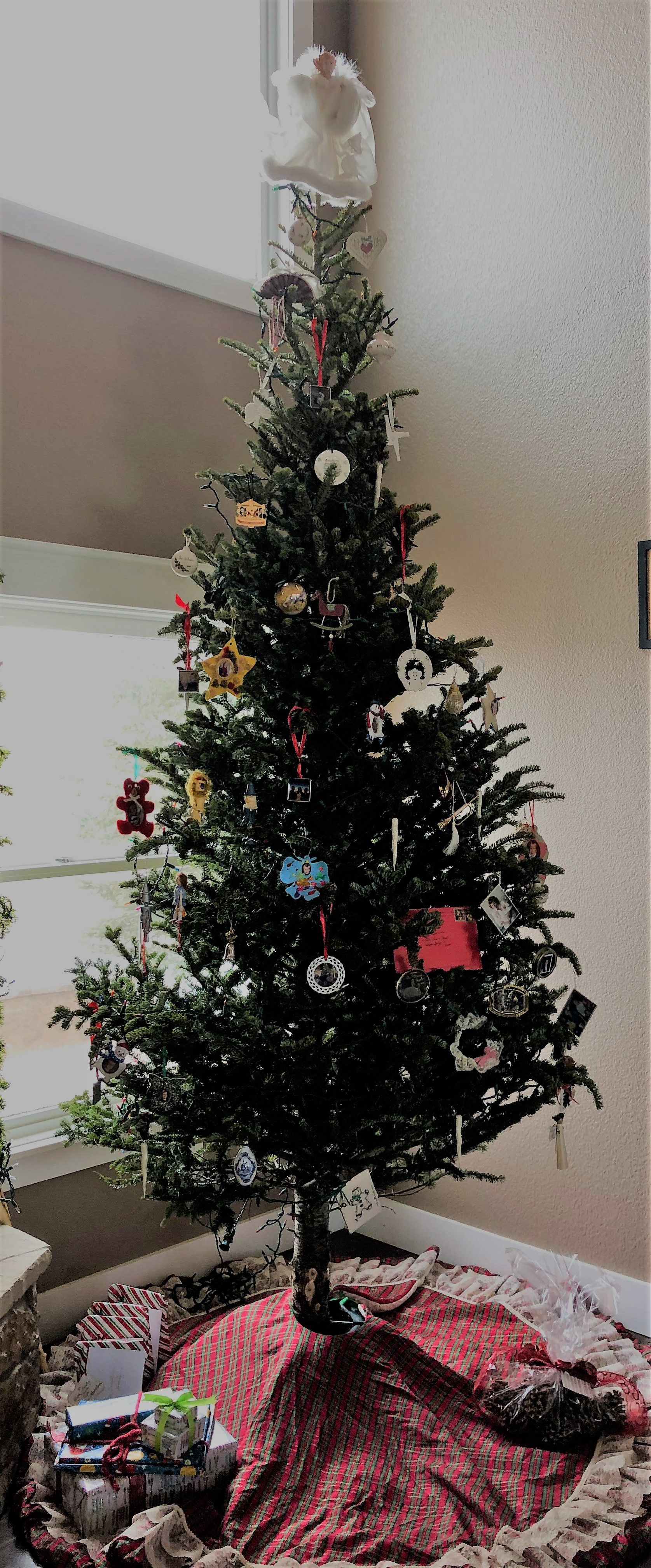
Let me “wrap” (ha) with one more holiday task we completed earlier than usual: decorating our tree. Christmas trees must’ve been in high demand (or short supply) this year because our local lot only had one left in the 10′-12′ range we prefer. It’s tall and thin (kind of like you see in Whoville in the original “Grinch” movie). It’s so tall our angel at the top seems poised in the heavens, which is wonderfully appropriate this year. She was the only decor on the tree all of last Sunday before we added everything else the following night. So now our tree boasts the usual organized chaos of lights and ornaments. But it’s only the angel I see. She’s watching over us and giving us exactly what we need this year: a silent night, a holy night.
This post is in memory of Marion.





About Me
The sky is not completely dark at night. Were the sky absolutely dark, one would not be able to see the silhouette of an object against the sky.
Follow Me On
Subscribe To My Newsletter
Subscribe for new travel stories and exclusive content.
 Life In A Word