
Hello, I’m Veronica
The sky is not completely dark at night. Were the sky absolutely dark, one would not be able to see the silhouette of an object against the sky.


-
Forty Days and Forty Nights
Tuesday seems like weeks ago. Some call it “Fat Tuesday” (esp. those pancake-bingers partying hard at Mardi Gras) but to me, it’s just the last day of my food free-for-all. My wife and I decided to give up “flour” for Lent (more on that in a minute) so Tuesday night we overate at our favorite Mexican restaurant. Chips and salsa (the chips a hybrid of corn and flour). Enchiladas and tacos wrapped in big, fluffy flour tortillas. Sopapillas fried from puffy flour tortillas, drenched in honey. Big, frosty margaritas to wash it all down. It was kind of a fiesta final before Lent.
 Now it’s Ash Wednesday as I type and I’m already obsessing about my forbidden flour. This morning’s breakfast was hardly a fiesta – coffee and a protein shake. Not a tablespoon of flour to be found anywhere. My upcoming fever dreams will be liberally dusted with flour. I’ll have fantasies of consuming an entire bakery case (shelves and all), eating my way out of a gigantic loaf of bread, or parking my mouth below the pasta-maker while endlessly turning the crank. I’m looking at all the snow outside my office window right now. It looks exactly like white flour. It probably IS white flour. Hang on, I’ll be right back…
As of today, we’ve officially started the season of Lent again. The next forty-odd days and nights are gonna be the usual challenge. Did you know the Old English translation of “Lent” is “spring season”? How that computes with all the flour I’m seeing outside my windows right now is beyond me. More to today’s point, Ash Wednesday is the deadline to answer the question, “What am I giving up for the next seven weeks?”

Lent = “no mas” Lent, as even non-Christians know, is the religious season of preparation leading up to Easter. It’s the time to reflect inward, with more attention to prayer and the Good Book, less attention to “shortcomings” (sins, people), more charitable service to others, and finally, a cruel little something called “self-denial”. Self-denial is anything you want it to be, but the idea is to subtract from your daily equation: something you don’t need but you’ll struggle to be without. Consider seven popular choices for 2021:
- Chocolate. Maybe this one’s popular because it’s the easy way out. Chocolate’s often in my desserts, occasionally in my protein shakes, and every-now-and-then in my mid-afternoon pick-me-ups. But I can certainly do without the sweet stuff for forty days. C’mon, people used to give up food for Lent! A little chocolate’s not really what the Big Guy had in mind.
- Meat. Christians forego meat on Lenten Fridays anyway but some choose to give it up the whole way. Not me. If I’m giving up flour, I’ve got to have meat-and-potatoes to soften the blow of all my bread, pasta, and baked goods currently on hiatus. For Pete’s sake, I can’t even have chicken noodle soup! What was I thinking?
- Smoking or Drinking. Maybe these are your vices but they’re not mine, so either would be a Lenten cop-out. I enjoy the occasional glass of wine or a beer, sure, but putting them on the shelf for the next month or so? Hardly a stretch.
- Coffee. Okay, we just shifted from first to fourth gear. There is nothing – NOTHING – to fill the vast and infinite void left behind by my morning cup of joe. I understand self-denial but don’t turn me into a raging lunatic. Force me to give up coffee for Lent and I’ll have a newfound respect for the next option, which is…
- Sleeping In. Normally this would be another cop-out for me because I’m one of those annoying morning people. But deny me my coffee and I’ll gladly hibernate until early afternoon – every day until Easter.
- Social Media. I dropped Facebook late last year. I’m only on Instagram a couple of times a week. I have no Twitter feed. I get it – it’s 2021 – but this one’s a no-brainer for me. I mean seriously, just give me a call.
- Speaking Poorly about Others. I asked my sister-in-law what she was giving up for Lent and she said, “I’m going to be nice to others”. That gave me a good laugh until I found this item on the list. My sister-in-law has plenty of company. So, consider: could YOU give up airing dirty laundry for forty days?
 One more thing about Lent. Each of the liturgical seasons has a color, and Lent’s is purple. You’ll see a lot of it in churches, cathedrals, and flower arrangements this month and next. I like purple enough, but ask me to name purple items and all I come up with is eggplant (the nightmare vegetable of my youth), figs (the nightmare fruit of my youth), grapes (I prefer the green ones), cauliflower (yep, it comes in colors), and lavender and amethysts, both of which I have little use for. Purple is about as smart a choice for Lent as giving up flour.
 In conclusion, I could use your prayers as I endure my forty-day flour fast. By late March my car tires will look like doughnuts and my paperback novel a nice, thick Pop-Tart. Toss me a Frisbee and I’ll slather it in syrup and devour it like a pancake. Put your pasta under lock and key. Guard your pizza with your life. I’m coming for your cupcakes.
Some content sourced from the Delish.com article, “7 Things To Give Up For Lent That Go Beyond Food”, and Wikipedia, “the free encyclopedia”.
-
Fine Print
I’ll never forget the first time I saw the movie, Jurassic Park. I’d read the Michael Crichton novel so I already knew the story, but I still couldn’t wrap my mind around that first dino scene, where a brachiosaurus casually munches on the uppermost leaves of a forty-foot tree. The gigantic creature was so lifelike I thought, “Where’d Steven Spielberg get a dinosaur?” In my defense, computer-generated imagery (CGI) was brand-spankin’ new back then. A ferocious T-Rex looking and moving like the real thing was still jaw-dropping in the 1990s. And I’m having the same reaction to the stuff rolling off 3D printers right now.

A “printed” toy tugboat If you’re like me you haven’t paid much attention to 3D printing. You see some of the items a 3D printer can generate and they seem like child’s play. In fact, 3D printing reminds me of a 1970s toy called “Creepy Crawlers”. You had these tubes of colored goop you squeezed into metal molds, and then the molds went into an electric oven. The goop would grow from flat to 3D with heat, and suddenly the oven was spilling out all kinds of bugs and spiders you could drop on your friends. (There was also consumable goop called “Incredible Edibles”; products to compete with whatever the girls were making in their Easy-Bake ovens).
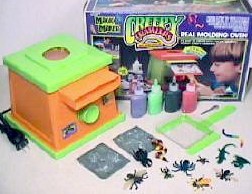 But I digress. Here’s my 3D printing naivete in a nutshell: I still think my 2D printer is the more impressive technology, cranking out high-resolution photos and perfectly addressed envelopes. I mean, whatever would I need a third dimension for?
Yep, I am seriously naive about 3D printing. The scope of this topic is mind-boggling if you really take the time to understand its potential. Here’s a good example. Picture a printer as big as your living room. Picture a printer cartridge of concrete instead of ink. Now watch the printer build your living room, one horizontal layer at a time. The printer can also build the rest of your house. Just add plumbing and electric when it’s done.

“Printed” storage crates Without getting too far into the weeds, let’s define 3D printing for what it really is: additive manufacturing (AM). Here’s an easy way to picture the AM process. When you build a log cabin you lay out the entire foundation of logs for the house – with breaks for the doors – before you add the next layer of logs. You work your way up a layer of logs at a time, keeping those breaks for the doors, adding breaks for windows, pipes, and such, completing the structure with a sloping roof on top. Perhaps you add a fireplace in the process; again, layering bricks on top of bricks until you’ve reached the top of the chimney.
That’s pretty much how a 3D printer works. It “pictures” an object in horizontal layers and “prints” it from the ground up. 3D printing has been around longer than you think. 3D printers were developed as early as the 1970s (preceding your inkjet 2D printer!). The early versions just had to be manually programmed. Once we attached a computer and software, 3D printing really came into its own.
Watch the following video of a 3D printer confidently layering a basket weave – it’s mesmerizing:
The products speak for themselves, of course. A shortlist of the more cutting-edge printed creations gives you an idea of where our world is heading:
- Cakes and pastries – The “ink” is baked goods in one nozzle and frosting in another. Design it on your computer screen and then “print”. It’s like the Easy-Bake Oven on steroids. Only you don’t need the oven.

3D-printed confectionery from Ukrainian chef/architect Dinara Kasko - Bones – No, not some plastic or other polymer designed to replicate bones, actual bones. It’s called bioprinting – the fabrication of natural tissue using cells and other building blocks, and it’s coming soon to a clinic near you. Don’t worry how long a broken bone will take to heal; just replace it!
- Buildings – Forget about building that log cabin one layer at a time. Your 3D printer will do the whole job for you (and it’ll still look like a log cabin). Your printer can also build sturdier houses out of concrete. This one’s on the market in Riverhead, New York, for $300K.

- Vehicles – 3D printers have already created boats, kayaks, and most of the makeup of cars and trucks. Long ago I was impressed with the robotics of the Ford Motor Company, employed on a long assembly line to build cars one part at a time. A 3D printer can essentially do the same job standing still, no assembly line required.

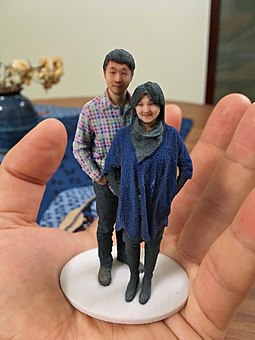
- You – I could speculate on the potential for a full bioprint but let’s avoid that scary future for now and just say, a 3D printer can create a figurine to look exactly like you. Think of it as printing a 3-D photograph.
If your mind is not blown by what you’ve just read, consider this: 3D is already passe. That’s right, we’ve already moved on to 4D printing. 4D – at least with printing – refers to materials that can change shape with time, temperature, or some other type of stimulation. A good example would be a printed window shade, sitting tight and virtually unnoticed at the top of the window in daylight but expanding to full cover as darkness falls.
Don’t know about you but this level of technology makes my head hurt. When I’m done with this post I’m gonna push “print” and generate a nice 2D copy for my files. Oh, and maybe watch Jurassic Park again.
Some content sourced from the 7/24/2020 Forbes article, “What Can 3D Printing Be Used For?”, and Wikipedia, “the free encyclopedia”.
- Cakes and pastries – The “ink” is baked goods in one nozzle and frosting in another. Design it on your computer screen and then “print”. It’s like the Easy-Bake Oven on steroids. Only you don’t need the oven.
-
Dots ‘n’ Dashes
Back in my days in the Boy Scouts, they had a merit badge called “Signaling”. To earn the badge you had to build a basic communication device (buzzer, blinker) and demonstrate a knowledge of Semaphore – visual signaling by flags – and Morse – audible signaling by “dots” and “dashes”. Today most people wouldn’t have a clue about Semaphore, and their only familiarity with Morse might be from the frantic telegraph typing in the movie Titanic. Dots ‘n’ dashes have stepped down, more associated with the mundane pavement markings of the streets we drive. Well hey, at least they’re still signaling devices.

“Dashing through the… street…” Let’s talk about street dashes first. The highway to our rural neighborhood was recently restriped, mostly dashes but occasionally a solid for safety’s sake. Some lanes were shifted, and they just covered up the old stripes with blackish paint similar to the asphalt below. But my car was not fooled, no sir. It still sees the old striping. Anytime I pass over those areas my car’s “lane-keeping assist” emits an audible warning and tries to bump me back onto the road, when in fact I’m just passing over covered-up stripes. That’s annoying. Either car tech needs to improve or road striping needs to come up with a better cover. Until one or the other happens I’m all over the road.
Here’s an even better story about dashes. Long ago, my parents were driving my brothers and me back from my grandparents’ house. We were cruising along a paved winding road late at night when all of a sudden my dad gets to wondering about those highway dashes. He starts to guess – if you measured one, how long would a dash be? Talk about useless information, right? But then, right in the middle of a darkened highway, no cars in the rear-view mirror, my father stops the car, gets out, and starts measuring a dash, foot-in-front-of-foot like he’s taking a sobriety test. Then he gets back into the car and announces proudly, “six feet”. Think about that the next time you pass those stripes at forty miles an hour. (But please, don’t get out and actually measure one).
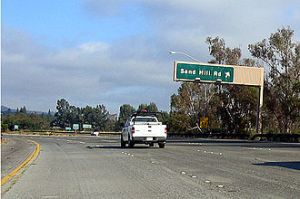
California highways are usually dotted, not dashed. Now let’s talk about street dots. You know, those round, non-reflective raised pavement markers used to designate lanes and borders and such? They’re actually called Botts’ dots. It’s a name I’ve known since childhood because I grew up in California where they were invented. California has over 25 million of the little guys marking its endless streets. And if you must know, Botts’ dots were named for their inventor, Elbert Dysart Botts (and how’s that for a mouthful?)

Kinda cute, right? Botts’ dots might’ve never been a thing were it not for their total makeover. At first they were glass discs attached to the road with nails. (How’d you like to have that job? Whack, whack, whack!). But then they started popping loose, and people got flat tires from the nails and the broken glass. So Botts (or a coworker) devised a hard plastic to replace the glass and an asphalt-friendly epoxy to replace the nails. Now the dots – and the speeding cars above them – stay where they’re supposed to.
But now Botts’ dots have a whole new challenge. We face a future with self-driving cars. Turns out, Botts’ dots mess with that technology. The car may or may not recognize a dot as the border of a lane. That’s not good when you put your steering wheel in the hands of a robo-chauffeur. But can you imagine the task of removing 25 million Botts’ dots? That’s worse than hammering them in one by one!

Botts’ dots may go the way of the telegraph. Over here in rural Colorado, I got pretty excited about the prospect of California surrendering all of its Botts’ dots. We can use ’em. You see, out here we have mostly two-lane highways divided by dashes, or occasionally solid lines instead of the dashes (don’t pass!), or very occasionally the luxury of a defined left-turn lane. But “dash-it-all” when it snows. You not only lose the striping, you lose the road. At least a Bott’s dot would make noise and give you a jolt to let you know you’re not about to cruise into somebody’s cow pasture.
Alas, my dream of millions of Botts’ dots flying over the Rocky Mountains died before it was born. Turns out the asphalt epoxy of a Botts’ dot cannot compete with the combined weight and speed of a snowplow. The dots’d go flying every which way from the snowplow blade, like hundreds of tiny shuffleboard discs. Ping! Ping! Ping!
 Signaling merit badge was retired by the Boy Scouts in 1992 (yet another reminder of my advancing age). Looks like the Botts’ dot is headed for a similar scrap heap, at least if self-driving cars become more mainstream. Meanwhile, you’ll find me out in my neighborhood navigating the painted dashes. Even if I do prefer the dots.
Some content sourced from Wikipedia, “the free encyclopedia”.
-
Chocolate Cremè de la Cremè
 Godiva, the incomparable Belgian chocolate maker, is closing every one of its retail shops in North America. Maybe you’re blaming the pandemic but Godiva claims foot traffic at shopping malls – where most of its boutiques are located – “plummeted” over the last few years. I’m sorry to see Godiva go. Mind you, it’s not that I make a habit of buying $3 truffles. It’s more the idea that I could if I wanted to.
Godiva is the cremè de la cremè of chocolate. Their products are born of a family business dating back to 1926. Their Truffe Originale, “an intense dark chocolate mousse in fine dark chocolate, rolled in pure cocoa powder”, is the standard by which most Belgian truffles are measured. Godiva’s three chefs are profiled on its website (I discuss one of them in my post Confection Perfection), and endeavor to maintain the very high standards of Godiva while churning out new and different creations. It’s no wonder Godiva isn’t considered a “candy store” or a “chocolate shop” but rather a chocolatier. Only the very best get a label like that.

Godiva’s handcrafted “gold box” assortment To me, Godiva chocolate is a taste of heaven on earth. But it’s also a taste of a lifestyle – one most of us will never afford. Godiva has me picturing mansions (not houses), yachts (not boats), private planes (not the middle seat in coach). Godiva is a brief, delicious dip into the behind-the-gates world of the uber-wealthy.
I’ve stepped into a Godiva chocolatier exactly twice in my life. The first was in college, after a visit to the Rizzoli bookstore at exclusive Water Tower Place in downtown Chicago. After spending too much money at Rizzoli I was in the perfect mindset for Godiva (which was right next door). I still remember selecting a single truffle from the glass display case. The petit woman behind the counter wrapped up my tiny purchase in box, bow, and bag, as if I’d just purchased a fine piece of jewelry. She bid me a fond farewell. I walked out of there feeling, well, special.

Would you pay $20 for six truffles? My only other visit to Godiva was more recently with my wife and daughter, on a Saturday at one of Denver’s nicer shopping malls. We’d just come out of Starbucks, coffees in hand, and there beckoned Godiva. After much deliberation, we spent the better part of $10 and walked away with three truffles. I’m sure they were elegantly wrapped. I’m also sure they were delicious. But with Godiva, it’s more about the taste of something beyond your means. That taste may be more satisfying than Godiva chocolate itself.

Tiffany & Co, NYC Tiffany is a comparable experience (as I wrote about in my post All That Glitters). Walk past the front-door security guard into their multi-level department store in downtown Manhattan. Your first thought will be either, “I don’t belong here”, or, “I’m underdressed”. Ooh and ahh at their lavish necklaces, bracelets and rings, but don’t expect to see price tags. Like Godiva, Tiffany’s best is behind glass and you have to ask a staff member about the cost. My wife and I made it to Tiffany’s fifth floor before we found something we could afford – a pair of ceramic coffee mugs. At least we also walked away with their signature blue gift boxes.

Think twice before entering! Then there’s Prada, the Italian fashion house famous for its luxurious leather handbags and shoes. My twelve-year-old daughter dragged me into their Madison Avenue boutique once (past the requisite security guard) but I realized our mistake as soon as we entered. Prada displays maybe a dozen items in a single museum-like showroom, each carefully positioned on an individually lit shelf. You are invited to sit on the central couch and offered a choice of beverage. Then a person brings you items of your choosing (but don’t touch!). Once I realized Prada purses start at $1,000, I asked my very disappointed daughter if maybe she’d like to go for ice cream instead.

Godiva’s tiny “biscuits”… $0.75 ea. Godiva’s North America retail shops will be gone by March, but you’ll still have other options to purchase. You can find small displays of their products at the cash registers of upscale department stores. You can order most of their delicacies online (including “Gold Box” assortments, which cost more than you can afford). You’ll even find Godiva’s “Signature Mini Bars” at lowly retailers like Target and Walgreen’s. But let’s face it, Godiva is as much about the experience as it is the chocolate, and I’m just not gonna feel uber-rich when I’m at Target.
Some content sourced from the 1/24/2021 CNN.com article, “Godiva is closing or selling all of its stores in the United States”, and Wikipedia, “the free encyclopedia”.
-
It’s Raining DONUTS!
Pikes Peak, the majestic 14,000′ mountain nestled in the Colorado Rockies west of Colorado Springs, is getting a major makeover. Okay, maybe not the mountain itself. Her nine-mile Cog Railway reopens in 2021 with new train cars and tracks to carry visitors to the summit. Her Manitou Incline, the one-mile ladder-like hiking trail up her eastern flank, has been improved for safer climbing. Finally, her Summit House visitor center is being replaced – sixty years after the original – with a state-of-the-art glass jewel.

“America’s Mountain” in the Colorado Rockies Local folks like me only have one concern with all this Pikes Peak activity: the donuts. What’re they gonna do about the donuts?
You can drive, hike, or take the Cog Railway to the top of Pikes Peak, but you’ll always stop in at the visitor center once you get there. It’s the only thing you’ll find on the tiny summit beside the stunning views of the world below. Maybe you’ll purchase a supremely tacky, overpriced souvenir while you’re there. Maybe you’ll need a bathroom break. Whatever you do, you will buy a donut. Pikes Peak’s “World Famous” treats are sort of a reward for making it to 14,000 feet. Okay, so they’re not Krispy Kreme but they’re not terrible either. Just eat them at altitude. Once you begin your trek down the mountain they collapse into a mushy mess and they’re awful.
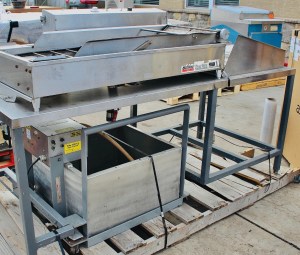
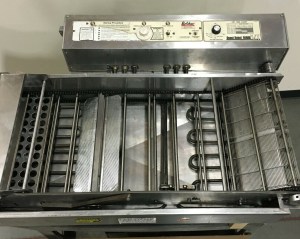
When I first realized the Summit House was getting demolished instead of remodeled my thoughts went straight to the donut machine. What are they gonna do with the donut machine? The “Belshaw Mark VI Donut Robot” delivered its final batch last week before someone pulled its plug. The Mark VI is a mechanical marvel. It can produce 700 donuts an hour (the summertime demand for Pikes Peak). The Mark VI endlessly dispenses the raw dough, four rings in a row, and creates donuts through a conveyer system of automated frying, rotating, and dispensing. Leave it on for twenty-four hours and it’ll pile up 17,000 of the little buggers.
 Meanwhile, the new visitor center is getting a new donut machine. Maybe it’s the latest model of Belshaw’s Donut Robot and makes 1,000 donuts an hour. Maybe the donuts taste more like Krispy Kreme. Whatever it can do, this machine is a beast. It’s so big they had to use a crane to lift it into the building before they even closed up the walls.
 If I’m the old Mark VI Donut Robot I’m not happy about being replaced, not at all. I mean, c’mon! I faithfully produced thousands of donuts day in and day out for decades! I’m not yesterday’s news just yet! Why not let me keep my job instead of giving all the love to a newer model? No siree Bob, I’m not gonna take it. I need to make some sort of statement. Y’know, demonstrate the extent of my discontent.
OH MAN, can’t you just picture it? Standing down on the streets of Colorado Springs one morning you suddenly hear this massive BAH-BOOM from the direction of Pikes Peak. Sidewalks start shaking and people start pointing. You look up to the mountain and there’s a freaking volcano blowing its top. A huge column of fire rises to the heavens. The sky is instantly air-brushed with white smoke. There’s ash raining down in every direction. Except, wait, it’s not ash… it’s…. it’s…. it’s donuts.
 The rain of donuts, of course, is the Mark VI Donut Robot run amok. In its desperate attempt not to be overlooked it starts making donuts like crazy. Four at a time, plop-plop-plop-plop, fry, rotate, dispense. Faster and faster and faster, until its conveyor builds up a big head of steam and starts to break apart. Then the whole thing just blows up. Boom.
  Down and further down come the donuts. Rolling by the hundreds along the hiking trails. Bobbing down the rivers and creeks like mini inner tubes. Ricocheting off the pine trees as they come back to earth until they just go poof! in a cloud of powdered-sugar smithereens. Decorating the rocks and trees with a cream-filling look of snow. Piling up in the low spots like generous helpings of oversized Cheerios. Clogging up the cog railway so the only way the train gets to the summit is for the riders to get off the train and start eating.
 The Mark VI may have imploded but man what a way to get noticed, right?
Truth be told, there’s an aftermarket for Belshaw’s Mark VI Donut Robot. Do the Google search if you don’t believe me. A used one runs $15,899 plus $600 for shipping, and don’t look now; they take credit cards and toss in a limited warranty! Just think what you could do with 700 donuts an hour. All you have to do is click the “Buy It Now” button on the website. But one more thing before you do. Ask the seller if their Mark VI has given them attitude lately. Like it used to be on a majestic mountaintop or something wacky like that.
 Note: This post would not even be a whisper of a thought were it not for Robert McCloskey and his wonderful children’s book, Homer Price. In Homer’s short story “The Doughnuts”, a restaurant donut machine goes bonkers and starts dispensing hundreds upon hundreds. How the town resolves this donut deluge makes for a great story. Thanks, Robert.
Some content sourced from the KKTV 11 News story, “Final Batch of Pikes Peak Donuts…”, and the Thrillist.com article, “You Can Only Get These Incredible Donuts at the Top of a Mountain in Colorado”.












About Me
The sky is not completely dark at night. Were the sky absolutely dark, one would not be able to see the silhouette of an object against the sky.
Follow Me On
Subscribe To My Newsletter
Subscribe for new travel stories and exclusive content.
 Life In A Word