A few months ago, authorities in New Zealand wrapped up a five-month sting where they confiscated the largest import of methamphetamine in the country’s history. Millions of dollars of the liquid stimulant were discovered in, of all places, a shipment of maple syrup jugs. Agents swapped out the drugs with water and let the jugs continue to Australia, where the recipients were quickly apprehended. Did this story captivate me? Why yes it did, but not because of a million-dollar drug bust. I pretty much stopped reading at jugs of maple syrup.
With all due respect to fruit, I think maple syrup is the better example of “nature’s candy”. After all, it’s essentially organic liquid sugar. If you have the tree, the tools and the time (a lot of time), you can tap your own supply. Simply drill a hole into the trunk of your sugar maple tree, hang a bucket below the opening, and let the goodness s-l-o-w-l-y flow. After you’ve collected what you need, boil off the water, filter off the crystallized sugar, and your pancakes or waffles are set to be topped.
Sugar maple
If you prefer a more solid sweet, make snow candy like Little House on the Prairie’s Laura Ingalls did back in the day. Pour boiling maple syrup into short lines on a fresh bed of snow. Press Popsicle sticks into the lines. Then roll the cooling syrup around the sticks and voila! – a sweet handheld-treat. Last Saturday’s arrival of the fall season makes this confection seem extra appealing.
My very favorite doughnuts are maple bars
In the U.S., “real” maple syrup is not so common anymore. Years ago at my childhood breakfasts I was already consuming imitators like Log Cabin, Mrs. Butterworth’s, or Aunt Jemima (more recently known as “Pearl Milling Company”). These brands and countless others are known as “table syrups”, made from corn syrup and chemicals instead of anything found in a tree. They can’t even use the word “maple” in their names because of a consumer protection law known as the Pure Food and Drug Act.
Maple sugar
Enough about the impersonators. Maple syrup’s rich flavor and density should be the preference to table syrup’s as long as a) Your taste buds can be reeducated, and b) you’re willing to spend a few more pennies. And maple syrup is just a step removed from some distinctive treats. Maple sugar candy is compacted maple sugar formed into small squares or maple leaves (delicious!) Maple taffy is what you get if you boil maple syrup past its liquid form. And for the truly obsessed (me), you’ll also find maple versions of toffee, butter, and liqueurs.
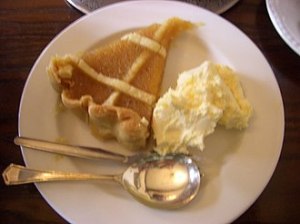
Treacle tart
Let’s take a paragraph for a confection of honorable mention. Ever heard of a treacle tart? Yes you have, if you know the timeless children’s classic Chitty Chitty Bang Bang. In the story, the evil Child Catcher in the fictional village of Vulgaria tempts young Jeremy and Jemima Potts with ice cream, candy, and treacle tarts (“and all for free!”) Those tarts are small pastries filled with maple syrup, breadcrumbs, and a splash of lemon juice, served warm with a cream topping. Yum. Catch me if you can, Child Catcher.
If you know your flags, you can guess which country produces most of the world’s maple syrup. Canada accounts for fully 80%, with most of the sweet stuff coming from the province of Quebec. Vermont’s production is similarly dominant compared to other U.S. states. Both locales are northern climates, where sugar maple trees thrive in the cold winters. So as much as I’d like to channel my inner L.L. Bean by planting a maple tree and drilling a hole, donned in flannel shirt and snow boots, it’s never going to happen here in hot-and-humid South Carolina. Guess I’ll have to settle for a store-bought jug of nature’s candy instead.
Some content sourced from the Deutsche Welle (DW) article, “Authorities find drugs worth millions hidden in maple syrup”, and Wikipedia, “the free encyclopedia”.
The state line between South Carolina (SC) and Georgia (GA) follows the twists and turns of the Savannah River. You know you’re heading into one state or the other whenever you cross the water. Driving from our part of South Carolina into nearby Augusta, GA is interesting. The interstate loops Augusta by starting in SC, touches a bit of GA, goes back to SC for a few miles, then continues into GA again as it follows the river. It’s an example of my life on the edge.
In California, W means “water”
Growing up on the coast of California, it never occurred to me the geography of my younger days was limited to only three of the four cardinal directions. If I headed north I’d leave the urban stretches of Los Angeles for the more rural towns of the the central coast. Head south and I’d parallel the beaches all the way to San Diego. The only thing east of the city seemed to be the endless Mojave Desert. As for the last of the four directions? Not an option, at least not without a boat, plane, or a whole lot of swimming. Horace Greeley would’ve never told me to “Go West, young man”.
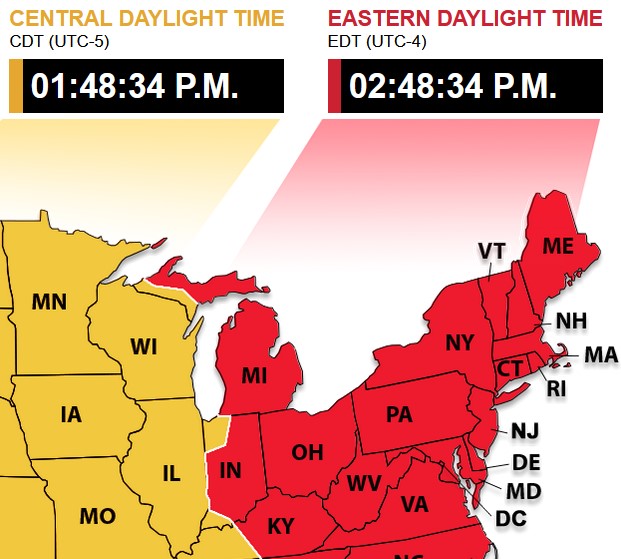
South Bend sits where the yellow and red come together at the very top of Indiana.
In my college years in South Bend, IN, I was a fifteen-minute drive from the line where the Central and Eastern time zones meet. Back then you didn’t touch your clock for Daylight Savings, so half the year you were the same time as Detroit while the other half you were Chicago. It was confusing, but not as confusing as someone who lived on one side of the line and worked on the other. Imagine leaving the house at 8:00am, driving an hour, and arriving at the office at… 8:00am? It’s a neat trick, pulled off by a lot of those who live on the edge of a time zone.
Raising our kids in Colorado Springs, we always knew which direction we were heading because the line of the Rocky Mountains lay immediately to the west. Those peaks rose up like the Great Wall of China, just daring you to push through. Sure, we drove the interstates into the Rockies for skiing, hiking, and such, but day-to-day we were down at the base, literally living on the edge. Like California, we had one less cardinal direction at our disposal.
Grays Peak, on Colorado’s Continental Divide
The Rockies conceal another important edge, known as the Continental Divide. The Divide is elevated terrain separating neighboring drainage basins. Plain English? The north-south line from which water flows either west to the Pacific Ocean or east to the Atlantic. I always wanted to stop somewhere flat on the Divide and pour out a bottle of water. Let’s see if it really flows both ways from the line, right? It’s an experiment that to this day remains unconducted.
Football is a game of lines and edges
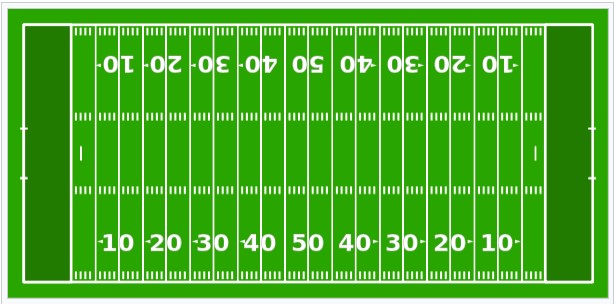
Football, one of my favorite spectator sports, is all about lines and edges. One team faces the other, on an imaginary line defined by where the referee places the ball. Cross that line before the ball is snapped and you’ll be flagged with a penalty. Advance the ball ten yards past that line – to another imaginary line – and your team is awarded more play. The sidelines of the field might as well drop off to a bottomless void. Catching a pass outside of that edge is not allowed. Running the ball outside of that edge brings the game to a halt. But catching or running across the lines at end of the field? That rewards you with a score.
$50 gets you a spot on “The Edge” sky deck
For all this living and playing on thresholds, maybe I should visit one of New York City’s newest high-rise attractions. One hundred floors above the sidewalk, The Edge is billed as “the highest outdoor sky deck in the Western Hemisphere”. Jutting out from its host building, The Edge allows unparalleled views of the city below, because the surrounding walls are solid glass, as is a portion of the deck floor itself (yikes!) If Spider-Man is your thing, you can go even higher by scaling the outside of the remaining floors of the skyscraper. I have to say, this sort of thing draws a “fine line” between entertainment and, well, insanity.
I won’t be going to The Edge… ever. I’m not good with heights, so anything above a pedestrian Ferris Wheel just isn’t my cup of tea. Nope, leave me behind, comfortably grounded, where crossing the Savannah River from one state to another is plenty adventurous. That’s my definition of life on the edge.
Some content sourced from Wikipedia, “the free encyclopedia”.
Passing through another anniversary of the events of 9/11 this week, I was touched by a YouTube short of U.S. Marines demonstrating the proper method of folding the American flag. The video includes gentle background music but no words, lending reverence to the ceremony. Folding the Stars and Stripes the right way is not only a nod of respect to our nation’s banner, but also an example of (flag) etiquette.
One of my favorite memories of my late mother was her ability to gently but effectively prod her sons to behave properly. She would sometimes say quietly, “Mind your manners”, which meant two things. One, something in our current behavior wasn’t in sync with how she raised us; and two, we would get a talking to later. “Please” and “thank you” barely scratched the surface of how my brothers and I were expected to carry ourselves back then.
I’ve always thought of manners and etiquette as one in the same, but the former is a subset of the latter. Etiquette is “the set of norms of personal behavior in polite society”, while manners are simply behaviors deemed “good” or “bad”. An example of both is the way we drive our cars. We’re taught the rules of the road, also known as “driving etiquette”. But when we blatantly ignore those rules by, say, refusing to let a car merge onto the interstate in front of us, we’re letting bad manners get the better of etiquette.
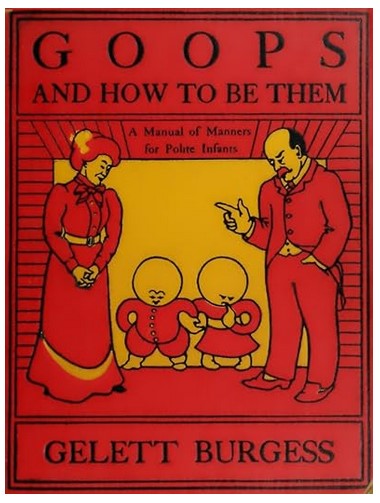
Manners always remind me of a book my grandparents encouraged us to read whenever we visited: Gelette Burgess’ 1903 classic The Goops (and How To Be Them). Here’s an example of Goop behavior in Burgess’ poetry, simply titled “In Table”:
Why is it Goops must always wish
To touch each apple on the dish?
Why do they never neatly fold
Their napkins until they are told?
Why do they play with food, and bite
Such awful mouthfuls? Is it right?
Why do they tilt back in their chairs?
Because they’re Goops! So no one cares!
My mother probably labeled us Goops at one time or another, because my brothers and I were all about fingering our food or talking with food in our mouths or rocking back in our chairs. It’s a wonder we developed any manners at all. Maybe it’s because our mother’s parenting was fueled by a finishing school of sorts: her college sorority, where a premium was placed on etiquette.
Alpin Videmanette
Finishing schools, designed to “teach young women social graces as preparation for entry into society”, are something of an outdated concept now, at least in America. You can still find a few “charm schools” in Europe, such as Switzerland’s prestigious Institut Alpin Videmanette – (whose teenage graduates included Lady Diana Spencer). The Institut teaches young women to cook, make dresses, speak French, and even ski, but at its core, the curriculum is an education in etiquette.
Emily Post
The undisputed authority on etiquette, Emily Post, wrote several books and newspaper columns on the topic. In the America of her lifetime (1872-1960) Post’s first etiquette book became a bestseller because it catered to “the country’s exotic mix of immigrants… eager to fit in with the establishment”. I suggest most of Post’s etiquette is as relevant today as it was back then… and a lot of us could use an extensive refresher.
Always pass them together!
Besides the Goops, etiquette reminds me of an old poem teaching children the days of the week. “Monday’s Child” goes like this:
Monday’schild is fair of face,
Tuesday’schild is full of grace,
Wednesday’schild is full of woe,
Thursday’schildhasfar to go,
Friday’schild is lovingandgiving,
Saturday’schildworkshardfor a living,
Andthechildthat is born on theSabbathday, Is bonnyandblithe,andgoodandgay.
Google tells me I was born on a Monday. Darn it, so close. If I was Tuesday’s Child I’d be defined as “… agreeable, refined, and polite in manner or behavior.” In other words, demonstrating a solid understanding of etiquette.
The next time you’re standing on an escalator, step to the right to let those in a hurry pass by. The next time you play golf, stay out of the line of sight when your opponent putts. The next time you’re at the movies, don’t utter a word until the final credits roll. And the next time you fold the flag, do it the way the Marines do. After all, you’d rather be credited with following the rules of etiquette than perceived as having bad manners.
Some content sourced from Wikipedia, “the free encyclopedia”.
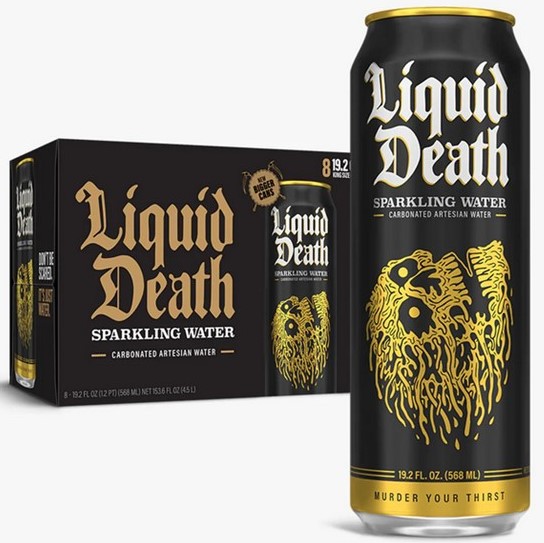
In the refrigerator of the beach house where my family and I vacation every summer, you’ll find an extensive collection of aging condiments. With different people in the house almost every week, the mustards, ketchups, salsas and spreads breed at an alarming rate. And the beverages aren’t far behind. Forage past the wine and beer bottles and you encounter all sorts of curious cans and contents. One in particular tempted me this time around but I couldn’t muster the courage to take a sip. I mean, would you try something called “Liquid Death”?
If you’re already familiar with Liquid Death, you know the joke’s on me. Liquid Death (“Murder Your Thirst!”) is nothing but drinking water, carefully sourced, packaged in a can covered with horror-movie graphics. The company believes their distinctive can means a) one less plastic bottle into landfill and b) one more serving of water into you (instead of something less healthy). Liquid Death also cans flavored sparkling waters and iced teas, and – no joke – invites you to sell your soul to the company. The company’s sales are no joke either – $130 million last year alone.
Liquid Death is one of countless examples of “packaged water” available to consumers these days. Since 2017, Americans are quaffing more bottled water than any other drink. 86% of us purchase water regularly, in addition to the H2O we drink from our faucets. Why? Because we’re waking up to the downsides of the sugar/chemical concoction known as the “soft drink”. We’re also subscribing to the belief we’re healthier if we drink more water. Finally, single/double/triple-serving containers appeal to us because we’ve already become so conditioned to them, thanks to… Starbucks.
Here’s a story to prove the statistics hold water. At a volleyball tournament in Atlanta last weekend, I ventured to the nearby snack stand to buy a drink. The cashier invited me to fish around in his giant coolers for whatever I wanted. What I wanted was water, but all I could find were dozens of neglected bottles of soft drinks, “sports drinks”, and energy drinks. So I asked the cashier, “What, no water?”, to which he replied, “Oh, we sold out of the waters hours ago”.
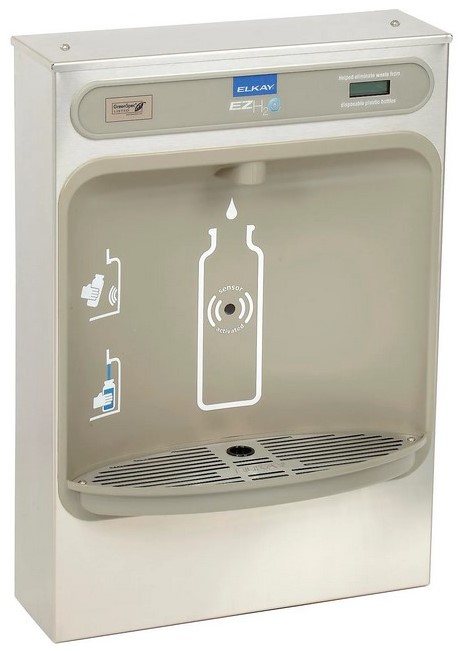
The new “drinking fountain”
Then I went in search of a drinking fountain and couldn’t find one in the entire arena. Drinking fountains are quickly going the way of pay phones. In their places: dispensers designed to fill your personal bottle. I’m on board with this trend, especially because it reduces the use of plastic. But don’t forget your water bottle like I did or you’ll be forced to settle for one of those more colorful concoctions.
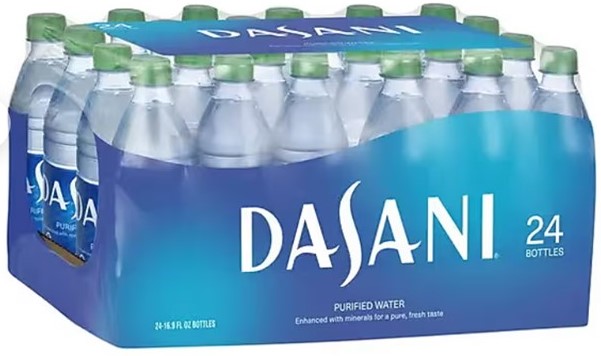
Lest you think otherwise, the bottled waters dominating the marketplace are brought to you by the same companies behind soft drinks. Accordingly, Dasani = Coca-Cola, Aquafina = PepsiCo, and Poland Spring = Nestlé. On the other hand, Arrowhead is only Arrowhead water, as is Evian’s natural spring variety (and whether “Evian” is intentionally “naive” spelled backwards is for you to decide).
We’ve taken water one step further now. Into our personal water bottles, tumblers, and jugs we add “flavor enhancers”, designed to a) give us more of what we lack (ex. electrolytes) or b) encourage us to drink more water by adding flavor. Crystal Light and Gatorade set this tone years ago. Today we choose from a dizzying array of powders, drops, and tablets, all designed to make water more appealing. But if we’re thirsty, shouldn’t water be appealing enough just the way it is?
A final sip of this subject. The average person has thirty-five “beverage occasions” a week. With each occasion you choose the container, contents, and quantity of whatever you’re going to drink. So even if your every day begins with a “Venti half-soy nonfat decaf latte” and ends with a fruit-forward, moderately dry Cabernet Sauvignon, you still have twenty-one other occasions for a tall drink of water. Liquid Death, anyone?
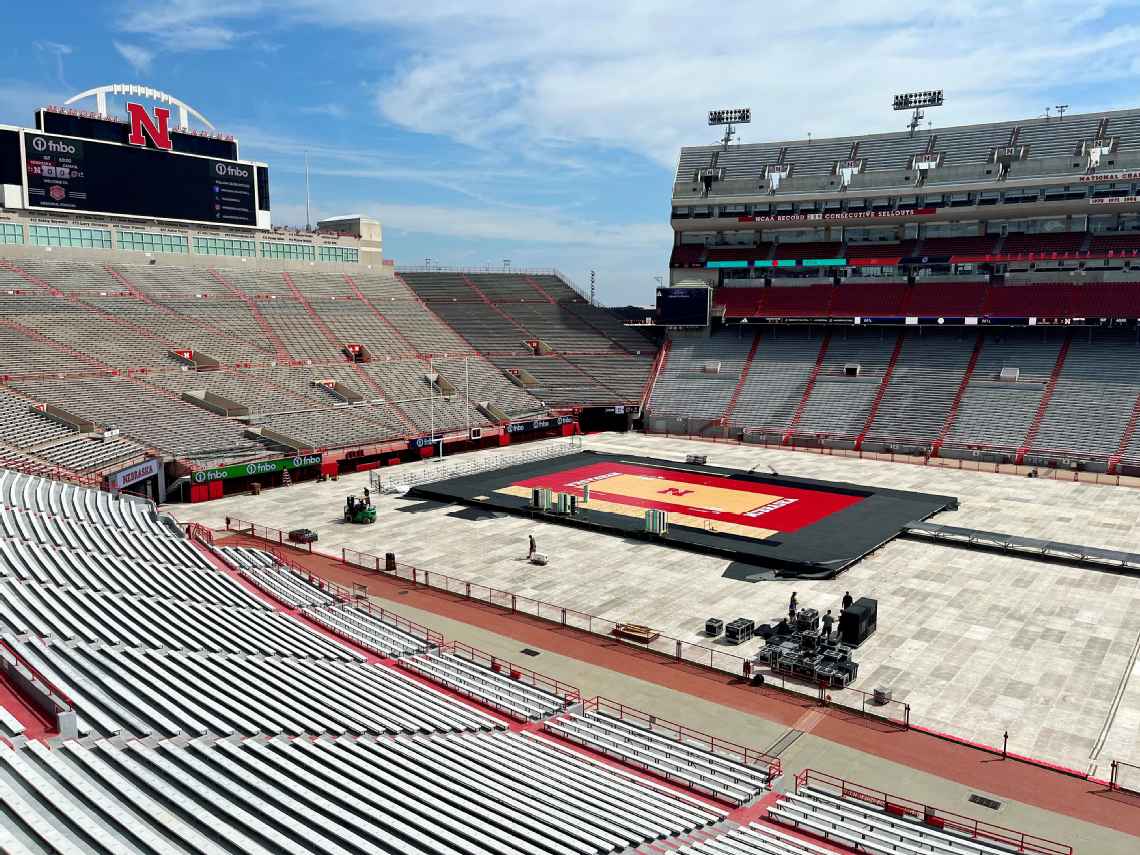
Last night, the University of Nebraska women’s volleyball team played the fourth match of their 2023 campaign. College volleyball doesn’t get much coverage sharing seasons with (American) football, but this match made the sports headlines for several reasons. One, it was played outdoors. Two, it was played in Nebraska’s massive Memorial Stadium (normally a football venue). And three – most notably – the Huskers brought home the straight-sets win in front of 90,000 riotous fans… at $25 a ticket.
Volleyball instead of football
I know what you’re thinking. How do you get 90,000 people to cough up $25 for a college volleyball match? Well, it helps to throw in a country music concert for starters. Then add a second match to double the volleyball (Nebraska-Kearney vs. Wayne State). Finally, most importantly, let fans know they just might break the regular-season attendance record for a women’s volleyball match… the same attendance record that volleyball rival Wisconsin stole from Nebraska just last season.
Memorial Stadium on any given Saturday
It fascinates me to read about sports competitions played in front of massive sold-out stadiums, weekend after weekend. Nebraska has filled those same 90,000 seats for every Husker football game for the past sixty years (making the venue the “third-largest city in Nebraska” for several hours each Saturday). Michigan’s Wolverines compete in the largest college stadium in America – 108,000 seats – with every seat taken more often than not. And like Nebraska’s volleyball match last night, my fascination is not just with the number of fans but also with how much they’re willing to pay. I’m in the market for tickets for my beloved Notre Dame; the football team headed to nearby Clemson later this season. Unless I’m looking for a nosebleed I’ll be paying north of $450 no matter where I sit.
My weekends are busy so I’m lucky to watch a football game on TV, let alone attend one in person. Yet every Saturday (and Sunday with the NFL) you have tens of thousands of fans gladly opening their wallets and purses to do just that. It’s a loud, colorful thread (rope?) in the fabric of American society.
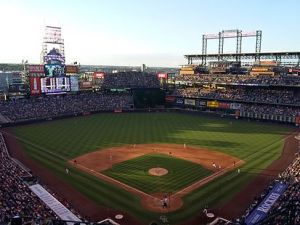
Denver’s “Coors Field”
Major League Baseball (MLB), with an average of 45,000 seats per stadium, is even more confounding to me. In an endless spring-summer season of 162 games, half are played at the team’s home stadium. The majority of those seats are taken by season ticket-holders. With an average ticket price of $36 you’re handing over $3,000 for the season before you’ve even seen the first game. Besides, who has the time to watch so many baseball games (mostly at night)? Do what my friends back in Colorado do: split the season ticket in half with another fan and sell most of the tickets to family and friends. You’ll make a small profit and still go to as many baseball games as you can stomach.
My appetite for baseball games is about two a season; that’s it. Frankly I enjoy sitting outside in the summer air beside a friend as much as I do the game itself. Otherwise, keep me far from those madding crowds. The investment of time, money, effort (and sometimes hassle) to watch a game in person is almost always won over by the convenience, commentary, and cameras of television.
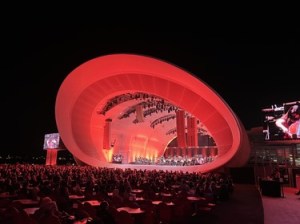
San Diego’s “Rady Shell at Jacobs Park”
Of course, this is sports we’re talking about. If the topic was music and concerts, my post would take on a decidedly different “tone” (heh). Tempt me with a chart-topper from the 1980s – Billy Joel comes to mind – and I’d give up the time and money to see a live performance. Even better, dangle classical concert tickets in front of me, such as the San Diego Symphony at its cozy waterfront bandshell, or a summer concert in the outdoor gardens of Vienna’s Schönbrunn Palace (see below video). Classical concert crowds are not nearly as madding as those for sports.
Nebraska is a five-time national volleyball champion
About that regular-season attendance record for a women’s volleyball match. Wisconsin set the bar with an impressive 16,833 fans last season by filling its basketball arena. Nebraska’s official tally last night was 92,003 fans… more than five times as many (on a Wednesday night, no less). Way to crush those rival Badgers, Husker Nation. That’s what I call a madding crowd.
Some content sourced from the ESPN article, “How Nebraska volleyball plans to pack Memorial Stadium”, and Wikipedia, “the free encyclopedia”.
LikeLoading…
About Me
The sky is not completely dark at night. Were the sky absolutely dark, one would not be able to see the silhouette of an object against the sky.


 With all due respect to fruit, I think maple syrup is the better example of “nature’s candy”. After all, it’s essentially organic liquid sugar. If you have the tree, the tools and the time (a lot of time), you can tap your own supply. Simply drill a hole into the trunk of your sugar maple tree, hang a bucket below the opening, and let the goodness s-l-o-w-l-y flow. After you’ve collected what you need, boil off the water, filter off the crystallized sugar, and your pancakes or waffles are set to be topped.


 If you know your flags, you can guess which country produces most of the world’s maple syrup. Canada accounts for fully 80%, with most of the sweet stuff coming from the province of Quebec. Vermont’s production is similarly dominant compared to other U.S. states. Both locales are northern climates, where sugar maple trees thrive in the cold winters. So as much as I’d like to channel my inner L.L. Bean by planting a maple tree and drilling a hole, donned in flannel shirt and snow boots, it’s never going to happen here in hot-and-humid South Carolina. Guess I’ll have to settle for a store-bought jug of nature’s candy instead.


 I won’t be going to The Edge… ever. I’m not good with heights, so anything above a pedestrian Ferris Wheel just isn’t my cup of tea. Nope, leave me behind, comfortably grounded, where crossing the Savannah River from one state to another is plenty adventurous. That’s my definition of life on the edge.
 One of my favorite memories of my late mother was her ability to gently but effectively prod her sons to behave properly. She would sometimes say quietly, “Mind your manners”, which meant two things. One, something in our current behavior wasn’t in sync with how she raised us; and two, we would get a talking to later. “Please” and “thank you” barely scratched the surface of how my brothers and I were expected to carry ourselves back then.I’ve always thought of manners and etiquette as one in the same, but the former is a subset of the latter. Etiquette is “the set of norms of personal behavior in polite society”, while manners are simply behaviors deemed “good” or “bad”. An example of both is the way we drive our cars. We’re taught the rules of the road, also known as “driving etiquette”. But when we blatantly ignore those rules by, say, refusing to let a car merge onto the interstate in front of us, we’re letting bad manners get the better of etiquette.
 Manners always remind me of a book my grandparents encouraged us to read whenever we visited: Gelette Burgess’ 1903 classic The Goops (and How To Be Them). Here’s an example of Goop behavior in Burgess’ poetry, simply titled “In Table”:Why is it Goops must always wishTo touch each apple on the dish?Why do they never neatly foldTheir napkins until they are told?Why do they play with food, and biteSuch awful mouthfuls? Is it right?Why do they tilt back in their chairs?Because they’re Goops! So no one cares!My mother probably labeled us Goops at one time or another, because my brothers and I were all about fingering our food or talking with food in our mouths or rocking back in our chairs. It’s a wonder we developed any manners at all. Maybe it’s because our mother’s parenting was fueled by a finishing school of sorts: her college sorority, where a premium was placed on etiquette.


 The next time you’re standing on an escalator, step to the right to let those in a hurry pass by. The next time you play golf, stay out of the line of sight when your opponent putts. The next time you’re at the movies, don’t utter a word until the final credits roll. And the next time you fold the flag, do it the way the Marines do. After all, you’d rather be credited with following the rules of etiquette than perceived as having bad manners.
 If you’re already familiar with Liquid Death, you know the joke’s on me. Liquid Death (“Murder Your Thirst!”) is nothing but drinking water, carefully sourced, packaged in a can covered with horror-movie graphics. The company believes their distinctive can means a) one less plastic bottle into landfill and b) one more serving of water into you (instead of something less healthy). Liquid Death also cans flavored sparkling waters and iced teas, and – no joke – invites you to sell your soul to the company. The company’s sales are no joke either – $130 million last year alone.
 Liquid Death is one of countless examples of “packaged water” available to consumers these days. Since 2017, Americans are quaffing more bottled water than any other drink. 86% of us purchase water regularly, in addition to the H2O we drink from our faucets. Why? Because we’re waking up to the downsides of the sugar/chemical concoction known as the “soft drink”. We’re also subscribing to the belief we’re healthier if we drink more water. Finally, single/double/triple-serving containers appeal to us because we’ve already become so conditioned to them, thanks to… Starbucks.
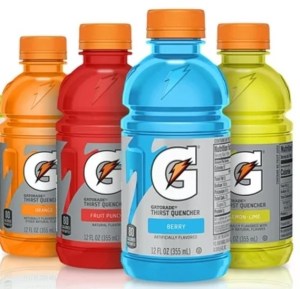 Here’s a story to prove the statistics hold water. At a volleyball tournament in Atlanta last weekend, I ventured to the nearby snack stand to buy a drink. The cashier invited me to fish around in his giant coolers for whatever I wanted. What I wanted was water, but all I could find were dozens of neglected bottles of soft drinks, “sports drinks”, and energy drinks. So I asked the cashier, “What, no water?”, to which he replied, “Oh, we sold out of the waters hours ago”.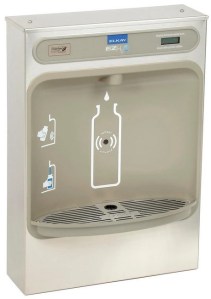
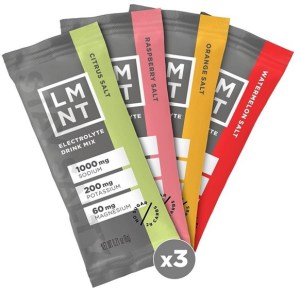
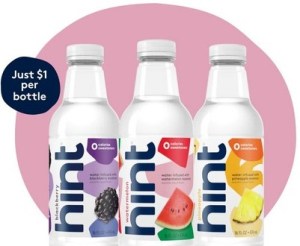 We’ve taken water one step further now. Into our personal water bottles, tumblers, and jugs we add “flavor enhancers”, designed to a) give us more of what we lack (ex. electrolytes) or b) encourage us to drink more water by adding flavor. Crystal Light and Gatorade set this tone years ago. Today we choose from a dizzying array of powders, drops, and tablets, all designed to make water more appealing. But if we’re thirsty, shouldn’t water be appealing enough just the way it is?
 A final sip of this subject. The average person has thirty-five “beverage occasions” a week. With each occasion you choose the container, contents, and quantity of whatever you’re going to drink. So even if your every day begins with a “Venti half-soy nonfat decaf latte” and ends with a fruit-forward, moderately dry Cabernet Sauvignon, you still have twenty-one other occasions for a tall drink of water. Liquid Death, anyone?













 Life In A Word