
Hello, I’m Veronica
The sky is not completely dark at night. Were the sky absolutely dark, one would not be able to see the silhouette of an object against the sky.


-
It’s Thanksgiving Season (#1)
Listen carefully… hear the clock a-tick-tick-ticking? Better hurry up! You’re already a day (or more) into the Thanksgiving season and you have so much to do! “No Dave”, you correct me, “Thanksgiving’s just one day (or at most a long weekend) way-ay-ay at the end of the month… I still have plenty of time to prepare!” No you don’t. Junk that perception, online friends, because the times they are a-changin’. I, blogger Dave, hereby decree Thanksgiving to be three weeks… and the season’s already underway. So c’mon – get grateful already!

It’s fitting I’m writing this post on Halloween, “… the conclusion of spooky season…” as Lyssy in the City referred to it. And isn’t it true? Just like Christmas, the air goes out of the holiday balloon the very next day. Cinderella’s carriage turns back into a pumpkin at midnight (ironically). There is no “residual” spooky season on November 1st. Halloween died the night before.
Retailers are determined to steamroll Halloween and Thanksgiving with the Christmas season, of course. The artificial trees and decorations were available for purchase at Costco and Lowes this year before the Halloween candy even colored the shelves. As I said in Third-Wheel Meal two years ago, Thanksgiving is fighting an uphill battle between the ever-expanding seasons before and after. It’s like a sandwich with two massive pieces of bread but not much in between.

Thanksgiving is not just another holiday in my book; it’s a uniquely American holiday. It’s the one we’ve been celebrating in the U.S. for 160 years thanks to the persistence of one Sarah Josepha Hale (who also wrote “Mary Had a Little Lamb”). Hale, along with Abraham Lincoln’s stroke of the presidential pen, made sure the holiday was “permanent… an American custom and institution”. Gives this juncture in the holiday season a little more respect, wouldn’t you say?

Day-by-day gratitude Like an Advent calendar, I propose we take twenty-three days to be grateful for what we have. Open the little cardboard door on any given morning of November and the question will always be the same: What are you thankful for today? Surely you can come up with twenty-three things. Or how about twenty-three people? Wouldn’t it be something if you told one person how grateful you are to have them in your life… every day until Thanksgiving Day?
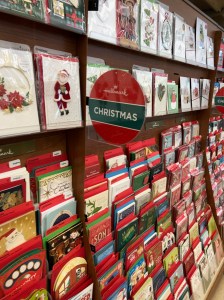
Already on the shelves, sigh… As with Christmas, it’s not the wrapping; it’s the gift inside. Thanksgiving goes way deeper than turkey and football. If you’re planning a trip to America and don’t know much about Thanksgiving, VisitTheUsa.com is not helping my cause. The website reduces Thanksgiving into turkey and pie, Turkey Trots, parades, football, the pardoning of a single turkey, “shop ’til you drop”, and the travel challenges of a four-day weekend. Really? That’s the meaning of America’s Thanksgiving?

It’s not about this… Maybe it would help if moviemakers and songwriters joined my cause. I mean, think about it. Halloween movies come to mind without much thought (with some, like A Nightmare on Elm Street, approaching ten sequels). Hallmark churns out Christmas movies faster than you churn out Christmas cookies. But are there any movies about Thanksgiving? Well, yes actually, just this year we have Thanksgiving (the movie). But please, don’t seek out the trailer. This garbage has nothing to do with gratitude and everything to do with gratuitous violence.

or this… I was going to make the same case for music. Halloween has you dancing to “Thriller” and “Monster Mash”. Christmas has you “Rockin’ Around the Christmas Tree”. There is no “Thanksgiving carol”. But then I remembered Amy Grant’s “‘Til the Season Comes ‘Round Again” (my wife’s favorite). It’s a song about Christmas, make no mistake, but you could argue there’s a little Thanksgiving dressing mixed into the first verse:
Come and gather around at the table
In the spirit of family and friends
And we’ll all join hands and remember this moment
‘Til the season comes ’round againGet what I’m saying? Take the next three weeks and find the true meaning of Thanksgiving. Like Halloween, the treats will still be there on November 23rd. Like Christmas, you’ll still have the stress of travel and getting things done. Those holidays are about finding your inner child. This one’s about finding your inner adult. So c’mon – get grateful already!
Some content sourced from Wikipedia, “the free encyclopedia”.
-
Not-So-Thruways
We live on a long, straight-run residential street, with the option to exit at either end to access the outside world. Close by, a cluster of our neighbors live on a short, stubby lane, where you won’t get very far before having to turn around and go back the way you came. A sign posted at their street’s entrance declares, “Not A Through Street”. It’s what the French – and we Americans – call a cul-de-sac.

In a rather desperate effort to come up with something Halloween-related this week, I landed weakly on “dead-end streets”. Of course, these tiny avenues are often very much alive. Cul-de-sac’s host a quaint gathering of houses, with a few on the straight run and even fewer around the end circle. The setup allows these neighbors to get to know each other easier. And with so little traffic, the end circle encourages kids to do what their parents normally nix: play in the street.

But maybe I shouldn’t paint/assume such a rosy picture (especially with Halloween right around the corner). What if your neighbor living right next door on that little end circle is someone you’d sooner see in a horror movie? Or what if the statistics are true: even more people are struck by cars on a cul-de-sac because of the assumed safety of a quiet street? Finally, consider the double-hyphenated phrase staring you right in the face. Cul-de-sac – French translation – “bottom of bag”. Suddenly your house feels like one of those throwaway candies you find deep down in your trick-or-treat sack.
I didn’t know “cul-de-sac” had such a negative connotation. I found it rather quaint because it’s double-hyphenated (and French). Curious, I went in search of other double-hyphenated words to see if I could find something more positive. Know-it-all. Word-of-mouth (which is often gossip). Son-in-law. Okay, that last one has potential. I mean, he’s only been married to my daughter for year now, so…

Here’s a really nasty double-hyphenated for you. Fer-de-lance. It means “head of spear”, which isn’t so nasty until you realize it’s the name of a snake; an extremely poisonous viper who lives in the tropics. The fer-de-lance was the killer (literally) in a 1974 movie by the same name. A movie I never should’ve watched at the fairly innocent age of twelve. Fer-De-Lance was the original Snakes on a Plane, only the plane was a submarine carrying a crate full of deadly creepy-crawlies. How’s that for Halloween-scary?
Like Fer-De-Lance, Cul-De-Sac was also a movie (1966), about “a hermit living with his wife in a large dank castle on an island… terrorized by two escaped prisoners.” Not exactly a romantic comedy, and no explanation of the film’s title, other than maybe this couple finding themselves at their ultimate dead-end.

Let’s circle back to the suburban version of the cul-de-sac (please!) Two addresses ago we actually lived on one. There were two houses on each side of the straight-run and four houses on the end-circle. We lived on the circle. Were we tight with our neighbors? No! Each of our driveways were long and steep so our houses were actually pretty far apart. I still remember how we’d greet our neighbors faithfully only one day out of the year. What day? Halloween, when we’d accompany our kids to their front doors.
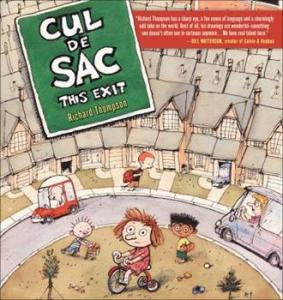
We need to end this more-Halloween-than-I thought post on a positive note, so I don’t have you thinking about poisonous snakes and escaped prisoners. Cul-de-Sac is a locale on the beautiful Caribbean island of Saint Martin. It was also the name of a 1990s alternative rock band. And Cul-de-Sac was the title of “a light-hearted comic strip centered around a four-year-old and her suburban life experiences.” Okay, now we’re talking.

Some advice before I close. If you live on a cul-de-sac, I suggest you double-stock the candy this Halloween. After all, trick-or-treaters who make it to your dead-end street may find themselves going round and round the end circle without realizing what they’re doing. Keep an eye out for repeat customers.
Some content sourced from Wikipedia, “the free encyclopedia”.
-
Fuzzies and Buzzies
My granddaughter, almost six months now, adores her soft-stuffed black-and-yellow bumblebee. Her little buzzy has a Velcro loop to attach to the car seat or stroller. In her first months, she fixated on Mr. Bee like a best friend. Today she takes an interest in other things, but I told her mother to set the bee aside as a future keepsake. Doesn’t everybody wish they still had their first stuffed animal? Well, I sure do, and mine was more fuzzy than buzzy.

“Baa-a-a-a!” Nope, not a bear. Not a dog, not a cat, a fox or a tiger. My one-and-only stuffed animal was a lamb. An off-white fuzz-filled plush-soft domesticated farm critter, about 12″ head to hooves. I named him “Lambie”. We were inseparable for years.
I’m not here to revisit childhood memories (though it’s remarkable how a cherished wooly companion comes back to mind). Instead, I want to give sheep their due. I think sheep are one of the world’s most overlooked animals. At the farm, everyone pretty much skips the bleating balls of fluff in favor of the more interesting horses, cows, and pigs. At the zoo it’s the lions, tigers, and bears instead. And I get it. Timid, fuzzy herbivores just don’t inspire awe. So how about instead, we take a look at what you don’t know about sheep:

“Hey! I like ewe!” - They have rectangular pupils. I’ve always thought it was cool how horses can see to the left and right without moving their heads. Sheep have it even better; a full 270 degrees of vision, meaning the only thing they can’t see is what’s directly behind them.
- They’re more intelligent than you think. Sheep can retain the details of fifty faces – human or otherwise – and recall them two years later (no idea how we know this). They can also be led through a maze and then solve it on their own the second time around, probably because…
- They have an excellent sense of smell, thanks to scent glands in front of their eyes and in their hooves. Sheep can leave their scent behind as a sort of trail of bread crumbs while on the move.
- They self-medicate. I’m not pulling the wool over your eyes here. Sheep can identify plants and other substances having no nutritional value but with healing properties. They also pass this information on to their offspring.
Now let’s change the channel to what you already know about sheep. They are followers in every sense of the word (hence the label for like-minded humans). They are timid, easily led, and never without their flocks. Just watch this speedy video to see how our fuzzy friends stick together.
Sheep have little ability to defend themselves (how would they when they’re essentially balls of fluff on sticks?) As a result, they’re in constant fear of their predators. In fact, sheep are so much “flight” versus “fight”, they sometimes die of self-inflicted panic attacks.

Care about them or not, sheep find their way into the narrative. If not a lamb for a stuffed animal, you learned nursery rhymes like “Baa Baa Black Sheep” (have you any wool?), “Mary Had a Little Lamb”, and “Little Bo Peep” (has lost her sheep). Maybe you’ve counted sheep (jumping over fences) while trying to fall asleep. Or listened to Bach’s “Sheep May Safely Graze” while trying to relax. Dodge’s best-selling truck is the “Ram” and Los Angeles’s NFL team is the “Rams”. Most noteworthy, in 1996 an ewe named “Dolly” became the first mammal of any kind cloned from a single cell. Do sheep matter? You bet your shears they do.

So if you’re sheepish I say, “Be proud to be so!” If you’re something of a black sheep I say, “Consider yourself ‘outstanding’”! And if you’re like me, a dyed-in-the-wool fan of fluff balls on sticks, choose fuzzies over buzzies every time.
Some content sourced from the BCSPCA article, “10 fun facts about sheep”, and Wikipedia, “the free encyclopedia”.
-
Fresh-Breath Foods
There was a time, not so long ago, when the Girl Scouts knocked on your front door instead of standing outside your local supermarket, selling their popular cookies. My wife would tease me because I never had the heart to turn down the cute little uniformed kids on my doorstep. But let the record show, I really do like Girl Scout cookies. And if I had the money to buy just one box, it’d be the Thin Mints every time.

Nature’s fresh-breath herb I’ve been a mint fan as long as I can remember. I’m not talking about foods (yet) so much as the flavor itself. Peppermint, spearmint, wintergreen, or even a fresh sprig right out of the ground – they all speak to me with a sort of spicy vibe. I find a food so “tasteful” when it’s freshening your breath at the same time.
For a hot minute I thought the Girl Scout Thin Mints were gone for good. A recent headline teased the departure of a “cult-favorite” cookie flavor and I feared the Mints had run their course. Instead, it’s the lookalike “Raspberry Rally” calling it quits. No harm, no foul. As long as I can still buy the Thin Mints (and an occasional Caramel Delite) I’ll happily fork over the $5 (now $6) a box.

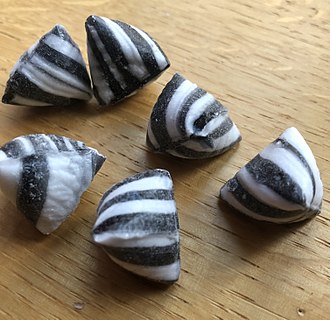
Mint-striped “humbug” candies Had the Thin Mints really been gone for good, I needn’t look far to find other fresh-breath foods. Who doesn’t like a scoop of peppermint or mint chocolate-chip ice cream? A pack of Mentos? Listerine? Heck, I’ll even settle for that gritty peppermint paste the hygienist uses to polish your teeth.

Brach’s “Star Brights” Minty consumables really do run the gamut. You’ll find over fifty global brands of breath mints, including Altoids (my favorite), Breath Savers, Certs, Clorets, Ice Breakers, Tic Tac, and Velamints. But put all of these together and you still wouldn’t come close to the Starlight Mint population. The origin of Starlights is one of the world’s great mysteries. Brach’s Candy claims their invention, but if so then why do they call them “Star Brights”?
If Starlights are too dime-store for your taste perhaps you prefer the softer texture of a “butter mint”. Butters are often found, individually wrapped, in the lobbies of fine restaurants (gone are the days where you’d just spoon yourself a handful on the way out the door). I’ve always thought a butter mint is caught in a quandary, Does it identify more as “butter” or “mint”?

Mint julep Speaking of a refined palate, minty liquors make for some mighty fine beverages. The first drink my wife and I ever shared was hot chocolate and peppermint schnapps from a thermos at our college’s movie night. A grasshopper (and my wife has a killer recipe for one) is a fresh-breath milkshake made with crème de menthe. And the Kentucky Derby’s mint julep is more bourbon than mint but you’ll always find fresh sprigs garnishing the top.
If not the Starlights, my first introduction to mint was probably packs of Life Savers. There used to be several mint flavors of “the candy with the hole in the middle” including Wint-O-Green, Stik-O-Pep, and Spear-O-Mint. But when the trendier Mentos and Tic-Tac came along, Life Savers headed for the rear-view mirror.
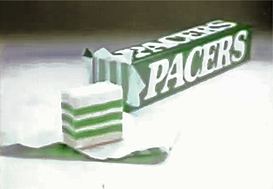
Mistake-O-Mint No mention of mint would be complete without a couple of failures (at least IMHO). In the 1970s the makers of Starburst came out with a short-lived minty version called Pacers. They never worked for me because I always expected those chewy little squares to be fruit-flavored. Nabisco’s Oreo, which blossomed into 85+ varieties from their black-and-white signature sandwich cookie, include ones with green mint filling. No, just no. Oreos are meant to be the vanilla originals. Food-color them orange for Halloween if you will but don’t change the taste.
[Side advertisement: The next time I fly overseas I’ll have to give Jet Blue’s Mint class a try. Their individual “apart-mint” cubicles allow you to lie flat, with lots of cushions, a TV, and plenty of storage space for your carry-on items. Fancy, huh? All that’s missing is a chocolate mint on your memory foam pillow before you drift off to sleep.]

France’s “Monnaie de Paris” Mint Here’s a chicken-or-egg question. Which mint came first, the flavor itself or the stodgy industrial facility which manufactures coins? I always thought it’d be cool to work in a mint. You’re handling millions of dollars every day and if someone asked what you do for a living, you just say casually, “Oh, I make money.” And If it were up to me I’d give all those coins a sweet-smelling scent on their way out the door so they’d be “freshly-minted” two times over.
 Our Christmas celebrations used to include a box of Frango Mints, the melt-in-your-mouth chocolates you could buy at Chicago’s Marshall Field’s. These days we go with Williams-Sonoma peppermint bark. Our tree will always welcome a peppermint candy cane or two. And if a Girl Scout should ever knock on my front door again, I’ll be happy to help her meet her quota, because the Thin Mints will always be a breath of fresh air.
Some content sourced from the CNN Business article, “The Girl Scouts are discontinuing a cult-favorite cookie”, and Wikipedia, “the free encyclopedia”.
-
Mom-and-Pop Music
Flip through the chapters of my life and you’ll find a bookmark at 1975. It was the year I became a teenager. It was the year I started middle school. But most importantly, 1975 was my first foray into Top 40 music. In those days, punk, funk, disco, and metal were just getting started; all too progressive for a kid taking his first dip into the pool of radio rock. Instead, my preference was to chew on something a little sweeter. Like bubble gum.
 In the 1970s, I was way too young to witness the birth of rock and roll. I also missed the advent of pop music. But I was right on time for a musical genre known as bubblegum. Bubblegum siphoned off pop music’s more catchy, upbeat tunes and marketed them to children and adolescents. And what better way to market theses songs than kid TV? Anyone who ever watched The Partridge Family, The Monkees, or the cartoon rock of The Archies on Saturday mornings enjoyed bubblegum music.
As for 1970s Top 40, it’s easy to look back on those weekly lists and find bubblegum. “Love Will Keep Us Together” (Captain & Tennille), “Laughter In The Rain” (Neil Sedaka), and “He Don’t Love You, Like I Love You” (Tony Orlando and Dawn) are just a few examples from fifty years ago. Like most things back then, music was more innocent.
Having said that, bubblegum wasn’t even specific enough to define my own tastes. The industry standard Billboard Magazine generates a Hot 100 list at the end of every year based on sales and radio plays. It’s fun to go through the 1975 list and recognize just about every song. But I was looking for three names in particular and – no surprise – all of them made the list with multiple entries. Hello again, John, Olivia, and Barry.
 John Denver was only 53 when he was tragically killed piloting a single-engine plane above California’s Monterey Bay, yet he managed to create over twenty-five years of gentle hits before that. When I first heard his voice he’d already landed top-ten’s like “Leaving on a Jet Plane” (from the movie Armageddon for you younger readers), “Take Me Home, Country Roads”, and “Rocky Mountain High”. One of Denver’s biggest hits, “Annie’s Song”, was a love song to his first wife. Another, “Calypso”, paid tribute to the late ocean explorer Jacques Cousteau. I purchased most of Denver’s albums (cassette tapes!) with a good chunk of my meager teenage savings.
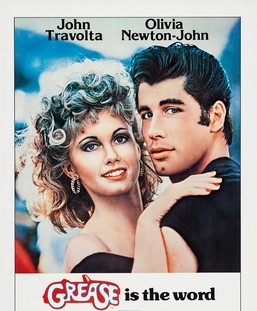
 I was an Olivia Newton-John fan well before 1978’s Grease became a Hollywood phenomenon. Newton-John and her sweet Australian accent were an instant teenage crush, with songs like “If You Love Me, Let Me Know”, “Have You Never Been Mellow”, and “I Honestly Love You”. Then Grease came along and good-girl-turned-bad Olivia turned my teenage heat up several notches. A testament to Newton-John’s popularity came in the form of 100 million records sold, fifteen top-ten singles, and four Grammy awards. To this day, the soundtrack to Grease remains one of the world’s best-selling albums.
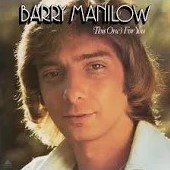 Barry Manilow and his music are more of a confession than the two we’ve already visited with. It wasn’t at all cool to admit to liking Manilow’s “adult contemporary” music back then. His hits were better suited for your parents, like “Mandy”, “This One’s For You”, and “Even Now”. “Copacabana” was a dance number you couldn’t get out of your head. “I Write the Songs” spoke to my inner-musician wannabe. Manilow’s talents on the keyboard certainly captured my attention as I pursued the piano myself. Unlike Denver and Newton-John, I purchased every Barry Manilow album as soon as it hit the shelves. Somewhere in my attic I still have a boxed CD collection of his best work.
Like him or not, what is remarkable about Manilow is his enduring popularity. He has been ensconced in Las Vegas for years now. He just completed his 600th performance at Westgate’s Resort & Casino (an achievement which prompted this post), breaking a record held by Elvis Presley. The one time I saw him in concert – at an outdoor venue in the Bay Area – I knew every song he performed. Sure, almost all of his audience members are now graying at the temples, and his popular music is from five decades ago (!) but you still have to give him props. The man has staying power.
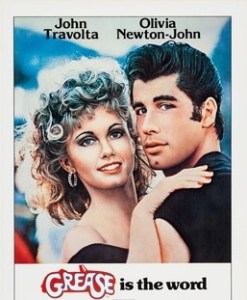 Do I still listen to John, Olivia, or Barry? No, but I can sing entire songs from memory. There’s nothing like the music of those three to take me back to my teenage years. Call it adult contemporary if you want, but this guy will always think of it as “Pop” music.
Some content sourced from The Atlantic article, “It’s Okay to Like Barry Manilow”, and Wikipedia, “the free encyclopedia”.








About Me
The sky is not completely dark at night. Were the sky absolutely dark, one would not be able to see the silhouette of an object against the sky.
Follow Me On
Subscribe To My Newsletter
Subscribe for new travel stories and exclusive content.
 Life In A Word