
Hello, I’m Veronica
The sky is not completely dark at night. Were the sky absolutely dark, one would not be able to see the silhouette of an object against the sky.


-
Five Gold Rings
So… if it really was the fifth day of Christmas you wouldn’t be singing Christmas carols anymore, now would you? I mean, how many of us do Christmas anything after December 25th? Not many. Accordingly this post is an early Christmas present to you: five carols worthy of the coveted Gold Ring award. “It’s impossible”, you say. “Select only five Christmas carols?” Yes, I get you, but today’s challenge isn’t fruit(cake)-less. We just need a few rules to refine the recipients:

- You can’t choose more than one from the same singer (which eliminates about five hundred from Amy Grant).
- You can’t choose more than one version of the same song (in other words, please dream of only one “White Christmas”).
- Your choices should dance into your head like sugar plums, instead of having to consult your several Spotify holiday playlists.
- (and perhaps the most difficult): Your choices should qualify as “carols” and not just “songs”. I mean, c’mon people, if we’re giving out gold rings the music better convey the spirit of Christmas, right?
Here then, my five gold rings; the ones adorning my hand every Christmas for as long as I can remember (or at least, for as long as Carrie Underwood’s been alive). They’re probably not the same as your five gold rings but that’s okay, because you wouldn’t give me the same presents I give you, would you? Would you?
Sissel Kyrkjebo/Mormon Tabernacle Choir – “In The Bleak Mid-Winter”. The Methodist church I grew up in always reserved a spot for this 1906 carol in its Christmas Eve services, so it blooms with nostalgia for me. Sissel’s angelic voice – backed by The Choir – captivates me every time, especially on the introspective lyrics of the final verse. I think you’ll agree; Sissel is as graceful as one of those seven swans a-swimming.
Amy Grant – “Breath of Heaven”. I love everything Amy Grant sings about Christmas (until her 2016 album “Tennessee Christmas” came along, which was as bad as curdled eggnog). I thought it would be difficult to choose just one of her carols, but “Breath of Heaven” is Amy’s unparalleled signature to Christmas. The lyrics “Help me be strong… help me be… help me…” always get to me, and are as successive as three french hens, one after another.
Laura Story – “I Lift My Eyes”. Laura Story is a pastor, songwriter, and singer (better known for her contemporary Christian hit “Blessings”). She sings from the heart. Of the ten carols a-leaping on her Christmas album “God With Us”, “I Lift My Eyes” leaps the highest. Frankly, it soars.
Michael W. Smith – “Almost There”. Bit of a cheat here because Amy Grant shares in the singing, but I still consider this one a standout Michael W. Smith carol. The lyrics speak to Mary’s journey to Bethlehem, her journey to the birth itself, and anyone’s journey through Advent to Christmas. You could also say it’s a carol about the partridge pursuing the pear tree, but not quite to the branches yet.
Carrie Underwood – “All Is Well”. Michael W. Smith also gets the credit for this one, which was recorded by two other artists before this latest rendition. The lyrics are simple and repetitive, but with Carrie’s ridiculous range you’ve got something more powerful than eleven pipers piping. Carrie draws out the final (all is) “well” for so long, you’ll wonder if it isn’t New Years Day when the carol is done.
So there you have them, and now it’s time for your own gold rings. Remember, five off the top of your head, only one per singer, only one version of any choice, and music that speaks reverently to the season. Gift your rings back to me in the comments and we’ll feel as cozy as two turtle doves. Whatever those are.
-
Beyond Quenching
Last week on Thanksgiving, I drank the following beverages in a start-to-finish order I may or may not recall correctly: water, coffee, more water, eggnog, water again, wine, and just before bed, a final gulp of water. Eggnog aside (and wine only occasionally) it was a typical day of liquid consumption. But on the list of reasons why I drink anything at all, I find it interesting “quenching thirst” settles to the bottom of the pool. Closer to the surface are the more interesting intentions. Collectively you might refer to these habits as my daily fluid dynamics (DFDs).
 When I wake up, the first thing I do (make that the second thing I do, after walking the dog) is to down a glass of water; a full sixteen ounces. I used to knock back just enough to chase my daily vitamins but then I read how you should drink water first thing in the morning, because technically you’ve been dehydrating for the last eight hours. So I started filling ‘er up to the top of the glass, a two-cup habit I’ve maintained for a long time now. Let’s list that habit as DFD #1: To help swallow things (like vitamins).
 My top-o’-the-mornin’ water stands in the way of the one drink that truly matters in life: coffee (or tea for the rest of you). My daily dose of caffeine is always the same: twelve ounces of the rich and robust stuff, with just a splash of cream to take the edge off. Coffee takes me from foggy to functioning in a matter of sips. Post-coffee Dave is alert and ready to conquer the day. Call it a chemical dependency? Hardly. I can skip my “daily grind” here or there and be none the worse for wear. But morning brew is undeniably one of life’s simple pleasures. DFD #2: To deliver a morning wake-me-up.
  Let’s make a brief rest stop on our tour of daily fluid dynamics… literally. My morning coffee comes with one utterly inconvenient side effect: the recurring “call of nature”. Something about caffeine seeks to clear out every available drop of moisture from my body, until I might as well be dust. It’s like one of those juice presses, only press down uncomfortably on the fruit every, oh, twenty minutes. If I could down an entire liter of cold brew, not only would I be bouncing off the walls but I’d also lose at least ten pounds in water weight over the next hour. Maybe I’ve discovered America’s next diet craze.
Okay, we’re back from our visit to the “powder room”. I’m chugging water several more times during the day (indeed, high/dry Colorado made my faithful companion a water bottle, wherever I go). But is all this water because I’m thirsty or because I can’t get the old saw out of my head, the one that recommends “eight to ten cups a day”? A similar water saw says to consume half your body weight in ounces, but let’s be real: I never get to that number (nor do I believe in one-rule-applies-to-all). Yet getting enough H2O still rattles around in my brain. So, DFD #3: To hydrate the body.
 Eggnog done right (meaning it’s often done wrong) is my favorite drink of the holiday season. Conveniently, the creamy concoction also serves as a throat-soother when you’re sick. It’s cold, with a thicker-than-milk consistency that settles on your throat for a fair amount of time. Reminds me of the old Pepto-Bismol jingle (“the pink stuff”), how it “coats, soothes”. Eggnog might be as effective as a cough drop and it tastes a whole lot better. DFD #4: To ease a sore throat or cough.
 Wine makes my fluids list regularly, and it would even if I had no argument for a DFD. But I do. Like today’s college “pre-game” drinking (or tomorrow’s holiday party you’re dreading), sips of wine dull the senses, warm the insides, and melt away stress. Loose lips are a common side effect, but wine in moderation typically makes the conversation flow. Plus, the right vintage simply tastes great, time and again. DFD #5 then: To act as a “social lubricant”.
 Last (and least), water is not only my top o’ the mornin’ but also my close o’ the evenin’ drink. After the toothpaste, the floss, and the oral rinse, the water goes in and comes right back out. Swishing, gargling, rinsing, and spitting – it’s all an effort to restore order beyond the lips, so you head to bed without the breath of the dead. The only more effective approach would be a fire hose on full blast. So, DFD #6: To cleanse the mouth.
Maybe you’re a little more introspective about your consumption of beverages now (and you’re welcome). Like I said, quenching thirst is somewhere near the bottom of the pool. So the next time you’re taking a sip, and someone notices you being particularly thoughtful about it, just tell them you’d like to explain a little something called daily fluid dynamics.
-
It’s Thanksgiving Season (#4)
Well now, I told you the Thanksgiving season would fly by didn’t I? Those 23 days came, went, and BAM! here we are – Thanksgiving Day itself. Good thing you kept a Gratitude Calendar like I asked you to. You did keep one, didn’t you – the list of things you’re grateful for this season? No, you can’t have my list (who are you, that kid who copied off of others in grade school?) but I will let you read it:
- WordPress, which allowed me to schedule this post ahead of time so I can spend Thanksgiving Day focused on much more important things.
- Thanksgiving cards, purchased for family and friends before the torrent of Christmas cards pushed them off the shelves.
- Our son, visiting this weekend all the way from Colorado.
- Witnessing my beloved alma mater face Clemson on the football field (even if Notre Dame “didn’t show up”).
- Today’s extra hour of sleep, even if I couldn’t manage to sleep for an extra hour.
- Babysitting my granddaughter, even if she produced what I’d politely call a “blowout”.
- Making it to the car dealership safely on a suspect front left wheel.
- Repair of that wheel by mechanics who know a lot more about fixing cars than I do.
- A perfectly still morning with the dog and a cup of coffee before easing into the day’s activities.
- My mother, who was born on this day 95 years ago.
- My body, which allows me to continue the regular, rigorous workouts I enjoy.
- My wife, my endless source of love and laughter.
- The quiet, peaceful, safe community I live in (and utterly take for granted).
- A long-awaited rain shower, and hopefully the first of many.
- The many entertaining blog posts from my “online family”: those I faithfully follow and who faithfully follow me.
- The family and friends who keep us tied to our former years in Colorado.
- A perfect fall day in Colorado, allowing me to accomplish the many things I had on my agenda.
- The reunion of my wife’s family with her mother (a gathering that hasn’t taken place in over ten years).
- A visit with my Colorado granddaughters, and the opportunity to walk my eldest to kindergarten the following morning.
- A visit with my best buddy and his wife, and the realization our relationship will stay strong no matter the time or distance.
- The countless workers in the airline industry who make travelling safe, including the singing traffic cop at the airport crosswalk.
- The simple comforts of being back at home
- My brothers and their families, who I will truly miss this year as they gather together in Williamsburg, VA.
And… that’s enough for today. You should be focused on family and friends anyway, not blog posts. Wait – one more thing – a throwback term to mix in with your Thanksgiving spread: requital (with the middle part of the word pronounced like “quite”). A requital is a return or a reward for an act of kindness. Here’s how Beethoven used it back when he was still making music: As a slight requital of your kind souvenir, I take the liberty to send you some variations, and a Rondo with violin accompaniment. Fancy, huh? Now, go impress your guests around the table by using your new word.
Oh, and if you didn’t keep a calendar of things to be thankful for? Seriously, what are you waiting for? C’mon, get grateful already!
-
It’s Thanksgiving Season (#3)
Earlier this week the first Christmas card arrived in the mail. For heaven’s sake it’s not even November 25th, people. Then we stopped by Chick-fil-A and my wife asked if they had their Peppermint Chip milkshake, which of course they did because it’s “Christmas season”. Finally, we’re seeing strings of colored lights and decorations on houses already. Am I losing the battle of the Thanksgiving season with a full week still to go? Maybe I need a different tack with my campaign.

Let’s talk about Thanksgiving dishes today. Are yours made of pottery, wood, metal, or glass? Oh, you thought I meant food. Well, yes, I do, but somehow we’ve stretched the definition of “any container used at the table” to also mean what’s in or on that container. So let’s talk about that. Have a favorite dish at Thanksgiving? Of course you do; everybody does. In fact, the better question is, if your Thanksgiving “dish” is a “favorite” then why don’t you serve it all year round?
Here are my three favorite Thanksgiving dishes for your consideration:

Stuffing. Nine out of ten Thanksgiving stuffing recipes never made it into the bird in the first place. Okay so I made that up, but I find it funny when a food that is “inside” by definition was never, ever inside. Whatever. Stuffing used to be that little pile of gently-spiced spongy material sitting benignly aside your helping of turkey. I’d ignore it or push it around a little but most of this autumn pillow fluff never made it onto my fork. Then I met my wife. You could hibernate for an entire holiday season on my wife’s stuffing recipe. It starts with ground sirloin and pork sausage and a whole lot of butter. It ends with a ton of seasonings and spices, including sage and something called “parsley” (more on that later). Forget the turkey… if a food ever deserved to be called “main course” it’s my wife’s stuffing recipe.

Cranberry sauce. Is there a more wasted food on earth than cranberry sauce? Seriously, this poor little enhancement sees the light of day only once a year, where it sits on your plate for the length of the meal before being scraped mercilessly into the kitchen trash. How many people really make the perfect Thanksgiving “bite” – a combo of turkey, stuffing, and cranberry sauce? Not many. I think cranberry sauce was created to brighten an otherwise autumn-colored “dish”. Chateaubriand has its Béarnaise sauce. Lamb has its mint jelly. Turkey seems to acknowledge cranberry sauce as a garnish at best: something ornamental instead of “food”.
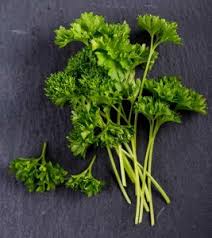
worthless Speaking of garnishes, can we all agree parsley is the perfect example of one? Yes, you’re adding color to the plate, but don’t you always wonder what you’re supposed to do with those little green trees? Just like the colorful toothpicks you sometimes find holding your sandwich together, parsley is the first thing you remove (at least cranberry sauce rides out the plate for the entire meal). Parsley is transported from wherever it invaded your plate (and what the heck is it doing in my wife’s stuffing, anyway?) to your bread plate, where it lays until its ultimate demise. The relevance of parsley to the Thanksgiving meal (and to any “dish” for that matter) remains a mystery. One I don’t have time for in this post.

Mince pie (AKA “heaven on earth”) Mince pie. We conclude my favorites with the most underappreciated, over-carb’d dessert of them all. Mincemeat pie really did include meat back when the Pilgrims were celebrating Thanksgiving with swans and seals, but eventually someone (who deserves a medal) thought to remove the meat and add a whole lot of sugar to the chopped dried fruit, distilled spirits, and Thanksgiving spices. The result is a pie that is scrumptious in some books (mine) and a veritable construction material in others (everyone else’s). Seriously, this stuff is a brick. It’s like pecan pie – or concrete – only ten times as dense. And don’t forget to soften the blow with a little brandied hard sauce on top. The spiked whipped cream is so good my wife skips the pie and has a dollop of the sauce instead. But if you ask me, she’s missing out on the real dessert.

Your Thanksgiving dinner will no doubt include a favorite “dish” or two this season (glass? metal?) which should also make you wonder why you don’t eat it more often. Is it because the Thanksgiving season is special, and you don’t want to dilute the magic by having your favorites year-round? Yes, I think that’s the reason. Thanksgiving deserves its own “dishes”… and it’s own season. So c’mon, get grateful already!
Some content sourced from the Delish article, “50 Traditional Dishes You Need For The Ultimate Thanksgiving Menu” (mince pie is conspicuously absent from the list). The parsley rant is a loving shout-out to my sister-in-law.
-
It’s Thanksgiving Season (#2)
So here we are, nine days into the Thanksgiving season already. Didn’t the time positively fly (even with the extra hour last Sunday)? Have you already booked your travel to visit loved ones later in the month? Have you already made pumpkin pie (because you can never have enough pumpkin pie, so why wait until Thanksgiving Day)? Whatever you’ve done for the past nine days, I’ve already hinted at the three “F’s” of Thanksgiving: food, family, and friends. Now let’s add a fourth.
Not football. Not fun runs. The most important Thanksgiving “F” is full; as in “full of thanks”. You are thankful this season, aren’t you? If you joined my bandwagon from last week’s post, you already have nine reasons (or nine people) to be thankful for. Keep that list going until the big day, band-wagoner.
Now that you know the four (not three) “F’s” of Thanksgiving, let’s visit five facts you probably don’t know about the holiday. Here’s a morsel for your taste buds: the very first Thanksgiving feast probably included lobster, deer, swans, and seals. PETA and I struggle with those last two, but the list stands to reason because we’re talking pilgrims and Indians on the coast of Massachusetts, four hundred years ago, making merry for three straight days. Those flavorful “entrees” were abundant back then, with nary a turkey to be found.

Too cute to eat! Remember last week’s mention of Abraham Lincoln making Thanksgiving a holiday? That was in 1863, declared as every last Thursday in November. Seventy-odd years later, Franklin D. Roosevelt moved Thanksgiving Day one week earlier to extend the shopping season during the Great Depression. But some states pushed back on Roosevelt’s pushback so in the 1940s you had several years with multiple Thanksgiving Days (more turkey for everyone – hooray!) Eventually the compromise was made as we know it today: one Thanksgiving Day, the fourth Thursday of every November.
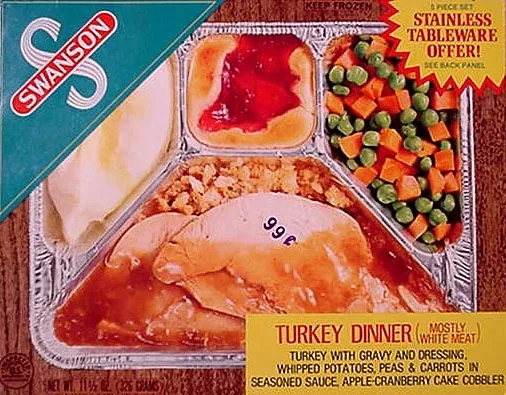
 My wife and I love dinner in front of the TV, don’t you? But have you actually eaten a TV dinner? You know, the frozen full meal in a box, with the tiny portions of generic food in the partitioned aluminum-foil tray? Well, you can thank Thanksgiving for TV dinners. Swanson overestimated the demand for turkey one year, and in a totally give-that-person-a-raise move, converted 260 tons of leftover turkey into 5,000 hand-packed dinners, complete with dressing, gravy, peas, and sweet potatoes, at a mere $0.98 a pop. A year later they’d sold ten million of them. Voila – the birth of the TV dinner.
Trivia question: What teams always play football on Thanksgiving Day? Trivia answer: the Dallas Cowboys and the Detroit Lions. Better trivia question: What teams first played football on Thanksgiving Day? Answer: Yale and Princeton way-y-y-y back in 1876. I didn’t even know football was a sport in 1876. As for games played on Thanksgiving Day, I would’ve guessed they started like, a hundred years after that.

If your Aunt Betty spends a little too much time at the holiday punch bowl and thinks it’s funny to start gobble-gobble-gobbling at your kids, you might want to remind her females don’t gobble. Er, female turkeys that is. The signature Thanksgiving sound is reserved for the males of the species. Female turkeys have been known to purr and cackle instead. This is good information for your Aunt Betty (the purr , not the cackle).

Pay it “backward” Okay, enough what-you-didn’t-know fun for today. Let’s wrap with another nod to being thank-full (or, if you will, having “gra-attitude”). I love this time of year because Starbucks gives away free coffee. Okay, so they’re not really giving away free coffee. Instead, drive-thru patrons continue the seasonal tradition of paying for the car behind them (and driving off quickly so as to remain anonymous). I go to Starbucks more often just to participate (as payer, not payee). So, for whatever you are grateful for, share that happy feeling with the people behind you in line. Not a patron of Starbucks? Doesn’t matter; any drive-thru will do. So c’mon, get grateful already!
Some content sourced from the October 2023 Town & Country Magazine article, “14 Surprising Facts You Never Knew About Thanksgiving”, and Wikipedia, “the free encyclopedia”.

About Me
The sky is not completely dark at night. Were the sky absolutely dark, one would not be able to see the silhouette of an object against the sky.
Follow Me On
Subscribe To My Newsletter
Subscribe for new travel stories and exclusive content.
 Life In A Word