
Hello, I’m Veronica
The sky is not completely dark at night. Were the sky absolutely dark, one would not be able to see the silhouette of an object against the sky.


-
Concourses or Golf Courses?
Whenever flying is a part of my travel plans, I wear my most comfortable pair of walking shoes. Long gone are the days of the coat-and-tie-to-fly dress code, in favor of sneakers (and jeans). My reason for rubber-soled kicks used to be, “What if we’re in some kind of accident and I need to get off in a hurry?” Today I go with a wholly different reason. The long, long walk I can expect from curb to concourse to airplane cabin simply demands something easy on the feet.
 Here’s a startling comparison. If you play golf and skip the cart, you’re going to walk over four miles to finish your round. By almost the same token, if you’re connecting through Dallas-Ft. Worth or Atlanta and choose to walk from Terminal B to Terminal E, you’re going to walk over two miles. Add in the inevitable search for food, a stop or two at retail, and a visit to the restroom and you’re closer to three miles. And none of that includes the distance from the curb to the ticket counter, from the counter through security, and from your gate down the jetway to your seat on the plane.
How do they do it in heels? Now for the bad news. Airports are only getting bigger, and not for the reasons you might think. Sure, more people fly than ever before, which adds more planes, more gates, and even more airports. But behind the scenes a couple of stronger forces are at work. One, airlines are shifting to larger aircraft, which translates to more space between parked planes. Two, airport parking revenue is down (thanks to Uber, Lyft, and more mass transit), which translates to the airport’s need to find revenue elsewhere. Where? Retail, bars, and restaurants.

Don’t get used to these… From recent trips through airports, I’ve noticed the following. In Denver International, remodeled Concourse B is already labeled “Gates 1-100”, even though there aren’t a hundred gates. It’s a straight-line concourse and it’s only going to get longer. In Atlanta’s Hartsfield-Jackson, the concourses are so long and narrow (and so crowded), that last gate is farther than you can see without binoculars. And in San Diego’s Lindbergh Field, when you’re processed into Terminal 2 from security, you can’t see a single gate, because you have to pass through a veritable shopping mall first.
In the ultimate insult to long walks to planes, some airports have left the moving walkways out of their concourse remodels. Those walkways discourage you from passing directly in front of the food and retail the airport so desperately needs you to patronize. And intentional or not, the airlines encourage these purchases by offering less food onboard. You, weary traveler, are a captive audience to more than one performer.

I prefer this kind of walk Let’s not forget the rental cars. Avis’s slogan is “We try harder”. Maybe it should be, “We try harder… to take more of your money“. I just reviewed my receipt from a recent San Diego rental for a full-size standard Kia sedan. Right there below the actual daily rate: “11.11% Concession Recovery Fee”; essentially the cost of doing business at the airport. Add in Vehicle License Recoup fee, Customer Facility Charge (another airport fee), California Tourism Fee, and a final flourish of “tax”, and the rate increased by 32%. All so I can walk further to get to my rental car?
An early chapter of my career was in airport planning. We’re the people who figure out how to get the planes from the runways to the taxiways to the gates without hitting each other. We also design the terminal buildings to include enough gates, concessions and restrooms (yeah, yeah, bring on the heat with that last item). Concourse design used to be “spoke and hub”, meaning you walked down the spoke to a circular boarding hub of several gates. It made the airplane taxiing a little trickier outside, but it significantly reduced a passenger’s walk to the gate. Today, airports no longer favor the design (er, traveler) because it reduces the square footage for concessions.
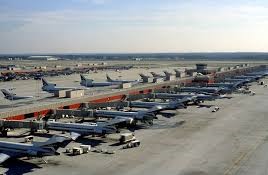 For those of you who live and die by your 10,000 steps, take heart; airports are helping you accomplish your daily goal. Phoenix Sky Harbor even disguised the long walk through the concourses by calling it a “Fitness Trail”. Be sure to allow enough time to get in a (seriously overpriced) shopping trip at all those concessions. But don’t forget, the airlines only allow one reasonably sized carry-on these days. Any others will cost you a checked bag fee… because the airport isn’t making enough money already.
Some content sourced from the CNN Business article, “Why you have to walk so far to your gate at the airport”, and Wikipedia, “the free encyclopedia”.
-
The Times of Sand
I’ve often thought the airport is the best place to people-watch. With downtime while you wait for your flight and the close proximity to others, it’s inevitable you’re going to look around. Every kind of person can be found at the airport (sporting every size, shape, fashion statement, stress level, and age). Travelers are unknowingly entertaining to those who watch them. But today let’s explore perhaps an even better venue where people do their thing: the beach.
 As I type today, a sweeping look at the sandy shore beyond my patio shows me (in no particular order): A mother and daughter in animated conversation with a lifeguard; a group of teenagers (male) playing an aggressive form of beach four-square called Spikeball; another group of teenagers (female) sprawled on beach towels in giggly conversation; a father dragging his young son through the shallow waves on a boogie-board; a surfer wiping out in the not-so-shallow waves further out; and an ambitious child shoveling dirt out of a divot of sand as if digging to China.
 I look away for a second and then look again: A pack of aggressive seagulls pecking away at someone’s leftovers aside their abandoned beach chair; that same lifeguard sprinting into the water to rescue a struggling swimmer; an older couple having a (clearly) not-so-happy conversation at the water’s edge; a jogger attempting to put in the miles while dodging the less active in his way; and a paused beach volleyball game where the players can’t determine if the ball hit the (sand) line or not.
 It’s a rare treat when I can create a blog post from the goings-on on right in front of me, but the beach allows me to do just that. More to today’s point, an active beach like this one changes character throughout the day. In other words, there are the sands of time and then there are the times of sand:
- Dawn: Seagulls, sand, and surf. The beach at its most peaceful and pristine.
- Early morning: Serious runners at the shore (unlike the casual joggers later in the day); an Asian elder performing a standing form of meditative yoga; a surf camp for pre-teens to the north; a lifeguard training camp for teens to the south; a pickup truck clearing the trash from the evenly-spaced cans.
- Mid-morning: The gradual arrival of the masses (and all they bring with them). Also the arrival of the lifeguards, with bright cones marking the “no-man’s land” for emergency vehicles, flags indicating the adjacent street number so people know where to find you, and more flags to mark the beach’s “surf zone” versus “swim zone”.
- Midday: Everything I observed at the start of this post (and so much more).
- Mid-afternoon: The gradual departure of the masses, and (hopefully) all they brought with them. Also the departure of the lifeguards, signing off with a megaphone farewell to those who remain behind.
- Early evening: The ritual of the sun-worshippers, who simply must remain behind to witness the (West Coast) sunset. There’s nothing like a setting sun to bring a person to a focused standstill.
- Dark: An umbrella of stars, a rhythmic ribbon of white foam as the waves crash to shore, and an occasional party of two out for a romantic stroll at the water’s edge.
 Trust me, it’s easy to be mesmerized by the times of sand if you watch them long enough. They’re the reason I never make progress with my latest “summer read”, and the reason I can abandon my electronic devices for hours at a time. Frankly, it’s a wonder I was able to turn away from the sands long enough to bring you this blog post today.
-
Solitary Singles
A recent study of lifestyles determined the eight healthy habits that can add the most years to a human life. It’s a list of what to do (four) and what not to do (another four) to live longer. All eight are fairly commonsense, but one in particular stood out to me: Surround yourself with positive social relationships. You’ll increase your chances of a longer life by five percent, and you won’t be able to claim COVID-y words like “lonely” and “isolated”.
 Let’s not make this a sad blog post, okay? I could spend the rest of my paragraphs talking about loneliness and isolation, but why bother when so many musicians have already done so before me? “Lonely” songs go back decades. In 1960, one of the biggest solitary singles was Roy Orbison’s Only The Lonely. The same year, Elvis released Are You Lonesome Tonight? And anybody who remembers the Beatles’ Eleanor Rigby (1966) knows Eleanor’s story is all about loneliness.
The 1960s is a little too far back for my purposes. I’d rather focus on two more recent songs you know (from popular re-recordings) and another one you might know. One thing’s for sure; all three play in my brain now and again, but especially when I’m “Alone” or “All by Myself”.
Alone
The power ballad made famous by Heart (and then Celine Dion) is not so much about being alone but about wanting to be with a particular someone else… but not being able to. “Alone’s” lyrics voice the frustration of a romantic longing. It’s more about how do I get you alone than actually being alone. There’s even this suggestion of before versus after: Till now I always got by on my own. But the song’s final lines – nothing but repeating, wailing, unsatisfied “alones” – gets me every time. Heart’s version of “Alone” spent three weeks at #1 on the U.S. Billboard Hot 100 and still makes an occasional appearance on the radio.
All by Myself
Even though this was another Celine Dion’s hit (what’s with all the loneliness, Celine?), no one who lived through the 1970s would ever take “All by Myself” away from Eric Carmen. The song hit #2 on Billboard’s Top 100 and sold more than a million copies (back when listeners actually purchased music). “All by Myself” is also categorized as a power ballad; “a style of music that often deals with romantic or intimate relationships… usually in a solemn but poignant manner”. The second verse is a good example:
Livin’ alone
I think of all the friends I’ve known
But when I dial the telephone
Nobody’s homeLike “Alone”, there’s no happy ending to “All by Myself”. In fact, the lyrics are disconsolate from start to finish (yet somehow they work). Also, trivia buffs, you’ll hear the song’s melody in the second movement of Sergei Rachmaninoff’s classical Piano Concerto No. 2 in C minor, which is odd but intentional.
Alone Again (Naturally)
I find it fascinating when a song sounds happy but really isn’t. Maybe that’s why Gilbert O’Sullivan’s “Alone Again (Naturally)” has stayed with me all these years. It’s easily the “loneliest” song of the three I cover today, and seems to take pride in being so from start to finish. “Alone Again” manages to pack suicide, being left at the altar, wondering if there’s a God, and losing one’s parents into a single set of lyrics, layered on top of a merry duet of piano and guitar. The song spent six weeks at #1 on the U.S. Billboard Top 100 and was re-recorded by several others, including two American Neils (Diamond and Sedaka). But it’s Irishman O’Sullivan’s rendition I’ll always hear in my head.
Regarding those healthy habits I mentioned earlier, I think my report card’s looking pretty good. So good in fact, I can enjoy these chart-topping “lonely” songs without getting down. I hope you can do the same.
Some content sourced from the CNN article, “These 8 habits could add up to 24 years to your life, study says”, and Wikipedia, “the free encyclopedia”.
-
Rocket Men (and Women)
A year from today, we’ll all be glued to our televisions and tablets watching the Olympic Games in Paris. I will be glued, at least. The Summer Games get me all fired up, especially the track and field events. Especially especially the field events. I mean, c’mon, you can watch running all year long, but how often do you get to see a javelin thrown, a discus tossed, or a shot “put”? (and how often do you even say “javelin” or “discus”?) But one field event tops all others. There’s simply nothing more gawky-entertaining than a human launched into space by a pole.
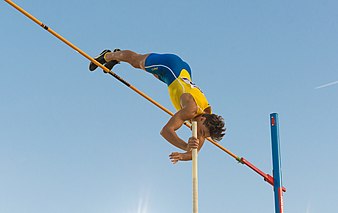
 If you live in a two-story place with a fairly flat roof, it might be a little unnerving to learn Swedish-American pole vaulter Armand Duplantis can jump over your house. While the rest of us have to walk around at ground level to get to your backyard, Armand will simply sprint up your front path, plant his pole in your rose bushes, launch himself past the bedroom windows and between the chimneys, and make a splash landing in your swimming pool. Armand can do this because he can pole vault 20.4 feet, a world record he set last February. It’s the fifth time this twenty-something has broken his own world record.
Duplantis Pole vaulting is a truly bizarre sequence of movements constituting an Olympic event. The vaulter balances a long fiberglass pole in one hand while sprinting down a rubber-surfaced runway. Just before running out of runway he or she raises the pole overhead with both hands, stabs the leading end into a boxed area on the ground, and pushes… hard. The ensuing bend of the pole and a whole lot of momentum hoists the vaulter into the air, feet first. With gymnastic flair, the vaulter then rotates his or her body around to be facing a high horizontal bar, just as gravity counters flight. The final flop back to Earth (and onto a giant cushion) is typically punctuated with a mid-air fist pump if the bar is successfully cleared.

Armand doing what Armand does best Imagine that exhilarating feeling when a pole vaulter is at peak height, pointing skyward, feet above body, pole released, practically cruising into the earth’s atmosphere. As Elton John sings “… it’s gonna be a long, long time ’til touchdown brings me round again…”
Four Olympic field events involve jumping: 1) pole vault, 2) long jump, 3) high jump, and 4) triple jump (the ol’ “hop, skip, and jump”). None of the last three hold my interest because they’re easy to do. But not pole vaulting, not even close. Launching my body even a few feet off the ground with a bendy pole? Let’s just agree, I am no Rocket Man.
 Pole vaulting brings to mind two questions (or three if you include Why in heaven’s name does anyone do this?). First question: What happens if the pole breaks? Seriously, sports equipment fails. Golf clubs break in two with enough swings. Tennis racket strings get loose. At some point a pole vault pole will bend one too many times. Yikes. Second question: How does the pole translate horizontal energy into vertical energy? It’s a physics problem akin to the catapult, but I’d have to go back to high school to solve it. No thanks.
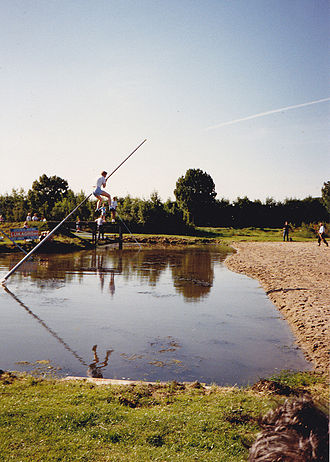
Leap of faith The origin of pole vaulting is a bit of a letdown. My too-many-movies imagination pictured a medieval war, with soldiers clearing castle walls on long pieces of bamboo. Instead, pole vaulting is a rough translation of an old technique used to scale narrow natural obstacles, like watery marshes. Get a running start, plant the pole, and sail from one side of the marsh to the other. But those poles don’t bend, and nobody cares how high you go as long as you make it over. So you see, even the origin of pole vaulting is gawky.
The pole vaulting world record was eighteen feet in 1970. Fifty years later it’s been pushed two feet higher. Do the math; maybe we’ll be clearing one hundred feet by the year 2773. But we’ll probably have flying cars by then as well, so any interest in humans launched by poles will be gone. My advice: watch the Paris Games, especially the pole vault. These rocket men and women won’t be around forever.
Some content sourced from the CNN article, “Olympic champion Armand Duplantis…”, and Wikipedia, “the free encyclopedia”.
-
Sphere Delight
My wife’s sister and her husband just wrapped up a visit here in South Carolina. On the drive down from Colorado they made several sightseeing detours, but the trip back was pedal-to-the-metal… with the exception of one stop: the Moon Marble Company in Bonner Springs, Kansas. Moon Marbles stocks beautiful handmade wooden games and toys but c’mon, who braves the barren wastelands of Kansas for those? Marbles on the other hand, would draw me in like a bee to nectar.
 A marble is the perfect example of a sphere, isn’t it? I love spheres (including the word itself; much more elegant than “ball” or “orb”). Take a semicircle, revolve it a full loop around its diameter and voila! – a sphere. Calculating the volume of a sphere involves cubing its radius but let’s stop right there with the math lesson. Cubes and spheres just don’t belong in the same conversation.
Lemons can be oblate spheroids Most of you readers are tuned in from the Northern Hemisphere, the half of our planet above the Equator. I find it cool to think of Earth as a sphere (with “big blue marble” a close second). It’s the biggest sphere we humans know (or have you been to Jupiter?) At your next party, wow your friends by telling them Earth is actually an oblate spheroid: flattened at both poles and bulging at the Equator. Ewwwww. Not a very pretty sphere, now is it?
Here’s the paragraph where I cop out and simply list a bunch of spheres, like oranges, Christmas ornaments, eyeballs, pearls, and the moon, but that’s just so three-hundred-blog-posts ago. Spheres can be much cooler. For instance, picture an atom (I’ll pause for those who need a microscope). An atom is a spherical cluster of neutrons and protons (which are also spheres) encircled by whizzing electrons (more spheres). Did you know your body is made up of over 7 octillion atoms? That’s a lot of spheres. You might want to lose a little weight.

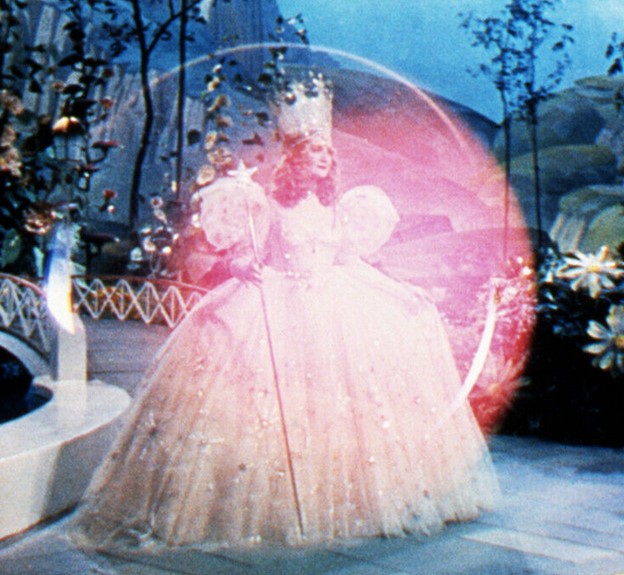
Glinda traveled to Oz in a sphere (photo courtesy of MGM) Soap bubbles are spheres. Sure, you aim to create those giant wibbly-wobbly monsters but for the most part you generate a cloud of perfectly spherical transparent globes, born on a whisper of air and extinguished seconds later. I’m guessing soap bubbles have the shortest lifespans of all spheres.
When a college buddy visited several years ago, he brought a paperweight made by an artist near his hometown in New Jersey. It’s a glass sphere with just the slightest bit of the bottom lopped off so it doesn’t roll off my desk. I’ve picked up a lot of tchochkes over the years but I’m not letting this one go. Did I mention spheres are cool?
 Three years before he wrote Jurassic Park, Michael Crichton authored a novel called Sphere. It’s about a group of scientists exploring a giant spacecraft sunk to the bottom of the Pacific Ocean. In the spacecraft’s cargo hold: a mysterious sphere, determined to be extraterrestrial and literally mind-blowing. Mark my words; spheres can be as terrifying as dinosaurs. Read it.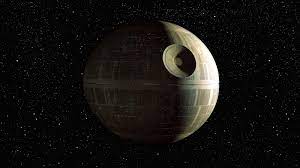
Dimples can be cute. Not this one. Star Wars focused on a giant spherical colony – the Empire’s “Death Star” – but the air went out of my perfectly round balloon as soon as I saw the giant divot on its side, not to mention all those channels and openings pierced by the X-wing starfighters. In other words, the Death Star was a decidedly less-than-perfect orb. So I applauded alongside everybody else when Luke Skywalker blew this sphere to kingdom come.
Here’s a place you wouldn’t expect to find a sphere: a Christian hymn. In the first verse of This Is My Father’s World we have, “All nature sings and round me rings, the music of the spheres”. The plural throws me off, because more than one sphere suggests more than just Earth (the entire solar system?) Or maybe we aren’t singing about the planets at all. A quote from August Rush seems relevant; the final line in the movie: “The music is all around us… all you have to do, is listen.”

Coming soon to Sin City We’re starting to go round and round here (heh) so let’s conclude with the world’s largest sphere. The Guinness Book writers will deem it so once the “MSG Sphere” opens in Las Vegas in a few months. At 300 feet tall and 500 feet wide, the Sphere will dramatically change a skyline that’s already pretty dramatic, especially with 1.2 million LEDs on its surface generating all sorts of images and animation. For concerts, sports, and the like, the Sphere can seat up to 18,000 spectators. I plan to be one of them… just as soon as I make it to Moon Marbles in Kansas.
Some content sourced from the CNN Travel article, “This futuristic entertainment venue is the world’s largest spherical structure”, and Wikipedia, “the free encyclopedia”.











About Me
The sky is not completely dark at night. Were the sky absolutely dark, one would not be able to see the silhouette of an object against the sky.
Follow Me On
Subscribe To My Newsletter
Subscribe for new travel stories and exclusive content.
 Life In A Word