
Hello, I’m Veronica
The sky is not completely dark at night. Were the sky absolutely dark, one would not be able to see the silhouette of an object against the sky.


-
Game, Set, Matches
The LEGO Eiffel Tower is the tallest of its model kits and undoubtedly the largest of its Architecture Series. At a deliberate count of 10,001 pieces, this behemoth is a whole lot more detailed than LEGO’s 2014 original, which clocked in at a mere 321 pieces. So imagine my awe (okay, and shock) when I learned about another Eiffel Tower model; one with a staggering 700,000 pieces. Suddenly 10,000 seems like a nice, reasonable number.

Matchstick model It’s true, of course. A Frenchman recently converted 700,000 matches into a model of the Eiffel Tower, in an attempt to break the world record for, naturally, “tallest matchstick Eiffel Tower”. (Is there a world record for everything these days?) I suppose I can get past the 700,000 matches – even if I can’t picture that many in one model – but what I can’t fathom is the eight years Richard Plaud sacrificed to build his creation. I’m picturing Monsieur Plaud waking up each morning, bidding adieu to his wife after a croissant and some French press coffee, and heading off to his studio to play with matches, a giant bottle of glue in hand. Day after day after day.
 Our Frenchman’s accomplishment wouldn’t be so interesting if there weren’t a little drama thrown in for spice. Turns out his 23.6-foot model may not earn the world record after all. Why? Because Plaud cut the heads off the matchsticks as he built. When he got tired of cutting, he contacted a French “matchmaker” (ha) and asked if he could place a massive order of headless matches. And there’s the rub, fellow model builders. Guinness is disputing Plaud’s claim of the world record because the materials used can’t be purchased by you or me, should we try to build our own matchstick Eiffel Tower (but would we?)
Meanwhile, a 21.6-foot Eiffel Tower model built by Toufic Daher (coolest name ever) retains the world record. Daher’s model was completed in 2009 using six million (headed) matches. I have no idea how long it took him to build, but seriously, how long does it take to simply pick up six million little sticks, let alone shape and glue them into a replica of the Eiffel Tower?
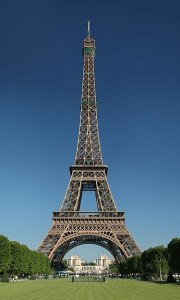
“La Dame de fer” Gustave Eiffel (another cool name) surely had no idea people like Plaud and Daher would be obsessed with his tower 135 years after the fact, in pursuit of world records. Frankly (“France-ly?”) Eiffel’s “Iron Lady” is impressive enough to stand on her own wrought-iron feet. After all, she’s among the most recognizable structures in the world. She surpassed the Washington Monument when she opened to the public in 1889, as “tallest human-made structure” (sadly, seventy years before Guinness started tallying world records). Today she still merits an entry in the world record book, albeit for a different reason:”Most Visited Monument with an Entrance Fee”.
 There’s a touch of iron-y to this post. As much as I’m making blog fodder of these Eiffel Tower model builders, I’m tempted to become one myself. Not with headless matchsticks; the LEGO version. Several years ago I completed the LEGO U.S. Capitol Building (1,032 pieces), followed by the LEGO Grand Piano (3,662 pieces), and more recently, LEGO Fallingwater (811 pieces). I keep an eye on the LEGO catalog for other models of interest but not one calls to me… except La Dam de fer. But then I pause to ask myself, am I really willing to dive into a project that’s effectively one hundred bags of one hundred pieces each, where ever single piece dark grey? Stay tuned.
LEGO’s version As for our French ami Richard Plaud, his eight years of pick-up sticks may not have been in vain after all. Guinness admits they might’ve been a little quick to dismiss his claim. In their words, they wanted to make sure “the playing field is level for everyone”. Playing field? Ah, so this Eiffel Tower model-building is a game, is it? For Plaud at least, I’d call it game, set, matches.
Some content sourced from the USA Today article, “8 years down the drain?…”, and Wikipedia, “the free encyclopedia”.
-
Dreamy Las Vegas
DID YOU HEAR? The price of Super Bowl tickets dropped this week! That’s right, you and me will pay less for seats today than those jump-the-gun fans who got theirs ten days ago. The game’s in three days so we’ve got no time to lose! Let’s make our travel plans!
 I’m gonna surprise my wife. I mean, I’m the bigger football fan, yes, but she’ll be so proud of me for getting our game tickets for less! And to celebrate “all things her” I figure, why not splurge on the rest of the trip since I’m saving money on the game? Once in a lifetime, I’m telling myself. Heck, by the time the Super Bowl comes to Vegas a second time she and I could be dead!
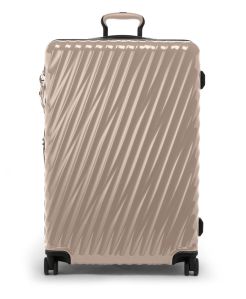 FIRST, new luggage. I want the two of us to be those people, where just a glance at their bags has you thinking, “Whoa, who are they?”. So, a quick trip to Tumi for a couple of their hard-shell packing cases ($1,500 per) and matching carry-on’s ($750). Getting the gold finish too, because you’ve got to look the part if you’re going to Vegas.
SECOND, airfare. I got me an itinerary lickety-split on Expedia, flying American. Leave Thursday, return Tuesday. Turns out we can’t get there direct since we live in the middle of nowhere but at least we can fly first class, for just $6,826, with only $600 in taxes and fees. Score!
 THIRD, transportation to the hotel. I’m not about to show up at the front doors with Tumi luggage in a rental car so it’s limo service for us! My choice: a modest SUV for two (well, three, including our private driver). I know, I know, I could’ve gone with the BMW stretch limo that seats twenty-five, but what are my wife and I gonna do – run laps around the inside of it? Besides, the SUV is described as “… for the VIP who prefers discretion” and that’s a great way to describe my wife. Round-trip: $375, with $75 in tips.
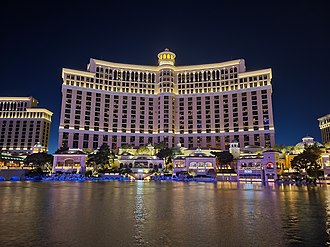
NOW THEN, the hotel. Gotta be big and flashy, right? Can’t be going to Vegas and the big game and staying at a Motel 6. Let’s go with the Bellagio. I don’t need a suite but I’d sure like a view of those lovely fountains. The hotel website quotes five nights for a “1 King Bed Fountain View” at $10,113, including $3,144 in resort fees. Yeah, I winced a bit with the five-figure quote but then the website flashed, Jackpot! This is today’s low rate! so I felt much better. The website also added a ten-minute timer on the rate but no worries – I booked it in less than five! Makes the $300 room service dinners seem like nothing, doesn’t it?

Bellagio Hotel In the days leading up to the game I’ll pamper my wife a little. In fact, since I love the view of those Bellagio fountains so much, guess what? I can order up a couples massage right there in the room! Only $650 for the two of us, including $110 of gratitude to the masseuses. Then we’ll be nice and relaxed for a dinner at, say, the Eiffel Tower Restaurant at the Paris Hotel (and another view of those fountains). We’ll start with Casco Bay scallops ($32), followed by mixed greens ($38) and the “Queen’s Cut Beef Tenderloin Filet Mignon” ($138), with a plate of accompaniments and sauces ($42). We’ll finish up with a couple of the house special “Eiffel Tower soufflés” ($44), and wash it all down with a nice enough bottle of red ($80). Another $110 in tax and tips calls it a night.

Paris Las Vegas Now wait a sec’. Since when does anyone in Vegas “call it a night” after dinner? So I thought about taking my wife to a big-name concert at the new Sphere but then it hit me. ‘O’ by Cirque du Soliel is right there in the Bellagio hotel! Two orchestra-center seats: $657, and only $93 tax/fees!
FINALLY… what I’ve been building to for hundreds of words now – Super Bowl XVIII. I’ve never been to Allegiant Stadium before and this’ll probably be my only visit, so… No, I didn’t go completely off the rails (like seats on the fifty or a sky box) but I do want to see the plays up close and personal so it’s got to be lower bowl, at least the 20-yard line. Oh man, what a relief! I found the last pair of tickets in Section C137 for $29,000 out the door (only $5,000 in service fees!) A flame emoji and a blinking “selling fast” sign had me sweating but I managed to get ’em before the next guy! Don’t forget, these same tickets would’ve cost me even more just a week ago. Can I find a bargain or what?
(Yawn… stretch…)
Oh, uh… hey… it’s Dave, your, uh, “weekly blogger”. Holy cow, let me tell you, I just woke up from the craziest dream. I was headed to the Super Bowl last-minute, see, and everything about the trip was the best Vegas had to offer. Hotel, dinner, show, game tickets – the works. Now that I’m awake, I’m wondering what all that fun would’ve cost me. $53,598 comes to mind for some reason but I’m sure I didn’t “spend” anywhere near that amount. Just a crazy dream. Anyway, sorry to write and run but I’ve got to return a call to my bank, asking about unusual activity on my credit card.

Some content sourced from the CNN Business article, “Super Bowl ticket prices have dropped but they still cost a fortune”, and Wikipedia, “the free encyclopedia”.
-
Poor Little Ginny
Next Tuesday, if I could drag myself out of bed before dawn, I’d see the planet Venus hole-punched into the inky sky, low and bright. If I looked further I’d probably see Mars – dim but distinctly red. And if I really did see Mars I’d be sad, because I know Ginny’s up there, all alone, waiting for someone to bring her home. I’m sorry, Ginny… I’m so sorry. Nobody’s coming for you, not for a long, long time. Rest your rotors in peace, little helicopter.
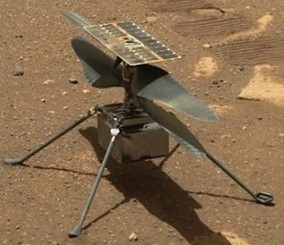
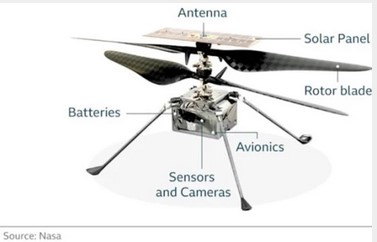
“Ginny” Ginny (known more formally as Ingenuity) is a brave little helicopter. She may look like a nasty bug instead of something you’d want to cuddle with, but she’s quietly been filling up the record books with her remarkable achievements. Four years ago Ginny hitched a ride to Mars on the belly of NASA rover “Perseverance”. A few months after Percy plunked down on Mars, Ginny took her “first steps”. She spun her rotor blade into a blur, rose ten feet above the Martian soil, took a quick look around, and dropped right back to where she started. That brief maneuver earned her the title: “first powered, controlled, extraterrestrial flight by any aircraft”.
[Note: You can read about Ginny’s first flight in the post Whirlybird Wonder]
Ginny may not be easy on the eyes but I’m in awe of what she accomplished in her brief time on Earth (er, Mars). I should’ve paid better attention in science class. Imagine the teacher saying, “Okay Dave, here’s your assignment. I need you to design a mini-copter that can travel to Mars, perform a few lighter-than-air maneuvers, and be able to take a few photos at the same time. You’ll be at the controls back here on earth, so whatever communication mechanism you come up with needs to work over, uh, 140 million miles.” Cue my blank stare.
 The smarter-than-I-am people at California’s Jet Propulsion Labs (JPL) designed little Ginny to do all those things. What makes her ten-foot hop on Mars so remarkable is this: the atmosphere up there is less than 1% as dense as Earth’s, so there very little to hold Ginny aloft. To put it another way, earthly helicopters can only fly to 25,000 feet. Ginny had to be designed to fly to 80,000.
Let’s call her “The Little Copter That Could”, shall we? Ginny was supposed to fly five times in thirty days. Five little hops in a month’s time and her mission would’ve been considered an unqualified success. But Ginny chose to be an explorer instead of an experiment. She flew seventy-two individual missions, further and longer each time than her JPL designers ever expected. She also captured images as she flew, so scientists could better decide where on Mars they wanted big-brother Percy to rove.

Ginny’s a good photographer! Ginny was more “alive” than any helicopter I’ve ever known. She cleaned herself up after nasty Martian dust storms. Her solar panels froze unexpectedly during the rough winters, rendering her unable to fly or even take commands, yet she still radioed “wellness reports” to Percy so the JPL people would know she was (barely) there. She made three emergency landings when her sensors detected trouble. And even when one of those sensors went dead, Ginny kept her rotors a-whirling on demand.

Ginny captured the shadow of her “broken wing” Whatever happened on Ginny’s Flight #72 two weeks ago remains a mystery, one Percy hopes to figure out as he rovers back to her location. Ginny had been close to another landing when she suddenly stopped communicating. A day later the JPL team reestablished the connection to find Ginny resting comfortably on the Martian soil. Somehow she’d still landed on her feet. Somehow however, she also damaged a rotor blade. Ginny can’t repair herself so alas, her flying days are over. Now her waiting days begin.
 Admirers like me refer to Ginny as “that little extraterrestrial trailblazer”. Haters call the dormant helicopter “the first piece of trash on Mars”. As long as Percy’s in her neighborhood, Ginny will keep sending her little wellness reports (even though she’s really not so well). I just hope the scientists at JPL are already hard at work on their next mission to Mars. A brave little copter is waiting to be rescued and brought home to the Smithsonian.
Some content sourced from the CNN article, “After damaging a rotor blade, NASA’s Ingenuity helicopter mission ends on Mars”, and Wikipedia, “the free encyclopedia”.
-
Renaissance Man
In the second movement of Antonin Dvořák’s New World Symphony, the orchestra settles down as the English horn begins its soft, wailing solo. You’ve heard this famous lullaby in one version or another, but never more powerfully than in the “Largo” movement of Dvořák’s symphony, with the strings and woodwinds providing the sweeping background (~45 seconds into the following video). It’s one of my favorite classical pieces, and my performance is flawless every time I play it. Play it in my head, that is.
I’ve developed a satisfying habit over the years which you might share (or at least, be willing to try). Think about something that interests you, or an activity in which you like to participate. Over time you’ve developed a fair understanding of your subject, though your level of knowledge and skill would never qualify you as a professional. But what if it did? What if you suddenly had the smarts or the talent to find yourself among the world’s best? Wouldn’t your life be wildly different?
 My years of piano lessons never propelled me anywhere close to the ranks of “professional” or “best”. I never even advanced beyond the piano’s foundation to pursue an instrument like the English horn. To do so would’ve meant a wholly different direction in life. More practice and lessons instead of time spent with friends or years in the Boy Scouts. A different college or at least a different degree. Competitions. Travel.
 Music eventually gave way to an interest in sports and soon I found myself on the basketball court more than in front of the piano keyboard. I’d practice endlessly at our backyard hoop, imagining myself making game-winning shot after shot. I did play a couple of years of JV ball in high school and went to college games at nearby UCLA. But my skills never developed to the varsity-, let alone college-level. Was I infatuated with basketball at the time? Yes, but I also knew early on I’d never be one of the greats.
 You’re starting to see a pattern here and it continued in college. I studied architecture (“I’ll be the next Frank Lloyd Wright!”) but only spent the first few years of my career in the field. I had a good run with info technology companies (“Bill Gates!”) but never developed the level of expertise to be labeled a “techy”. I write these weekly blog posts (“John Grisham!”) but have no plans for the next Great American Novel.
Here’s my point, and maybe you never saw it coming. I find all of this dabbling and dreaming incredibly satisfying. My interest in a subject or activity wanes well before it becomes an obsession, and then I simply move on to the next thing vying for my attention. Why do I behave this way? Two reasons. First, I prefer to be a jack of all trades (or a master of none, if you will), not a virtuoso. Second, more importantly, I am far too content with my life as it is to ever be tempted by the sacrifices necessary for the pursuit of singular success.

Michelangelo’s “David” 🙂 There’s a complimentary phrase for people like me: Renaissance Men. We hearken back to the great thinkers and artists who came along just after the Middle Ages; Leonardo da Vinci and Michelangelo, for example, with “unquenchable curiosity” and “feverishly inventive imaginations”. Mind you, I can’t paint like da Vinci or sculpt like Michelangelo, but my curiosity and imagination may run just as rampant. The modern Renaissance Man, in a nutshell, has “broad interests” and “superficial talents”. Me to a tee.

Playing in my head The next time I hear Dvořák’s “New World Symphony”, I’ll think about playing the English horn. Maybe I’ll sign up for lessons and eventually get good enough to play the “Largo” movement. Maybe then I’ll join the local orchestra so I get the chance to perform in front of a live audience! Yeah… probably not. Long before my much-anticipated stage debut, some other activity will vie for my attention and off I’ll go.
Some content sourced from Wikipedia, “the free encyclopedia”.
-
Celestial Silver Dollar
I walk the dog late at night, just to be sure he doesn’t nudge me awake in the wee hours of the morning. The walk can be a chore when I’m tired but most nights it’s a quiet, peaceful stroll through our pitch-black horse pastures. We’re usually blessed with clear skies here in South Carolina, which means the stars and planets put on a display worthy of a paid ticket to an observatory. Regardless, the moment I’m out the door I’m in search of my other faithful companion: the moon.
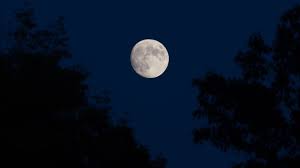
Through the trees The “heavens” offer a plethora of topics to blog about (which I have: Saturn in Of Rings and Romans or Starlink satellites in Celestial Strings of Pearls, for example) but I’m overdue with a few words about the moon. Our nearest galactic neighbor is a constant wonder to me. The moon (or is it “The Moon”?) is the reason we have ocean tides here on Earth and solar eclipses far, far away. The moon has been the target of some of the most impressive space technology and exploration in history. But let’s put the science aside, shall we? Today I’d rather just muse about the moon as its sits in the night sky, like a shiny silver dollar laid out on top of a black velvet cloth.
My favorite moons are full – the perfectly round ones – but the shadowed partials can be just as beautiful. Depending on the season and the atmosphere, the moon takes on countless looks. Some nights it rises giant above the trees, as if invisible binoculars rest before my eyes. Other nights the moon sits as an elegant crescent, a perfectly white slice of melon. Still other nights the moon doesn’t rise at all, or at least, not until well after I’m in bed. It’s a guessing game every time the dog and I head out into the dark.
I also make a game of trying to guess when the moon is full just by looking at it. On the nights just before or after it occurs the moon can still appear as full. So you have to look very carefully at the edges to decide if it’s perfectly round or not. Conveniently, the moon is full about once a month, or at least, once every month in 2024. Next year or the year after, perhaps we’ll get a “blue”: that second full moon in a calendar month. Doesn’t happen very often, of course.
Here’s a fascinating fact about the moon. It’s locked into place by the earth’s gravity, meaning it’s always showing you the same face. Try to picture the earth taking a trip around the sun (once a year or so), while it’s spinning on its own axis (once a day), while the moon is spinning around the earth. Technically the moon is rotating, just not on its own axis. So you never get to see “the dark side”.
Here’s another fact that makes me pause. If you drive across the United States from coast to coast and back again, you’re driving about 6,000 miles. Do that same drive thirty times and you’ve driven to the moon. Suddenly our celestial silver dollar doesn’t seem so far away, does it?
The next full moon (from my perspective), nicknamed “The Wolf”, is a week from this posting, on Thursday, January 25th. It’ll be the first full one of the new year. Good timing really, because some of you readers don’t make it to my blog until several days after the fact. If you’re exactly a week late, walk outside tonight after dark. A spectacular scene in the heavens awaits.
Some content sourced from Wikipedia, “the free encyclopedia”.








About Me
The sky is not completely dark at night. Were the sky absolutely dark, one would not be able to see the silhouette of an object against the sky.
Follow Me On
Subscribe To My Newsletter
Subscribe for new travel stories and exclusive content.
 Life In A Word