Sphere Delight

My wife’s sister and her husband just wrapped up a visit here in South Carolina. On the drive down from Colorado they made several sightseeing detours, but the trip back was pedal-to-the-metal… with the exception of one stop: the Moon Marble Company in Bonner Springs, Kansas. Moon Marbles stocks beautiful handmade wooden games and toys but c’mon, who braves the barren wastelands of Kansas for those? Marbles on the other hand, would draw me in like a bee to nectar.

A marble is the perfect example of a sphere, isn’t it?  I love spheres (including the word itself; much more elegant than “ball” or “orb”).  Take a semicircle, revolve it a full loop around its diameter and voila! – a sphere.  Calculating the volume of a sphere involves cubing its radius but let’s stop right there with the math lesson.  Cubes and spheres just don’t belong in the same conversation.

Lemons can be oblate spheroids

Most of you readers are tuned in from the Northern Hemisphere, the half of our planet above the Equator.  I find it cool to think of Earth as a sphere (with “big blue marble” a close second).  It’s the biggest sphere we humans know (or have you been to Jupiter?)  At your next party, wow your friends by telling them Earth is actually an oblate spheroid: flattened at both poles and bulging at the Equator.  Ewwwww.  Not a very pretty sphere, now is it?

Here’s the paragraph where I cop out and simply list a bunch of spheres, like oranges, Christmas ornaments, eyeballs, pearls, and the moon, but that’s just so three-hundred-blog-posts ago.  Spheres can be much cooler.  For instance, picture an atom (I’ll pause for those who need a microscope).  An atom is a spherical cluster of neutrons and protons (which are also spheres) encircled by whizzing electrons (more spheres).  Did you know your body is made up of over 7 octillion atoms?  That’s a lot of spheres.  You might want to lose a little weight.

Glinda traveled to Oz in a sphere (photo courtesy of MGM)

Soap bubbles are spheres.  Sure, you aim to create those giant wibbly-wobbly monsters but for the most part you generate a cloud of perfectly spherical transparent globes, born on a whisper of air and extinguished seconds later.  I’m guessing soap bubbles have the shortest lifespans of all spheres.

When a college buddy visited several years ago, he brought a paperweight made by an artist near his hometown in New Jersey.  It’s a glass sphere with just the slightest bit of the bottom lopped off so it doesn’t roll off my desk.  I’ve picked up a lot of tchochkes over the years but I’m not letting this one go.  Did I mention spheres are cool?

Three years before he wrote Jurassic Park, Michael Crichton authored a novel called Sphere.  It’s about a group of scientists exploring a giant spacecraft sunk to the bottom of the Pacific Ocean.  In the spacecraft’s cargo hold: a mysterious sphere, determined to be extraterrestrial and literally mind-blowing.  Mark my words; spheres can be as terrifying as dinosaurs.  Read it.
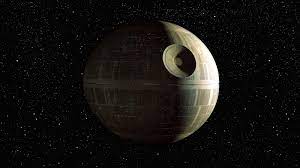
Dimples can be cute.  Not this one.

Star Wars focused on a giant spherical colony – the Empire’s “Death Star” – but the air went out of my perfectly round balloon as soon as I saw the giant divot on its side, not to mention all those channels and openings pierced by the X-wing starfighters.  In other words, the Death Star was a decidedly less-than-perfect orb.  So I applauded alongside everybody else when Luke Skywalker blew this sphere to kingdom come.

Here’s a place you wouldn’t expect to find a sphere: a Christian hymn.  In the first verse of This Is My Father’s World we have, “All nature sings and round me rings, the music of the spheres”.  The plural throws me off, because more than one sphere suggests more than just Earth (the entire solar system?)  Or maybe we aren’t singing about the planets at all.  A quote from August Rush seems relevant; the final line in the movie: “The music is all around us… all you have to do, is listen.”

Coming soon to Sin City

We’re starting to go round and round here (heh) so let’s conclude with the world’s largest sphere.  The Guinness Book writers will deem it so once the “MSG Sphere” opens in Las Vegas in a few months.  At 300 feet tall and 500 feet wide, the Sphere will dramatically change a skyline that’s already pretty dramatic, especially with 1.2 million LEDs on its surface generating all sorts of images and animation.  For concerts, sports, and the like, the Sphere can seat up to 18,000 spectators.  I plan to be one of them…  just as soon as I make it to Moon Marbles in Kansas.

Some content sourced from the CNN Travel article, “This futuristic entertainment venue is the world’s largest spherical structure”, and Wikipedia, “the free encyclopedia”.

Oliver Twist

Because of the numbering system I use to save photos for my blog, I know last week’s dish on ice cream (ha) was my four-hundredth WordPress post. I’m not one to track statistics but unexpectedly, reaching this milestone begs the question: Will I make it to #500? Mind you, it’s not about staying in the game. Topics worth my exploration are endless and creative writing is a welcome escape. No, today begs a much more relevant question: What about artificial intelligence (AI)?

If I could meet you readers face-to-face in the Amazon rain forest I’d whisper a secret password for all to hear.  Then when I use that password in a post, you’d know it’s actually me, Dave, the human, and not some updated version of HAL 9000 doing the typing.  Surely you wonder, as I do, when will AI get so good at authoring documents, so genuine, you won’t even realize you’re reading something untouched by human hands?

“Hello, Dave.”

Before we go any further, I think “AI” sounds awfully impersonal.  I suppose impersonal is appropriate for a silicone wafer and a pile of circuit boards.  I just think we need a friendlier word for it; something we humans can better identify with.  How about “Oliver”?  Oliver is the third most popular boy name of 2023.  Oliver Twist was one of Charles Dickens’ most beloved characters (and AI will certainly be a twist on the way we ask for and receive information moving forward).  Let’s nickname it (him?) Ollie.

Wikipedia’s article on artificial intelligence (yes, there’s already an article) says one of Ollie’s primary goals is problem-solving.  Okay, that digests well.  But then you see goals like reasoning, learning, perception, and social intelligence and your stomach flips a flop.  My reasoning and perception are tools I use for this blog.  If Ollie develops those same tools, it’s only a matter of time before Dave 1.0 (me) is replaced by Dave 2.0 (machine).

Let’s go back to ice cream for a second.  Let’s say you want to read an opinion piece on ice cream.  If you have AI at your disposal, you could say, “Hey Ollie, write me a post about ice cream, 600 words or so, with arguments in favor of plain old ice cream over sundaes, bars, and other frozen treats.  Reference a few commercial ice cream brands, a few local brands, and finish by talking about the most expensive ice cream in the world.  Oh, and speak the page back to me in James Earl Jones’s voice.”  Then you’d hit the ENTER button and who knows?  Your screen might light up with something remarkably similar to my last post in Life In A Word.

Also consider, Ollie will have his own opinions on what you read.  After you ask about ice cream, he may spam you with posts on healthy lifestyle.  He also may counsel you about spending your time on more important topics.  Like world peace.  Newsflash, Ollie.  We’re all trying to figure out world peace.  How about you put your circuit boards together and come up with a post on that?

Here’s my point.  If you have Ollie you don’t need me.  In fact, you don’t even need the WordPress platform.  You could simply slip on a VR headset and ask for a post with just the right topic, tone, reading level, length, and restrictions. It’s like placing an order at the drive-thru of a fast food restaurant.  Seconds later, what you asked for is right there in front of you (no paper bag necessary).  And if Ollie “reads” all four hundred of my posts, he’ll write it pretty much the same way I would. 

At the rate I’m posting, I’ll publish blog #500 in about two years.  Two years.  Considering all we’ve covered today, how advanced will Ollie be in two years?  Enough to put WordPress out of business?  Enough to where you can generate your own Life In A Word posts by simply entering a handful of carefully chosen criteria?  I hope not.  I’m having a good time with you people (especially those of you who also write blogs).  Maybe all of us should pick up and move to the rain forest.  Then we could pass our handwritten pages around and keep this artificial intelligent party going.  Someone make sure Ollie doesn’t get an invite.

Some content sourced from Wikipedia, “the free encyclopedia”.

Power of the Purse

On a daylong trip to the shopping mall last week, my wife excused herself from my daughter and me and disappeared into a Kate Spade boutique. Forty-five minutes later she emerged with a purse, proudly declaring her new tote to be “discounted on top of the sale price”. As I’ve learned over many years of marriage, buying a new purse is a big deal for women, akin to slipping into the leather seat of a new sedan. After all, her purse is in hand almost as much as her smartphone.

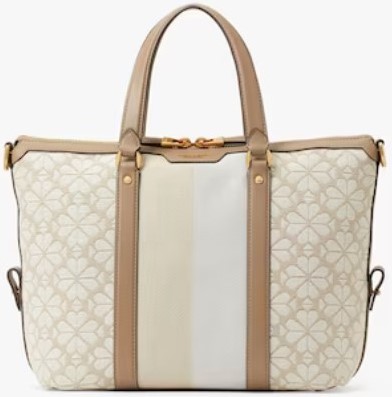
The Kate Spade “Flower Jacquard Stripe Faye Medium Satchel”

If you’re a guy, don’t ever, EVER make the following statement about a purse: It’s just a bag.  When I was a young and naive husband, it took me several bags – er, purses – to realize a) a new one will always be on the near horizon, and b) a purse contains the very essence of a woman’s life.   There’s a lot in there and a lot going on in there – stuff we guys are better off not knowing about. Kind of like the women’s restroom.

In our defense, we guys can only relate from the perspective of the pedestrian wallet.  Our “purse” is a whole lot smaller, stored out of sight versus over the shoulder, and designed to hold a minimum of essentials.  In these terms, wallets and purses could be considered polar opposites.  Not to suggest bigger is better, mind you.

My style of “purse”

My wife’s purse has countless zips, snaps, buttons, and hidden compartments, each of which she designates for specific items.  She’ll go “here” for a pen, “over here” for some loose change, “out here” for the car keys, and “right here” for lip balm.  And I’m not even talking about the main space.  When you open the main pocket of a purse, it’s a dark, cavernous void suggesting a passageway to another world.  I don’t venture in there very often – usually just to help myself to a little of my wife’s “cash stash”- and then I always get caught.  No… no… not red-handed but rather after the fact, because I don’t put things back exactly as I found them.  My wife knows precisely how her purse is laid out, so I can never deny her accusation of, “HEY!!! Have you been in here?”

Every now and then my wife goes fishing for a something in her purse and can’t find that something.  This process is a joy to behold from the safe distance of the kitchen table.  She knows whatever she’s looking for is in there somewhere; it just won’t surface.  So she fishes and fishes to no avail.  Sometimes she’ll resort to pulling out half of her stuff just to see what’s underneath.  Other times her hand goes in so deep, half her arm disappears.  With this in mind, I should know better than to go into my wife’s purse.  I mean, there could be a wild animal in there!

When my wife moves into a new purse, it’s another process worth my witness.  Everything comes out of the old bag (darn it all, Dave… PURSE!) and piles up on the counter.  Then almost everything goes back into the new one (in exactly the same places).  What’s left behind on the counter could fill the shelves of a curiosity shop. Ancient starlight mints. Expired gift cards. Pens from businesses we’ll never use. Faded receipts. And photos so old, you can’t help but say about the person, “Man, didn’t they look great back then?”

A wallet is a wallet, but a “purse” – in more technical terms – is a shoulder, satchel, sling, quilted, clutch, minaudiere, hobo, wristlet, beach, or even, yes, “wallet”.  I’m sure the list goes on from there.  As for size, my wife’s satchel preference probably rates an “M” on a purse scale of XS/S/M/L/XL.  Too big to hold in the hand but too small to double as a changing room.  She’s tried a few times go bigger or smaller but inevitably returns to “just right”.  Goldilocks would’ve approved.

Little “Louis Vuitton”
Look closely…

My wife’s birthday is this Sunday.  If you read last week’s post you know I hinted at a rather expensive gift for her.  Instead, I think I’ve found something a little more affordable.  A purse, of course (don’t tell!)  It’s a yellowish-green Louis Vuitton, in the style of a handbag, with the bold pattern of the designer’s signature initials.  Gorgeous.  Admittedly, I have two concerns.  One, the bag (PURSE!) runs $69,000 USD.  Two, it measures 0.03″ wide, or barely visible to the human eye.  Yep, we’re talking an XXXXXXXXXXS from a 3D printer here, with it’s size described as “grain of salt” or “eye of needle”. It’s almost worth the cost just to see my wife try to move into it.

Some content sourced from the CNN Style article, “Handbag ‘smaller than a grain of salt’ sells for $63,000”.

Boundaries

My wife and I took a “triangle trip” last week to see her family and then our son, flying from Augusta (GA) to Denver to Dallas, before returning to Augusta again. There’s nothing round-trip about an itinerary like that; just three one-way flights in a row. Like any other frolic in the friendly skies however, the journey served up easy fodder for a blog post. Hectic airports? Uncomfortable turbulence? Delayed flights? Yes, yes, and yes.  But for today’s post, step up to the podium my fellow passengers, for it is you who have earned my writing wrath.

We’re in familiar territory here.  I’ve written about my flying annoyances in Sitting in the Catbird Seat and First Class is now un-American (among others). But those musings focused on airplane seats and airplane sections.  Today is about airplane occupants.  Some of them are making the national headlines for their ridiculous antics.  The others all seem to have ended up on my flights.  Allow me to introduce my new “friends”.

Which one is the child?

On the flight from Augusta to Denver, a family of three filed into the row directly in front of us; wife on the aisle, young child in the middle, husband on the window.  As they settled into their seats, the kiddo started rapid-firing questions:  Dad, when are we going to take off?  Mom, where do I put my jacket?  Dad, I can’t get my seat belt on!  Do we get snacks? Dad? Hey, DAD!!!

Kids are loud.  I remember my first flight too, and the drive-you-crazy curiosity of a six year old.  But I certainly didn’t expect the parents to answer in baby talk.  Oh Stevie, the biggy wiggy pilot way up in the fwont of the plane decides when we get to fly up, up, up in the sky!  Maybe if you’re a weely weely good boy he’ll give you a wittle pair of wings to put on your backpack!

Or how about… Now Stevie, yelling at Mr. Seat Belt isn’t very nice. Look, there’s a wittle buckle and a wittle other end!  Let’s make it a game!  See if you can snap those bad boys together!

This is why I never leave home without noise-cancelling headphones.

“Hola!”

On the flight from Denver to Dallas, we had our choice of “uncomfortable”.  First, we trudged to the back of the plane, in front of and back of a large group of men who a) chose to be loud and laughy, and b) chose to speak across the aisle/rows in Spanish (even though the smattering of English made it clear they were fluent in both).  At first I thought my nearby amigos were just being a little obnoxious.  But the longer they kept it up, the more I thought I probably ought to know what they’re saying just in case…

This is why I never leave home without Google Translate.

Also on Denver to Dallas, a small child several rows forward spent the whole flight wailing I want Mommy!  I want Mommy!  I want Mommy!  We were too far behind to see or hear what her traveling companion was doing (if anything) to make her feel better, but eventually some kind of alarm went off in my head.  What if this child was being abducted?  After all we were heading to Dallas, which could be considered a gateway to the world for that sort of thing.  I alerted the flight attendant, who assured me everything was okay.  And it was.  Turns out the child belonged to one very overwhelmed father, solo-parenting (or not) a total of three kids.

This is why I never leave home without my wife.

I haven’t even mentioned the usual annoyance.  Since my wife prefers the window seat I graciously accept the middle.  So why is it my neighbor in the aisle seat always takes the armrest?  Doesn’t he or she realize I’m squeezed between two bodies?  Over the last two decades the average airline seat width has shrunk from 18.5″ to 17″.  If the passenger on either side of the middle takes the armrests that means I’m reduced to 15″, while each of them gets 18″.

This is why I never leave home without my elbows.

If you ever fly with me, I’m the guy with his head down reading his Kindle.  I’ll be polite and, for the most part, leave you alone.  But don’t be fooled.  I’ll only have one eye on my e-reader.  The other – and both ears – will be tuned into whatever you’re up to in your seat.  Please respect your boundaries.

Seaweed Sarge

With the U.S. Memorial Day holiday in the rear view mirror, the 2023 summer season is officially upon us. According to surveys from American Express Travel, sun-and-fun seekers prefer New York City, Las Vegas, and Los Angeles this year. Las Vegas raises an eyebrow (after all, summer in Sin City is broiler-setting hot) but notice something else: Florida didn’t make the top three. Maybe – no, probably – it’s because Seaweed Sarge is already wreaking havoc on the Sunshine State’s beaches.

Miami Beach

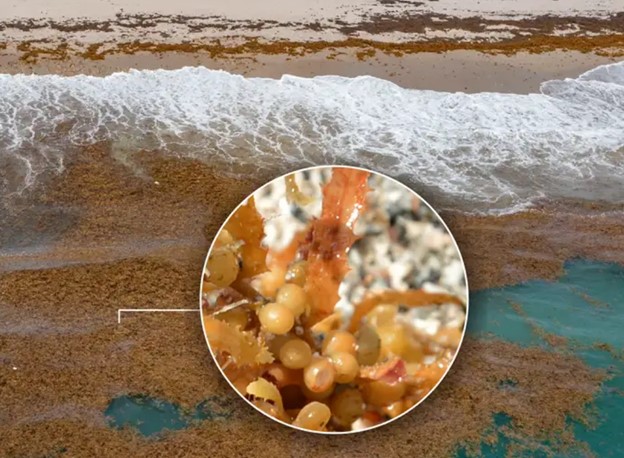
If you don’t know Seaweed Sarge, it’s because 1) you deliberately avoid the news these days – an increasingly popular trend – or 2) like me, you need a more creative label for sargassum, because it’s a weird name for the seaweed intent on taking over the world.  Sarge is a little intimidating, if only for his size.  Picture him as a belt of algae 5,000 miles long (I can’t picture anything 5,000 miles long, can you?)  Now consider: Sarge will double in size by July, the peak of his “bloom season”.

Sargassum

Sargassum is a particularly annoying form of seaweed.  It’s rootless, which means it can reproduce while simply floating around on the ocean’s surface.  Its rapid growth is bolstered by nutrients leached into rivers and oceans from land-based agriculture.  Once it makes shore sargassum rots immediately, releasing irritating hydrogen sulfide and the stench of rotten eggs.  And trying to remove countless tons of seaweed begs the question: where the heck do you put it all?

Florida’s gonna have to figure out the answer to that last question, and fast.  Sarge is already littering beaches from Ft. Lauderdale to Key West and we’re just getting started.  Come July and August it’ll be virtually impossible to walk along the shoreline.

Ft. Lauderdale

My own visits to the beach have been blissfully Sarge-free.  Most of my sun-and-fun takes place in San Diego, far from Sarge’s primary Atlantic Ocean residence.  The only real nuisances on San Diego beaches are the occasional jellyfish or stingray, and a once-in-a-blue-moon shark sighting (which stirs up more anxiety than actual sightings).  Admittedly, Sarge washes ashore in San Diego as well, but mostly just here and there as a remnant of off-shore harvesting.  Seaweed does have its upsides, in foods, medicines, and fertilizers.

Ironically, I have fond memories of Sarge as a kid.  He’s built with giant flappy leaves reminiscent of a mermaid’s fishtail.  He’s got countless air sacs to keep him afloat, which make a popping sound as satisfying as squeezing bubble wrap.  If I’d thought to take pictures back in the day, I could show you Sarge as an adornment to many a childhood sand castle.

It’s time for robots

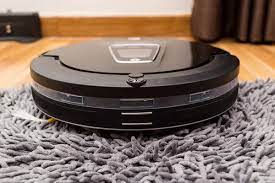
An army of beach tractors could work all summer in South Florida and barely make a dent in Sarge.  The seasonal maintenance of the single half-mile beach in Key West alone is in the millions of dollars.  But a better solution may be in play.  A prototype robot has been designed to do battle at sea.  “AlgaRay” cruises slowly through the water, hooking tons of Sarge’s strands in a single pass.  Once at capacity, AlgaRay drags Sarge underwater to a depth where all of those air sacs explode.  No longer buoyant, Sarge sinks to the ocean floor; a “watery grave” if you will.  AlgaRay has been likened to a weed-eating Pac-Man or a vacuuming Roomba.  Either image works for me.

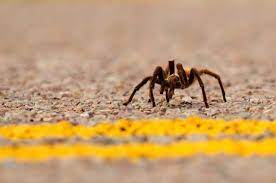
Let’s have one more look at those tourist surveys.  One in ten say they’d cancel or reschedule a trip to Florida if they knew Sarge was coming ashore.  Maybe that explains why landlocked Las Vegas ranked #2 on this summer’s most popular U.S. destinations.  Not that Vegas doesn’t have its own threats.  Three years ago a swarm of locusts descended on the Strip, blotting out casino windows and streetlights.  An annual migration of tarantulas passes by in the surrounding desert.  So take your pick: hordes of flying/crawling bugs or a giant mass of inanimate algae.  Maybe Sarge isn’t so bad after all.

Some content sourced from the NPR.org article, “Giant blobs of seaweed are hitting Florida…”

Lifeless Buds

I have a Venus flytrap named Frankie. He lives alone in a plastic cup on the patio table, happy in the humid air as he nabs the occasional bug. My wife’s nearby garden is boasting fruit, vegetables, and colorful blooms but I’m content to just watch my little tabletop carnivore do his thing. I’ll get to why I named my bud “Frankie” in a minute but let me just say this: At least he’s a live little bud. That’s more than a lot of people can say about their more imaginary friends.

“Frankie”

Here’s a morsel of self-discovery for you, extracted from my several years of blog posts.  I have a habit of referring to inanimate objects with terms of endearment.  My most recent example: two weeks ago when I discovered the SpaceX satellites launching into outer space.  I referred to those technological marvels as “little guys who talk to one another”, and, “when their time is done they’ll return home for a proper burial”.  Whether this is just cheap entertainment or an effort to elicit empathy from you readers, I regularly inject life into the lifeless (or in this case, a soul into the metal and mechanical).

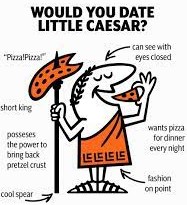
“Little Caesar”

I didn’t have to scroll back very far to find other examples.  My post a week before the satellites, Hail, Caesium, endeared of all things, a lost capsule of nuclear waste.  First, I nicknamed the capsule “Little Caesar”.  Then I re-nicknamed it “LC” and noted how detection equipment ultimately “…led the search team right to our little friend”.  Were you more relieved to know the waste had been contained or that our little lost friend had finally been found?

Pine cone “sororities”

Conifer Confetti, a post from last fall, lamented the hours I sacrifice to contain the untold number of pine cones on our property.  I referred to the cones as “females” (because biologically, they really are) and in one frustrated burst of endearment, said “It’s like having the world’s biggest sorority row above my backyard, and every house is about to disgorge its girls for a giant party on the ground”.  So which is it Dave, a whole lot of “yard waste” or thousands of “little ladies”?

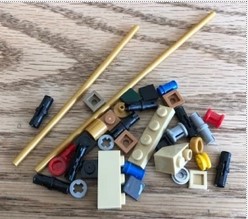
The “poor” leftover pieces from the LEGO Grand Piano

Finally, my series of posts on building the LEGO Grand Piano and LEGO Fallingwater were rife with terms of endearment.  All those plastic pieces were like little families bagged up in a single box; couples waiting to be married.  At times I thought I lost “one of the little guys”, and I felt sorry for the leftovers who’d never realize their destiny of being a part of the completed model.

“Cassini” (image courtesy of NASA/JPL)

This topic was inspired by an article in The Atlantic about the spacecraft Cassini.  Six years ago, Cassini completed a 13-year data-gathering cruise around Saturn and its moons.  Utterly alone and running out of fuel, Cassini turned towards the planet, eventually burning up in the atmosphere.  As NASA described the final moments, Cassini “fought to keep its antenna pointed at Earth as it transmitted its farewell”.  An entire room of scientists at Pasadena’s Jet Propulsion Laboratory fell into tears.  Cassini is the perfect example of – big word here  – anthropomorphism.  In simpler terms, the more “alive” a machine appears to be, the more empathetic the response from humans.  Some robots are deliberately anthropomorphic, a subtopic we just don’t have enough words for today.

As I watch Frankie ingest another insect, it’s time to reveal the genesis of his name.  Maybe you don’t remember Frankie Avalon in his prime but you do remember the 1970s movie Grease.  Avalon showed up in a memorable scene, descending a staircase dressed in white while singing “Beauty School Dropout” to Didi Conn’s “Frenchy”.  Guess what?  Avalon had an even bigger hit: Venus.  That song is a plea to the goddess of love to bring him romance; someone pretty and very much alive.  Okay, so my Frankie isn’t pretty, but at least he’s alive.  That’s more than I can say about all those other little buds who keep showing up in my blog posts.

Some content sourced from The Atlantic article, “How to Mourn a Space Robot”, and Wikipedia, “the free encyclopedia”.

Celestial Strings of Pearls

When I take the dog for a walk after dark, I never know what to expect in the night sky above me. We live in an area devoid of city lights so the celestial show is clear and sometimes dramatic. Ursa Major (aka Big Dipper) often makes an appearance. Venus is the brightest star planet low in the western sky at twilight. And the full moon, seemingly biggest as it rises just above the pine trees, can be breathtaking. But none of this prepared me for the bold processional streaking across the heavens last Thursday night.

It could’ve been Santa Claus and his reindeer for all I knew.  Sitting around a backyard fire pit with friends, having drinks and swapping stories, one of the women suddenly shrieked, “LOOK!!!” and pointed skyward.  At first it didn’t register what we were seeing (nor at second, nor at third).  I can only describe it as a tiny string of bright pearls, two or three dozen in the strand, perfectly spaced and moving silently across the sky.  Neither pulling nor pushing, they simply proceeded in a line as if drawn to some unknown destination.  It almost looked like the one-after-another cars of a roller coaster, heading up that first steep incline.

Our group was at a loss to explain this extraterrestrial.  We thought it might be the neatly arranged contrails of a stealth fighter.  Or some faraway electronic billboard advertising in Morse code (only with dots, no dashes).  Turns out we weren’t even close.  Our little alien spacecraft parade was the latest launch of Starlink satellites from SpaceX.

You’ve probably heard of SpaceX, even if you don’t know much about what they do.  Founded in 2002, SpaceX is one of Elon Musk’s ambitious companies, with the “modest” long-term goal of colonizing Mars.  While they design and launch the spacecraft to make that happen, SpaceX is providing Starlink Internet service to under-served areas of the globe by building a “constellation” of satellites around the planet.  42,000 of them.

This is technology way beyond my understanding, but here’s the basic setup.  A transmitter somewhere on earth sends the Internet up to one of those satellites and the satellite then rebounds the signal back to you.  If the satellite loses your direct line of sight, it can hand off the signal to one of its buddies and your Internet service continues uninterrupted.  SpaceX earned the license for a ten-year window – starting in 2019 – to complete its Starlink constellation.  At last count they’ve already got 4,000 of these little guys in orbit.

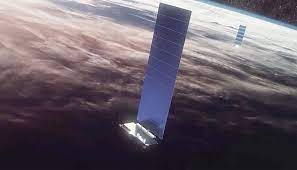
Starlink satellite

Credit Musk for identifying a market in need.  Mars may not be on my bucket list but faster Internet service certainly is.  Two years ago 10,000 Earthlings signed up for Starlink subscriptions (at $599 USD for the hardware and $120/month for the service). Today? Fully 1.5 million customers are bouncing data back and forth with all those satellites.  My rural location here in South Carolina (and the s-l-o-w speed of my current Internet provider) make me a prime Starlink candidate.  Later this year, I’ll also be able to switch over my cell phone service.  Yep, Elon Musk is literally taking over the planet.  Come to think of it, maybe the entire solar system.

A “string of pearls” before the satellites go their separate ways

Whether or not I subscribe to Starlink, I find the satellite technology fascinating.  We have a lot of “space junk” circling Earth but this constellation of man-made stars seems more elegant.  They’re launched in strings of up to 60, separating once they’re high enough. Each satellite’s thruster is powered by krypton and argon.  They talk to one another to avoid collisions.  They’re currently undergoing “dimming” to appease astronomers by taking a back seat to the real stars in space.  Finally, these satellites can “de-orbit”.  In other words, when they’re time is done (even satellites don’t live forever), they return home for a proper burial, which means burning up entirely as they attempt reentry through Earth’s atmosphere.

Starlink satellites x 42,000

Several websites track the continuing launches of Starlink satellite strings (like this one).  You can find out exactly when they’ll be passing overhead in your neighborhood, destined for their rightful place in the budding constellation.  If you see them stream by, remember, it’s not Santa and his reindeer (wrong month).  It’s a string of pearls designed to provide you with faster Internet service.

Some content sourced from Wikipedia, “the free encyclopedia”.

Hail, Caesium!

I acquired a taste for Caesar salad later in life. After decades of boring lettuce/tomato and franchise salad bars, I learned to branch out a little. Caesar, with its romaine, croutons, Parmesan, and distinctive dressing, has become my go-to at restaurants. But I always double-check my “hold the anchovies, please” because even a thimbleful would put a damper on things. Kind of like caesium-137.

Small but mighty

You probably don’t know much about caesium.  Pronounce it just like the salad (or like “seize” in Seize the day!).  Caesium-137 is a nasty little byproduct of nuclear fission, deadly enough to turn your life into a… uh, half-life with just a brief introduction.  So here’s the story of the little caesium capsule – a.k.a. Little Caesar – that could get away, and did.

It’s a simple enough task, really.  Transport an item from Point A to Point B, like the new washing machine we just had delivered from Home Depot.  But let’s make the job a little more challenging, shall we?  The distance you have to travel shall be almost 900 miles.  The journey itself shall be on the oft-barren Great Northern Highway of Western Australia, which isn’t always the smoothest of rides.  Finally, transport a potentially lethal substance… without dropping it.

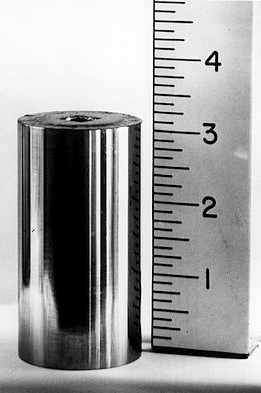
“Little Caesar” was t-i-n-y

You’d think radioactive caesium-137 – no matter how small an amount – would be literally welded into the delivery truck it rides in.  Instead, the pill-sized capsule – already parked inside the density gauge equipment it was a part of, was placed in a “package”, then attached to the truck with four mounting bolts.

Now then, imagine you’ve just completed the long and boring four-day drive to the nuclear waste treatment facility in Perth.  You hop off the truck, walk around to the back, open the doors, and discover not only a broken gauge and a missing mounting bolt, but no caesium-137 capsule.  In fact, the delivery truck wasn’t even inspected until nine days after arrival.

This scenario raises a half-life of questions for me.  First, just how bumpy was that Great Northern Highway?  Second, even if the gauge broke open and the capsule got loose, how the heck did it escape, not only out of the package but out of the entire truck?  Finally, we’re talking about lethal goods here.  Wouldn’t some sort of alarm go off if Little Caesar skipped town?  I’m guessing someone is answering these kinds of questions as we speak, and his/her seat is a little warm.

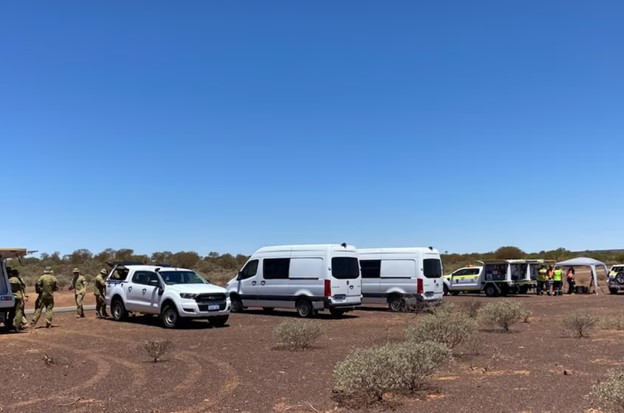
The fearless search committee

imagine being a member of the ad hoc search-and-rescue crew.  Not only are you looking for something that can kill you just by being in close proximity, it’s the proverbial needle in the haystack, only the needle is the size of a paper clip and the haystack is a highway longer than the coast of California.  No matter, you’re handed a radiation detection device, the keys to a truck with flashing hazard lights, and off you go.  Oh, and by the way, you can’t go faster than 30 mph or your detector can’t do its job.

This isn’t the first unintended release of Little Caesar.  He escaped in much larger quantities from the Chernobyl nuclear power plant in 1986 and from Japan’s Fukushima Daiichi plant in 2011.  You can read about nine other incidents involving “LC” here, including one in Seattle four years ago and one in Thailand in March.

At the time I saved this story in January, Little Caesar was still at large.  Worst-case scenarios were running rampant.  What if LC bounced to freedom on a populated area of the highway?  What if a hiker happened upon the capsule and threw it into his or her backpack before returning home?  Or, God forbid, what if a bird snatched the capsule in its beak and transported it to its nest in the middle of downtown Perth?

LC was hiding here

Three months later (this week), I caught up with this story.  The run-of-the-mill conclusion is that Little Caesar was found just six days after his escape, off the highway in a remote area not far from the truck’s point of departure.  The radiation detection equipment sounded the alarm and led the search team right to our little friend.

A close-up of the escapee

As for what happened once LC was found?  A 20-meter “hot zone” was set up around him to fend off the inevitable lookie-loos.  He was given a thick casing of lead in case he was feeling “radiant”.  Finally, Little Caesar was scheduled to be transported to the county health facility for further examination.  Yes, I said “transported”.  No word on whether or not he made it to his final destination.

Some content sourced from the ABC News article “Missing radioactive capsule found in WA outback after frantic search”, and Wikipedia, “the free encyclopedia”.

Games of the Travel Gods

Blondie is the trend-setting American rock band from the 1970’s. A blondie is also a rich vanilla dessert bar. But just for today, Blondie is the newspaper comic strip that, remarkably, still runs after 92 years. Blondie is the female lead and Dagwood is her food-loving husband. Which brings me to today’s topic. A Dagwood is a tall, multi-layered sandwich… the perfect image for my travel nightmare from last Friday.

It all started with a bridge.  Make that seventeen bridges.  As my wife and I were motoring mid-morning towards the Charlotte airport, en route to my niece’s wedding in Los Angeles, the Maps app colored the interstate yellow here and there.  No big deal; traffic slowed, then quickly started up again.  All of a sudden, middle of nowhere, we came to a complete stop.  Five minutes passed without movement.  Ten.  When I finally looked down at the Map app twenty minuets later, our section of the interstate was colored black.  Wait, black?  Never seen that color before.

My car is somewhere beyond the vanishing point

For future reference, Map app black means “not an option” (or better still, “you’re dead”).  Five miles of the upcoming interstate were closed off for nine days to repair all those bridges.  We didn’t “eye-spy” so much as a detour sign before we joined the monstrous backup.  When cars began leaking into the grass median and making U-turns, I sensed the presence of the travel gods, selecting a dawdling pawn for their vicious game.

Heading back the way we came, the first detour we encountered was the same idea as a hundred other drivers.  The off-ramp was backed up forever.  Instead, we continued miles further, finally exiting onto a two-lane highway to what can only be described as a drive through the backwoods of the back country of America’s uh… backside.  Tight little curvy roads sprouting driveways to nowhere, bars with bars on the windows, churches with desperate Easter pleas like “It’s not about the Bunny, it’s about the Lamb”, and one-stop-sign towns you really don’t want to stop in.  Eventually we emerged unscathed (physically, not mentally), flung back to a point on the interstate that wasn’t colored Map app black.

The travel clock ticks faster now.  When the travel gods remind you bags must be checked forty-five minutes before departure, beads of sweat start to pop.  The Dagwood sandwich gains another layer.

Our daughter (who I now refer to as “GPS Goddess”) expertly phone-guided us all the way into the Charlotte Airport hourly parking garage ($24 USD/day), where she offered a not-so-confident “you’ll make it” before hanging up.  And so we dashed, from one end of the garage to the other, down the elevator, across the lanes of buses and taxis, through the under-construction section of the terminal sidewalk, finally bursting through the sliding doors to the American Airlines self check-in kiosks to declare our victory.  Which was premature.

Just like the black of the Map app, I’ve never seen a self check-in kiosk dispense a piece of paper saying “See Counter Agent”.  Uh-oh.  Sure enough, we missed the deadline to check luggage.  Our bags were also too big to gate check or they would’ve pushed us through.  I thought we were done.

But at the ticket counter, I deflected phrases like “You can’t travel without your luggage, sir” or “We’re not finding any other flight options, sir” with “I have faith in you, American Airlines!” and “You can do this!”, and darned it they didn’t find an itinerary to get this “sir” (and his “ma’am”) to Los Angeles.  Through Boston.  Uh, sorry miss, isn’t Boston taking us in the wrong direction?  She told me not to argue.  Add another layer to the sandwich.

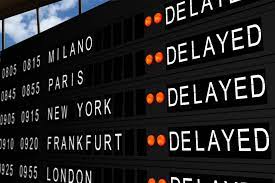
Cut to the Charlotte boarding gate.  Flight to Boston delayed.  Then again.  Then again.  In a phrase that sounds comical (just not at the time), the gate agent calmly informed passengers “the control tower can’t seem to locate our flight crew”.  But then they did, then we boarded, and suddenly we’re flying to Boston… knowing we have, oh, ten minutes to catch our connection once we land.

For the record, you can make a connecting flight in Boston in ten minutes.  You need five of those minutes to let the achingly slow passengers in front of you deplane.  You need the other five minutes to hustle down the concourse (ignoring the bathrooms that beckon for good reason), cursing the loudspeaker blasting your name with “Flight XXX to Los Angeles, this is your final call.  We’re about to close the doors”.

Which is exactly what the gate agents did, right behind us as we sprinted down the jetway, but not before shouting, “Don’t worry, your baggage has a much better chance of making the connection than you do!”  [Wrong.  Turns out only one of our bags made the flight.  The other would arrive (mercifully) the next morning, just in time to change into wrinkled formalwear before the wedding.]

Hoping I looked more like the guy on the left

On the Boston-Los Angeles flight, sitting in the very last row (where you meet/greet every single passenger headed to the bathroom) I let out a slow breath and assessed the good and bad of our whirlwind journey.  The good: we’d make the wedding after facing a dozen trip-blocks.  The bad: the Boston-LA flight ended up having to go wide-right over Canada to avoid some nasty weather in the Midwest.  Add an hour to an already long, seriously turbulent flight.  We could’ve headed the other direction and made it to Ireland in less time.

In total, the travel gods played their game for twenty-one hours, leaving us bleary-eyed by the time we walked into the wedding venue the next afternoon.  (Hey, at least they got married.  After all, the wedding was on April Fools’ Day.  A no-show at the altar would’ve been just another layer on the sandwich.)

Here’s a little Blondie trivia.  Dagwood was the heir to the Bumstead locomotive fortune, but when he married Blondie the deal was off.  I didn’t know that.  I only knew about his namesake – the tall, multi-layered sandwich.  Otherwise I might’ve thought to take the train to Los Angeles instead.

Some content sourced from Wikipedia, “the free encyclopedia”.
Advert Converts

Texting while driving has quickly become the norm, at least in U.S. states where it continues to be legal. Not a day goes by where I’m not witness to a slow or erratic driver, the annoying behavior the direct result of a smartphone. My car horn gets a regular punch, reminding drivers, “HEY… the light just turned green!” All of which makes the notion of billboards as a driving distraction almost obsolete.

Like most things, billboards had their young and innocent days.  They popped up on interstates and major thoroughfares almost as soon as cars themselves did; bright, colorful advertisements meant to plant seeds in driver brains for future purchases.  At last count there were over 350,000 billboards in America alone.

Unlike smartphones however, billboards earn nothing but a passing glance as you speed by.  Their images and words are simple by design so you “get the picture” in an instant.  A few scientific studies went to great lengths to prove billboards increased the potential for accidents. Others showed they really had no impact at all.  Whichever is true, billboards stubbornly continue a part of the urban landscape.

But no matter how I spin this topic, we’re just talking about a straightforward means of advertising.  What’s so interesting about that, you ask?  Well, let me tell you.

Consider the lifespan of a billboard.  The artwork is created on a smaller scale, reproduced to billboard size (previously by hand, now by computer), mounted up high on a roadside frame, and then allowed to distract drivers for months.  But eventually the billboard comes back down and you’re left with 700 square feet of heavy-duty used vinyl.  What now – off to the dump?

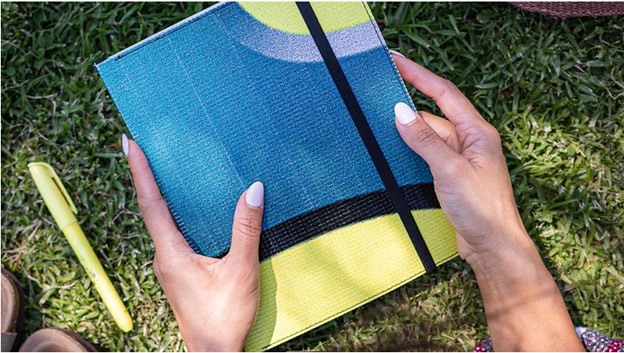
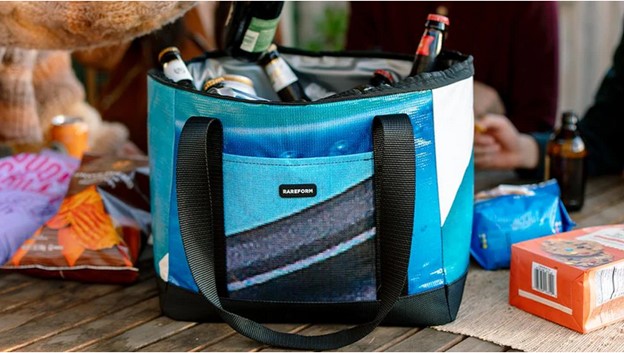
Not if you’re Rareform.  This company converts adverts into bags, totes, and duffles.  You can purchase anything from a travel surfboard bag to a soft-sided cooler, all fashioned from billboard vinyl.  You can even buy a cross-body bag for your laptop, with a cushy interior made of recycled water bottles.  Talk about “walking advertisements”, eh?

“Billboard” notebook

I really admire people who think outside of the box (because I find it so much more comfortable inside).  Rareform thinks outside of the board.  They brokered deals with advertising agencies for the used vinyl, hired cleaners, designers, sewers, and photographers to produce their one-of-a-kind products, and then created a website to bring it all to you.  As Rareform’s founders put it, “We’re in the business of change… and we believe billboards deserve a second chance.”  Considering they stock over 50,000 unique re-creations in their warehouse, I’d say they’re on to something.

A billboard can be a cooler if it wants to be

Billboards never really caught my eye until now.  Sure, I enjoy their creative advertising tactics, like using several billboards spread out over a mile or two, each one containing part of a message about a business you’ll find off the next off-ramp.  Or how about the ones like Chick-fil-A’s, with three-dimensional characters in front of the boards?  In 2010 in North Carolina, you could find a billboard of a giant, juicy steak with a big fork sticking out of it, emitting the scent of black pepper and charcoal.  Ready to grill?

Today’s billboards, of course, have gone digital.  You can pack a rotation of advertisements into the same space where there used to be one.  On broadcasts of Major League Baseball, you’ll see advertisements on the walls behind home plate as the camera shows the pitcher’s view of the batter.  Those advertisements aren’t really in the ballpark;  they’ve just been digitally applied back in the television studio.

Times Square is full of billboards

None of these billboard tricks impress me like the one Rareform conjured up.  I mean, what kind of brain looks at a billboard and goes “Hey, that could be a fashionable bag one day!”  Not my brain.  Rareform not only diverts tons of vinyl from landfills, it then puts it to practical re-use.  Makes me want to dumpster-dive my garbage can out back to see if I can come up with a trash rehash of my own.

Some content sourced from the Rareform website, and Wikipedia, “the free encyclopedia”.