A Pricey Drive down Memory Lane

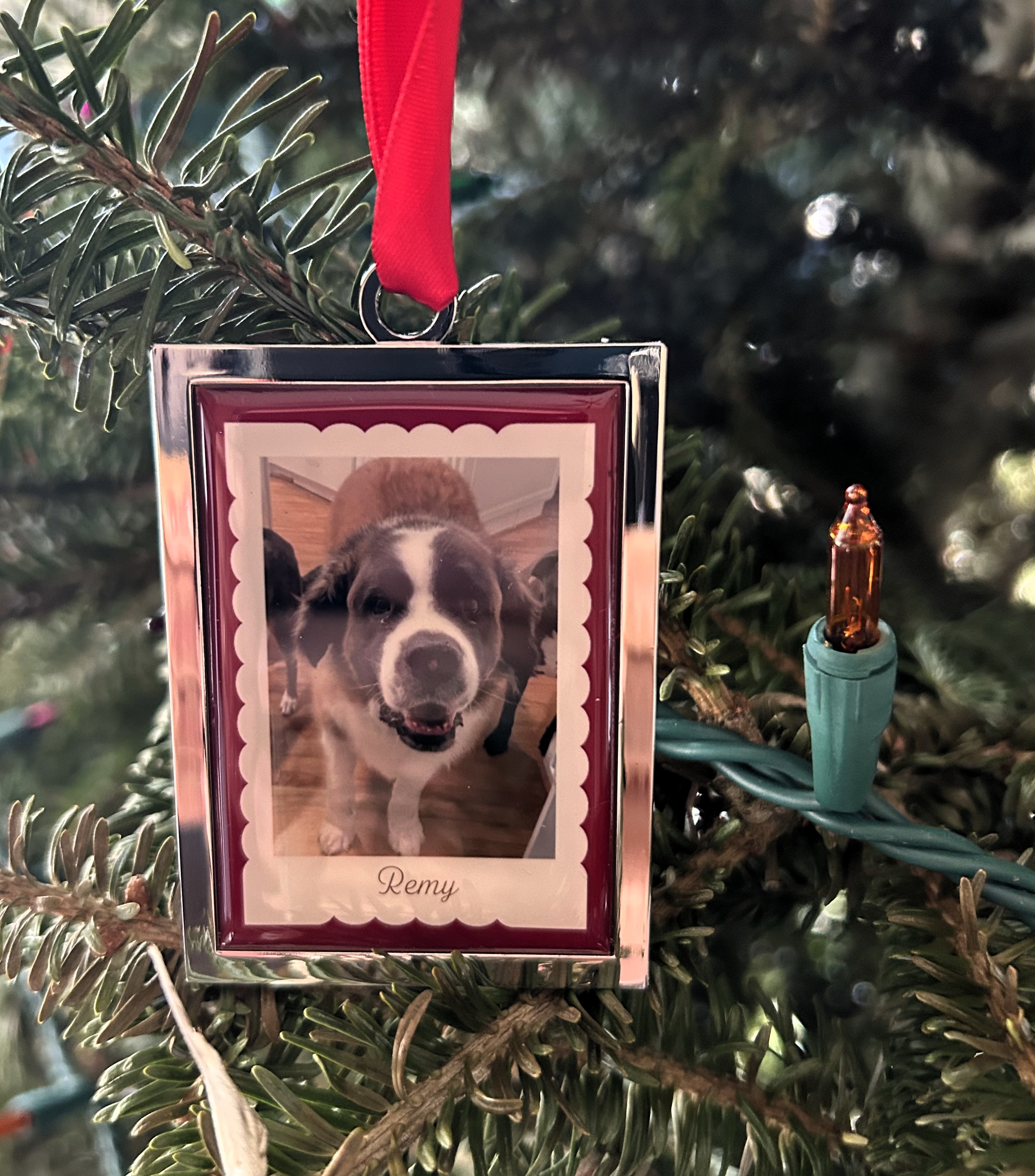
We sure love our pets, even long after they’ve moved on from this world. When we lost our Saint Bernard last September, after eleven memory-filled years together, we kept reminders of him around the house. Remy’s ashes now lie in a stately wood box up on the fireplace mantle. His leash still hangs by the back door, as if we’ll take him for another walk in the neighborhood. And the kids gifted us framed photos of our favorite moments with him. Having said all that, I never expected this under the Christmas tree…

No, this isn’t our Remy. Well, okay, it is Remy but not in the “fur” (so to speak). Instead it’s a remarkably accurate likeness based on digital photos… and it serves as a head cover for one of my golf clubs. The double-takes I get on the driving range are priceless. Those puzzled expressions from other golfers beg the question, Wait, where’s the rest of the dog?

If these doggy head covers really get popular, I’d love to see future versions get a little animated.  Along with the photos, send in an audio file of your dog’s bark.  Then design the mouth to open and close on cue.  Remy may have been a “gentle giant” but man he had a ferocious bark.  Talk about a great way to say don’t touch my clubs!

If I had any concerns about the money my wife spent on my Remy head cover, I’ve gained some perspective to make me feel better. Forget about golf clubs for a moment. Did you know you can now have your car customized as a memorial to your beloved pet?

“Golden Retriever brown”, anyone?

It’s safe to say I will never own a Rolls-Royce.  Even if I had the money for one I can easily come up with a dozen ways I’d rather spend that much dough.  But the car-as-your-dog thing is apropos for those who have way too much money in their paws.  Consider, you’re already spending upwards of $500K on the car itself so why not put another $100K into it for personalization?

Your dog in the details

The options for customizing your Rolls border on the ridiculous.  You can choose the paint color to match your dog’s coat.  You can have his image created in intricate wood veneer inlays between the seats.  His paw prints – authentic reproductions of course – can be used to dot the pinstripes (which is nowhere near subtle with a paw the size of a Saint Bernard’s).  And the possibilities with the leather seats are endless.

Candidly, when your world includes a Rolls-Royce the word “customization” really means anything you want.  You begin in the lobby of a design studio, which is an unmarked ultra-secure building in downtown Manhattan.  You’re escorted upstairs by an armed security guard.  You then sit down to a team of consultants to fine-tune every little canine detail.  Now walk away and let the Rolls-Royce crew create your personalized masterpiece.  Time and money are no object so neither is negotiated.  All that matters is having your dog in the details.  And if you’re so inclined, those details can include real gold in the paint job.

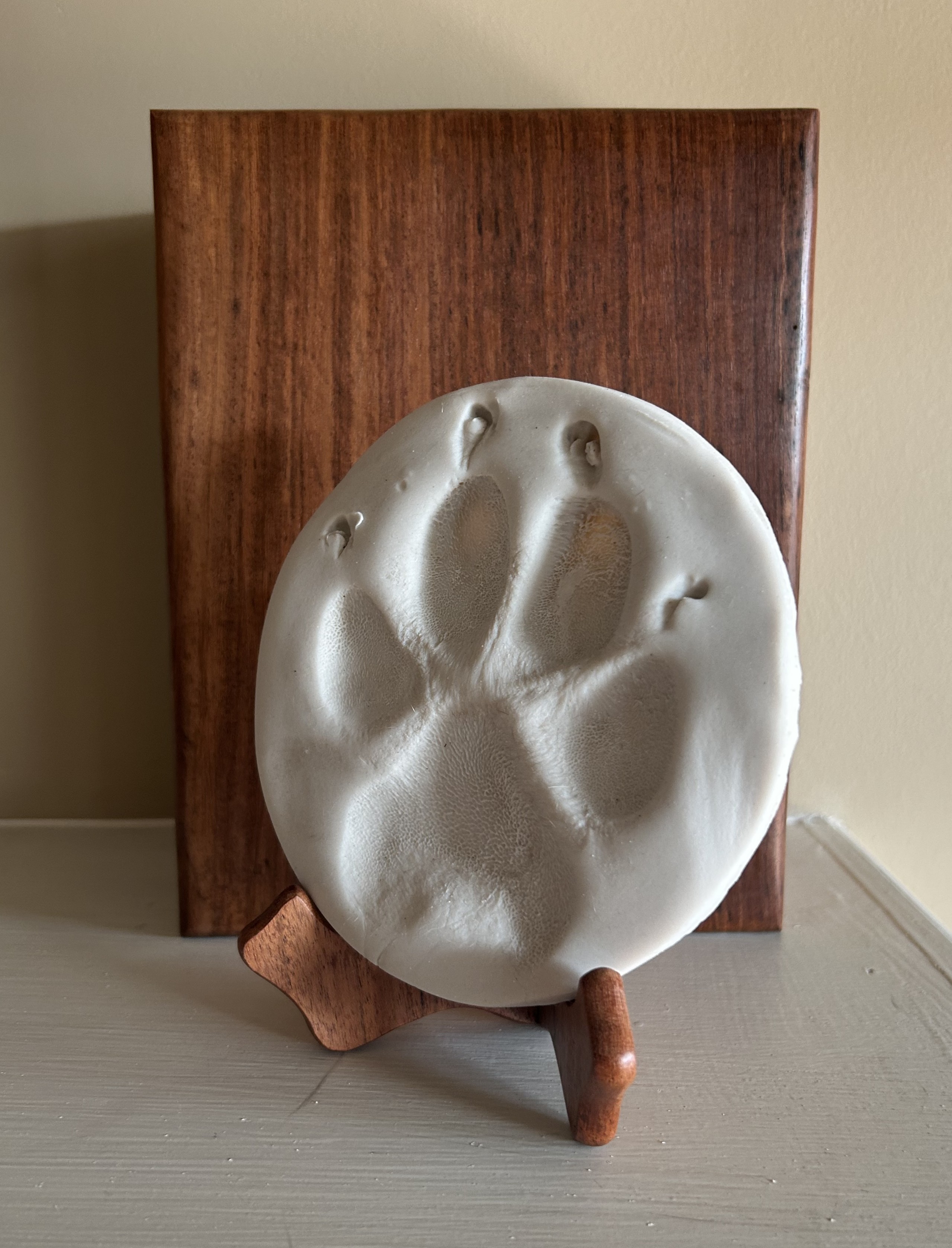
As much as this makes for a good blog topic, I’m no fan of excess.  If I’m spending six figures to embellish my vehicle with remembrances of my dog, I’ve lost all sense of fiscal responsibility.  No thank you.  I’ll limit my purchases to those little framed photo ornaments from Shutterfly or wood cuts like this one. 

One of these days my wife and I will take down the wooden box of ashes and put away the photos of our beloved Remy.  Even the golf club head cover is bound to deteriorate at some point.  When all that happens, I hope I can still picture our good ol’ boy in my mind.  Otherwise I might be telling myself, I should’ve bought a Rolls-Royce!

Some content sourced from the CNN Style article, “Want your Rolls Royce to match your pet Labrador?…”.
Fill ‘er Up

Several years ago at a banquet, I stood at the podium to introduce the evening’s guest speaker. After sharing some of her background and accomplishments, I went with the expected, “So without further ado, please welcome”…, and then I paused. And paused some more. I’d forgotten the speaker’s name. The silence, as the saying goes, was deafening. Eventually I found her name in my notes, but not without an uncomfortable gap in my speech. Perhaps a filler word would’ve smoothed things over.

Do you use filler words?  Actually, let’s make that question a statement.  You use filler words.  Every now and then in conversation you’ll throw in the occasional “uh”, “like”, or “so”.  Filler words do exactly what their label implies: they fill up the awkward gap of silence created by a pause.  Every one of us can recall an experience where we’ve left out filler words in a vain attempt to keep the polish on our speech, but it’s a no-win situation.  If you go with the pause your audience looks at each other with one of those Is he okay? glances.  If you go with a filler word you’re hinting you’re not completely on top of your material.

The parade of filler words is much longer than the commoners I mentioned above.  The filler “uh” comes from its own family, including “um”, “oh”, “er”, and “ah”; tiny signs of reluctance to say whatever comes next.  And speaking of next, how about “very”, “really”, and “highly”?  These three are fillers disguised as words of emphasis but are usually superfluous.  Then we have “You know…” and “You see…”, which seem to politely draw the listener into the conversation.  But sorry, they’re also fillers, allowing a pause at the start of a thought.  Finally (as if there’s an end to this parade), let’s add “I guess” and “I suppose”, both designed to soften a response when what you should go with instead is a confident “yes” or “no”.

I deliberately skipped one filler here because it deserves it’s own parade.  “Like” sprinted to the front and center of casual English in the last couple of generations, taking up a lot of the spaces “uh” and his pals used to fill.  Some people use “like” so often it starts to feel like every other word they’re saying.  But make no mistake – every “like” is simply a mini-pause to allow the speaker to reboot their thoughts.

Watch out, because filler words can be contagious.  I used to work for a company where it seemed every one of my teammates couldn’t start a sentence without the word “So”.  Somehow “so” sounds a little smoother than “uh” but it’s basically the same filler.  Before I knew it I caught myself also using “so”, as if it was the only way to start a sentence.  At least “so” has a built-in bonus: you can drag it out for drama.  So-o-o-o-o…

Filler words somehow sound better with a foreign accent.  The Irish “um” sounds like the more pleasing ehm.  Even throwing in a bunch of “you knows” in the Irish accent seems to work.  And speaking of accents, Hollywood (or maybe just Los Angeles) brought us Valley Girl talk, which includes a weird form of attitude along with its own set of meaningless filler words like “totally”, “whatever”, and “as if” (think Cher from Clueless).  Valley Girl talk has had a remarkable run considering its roots were in the 1980s.  You still hear the words today.

The next time you call out a friend with Hello? Is anybody home? for not paying attention, consider they’re trying to avoid filler words by simply not saying anything.  That’s harder to do than it sounds.  Try speaking for a few minutes without filler words.  It’s so difficult it’s birthed a string of funny videos on TikTok.  As for me, I’ll keep using my fillers wherever I need them.  Especially when I forget the name of a guest speaker.

Some content sourced from the CNN Health article, “Should you stop saying ‘um’?  Here’s what the experts said”.

Priceless Hatches

I’m enjoying a couple of soft-boiled eggs right now, my every-other-day breakfast entrée. The timer I use to prepare them sits right in the pot of water, indicating when the eggs are cooked to perfection. I pay a little more than average for my eggs, to producer Vital who advertises “pasture-raised – tended by hand by farmers who care”. On the other hand, if I wanted to pay a lot more than average I’d simply go to a rare goods auction and buy one from Fabergé.

“Gatchina Palace” Egg

You wouldn’t have a Fabergé egg for breakfast, of course.  No one would ever sink their teeth into a priceless work of art (well, maybe a banana), let alone one of only fifty that were ever created.  One of the Fabergés – the “Winter Egg” – went under the auction block last week, with the winning bid confirmed in a mere three minutes.  The buyer’s purchase of a single Fabergé for $30.2 million dollars is a new record; noteworthy considering how many times the eggs have changed hands in the last 140 years.

“Catherine the Great” Egg

I can’t say why we Westerners even know about Fabergé eggs.  Most hide in private collections or in museums you’ve never been to.  The eggs were created in St. Petersburg, Russia in the late 1800s by jeweler House of Fabergé for the reigning tsars of the time.  One or two eggs were produced every year as exquisite Easter gifts, from 1885 through 1917.  Most are jeweled with diamonds and other precious gems, and hinge open to reveal delicate animals or scenes within.

The Winter Egg (1913) is described as “the most spectacular, artistically inventive and unusual” of all fifty Fabergés, which is quite a statement when any one of the eggs deserves the same praise.  The Winter Egg took almost a year to design and create, and the value is evident in the details.  4,500 tiny rose-cut diamonds are married to a platinum snowflake motif to create the impression of a block of ice dusted with frost.

“Winter” Egg

The Winter Egg hinges opens to reveal a hanging basket of wood anemones, made from white quartz and rare green “Tsavorite” garnets.  I can’t imagine working with these expensive materials on such a small scale but maybe that’s because I don’t have the delicate fingers of a woman.  The Winter Egg was designed and created by Alma Pihl, the only female jeweler in the House of Fabergé.

“Imperial Coronation” Egg

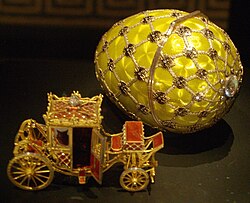
On a cruise around the Baltic Sea several years ago, my wife and I were fortunate to spend a couple of days in St. Petersburg, touring Catherine Palace and Peterhof among the city’s other sights.  When we returned to the ship we were greeted by a local jeweler, who offered replicas of the Fabergés (for less than $32M, thank goodness).  We chose the Imperial Coronation Egg (1897), inspired by the color of Tsar Alexander III’s robe.  The Coronation Egg houses a replica of the imperial carriage, made with gold and platinum and detailed with rubies and diamonds (the original egg that is, not ours).

After learning a single egg can set you back $32M, I now look at my breakfast eggs a little differently.  $10.99 a dozen?  That used to be top of the heap.  Now it’s just pocket change.

—————-

LEGO Trevi Fountain – Update #6

(Read about the start of this build in Brick Wall Waterfall)

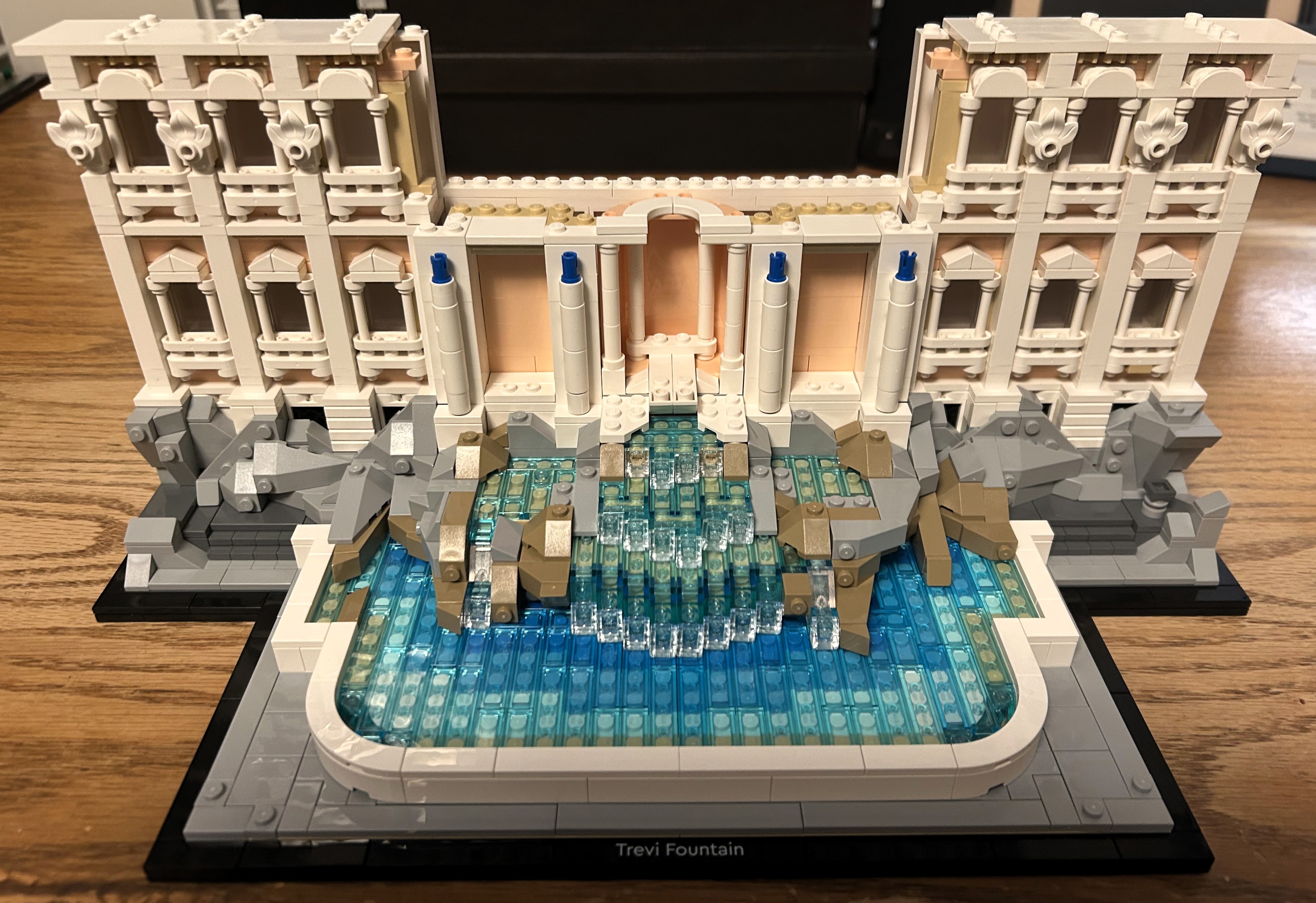
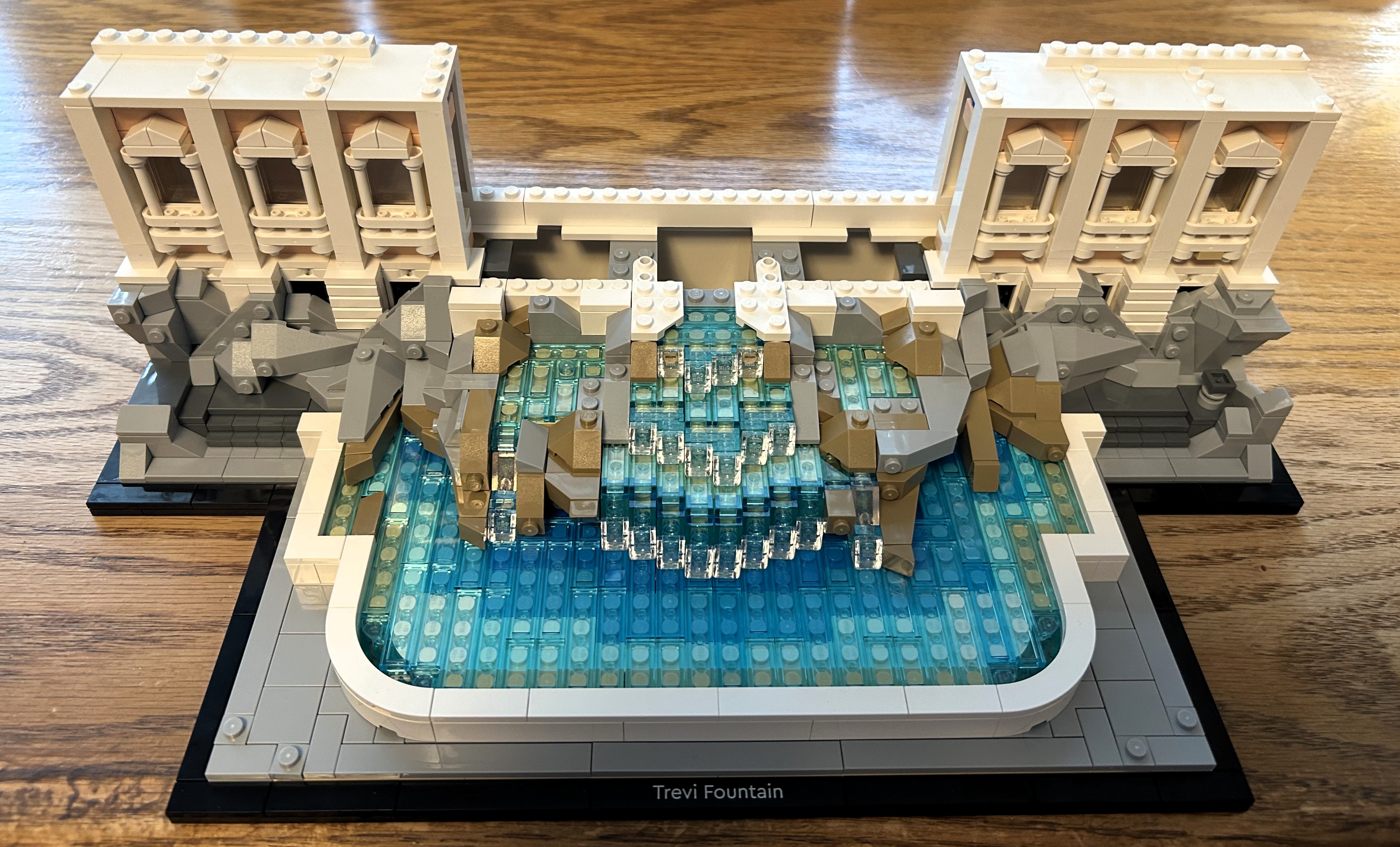
There’s a moment in every LEGO build where you look at what you’ve constructed and think, Hey, I’m almost done!  That moment was today.  Bags 10 and 11 – of 15 bags of pieces – brought the structure of the Trevi Fountain to new, practically finished heights.  The tiny, tiny pieces I worked through (so many of them I was afraid to count) resulted in the uppermost level of the backdrop you see in the final photo.

Bag 10

From my magic hat of Italian composers I somehow chose Claudio Monteverdi for my musical accompaniment today.  You don’t know Monteverdi and apparently I don’t either.  Had I realized his contribution to classical music was mostly opera (hard pass) I would’ve reached into the hat again.  Alas, I was subjected to Monteverdi’s L’Arianna “lament” – equal parts sorrow, anger, fear, and so on.  Those singers sure didn’t sound happy as I snapped together LEGO pieces, but honestly who knows?  I don’t speak “sung” Italian.

mirrored element

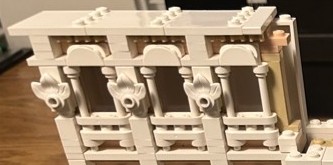
Here’s an expectation with a symmetrical LEGO build.  If you construct an element that goes on one side of the model you’ll be mirroring it on the other side before you know it.  A hundred or more pieces went into the windowed wall you see here, and a hundred more went into its twin soon after.  It’s repetitive yes, but at least you go faster the second time around since you just had practice.

A word about the little devils in this photo.  Because they’re cylindrical they can roll.  Because they roll they can hide under something.  Something like a LEGO instruction manual.  Once again I was fooled into thinking I was missing pieces… until I thought to look under the manual.  Sure enough, there they sat just smirking at me.  So I promptly arrested and cuffed them, hauled them away, and now they’re jailed in the backdrop you see here, without possibility of parole.

We’re just four bags of LEGO pieces from “turning on the water” of the magnificent Trevi.  I’ll admit to peeking into the box at those upcoming bags.  They are small, all four of them.  Perhaps I’ll wrap the fountain construction in a single go next week.  Even if not, conveniently, the final block of travertine would be laid the following week, just in time for Christmas.  Now that’s what I call a gift!

Running build time: 5 hrs. 42 min.

Total leftover pieces: 32 (tiny, tiny pieces)

Some content sourced from the CNN Style article, “Faberge egg fetches record $30.2 million at rare auction”, and Wikipedia, “the free encyclopedia”.

Failing Asleep

I’m almost done with Dan Brown’s latest novel, The Secret of Secrets. The tagline on the front cover: “Author of The Da Vinci Code” was a good add, because that romp through Europe was written over twenty years ago. This romp, alas, is not really much of one. The story ping-pongs relentlessly between explanation and action – making for restless reading – but at least the premise is intriguing. What if the human conscience could operate outside of the human body? What if “you” could exist in both a spiritual and a physical form at the same time? Well, maybe I do, at least when I’m trying to fall asleep.

When you get to be my age – somewhere between “middle” and “senior” – you wake up at least once a night.  Not for an outdoor stroll under the stars and not for a midnight snack.  You wake up “to take care of business”.  It’s an inevitable phenomenon as we get older, especially for us guys.  And when I stumble out of the bathroom I also grab a quick drink of water.  That one-two punch wakes me up, at least enough to get the gears turning and thoughts churning.  Getting back to sleep can be a real challenge.  There are nights I log many minutes memorizing the look of our bedroom ceiling.

Counting sheep has never been my thing, nor the “white noise” of those bedside appliances, but some new strategies have been an interesting experiment.  The first is known as cognitive shuffling.  It’s word play, where you take the letters of a word and spin off new words on each letter for a few seconds.  I start with “piano” (my Wordle starter!) and then go “pepper, portray, people, ponder”, “illuminate, inch, icicle, ignite”, and so on.  What does this do?  It puts the mind in a random state, where you can’t concentrate on stressors like paying bills or fixing stuff.

The next sleep strategy is called “sensory grounding”, which means coming up with lists of things you can smell, touch, taste, hear, and see.  It’s kind of like cognitive shuffling so I’ve never given it a try.  Nor have I tried the breathing techniques, the calming playlists, or getting out of bed and writing down my thoughts on paper (to “release them from my mind”).  All of those seem like a lot of effort just to fall asleep again.

Finally though, there’s a technique called “mental walk-throughs”.  This one is more fun than word games and works pretty well for me.  Think of somewhere you’ve been, preferably a long time ago.  Maybe the neighborhood you grew up in, a house you lived in, or a store you enjoyed spending time in.  Now take a virtual walk through one of those (and here’s where I sense my mind separating from my body).  Look in several directions to see what surrounds you.  Think about how you feel as you’re taking it all in.  Trust me, it’s nostalgic, it’s calming, and it’s calming enough to put you back to sleep.

I read somewhere that The Secret of Secrets is already being made into a movie.  That was fast.  The ink hasn’t even dried on the critic’s reviews, but I guess having the The Da Vinci Code in your back pocket promises another profitable venture.  Maybe I’ll buy a ticket and go see the show.  It’d be another effective strategy to help me fall asleep.

—————-

LEGO Trevi Fountain – Update #5

(Read about the start of this build in Brick Wall Waterfall)

LEGO decided I needed a big helping of humility this week.  Bag 9 – of 15 bags of pieces – brought me to my knees in one heart-pounding moment.  Just as I was cruising to the final steps of the build (in a brisk forty-five minutes), my pulse went into overdrive as I realized the module I’d just constructed wouldn’t attach to its rightful place on the fountain.  It just wouldn’t click in.  In the land of LEGO this is very bad news.  You might as well unfurl a big banner saying: Start over, Dave.

Today’s challenge

If you’ve built IKEA furniture, you know those do-it-yourself sets are engineering marvels.  Everything goes together perfectly; not a piece out of place.  So it is with LEGO.  If one part of the model doesn’t “click” comfortably with another, you’ve done something seriously wrong and that, my friends, summarizes today’s build in a nutshell.  The pile of parts above resulted in the module you see below… only it’s wrong… just slightly off from the way it’s supposed to look.  My penalty: disassemble all those pieces back to the first step to figure out where I’d gone astray.

Just like the second time through Antonio Salieri’s Sinfonia in D Major, I took another forty-five minutes to reconstruct what I’d already built.  The scene at my desk was an interesting disharmony of orchestral beauty, pinched fingers, and nasty thoughts.  Thankfully (and with no surprise), once I got the build exactly as it was supposed to be, everything clicked together the way you see it here.

Bag 10 had to be laughing at me from inside the box.  Bag 10 was scheduled to be opened and completed along with Bag 9 today  Then it watched me fumble the football early on in the build.  Yo, Bag 10, why didn’t you say anything?  You’re a mean one (just like Mr. Grinch) but “I’ll get you my pretty”.  Your time is coming… er, just next week instead of this one.

Running build time: 4 hrs. 33 min.

Total leftover pieces: 25

Some content sourced from the CNN Health article, “If worries keep you from falling back asleep, experts know what to try”. 

An Unhealthy Modern Phenomenon

Somewhere in the wee hours of Tuesday morning I had a bizarre dream; one I retained well into my conscious hours. I was on some sort of overseas sightseeing excursion with others, and our group stopped for lunch at a historic convent. Egg salad sandwiches were handed out by the nuns and I promptly dropped mine onto the cobblestones. The dream only gets more disconnected from there but I’ll share one more noteworthy detail. My traveling companion was the actress Mary Stuart Masterson.

“Watts” on the right

Got all that?  Okay, now forget about everything except Mary Stuart.  Masterson has had a respectable (if not award-winning) career as an actress.  She was only ten years old when she first appeared on the silver screen, in the original version of The Stepford Wives.  She went on to play colorful characters in Fried Green Tomatoes and Benny & Joon.  But her most enduring performance – the one she will forever be linked with – was as “Watts”, the companion/tomboy of “Keith” in the high school rom-com Some Kind of Wonderful.  Masterson’s turn as the loyal friend who quietly wanted to be more absolutely stole the show.

As if nuns and egg salad sandwiches aren’t enough, you’re wondering why Mary Stuart Masterson was sitting next to me in my dream.  Actually it wasn’t Masterson herself; it was her movie character Watts.  Which brings me to the Cambridge Dictionary’s 2025 Word of the Year.  Would you believe Cambridge added 6,000 new words to its big book this year?  5,999 of them were runner-ups to parasocial, a word “describing a connection people feel with someone they don’t know (ex. celebrities, influencers, and other online personalities)”.

Blogger’s Note: WordPress needs to get on the ball here.  “Parasocial” is underlined here in my draft post as being an unrecognized word.

Taylor & Travis

Parasocial’s win as Word of the Year has everything to do with Taylor Swift.  Her engagement to NFL star Travis Kelce generated countless claims of “heartfelt feelings toward a couple the vast majority had never met”.  The same applies to Watts.  I don’t know the first thing about Mary Stuart Masterson herself, but I know everything about Watts from watching Some Kind of Wonderful a dozen times or more.

“Parasocial” has actually been around since the 1950’s.  In that era it referred to the innocence of television viewers connecting to television characters (or in my case, movie viewer to movie character).  But today’s version of the word is described as “an unhealthy modern phenomenon”.  Why?  Because of social media.  Because of artificial intelligence.

Ms. Masterson today

My example of Watts is one movie and one instance.  I’ll finish this post and the “encounter” will fade into my memory forever.  But social media – which brings the viewer constant feeds about the “viewed”, and artificial intelligence – which creates a sense of connection where there really isn’t one, makes it clear why there’s reason to be concerned.  Are we really so desperate as to develop foundation-less relationships with strangers?

AI has already found its place on Spotify.  Search for Xania Monet, the first artificially intelligent singer to grab a ranking on a Billboard chart (Adult R&B).  Everything about Xania was created on a keyboard.  But her face, her social media profile, and her voice suggest she’s a living, breathing human somewhere out there in the world.  I wouldn’t be surprised if you can even chat online with Xania.  If so, you’re developing a one-sided relationship (you) with someone who isn’t real whatsoever (a computer).  Seriously, who has time for this nonsense?

“Xania Monet”

Coincidence or not, one of the Cambridge Dictionary’s runner-ups for Word of the Year was “slop”, which in this day and age means “content on the internet that is of very low quality, especially when created by artificial intelligence”.  Let’s declare “slop” a lot of what’s going in parasocial relationships as well.

The real message of this dictionary winner is clear.  We need to remove the “para” from parasocial and focus on simply socializing with our fellow humans.  It’s the only path to truly fulfilling relationships.  Having said that, for some reason I’d love an egg salad sandwich right about now.

—————-

LEGO Trevi Fountain – Update #4

(Read about the start of this build in Brick Wall Waterfall)

The travertine is stacking up quickly  as we continue our work on the LEGO Trevi Fountain.  Bags 7 and 8 – of 15 bags of pieces – came together like the Domenico Scarlatti piano sonatas that accompanied them – seemingly simple on the surface but more intricate and involved the further we dove in.

The Trevi Fountain has some strange elements, made even stranger when represented by chunky LEGOs.  Check out the shapes I assembled today (and don’t ask me what they’re meant to represent).  Little LEGO pieces positioned in just about every point on the compass.  My singular mistake this round – realized well after the fact – was putting the right piece in place, only the wrong color.  Then when I came across another “right piece wrong color” I knew I had them transposed.  Took a little disassembly to get everything correct.

Bag within a bag

A continuing mystery of LEGO sets is bags within bags.  When I opened Bags 7 and 8, each came with a smaller bag of pieces like you see here.  It’s not like the smaller bag represents its own unit of the fountain.  You just tap into those pieces every now and then as the instruction manual demands.  Yes they’re tiny, tiny but you also find tiny pieces in the bigger bag.  Maybe someday I’ll tour the LEGO factory and solve this packaging mystery.

We worked with some surprisingly large pieces of travertine today – the entire wall of white you see behind the fountain and the white surround you now see defining the entire front of the main pool.  Would’ve taken a dozen Italians to put these monster pieces in place on the real Trevi.  And don’t miss the pink accent strips to the left and right of center (pink!)  This fountain is turning out to be more colorful than I expected.

Running build time: 3 hrs. 5 min.

Total leftover pieces: 23 (10 more extras today!)

Some content sourced from the BBC.com article, “Parasocial is Cambridge Dictionary Word of the Year”, IMDB, “the Internet Movie Database”, and Wikipedia, “the free encyclopedia”.

A Bowl of Snowflakes

Part of the appeal of Halloween – at least for us baby boomers – is the thought of innocent days (and nights) from our distant past. Not only were we kids back then, we cavorted in full costumes through our neighborhoods without a parent in sight. Every house left a light on or a door open to welcome trick-or-treating. Every street seemed safe and inviting.  And the treats were often as homemade as they were store-bought. Cookies. Lollipops. The odd neighbor doling out little sausages hot off the grill from his front yard (BBQ sauce optional). And the occasional popcorn ball.

Who doesn’t love a good popcorn ball?  Me.  I don’t.  Popcorn balls may be a nostalgic Halloween memory but they’re also an insult to popcorn.  Whoever invented them turned a savory snack into a sickly sweet one.  We’re not talking caramel-, chocolate-, or even kettle-corn sweet here;  just liquid sugar designed to act as glue to make popcorn a convenient handheld.  Awful.

I admit it, I’ve become a popcorn snob the way some people are about coffee.  There’s a way to enjoy popcorn and there’s a dozen ways not to.  It’s a snack that deserves to get it right, because getting it wrong is anything but a “treat” (like popcorn balls).

Popcorn eased its way into our after-dinner desserts by necessity.  One day (night) my wife and I sat there after the evening meal and realized we were having dessert way too often.  It was always ice cream, cookies, or whatever else we could find in the pantry.  Somehow a savory dinner necessitated a sweet dessert.  Bad habit – very bad.  Instead, make the dinner healthy enough, eat it early enough, and keep yourself off the couch watching TV.  Then dessert rarely enters the conversation.  Yeah, uh, we’re still working on that.  The dinners are healthy, but we can never get them on the table – er, couch – before 7pm.

Popcorn to the rescue. It’s a dessert that doesn’t feel like a dessert.  It’s not sweet, and with an air popper it’s all of three ingredients.  Popped corn, topped with butter and salt.  Make those first two “organic” and the last one “Celtic sea”, and it sounds like something that’s actually good for you.

Popcorn belongs in a bowl, not in a ball.  We take the largest bowl in our kitchen, fill it almost full with popped corn, and call it dessert.  Oh, right, but that’s just for me.  Then we take the second-largest bowl in our kitchen and pop a similar serving for my wife.

Before…

Since I always aim to educate a little, here’s popcorn trivia worth remembering.  One, the corn used for popping is not the same as the kernels on the cob (so don’t get any ideas).  Two, when the kernels burst – literally inside out – you get one of two shapes; snowflakes or mushrooms.  Snowflakes are what we have at night for dessert, and what you find severely overpriced in movie theaters.  Mushrooms are what you find in a box of Cracker Jack or Fiddle-Faddle.  Think teeny-tiny popcorn balls.  As for the kernels that don’t pop?  They’re called “old maids”.  In the world of popcorn at least, you’d rather be a snowflake than an old maid.

After…

Some more fun facts.  Popcorn displaced movie candy during the WWII years because there was a shortage of sugar.  Years later it’s still the more popular concession at the theater.  On average every American consumes 58 quarts of popcorn every year.  Picture those red/white striped cardboard containers you see when you purchase popcorn from a cart.  Multiply by 58.  You eat a lot of popcorn.  But why shouldn’t you?  It’s convenient, easy-to-make, and healthy as long as you use an air popper.  Really healthy if you substitute olive oil for the butter, which a lot of people do these days.  But I say ewwwwwww to that.  Leave olive oil to the Mediterranean diet instead.

All this talk of popcorn has me thinking it’s time for dessert.  It’s easy to forego the sweet stuff when savory snowflakes beckon.  Just remember, it’s not a ball of popcorn, it’s a bowl.  A proper presentation precedes perfect popcorn.

—————-

LEGO Trevi Fountain – Update #2

(Read about the start of this build in Brick Wall Waterfall)

Let it echo throughout the streets of Rome, Dave is no Michelangelo (and yes, I know Michelangelo didn’t design the Trevi Fountain but he could sure sculpt).  In today’s effort to rise the LEGO fountain from its foundation, I made countless placement mistakes.  I got four steps into Bag 4 – of 15 bags of pieces – and realized I’d placed everything  just a little bit off on the foundation.  That meant breaking it all down, going back to the first step, and starting over.  Can you imagine my fate if I made this mistake with the real Trevi?  Placed and set the travertine just a little bit off?  The foreman would have my head! (which is no joke, at least not three hundred years ago).

“Building” water is not that easy

Frankly, everything seemed off today.  I kept getting the piece placement slightly wrong, as if I refused to learn from my last mistake.  At one point I turned two pages forward in the instruction manual instead of one, skipping a full two steps in the build.  And the below photo is what “broke the camel’s travertine”.  Tell me reader, what’s wrong with this picture?  Five little leftover pieces and one BIG piece, that’s what.  LEGO never throws in big leftover pieces.  Sure enough, I paged back through the manual, and there it was.  I’d overlooked the step where you place that arch.  Never mind that it’s buried under “pieces” of blue water now.  Leave it out and our beautiful fountain might collapse into a pile of very expensive rubble.

You know who’s laughing about all of my missteps today?  The singers in the music I chose for my accompaniment: Rossini’s The Barber of Seville.  His opera may be about money, disguises, lovers and all that, but it sounded more like getting scolded over and over through song.  You got overconfident, Dave (tra-la-la).  You’re no sculptor, Dave (la-ha-ha).  Maybe LEGO isn’t for you after all, Dave (wha-ha-ha-HA!)

The gleeful singing in “The Barber of Seville” is all in Italian, so for all I know they really did change their tune to berate my amateur building efforts.  I took that to heart.  Bags 5 and 6 are gonna have to wait until next week.  I sure hope the foreman won’t look at this decision as “getting behind schedule”.  He might have my head!

Running build time: 1 hr. 44 min.

Total leftover pieces: 10

Some content sourced from Wikipedia, “the free encyclopedia”.

Brick Wall Waterfall

If you were to spend an entire year in Rome, you could visit five churches every day and still miss out on some of the more than 1,600 within the city limits. You could also visit five piazzas (public squares) and never see all 2,000. If monuments are your thing, Rome has so many that instead of an actual count they simply say “more than any other city in the world”. And then we have Rome’s fountains. You could dip your hand in five a day and never see them all in a year. So here’s a better idea.  Just spend a few hours at the Trevi and assume all of the others are second best.

Fontana di Trevi

I wouldn’t decree “best fountain in all of Rome” if I hadn’t been there and seen it for myself.  I spent a college year in the Eternal City studying architecture, and you can’t help noticing the other elements of the city while you’re at it.  Like fountains on every street corner.  The Trevi Fountain was walking distance from the hotel/dorm we Americans lived in, so you can bet I stood before the Trevi’s gushing waterfalls many a day.  Even a few nights.

Most people assume “Trevi” is an Italian word.  It’s actually two words mashed into one. Tre = three, vie = ways.  The Trevi is located at the intersection of three streets.  It’s also the terminus for an aqueduct from ancient times.  Water is picked up from a source outside of the city, carried over fourteen miles through the aqueduct, and deposited “with a splash” at the Trevi, to be further dispersed to the city underground.

Here’s a little more trivia on the Trevi.  It was designed and built in the 1700s, on the back wall of a palace.  It’s primary material is travertine stone (pricey!) quarried from nearby Tivoli.  Besides the columns, arches, and niches along the wall, you have quite the trove of imagery going on over the water, with mythological creatures like tritons and hippocamps.  I have no idea who the sculpted figures gazing down from either side are, but the big guy front and center is Oceanus, a pre-Olympian god.

If you’re a top-five tourist attraction in Rome, you must be pretty darned attractive for a city with countless places to visit.  Maybe it’s the coin thing.  Why do tourists stand with their backs to the fountain and toss three coins over their shoulder into the water (right hand, left shoulder)?  Because legend says they’ll return to Rome some day if they do.  “Legend” is really just Hollywood, from the movie Three Coins in the Fountain.  But if you really know your Trevi trivia, you say the tossed coins follow the ancient tradition of honoring the gods of the waters, granting you safe passage home.  

I’ve talked about the Trevi before, in Too Many Roads Lead to Rome.  The fountain has become so popular you now need a ticket and a specific time to stand in front of it.  But what I haven’t done before is build the Trevi.  Last spring, the “architects” at LEGO immortalized the fountain in a 731-piece model, which I will construct over the next several blog posts.  I haven’t put my hands on a piece of LEGO since Notre-Dame du Paris last January (which still beckons me to add its lighting kit).  I might be a little rusty at this.  The fountain might leak a little.  But I’m up for a dip in this brick wall waterfall if you are.

Author’s Note: The title of this post was inspired by the strange-but-sweet Dickie Roberts: Former Child Star.  The movie included a little ditty my thirty-one year old daughter can still recite to this day: “Brick wall, waterfall, Dickie thinks he got it all but he don’t, and I do, so BOOM with that attitude. Peace punch, Cap’n Crunch, I’ve got something you can’t touch. Bang-bang choo-choo train, wind me up I do my thing. No Reese’s Pieces, 7-Up, you mess with me, I’ll mess you up.”

Some content sourced from the TripAdvisor.com article, “Everything you need to know about the Trevi Fountain coins”; IMDB, “the Internet Movie Database”; and Wikipedia, “the free encyclopedia”.

Horses on Circular Courses

In 1972, Billy Preston topped the Billboard Hot 100 chart with the catchy “Will It Go Round In Circles”. A year later, The Spinners spent five weeks at #1 on Billboard’s R&B chart with “I’ll Be Around”. More recently, Kacey Musgraves’ debut single “Merry Go ‘Round” won the Grammy Award for Best Country Song.  All of which is to say, if I’m asked to celebrate “National Carousel Day” I have a great choice of theme songs for the occasion… played on endless loop, of course.

A double-decker!

National Merry-Go-Round Day (I prefer “Carousel”) was this past July 25th, as it has been every year since 2014.  Did you skip it like I did?  The holiday claims to “celebrate the carousel’s history and joy, particularly marking the first U.S. patent by William Schneider in 1871.”  And to celebrate, we’re meant to visit a local carousel, go for a spin, and post pictures of ourselves doing so online.  So we drop everything we’re doing on July 25th and climb on a wooden horse?  National M-G-R Day doesn’t even rate as a Hallmark holiday (and don’t waste your time trying to find a card to prove me wrong).

Contrary to my opinion about M-G-R Day, I think carousels are charming and a bit of innocent fun (other than those brass rings, which we’ll get to in a second).  Carousels inspired memorable scenes in Mary Poppins and BigCarousel was the Rodgers and Hammerstein musical that Time magazine deemed “the best of the 20th century”.  The “Carousel of Progress” was (and still is) one of the more unique attractions at Disneyland.  And of course, carousels led to those pipe and metal spinners we all played on at the park when we were kids.

Carousel is derived from the French word for “little battle”, which hints at why we’re riding them at all today.  In 17th century Europe, equestrian tournaments included “ring jousting”, where the rider attempts to spear a ring-on-a-string with his joust as he flies by.  To practice this sport without wearing out the horses, a clever soul invented the carousel, complete with wooden horses on poles and a real horse to pull the device in circles.  Eventually carousels made their way into carnivals, and then to the prominent locations where you find them today.

Care for a ring?

Now you also understand why early carousels had ring dispensers.  They were a nod to ring jousting!  The dispensers were filled with iron rings along with a few brass ones.  If you were lucky enough to ride an outside horse and grab a brass ring (which is harder than it sounds as your horse goes up and down), you could exchange the ring for a prize or another loop on the carousel.  For good reasons – safety being one – ring dispensers have been removed from most carousels today.

The people who came up with National M-G-R Day should’ve probably gone with “International”, because many of the world’s most distinguished carousels spin outside of the United States.  The Carousel El Dorado in Tokyo, Japan, built in 1907, is the oldest amusement park ride still in operation in the country.   The Lakeside Park Carousel in Ontario, Canada (1905) includes a self-playing organ that uses rolled sheets of music, rewinding one while playing the next.  The Letná Carousel in Prague, Czechia (1892!) is one of the oldest in Europe, remodeled in 2022 but still housed in its original wooden pavilion.

Looff Carousel (1911)

America has its share of prominent “gallopers” as well.  The Looff Carousel in Santa Cruz, CA is one of the few remaining with a ring dispenser, and entertains with the music of three organs.  The Over-The-Jumps Carousel in Little Rock, AR (1924) simulates the natural movement of a horse instead of just going up and down on a pole.  And the Flying Horse Carousel in Westerly, Rhode Island (1876!) is exactly as advertised.  The horses are attached to the center spindle instead of the wooden platform, creating a better sensation of flying through the air.

Dorothea Laub Carousel (1910)

Okay, I have a confession.  I had the perfect opportunity to celebrate National M-G-R Day just days after it happened this year.  My wife and I traveled to San Diego with our children and grandchildren for a beach vacation and found ourselves in Balboa Park, home of the Dorothea Laub Carousel (brass ring dispenser!)  If we hadn’t already worn out the little ones on a long walk through the Japanese Friendship Garden we might’ve made it to the wooden horses.  But I’m not losing sleep about it.  After all, National M-G-R Day will come ’round again next year.

Some content sourced from Wikipedia, “the free encyclopedia”.

Ellen Makes Her Move

When we moved into our current house (and even the one before it), we made the classic mistake of saying, “We’re never moving again”.  After all, picking up and going from one place to the next can be a real pain in the you-know-what, especially with pets and vehicles to relocate on top of the furniture and clothes. But at least we’re only talking about moving houses. What if you had to move an entire town?

Ellenton, SC

If you live in an RV or a tiny home, you’d think nothing of pulling up stakes and going somewhere else.  You have the wheels or the flatbed to make it happen.  But moving an entire town means a population of people and a collection of structures.  it sounds like something that could only happen on a Hollywood movie set.  Unless you’re the U.S. government with its sights set on Ellenton, South Carolina.

Ellenton train depot

Ellenton first appeared on a map the way a lot of small towns did back in the day.  The railroad was interested in running new tracks through the farms of the area and a deal was made to acquire the land, including a plot for the train station.  In Ellenton’s case, the railroad developer was smitten with the primary landowner’s daughter (Ellen).  The relationship never blossomed but he did name the budding town after her.  Thus we have “Ellen’s Town”, shortened to “Ellenton”.

Ellenton grew quickly in the late 1800s, from a host of agricultural productions to a working, living community of 600 residents.  Eventually you’d find churches, schools, a post office, a general store, a dairy, and even a milling company and a cotton gin.  But what nobody saw coming was the potential of the area for the construction of a massive facility know as the Savannah River Site (SRS).  In the 1950’s in Cold War America, the U.S. government decided Ellenton and its surrounds were the perfect riverside location for plutonium and tritium production, for the development of the hydrogen bomb.  Ellenton “won the lottery” over a hundred other locations.

I can’t imagine sitting in Ellenton’s town hall back when the announcement was made.  Someone who drew a very short straw had to stand in front of the residents and say, “Sorry folks, we’re going to tear down your town so we need you to find somewhere else to live”.  Then the government wrote checks for the properties and businesses and simply walked away.  Eminent domain in capital letters.

I’ll admit I thought the government really did move Ellenton to another location.  I pictured a cartoon image of the world’s largest spatula, sliding under Ellenton’s streets and buildings like an entire sheet cake, then dropping the whole mess several miles away.  But I really thought the government moved Ellenton because we live right down the street from a town called New Ellenton.  Turns out, New Ellenton is simply where a good chunk of the original residents chose to call home.  The government had nothing to do with it.

Maybe the government didn’t move the living but the law required they move the dead.  By the time Ellenton and several other small towns were acquired and shut down, the SRS property encompassed 310 square miles.  That meant the relocation of 130 cemeteries, amounting to over 6,000 grave sites.  They didn’t get every last one, so it’s fair to say old Ellenton still has a few residents.

The black-and-white photos I share here – from the Ellenton website – give the town a charming, old-timey feel.  The few residents alive today hold reunions to share the memories of a place they can no longer see or even visit.  Some of Ellenton’s stories make it sound very cozy.  I wish I could say the same about New Ellenton, which is nothing more than a couple miles of highway with gas stations and bars scattered on either side.  Frankly, the only reason you drive through New Ellenton is because you’re on your way to somewhere else.

I wouldn’t be nostalgic for Ellenton if the government didn’t make it disappear.  Kind of reminds me of Brigadoon, the Scottish village that magically appeared out of the mist every hundred years.  Maybe Ellenton will appear out of a nuclear winter on the hundredth anniversary of it’s own demise.  In the meantime, a songwriter captured the story of the town in a rather sad ballad.  “The Death of Ellenton” was never a big hit, but the town it celebrates sure took one.

Some content sourced from the WJBF website article, “Hometown History: The Forgotten Town of Ellenton”; the Ellenton SC website (including all photographs); and Wikipedia, “the free encyclopedia”.

Golden Recall

My wife and I go for massages once a month, which has turned out to be a solid therapeutic routine. As is the case with any spa, the air is diffused with pleasant scents as well as soothing instrumental music. They also overlay a soundtrack of birds, as if to place you in the out of doors. The sensations are designed to relax and they do their job; so well in fact I’d swear I was transported to the shores of a pond.  More on that in a minute.

Candidly, it’s not often I notice the background music in a spa. I focus on breathing deep and keeping my eyes closed instead. But I couldn’t ignore the music when “Bring Him Home” from Les Miserables started playing. Whatever playlist the spa chose included a simple rendition of that song; just piano and violin. It was beautiful, and suddenly I was back in the Broadway theater where we saw the show years ago. I would’ve put “Bring Him Home” on “repeat” if I could have.

But we’re not talking about Les Miserables today. We’re talking about a pond. “Bring Him Home” was followed by a nameless instrumental piano piece, and again my mind began to drift. Then I heard the birds. Piano keys.  Birds.  And there I went… back to “On Golden Pond”.

Several instrumental movie soundtracks will reside in my brain forever. Whenever their signature melodies play I’m immediately returned to the film itself. I’m not talking about the bold, orchestral works of John Williams (think Star Wars or Jurassic Park) but rather the simpler repetitive tunes that still somehow define the story on the screen. Chariots of Fire is a good example. Cast Away is another. Leap Year was a so-so movie but the soundtrack is wonderfully catchy. And the music of A Little Romance – Diane Lane’s debut film – was so well done it won 1979’s Oscar for Best Original Score.

So you see, this is how a massage becomes a trip back to On Golden Pond, a movie from almost fifty years ago. The piano plays. The birds sing (even if they aren’t loons). And there it is, that simple poignant story playing out in front of my closed eyes as if I’d just seen the film last week.

Was I ever a fan of Jane Fonda? Not really. I remember her more for her workout videos than her movies. But On Golden Pond was the exception because she’s on screen with Henry Fonda, her father in real life and her father in the movie. The movie is about the struggles of their father-daughter relationship, which surely echoed real life. Add in Katherine Hepburn as the mother character and the bar is raised well beyond the movie itself. The story is good enough, but who from my generation wouldn’t watch Henry Fonda and Katherine Hepburn in anything together?

Henry Fonda died less than a year after the filming of On Golden Pond. Katherine Hepburn made a few more movies but this was pretty much the conclusion of her career as well. So On Golden Pond is something of a swan song for both. If you have any recollection of the film, try this: Ask Alexa for instrumental piano music. Ask Siri for a soundtrack of birds at the same time. Then close your eyes and relax.  You may be transported back to a golden pond. It’s pretty cool.

Some content sourced from IMDB, the “Internet Movie Database, and Wikipedia, “the free encyclopedia”.