Humble and Kind

This week’s list of “Hot Country Songs” – according to Billboard – includes Tim McGraw’s Humble and Kind; an easy waltz with timeless lyrics. A glance at other songs on the list finds the more typical topics of country music: fishing, hunting, lost love, found love, even t-shirts.  But Humble and Kind digs a whole lot deeper.  It’s a virtuous dose of substance in a music genre that often settles for less.

43 - virtuous 1

Humble and Kind sings about several examples of doing the right thing, like holding doors for others and minding your manners.  But the following verses are more insightful and are my favorites:

When the dreams you’re dreamin’ come to you,                                                                  When the work you put in is realized,                                                                                        Let yourself feel the pride but,                                                                                              Always stay humble and kind.

Don’t take for granted the love this life gives you,                                                              When you get where you’re goin’ don’t forget turn back around,                                       And help the next one in line,                                                                                                Always stay humble and kind.

Humility and kindness are virtues by definition.  If you time-traveled back to 400 AD, you’d meet the Roman Christian poet Aurelius Prudentius (great name).  “Aury” came up with the “Seven Heavenly Virtues” and the list remains unchanged to this day.  The first five are Chastity, Temperance, Charity, Diligence, and Patience.  The last two are Humility and Kindness.  If you lived your life according to the list, the pearly gates would swing wide when you arrive.  But let’s be real – how many of us can check the boxes next to all seven virtues by the time we climb that final staircase?

43 - virtuous 2

Humility (Latin: humilitas) is not thinking less of yourself; it is thinking of yourself less.  Kindness (Latin: benevolentia) is charity, compassion, and friendship for its own sake.

Ponder the final words of those definitions for a second.  It’s not so much what you do (or don’t do) but more what your intentions are.  Don’t show me things you’ve done that qualify as “humble” and “kind”.  Instead, consider whether you had a hidden agenda with your actions.  And that’s the kicker with the virtues game – it’s not only how others judge you but also how you judge yourself.  Still think you can check the boxes?

Humble and Kind inspired a pay-it-forward movement you can learn more about at http://stayhumbleandkind.com .  You’ll find all kinds of inspiring entries on the website – over eighty in the four months since the song was released.  Click on any of the photos and you’ll get the story behind the good intentions.  You can even request small printed cards that say #StayHumbleAndKind – meant to be left behind after you complete your acts of anonymous goodwill.

Ironically, some of Tim McGraw’s biggest country hits are about fishing (“Don’t Take the Girl” – 1994), love (“Just to See You Smile – 1997) and t-shirts (“Something Like That – 1999).  But like our virtuous Roman Christian Aury, Tim and his writers step it up to poetry every now and then.  Humble and Kind made it to #1 on Billboard’s “Hot Country Songs” last month.  This week’s list has it at #4.  Frankly, I hope it hangs on for awhile and gets a ton of airplay.  The world can learn a lot from its seemingly simple words.

Some content sourced from Wikipedia, “the free encyclopedia”.

Music of the Night

Last weekend we went to Saturday night church to hear our daughter-in-law sing. Or more accurately – as I discovered the next day – we went to Evensong.

42 - evensong

I was raised as a Methodist, with little exposure to the customs of other faiths.  It was only later in life that I came to appreciate the different spins on “church”.  Our Methodist church had three services on Sunday mornings – that was about it for formal worship.  But my years at a Catholic university taught me that “church” can happen on Saturday nights, or Friday nights, or every morning, afternoon and evening of the week if you simply can’t get your fill.  “Church” also has different names, like Vespers, Eucharist, or Matins.  Or Evensong.

Saturday night’s service with my daughter-in-law didn’t seem so unusual.  We were sitting in pews in a sanctuary; a healthy congregation of worshipers around us.  The service began with singing and music.  But fifteen minutes into the hour it was still singing and music.  The stubborn Methodist in me wondered when we’d get to the sermon and the Bible verses and the prayers (they came eventually).

Evensong wouldn’t “even” (ha) have become this week’s blog topic if it wasn’t for Jeffrey Archer.  I was reading the British author’s latest novel last Sunday and he made reference to Evensong.  The word stuck with me – a beautiful term – so I had to learn more.  Evensong has its roots in the Church of England: an evening prayer service delivered through singing and music.

Today, Evensong in its purest form is still more common in the U.K. than in the U.S.  You can attend the service every day in most cathedrals in the Church of England, but you’ll only find a handful of options in the States.  And you’ll have to search even harder to find Choral Evensong; the original version of the service sung “a capella” (without instruments).

One of my neighbors down the street here in rural Colorado saw fit to name her “relaxing forest getaway rental” Evensong Place (made the top ten in my Google search!).  That’s a little eerie considering I chose this topic at random just this week.  Maybe I should wander down and have a look.

A popular Methodist hymn – from the early nineteen century but still sung at Christmas – is “There’s a Song in the Air”.  It doesn’t rate as high as “Silent Night” or “It Came Upon a Midnight Clear” but the melody and the words captivate me.  In the final verse we sing “…and we echo the song that comes down through the night…”.  Well what do you know?  Even us Methodists had a sense of Evensong well before it became “Saturday night church”.

Some content sourced from Wikipedia, “the free encyclopedia”.

Field of Flowers

In the heart of timeless Rome, not far from the Pantheon and the Coliseum and the Vatican City, lies a field of flowers.  The Italians call it the Campo de’ Fiori (literally, “field of flowers”) and it is a welcome retreat from the bustling metropolis that surrounds it.  The Campo is open and happy and bright; a sanctuary nestled within a vast maze of winding streets and crowded buildings.

38 - sanctuary 1

You can see the Campo in the photo above: the rectangular area with all the white tents.  Admittedly the Campo is not really a field, but rather a piazza (a public square).  But the place abounds with flower-vendors.  And the square hosts a daily food market, bars and restaurants, and a bath-like fountain to keep all those cut flowers fresh.

38 - sanctuary 2

The Campo has a special place in my heart, because in 1982-1983 I spent nine months in Rome, studying architecture.  The Hotel Lunetta (also in the map photo at the upper right) was our “dorm”, and the streets of the city our “campus”.  The Campo was our “quad”.  It was where we played Frisbee (while the Italians played soccer alongside us).  It was where we had our laundry done or grabbed a snack or shopped for conveniences.  But mostly it was just a cozy place to hang out after classes.

The Campo is one of Rome’s smaller piazzas.  To contrast, here’s a photo of nearby Piazza San Pietro, the vast open space in front of St. Peter’s Cathedral in the Vatican City:

38 - sanctuary 3

The Campo has an interesting history that dates back to the Middle Ages (see https://en.wikipedia.org/wiki/Campo_de’_Fiori).  It really was a field to begin with, until a Cardinal had it paved over in the fifteenth century.  Many of the buildings that surround the open space are the originals from hundreds of years ago.  My wife Brigid, an equestrian, would enjoy the fact that a) the one church on the Campo is for Santa Brigida (a Swedish saint), and b) the square was once the site of a twice-weekly horse market.

Several streets that lead to the Campo are named for the trades that occupied the area all those years ago.  Via della Corda – approaching from the southwest – means “Street of the Rope-makers”.  Via dei Cappellari – approaching from the northwest – means “Street of the Hat-makers”.

38 - sanctuary 4

The Campo also boasts a not-so-nice aspect.  In the seventeenth century the square was used for public executions, particularly for those at odds with the Church.  Almost in kind, the Campo of recent years has become a gathering place for drunken tourists, soccer enthusiasts, and overzealous youth, earning the distinction of “one of the most dangerous places in Rome at night”.  What a shame.  Perhaps the Campo should remain a keepsake memory for me instead of a place to revisit – my Campo – an unspoiled sanctuary more akin to a field of flowers.

Photos courtesy of Google Maps: https://www.google.com/maps)

I Need A Fix

Home improvement gets a lot of attention these days, thanks to HGTV programs and the do-it-yourself draw of Home Depot and Lowe’s. Home maintenance however, lurks gleefully behind the scenes.  Home maintenance demands your attention regularly, whether you want it to or not. If you’re a home owner, you’re a home maintainer. It’s the gift that never stops giving.

35 - mantra

Last week our kitchen garbage disposal finally got the best of me. It’s kinda-sorta worked for several weeks now, but the occasional drip-drip below the sink (and why is it just occasional?) and the uncomfortably loud grind of its teeth had my disposal practically begging to be replaced.  So I finally completed the task, but not before discovering some unexpected wiring and plumbing as a bonus.

For me, that’s how it goes with all home maintenance projects.  Something breaks.  I assess the situation and decide how long I can put off the fix.  I don’t wave the white flag until I find all of the work-around options I can think of.  Then, at last I purchase the parts and round up the tools, take a deep breath and dive in.  That’s where a project gets really interesting, because there’s always more adventure in the repair than meets the eye.

When I wrote about my smoke detector assault a couple of weeks ago, the fact remained that I had ten outdated detectors still to be replaced. Amazon Marketplace came to my rescue.  One mantra for modern times is “you can buy anything on Amazon”, and home maintenance projects back up that claim.  I matched my ten-year-old smoke detectors to photos and details on Amazon and instantly purchased a whole box of the exact same little devils. But what looked like an easy project became anything but.  It wasn’t until I replaced the first one that I realized the ceiling mount on the new units is slightly different than what I already have. So instead of just clicking in the new units, I also get to replace each ceiling mount, including the electrical wiring.

Perhaps you’re one of those who pays someone else to do your repairs. You figure, cough up the money and the job will be done a lot sooner (and better) than through your own effort.  Much as I want to walk that road, my conscience always gets the better of me.  I grew up with a father who basked in the curiosity of home maintenance and improvement.  He just about lived for any kind of fix-it project on his weekends.  His own upbringing – including a hand in the construction of his own childhood home – gave him the confidence to even take on the projects he’d never done before.  Hence one summer my brothers and I found ourselves digging trenches and piecing together PVC pipe in our front yard as we constructed a massive sprinkler network.  I’m not sure I even knew how to turn on the sprinklers before that.

Twenty-five years of home ownership would suggest I’ve evolved into a home maintenance expert.  Nope; just not built that way.  Even the most routine project still finds a way to confound me.  Whether I’m replacing the guts of a toilet, rewiring a light fixture, or addressing the next water crisis (and there’s always a next in that department), I cut myself a break by assuming the project will not go as planned.  That’s a good strategy for those of you just getting into the fix-it game.  Beware the phrases “easy to install”, “replaces in minutes” or “requires no tools”.  It will never go down as simple as swapping the old for the new.

Here are five home repair mantras worth memorizing.  One, your project will require parts or steps that were not part of your original plan.  Two, your project will involve words and gestures that are not typically part of your vocabulary.  Three, double the time you need to complete your repair (actually, triple it).  Four, the previous installation was not done perfectly – and you will suffer because of it.  And Five, you will worry for days or weeks after your repair, wondering whether you got it right.

Yesterday – utterly mocking this topic – my coffeemaker called it quits.  I worked on it for over an hour to no avail.  Broken coffeemaker and no morning joe?  Makes me want to call the repairman from here on out.

You’ll Find This Alarming!

They came for me quickly, in the deep of the night when my defenses were completely down.  A coordinated attack as I slumbered. Theirs was no slow, stealth-like movement of sentries, but a full-on guns-a-blazin’ ear-splitting blitzkrieg. Who was this ruthless after-hours enemy, you ask?

My smoke alarms, of course.

33 - blitzkrieg

Smoke alarms sit quietly on the ceilings of your bedrooms and hallways.  They rest there upside-down like giant aspirins, waiting for a reason to blow their horns.  They smugly advertise themselves as safety mechanisms (“you need us, pal”) but don’t be fooled.  Even as I type they’re plotting another one of their coordinated onslaughts.

I have ten of these little monsters in my house: three upstairs, three on the main level, and four in the basement. In the dozen years we’ve lived here our smoke alarms have never – not once – alerted us to actual smoke or fire.  Sometimes they chirp their once-a-minute beeps, demanding their failing batteries be replaced.  Other times they sound off in pain as the static electricity of nearby lightning fills the air.

Lately it’s gotten worse.  Now they’re making unreasonable demands, exploding in unison for no reason whatsoever.  It always starts with one and then the others join in quickly.  It’s downright deafening.  A symphony of sirens more ear-splitting than the cannon fire of the 1812 Overture.

Their latest invasion came last Friday, in the wee hours of the morning.  As usual they attacked without warning.  The general (oh yes, I know which one he is) commanded one of his basement infantrymen to sound off, and per design as soon as one opened his mouth the other nine joined in with obnoxious harmony.

The net effect of this audio jolt was a magic trick.  I levitated off the bed at least a foot – still horizontal, still under the covers (my wife missed an opportunity to wave her hands with a flourish and say “ta-dah!”)  But shortly after returning to earth my brain kicked in to fully 5% of capacity and I was on the move.  Alarms screaming, dogs barking, feet pounding, and no smoke or fire anywhere to be seen, I clapped my hands over my ears and dashed to the garage to grab a ladder.  Then I climbed to the nearest little devil and ripped his battery out.  Then to the next one.  And the next.  Hurrah, I was winning the battle!  Or so I thought.

After dismantling four of these buggers it occurred to me the batteries-down approach was having no effect.  All alarms continued their gleeful shrieks, and no amount of screaming obscenities would shut them up.  Then it dawned on me: batteries or not, my alarms were still feasting off the house current.  I dashed back to the garage, threw open the breaker box door, and triumphantly killed the circuit.  Better.  But six of ten still wailed away on battery life.

The remainder of my counterattack was the beginning of the merciful end.  Each time I yanked out a battery, the siren would weaken to a pathetic moan and finally die away.  I’m not saying it was music to my ears but you get the idea.  After I dismembered Number Nine the sirens stopped entirely.  And thank goodness for that.  Number Ten – the general – sits seriously high up in the two-story stratosphere of our family room.  It takes the full height of my extension ladder and tippy-toes to bring him to his knees.  So I left the general with his battery, but fully detached from his regiment.  He all but waved the white flag.

The following morning, as I surveyed the carnage hanging from my ceilings, I wondered how I could bring this war to an end once and for all.  I decided to take down one of the dead bodies and have a closer look.  Just as I was about to crack open the plastic cylinder for the autopsy I noticed the following words, printed in raised lettering around the edge:

“REPLACE THIS DEVICE BY YEAR 2012 TO AVOID MALFUNCTION”.

Seriously?  Smoke alarms have a shelf life?  Apparently the joke’s been on me for the past four years.

The general’s still up there and I swear I hear him laughing.

Go On, Take the Money and Run

If you buy e-books through Amazon, you’re familiar with the option “send a free sample”.  Rather than buying the book up front, Amazon sends the first 5% to your e-reader as a teaser.  The sample cuts off abruptly (sometimes mid-sentence), but you get enough of a taste to decide whether you want to commit to the purchase or simply walk away.

32 - mediocre

Free samples are a genius sales tactics (think Costco), but I say free samples are saving graces for an often mediocre world.

Mediocre.  It means you experienced something run-of-the-mill or commonplace.  Think about the last food item you purchased.  Would you say it was deliciousLike nothing you’ve ever tasted before?  Would you rush back and buy another one?  Probably not.  Yet you ate the whole thing even though the first bite screamed “meh”.  Why did you do that?

Here’s a better example.  How often are you at the movies and twenty minutes into the film you start to wonder if it’s going to get any better.  You become more interested in your surroundings than what’s up on the screen.  For me, the first red flag is when I suddenly double-check my pockets for my wallet and car keys.

Sometimes you see people get up and leave in the middle of a movie – the bold ones.  Do you leave?  Chances are you don’t.  You finish out the show, turn to the person you came with and say, “ah, it was just okay”.  Again, why did you do that?  You could’ve been gone almost two hours ago and salvaged the evening by doing something better!

I think we should apply Amazon’s “first 5%” to more of life’s experiences.  At the movies, why don’t they flash a little question mark in the corner of the screen fifteen minutes in.  If you’re not into the film you get up and leave at that moment, and the theater refunds you 20% of the ticket price.  Sure they might have to charge a little more to offset the loss, but guess what?  Movie producers would track the “leave” statistics and make better films.

The other night I saw the Harlem Globetrotters, an act I hadn’t seen since childhood.  They’re not as entertaining as they used to be.  The basketball is still impressive, but the slapstick comedy is dated, and the focus seems to be as much about their charity and the products they’re selling as it is about the show itself.  Again, the “first 5%” rule says you decide within the first fifteen minutes whether to stay or go, and you get a 20% refund on your ticket.  And, that ticket could be handed off to another line of patrons, who would then watch your remaining 80% for free (and probably buy enough concessions and products to offset the refund).

We’re in an election year.  You may consider your choices for President mediocre.  No problem.  The “first 5%” rule says the winner has 75 days to make good on those “when I get in office” promises.  If he/she comes up short, the Vice-President (or even more interesting, the runner-up) takes over and also gets a 75-days shot.  Sure, I’m making the early months in office more demanding and the election process more complicated.  But at least the VP would no longer be a figurehead.  And you the voter would no longer feel like your “purchase” of the next four years demands a refund.

Left, Left, Left-Right-Left

I’ve never been a baseball fan, but I do like the nostalgic origin of the term “southpaw”. Baseball claims the word because early ballparks oriented their fields with the batter facing east (to avoid the setting sun).  That put the pitcher facing west, and in the case of a lefty, his pitching “paw” to the south.

30 - sinistral

I am a southpaw myself.  The more formal term for me and my left-handed brethren is sinistral.  We are the ten percent of the world’s population who curse as we ladle from the punch bowl, write in our spiral-bound notebooks, or cut that not-so-straight line with our scissors.  We are the annoying person to your right at dinner parties; the one who bumps your elbow every time we lift our fork.

Handedness is often determined in the womb but almost always by the age of two.  Handedness suggests a tendency towards the opposite side of the brain (that is, left-handed people are more “right-brain” and vice-versa).  But it is also believed that left-handed people have the hemispheres of the brain reversed, so that their right-brain skills actually reside in their left hemisphere.  Confusing, no?

Whether left or right, the connotations go beyond the body itself.  Left-brain people favor analysis, logic, and facts, while right-brains favor creativity, imagination, and feelings.  I generally behave left-brain (which would confirm that reversed-hemisphere notion), but just to be sure I took the following 30-second test: http://braintest.sommer-sommer.com/en/ .  Try it yourself.  It tells me I am 59% right-brain.  Huh?  Then again – to squash this approach completely – logic tells me a right-brain person would not even subscribe to the idea that a test can determine these distinctions.

When we lived in San Francisco there was a small shop in Fisherman’s Wharf called “The Left-Hand Store”.  Among its more popular products: watches that could be set from the left, measuring cups that could be read when held in the left hand, and notebooks spiral-bound on the right.  They also sold an impressive selection of scissors and cutlery with the cutting edge on the -ahem – correct side.  Finally, they sold a “Super Power” hoodie proclaiming “Left is Right”, which is really just a desperate plea for sympathy from all you righties.

We lefties may need super power to overcome the perception that we are out of favor in a right-handed world.  After all, “right” connotes “correct” and “proper”, while sinistral connotes “unlucky” and “clumsy”.  The English derived “sinister” from sinistral, while the French termed “gauche” for “left”, but also for “awkward”.  Black magic is sometimes referred to as the “left-hand path”.  Many cultures seek to convert their left-handed children to the right.  Why is it never vice-versa?  Hence the perception.

Admittedly, some tasks remain nightmarish when performed from the left.  I will never again take chalk to board (as most ends up on my hand).  My spiral notebooks will always be bound from the top, to avoid the indent of metal wire on the edges of my palm.  My writing will forever be illegible since my hand curves awkwardly around the words I write, (to avoid smearing).  And if I ever wish to play the guitar – or the accordion – I need to play them upside-down for the benefit of my more dexterous hand.  At least Sir Paul McCartney feels my pain.

Here’s an interesting premise.  It is said that more left-handed drivers die in accidents than right-handed drivers.  Why?  Because in the effort to avoid that head-on collision, we southpaws instinctively pull the wheel down to the left… which takes our car into oncoming traffic.  At least in America.  Perhaps I should move to England.

From the Facebook community That’s One Awesome Mommy, we read “Left-handers are wired into the artistic half of the brain, which makes them imaginative, creative, surprising, ambiguous, exasperating, stubborn, emotional, witty, obsessive, infuriating, delightful, original, but never, never dull.”  Whoa.  Now that’s what I’d call a left-handed compliment!

Can We Talk?

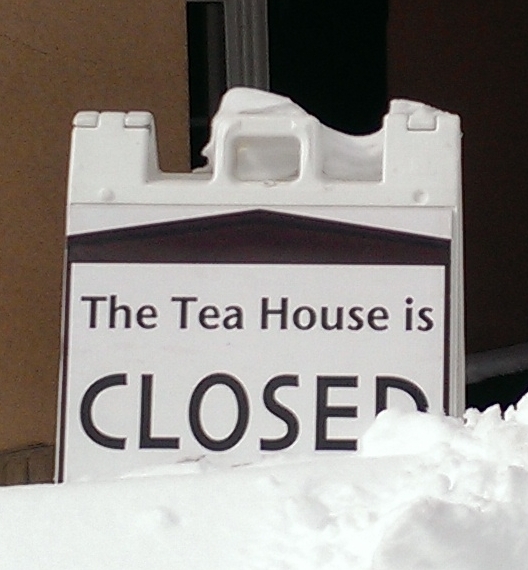
We lost a good friend last month.  Wisdom Tea House, one of our local cafes, closed its doors for good after eight years of business (and a little snow).  And that’s just sad.

29 - requiescence 2 (1)

Why am I sad?  Let’s start with a quick tour of the house itself.  You walk in the front door to the roomy foyer, commanded by a large hutch with dozens of tea cups – choose your own – and a welcoming kitchen where you place your order. If the scrumptious lunch items don’t tempt you, the fresh-baked goods on display certainly will.  Then choose from any room in the house and pull up a chair. Perhaps the living room with the small fireplace. Or one of the upstairs sitting rooms with their small couches and comfy chairs. Your tea and cakes will be delivered no matter where you sit.  This could just as easily be your grandmother’s house.

29 - requiescence 2 (2)

Here’s what I’ll really miss about Wisdom.  You won’t see people talking on their cell phones or working away on their laptops.  You won’t plop down next to a large, loud group of people gathering after work for a drink.  Wisdom’s music is quiet and instrumental.  The tea and coffee are served in their simplest forms (no Oprah Cinnamon Chai Tea Latte here).  In sum, they created a gathering place for requiescence – a bit of rest to escape the bustle of the world beyond the windows.

As I reminisce on Wisdom, I’m sitting at Starbucks.  I typically appreciate the convenience of the drive-thru, but today I’m on the inside, observing Starbuck’s brand of “gathering place”.  Open floor plan.  Hard surfaces.  Rock music.  A few high tables for two and one large low table for many.  Stools at a counter facing the windows with no view to speak of.  The handful of patrons I observe are to themselves, engrossed in all forms of personal electronics.  The few engaged in conversation raise their voices above the music and the baristas just to be heard.  It’s all just so “un-Wisdom”.  But that’s Starbucks – and it works.  It’s grab-n-go coffee, especially with that drive-thru lane (churning out cars so much faster than people passing through the front door).  Having your coffee inside a Starbucks almost feels wrong.

A few years ago my wife and I visited Ireland for the first time..  If you’re ever in Dublin, find your way along the cobblestones to Wicklow Street (just off the wonderful Grafton Street shops), and stop into a little cafe called Gibson’s.  Gibson’s is akin to Wisdom Tea House.  Order at the counter (the pear tarts are a must) and choose from one of the dozen small tables just beyond.  Take in the gentle ambiance and soft decor, and breathe deep.  The Irish come to Gibson’s to meet and to chat; to catch a break from the fervor that is downtown Dublin.  We stopped in several times during our trip and it was always the same: happy patrons engaged in quiet conversation with – at least for the moment – no cares in the world.  I can still picture one particularly well-dressed gentleman a few tables over from ours, sitting alone with his coffee and reading a book.  The very picture of requiescence.

Perhaps you have a Wisdom Tea House in your town.  A place the locals seek out to unplug, and to spend a quiet moment or two with each other.  If you are so fortunate, be regular patrons and keep your little gathering place in business.  Without Wisdom, our little town has precious few places to rest.  We might as well just head home instead.


gratuity

Last week as I was buying lottery tickets, it occurred to me that very few transactions require payment by cash these days. Perhaps you still buy your newspaper at the street corner box.  Or you feed the parking meter with coins, even though most meters now take credit.  Maybe you still throw coins into the bridge toll basket just because it’s fun.

My family and I were in New York City this past weekend and I was quickly reminded that cash is a necessity in the big city.  Specifically, I’m talking about tips.  “Tip” is a word that supposedly originated in the 17th century, and somewhere along the way it was more elegantly referred to as a gratuity.  But sometimes I question how elegant the practice of tipping really is.

26 - gratuity

When my family and I arrived at our mid-town Manhattan hotel last Friday, I found myself tipping three people inside of fifteen minutes.  The cabbie, the curbside bellman, and the valet (who helped us with our bags and refused to step aside until I “greased his palm”).  In my book, a gratuity is a gesture of recognition for a job well done; a service that went above and beyond what you had in mind.  Nowadays however, tipping has reduced itself to more of an expectation.

Case in point.  That New York City cab ride was nothing more than a lift from Point A (airport) to Point B (hotel).  The cabbie did not say a word the entire time, when in fact he could’ve joined in the family conversation or at least pointed out the city sights as we passed them.  When we arrived at the hotel, the cab’s credit card machine allowed me the gratuity options of 20%, 25%, and 30% (nothing lower), and the cabbie actually complained about my choice of 20% for a large party.  I suppose you could decline all of those options and hand over less cash instead (which is what the cabbie’s sour attitude deserved).  Regardless I felt manipulated, as if the tip was mandatory instead of voluntary.

Americans would be surprised to learn that tipping is not a common practice outside of this country.  Canada and a few locales in Europe promote the practice, but otherwise the world’s countries don’t expect tipping and in some cases discourage it.  I find it interesting that tipping in the U.S. supposedly started in the Prohibition Era, when business owners reluctantly promoted tipping as a means of supplementing their employees’ wages at a time of lost revenue.  But again, the spirit of tipping in those days was for recognition; not as an expectation.

When I was in sixth grade, gratuity showed up on the weekly list of spelling words.  A few days after, a friend and I found ourselves at a local snack bar; the kind where you order at the counter and take your tray to a dining area.  After finishing our food we realized we could be “cool” and use one of our spelling words.  We left a $10 gratuity (virtually the same amount we spent on our snacks), then went to the corner of the dining area where we could watch the person who clears the trays.  I remember that person looking around as if someone had forgotten their cash.  I also remember the lecture from my friend’s mother a few hours later.  That verbal smack-down – fully deserved – included something along the lines of not understanding the meaning of our spelling words, and clearly not understanding how long it took our fathers to earn $10.  Whoops.

Here’s a little tip for you – ha.  The next time you dine at a restaurant or have your hair done, or receive some other service that asks for a little recognition, ask yourself the following:  Was the experience beyond expectation?  Did the person go out of their way to make the meal or the service a little more meaningful?  If yes, then the inevitable gratuity will be given in the spirit it was intended for all those years ago.


abeyance

Imagine what it’s like to get knocked out cold.  You’re in the boxing ring, or you slip on the ice, or you faint, and WHAM! – you’re out for the count.  You never see it coming.  Your very next memory is waking up as if it never happened at all.  To be fair, you can’t imagine what it’s like to get knocked out cold.  Your brain doesn’t register the experience; or if it does, it stores the memory in a place you’ll never be able to access.  It’s as if you’ve took a break from your conscious world.  This temporary inactivity of the mind – a kind of suspended animation – is known as abeyance.

25 - abeyance

Recently I had a tooth extracted.  Since I have a strong jaw my dentist suggested I should be fully knocked out instead of hitting the laughing gas.  So there I went, from “counting backwards from ten” to waking up post-op, as if the hour the procedure required was a split second.

After a tooth extraction, the dentist talks to you to make sure you feel okay, and more importantly to give you instructions for self-care for the next several hours.  And here’s where it gets interesting.  In the time frame of those several hours your brain is awake but not fully awake.  My wife was in the room when I received my self-care instructions, and she said I was coherent and having a perfectly normal conversation with the doctor.  But one day later I had no knowledge of that conversation – and I never have since.

That little amnesia experience got me to thinking: what if I could capture the “half-awake” brain in writing?  Wouldn’t it be interesting to see what I write about in my semi-comatose stage, knowing that after the fact I’ll have no recollection of writing a single word?

I completed this experiment last month, when I went back to the dentist to have a post inserted (for a future crown).  It was the same drill as before (ha).  I was knocked out and woke up an hour later with no memory of the surgery.  But when I was at home later in the day to recover, I wrote a quick story before my brain fully restored itself.  The following day, and now a month later, I have no memory of writing that story.

To conclude, I am sharing that story with you below.  I’ve read it several times and have zero recollection of ever writing it.  Isn’t that amazing?  Don’t ask me for the hidden meaning because I don’t think there is any, and needless to say, the story is unfinished.  But I do think it’s remarkable this story was created – and stored – in a part of my brain I’ll never have access to.  Here then – my moment of abeyance.

Todd was a gentle man, who worked an apple farm near the west coast of Central Washington. Each morning he’d get up with the dawn, climb on his John Deere tractor, and plow the rows between the trees, keeping the orchard nice and neat. The trees produced a variety of apples: Macintosh, Gala, Red Delicious, Granny Smith, and so on. It was not the sort of orchard that required a lot of labor or equipment. A typical harvest yielded 100 bushels or so, which were largely sold to the small organic markets in the region. Todd’s apples boasted a quality product year-in and year-out over several years.

One harvest season, Todd discovered that many of his apples were bigger and heavier than in previous years. They even shone brighter with their reds, yellows, and greens. Thinking nothing of it, Todd continued the harvest as usual, bringing home the first day’s bushels to prepare for market. As was always his custom, Todd brought several samples of each variety into the house, to give them a closer inspection and taste. Again, as he looked at an especially ripe Macintosh, he noticed the brightness: an almost glittery look to the skin. The fruit was probably an inch or so larger in diameter than any he had seen from his trees in previous years. The bite was crisp and delicious, the flesh firm and consistent.

After a couple of bites, Todd took a sharp knife and cut the fruit to the core. Imagine his surprise when his knife hit a solid core; the consistency of a peach pit instead of small seeds. Carefully, Todd cut the apple into vertical slices, revealing a one-inch solid core in the middle of the fruit. This was most unusual, as an apple typically has a hardened fruit core with seeds distributed throughout.

Todd took the pit to the sink and washed it carefully under mildly hot water. The surface was the woody gnarled look you would expect from most fruits, but it was as if a peach pit had found its way into an apple. Looking closer, Todd saw small bits of light emanating from between the gnarls. Taking up the knife once again, Todd began to scrape the outer surface of the core. Suddenly the core divided neatly into four sections, and fell away easily, to reveal… the most beautiful diamond Todd had ever seen. It was egg-shaped, with countless pentagonal facets, and it shone so brightly it was almost a brilliant blue.

Holding it up to the light, Todd thought he could see yet another core within the diamond, but it was difficult to make out with the layers of faceted diamond on top of it. The diamond felt solid and heavy; almost 10 ounces by his amateur guess.

With no small amount of anticipation, Todd returned to the fruit basket, picked a Granny Smith, and carefully cut the fruit into several slices.. While he discovered the same “peach pit” core, this time the core revealed a spectacular center cut emerald. Again, the core of the emerald was darker than the surface, suggesting something different inside of it. Otherwise, Todd was looking at two large gems, apparently the product of two fruits from his orchard.

Just what had happened here? How does a fruit generate a gemstone at its core?