The Game of the Name

When our youngest granddaughter was born last year, I wouldn’t have guessed her first name was the most popular among newborn girls in the U.S.  Olivia is the current front-runner (and Liam for boys), as it has been for the last six years. Emma sits firmly in second place (and Noah) – also on a six-year streak – while Amelia (and Oliver) takes third. It’s nice to see the use of “normal” names in this day and age because you’ve got to admit; some really odd ones float around out there.  But there’s another list of baby names you probably don’t know about: the ones you’re not allowed to use.

Two or three generations ago, the topic of baby naming wouldn’t have made for interesting reading.  Back then parents defaulted to monikers from their family tree or from the Bible.  In the decade of my birth for example (the 1960s), the most popular names for boys were Michael, David, John, and James.  Compare those to today’s “trendy” choices: Truce, Colsen, Bryer, and Halo. (Colsen aside, I’d be hard-pressed to guess the gender of any of the others.)

At least Halo is legal.  The U.S. Constitution protects a parent’s right to name their child, yet the courts still came up with a not-an-option list.  Including the following:

  1. King
  2. Queen
  3. Jesus Christ
  4. III
  5. Santa Claus
  6. Majesty
  7. Adolph Hitler
  8. Messiah
  9. @
  10. 1069

Right off the bat you can understand why most of these would cause problems.  If your baby’s name is “King” I’m looking for his bejeweled crown.  If your baby’s name is “Jesus Christ” I’m looking for a crown of a different sort.  As for Santa Claus, the courts in Miracle on 34th Street may have determined he and Kris Kringle were one and the same but let’s be honest: Nobody south of the North Pole should be named Santa Claus.

“III” and “1069” require a little more explanation.  Both are examples from real court cases where persons decided a numeral or number were preferable to their given name (seriously?)  But the courts denied both petitions, deciding numerals and numbers fall more appropriately into the category of “symbol” than “name”.  The same can be said of the @ sign, which better belongs in your email address than in your signature block.

U.S. federal guidelines seem sensible enough but the individual states add more rules.  Consider New York, where your first name can be no longer than 30 characters, while in Arizona it can be up to 45.  Rhode Island won”t allow you to put an accent above any character.  In New Mexico you can’t name your baby boy “Baby Boy” (nor your baby girl “Baby Girl”).  And in Arkansas you can’t name your child “Test” or “Void” because they wreak havoc with the state computer systems.

The game of the name is not unique to the United States.  Indeed, the lists of illegal names in other countries include some really creative ones.  Here are my favorites:

  • “Thor” – Portugal banned this one but only because they don’t consider Thor to be a word in the Portuguese language.
  • “IKEA” or “Ikea” – Banned in Sweden (of course!)
  • “Judas”, “Cain”, etc. – Switzerland doesn’t wish to promote the Bible’s bad guys.
  • “Fish” and “Chips” – New Zealand decided no child deserves either of these names alongside his or her twin.
  • “Spinach” – Australia said no to the green veggie, probably also warning the parents that just because spinach is good for you doesn’t mean your child will also be.

Considering what my granddaughter could’ve been named I’m glad her parents went with Olivia, even if she is one Olivia among many.  At least her name need not be contested in court… like the French couple who wanted their child to be named “Nutella” and were promptly denied.  They did settle on “Ella” – which is nice enough (and maybe her cutesy nickname will be “Nut”) – but if I were that crazy about Nutella I would’ve just gone with “Hazel”.

Some content sourced from the Parents.com website article, “32 Illegal Baby Names You Might Want To Keep Off Your List”, and Wikipedia, “the free encyclopedia”.
Up, Up and Away Birthday

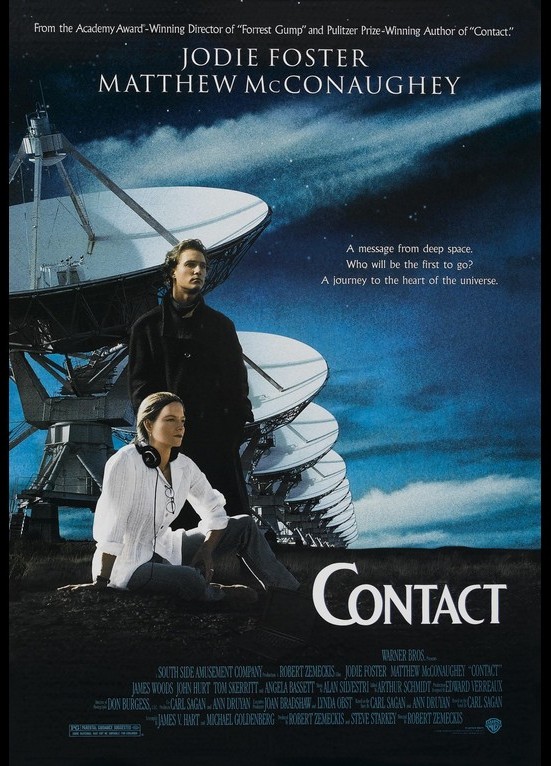
One of my favorite lines from the science-fiction classic “Contact” (starring a young Jodie Foster and and even younger Matthew McConoughey) comes from one of the lesser-known characters. Foster’s Dr. Arroway discovers a communication stream from beyond Earth, while an anonymous millionaire funds the spaceship capable of traveling to the source of the signal. The donor then turns to Foster’s character with a smirk and says, “What do you say, Dr. Arroway… wanna take a ride?”  This year, the same question was posed by the (good) people at Goodyear.

Wingfoot Two is a “semi-rigid airship”

In a nod to my advancing age, the Goodyear Blimp turned 100 on Tuesday (or I should say, one of the Goodyear Blimps).  “Pilgrim”, Goodyear’s dirigible based in Akron, Ohio, took it’s first flight on June 3, 1925.  Now Goodyear can claim a hundred years of lighter-than-air travel, even if this noteworthy form of transportation never made it to the masses.

To be clear, Goodyear started with rubber, and then tires.  They manufactured tires for bicycles and carriages back in the day as well as horseshoe pads and poker chips, before Pilgrim first took to the skies.  Sure, you’ll find their products on vehicles everywhere but what comes to mind when I say “Goodyear”; tires or blimps?

The Goodyear Blimp of my childhood

I choose blimps.  I grew up just thirty minutes from Goodyear’s blimp airbase in Carson, CA.  The blimp I saw back in the ’60’s and ’70’s was named something like “Puritan” or “Reliance” or “Defender”, because Goodyear honored the sailboat winners of the America’s Cup.  Not today.  Thanks to a public naming contest the blimp down the street from my childhood neighborhood is named “Wingfoot Two”.  (I prefer the America’s Cup names instead.)

Maybe you also choose blimps because you drive on Michelins or Firestones.  More likely it’s because you’ve seen a blimp buoyant over the Super Bowl or other sporting event.  And speaking of football, if the Goodyear Blimp sets down on the field it covers 80% of the yardage.  That’s one big balloon.

“LZ 129 Hindenburg”

Goodyear’s flying machines of my childhood were literally balloons filled with helium, without any of the technology of today to make them easier to steer.  Coincident with middle-school history class, whenever I’d see the blimp I’d think of Germany’s Hindenburg, the Nazi propaganda passenger dirigible that, like the Titanic, is best known for its final flame-filled disaster, on approach to Lakehurst Naval Air Station in New Jersey in 1937.  Perhaps we should be thankful Goodyear never promoted its blimps as a form of mass transportation.

Also in my childhood, blimps offered a far more romantic image in the movie Chitty Chitty Bang Bang, where a colorful zeppelin traveled here and there over the fictional country of Vulgaria, carrying the villainous Baron Bomburst and his crew.  (And here’s my opportunity to distinguish between terms.  A zeppelin has more of a cylindrical shape, while a blimp looks more like a sausage.  A dirigible? Just a general term for an airship.)

Speaking of sausage, it was inevitable someone would open a sub sandwich shop named after the aircraft.  The Blimpie franchise (“America’s Sub Shop”) began in the 1960s, spread to locations around the world, and enjoyed a good fifty years of success.  Today most of the helium has left their balloon.  There are only about 25 Blimpie stores left in the U.S. (compared with almost 20,000 Subways).  IMHO Blimpie’s was the better product, at least the version I remember from the 1990s.

Oh how I wish I could’ve concluded this post with another wanna take a ride?  You and I missed the boat, er, airship on that opportunity.  Goodyear held a contest at the start of 2025 and leading up to Pilgrim’s birthday, where three lucky passengers won a blimp ride.  I say “lucky”, when in fact my fear of heights takes away any personal appeal to float up, up, and away.  No worries, because now I’m thoroughly distracted by hunger pangs.  Think I’ll hunt me down a “blimp sandwich”.

Some content sourced from IMDb,  “the Internet Movie Database”, and Wikipedia, “the free encyclopedia”.

Finial Touch

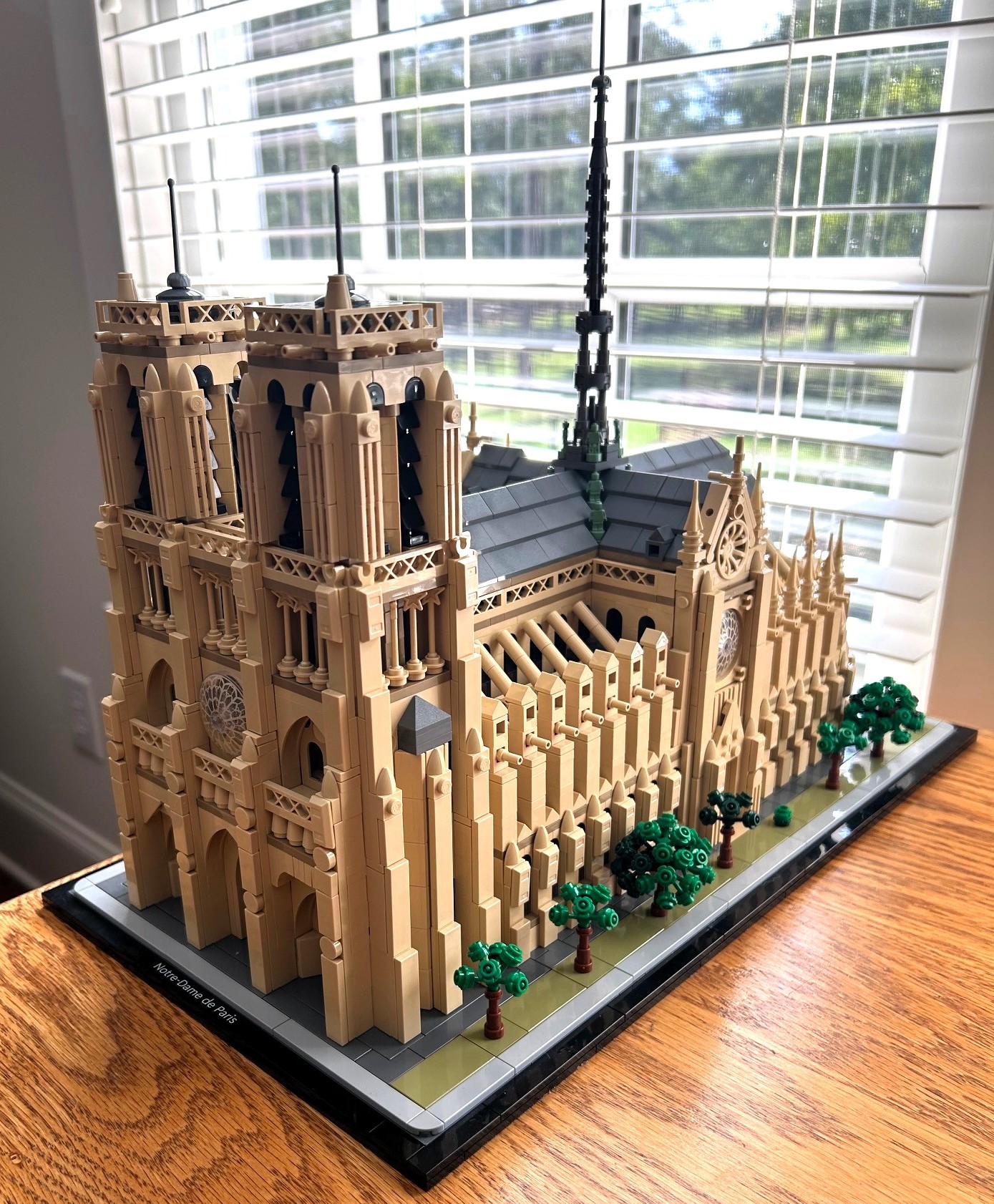
In early January you walked into my blog, took a seat in a pew up front, and witnessed the longest church service in the history of France. From the first LEGO piece I laid as the cornerstone – a now-hidden flat black rectangle – to this week’s placement of the oversized finial on top of the roof, you watched – for almost two hundred years – the slow, somewhat steady rise of Notre-Dame de Paris. Time sure flies, doesn’t it?  But at last we’ve made it to the end (or at least, the year 1345), where the pastor dismisses the congregation with a “Go in peace!”(which sounds much better than “Go in pieces!”)

Notre-Dame de Paris

Some reflection is in order today, especially since we’re talking about a building of faith. Our cathedral adventure over the last 19 weeks took us through 4,383 LEGO pieces and 393 steps of the instruction manual, snapped together in fifteen hours, resulting in a five-pound plastic model that – “thank heavens” – really does look like the famous French cathedral on the Seine River in Paris.

[Builder/blogger note:  I chose my Spotify classical music playlist while I finished up the cathedral.  The first selection was entirely fitting: Edward Elgar’s “Pomp and Circumstance”, because this really did feel like a graduation of sorts.  But the second selection was eerily more fitting: the final chorus of Handel’s “Messiah”.  Ha-a-a-a-a-llelujah indeed!]

Some of the photos here aren’t much different than last week’s, but only because bags 31-34… of 34 bags of pieces, were all about embellishment: capstones, pinnacles, tabernacles, finials, statuary, and all the other little architectural flourishes unique to a cathedral (plus a little landscape on the sidewalk).  You know those cake decorator videos where a white cake sits on a spinner and you get to witness the slow, mesmerizing development of frosting, flowers, and such?  That was me this week; spinning, applying, and fully decorating my cake… er, cathedral.

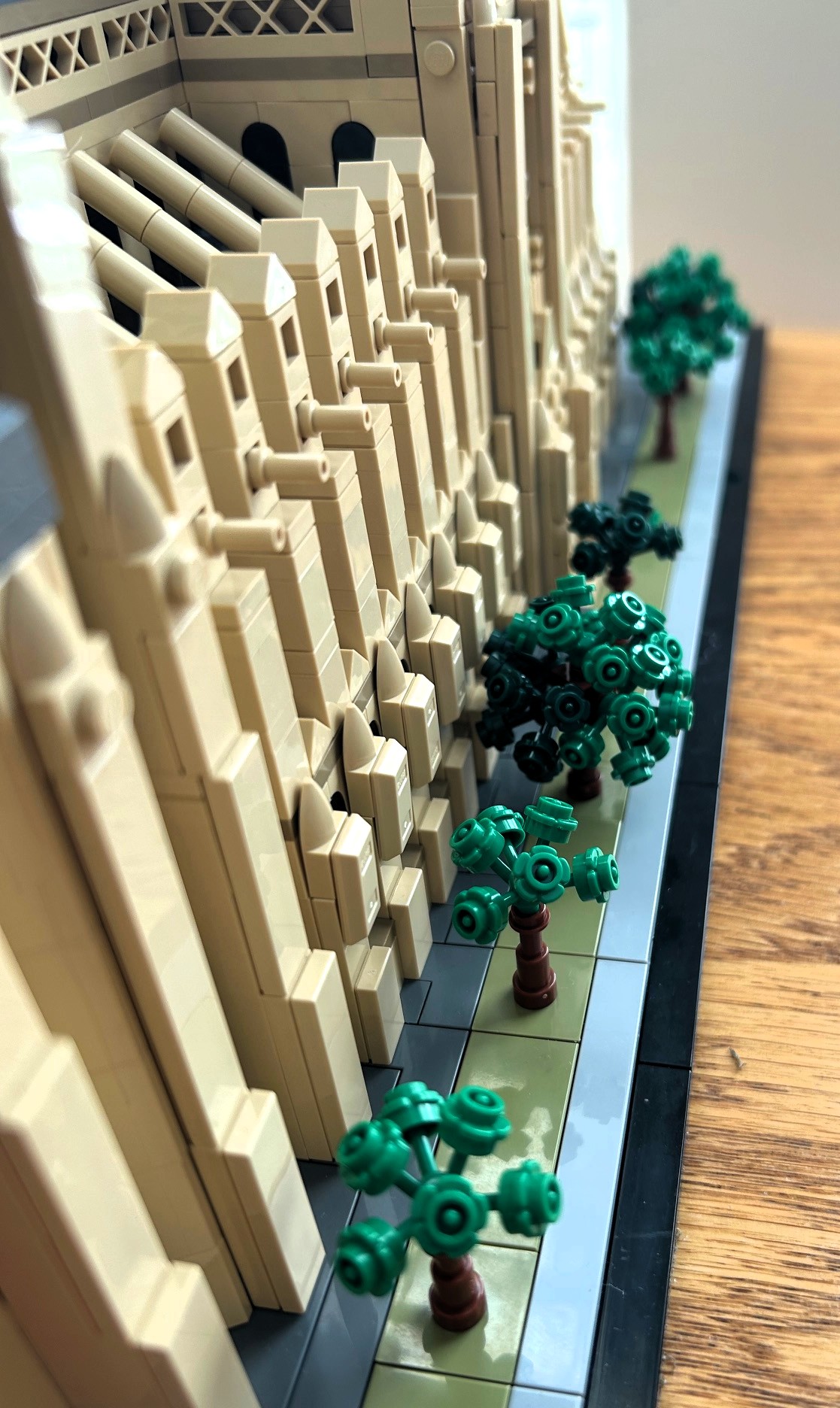
Here’s a good photo of some of this decor (and click on any of the photos to see everything better).  To the far left you can see several of the pinnacles; the little spires all in a row high up.  There are 30 pinnacles on the entire cathedral.  To the right you can see a couple of the tabernacles (14 of those); the open box-like structures above the tiny drainpipes.  And running along the first floor you can see capstones; the helmet-like headers on either side of the open bays.  There are more capstones on Notre-Dame de Paris than any other decorative element (68!)

Here’s a look at the cathedral’s famous flying buttresses, the exterior structural elements keeping the building from falling in on itself.  There are 28 buttresses, including 14 running around the chancel and apse on the east end.  Just below the tabernacle boxes you see the drainpipes.  There are 46 of those.  During a good rainstorm this view would include an elegant line of waterfalls.

Remember those curious “stars on flagpoles” (or “magic wands”)?  Here they are again, all grouped together just below the part of the towers housing the bells.  There are 24 of them.  You can also see one of the cathedral’s three majestic rose windows front and center.  Finally, note the round “medallions” just under the curved arches on either side of the rose window.  You’ll find 24 of those on Notre-Dame de Paris as well; several stamped proudly with a “LEGO” logo.

Okay, one more example of embellishment.  Here you can see the 12 disciples in green, symmetrically positioned around the base of the finial (all facing inward).  When I pulled these little guys out of the plastic bag I thought they were scale figures for down on the sidewalk, but instead they are the statuary I referred to when I first talked about the cathedral back in January.

I’d be remiss if I didn’t say something about the model’s landscape elements.  LEGO has come a long way since the boxy trees surrounding LEGO Fallingwater.  These little “growees” are pretty sophisticated.  Consider the tree in the middle. (Click on the photo for more detail).  It’s made up of 37 LEGO pieces, including the trunk, branches, and leaves.  Furthermore, the branches up against the cathedral are a darker green because, of course, that part of the tree is typically shaded.

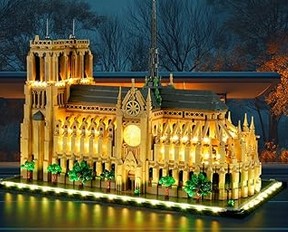
Now then, before you “go in peace” I must mention one more thing; the so-called surprise I teased in last week’s post.  Notre-Dame de Paris is such an elegant structure it deserves to be seen by day… and by night.  Thanks to the good people at Briksmax, I am able to do just that: light up the cathedral from one end to the other.  That’s the good news.  The bad?  I’m looking at another 2 instruction manuals and another 230 steps to get it done.  Are you kidding me?

Briksmax lighting

When I purchased the lights I figured they would be simply and cleverly inserted in and around the completed structure, but NO-O-O-O-O-O!!! (cue horror-movie music).  In order to light up Notre Dame de Paris I must deconstruct the model.  Again I say, are you kidding me?  Here I finally complete my cathedral and now you want me to take it apart again?  Sorry good readers; it’s just not something I can stomach right now.  I’m going to sit and admire my completed cathedral while you settle for admiring the Briksmax photo above.  You don’t place the finial on the roof of the catheral with a flourish, only to then remove the entire roof.  Another church service for another time.

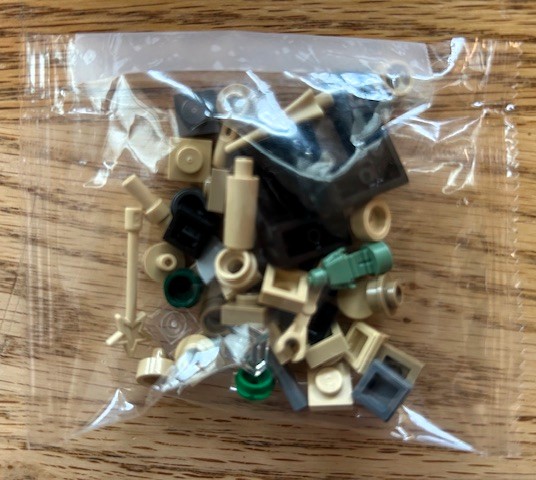
I leave you with one last look at our poor, unused, leftover pieces, all 48 of them in plastic-bagged captivity (but still trying to escape).  I think they all ganged up and cried, “RUN FOR IT!”, because the 49th leftover – a tiny cluster of leaves from one of the trees – went skittering off the desk and onto the carpet below, where it immediately hushed and hid. I still haven’t found it, but no worries.  The next time I walk into my office I’ll probably step on it with a satisfying crunch.

Running build time: 15 hrs. 6 min.

Total leftover pieces: 49

My Unforeseeable Future

In the not-so-distant year of 2062, forecasters predict we will have perfected the invention of “nanofabricators” – machines capable of producing food, clothing, electronics and such, not from assembly-line parts but from the very atoms of those parts. It’s a mind-blowing concept: technology that creates virtually anything by manipulating the structure of raw materials at the molecular level. Too bad I won’t be around to see it.

Is it making your dinner?

When you reach your mid-sixties, the harsh reality is that predictions of what life on Earth will look like in the future focus on a period of time beyond the years you’ve been given.  The experts tend to look fifty years ahead or more, so, sorry Dave, you just won’t be here when all these wonders take place.  It’s a little strange to think about a world without you in it.  Sure, you can also imagine the years before you were born, when your parents and grandparents were living life without you, but those were simpler times devoid of the technology we take for granted today.

Driver’s license not necessary

Consider self-driving cars. Fifty years ago I was a teenager and couldn’t wait to get my driver’s license (the very definition of “freedom” back then). But had you told me, “Hey Dave, you’re not going to need that little card in fifty years because cars will drive themselves”, I would’ve given you a strange look and accused you of watching too many science-fiction movies. Yet here we are.

I hit on this topic today because I’m still processing the fact we have humanoids who can run half-marathons (my post from last week).  When the world’s technology exceeds your expectations, you push the pause button and wonder if you’re getting left behind (or just getting old).  Am I suddenly more inclined to believe those fifty-year forecasts?  You bet I am.  And nanofabricators are just the tip of the inventive iceberg.

Ping-pong partner

Nanobots (does everything in a post-Dave world start with “nano”?) are in the works as well.  A nanobot is a robot so tiny you might not be able to see it with the naked eye.  I was introduced to the concept in Michael Crichton’s sci-fi novel Prey.  Imagine a pile of nanobots sitting in the corner of a window in your house.  Once a day those nanobots spill out over the glass like a wave, consuming any dirt or other matter like little vacuums.  Perfectly clean windows!  Of course, “Prey” takes the technology in a more sinister, out-of-control direction and a bestseller is born.

[Blogger’s note: You’ll find “nanobot” in your favorite online dictionary. At least in some lab environment out there, nanobots are already here.]

With Prey in mind, Hollywood isn’t helping us to embrace these fifty-year forecasts.  Virtually every movie (or book) about yet-to-be-here technology takes the concept in a not-so-nice direction. (The Terminator comes to mind.)  The fact is, nobody’s going to buy a ticket just to watch a happy application of future tech on the big screen.  Something always has to go “worng” (to quote Westworld).

I hope you’ll be around in fifty years to see and experience some of the wonders our forecasters predict today.  Brace yourself: you’ll have a “wearable” of some sort (watch, eyeglasses, implant).  One of you will have bionics in a limb or organ that wasn’t functioning properly.  Some of you will live up in space or deep down in the ocean instead of on terra firma.  It’s a wonderous world I’ll never get to see, but I’ve made peace with it.  At least I won’t be around in 2182, when Asteroid Bennu (we name asteroids?) will be on a collision course with Earth.


LEGO Notre-Dame de Paris – Update #14

(Read about the start of this “church service” in Highest Chair)

The service is rapidly coming to a close. I sense the inevitable benediction and dismissal of the congregation as our work on LEGO Notre-Dame de Paris wraps up. The remaining pieces in Bag 28 brought the cathedral’s bell towers to an even (if not finished) height, while Bags 29 and 30 – of 34 bags of pieces – added more detail to those towers, as well as some elegant structure above the transept doorways.

Bell tower detail

We worked high off the ground today; quite a bit higher than the roof line of the cathedral. My shaking fingers had a sense of vertigo as I added the little drainpipes, railings, and such you see here. I imagined one of those towering mechanical cranes dropping the LEGO pieces into place until, of course, I remembered I was working in the thirteenth century. The word “crane” hadn’t even been invented yet.

Again with the missing pieces.  For the first time since I laid the cornerstone I thought I threw a piece away, along with the plastic bag it came in.  I searched in vain on my office desk, only to decide I’d be going through the garage trash later on.  Then lo and behold, just as I was completing today’s build, there sat the missing piece right in front of me as if to say, “What the heck is wrong with you?  I was right here in plain sight!”

My hat is off to LEGO’s engineers today.  Look at the process above where I completed the structure above the transept doorways.  Those two long LEGO pieces in the first photo are designed to hinge open, simply to allow easier placement of the central cap piece in between.  Then you close those long pieces around the cap like a hug and voila – second photo – the transept is complete.

Our work really is almost done.  Just four small bags of pieces remain – two for the top structure of the bell towers (and a little ornamentation around the cathedral roof), and two for landscape elements to soften the edges of the model.  Don’t walk out of the sanctuary just yet.  The final product includes a surprise!

Running build time: 13 hrs. 58 min.

Total leftover pieces: 40

Some content sourced from the FutureTimeline.net website, the CNN Science article, “Near-Earth asteroid Bennu could hit Earth in 157 years…”, and Wikipedia, “the free encyclopedia”.

Pretty In Pink (and Green)

Here in the South, the arrival of spring has been declared with aplomb. You can already watch the grass grow, and it seems to need cutting every other day.  But even more apparent, the blooms are everywhere. Pink azaleas (a staple at last weekend’s Masters golf tournament) run rampant. The roses have never been redder. And the giant flower heads of white hydrangeas will soon spring forth. This Easter week therefore, it seems appropriate for this blog to pay a visit to another cathedral: Saint Mary of the Flowers in Florence, Italy.

Santa Maria dei Fiore

My LEGO creation of the cathedral of Notre-Dame de Paris is quickly coming to a close, so I need to tour you through at least one or two more cathedrals before I’m done.  The first, you may recall, was Saint John Lateran in Rome (read about that one in Tucked-Away Place to Pray).  Today we’re a three-hour drive to the north, at Santa Maria dei Fiore.  It’s no surprise my tour of the world’s prominent cathedrals continues in Italy.  To be honest, the whole tour would do just fine if it never left the country.

West facade and bell tower

Florence is the capital city of the Italian region of Tuscany, known for its stunning landscapes, world-class wines, and Renaissance art and architecture.  Approaching the city from any direction, you cannot help but notice Santa Maria dei Fiore.  The cathedral is not only one of the largest in the world, but its exterior is finished with marble panels of pink and green, giving the structure a light, airy contrast to the surrounding buildings.  The church is crowned by a distinctive dome, which captures your attention even before the church itself.

Inside shell of the dome

The architect in me wants to highlight Santa Maria dei Fiore for the remarkable engineering that went into this massive structure.  I could spend an entire post talking about the design of the dome alone.  Consider, its structure is actually one inside of another.  The brick-clad concrete shell you see from the outside is connected to the one you see from the inside by “chains” of stone, iron, and wood.  With this approach, Santa Maria dei Fiore doesn’t require the flying buttresses so prominent in Notre-Dame de Paris (a structural element the Italians regarded as “ugly makeshifts”).  And the dome’s four million bricks – which might seem heavy-handed (ha) – are a much lighter material than stone or tile.

There’s more to this cathedral than its dome, of course.  The plan, a traditional Latin cross, includes three rounded apses surrounding the altar, each used as a chapel.  The nave (sanctuary) is the length of two football fields; a vast interior space with single aisles on either side.  The structural arches soar 75 feet above the seemingly endless marble floor.  And perhaps most unusual, Santa Maria dei Fiore is actually a complex of three buildings.  You enter the adjacent octagonal Baptistry of St. John through sets of bronze doors (which are replacements for the famous originals now residing in a nearby museum).  And the slender free-standing Giotto’s Campanile (bell tower) is a decorated work of art in itself.  All three structures blend together with those distinctive pink and green marble tiles.

Baptistry of St. John

If you’re ever fortunate enough to visit Saint Mary of the Flowers, be sure to purchase the ticket to climb to the top of the dome.  Filippo Brunelleschi – the architect -included a narrow staircase between the two shells so you can reach the uppermost cupola for a spectacular view of Florence and the surrounding countryside. Brunelleschi designed other structures in his lifetime; churches, chapels, hospitals, and such, but the Florence Cathedral is his crowning achievement.  It’s no wonder you’ll find his tomb right inside the entrance, alongside the more prominent players in Santa Maria’s storied history.


LEGO Notre-Dame de Paris – Update #12

(Read about the start of this “church service” in Highest Chair)

Oh my stars, the build was challenging today!  Bags 22, 23, and 24 – of 34 bags of pieces, focused almost exclusively on the west facade and the rising of the bell towers.  We added the final rose window (above the west entrance) and reinforced the upper reaches of the nave in anticipation of adding the roof.

Magic wands?

So here’s a detail I didn’t expect.  In Notre-Dame’s towers, just below the uppermost structure (where the bells live – still to be built), you have – how else can I say it? – “stars on flag poles”.  Forty stars on flag poles, to be precise.  When I dumped out Bag 24, I thought, “What the…?” as the pile of magic wands you see here appeared.  Did LEGO mistakenly add pieces from a Harry Potter model into mine?  A Disney perhaps?  Nope.  Look at the final photo.  Every one of those stars is planted at the west end of the cathedral like palm trees; most of them in the bell towers.  Nice detail, Notre-Dame.  As for installing them?  It’s tough enough to push little poles into LEGO holes one-by-one-by one, but then you have to rotate the stars precisely forty-five degrees from the plane of the cathedral walls.  The engineers at LEGO are having a barrel of laughs at my expense.

(Click for more detail)

By the way, we’ve made it to the year 1245 as we build the bell towers, almost a hundred years after laying the first cornerstone at the opposite end.  And we are almost done.  By the numbers we have ten bags of pieces to go, but by the look of the model we’re closer than that.  They must be small bags of pieces.  Whatever.  I just hope they don’t contain any more stars on flagpoles.

Running build time: 12 hrs. 01 min.

Total leftover pieces: 32

Some content sourced from Wikipedia, “the free encyclopedia”.

Chugga Chugga Chew Chew

Technology isn’t always our friend. Recent studies show plastic water bottles shed as many as 24,000 “micro-bits” of plastic into the consumer’s body. These bits measure 1/1000th of a meter across. But more recent studies – studies we didn’t have the technology for even five years ago – reveal the same bottles sheds another 200,000 “nano-bits”. At 1/1,000th the width of a human hair, these infinitesimal particles are so small they pass through the membranes of the body’s organs, leading to heaven knows what kind of damage. “Gulp!”

We love our water bottles!

Let’s leave this horror movie of science-you-didn’t-want-to-know behind and go with glass or metal containers instead.  But it’s virtually impossible to avoid ingesting plastic particles anyway.  And many people make a habit of it every day… with chewing gum.  Gum contains the same microplastics as water bottles.  No surprise there.  You shouldn’t really ingest any of the ingredients in chewing gum.

When you’re a kid however, you don’t care about ingredients (let alone bits of plastic).  Gum chewing is a habit I absolutely subscribed to in childhood.  I still remember the barber who cut my hair when I was single-digits old.  The reward for being a good boy in the chair was to help myself to one of those little wrapped chunks of Bazooka bubble gum.  Bubble gum has a distinctive flavor I can still recall decades later.  The pink stuff also has the built-in game of blowing big, sticky bubbles.

gumballs

After Bazooka came Bubble Yum, a trendy alternative because it was a softer chew from the get-go and packaged in larger chunks.  Bubble Yum came in several flavors.  But for me, chewing gum evolved from “bubble” to “sugarless” in a heartbeat, thanks to one too many trips to the dentist.  Choosing from the “prize shelf” after my fillings, I always went for the pack of Dentyne instead of the toys.  Dentyne was the dentist’s way of encouraging less sugar (and more saliva).  Dentyne was my way of thinking it was still okay to chew gum.

Somewhere between Bubble Yum and Dentyne came those slim packs of “stick gum”, including Doublemint, Juicy Fruit, Clove, and for this licorice aficionado, Black Jack.  I also consumed my fair share of Chiclets.  But my gum habit eventually evolved to more of  a”breath mint” chew.  The one I remember best was “Freshen Up”, the green chunk of gum encasing the small dose of mouthwash gel.  You’d get this mind-blowing burst of mint the moment you bit into it.  Pretty novel for chewing gum.

What I never saw coming – which ground my chewing gum habit to an abrupt halt – was TMJ, also known as (the more scary-sounding) “dysfunction of the temporomandibular joint”.  In plain English, TMJ is sustained pain in the jaw muscles from overuse.  It’s nasty, and if you’re not careful it can be chronic.  For me it was relieved by backing off on the chewing gum… as well as breakfast bowls of Grape Nuts.  If you’ve had TMJ yourself, you know it’s a little unnerving (pun intended) because there’s no guarantee you’re ever gonna get rid of it.

Every now and then someone offers me a piece of gum and I politely decline.  I’m not interested in the return of jaw pain and besides, I’ve developed a preference for breath mints instead.  As for you, whether you chugga chugga (your water) or chew chew (your gum), don’t forget about those nasty nano-plastics.  Just like Mr. TMJ, they’re not your friend.


LEGO Notre-Dame de Paris – Update #11

(Read about the start of this “church service” in Highest Chair)

Today we “leveled the praying field” 🙂   Bags 19, 20, and 21… of 34 bags of pieces, brought the height of the nave to virtually the same as the chancel.  It’s safe to say the lion’s share of the remaining pieces will be (tiny and) focused on building the roof structure and west end bell towers.

Arches and more arches

Dropping a piece down, down, down into the sanctuary – which I managed to do twice today through the top square openings you see here – is no laughing matter.  You might say, “Just flip the model over and shake them out, Dave” but I’m way too far along to risk it falling apart.  Instead, I had to reach down with my giant fingers, gently pinch, and then pull back like a construction crane.  I hope I didn’t scare the parishioners in the process.

We built framed windows today, (plastic) glass and all!  These can be seen in the final photo, on the west end of the cathedral above the doors.  We also built – in somewhat assembly-line fashion – another fourteen of the cathedral’s distinctive flying buttresses.  But the most tedious, time-consuming task of all was the arched windows you see along the upper walls of the nave in the first photo.  Each is assembled from a dozen finger-numbing pieces.

Uniform height

Finally, a word about weight.  I picked up the cathedral the other day and went, “Holy cow!” (ha).  Turns out this beast weighs a robust three pounds already.  That’s a lot of plastic.  And given today’s blog topic I’m thankful the model isn’t edible. 

Running build time: 10 hrs. 28 min.

Total leftover pieces: 28 (no new ones!)

Some content sourced from the CNN Health article, “Chewing gum can shed microplastics into saliva…”, and Wikipedia, “the free encyclopedia”.

Crop of the Cream

One of the essentials you’ll find in our refrigerator is a container of “half & half”.  The 50/50 concoction of milk and light cream creates the perfect texture in our morning cup of coffee.  Anything leaning more towards nonfat just doesn’t cut it for us.  Earlier this week I noticed (with a wry smile) our half & half was parked right next to a tall, red can of Reddi Wip.  Talk about your polar opposites.  In the Jeopardy category of “Cream”, it doesn’t get much different.

Today’s topic is brought to you by the makers of Häagen-Dazs.  My wife brought home a couple of containers of their ice cream the other night, and right after dinner I was eager to dig in.  The little tubs were smaller than what I was used to but I figured it was a good way to curb consumption.  After the first bite however, I realized something wasn’t quite right.  Or maybe it was very right.  Turns out, I was enjoying the coffee flavor of Häagen-Dazs’ “cultured crème”.  In other words, yogurt instead of ice cream.

Häagen-Dazs describes its new product as “a unique blend of dairy cultures that offer a smoother taste experience unlike the slightly sour flavor of traditional yogurt.”  Okay, that’s a mouthful (ha).  It’s a tasty mouthful but it’s also just another spin on food products with creamy consistencies.  We foodies are all about “mouth feel” aren’t we?

You probably have more cream-based products in your refrigerator/freezer than you realize.  Go take a look.  It wouldn’t surprise me to learn you also have a can of Reddi Wip (at least you Americans), as well as a tub of sour cream, several sticks of butter, several flavors of ice cream, and whatever version of “creamer” you prefer in your coffee.

Cream itself is, of course, the higher fat layer skimmed from the top of raw milk.  It’s sold in several grades depending on the butterfat content.  IMHO the Canadians have the most straightforward set of descriptors, as follows:

  • 40% milk fat: manufacturing cream (not available as retail)
  • 33-36%: whipped cream (for topping)
  • 15-18%: table cream (for coffee)
  • 10%: half and half (for cereal, sauces, and soups)
  • 3-10%: light cream (lower-fat alternative to any of the above)

Other countries complicate the matter, but often for the better.  The French have their crème fraîche, which belongs in the 40% category above and makes for a nice unsweetened topping on a very sweet dessert.  The Swiss produce a “double cream” that hits closer to 45% and is probably as thick as yogurt.  And the Brits are famous for their “clotted cream”, which tops the milk fat charts at 45% and spreads on a scone like butter.

Whether “cream” or “crème” (or even “crema”), the word enhances the appeal of a food product.  Consider cream pie versus just “pie”.  Cream puff instead of just “puff”.  Want a cookie, or how about a cookie with cream filling?  And anything with buttercream frosting – versus just “frosting” – is more decadent.  Heck, I’d even try “plant cream” if you asked me to (the vegan spin on dairy).

For my money, any product with “Häagen-Dazs” printed on the label is worth a try.  Their ice cream products are the cream of their crop but it’s safe to say I’ll be buying more of their cultured crème cups.  Not a bad substitute for less healthy dessert options.  And just the latest entry in the crop of the cream.


LEGO Notre-Dame de Paris – Update #10

(Read about the start of this “church service” in Highest Chair)

Roses are red, violets are… hang on, hang on; back up the truck.  In Notre-Dame de Paris, roses are stained-glass windows.  Bags 17 and 18… of 34 bags of pieces, focused almost entirely on the construction of the cathedral’s spectacular wheel-like windows.  Today we worked away from the model to completely build two of the three roses, then installed them above the north and south walls of the cathedral’s transept.  The LEGO versions aren’t nearly as intricate as the real windows but each one is still made up of thirty tiny pieces.

LEGO’s rose windows are necessarily simplified, but that’s not to take away from the craftsmanship of the windows in Notre-Dame de Paris.  The transept roses are forty-two feet in diameter (about the width of a basketball court).  The artwork of their dozens of panes of stained glass contains scenes from the life of Christ, the twelve apostles, as well as martyrs, virgins, angels, saints, and more.  It’s a wonder these windows were created way back in the year 1250.  It’s also a wonder they’ve lasted through wars and such, undamaged, for almost 800 years now.

Besides the rose windows, we added more structure to the rising walls of the nave today, the area on the left side of the photo covered in gray.  I point this out because the sanctuary is getting more and more closed in as we anticipate more of the roof structure above.  Lest I’m fooled into thinking we’re almost complete, the fact is we have another sixteen bags of pieces to go!

Running build time: 8 hrs. 58 min.

Total leftover pieces: 28

Some content sourced from the Häagen-Dazs Cultured Crème website, and Wikipedia, “the free encyclopedia”.

Fruit of the Bloom

On Monday I noticed a lot of the wearing o’ the green because, of course, Americans celebrate St. Patrick’s Day as if we are somehow Irish. It’s a fitting burst of color as winter slowly but inevitably surrenders the seasonal baton. Soon you’ll find a full-on rainbow of blooms in every garden you pass. For now however, let’s drink and dance in honor of another bright color this week: pink. More to today’s topic, cherry pink.

If you’re tuning in from Washington D.C. you already know where I’m going with this one.  Today is the first day of spring, and the beginning of the Cherry Blossom Festival in our nation’s capital: four weeks of seemingly countless opportunities to celebrate the flowering of the graceful trees on the banks of the Potomac.  If you’d asked me a week ago what the bloomin’ fuss is all about, I’d have said the festival’s significance is as shallow as the water in the Lincoln Memorial Reflecting Pool.  But now I’m properly informed.  There’s more to this story than just pretty in pink.

“Yoshino” cherry blossom

In the early 1900s, America and Japan were unconditionally friendly countries (years before that little dust-up in the 1940s).  To acknowledge the friendship, Tokyo’s mayor shipped 3,000 Japanese cherry trees to Washington D. C.  There’s a longer, more convoluted history behind this gesture, including players from both countries making repeated efforts to populate the city with trees, but the details are about as interesting as pushing a bill through Congress.  Suffice it to say cherry trees were planted along the river, up and down the avenues, and in numbers worthy of an annual festival starting in the 1930s.

I love cherries; always have.  I think the flavor itself appealed to me before the fruit, in the popular junk food of the 1970s.  Hostess Fruit Pies.  Life Savers.  Slurpees from 7-11.  Or the proverbial maraschino on top of an ice cream sundae.  As much as I got my fill of those, I could never get my fill of my mother’s homemade cherry pie, and I mean homemade.  The cherries were passed down from her mother each year, picked, jarred, and ready to go.  The crust was made from scratch, including the signature latticework on top.  It’s a wonder the butter wasn’t churned from the milk of a family cow.

Alas, no longer on the menu

It’s also a wonder I’ve never been to D.C.’s Blossom Festival, considering my unabashed affection for the fruit.  I’m sure I’d find a couple dozen new ways to enjoy cherries besides the usuals.  I’d happily scarf down a serving of flambéed Cherries Jubilee over ice cream, or the cherry-filled sponge cake of a Black Forest gateau.  For the more adventurous there’s a savory Hungarian soup made with sour cherries.

“Petals and Paddles” race

Of course, there’s a lot more to the Blossom Festival than just food.  You’ll find parades, concerts, and kite-flying, with every shade of pink you can imagine.  Tour the historic Anderson House, filled with art and floral displays (featuring the cherry blossom, of course).  Compete in a “Petals and Paddles” boat race across the tidal basin surrounded by the trees.  Or get wet in “Pink in the Pool”, a family-friendly swim party replete with colorful beach balls.  There’s even an “Opening Ceremony” event on the first Saturday, (already sold out by the time I checked the website).  The weeks-long agenda proudly declares “events are primarily free” but I beg to differ. Tickets to the first several on the list were decidedly pricey.

For all I’ve just written, it’s a wonder the word “cherry” appears less than ten times in the hundreds of posts I’ve published on Life In A Word.  One time I referred to the children’s game “Hi Ho! Cherry-O”.  Another I talked about Cherry Coke.  The rest were the same things I mention here – ice cream sundaes, Slurpees, and so on.  So let’s add the Blossom Festival to the list, shall we?  With four weeks of celebrating, it’s safe to say life is a lot more than just a bowl of cherries.


LEGO Notre-Dame de Paris – Update #9

(Read about the start of this “church service” in Highest Chair)

What was once a giant box of LEGO pieces is finally starting to resemble a cathedral!  Bags 15 and 16… of 34 bags of pieces, focused entirely on the body (nave) of the structure.  We’re now building in the years 1220-1225, when the walls of the nave rise to the same height as the semicircular chancel at the east end.

Under construction
Fully fortified

The parishioners look rather tiny, now that we’re working so far above them.  And notice all those free-standing columns from last week aren’t so free-standing anymore.  We’ve capped them with structural elements to support what is still to be built up above.  Also notice we’ve closed in the west end of the cathedral, which patiently awaits the addition of the soaring bell towers.

West end “front doors”

Okay, it’s time to address the elephant in the room; an elephant that gets bigger with every update.  A few of you have sounded the alarm on my running count of leftover pieces.  It’s a fair concern, considering the LEGO Grand Piano also started as thousands of pieces but only amounted to a handful of extras.

extras

Here’s the truth of it: the twenty-six leftovers shown here amount to just a handful as well.  Every one of them is among the tiniest pieces in the entire cathedral.  It probably cost LEGO pennies to add in these “bench players”.  And given the tendency of pieces to run away I’m grateful to have them.  Heck, by the time the cathedral is finished maybe I’ll have enough leftovers to build a small elephant. 

Running build time: 7 hrs. 57 min.

Total leftover pieces: 26

Some content sourced from the National Cherry Blossom Festival website, and Wikipedia, “the free encyclopedia”.

Tucked-Away Place to Pray

In trying economic times like these, it wouldn’t surprise me to hear about people using credit cards to pay their bills. After all, when you have more month at the end of the money you do what you must to stay above water. But it’s a bit of a fool’s game isn’t it, creating one debt to eliminate another?  Its what we call robbing Peter to pay Paul. And speaking of the Christian apostles, let’s talk about robbing John to pay Peter.

St. John

As promised when I began construction of the LEGO model of Notre-Dame de Paris last month (read about how I started this project in Highest Chair), I’d like to pay homage to a few of the world’s prominent cathedrals along the way.  These magnificent structures are places of worship at heart but oh-so-much more besides.   Each can be completely different in look and location.  My goal here is to not have you walk away from Notre-Dame thinking “seen one, seen them all”.

What better place to start than at the most significant cathedral in the world?  I’ll give you three hints.  It’s located in the middle of Rome.  It serves as the seat of Rome’s bishop (who just happens to be Pope Francis).  And it’s named for one of the most influential figures in the Bible.  Okay, time’s up, let’s have it.  Did you guess St. Peter’s?

Cathedral of Saint John Lateran

If St. Peter’s was your guess, you’d be… incorrect, and in fact, incorrect three times over.  The St. Peter’s you’re thinking of – the “largest and greatest” church in the world – is not even a cathedral (but merely a basilica).  St. Peter’s is not even in Rome, since the Vatican is technically its own country.  Finally, St. Peter’s is not the seat of the pope (or any other bishop), even though Francis does live close by.  Instead, the award for most significant cathedral goes to Saint John Lateran.

The Lateran cathedral is about a 5K jog from St. Peter’s Square.  In fact, if you were to make the walk from one church to the other you’d pass by several of Rome’s highlights.  The Pantheon.  The Trevi Fountain.  Piazza Venezia.  The Forum.  The Colosseum.  Eventually you’d be standing in front of the imposing facade you see above.

Click the photo to see the tiny tourists!

Saint John Lateran is old – even by Rome’s standards – first established in the mid-300s.  It sits on the site of the former Lateran family palace.  The cathedral survived several fires, earthquakes, and periods of deterioration, eventually retreating into the shadow of the grander St. Peter’s.  In the 1700s the Lateran received a complete overhaul, including the facade you see today.  But it has always served as the cathedral of Rome.  In fact, a plaque near its ancient bronze doors deems (in Latin): “… mother and head of all churches in the city and the world.”

Apostles guard the cathedral

Like Notre-Dame de Paris, the Lateran boasts a lot more than just the structure itself.  Giant statues of the twelve apostles line the interior of the sanctuary.  Six popes are buried here.  The ancient Egyptian obelisk in front of the church is the world’s tallest.  Finally, the Lateran claims to have hosted significant relics of Christianity over its many years, including the Ark of the Covenant, the wooden table where Jesus hosted the Last Supper, and (for the less faint of heart) the skulls of St. Peter and St. Paul.

St. Peter’s Basilica and Square

It goes without saying; a trip to Rome isn’t complete without a visit to St. Peter’s and its surrounds.  The sheer size and elegance of the basilica is unparalleled and worth several hours (if not days) of your time.  But now you know; Saint John Lateran also deserves your attention.  It’d be a shame to travel all the way to Italy and back without claiminng a visit to the most significant cathedral in the world.


LEGO Notre-Dame de Paris – Update #6

(Read about the start of this “church service” in Highest Chair)

The model-building word of the day, boys and girls, is structure.  Bag 9… of 34 bags of pieces, brought us face-to-face with the finished look of Notre-Dame de Paris’s iconic flying buttresses, installed carefully around the walls of the cathedral’s east end.  Most of those “pasta bits” I showed you in our last visit amounted to fourteen (or about half) of the cathedral’s buttresses. They look like tiny cannons, don’t they?

before
after

Remember, the structural support of this cathedral is on the exterior, allowing for tall, thin walls, and more uninterrupted open space inside.  Someone could come up with the ten coolest structural elements for buildings and I’d have buttresses “fly” to the top of the list.

If Notre-Dame’s parishioners felt a sudden sense of security and stability, it’s because the giant hand of Dave was buttressing the very walls around them as they worshiped.  And if these structural elements aren’t elegant enough, they also house horizontal pipes to drain the water from the cathedral roof. 

Chancel w/ flying buttresses
Side buttresses w/ low drainpipes

I keep referring to the cathedral’s “east end”, but now that we’re starting to see the finished product we should use proper terms for church architecture.  We’ve effectively completed the chancel, which is the altar and surrounds to the east of the transept.  Picture a giant Christian cross laying on the ground.  The top of the cross is the chancel and the crossbar is the transept.  The lower length of the cross, where most of the parishioners sit, is the nave.  At the very bottom of the nave will be the bell towers.

Gotcha!

Today’s build was not without its adventures.  A small black piece escaped to my home office floor early on, prompting a prolonged hands-and-knees search.  I swear I heard the piece clatter to the floor yet neither hands nor knees made the encounter.  I was perplexed.  Finally, with the aid of my handy-dandy iPhone flashlight, I found the crafty little devil way, way back in the dark central recess of my desk.  This little guy was clearly making a move to freedom.  Sorry, bud; it’s time to come home.

Are you lost?

Finally, I thought the adjacent photo was worth including.  Pretty much every single LEGO piece of Notre-Dame de Paris is unique in size and shape.  Except this one.  How does a singular “trademark” LEGO block end up amongst thousands of irregular pieces?  Sadly, this piece was installed one level below the dark gray roof line of the chancel, which means you’ll never see it in the finished product.  So I figured it deserved its moment of glory here instead.

Running build time: 5 hrs. 32 min.

Total leftover pieces: 23

Some content sourced from Wikipedia, “the free encyclopedia”.

Adventures in Library-ing

Early each calendar year I look back on the previous year’s expenses to discover areas in the family budget where I can trim. The price of food, gasoline, and other “have-to-have’s” always seems to go up, so I search for items that are not so “have-to-have” to balance things out. A good example is books. I read two or three a month on my Kindle e-Reader. At say, $14.99 a pop that’d be over $500 I could carve out of annual expenses… if I could only get those same books at no cost. But where-oh-where could I possibly find books for free?

You bibliophiles out there (and the rest of you, for that matter) are laughing as I’m about to describe going to the library as an adventure, but here’s the thing.  I’ve been e-reading on my Amazon Kindle for so long that the idea of holding a book and turning its pages – let alone checking one out of a library – has become, well, novel again.

I wouldn’t have reached this crossroads were it not for a particular book.  Amazon described Frank Delaney’s The Matchmaker of Kenmare just the way I’d hope: an intriguing WWII-era work of fiction.  So I went to “try a sample”(where Amazon allows you the first several pages of the book for free) and – horror of horrors – it’s not available in digital format.  WHAT?  No e-Version?  You’re saying, Amazon, I have to shell out $24.99 for the hard copy if I want to read it?

A book for $10 doesn’t make me pause but one for $25 sure does.  Hence began my library adventure.  The last time I spent meaningful time in one was in college (and I don’t want to tell you how long ago that was).  The library experience is probably different in every way now, starting online. When I “checked out” my library’s website (ha) I discovered I could get a digital library card almost immediately.  With the digital card I could reserve and check out books from the comfort of my home computer.  Hurrah, free books here I come!

Oh how I wish it were that easy.  Turns out, my library’s software is not compatible with an Amazon Kindle.  No digital books for me, sigh.  And besides, physical books – like the one I wanted – require a physical library card.  So with no other excuse to avoid it, I got in my car and headed off to my local branch.  Guess what?  Parking at the library is free.  Entering the building itself is free (no cover charge!).  Getting a library card is free.  Even the library bathrooms can be used without having to check out a book first.

Our main (and modern) library branch

Yes, this is my tax dollars at work of course, but the illusion of all this free stuff is fun while it lasts.  And boy howdy, libraries aren’t what they used to be.  Ours has all these rooms and services and people, as if the surrounding shelves of books are merely a carry-over from past generations.  You can sit down to public-access computers, attend a lecture, host a meeting, rent DVDs, buy coffee, and even spend time in a room of books dedicated to the history of the surrounding county.  Maybe this is all review for you, but it’s a little overwhelming for an e-reader who’s navigating libraries of the new world.

Our secondary (and ancient) library branch

There’s more to this adventure in library-ing than I have time for today (including the over-the-river and through-the woods visit to a different and decidedly ancient branch in my library’s network), but let’s close the book on this topic with a “laugh’s on me” conclusion.  As I was researching for this blog post I went to the Amazon page for my Matchmaker… novel again.  Go figure; it’s available in digital format after all, and even in paperback.  How did I miss these options the first time around?  Must be the library gods telling me to go old-school and get a physical copy for free.


LEGO Notre-Dame de Paris – Update #4

(Read about the start of this “church service” in Highest Chair)

Click the photo for a more detailed view

As Notre-Dame de Paris rises slowly from its foundations, I often picture a congregation of parishioners down there at ground level, sitting quietly in the pews.  Startled by the snap of a LEGO block above them, they gaze skyward, see my giant fingers, and wonder, “OMG is that the hand of God?”  No, no, little ones, it’s just Dave, working through Bag 7… of 34 bags of pieces.

The little devil was still in the bag

Today almost included the long-awaited moment where I realize with mock horror that LEGO left a piece out of one of their model sets.  I churned through my piles of pieces, endlessly stirring and turning them over and over, but to no avail.  A piece was missing, and that sick-to-your-stomach feeling settled in deep, the way you reach the end of a jigsaw puzzle minus one piece.  Then, to my utter amazement, I spied it out of the corner of my eye.  The tiny traitor was still in Bag 7.  Wow.  Good thing that plastic bag wasn’t already relegated to the trash, huh?

“Underfed” buttresses

On the other hand, with more excitement than it probably deserved, today we began construction of Notre-Dame’s signature flying buttresses.  At first I was disappointed in the LEGO pieces, because I thought they looked a little, well, “underfed”.  Then I remembered; we’re only beginning the structure of the buttresses.  The finished look you see on the outside of Notre-Dame is supported by a complex of arches and columns well below it.  Here I thought my “God’s hand” was already working at roof level but in fact, we’re only about halfway up the structure.

Running build time: 3 hrs. 32 min.

Total leftover pieces: 16