Flying Fur

When we take our aging dog for a drive, we go through a set routine to get him on board.  Prop the back passenger door of the truck wide open and position the homemade ramp against the threshold.  Get him into a running start so his momentum carries him up the ramp and onto the seat.  And don’t forget the water bucket, a couple of large poop bags, and a leash that doubles as a lead line for a horse.  With all that in mind I can’t imagine ever getting our St. Bernard onto an airplane.

You’re seeing furry friends on passenger laps more frequently these days (which creates a delightful image with a St. Bernard) so perhaps it’s no surprise to read about a commercial airline designed for “dog-first travel”.  BARK Air completed its inaugural flight last week from New York City to Los Angeles, hosting six dogs, six owners, four flight crew, and BARK Air’s CEO.  The ticket for each dog + owner cost an I-can’t-afford-it $6,000.  One way.

BARK Air’s mantra is “… to deliver a white-paw experience” and my jaw didn’t drop much when I read into the details.  Your dog only has to be leashed on takeoff and landing; otherwise he/she is free to romp around the plane and socialize with the other dogs and humans.  Your dog receives treats, toys, and calming scents and sounds along the way.  And “potty time” is anywhere – anywhere your dog wants it to be on the airplane.  The flight crew is trained to be at the ready for clean-up after every “accident”.  Would you want that job ?

I can see how BARK Air appeals to the one-percenters.  For the money they can’t seem to spend fast enough, they and their dogs fly in style instead of on “people planes” with the rest of us commoners.  Their dogs travel off-leash instead of in crates, which BARK Air speaks to repeatedly in its advertising.  In fact, BARK Air’s CEO traveled in a dog crate the entire inaugural flight, a nod I suppose, to their “dog-first travel” slogan.

Pretending to be rich/famous, I decided to book our St. Bernard and me on one of BARK Air’s New York-Paris flights next month.  I figured, why not take our boy to France, then on to Switzerland, where he could strap on a barrel of brandy, meet up with a bunch of other St. Bernards, and frolic in the Alpine snow?

The booking process was easier than I expected.  A few clicks on the website and BARK Air was ready to accept the $6,000 for me and my St. Bernard to fly.  Okay, so Paris isn’t one of their options yet (that’ll cost $8,000 when it is) but of the four flights in June, two were sold out and two were about half-full, so clearly dog lovers are going for the concept.  And unlike hotels, BARK Air doesn’t have the weight limit my St. Bernard always exceeds.

Still, I just can’t picture it.  My St. Bernard wouldn’t be coaxed, let alone be able to navigate that narrow steep ramp up onto the plane.  His constant panting would drown out BARK Air’s calming sounds.  His drool would be flung onto every other dog and passenger after he slurps from his water bucket.  And no amount of BARK Air’s calming scents could cleanse his breath, which my wife and I still back away from after all these years.

Our big boy is the one in the middle

We’re heading out on a two-week trip today, leaving our big boy behind for my daughter to take care of.  Gonna miss him big-time, which is probably why BARK Air somewhat appeals to me, crazy-expensive as it is.  But our St. Bernard’s in good hands while we’re gone, and he’ll do an adorably clumsy doggy dance when we walk back through our door.  Yep, I’ll leave BARK Air’s dog-first seats to someone else. Maybe I’ll reconsider when they start flying to Switzerland.

I’ll be back in touch after our vacation.

Some content sourced from the NPR article, “Air travel has gone to the dogs – literally…”, and the BARK Air website.

Berry Expensive

When it comes to fruit, berries top the list of my favorites.  I’ve always been a fan of grapes, apples, and pears – probably because I ate a lot of them when I was a kid – but over the years I’ve come to appreciate berries as much for their taste as for their healthy benefits.  Now don’t ask me to choose a favorite berry because I’d struggle between strawberries, blueberries, and raspberries.  And where-oh-where would I rank pineapples?

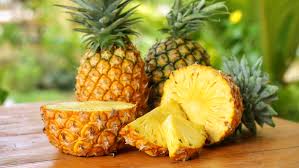
That’s no berry blunder I just made there.  Pineapples – go figure – are a berry.  I meant to start this post from a wholly different angle but I couldn’t get past this juicy tidbit of trivia.  As a pineapple plant grows, the individual flowers fuse together to create a cluster of “berries”, which go through an extraordinary evolution to end up as the cohesive pineapple you and I know and love.  Grow one in your garden sometime and watch it happen.  For the most part, all you have to do is slice off the top of the fruit and plant it.

I could’ve guessed pineapples fall among nature’s sweetest fruits.  In fact, on a list of the top ten the pineapple rates second-sweetest of them all (only mangoes contain a higher concentration of fructose).  For perspective, grapes, cherries, and strawberries are further down the list and each of those are plenty sweet.  We might as well be talking about candy here instead of pineapple.

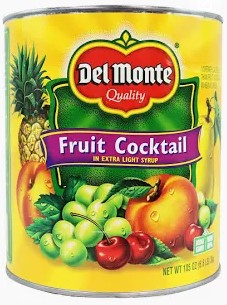
I do love pineapple, and I’m guessing part of the appeal is the nostalgia of childhood eats.  My mother liked to serve pineapple chunks on top of cottage cheese as a side salad.  She occasionally broke out a can of Del Monte “Fruit Cocktail”, a concoction of pineapple and other fruit pieces submerged in a sickly-sweet syrup.  My mother also baked whole hams with pineapple rings dotting the surface.  I won’t claim baked pineapple tastes as good as a fresh slice, but the slightly-burnt taste comes to memory like it was yesterday.

There was a pineapple upside-down cake or two in my childhood but I was never really a fan.  Fruit belongs in pies if you ask me (hence my dislike of Easter hot cross buns and Christmas fruitcake).  Admittedly, he or she was a clever soul who realized fruit could be nestled into the top of a cake if placed at the bottom of the pan first (followed by the cake batter, followed by a flip of the pan after baking).  And who knew: prunes, not pineapples, were the first fruit to grace upside down cakes.

My favorite pineapple story comes from our honeymoon.  Through a travel agent we booked several days at an all-inclusive resort in Hawaii.  The first morning we ordered fresh pineapple from room service.  It was so delicious we ordered more every morning thereafter, enjoyed on our private balcony as we gazed out to the Pacific.  But at check-out, my jaw dropped when I saw every one of those (overpriced) breakfasts on my bill.  I promptly asked the hotel manager to look into it and he goes, “Oh, that all-inclusive package your travel agent booked was discontinued years ago.  You have to pay for the breakfasts now.  Might want to take her back an updated brochure”.  Whoops.

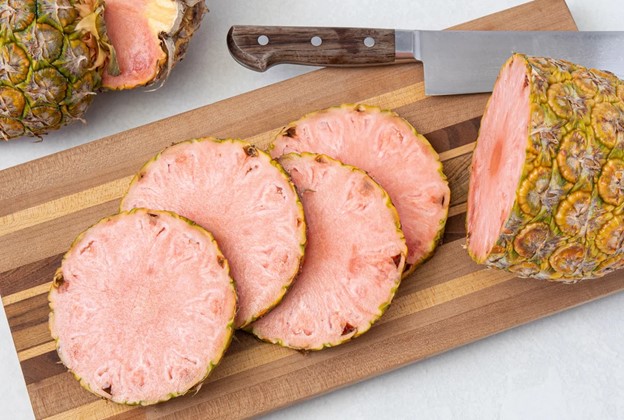
Del Monte’s “Rubyglow” pineapple

Speaking of pricey pineapple, a new spin on the tropical fruit will set you back almost $400.  Say that again, Dave.  Okay, you’ll pay $400 for a pineapple if you really want to.  One of Del Monte’s unique “Rubyglow” pineapples costs that much (and yes, I did say one).  Those who have already indulged say the only difference is the lack of bitter aftertaste you get with a regular pineapple.  Otherwise, you’re paying more for the distinctive look (and the fancy box) than you are for the fruit inside.  My first thought when I saw the photo: the Rubyglow looks like pineapple and ham all in one food.

At the start of this post I was stuck on “berry”.  Now I’m stuck on “berry expensive”.  $400 for a piece of fruit is bonkers.  I’ll never pay it.  For my hard-earned dollars I’ll take forty overpriced piña coladas instead.

Some content sourced from the Medium.com article, “Top 10 Sweetest Fruits”, the CNN Business article, “$400 for one pineapple: The rise of luxury fruit”, and
Wikipedia, “the free encyclopedia”.

Ear Plugs Recommended

I try to avoid topics causing thoughts of negativity or fear. After all, who wants to read about invasions when they can find plenty about them in their daily news feed? But one particular assault has been relentless, both in the media’s coverage and the anticipation of its arrival. They’re coming… I know they’re coming. One day very soon I’m going to be surrounded by buzzing, mating, disgusting cicadas.

“I’m coming for you!”

Until we moved to the South, I admit to knowing virtually nothing about cicadas.  Sure, I could pronounce the word and probably had a vague idea of what they looked like, but I’d never heard, let alone seen the insect in locales further to the West.  Well, Mother Nature has decided to address that deficit of knowledge this year, in spades.  The forecast infiltration of B-flick bugs is projected to run into the billions (as if anyone could possibly count how many).  And they’ll be here in the next week or two.

To prepare for this overwhelming assault, I decided to learn a little more about the humble cicada.  It is one of God’s more bizarre creatures, both the look and the lifecycle.  Cicadas live underground almost their entire lives.  They feed on the sap of plant roots.  The only time they surface is to mate, about fifteen years after birth.  The females lay their eggs in slits they make in the branches of trees.  After birth their little “nymphs” plunge to the ground, where they burrow down deep to begin their subterranean lives, and the cycle starts over again while Mom and Dad promptly enter the pearly gates of cicada heaven.

“Bug eyes”

It’s the stuff of horror movies, this bonanza of bugs.  The problem is, a realistic depiction on the big screen has to include a soundtrack loud enough to make the viewing unbearable.  THIS is what your local reporter is so jazzed about.  The male cicada makes a shrill sound to attract the female, which can only be described as an incessant scritch-scritch, scritch-scritch.  Now multiply the sound by billions, and the better descriptor is “lawnmower” or “jet engine”.  Best get a set of earplugs while the stores still have them.

The “buzz” (ugh) about this year’s offensive is the overlapping emergence of two broods where there would normally only be one.  It’s a doubling-up that hasn’t happened since the days of Thomas Jefferson.  There’s enough membership in both clubs to adjust the forecast from “billions” to “trillions”.  Brings a new meaning to “take shelter”.

Let’s build the horror film script, shall we?  Cicadas make their skritch-skritch sound with vibrating membranes on their abdomens [pausing here to allow stomachs to settle].  Cicadas shed their exoskeleton as they transition from juvenile to adult (time to grow up, little ones), and leave those shells all over tree trunks for us humans to find afterwards.  Finally, cicadas are chock full of tree sap.  For a wish-I’d-never-read-it analogy, just think of cicadas as nature’s Gushers… the bright green variety of the candy.

Nope, absolutely not

Birds will be thrilled with the arrival of trillions of Gushers.  They’ll feed on them to their heart’s content.  Okay, so now we’re talking about two cicada invasions followed by one bird invasion.  Oh, and throw in several poisonous copperhead snakes while you’re at it.  The copperheads like to hang out at the base of the trees, to feed on any falling cicadas.  I told you this would be a horror movie.

The rumors are flying on the when and where of this year’s cicada onslaught.  America’s Midwest and Southeast regions seem to be sure things.  More specifically, Illinois and Georgia, although one report includes several counties here in South Carolina.  Seriously, the thought of untold numbers of these winged nightmares living below the very ground I walk my dog on puts some serious shakes into my legs.

Despite the headlines and anticipation (and the inevitable movie due out next Halloween) there’s very little “horror” to expect from the cicada raid.  They don’t bite, they don’t move around much, and they die pretty darned quick after they mate.  I’m guessing they don’t care much about the humans walking underneath them either, because they’re too busy making trillions of nymphs.

Mr. and Mrs. Miller

Normally this time of year I’m complaining about a wholly different invasion of insects. Out in Colorado – where we still have a “For Sale” sign on the property of our former ranch – we’re about to get a visit from the wretched miller moth (which I blogged about in Late Night Racquet Sports).  Like the cicada, miller moths don’t bite and don’t care much about humans, but man do they migrate.  Like, from the Midwest to the Rocky Mountain states and on into Utah.  They’re so messy I’d almost prefer a double dose of trillions of cicadas instead.  Like I have a choice.

Some content sourced from the Mercer University article, “What’s up with all the cicadas?…”, and Wikipedia, “the free encyclopedia”.

Going for a Spin, Spin, Spin

My wife and I enjoy popcorn after dinner, probably because we’re watching more movies at home these days. It’s easy prep thanks to our Presto air popper. Dump in the kernels, plug in the popper, and “presto”; a delicious snack in an instant.  Of course, one of these days our air popper will break and we’ll have to buy another one. Unlike our KitchenAid stand mixer, which will spin,spin,spin until the end of time.

KitchenAid’s classic stand mixer

If your kitchen is like ours, the cupboards are full of appliances that only make an occasional appearance.  Our Breville panini press hasn’t made a “melt” in months.  Our Marcato pasta maker last saw action in the early 2000s.  And our George Foreman grill is retired for good, because it’s just as easy to fire up the barbecue.  But our KitchenAid stand mixer spins to our “Aid” time and again, always ready to make bread dough, cake batter, or cookies.

Stand mixers date to the early 1900s.  KitchenAid’s version came along in the 1930s, and it wouldn’t surprise me to learn some of the original models are still spinning almost a hundred years later.  The appliance is just that good.  The KitchenAid was designed to be as simple, efficient, and robust as possible, and with only one task in mind: to spin ingredients in dizzying circles until they’re thoroughly mixed.  Sure, you can add dozens of specialized attachments but none change what the stand mixer does at its core.  Spin, spin, spin.

with slicer/shredder attachment

When I make a batch of cookies, I stand back in wonder as our KitchenAid does its thing.  As I add the ingredients, the paddle blade works harder and harder to blend them together.  By the time I get to the last of a dozen ingredients; say, chocolate chips, the mixer is practically bouncing across the counter as it struggles to plow through the dough.  You’d expect the mixer to break down at any second in an explosion of flying gears and sizzling smoke.  But it never does.

I know a lot of people who own a KitchenAid stand mixer, and I’ve never heard of one that stopped working.  Even if it did break, the appliance is designed for easy repair.  The parts can be swapped out individually and quickly, eliminating the need for a repair person or a new mixer.  It reminds me of the old Maytag washers, and how their repairman was described as “the loneliest guy in town”.

Like most appliances, Maytags aren’t what they used to be.  We yearn for the models from the 1980s or earlier, which could wash anything and never break down.  Today’s Maytags are a shadow of their former selves.  They don’t do as good of a job, and every five years you’re thinking about replacing them.  Not so the KitchenAid stand mixer.  I have no doubt ours will be a part of our kids’ inheritance someday.

Speaking of kids, our daughter has her own KitchenAid and it sits proudly on her kitchen counter.  Counter space in the kitchen is precious so only a few appliances deserve to be full-time residents.  A coffeemaker.  Some sort of toaster oven.  And a KitchenAid stand mixer, which somehow manages to look appliance-elegant with its curves and swoops.

Color “ice”, with copper bowl

“Mixmasters” (a popular nickname for the KitchenAid) aren’t cheap.  Most models run about $300 USD for the basic setup.  Consider though, it’s the only stand mixer you’re ever going to need.  KitchenAid even admitted they expanded their color selection and limited-edition models in an effort to generate more repeat customers.  (This year – and only this year – you can buy one in “iridescent periwinkle blue”.)

Our Colorado kitchen had a very cool below-counter cabinet, designed specifically for a heavy stand mixer.  You opened the door, pulled a shelf handle, and your Mixmaster rose effortlessly out of the cabinet on special hinges, snapping into place at counter level.  An appliance has to be awfully special to justify a custom cabinet.  Or a spot in the Smithsonian Museum, where the KitchenAid stands as a part of the Julia Child exhibit.

Right there on Julia’s countertop

I don’t need to go to the Smithsonian to see a stand mixer (nor do you).  I have my KitchenAid right here in the kitchen cabinet.  I can put down the laptop and whip up a batch of cookies anytime I want.  Like, right now.  Time for my Mixmaster to spin, spin, spin again, just like it’s done a thousand times before.

Some content sourced from The Atlantic article, “KitchenAid Did it Right 87 Years Ago”, and Wikipedia, “the free encyclopedia”.

Fresh Food for Thought

When it comes to healthy lifestyle, the chatter seems to have shifted from diet to drugs. Instead of “you are what you eat” you could say, “you are… the product of whatever prescription you can afford”.  A regimen of Ozempic, the trendy weight loss injection of celebrities, will set you back $1,000 USD a month. So with this kind of pharmaceutical spending in mind, it was refreshing to read an article about the Atlantic Diet, a fresca (fresh) foods spinoff of its more famous predecessor, the Mediterranean.

“Atlantic” foods

Because it’s a common way to eat in Spain and Portugal, the Atlantic is formally known as the Southern European Traditional Atlantic Diet (a real “mouthful” there).  But you can just call it “The Atlantic” because it’s so simple.  A lot of fresh fish, a little meat and dairy, vegetables, whole-grain bread, and the occasional glass of wine.  To contrast, the Mediterranean demands more plant-based foods like fruits, vegetables, and olive oil on top of just about everything.

No surprise, the Atlantic improves your health by lowering blood pressure, insulin resistance, total cholesterol, and the circumference of your waist.  It’s not rocket science but it still takes fortitude to pass up the other temptations of, say, the American diet.  Soft drinks.  Processed foods.  Just about anything with sugar in it.  The usual sacrifices that come with a healthy diet.

There’s a more challenging aspect of the Atlantic diet besides whole foods.  The meals are meant to be home-cooked and served family style, encouraging social interaction.  Accordingly, an Atlantic dieter should a) turn off the TV, b) put away the cell phone, c) focus on meaningful conversations, d) chew slowly, and e) pause between bites.  Talk about overhauling the way you eat, huh?  So I ask, especially to you fellow Americans, which of those five would be the hardest to achieve?  You’re forgiven if you answer “all of the above”.

Admittedly, my wife and I would be challenged by the Atlantic approach.  We enjoy making dinner together, but after a long day there’s nothing more appealing than plopping our meals on trays and sitting down to another episode of mindless streaming TV.  And the cell phones are always nearby in case a text chimes in.  We’re so immersed in our show in fact, who knows how fast we chew or if we ever pause between bites.  Heck, do we even taste what we’re eating?

At least we’re not tempted by Ozempic.  “Miracle drug” perhaps, but don’t ignore the side effects.  Dropping the weight through injections can gift you with blurred vision, gallstones, allergic reactions, and a constant state of exhaustion (just to name a few).  Worst of all, you might literally wear your results with “Ozempic face”, a hollowed-out look with sagging skin and signs of premature aging.  No thanks.  Those couple of countries on the other side of the Atlantic have a much better approach.

Some content sourced from the CNN Health article, “A cousin to the Mediterranean Diet: the Atlantic Diet explained”, and Wikipedia, “the free encyclopedia”.

Feeling Better by Phone

My wife is recovering from a nasty eye infection, one where I’ve lost count of the visits we’ve made to the doctor and the pharmacy. She’s taking prescription eye drops and a strong antibiotic, and covers her eyes with hot compresses instead of her usual contact lenses. We’re hoping today’s appointment is the end of this ordeal. Odds are however, all of our scurrying around won’t be necessary in a year or two. Instead, my wife will simply seek relief from a digital prescription.

You knew it was coming.  The FDA approved the first smartphone app designed to address a diagnosed medical condition, and it’ll be ready for download in just a few months. Rejoyn (don’t ask me where they come up with these names) is a digital prescription designed to combat depression.  The patient’s six weeks of self-administered tapping and typing trains their brain back to a healthier state.  Or at least, that’s what’s supposed to happen.

My first thought here was, an app used to address a diagnosed medical condition sounds kind of silly, like playing Tetris or something.  But then I realized a prescription of Rejoyn would be one less dose of drugs.  Pills removed from the equation is a good thing.  But then I read how the results of a Rejoyn beta group were no more successful than those of a group prescribed a sham app.  Finally, Rejoyn only works in conjunction with a regimen of traditional medication.

You can see why I’m struggling with the concept.  I mean, you still have to take the meds you were already taking and there’s no guarantee the app will improve your condition.  So why invest the time and money in your phone?  According to an authority from the Division of Digital Psychiatry (which couldn’t have existed even ten years ago), “If the benefits are minimal but the risks are [also] minimal, perhaps there’s no harm in trying it.”  Does that strike you as a glowing endorsement of the technology?

Rejoyn is the beginning of a wholly different approach to healing.  One of these days you’ll find yourself at the pharmacy looking to fill a prescription, and instead of a receiving a bottle of pills you’ll hand over your phone for a download.  Then you’ll go home to your couch and – doctor’s orders – spend more time on your phone than you already were.  Oh, the irony.  Experts say spending too much time on your phone causes depression.  Now, the cure for that depression will be to spend more time on your phone.

A digital prescription gives a whole new meaning to “overdose”.  What happens if you indulge in twelve weeks of screen time instead of six?  What if you get so addicted to your electronic cure you can’t pull your eyes and fingers away from the screen?  Will the app timeout after so many uses, forcing you to plead with the pharmacy to “renew your subscription”?

Don’t overdo it!

Then there are the side effects.  Headaches, loss of sleep, loss of appetite; maybe the same ones you’d experience if you took a pill instead.  Maybe the same ones you experience from any use of your phone.  And what about your email, social media, and games.  Will they be neglected because of all the time you spend on Rejoyn?

Electronic medication is a novel concept, I admit.  It’s like having an IV drip of something that makes you feel great, only it’s “wireless” and you don’t need the nurse to give you a dose.  You have a little doctor right there in the palm of your hand.  But is that little doctor really going to make you feel better?

There is one indisputable positive to a digital prescription.  If you fill your meds at a grocery store pharmacy you’re going to save money.  After all, those fifteen minutes while you wait for the pills to be bottled are spent wandering up and down the food aisles.  A digital prescription can be downloaded instantly.  Now you’ll no longer buy the impromptu groceries you never needed in the first place.

Some content sourced from the CNN Health article, “FDA clears first digital treatment for depression…”

Loco for Cocoa

In the last few weeks a purchase of pure gold reached a record high of over $2,400 an ounce. Thanks to uncertain global markets and a stepped-up demand from China, the precious metal is a more popular investment than ever. I find it amazing you can stroll into your local Costco and add gold bars to your shopping basket.  The promo was so popular however, Costco ran out of their allotment in a couple of months.  But here’s an even bigger concern. I’m worried Costco’s going to run out of chocolate.

It takes a bold headline to get me to read the article, and here’s a recent example: Chocolate Might Never Be the Same.  What I hoped would be several paragraphs about a newer or even healthier spin on my favorite confection was anything but.  Instead, I was stopped dead in my reading glasses when I saw the words “global shortage”.  It seems the world’s supply of cacao beans, which come primarily from West Africa, has been threatened by climate change.

precious metal ingredient

What I found interesting in the story was not so much the reasons for the shortage (drought, disease, aging cacao trees) but rather the speculation on how chocolate as we know it will change.  Right away, of course, the cost of high-end products will increase (chocolate was already up 10% in 2023).  Down the road, the powers that be may even relax the definition of “chocolate”, which currently requires (only) 10% of a product’s weight in cocoa.  And further down the road you’ll find faux chocolate, which doesn’t contain any cocoa at all.  Kind of like an Impossible Burger.

My relationship with chocolate, one that has matured beautifully over sixty-plus years, feels a little threatened.  Like most kids growing up in the 1960s, I loved Hershey bars… and a lot of other candies that gifted me a mouthful of cavities.  Then as a teenager, most of those candies fell by the wayside in favor of chocolate bars like 3 Musketeers, Milky Way, and Snickers.  But technically each of those is a “candy bar”, where the only chocolate to be found is the outside coating.

childhood chocolate

I credit three products for developing my taste for “just chocolate”.  First, Nestle’s Toll House Morsels, a bag of which could always be found in my mother’s pantry.  Second, Chunky’s foil-covered blocks, which brought appeal to, literally, consuming chunk chocolate.  Finally, Ghirardelli’s “Flicks”, colorful foil-covered tubes of what can only be described as oversized Toll House Morsels, sold alongside the popcorn and boxed candies at the movie theater.

theater chocolate

Little did I know at the time, I was nowhere near the best that chocolate had to offer.  A college year in Europe introduced me to more exotic brands like Perugina, Lindt, and Toblerone, and my taste for chocolate quickly matured from the milk to the dark varieties.  Here’s how far I’ve come since then.  The percentage of cocoa in a pure bar of Lindt chocolate starts at 70% (and goes all the way to 100% if you’re so bold).  My preference? 78%, a far cry from the minimum 10% definition of chocolate.  And a far cry from the chocolate bars of my youth.

We’re fortunate to have an authentic Belgian chocolate shop here in our small town.  Its proprietor was trained as a chocolate artisan in Belgium, and her creations start with Callebaut chocolate (also from Belgium).  Her truffles, as you can imagine, are exquisite.  The pure chocolate nibs she sells by the pound are even better.  And yet, as if to underscore today’s topic, her shop’s website now warns in a big, bold font: … at this time we are no longer able to accommodate wholesale prices.  Meaning her big buyers are now paying as much as we smaller ones.  Meaning chocolate is getting more expensive.

If the quality chocolate I’ve learned to love rises to price points I can’t digest, I might be forced to relive my childhood and settle for the “satisfaction” a milk chocolate Snickers bar claims to provide.  It’s a regression I don’t look forward to, but at least it beats faux chocolate.  Come to think of it, I should pick up a few of those gold bars at Costco. Maybe my Belgian chocolate shop takes more than cash or credit these days.

Some content sourced from The Atlantic article, “Chocolate Might Never Be the Same”, and Wikipedia, “the free encyclopedia”.

Curtains for the Big Show?

My daughter and her husband went on a date the other night. They dropped their little one at our place because they wanted an evening to themselves. “A date” meant going right back to their own house and getting a few projects done without the distraction of an active one-year old. Really?  That’s a date?  I figured they’d do something like go to the movies. After all, the theater’s only five minutes from their front door.

Our one-and-only movie theater

The same theater’s only twenty minutes from our front door.  It’s the only show in (our small) town but it still carries the first-run films.  So now I’m asking myself, why haven’t we been to the theater either?  I mean, we’ve lived here almost two years yet we’ve never even been tempted.  Does our own dating routine need a little recharge?

“Stadium seating”

The truth is, like most who don’t go to the movies much anymore, the COVID years played a big part in our change of behavior.  Before then we were regular patrons, drawn to the promise of a well-reviewed blockbuster or sappy rom-com.  No matter the size of our TV or the quality of our sound at home, it couldn’t hold a candle to the big-screen experience.  Plush seats, popcorn, and larger-than-life images were the way to go.

But movie theaters struggle now.  We’re already two years past the last U.S. state mask mandate (time flies), yet theaters haven’t been able to bring back audiences in numbers comparable to the years before COVID.  The only movie to get my wife and I up off our couch and into the theater was Top Gun: Maverick, which seems forever ago now.  Much as I’d like to blame the pandemic for our recent lack of attendance, other forces are at work here:

Can’t we go back to this version?

1) Streaming.  Just as we all hunkered down in 2020 to wait out COVID, on-line entertainment options went full-stream ahead.  My wife and I cautiously subscribed to something called Netflix back then (knowing we could cancel at any time), and in no time we became the very definition of “binge”.  Today we plunk down money for several streaming services, which come and go according to what we choose to watch.  In other words, “network television” isn’t the only option to the big screen anymore.

2) The cost.  A few weeks ago, my wife and I binged the twelve-episode first season of a Hallmark Channel series, for $10.79.  Season 2 cost us $25.37 for the same number of episodes.  Season 3?  $26.99.  Sneaky streamers, huh?  They get you hooked on the first season, then charge big-time for the rest.  But here’s the thing.  Those thirty-six hours of television cost us less than two dollars an hour.  A movie in the theater runs four to five times that much.

3) The annoyances.  Before online tickets, you could show up at the box office and be reasonably assured of getting a seat, for the face value of the ticket.  Now – for the popular movies at least – a “walk-in” is virtually impossible. You’re going to pay fees, whether for the online service itself, the movie’s time of day, or the theater’s better seats.  Once you’re in your seat the annoyances bloom, whether the advertisements before the movie, the cell phone going off in the next row, or the couple behind you who simply can’t stop talking throughout the show.

4) The product.  IMHO of course, the movies being made today simply aren’t what they used to be.  Those mainstream blockbusters and adorable rom-coms of yesteryear have given way to so-so remakes, Marvel characters, and independent films that rarely appeal to the masses.  Sure, I could (and probably should) expand my horizons to other film genres, but first you’re gonna have to address items 1), 2), and 3) above.

Will the show go on?

The summer blockbusters begin Memorial Day weekend but they’ve taken a hit this year because of last fall’s writers/actors strike.  Movie theaters may be a little – ahem – breezy as a result.  They’ll aim to draw in more patrons with re-releases of films gone by, mini film festivals, and sales of film-related merchandise instead (themed popcorn tub, anybody?)

The sustainability of the movie theater is in question, the same as the drive-in that died before it.  Will the product and price attract enough patrons to keep the experience viable?  Will a trip to the movies morph into a wholly different kind of experience (like dinner, drinks, and a movie, or a stop at the in-house video game arcade first?)  And will the concept of a movie-house subscription ever be more attractive than simply buying a ticket?

All good questions there.  Whatever happens, I hope the curtains don’t close on the big screen for good.  When a film is worth watching, alongside an audience willing to behave, it’s a great date night.  Without the movies, my wife and I might be forced to complete a few more projects around the house.

Some content sourced from the CNN Entertainment article, “Movie theaters are getting creative to appeal to audiences”.

Middling Name

Sixteen years after her debut album Some Hearts, Carrie Underwood released a collection of Christian songs called My Savior, a genre for which her signature was long overdue. My Savior was the perfect companion for the drive to and from Easter church last Sunday. On the other hand, Carrie dabbles in hard-driving, anger-cleansing rants like “Last Name”, which is a convenient segue to today’s topic. What (and why) is your middle name?

Hard to believe, but only 75% of Americans had a middle name in 1970.

Think about it for a sec… when was the last time you used your middle name?  When you pulled out your driver’s license?  Your Social Security card?  When you signed an important document?  Most likely it was for your last airplane ticket.  After all, the name you enter into the reservation has to match the name on the form of identification you provide.

Middle names originated in the Middle Ages (and boy do I love that coincidence). European countries – and much later America – picked up on Italy’s tradition of “double” first names.  Since Italian descendants were often named after parents and grandparents, you had a whole lot of Leonardos and Marcos wandering around.  “Secondary first” names helped distinguish Leo III from Leo IV.  Kind of like George H. W. Bush and George W. Bush.

I don’t know anyone – and I mean anyone – who uses their middle name by way of introduction, let alone conversation.  Outside of family members you might know the middle name of a friend or two but that’s about it.  Whatever practical purpose middle names served seems to have come and gone.

Unless you’re me, of course.  “David Wilson” is about as common as “John Smith” (and the reason you readers will never be able to hunt me down… bah-ha-ha!)  Just how common is my name?  Years ago I joined Hertz’s #1 Club and proudly stated my name at the counter for my first rental.  The agent tapped away and then said, “Sorry, but we have over 400 David Wilson’s in our database.  Could you be more specific?”  Then I gave her my middle name (Scott), to which she said, “Okay, so now I still have five of you”.  Sigh…

Girls = “Marie”, Boys = “James”

Scott was a common middle name back when I was born.  In fact, Scott ranked in the top ten boys’ middle names of the 1960s. (See if your middle name is/was a top tenner here.)  Maybe that’s why my parents chose Scott, because I’m not aware of any ancestors with the name.  Then again, Ancestry.com tells me I’m 12% Scottish.  Hey, my parents could’ve gone with “Scot” instead!

Early in my career, my colleagues and I decided to use our middle names in a desperate attempt to sound cooler.  We started referring to each other by first initial and middle name.  Hence I was “D. Scott” around the office (which sounds oh-so pompous in hindsight).  Didn’t last very long and my signature never changed.  I’ve always been a first-name, middle initial, last-name kind of guy with the pen.

Wouldn’t be as elegant without the “S”, don’t you agree?

Chances are your middle name was given to you because it sounded good alongside your first name.  Such was the case with our oldest son Mark.  We came up blank with middle names when he was born, so my wife got in touch with a college friend, whose husband was also Mark.  Mark Christopher.  The middle name sounded great to us so we promptly “adopted” it.  Not that our Mark will ever meet his namesake.

Speaking of my wife, her middle name is Marie; the same middle name given to both of her sisters (and later on to our daughter).  Marie and Ann are the most popular American female middle names of all time (for the males: Lee, Edward, and Michael).  Check those decade lists again – Marie and Ann were tops in 1950 and again for the next forty years.  Ann dropped off a little after that but Marie continues to be the most popular to this day.

Here in the South, a lot of people combine first and middle names.  Hence, Sarah is better known as Sarah Beth and Billy is better known as Billy Bob.  At least they’re using their middle names.  Some of today’s parents are choosing names like “Symphony” and “Rembrandt” to go in the middle.  As if their kids will actually use those names someday, right?  With that in mind, I’d like to thank my parents for (middle) naming me “Scott”.  Sounds just fine to me.

Some content sourced from The Atlantic article, “Middle Names Reveal More Than You Think”, and the Fox8.com article, “The most common middle names from the last 12 decades”.

Season Before the Sun

Every now and then I come across a little fact that makes me feel my age.  Fifty years ago this month a one-hit wonder named Terry Jacks released the single “Seasons In The Sun”, which parked at #1 on the music charts for three weeks and burned itself into my twelve-year old brain forever.  Any teen from back then will never forget the We had joy, We had fun lyrics.  Ironically it wasn’t a happy song (as in …goodbye Papa, it’s hard to die…) but not to worry.  Today I want to talk about the season before the sun instead.

Whether you celebrate Easter (this Sunday), the vernal equinox (a week ago Tuesday), or college basketball’s March Madness (on-going), the hints are everywhere: spring is beginning to, uh, spring.  For my wife and I, the season means strawberries, when the best of the fruit is available for the next sixty days.  For others it means the kids are out of school for a week.  But surely there’s no better indication of spring than flowers.  The bright bursts put winter’s doldrums behind us while the sun shines more often.  Flowers signify new beginnings.

Oz is full of poppies

Guys don’t talk about flowers much (unless we’re gardeners) but it doesn’t mean we haven’t had our share of close encounters with them.  My first was probably with dandelions (yes, they’re flowers) and the childhood fascination of blowing the blooms into countless flying bits.  Growing up in Southern California also meant going to the Rose Parade, where the bigger floats average more than 50,000 flowers. Senior prom was probably the one and only time I bought flowers in high school.  Call a wrist corsage awkward if you will, but hey, it beats the terror of pinning flowers on a girl’s dress.

dicey

Speaking of awkward, when I first met my wife in college I decided to be coy and send flowers, forcing her to make the next move.  But fate played a part when the bouquet was delivered to the wrong dorm, the flowers wilting at the front desk for days.  I didn’t hear from her for a while and she didn’t hear from me, and that meant we were thinking nasty thoughts about each other. “Ungrateful” (my end). “Loser” (hers).  Another girl finally let her know about the flowers and it’s a good thing she found out.  A marriage was saved!

pricey

If you’re thinking my spend on flowers is below average, I’m confident I made up for it in a single day: at my daughter’s wedding.  Her bouquet, her bridesmaids’ bouquets, down the aisle, around the altar, at the centers of the reception tables, and on and on – the blooms were everywhere.  Let’s just say the cost of all that color was probably enough to buy a small car.

I’ve brought home several flower bouquets over the years, whether to my wife or to my mother.  What used to be an in-shop, DIY experience is now pretty much Amazon, where you click your way through the colorful screens of 1-800 FLOWERS or FTD to create the perfect arrangement.  And as you know, you rarely get the exact look you choose from the photos.  The fine print protects the companies by stating something like “depending on availability”.

I like to bake (which is not the same as “to cook”), so when someone says “flower” I’m thinking “flour”.  After all, flour is to baking as flowers are to spring.  Flowers wouldn’t taste good in my chocolate-chip cookies, but you do find them in other foods.  Top your soup with a squash blossom, your tea with chamomile flowers, or your salads with calendulas, pansies, or marigolds. Not for me; no thanks.  When it comes to flowers as food additives I might be tempted to say, “the bloom is off the rose”.

The Masters is full of azaleas

Okay, so I went through the lyrics of “Seasons In The Sun” again and noticed …now that the spring is in the air, with the flowers everywhere… , so… what do you know?  Terry and I are talking about the same season after all.  At least this one lyric brings a little joy and fun to an otherwise depressing song.  It’s what this kid born in the 1960s might call “flower power”.

Blogger’s note: “Seasons In The Sun” really was #1 on the music charts exactly fifty years ago this month.  My wife and I bought strawberries last weekend, which had me thinking about seasons, which had the song bouncing around in my brain.  But the fifty-years thing is an eerie coincidence, don’t you agree?  Maybe a higher flower power is at work here.

Some content sourced from Wikipedia, “the free encyclopedia”.