Rolling in the Isles

With the world “opening up” again, my wife and I often talk about places we’d like to visit. Some of them are more accessible now that we live near the East Coast. One in particular is further away. But coincidence or not, the five locales tempting the travel bug in me have one thing in common.  Every one of them is an island.

#16 at The Masters in Augusta, GA

Let’s get my first choice out of the conversation straight away, because it kind of stretches the definition of “destination” and “island”.  I want to go see a round of The Masters golf tournament in Augusta, Georgia.  If you’re not into golf you won’t understand the fuss, but trust me, when you’ve watched this competition on television every April since you were a kid, the place becomes a shrine of sorts.  The Masters never played into our decision to move to South Carolina, but the course is suddenly only forty-five minutes from my new front door.  So why is it an “island”?  Have you been to Augusta?  The Masters is like finding a bright green emerald in a bowl of gravel.  Let’s just say it would be complimentary to describe the rest of Augusta as “plain vanilla”.

There are no bad photos of Hawaii

Now for the real islands.  The first two fall on a lot of must-see lists: Hawaii and Ireland.  Hawaii is no less appealing even though South Carolina makes it three hours further than from where I used to live.  I’ve only seen “The Islands” on my honeymoon and on family trips (decades ago) so I know this time around would be decidedly more adventurous.  Not that I want to bungee-jump into a volcano or anything; rather just take a closer look at all Hawaii has to offer.

Ho-hum… just another town in Ireland

As for Ireland, it feels a lot closer when you live up against the East Coast.  If I had x-ray vision I might see the Blarney Stone from these parts.  My wife and I celebrated our 25th wedding anniversary with our first trip to the Emerald Isle, where we saw a lot of Dublin and only a wee bit of everything else.  We tossed a coin into the Trevi Fountain to be sure we’d go back, and… oh wait, right… that’s Rome.  Anyway, something we did in Ireland back then – whatever it was – instilled the yearning to go back someday.  And we will.

Mackinac Island’s Grand Hotel

Island #4 – Mackinac – sits neatly between the two peninsulas of the state of Michigan. The “Crown Jewel of the Great Lakes” has been on my must-see list ever since I watched Somewhere in Time in college in the 1980s.  Yeah the movie’s a little corny, but it’s utterly romantic and it stars Jane Seymour, so cut me some slack.  More importantly, Somewhere in Time shows off Mackinac’s Grand Hotel in all of its past/present glory.  No, I can’t afford the stay at the Grand (rooms start at $500/night) but I’ll settle for one of the B&B’s on the island and spend my money on other stuff instead.  Like a horse-drawn carriage tour with my wife (Mackinac has no cars).  Or a round of golf on the only course in the country where the trek between the front nine and the back is, again, by horse-drawn carriage.  Or a brick of Mackinac’s famous fudge.  Whatever the draw, I’ll endure two connecting flights, a couple hours of driving, and a quick ferry ride, just to experience Mackinac’s throwback delights.

I’ve saved the best for last (well, at least, I think it’s the best).  If I ever make it to France, I’m heading straight to Mont-Saint-Michel.  “St. Michael’s Mountain”, which I’ve blogged about here, first captured my imagination when professional sandcastle builders (yes, there are such people) built a replica on the beach where I grew up, and again when I studied architecture in college. 

Mont-Saint-Michel
The beach-sand version

The whole island setup is just so remarkable: nothing but a walled village of shops, restaurants, and other structures, connected by cobblestone streets ascending up, up, up to the Romanesque church and abbey at the pinnacle.  Only 29 residents at last count.  The surrounding tides ebb and flow, so at times Mont-Saint Michel is an island and at other times not so much.  And about that abbey on top.  The first cornerstone was laid in 1023, making Le Mont 1,000 years old this year.  All that time and I’ve never ever seen it?  Mon dieu.

One of Ireland’s many Aran Islands

If I make it to my five “islands”, I might have to add just one more.  Ireland is paying people almost $100k for the “gift” of an island off the western coast of the country.  There are twenty such islands.  The catch: you have to refurbish whatever structures you find and you have to live there.  Shelter yes, but food, water, power, and fellow humans are maybe’s.  Yeah, I won’t be rolling with any of those isles.  Let’s just start with that golf course down the street from me, shall we?

Some content sourced from the CNN Travel article, “Ireland will pay you $90,000 to move to a beautiful island home”

Boundaries

My wife and I took a “triangle trip” last week to see her family and then our son, flying from Augusta (GA) to Denver to Dallas, before returning to Augusta again. There’s nothing round-trip about an itinerary like that; just three one-way flights in a row. Like any other frolic in the friendly skies however, the journey served up easy fodder for a blog post. Hectic airports? Uncomfortable turbulence? Delayed flights? Yes, yes, and yes.  But for today’s post, step up to the podium my fellow passengers, for it is you who have earned my writing wrath.

We’re in familiar territory here.  I’ve written about my flying annoyances in Sitting in the Catbird Seat and First Class is now un-American (among others). But those musings focused on airplane seats and airplane sections.  Today is about airplane occupants.  Some of them are making the national headlines for their ridiculous antics.  The others all seem to have ended up on my flights.  Allow me to introduce my new “friends”.

Which one is the child?

On the flight from Augusta to Denver, a family of three filed into the row directly in front of us; wife on the aisle, young child in the middle, husband on the window.  As they settled into their seats, the kiddo started rapid-firing questions:  Dad, when are we going to take off?  Mom, where do I put my jacket?  Dad, I can’t get my seat belt on!  Do we get snacks? Dad? Hey, DAD!!!

Kids are loud.  I remember my first flight too, and the drive-you-crazy curiosity of a six year old.  But I certainly didn’t expect the parents to answer in baby talk.  Oh Stevie, the biggy wiggy pilot way up in the fwont of the plane decides when we get to fly up, up, up in the sky!  Maybe if you’re a weely weely good boy he’ll give you a wittle pair of wings to put on your backpack!

Or how about… Now Stevie, yelling at Mr. Seat Belt isn’t very nice. Look, there’s a wittle buckle and a wittle other end!  Let’s make it a game!  See if you can snap those bad boys together!

This is why I never leave home without noise-cancelling headphones.

“Hola!”

On the flight from Denver to Dallas, we had our choice of “uncomfortable”.  First, we trudged to the back of the plane, in front of and back of a large group of men who a) chose to be loud and laughy, and b) chose to speak across the aisle/rows in Spanish (even though the smattering of English made it clear they were fluent in both).  At first I thought my nearby amigos were just being a little obnoxious.  But the longer they kept it up, the more I thought I probably ought to know what they’re saying just in case…

This is why I never leave home without Google Translate.

Also on Denver to Dallas, a small child several rows forward spent the whole flight wailing I want Mommy!  I want Mommy!  I want Mommy!  We were too far behind to see or hear what her traveling companion was doing (if anything) to make her feel better, but eventually some kind of alarm went off in my head.  What if this child was being abducted?  After all we were heading to Dallas, which could be considered a gateway to the world for that sort of thing.  I alerted the flight attendant, who assured me everything was okay.  And it was.  Turns out the child belonged to one very overwhelmed father, solo-parenting (or not) a total of three kids.

This is why I never leave home without my wife.

I haven’t even mentioned the usual annoyance.  Since my wife prefers the window seat I graciously accept the middle.  So why is it my neighbor in the aisle seat always takes the armrest?  Doesn’t he or she realize I’m squeezed between two bodies?  Over the last two decades the average airline seat width has shrunk from 18.5″ to 17″.  If the passenger on either side of the middle takes the armrests that means I’m reduced to 15″, while each of them gets 18″.

This is why I never leave home without my elbows.

If you ever fly with me, I’m the guy with his head down reading his Kindle.  I’ll be polite and, for the most part, leave you alone.  But don’t be fooled.  I’ll only have one eye on my e-reader.  The other – and both ears – will be tuned into whatever you’re up to in your seat.  Please respect your boundaries.

The Cheese Stands Alone

Back in his days of stand-up comedy, Bill Cosby did a great routine on golf. He talked about the frustration of watching the game on TV, trying to locate a little white dot as it flies through a screen of blue sky. I can still hear his puzzled description of playing the game, where he’d say, “You had the ball right there in your hand, but then you went and hit it away! Now you have to go get it!” It’s the sort of “play on play” I thought of when I heard about cheese rolling.

Ready for racing!

Humans thrive on competitions and we’ve come up with some weird ones over the years.  Wife-carrying.  Fruitcake tosses.  Pole vault.  Or just about anything from the Scottish Highland Games (caber toss, anyone?) But the Cooper’s Hill Cheese-Rolling and Wake may be the weirdest one of them all.  Seriously, who willingly signs up to sprint down a seriously steep hill, in hot pursuit of a rolling, bouncing wheel of cheese, where the grand prize is… the cheese itself?

Here’s a video of one of this year’s races at Cooper’s Hill (near Gloucester in England).  I dare your jaw not to drop as you watch these contestants spill into view at the top of the hill.  Notice the leaders have already left their feet and are literally falling down the mountain.  It reminds me of the ad where the tire goes over the cliff, starts rolling down a steep incline, and then bounces high off the rocks and terrain as it gathers speed before disappearing below. 

The cheese really does stand alone at Cooper’s Hill because it’s never actually caught.  A rolling wheel of Double Gloucester is simply too fast.  Instead, the winner is the runner (“faller?”) who makes it to the bottom first.  Just about every participant sustains injuries.  In last week’s running, with the usual nod to the hospital emergency room, the winner of one of the women’s races knocked herself unconscious just as she crossed the finish line.  Revived in a nearby recovery tent, only then did she realize she’d won.

Cooper’s Hill

Organizers expect “damage to participants” at Cooper’s Hill.  A first-aid service is at the ready, as are several ambulances.  A local rugby club volunteers to be “catchers”, positioned on the hill to rescue anyone who finds themself out of control.  In a quote from the Sydney Morning Herald (yes, this event gets global attention), a participant described the race as “twenty young men chasing a cheese off a cliff and tumbling 200 yards to the bottom, where they are scraped up by paramedics and packed off to hospital.”  Sounds like a blast, doesn’t it?

Here’s my favorite quote about cheese-rolling.  Matt Crolla, who won one of this year’s men’s races, was asked how he trains for the event.  He admitted, “I don’t think you can train for it, can you?  It’s just being an idiot”.  That about sums it up in my book.

I tried to think of similar sports to cheese-rolling and drew a total blank.  Golf, shot put, and javelin all start by sending an object on its way (like a rolling cheese) but in none of them do you race after it.  Then I thought about hoop rolling.  Remember that game?  No, you don’t – you’re too young!  Nobody rolls hoops anymore! But there was a time when kids did just that, using a short stick to propel a wooden hoop along the sidewalk, trying to keep it upright as long as possible.  Sounds about as boring as cheese-rolling is dangerous.

In the timeless nursery rhyme The Farmer in the Dell, one of early lyrics includes “the child takes a nurse”. Several lines after that, “the cheese stands alone”.  Maybe the song was a nod to cheese-rolling.  After all, most participants are going to need a nurse whether or not they win this crazy race.  Maybe even a wake.

Some content sourced from the CBS News article, “Women wins chaotic UK cheese race…”, and Wikipedia, “the free encyclopedia”.

Seaweed Sarge

With the U.S. Memorial Day holiday in the rear view mirror, the 2023 summer season is officially upon us. According to surveys from American Express Travel, sun-and-fun seekers prefer New York City, Las Vegas, and Los Angeles this year. Las Vegas raises an eyebrow (after all, summer in Sin City is broiler-setting hot) but notice something else: Florida didn’t make the top three. Maybe – no, probably – it’s because Seaweed Sarge is already wreaking havoc on the Sunshine State’s beaches.

Miami Beach

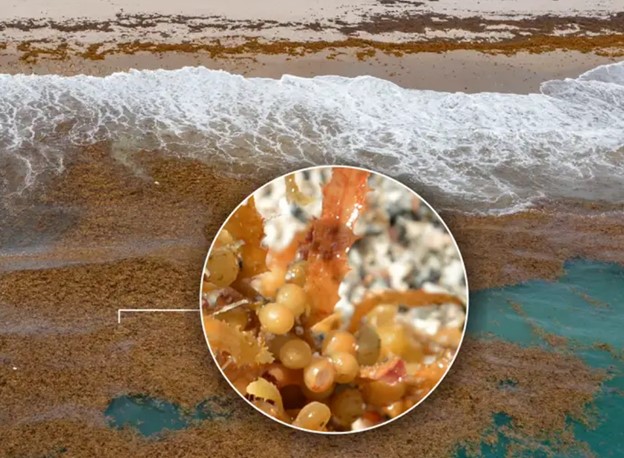
If you don’t know Seaweed Sarge, it’s because 1) you deliberately avoid the news these days – an increasingly popular trend – or 2) like me, you need a more creative label for sargassum, because it’s a weird name for the seaweed intent on taking over the world.  Sarge is a little intimidating, if only for his size.  Picture him as a belt of algae 5,000 miles long (I can’t picture anything 5,000 miles long, can you?)  Now consider: Sarge will double in size by July, the peak of his “bloom season”.

Sargassum

Sargassum is a particularly annoying form of seaweed.  It’s rootless, which means it can reproduce while simply floating around on the ocean’s surface.  Its rapid growth is bolstered by nutrients leached into rivers and oceans from land-based agriculture.  Once it makes shore sargassum rots immediately, releasing irritating hydrogen sulfide and the stench of rotten eggs.  And trying to remove countless tons of seaweed begs the question: where the heck do you put it all?

Florida’s gonna have to figure out the answer to that last question, and fast.  Sarge is already littering beaches from Ft. Lauderdale to Key West and we’re just getting started.  Come July and August it’ll be virtually impossible to walk along the shoreline.

Ft. Lauderdale

My own visits to the beach have been blissfully Sarge-free.  Most of my sun-and-fun takes place in San Diego, far from Sarge’s primary Atlantic Ocean residence.  The only real nuisances on San Diego beaches are the occasional jellyfish or stingray, and a once-in-a-blue-moon shark sighting (which stirs up more anxiety than actual sightings).  Admittedly, Sarge washes ashore in San Diego as well, but mostly just here and there as a remnant of off-shore harvesting.  Seaweed does have its upsides, in foods, medicines, and fertilizers.

Ironically, I have fond memories of Sarge as a kid.  He’s built with giant flappy leaves reminiscent of a mermaid’s fishtail.  He’s got countless air sacs to keep him afloat, which make a popping sound as satisfying as squeezing bubble wrap.  If I’d thought to take pictures back in the day, I could show you Sarge as an adornment to many a childhood sand castle.

It’s time for robots

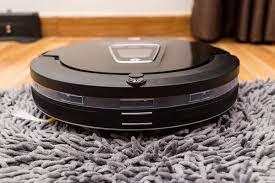
An army of beach tractors could work all summer in South Florida and barely make a dent in Sarge.  The seasonal maintenance of the single half-mile beach in Key West alone is in the millions of dollars.  But a better solution may be in play.  A prototype robot has been designed to do battle at sea.  “AlgaRay” cruises slowly through the water, hooking tons of Sarge’s strands in a single pass.  Once at capacity, AlgaRay drags Sarge underwater to a depth where all of those air sacs explode.  No longer buoyant, Sarge sinks to the ocean floor; a “watery grave” if you will.  AlgaRay has been likened to a weed-eating Pac-Man or a vacuuming Roomba.  Either image works for me.
Let’s have one more look at those tourist surveys.  One in ten say they’d cancel or reschedule a trip to Florida if they knew Sarge was coming ashore.  Maybe that explains why landlocked Las Vegas ranked #2 on this summer’s most popular U.S. destinations.  Not that Vegas doesn’t have its own threats.  Three years ago a swarm of locusts descended on the Strip, blotting out casino windows and streetlights.  An annual migration of tarantulas passes by in the surrounding desert.  So take your pick: hordes of flying/crawling bugs or a giant mass of inanimate algae.  Maybe Sarge isn’t so bad after all.

Some content sourced from the NPR.org article, “Giant blobs of seaweed are hitting Florida…”
Lifeless Buds

I have a Venus flytrap named Frankie. He lives alone in a plastic cup on the patio table, happy in the humid air as he nabs the occasional bug. My wife’s nearby garden is boasting fruit, vegetables, and colorful blooms but I’m content to just watch my little tabletop carnivore do his thing. I’ll get to why I named my bud “Frankie” in a minute but let me just say this: At least he’s a live little bud. That’s more than a lot of people can say about their more imaginary friends.

“Frankie”

Here’s a morsel of self-discovery for you, extracted from my several years of blog posts.  I have a habit of referring to inanimate objects with terms of endearment.  My most recent example: two weeks ago when I discovered the SpaceX satellites launching into outer space.  I referred to those technological marvels as “little guys who talk to one another”, and, “when their time is done they’ll return home for a proper burial”.  Whether this is just cheap entertainment or an effort to elicit empathy from you readers, I regularly inject life into the lifeless (or in this case, a soul into the metal and mechanical).

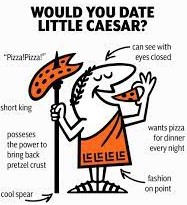
“Little Caesar”

I didn’t have to scroll back very far to find other examples.  My post a week before the satellites, Hail, Caesium, endeared of all things, a lost capsule of nuclear waste.  First, I nicknamed the capsule “Little Caesar”.  Then I re-nicknamed it “LC” and noted how detection equipment ultimately “…led the search team right to our little friend”.  Were you more relieved to know the waste had been contained or that our little lost friend had finally been found?

Pine cone “sororities”

Conifer Confetti, a post from last fall, lamented the hours I sacrifice to contain the untold number of pine cones on our property.  I referred to the cones as “females” (because biologically, they really are) and in one frustrated burst of endearment, said “It’s like having the world’s biggest sorority row above my backyard, and every house is about to disgorge its girls for a giant party on the ground”.  So which is it Dave, a whole lot of “yard waste” or thousands of “little ladies”?

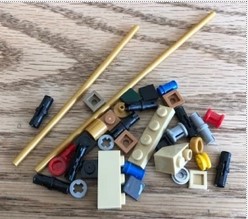
The “poor” leftover pieces from the LEGO Grand Piano

Finally, my series of posts on building the LEGO Grand Piano and LEGO Fallingwater were rife with terms of endearment.  All those plastic pieces were like little families bagged up in a single box; couples waiting to be married.  At times I thought I lost “one of the little guys”, and I felt sorry for the leftovers who’d never realize their destiny of being a part of the completed model.

“Cassini” (image courtesy of NASA/JPL)

This topic was inspired by an article in The Atlantic about the spacecraft Cassini.  Six years ago, Cassini completed a 13-year data-gathering cruise around Saturn and its moons.  Utterly alone and running out of fuel, Cassini turned towards the planet, eventually burning up in the atmosphere.  As NASA described the final moments, Cassini “fought to keep its antenna pointed at Earth as it transmitted its farewell”.  An entire room of scientists at Pasadena’s Jet Propulsion Laboratory fell into tears.  Cassini is the perfect example of – big word here  – anthropomorphism.  In simpler terms, the more “alive” a machine appears to be, the more empathetic the response from humans.  Some robots are deliberately anthropomorphic, a subtopic we just don’t have enough words for today.

As I watch Frankie ingest another insect, it’s time to reveal the genesis of his name.  Maybe you don’t remember Frankie Avalon in his prime but you do remember the 1970s movie Grease.  Avalon showed up in a memorable scene, descending a staircase dressed in white while singing “Beauty School Dropout” to Didi Conn’s “Frenchy”.  Guess what?  Avalon had an even bigger hit: VenusThat song is a plea to the goddess of love to bring him romance; someone pretty and very much alive.  Okay, so my Frankie isn’t pretty, but at least he’s alive.  That’s more than I can say about all those other little buds who keep showing up in my blog posts.

Some content sourced from The Atlantic article, “How to Mourn a Space Robot”, and Wikipedia, “the free encyclopedia”.

State Flyovers

The heavy-duty bracket I purchased to display our American flag sits patiently on the garage shelf. The flagpole and flag stay wrapped in the plastic they came in. I hesitate with this little DIY project because I’m mounting the bracket onto a rounded wood column on the front porch. If the column isn’t solid throughout, it may not support the Stars and Stripes. Or the Palmetto State flag, for that matter.

South Carolina

If you’re not familiar with the South Carolina state flag, you are now.  Not very exciting, eh?  A white palmetto tree in the middle and a white crescent to the upper left, on a rectangle of deep blue.  Okay, but what about why the flag has this look?  That’s a little more interesting.  All of it is a nod to the Revolutionary War.  The crescent could be found on an American soldier’s cap, palmetto logs were used to build the forts they fought from, and the deep blue was the color of their uniforms.  My assumption was simply, “Oh, our state has a lot of palm trees and a lot of clear moonlit nights.”

Colorado

The same could be said for the state of our former residence.  Colorado’s flag is likewise simple, with a big red “C” for Colorado surrounding what I assumed was a yellow nod to the state’s bountiful days of sunshine (300+/year).  Nope, I only got the sunshine part right.  The “C” represents “columbine” (state flower) and “centennial” (Colorado became a state in the hundredth year of America’s independence).  The red represents the state’s distinctive sandstone soil, the white its ever-present snow, and the blue its endless skies (which really are an amazing blue).  More than meets the eye with this “state flyover”, am I right?

Maine

Not content with just SC and CO, I decided to give a few other state flags a whirl… literally.  I flicked my mouse wheel the way someone might spin the bottle, for an unsuspecting kiss choice from the list.  Up came ME.  There’s a lot going on with Maine’s state flag, including a couple of proud characters and a moose that looks rather cartoonish.  “Dirigo”, from a long-ago-but-now-defunct language of the region, means simply, “I lead”.

Here’s a further sampling of U.S. state flag trivia:

  • Arkansas was the first of the fifty states to produce diamonds.
  • Hawaii was once under British control, so their flag includes a small version of the “Union Jack”.
  • Montana’s motto is “gold and silver”.
  • Ohio’s flag is not rectangular and includes a “swallowtail” notch (which can’t be said for any of the others).
  • Oregon’s flag has a different design on each side.
  • Utah’s flag changes in 2024, to better represent the makeup of the state’s residents.
Ohio

If you live in an American state, you should play this game yourself.  Scroll to the image of your flag in the article: The state flag for all 50 states… but before you read the written description, make your best guess on the colors and symbols.  It’s fair to say most Americans don’t really know our state flags.

Go Dawgs!

South Carolinians love to fly flags.  You’ll see the colors of colleges and universities from all over down here (including the red/black of those nearby football champion Georgia Bulldogs).  You’ll see a lot of those “garden flags” designed to represent the year’s seasons and holidays.  But mostly you see the Stars and Stripes, and the Palmetto and Crescent.  South Carolina’s forever nod to the Revolutionary War means I’ll never look at our flag the same way again.  Now I just have to get the bracket where it belongs so I can hoist the banner same as every other resident.

Some content sourced from the USA Today article, “The state flag for all 50 states…”, and Wikipedia, “the free encyclopedia”.

Celestial Strings of Pearls

When I take the dog for a walk after dark, I never know what to expect in the night sky above me. We live in an area devoid of city lights so the celestial show is clear and sometimes dramatic. Ursa Major (aka Big Dipper) often makes an appearance. Venus is the brightest star planet low in the western sky at twilight. And the full moon, seemingly biggest as it rises just above the pine trees, can be breathtaking. But none of this prepared me for the bold processional streaking across the heavens last Thursday night.

It could’ve been Santa Claus and his reindeer for all I knew.  Sitting around a backyard fire pit with friends, having drinks and swapping stories, one of the women suddenly shrieked, “LOOK!!!” and pointed skyward.  At first it didn’t register what we were seeing (nor at second, nor at third).  I can only describe it as a tiny string of bright pearls, two or three dozen in the strand, perfectly spaced and moving silently across the sky.  Neither pulling nor pushing, they simply proceeded in a line as if drawn to some unknown destination.  It almost looked like the one-after-another cars of a roller coaster, heading up that first steep incline.

Our group was at a loss to explain this extraterrestrial.  We thought it might be the neatly arranged contrails of a stealth fighter.  Or some faraway electronic billboard advertising in Morse code (only with dots, no dashes).  Turns out we weren’t even close.  Our little alien spacecraft parade was the latest launch of Starlink satellites from SpaceX.

You’ve probably heard of SpaceX, even if you don’t know much about what they do.  Founded in 2002, SpaceX is one of Elon Musk’s ambitious companies, with the “modest” long-term goal of colonizing Mars.  While they design and launch the spacecraft to make that happen, SpaceX is providing Starlink Internet service to under-served areas of the globe by building a “constellation” of satellites around the planet.  42,000 of them.

This is technology way beyond my understanding, but here’s the basic setup.  A transmitter somewhere on earth sends the Internet up to one of those satellites and the satellite then rebounds the signal back to you.  If the satellite loses your direct line of sight, it can hand off the signal to one of its buddies and your Internet service continues uninterrupted.  SpaceX earned the license for a ten-year window – starting in 2019 – to complete its Starlink constellation.  At last count they’ve already got 4,000 of these little guys in orbit.

Starlink satellite

Credit Musk for identifying a market in need.  Mars may not be on my bucket list but faster Internet service certainly is.  Two years ago 10,000 Earthlings signed up for Starlink subscriptions (at $599 USD for the hardware and $120/month for the service). Today? Fully 1.5 million customers are bouncing data back and forth with all those satellites.  My rural location here in South Carolina (and the s-l-o-w speed of my current Internet provider) make me a prime Starlink candidate.  Later this year, I’ll also be able to switch over my cell phone service.  Yep, Elon Musk is literally taking over the planet.  Come to think of it, maybe the entire solar system.

A “string of pearls” before the satellites go their separate ways

Whether or not I subscribe to Starlink, I find the satellite technology fascinating.  We have a lot of “space junk” circling Earth but this constellation of man-made stars seems more elegant.  They’re launched in strings of up to 60, separating once they’re high enough. Each satellite’s thruster is powered by krypton and argon.  They talk to one another to avoid collisions.  They’re currently undergoing “dimming” to appease astronomers by taking a back seat to the real stars in space.  Finally, these satellites can “de-orbit”.  In other words, when they’re time is done (even satellites don’t live forever), they return home for a proper burial, which means burning up entirely as they attempt reentry through Earth’s atmosphere.

Starlink satellites x 42,000

Several websites track the continuing launches of Starlink satellite strings (like this one).  You can find out exactly when they’ll be passing overhead in your neighborhood, destined for their rightful place in the budding constellation.  If you see them stream by, remember, it’s not Santa and his reindeer (wrong month).  It’s a string of pearls designed to provide you with faster Internet service.

Some content sourced from Wikipedia, “the free encyclopedia”.

Hail, Caesium!

I acquired a taste for Caesar salad later in life. After decades of boring lettuce/tomato and franchise salad bars, I learned to branch out a little. Caesar, with its romaine, croutons, Parmesan, and distinctive dressing, has become my go-to at restaurants. But I always double-check my “hold the anchovies, please” because even a thimbleful would put a damper on things. Kind of like caesium-137.

Small but mighty

You probably don’t know much about caesium.  Pronounce it just like the salad (or like “seize” in Seize the day!).  Caesium-137 is a nasty little byproduct of nuclear fission, deadly enough to turn your life into a… uh, half-life with just a brief introduction.  So here’s the story of the little caesium capsule – a.k.a. Little Caesar – that could get away, and did.

It’s a simple enough task, really.  Transport an item from Point A to Point B, like the new washing machine we just had delivered from Home Depot.  But let’s make the job a little more challenging, shall we?  The distance you have to travel shall be almost 900 miles.  The journey itself shall be on the oft-barren Great Northern Highway of Western Australia, which isn’t always the smoothest of rides.  Finally, transport a potentially lethal substance… without dropping it.

“Little Caesar” was t-i-n-y

You’d think radioactive caesium-137 – no matter how small an amount – would be literally welded into the delivery truck it rides in.  Instead, the pill-sized capsule – already parked inside the density gauge equipment it was a part of, was placed in a “package”, then attached to the truck with four mounting bolts.

Now then, imagine you’ve just completed the long and boring four-day drive to the nuclear waste treatment facility in Perth.  You hop off the truck, walk around to the back, open the doors, and discover not only a broken gauge and a missing mounting bolt, but no caesium-137 capsule.  In fact, the delivery truck wasn’t even inspected until nine days after arrival.

This scenario raises a half-life of questions for me.  First, just how bumpy was that Great Northern Highway?  Second, even if the gauge broke open and the capsule got loose, how the heck did it escape, not only out of the package but out of the entire truck?  Finally, we’re talking about lethal goods here.  Wouldn’t some sort of alarm go off if Little Caesar skipped town?  I’m guessing someone is answering these kinds of questions as we speak, and his/her seat is a little warm.

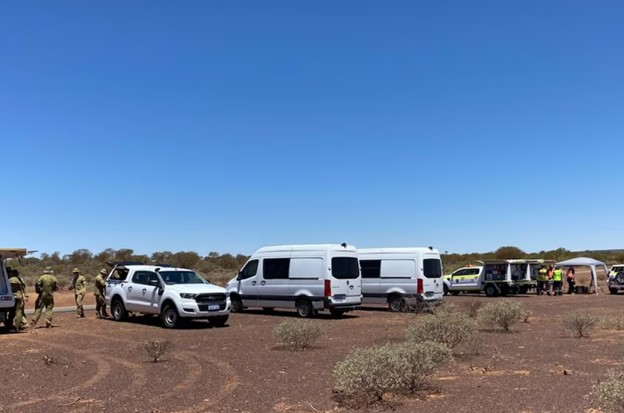
The fearless search committee

imagine being a member of the ad hoc search-and-rescue crew.  Not only are you looking for something that can kill you just by being in close proximity, it’s the proverbial needle in the haystack, only the needle is the size of a paper clip and the haystack is a highway longer than the coast of California.  No matter, you’re handed a radiation detection device, the keys to a truck with flashing hazard lights, and off you go.  Oh, and by the way, you can’t go faster than 30 mph or your detector can’t do its job.

This isn’t the first unintended release of Little Caesar.  He escaped in much larger quantities from the Chernobyl nuclear power plant in 1986 and from Japan’s Fukushima Daiichi plant in 2011.  You can read about nine other incidents involving “LC” here, including one in Seattle four years ago and one in Thailand in March.

At the time I saved this story in January, Little Caesar was still at large.  Worst-case scenarios were running rampant.  What if LC bounced to freedom on a populated area of the highway?  What if a hiker happened upon the capsule and threw it into his or her backpack before returning home?  Or, God forbid, what if a bird snatched the capsule in its beak and transported it to its nest in the middle of downtown Perth?

LC was hiding here

Three months later (this week), I caught up with this story.  The run-of-the-mill conclusion is that Little Caesar was found just six days after his escape, off the highway in a remote area not far from the truck’s point of departure.  The radiation detection equipment sounded the alarm and led the search team right to our little friend.

A close-up of the escapee

As for what happened once LC was found?  A 20-meter “hot zone” was set up around him to fend off the inevitable lookie-loos.  He was given a thick casing of lead in case he was feeling “radiant”.  Finally, Little Caesar was scheduled to be transported to the county health facility for further examination.  Yes, I said “transported”.  No word on whether or not he made it to his final destination.

Some content sourced from the ABC News article “Missing radioactive capsule found in WA outback after frantic search”, and Wikipedia, “the free encyclopedia”.

Another Peg in the Car

Our daughter gave birth to her firstborn this week, a precious little bundle with rosy cheeks and strawberry blonde hair. For her and her husband, life has changed forever. And for our granddaughter, barely two days old now, every sight and sound will be a complete and utter mystery. In other words, her game of life has only just begun.

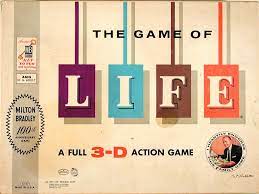
The 1960s edition

I was only nine or ten myself when I started playing at life.  Not real life, of course, but the board game in a box by Milton Bradley . “Life” (as we simply called it back then) was a significant rung up on the board game ladder. Once discovered, “Don’t Break the Ice”, “Hi Ho! Cherry O”, “Chutes and Ladders”, and the well-worn “Candy Land“stayed on the shelf forever.  Win or lose, “Life” was a ton of fun pretending to be an adult.  After all, we kids had no idea what we were doing.

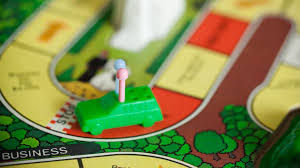
The original board

The genius of “Life”, like “Monopoly”, is that its players are too young to understand what they’re playing at.  In Monopoly, you buy and sell real estate, mortgage properties, and pay income tax, and somehow all of this is “fun” (especially when you win and become the one and only landlord in town).

In “Life”, you’re making decisions ten or fifteen years ahead of your time.  I find it ironic “Life” is a game for kids yet it skips the entire chapter of childhood.  The first move is to “Start a Career” or “Start College” (you choose).  If you start college you “Borrow $100,000 from the bank”, so you’re already saddled with debt.  You pay taxes or get a refund.  You earn raises or sometimes lose your job.  Wait, this is fun?  You bet it is.  You’re a kid and you don’t know the meaning of “responsibilities”.

Eventually,  the colorful cardboard path of “Life” takes you by a church, where you get married and add a spouse peg to your car.  Soon after you have babies (more pegs) and soon after that you buy a house.  The meandering path continues, until it stops “years” later at either “Millionaire Estates” (you’re rich!) or “Countryside Acres” (you’re not!)

When “Life” is over, it’s time to account for your accomplishments, which means simply adding up all of your cash.  The player with the most money wins.  Wouldn’t that be an interesting conversation with St. Peter?  Hey Pete, I won The Game of Life because I had the most money!  Open up the gates – I’ve earned my entry!

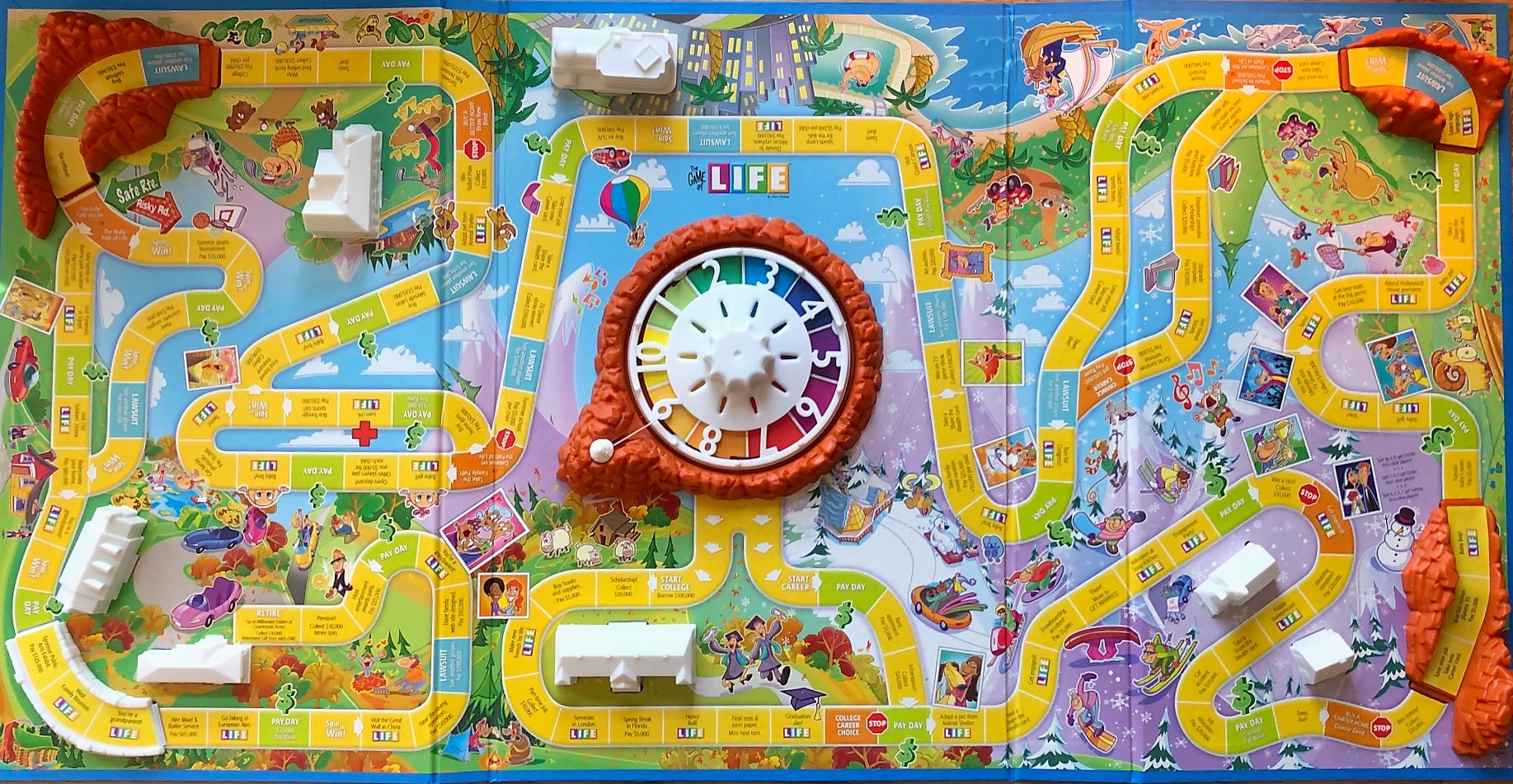
“The Game of Life” has evolved since it was first produced many years ago.  My childhood plays were on the 1960s version, which included a folding rectangular board with the wandering path for the cars, little plastic mountains you’d pass through at the corners, little plastic buildings you’d pass by here and there, and, smack-dab in the middle, a giant spinning numbers wheel to determine how far your car would go on any given turn.

Linkletter

The 1960s version also had insurance policies, promissory notes, and stock certificates.  Art Linkletter, who promoted the board game on TV, smiled out at you from the center of the $100,000 bills.  Finally, your choices on your final “Day of Reckoning” were “Millionaire Acres” or “Poor Farm”, depending on the size of your bank account.  But even before you chose “Poor Farm” you had a last-gasp chance to win the game by betting all of your money on the numbers wheel.

Today’s edition

The newest version of “Life” seems the same, with the little mountains and plastic buildings and giant numbers wheel.  But look closer and you’ll find the game is delightfully “PC” now.  You can perform “community service” or “good deeds” (which translate to monetary value at the end).  Your career choices include less traditional vocations like “Hair Stylist” and “Athlete”.  Your housing includes a mobile home or a “luxurious mountain retreat”.  You can even sue other players to the tune of six figures.  Today’s kids might actually understand that aspect of the game.

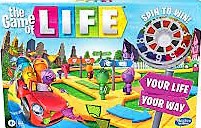
Finally, in a full-on nod to modern times, “Life” wants you to know it’s “Your Life, Your Way”.  Accordingly, you can choose pets instead of kids.  And the little people pegs are no longer just pink or blue because… you know.

Here’s the last word on “Life”.  The corner of the box top gleefully shouts, “Now with one-time assembly!”, meaning as soon as you put the mountains and buildings and spinner into place, the board is good to go every time you play it.  Now what fun is that?  Just like “Mouse Trap”, half the enjoyment of “The Game of Life” was putting the whole thing together.  At least we kids understood how to do that. As for what the game itself represented?  Not so much.

Some content sourced from Wikipedia, “the free encyclopedia”.

Phantom Farewell

Tonight, hours after this post goes public, my wife and I will attend a local stage production called Lovesong.  It’s our first foray into the offerings of our community theater so we’re really looking forward to it.  Lovesong has a run of five evening performances and one Sunday matinee while it’s in town.  A check of the theater website indicates about 20% of Thursday’s seats have been sold.  By my calculation, that’s about 80% less than any Broadway performance of Phantom of the Opera.

Maybe you heard.  After 35 years and 14,000 performances, last Sunday the curtain dropped for good on Phantom of the Opera.  Its creator, Andrew Lloyd Weber, was on hand at New York City’s Majestic Theater to offer the cast and crew a personal farewell.  He claimed their final performance as the best he’d ever seen.  You’ll forgive Andrew for being a little sentimental after all these years.

Theater District, Midtown Manhattan, NYC

Whether the stage production, the 2004 movie, the glorious soundtrack, or even the books on which it was based, you’re familiar with Phantom.  It’s a captivating story; part haunting and part romantic, with a lead character who has you wondering, “Is he real or imagined?”.  Reading Phantom’s synopsis (which you can do here), I realize I overlooked some details of the story the one and only time I saw the show. No matter.  The sets and the songs will stay with me for life.

Phantom took my admiration of stage performances to an entirely new level.  The one time my wife and I saw the show, in San Francisco in 1997, it literally took our breaths away.  The only shows we’d seen prior were the “off-off-off Broadway” offerings; the kind where they recruit locals just to fill out the cast.  Phantom left us yearning for more of the best, including seeing something on Broadway (which we did years later with Les Miserables, deserving of its own blog post).

Phantom was also a technical marvel.  What other show boasted a giant chandelier swinging out over the audience and threatening to fall?  Or a staircase giving the optical illusion of descending several levels as the Phantom dragged Christine downward?  Or the subterranean lake the Phantom rowed across, where you swore you were looking at a giant body of water right there on the stage?

Every Broadway production seems to have three or four unforgettable songs.  Phantom was no exception.  The show kicks off with an orchestral version of “Phantom of the Opera”, turns sweet with Christine’s solo “Think of Me”, and overwhelms with the duet All I Ask of You and especially The Music of the Night.  The latter includes one of the most powerful notes I’ve ever heard, when the Phantom sings, “Close your eyes… and let music set you… FREE-E-E-E-E-E-E-E-E…!”

Deservedly, Phantom won the “Laurence Olivier Award” for Best New Musical in 1986, the Tony Award for Best Musical in 1988, and pretty much everything else it was nominated for.  Besides the London and Broadway productions, Phantom enjoyed nine worldwide tours and one revival.  Over its 35 years, Phantom employed 6,500 people and played to over twenty million theater-goers.  Phantom even had a short-lived sequel, Love Never Dies, debuting in London but never making it to Broadway.

Sadly, Phantom’s closing can be considered a casualty of the pandemic.  The show was suspended from March 2020 to October 2021 (when all Broadway productions ceased).  After reopening, attendance was sporadic because patrons were still hesitant.  Meanwhile, Phantom’s production costs continued at a staggering $1M/week, which eventually became unsustainable.

Phantom was originally slated to close in February but once theatergoers found out, the show experienced a brief resurgence and lasted another two months.  I don’t expect Lovesong to extend its little run at our community theater.  Thanks to Phantom of the Opera however, I’m simply excited for the potential of a wondrous stage performance.

Some content sourced from the CNN.com article, “Final curtain comes down on ‘Phantom of the Opera'”, and Wikipedia, “the free encyclopedia”.