Following the Leader

Technology birthed the self-guided tour. More and more often, an admission ticket to sights worth seeing grants you a pair of headphones and a wearable device instead of a name-tagged human to show-and-tell you the way.  Self-guided touring allows for a more convenient and less distracted experience.  But it also removes the storyteller, and that, my friends, makes all the difference between a memorable tour and a forgettable one.

Budapest, Hungary

Viking River Cruises, one of which we completed on the Danube River in early June (see Going With the Flow), provide a plethora of tour guide experiences.  On any given day of the cruise, you disembark to one or two “land-based” locales, in the (sometimes) capable hands of a personal tour guide.  Viking contracts with local agencies to provide these guides for small groups of its travelers.  For example, having a Hungarian show you the sights of downtown Budapest is so much more satisfying than hearing someone drone on about it on a headset.  Sharing a beer with a German on a tasting tour is almost like being invited into his house.

Nuremberg, Germany

If I ask you to share one of your own memories involving a tour guide, you’ll probably recall a particularly good one.  Maybe you’ll even remember a bad one.  Regardless, your stories would support my theory: a top-notch guide can make the what or the where of the tour almost irrelevant.  The guide himself or herself can make the difference between a memorable experience and a forgettable one.

Consider, I still remember a tour of a southern plantation with my family from almost fifty years ago.  Why?  Because the tour guide presented herself in a way that made me think we were being welcomed into her own house.  She also had this soft, syrupy unforgettable Southern accent that had me hanging on her every word.  Do I remember anything about the plantation?  No, but I sure remember the tour guide.

Szentendre, Hungary

So it was on the Viking cruise.  We had good guides and we had outstanding ones.  The very best of the dozen or so – ironically – was a young woman working on contract with Viking for the first time, as a stand-in for our scheduled guide in Munich.  She was, in every respect, delightful.  She started our tour with a greeting and a smile, then a little conversation and questions to break the ice.  As she led us from one sight to another, she spoke with an energy and pride in her city that can only be described as vivacious.  By the end of the tour, as the saying goes, she had us feeding out of her hand.  I was so enthralled I forgot to take a picture of her.

But we also had a lesser guide a few days earlier in Vienna, who I’d describe as a speed-walking encyclopedia.  He led us on a many-thousand-steps rush through the sights, filling our heads with facts and figure as he went, in a pretty thick Austrian accent.  He never smiled and I don’t think we ever stopped walking.  Can’t remember much about that tour (or him for that matter) because it was a rush-rush blurry overload of the senses.  I need to go back to Vienna again someday so I can (literally) stop and smell their famous roses.
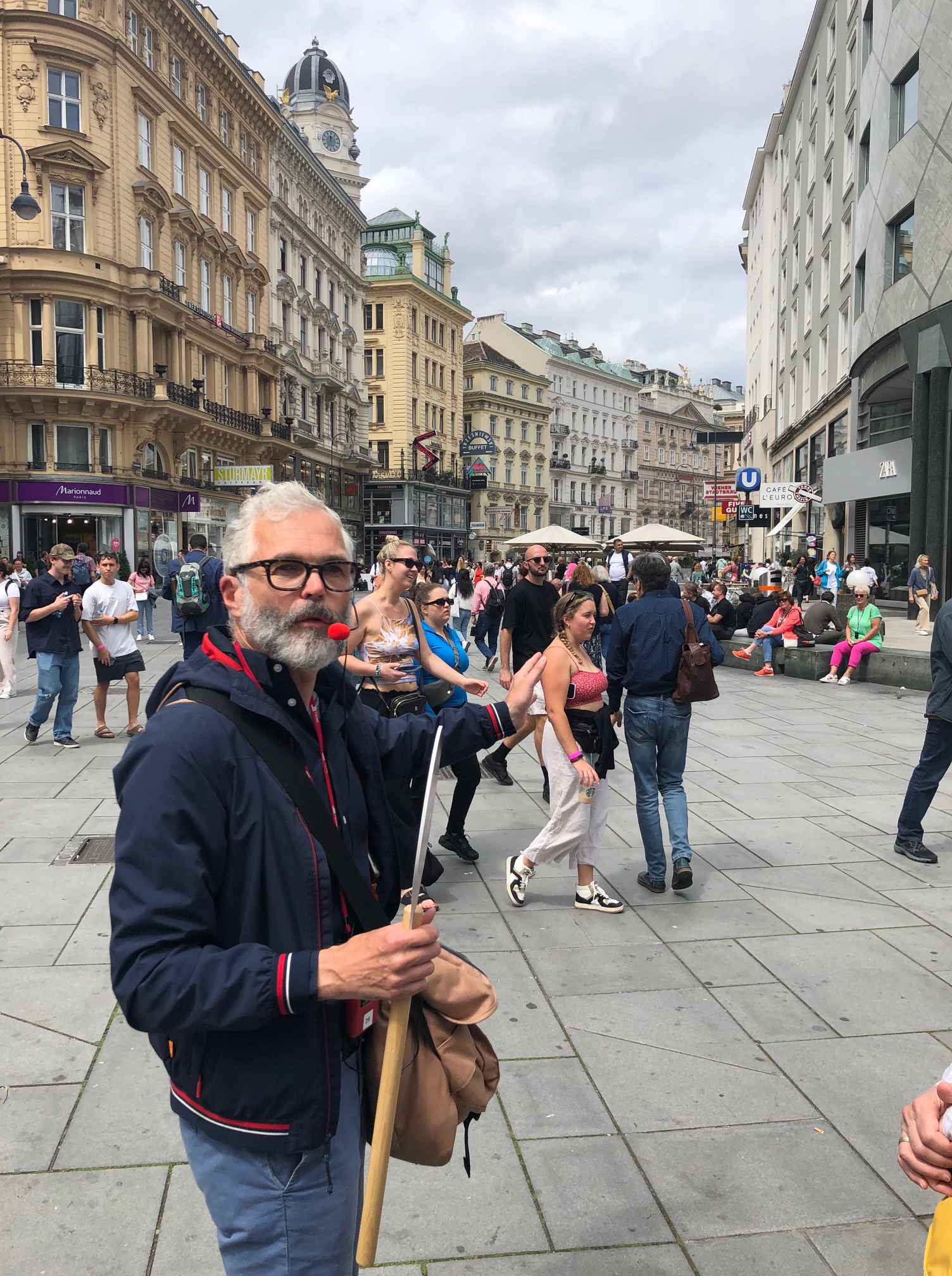
Vienna, Austra

Courtesy of Viking and those many tours near the Danube, I present to you, therefore, the attributes of the consummate tour guide:

  1. A local, familiar with the city or sight at hand through regular exposure.
  2. A personality; warm, friendly, energetic, and engaging.
  3. An overflowing font of knowledge on his/her subject, able to answer just about any question thrown their way.
  4. A storyteller, able to weave anecdotes at will into the facts and figures to keep it interesting.
  5. In tune with his/her audience, making adjustments to the tour as necessary (ex. “Am I going too fast for you?”)

If you take enough sightseeing tours, you’ll know whether your guide is missing one or more of the above within the first five minutes.  You’ll also know whether the next hour or two will fly by or drag on for all eternity.  If your guide checks all five boxes, consider yourself lucky.  Most of us aren’t cut out for the job (myself included), whether we like to think we are or not.  It takes a special set of skills to be the leader everybody wants to follow.
Noble Neigh-Sayers

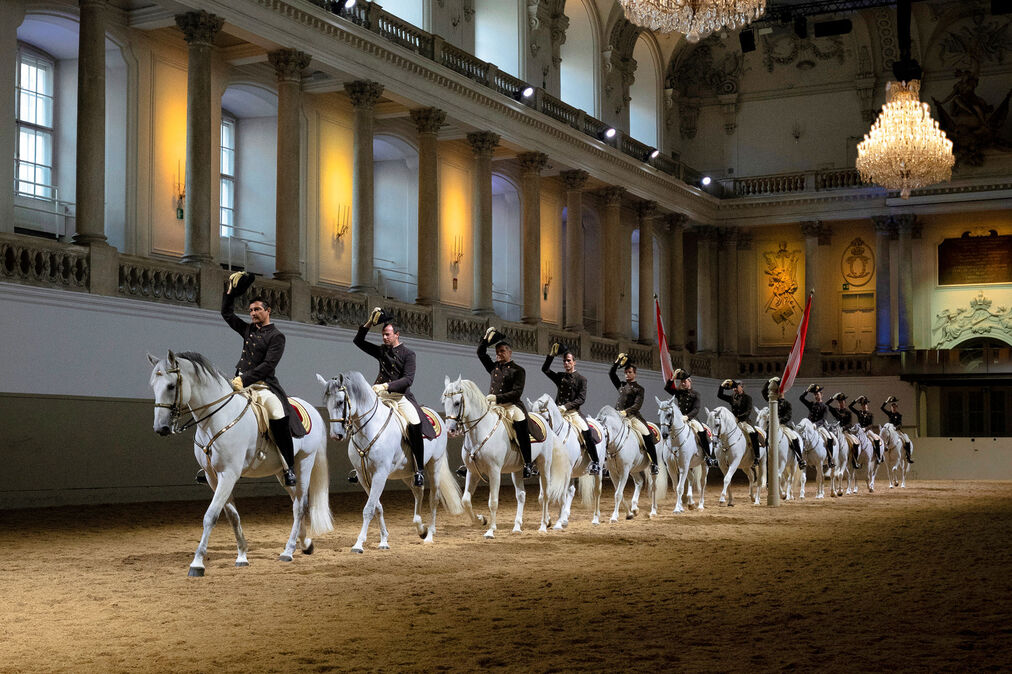
She’s only fourteen months and our granddaughter has already developed a keen interest and affection for our horses. As soon as she gets to the house she hightails it to the living room windows to see if our big boys are grazing in the nearby pasture. She calls them “Neigh-Neighs”; just about the cutest couplet of words you’ll ever hear from the lips of a small child. Makes me think she’d be utterly over the moon if she ever caught a glimpse of the Neigh-Neighs… er, horses at the Spanish Riding School in Vienna.

If you asked me to describe the nerve-wackiest moment of our Viking River Cruise last month, it would’ve been nine months beforehand when I went online to book the sightseeing excursions.  One of those tours – “Behind the Scenes at the Lipizzaner Stallions” – was, at least for us, the excursion of the entire trip.  If the Lipizzaners were sold out, well, there’s a good chance we would’ve a) cancelled the whole cruise, or b) emptied a nearby ATM of Euros, in hopes a couple of our fellow travelers would give up their reserved seats.  Lucky for us we didn’t have to do either.

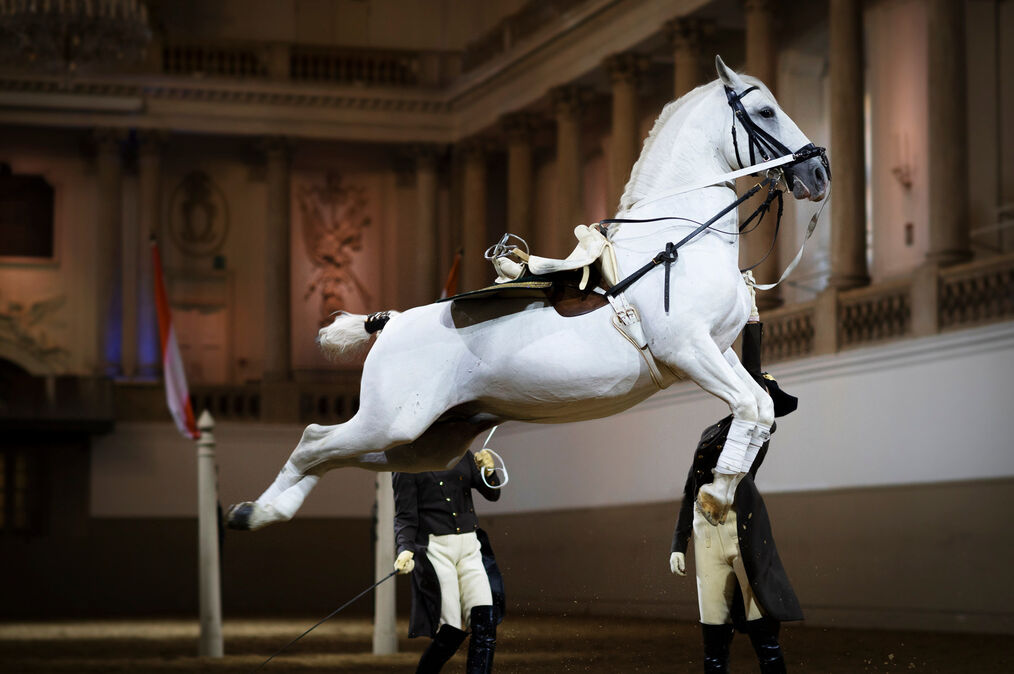
Maybe you’ve heard of them before.  The Lipizanners are a renowned breed of riding horse developed in sixteenth-century Austria.  All these years later they’re among the world’s most famous animals, both for their uniform look and unparalleled skill in the movements of classical dressage.  Five of these movements – known as “airs above the ground” – require horse and rider (sans stirrups) to completely leave the ground.  It’s a performance you’ll only see at prestigious academies like Vienna’s Spanish Riding School, and not in, say, the Olympic dressage competition later this month in Paris.

Spanish Riding School – central hall

So how was this remarkable performance?  I wish I could tell you.  We were in Vienna on a Tuesday and the Lipizzaners only show on Saturdays and Sundays.  But we knew this was the case heading into our trip.  The draw of the excursion was more about a behind-the-scenes look at the riding school facility, learning about the care and training, and of course, a peek at the horses themselves.  The Spanish Riding School is located in the former Imperial Palace of the Habsburg Monarchy, smack-dab in the middle of downtown Vienna.  Were it not for the smell of hay and manure you wouldn’t even know the stable was right through the stone walls adjacent to the sidewalk.

Tack room

But oh my, what a stable!  Each of the 68 resident stallions enjoys a roomy private stall (with a fancy nameplate), as well as outdoor courtyards for fresh air and exercise.  Those weekend performances take place in the spectacular sky-lit central hall, which still contains the royal box from the Habsburg era.  The tack room contains custom-made saddles, bridles, and reins representing a small fortune in leather craftsmanship.  And hay storage, manure removal, and other supporting aspects are somehow completely out of sight.  The Lipizzaners have it as good as we’ve ever seen for horses, at least in an urban setting.

Lipizzaner foals at the Piber breeding farm

Speaking of the Lipizzaners, the Spanish Riding School is just a part-time residence.  They spend a good portion of the year in nearby Heldenberg, enjoying the peace and quiet of the countryside instead of the hustle and bustle of the city.  Their breeding farm in Piber – even further removed from Vienna – is nicknamed “The Cradle of the Famous White Horses”.  And as you might expect, most of the young Lipizzaners go straight from Piber to the easy life in Heldenberg, without so much as a glance at the Spanish Riding School.  Only a select few achieve the look and confirmation worthy of this elite level of training and performance.

A couple weeks ago I described the Viennese Coffee House experience as an Element of Intangible Cultural Heritage.  So it is with the Spanish Riding School.  UNESCO has deemed the Vienna facility, the Lipizzaners, and their horse/rider performances as “an essential component… of [Austrian] cultural diversity and creative expression”.

Horses can fly?  Who knew?

I can understand why most visitors to Vienna would choose to see the Lipizzaners in their “Sunday best” instead of lounging in their stalls.  But I encourage you to see both.  A visit with these beautiful animals up close and personal is a unique experience (even if most tourists don’t seem to know how to behave around horses).  You’ll learn why the Spanish Riding School hosts one black stallion among the dozens of whites.  You’ll learn the historical significance of the trained movements of the Lipizzaners, as well as how to identify a rider’s ranking based on his uniform and equipment.  My granddaughter would have plenty of reasons to give this tour a “neigh-neigh”, but your own response is more likely to be “yay-yay!”

Some content sourced from the website of the Spanish Riding School, and Wikipedia, “the free encyclopedia”.

(Not far from) Madding Crowds

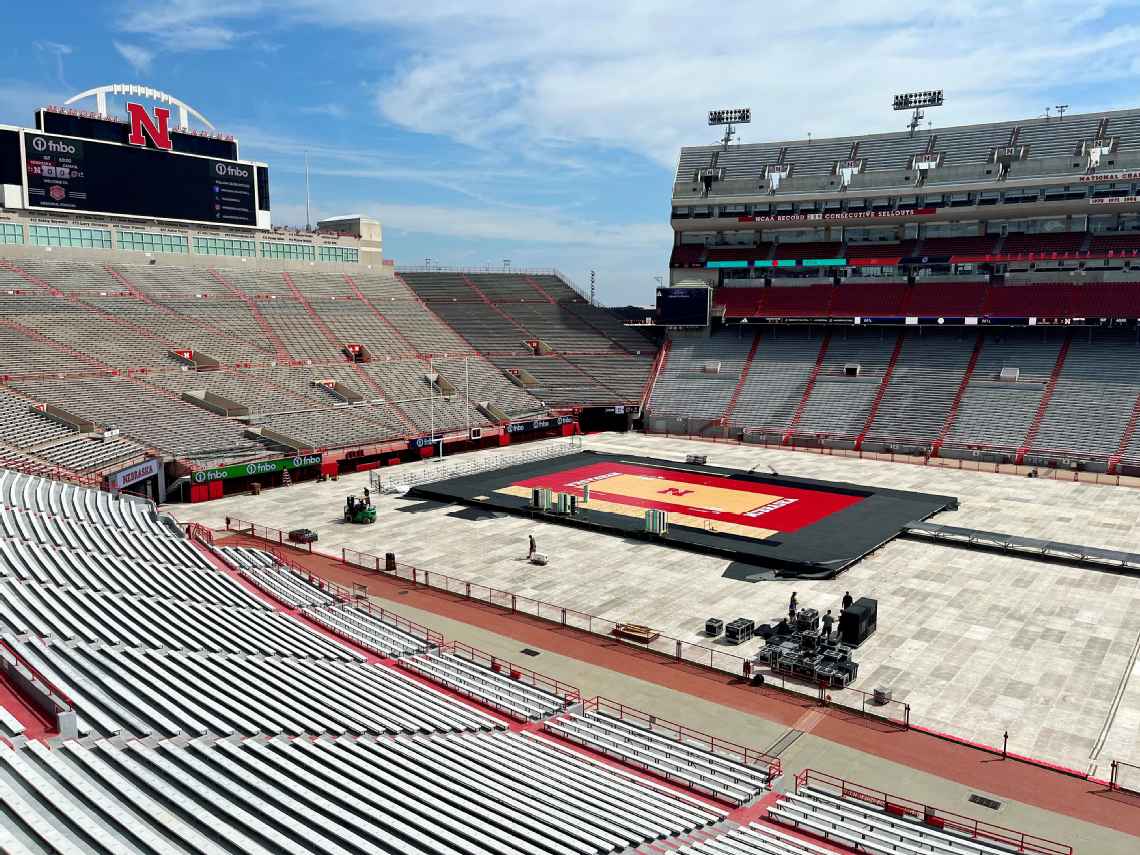
Last night, the University of Nebraska women’s volleyball team played the fourth match of their 2023 campaign. College volleyball doesn’t get much coverage sharing seasons with (American) football, but this match made the sports headlines for several reasons. One, it was played outdoors. Two, it was played in Nebraska’s massive Memorial Stadium (normally a football venue). And three – most notably – the Huskers brought home the straight-sets win in front of 90,000 riotous fans… at $25 a ticket.

Volleyball instead of football

I know what you’re thinking.  How do you get 90,000 people to cough up $25 for a college volleyball match?  Well, it helps to throw in a country music concert for starters.  Then add a second match to double the volleyball (Nebraska-Kearney vs. Wayne State).  Finally, most importantly, let fans know they just might break the regular-season attendance record for a women’s volleyball match… the same attendance record that volleyball rival Wisconsin stole from Nebraska just last season.

Memorial Stadium on any given Saturday

It fascinates me to read about sports competitions played in front of massive sold-out stadiums, weekend after weekend.  Nebraska has filled those same 90,000 seats for every Husker football game for the past sixty years (making the venue the “third-largest city in Nebraska” for several hours each Saturday).  Michigan’s Wolverines compete in the largest college stadium in America – 108,000 seats – with every seat taken more often than not.  And like Nebraska’s volleyball match last night, my fascination is not just with the number of fans but also with how much they’re willing to pay.  I’m in the market for tickets for my beloved Notre Dame; the football team headed to nearby Clemson later this season.  Unless I’m looking for a nosebleed I’ll be paying north of $450 no matter where I sit.

My weekends are busy so I’m lucky to watch a football game on TV, let alone attend one in person.  Yet every Saturday (and Sunday with the NFL) you have tens of thousands of fans gladly opening their wallets and purses to do just that.  It’s a loud, colorful thread (rope?) in the fabric of American society.

Denver’s “Coors Field”

Major League Baseball (MLB), with an average of 45,000 seats per stadium, is even more confounding to me.  In an endless spring-summer season of 162 games, half are played at the team’s home stadium.  The majority of those seats are taken by season ticket-holders.  With an average ticket price of $36 you’re handing over $3,000 for the season before you’ve even seen the first game.  Besides, who has the time to watch so many baseball games (mostly at night)?  Do what my friends back in Colorado do: split the season ticket in half with another fan and sell most of the tickets to family and friends.  You’ll make a small profit and still go to as many baseball games as you can stomach.

My appetite for baseball games is about two a season; that’s it.  Frankly I enjoy sitting outside in the summer air beside a friend as much as I do the game itself.  Otherwise, keep me far from those madding crowds.  The investment of time, money, effort (and sometimes hassle) to watch a game in person is almost always won over by the convenience, commentary, and cameras of television.

San Diego’s “Rady Shell at Jacobs Park”

Of course, this is sports we’re talking about.  If the topic was music and concerts, my post would take on a decidedly different “tone” (heh).  Tempt me with a chart-topper from the 1980s – Billy Joel comes to mind – and I’d give up the time and money to see a live performance.  Even better, dangle classical concert tickets in front of me, such as the San Diego Symphony at its cozy waterfront bandshell, or a summer concert in the outdoor gardens of Vienna’s Schönbrunn Palace (see below video).  Classical concert crowds are not nearly as madding as those for sports.

Nebraska is a five-time national volleyball champion

About that regular-season attendance record for a women’s volleyball match.  Wisconsin set the bar with an impressive 16,833 fans last season by filling its basketball arena.  Nebraska’s official tally last night was 92,003 fans… more than five times as many (on a Wednesday night, no less).  Way to crush those rival Badgers, Husker Nation.  That’s what I call a madding crowd.

Some content sourced from the ESPN article, “How Nebraska volleyball plans to pack Memorial Stadium”, and Wikipedia, “the free encyclopedia”.