Lifeless Buds

I have a Venus flytrap named Frankie. He lives alone in a plastic cup on the patio table, happy in the humid air as he nabs the occasional bug. My wife’s nearby garden is boasting fruit, vegetables, and colorful blooms but I’m content to just watch my little tabletop carnivore do his thing. I’ll get to why I named my bud “Frankie” in a minute but let me just say this: At least he’s a live little bud. That’s more than a lot of people can say about their more imaginary friends.

“Frankie”

Here’s a morsel of self-discovery for you, extracted from my several years of blog posts.  I have a habit of referring to inanimate objects with terms of endearment.  My most recent example: two weeks ago when I discovered the SpaceX satellites launching into outer space.  I referred to those technological marvels as “little guys who talk to one another”, and, “when their time is done they’ll return home for a proper burial”.  Whether this is just cheap entertainment or an effort to elicit empathy from you readers, I regularly inject life into the lifeless (or in this case, a soul into the metal and mechanical).

“Little Caesar”

I didn’t have to scroll back very far to find other examples.  My post a week before the satellites, Hail, Caesium, endeared of all things, a lost capsule of nuclear waste.  First, I nicknamed the capsule “Little Caesar”.  Then I re-nicknamed it “LC” and noted how detection equipment ultimately “…led the search team right to our little friend”.  Were you more relieved to know the waste had been contained or that our little lost friend had finally been found?
Pine cone “sororities”

Conifer Confetti, a post from last fall, lamented the hours I sacrifice to contain the untold number of pine cones on our property.  I referred to the cones as “females” (because biologically, they really are) and in one frustrated burst of endearment, said “It’s like having the world’s biggest sorority row above my backyard, and every house is about to disgorge its girls for a giant party on the ground”.  So which is it Dave, a whole lot of “yard waste” or thousands of “little ladies”?
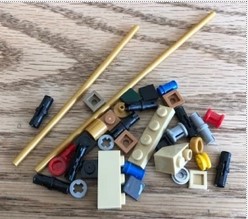
The “poor” leftover pieces from the LEGO Grand Piano

Finally, my series of posts on building the LEGO Grand Piano and LEGO Fallingwater were rife with terms of endearment.  All those plastic pieces were like little families bagged up in a single box; couples waiting to be married.  At times I thought I lost “one of the little guys”, and I felt sorry for the leftovers who’d never realize their destiny of being a part of the completed model.

“Cassini” (image courtesy of NASA/JPL)

This topic was inspired by an article in The Atlantic about the spacecraft Cassini.  Six years ago, Cassini completed a 13-year data-gathering cruise around Saturn and its moons.  Utterly alone and running out of fuel, Cassini turned towards the planet, eventually burning up in the atmosphere.  As NASA described the final moments, Cassini “fought to keep its antenna pointed at Earth as it transmitted its farewell”.  An entire room of scientists at Pasadena’s Jet Propulsion Laboratory fell into tears.  Cassini is the perfect example of – big word here  – anthropomorphism.  In simpler terms, the more “alive” a machine appears to be, the more empathetic the response from humans.  Some robots are deliberately anthropomorphic, a subtopic we just don’t have enough words for today.

As I watch Frankie ingest another insect, it’s time to reveal the genesis of his name.  Maybe you don’t remember Frankie Avalon in his prime but you do remember the 1970s movie Grease.  Avalon showed up in a memorable scene, descending a staircase dressed in white while singing “Beauty School Dropout” to Didi Conn’s “Frenchy”.  Guess what?  Avalon had an even bigger hit: VenusThat song is a plea to the goddess of love to bring him romance; someone pretty and very much alive.  Okay, so my Frankie isn’t pretty, but at least he’s alive.  That’s more than I can say about all those other little buds who keep showing up in my blog posts.

Some content sourced from The Atlantic article, “How to Mourn a Space Robot”, and Wikipedia, “the free encyclopedia”.

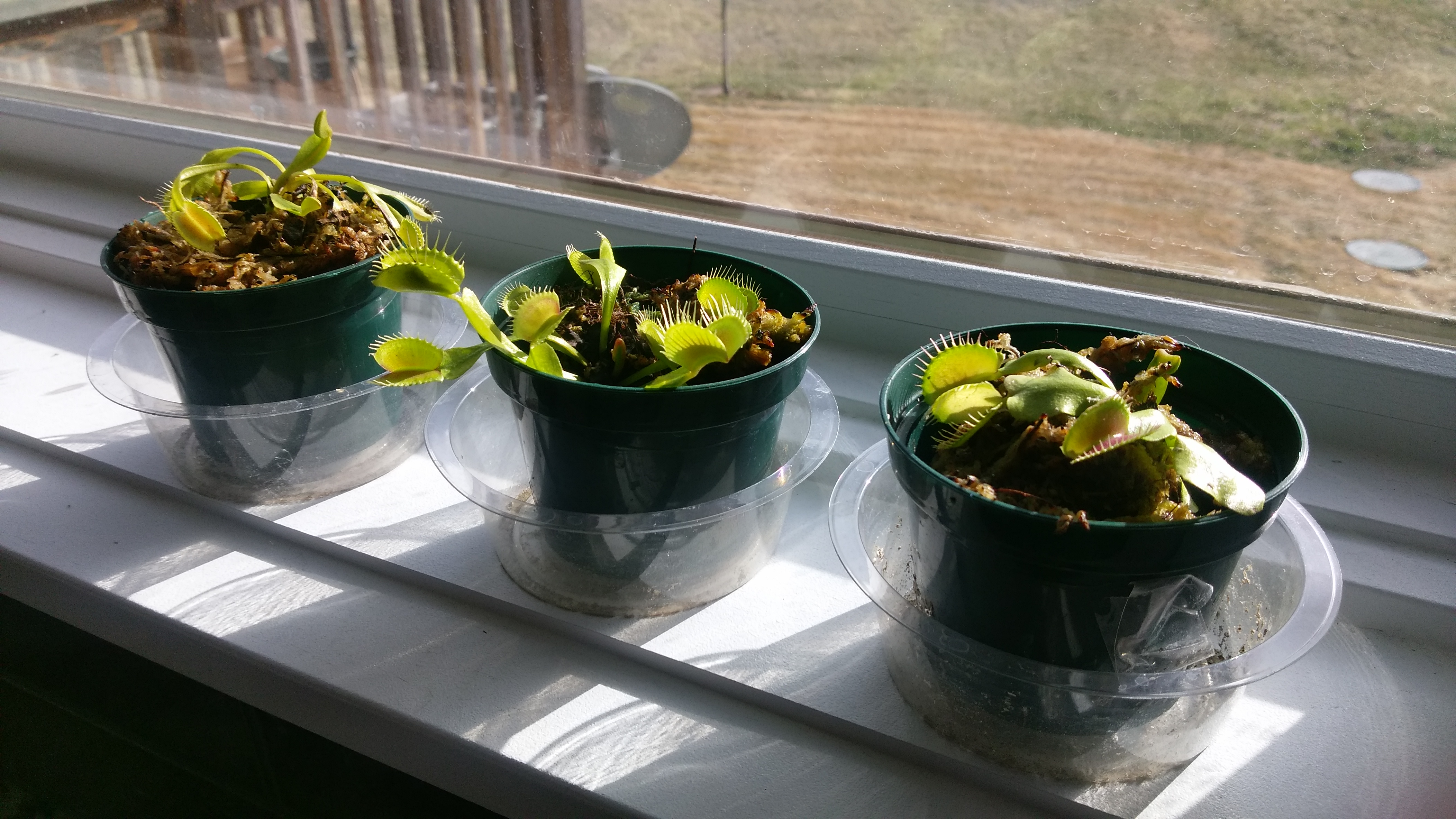
Venus and Her Deadly Sisters

Let’s begin with a quiz. Name a movie you’ve seen – any movie – where long after the fact you wished you’d never watched it. Not because it was a bad movie or a boring movie; rather because it left you with brain-burned images you’ll carry to the grave. I’ll give you a “pause” so you can come up with a movie.

[pause]

My own regret-I-saw-them movies are the following three: Fiend Without a Face (from the wonderful television series “Creature Features”, when I was a young and impressionable teenager), Deliverance, and Saving Private Ryan. If you haven’t seen those films, read the web synopses to understand where I’m coming from. Trust me; it’s safer than watching.

Recently, I’ve decided to add a fourth movie to my list: 2005’s War of the Worlds. Why recently? Because my wife decided to go all green-thumb on me in the last couple of weeks. She went to Home Depot and Lowe’s and purchased several plants for our recently remodeled home. She even ordered a few growee’s on-line (didn’t know you could do that).  We have quite the conservatory now, from potted palms to fruit-bearing minis to fresh herbs. But the real reason for my fourth movie sits quietly on the kitchen window sill: three Venus Flytraps.

Venus Flytraps fall into the category of “carnivorous plants”; which, from an insect’s perspective, is entirely accurate.  The organic mechanism of the Venus – called a “snap trap”, is frighteningly sophisticated.  Pairs of hinged leaves lay open at the ends of delicate stalks, secreting a sweet smell to attract the bug.  Once said bug steps on said leaves, hair-triggers activate a rapid closure, forming a capsule.  The more the bug moves, the more the capsule hermetically seals, forming a “stomach” to allow digestion over the next one to two weeks.  The capture itself takes less than a second.  I wouldn’t have believed it if I hadn’t seen it with our own Flytraps.  Venus #1 is still digesting the bug I placed on her leaves a week ago.

Besides the “snap”, carnivorous plants include four other delightful trapping mechanisms.  “Pitfall” traps, as in pitcher plants, collect prey in a rolled-leaf container complete with a deep pool of digestive enzymes.  “Flypaper” traps, as in sundews, utilize a glue-like substance all over their leaves to trap and starve their victims before digesting them.  “Bladder” traps, as in bladderworts, create a vacuum inside a cavity sealed by a hinged door (I did say sophisticated, didn’t I?)  Bladderwort victims trigger a surface hair and are literally sucked into the bladder, to be quickly digested.  Finally, “Lobster-pot” traps, as in corkscrew plants, remind me of the Eagles’ Hotel California: thanks to their inward-pointing bristles, “you can check out anytime you want, but you can never leave”.

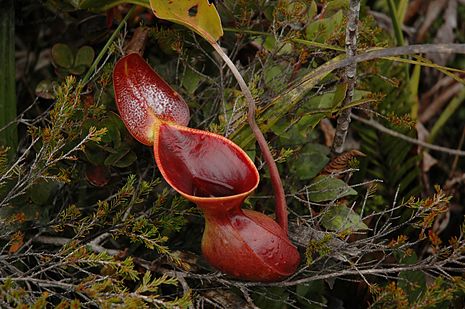
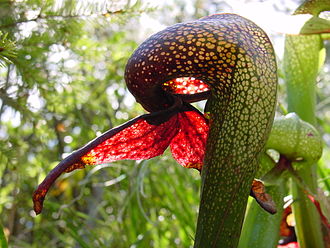
pitcher plant

tropical pitcher

Like my regret-I-saw-them movies, research on carnivorous plants should’ve stopped with the trapping mechanisms.  Unfortunately, I kept reading and there’s more.  Creature Features take note – these little guys are evolving.  Pitcher plants used to get flooded by rain (compromising the digestion process), so they developed a flared leaflet to cover the opening.  Sundews developed tentacles, which along with the flypaper help to trap their victims.  Even more disturbing, larger sundews developed a symbiosis with a species of assassin bug.  The bug eats the trapped insects while the sundew subsists off the insect feces (team effort!)  Finally, some versions of monkey cups (which contain pitfall traps) consume small mammals and reptiles.  Would you like another pause to consider that last bit of carnivorous plant trivia?

cobra plant (pitfall trap)

Carnivores are defined by just two characteristics.  They must exhibit an ability to attract, capture, and digest their prey; and, they must be able to absorb nutrients from the dead prey and gain a fitness advantage from those nutrients.  Hello, War of the Worlds human-harvesting Tripods.  Hello, exotic-but-pernicious Flytraps.  Maybe I should consider moving to Antarctica?  It’s the only continent on the planet where carnivorous plants cannot sustain themselves.

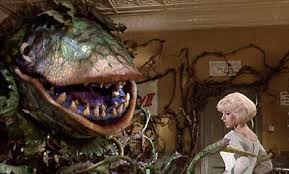
I know what you’ve been thinking since the very first paragraph.  “Dave, the perfect regret-I-saw-it movie for you is Little Shop of Horrors.”  No thank you, good reader.  I’m familiar with the Shop plot, and Audrey the Venus Flytrap sounds like a full-sized combo-nightmare of everything I’ve described above.  On that note, uh, hang on.  I should check my kitchen window Flytraps.  I swear they look a little bigger than the last time I checked.

Some content sourced from Wikipedia, “the free encyclopedia”.