
A year from today, we’ll all be glued to our televisions and tablets watching the Olympic Games in Paris. I will be glued, at least. The Summer Games get me all fired up, especially the track and field events. Especially especially the field events. I mean, c’mon, you can watch running all year long, but how often do you get to see a javelin thrown, a discus tossed, or a shot “put”? (and how often do you even say “javelin” or “discus”?) But one field event tops all others. There’s simply nothing more gawky-entertaining than a human launched into space by a pole.
 If you live in a two-story place with a fairly flat roof, it might be a little unnerving to learn Swedish-American pole vaulter Armand Duplantis can jump over your house. While the rest of us have to walk around at ground level to get to your backyard, Armand will simply sprint up your front path, plant his pole in your rose bushes, launch himself past the bedroom windows and between the chimneys, and make a splash landing in your swimming pool. Armand can do this because he can pole vault 20.4 feet, a world record he set last February. It’s the fifth time this twenty-something has broken his own world record.

Pole vaulting is a truly bizarre sequence of movements constituting an Olympic event. The vaulter balances a long fiberglass pole in one hand while sprinting down a rubber-surfaced runway. Just before running out of runway he or she raises the pole overhead with both hands, stabs the leading end into a boxed area on the ground, and pushes… hard. The ensuing bend of the pole and a whole lot of momentum hoists the vaulter into the air, feet first. With gymnastic flair, the vaulter then rotates his or her body around to be facing a high horizontal bar, just as gravity counters flight. The final flop back to Earth (and onto a giant cushion) is typically punctuated with a mid-air fist pump if the bar is successfully cleared.

Imagine that exhilarating feeling when a pole vaulter is at peak height, pointing skyward, feet above body, pole released, practically cruising into the earth’s atmosphere. As Elton John sings “… it’s gonna be a long, long time ’til touchdown brings me round again…”
Four Olympic field events involve jumping: 1) pole vault, 2) long jump, 3) high jump, and 4) triple jump (the ol’ “hop, skip, and jump”). None of the last three hold my interest because they’re easy to do. But not pole vaulting, not even close. Launching my body even a few feet off the ground with a bendy pole? Let’s just agree, I am no Rocket Man.
 Pole vaulting brings to mind two questions (or three if you include Why in heaven’s name does anyone do this?). First question: What happens if the pole breaks? Seriously, sports equipment fails. Golf clubs break in two with enough swings. Tennis racket strings get loose. At some point a pole vault pole will bend one too many times. Yikes. Second question: How does the pole translate horizontal energy into vertical energy? It’s a physics problem akin to the catapult, but I’d have to go back to high school to solve it. No thanks.
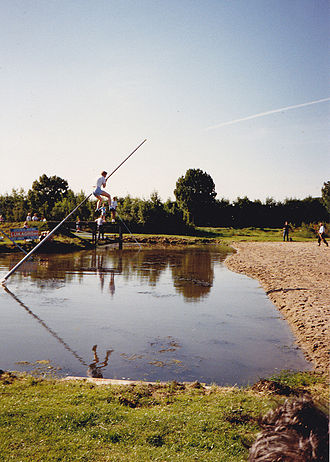
The origin of pole vaulting is a bit of a letdown. My too-many-movies imagination pictured a medieval war, with soldiers clearing castle walls on long pieces of bamboo. Instead, pole vaulting is a rough translation of an old technique used to scale narrow natural obstacles, like watery marshes. Get a running start, plant the pole, and sail from one side of the marsh to the other. But those poles don’t bend, and nobody cares how high you go as long as you make it over. So you see, even the origin of pole vaulting is gawky.
The pole vaulting world record was eighteen feet in 1970. Fifty years later it’s been pushed two feet higher. Do the math; maybe we’ll be clearing one hundred feet by the year 2773. But we’ll probably have flying cars by then as well, so any interest in humans launched by poles will be gone. My advice: watch the Paris Games, especially the pole vault. These rocket men and women won’t be around forever.
Some content sourced from the CNN article, “Olympic champion Armand Duplantis…”, and Wikipedia, “the free encyclopedia”.



 Life In A Word