
The state line between South Carolina (SC) and Georgia (GA) follows the twists and turns of the Savannah River. You know you’re heading into one state or the other whenever you cross the water. Driving from our part of South Carolina into nearby Augusta, GA is interesting. The interstate loops Augusta by starting in SC, touches a bit of GA, goes back to SC for a few miles, then continues into GA again as it follows the river. It’s an example of my life on the edge.

Growing up on the coast of California, it never occurred to me the geography of my younger days was limited to only three of the four cardinal directions. If I headed north I’d leave the urban stretches of Los Angeles for the more rural towns of the the central coast. Head south and I’d parallel the beaches all the way to San Diego. The only thing east of the city seemed to be the endless Mojave Desert. As for the last of the four directions? Not an option, at least not without a boat, plane, or a whole lot of swimming. Horace Greeley would’ve never told me to “Go West, young man”.
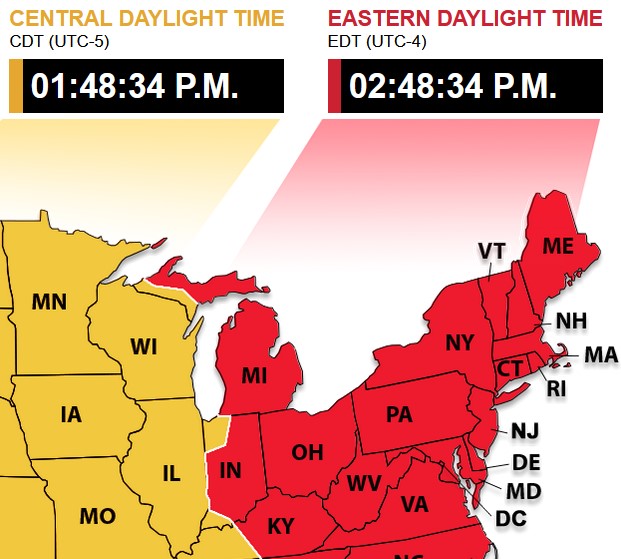
In my college years in South Bend, IN, I was a fifteen-minute drive from the line where the Central and Eastern time zones meet. Back then you didn’t touch your clock for Daylight Savings, so half the year you were the same time as Detroit while the other half you were Chicago. It was confusing, but not as confusing as someone who lived on one side of the line and worked on the other. Imagine leaving the house at 8:00am, driving an hour, and arriving at the office at… 8:00am? It’s a neat trick, pulled off by a lot of those who live on the edge of a time zone.
Raising our kids in Colorado Springs, we always knew which direction we were heading because the line of the Rocky Mountains lay immediately to the west. Those peaks rose up like the Great Wall of China, just daring you to push through. Sure, we drove the interstates into the Rockies for skiing, hiking, and such, but day-to-day we were down at the base, literally living on the edge. Like California, we had one less cardinal direction at our disposal.

The Rockies conceal another important edge, known as the Continental Divide. The Divide is elevated terrain separating neighboring drainage basins. Plain English? The north-south line from which water flows either west to the Pacific Ocean or east to the Atlantic. I always wanted to stop somewhere flat on the Divide and pour out a bottle of water. Let’s see if it really flows both ways from the line, right? It’s an experiment that to this day remains unconducted.
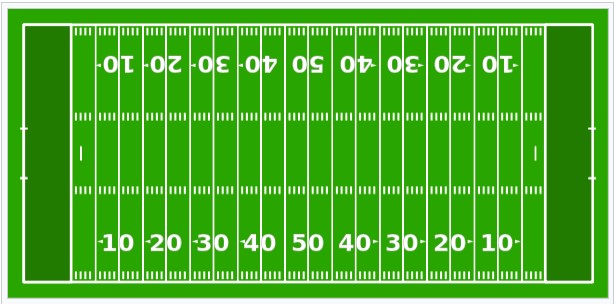
Football, one of my favorite spectator sports, is all about lines and edges. One team faces the other, on an imaginary line defined by where the referee places the ball. Cross that line before the ball is snapped and you’ll be flagged with a penalty. Advance the ball ten yards past that line – to another imaginary line – and your team is awarded more play. The sidelines of the field might as well drop off to a bottomless void. Catching a pass outside of that edge is not allowed. Running the ball outside of that edge brings the game to a halt. But catching or running across the lines at end of the field? That rewards you with a score.

For all this living and playing on thresholds, maybe I should visit one of New York City’s newest high-rise attractions. One hundred floors above the sidewalk, The Edge is billed as “the highest outdoor sky deck in the Western Hemisphere”. Jutting out from its host building, The Edge allows unparalleled views of the city below, because the surrounding walls are solid glass, as is a portion of the deck floor itself (yikes!) If Spider-Man is your thing, you can go even higher by scaling the outside of the remaining floors of the skyscraper. I have to say, this sort of thing draws a “fine line” between entertainment and, well, insanity.
 I won’t be going to The Edge… ever. I’m not good with heights, so anything above a pedestrian Ferris Wheel just isn’t my cup of tea. Nope, leave me behind, comfortably grounded, where crossing the Savannah River from one state to another is plenty adventurous. That’s my definition of life on the edge.
Some content sourced from Wikipedia, “the free encyclopedia”.
 Life In A Word